Introduction
Nucleopolyhedroviruses (NPVs) play important roles in the regulation of populations of many phytophagous insects (Anderson and May Reference Anderson and May1980; Foster et al. Reference Foster, Schultz and Hunter1992; van Frankenhuyzen et al. Reference van Frankenhuyzen, Thurston, Lucarotti, Royama, Guscott and Georgeson2002) and are becoming increasingly used in agriculture and forestry as biological control agents to suppress insect pest populations on economically important plants (Cunningham and Kaupp Reference Cunningham and Kaupp1995; Lacey et al. Reference Lacey, Frutos, Kaya and Vail2001; Moreau et al. Reference Moreau, Lucarotti, Kettela, Thurston, Holmes and Weaver2005; Szewczyk et al. Reference Szewczyk, Hoyos-Carvajal, Paluszek, Skrzecz and Lobo de Souza2006). Infections usually occur when larvae consume NPV occlusion bodies (OBs) on contaminated foliage. Upon entry into the midgut, polyhedrin proteins encapsulating viruses degrade, releasing viruses into the gut where they attach to and infect midgut epithelial cells. This is the limit of infection in sawflies (Federici Reference Federici1997), but in Lepidoptera larvae the viruses invade the midgut columnar cells and spread to the adjacent tracheae (Kirkpatrick et al. Reference Kirkpatrick, Washburn, Engelhard and Volkman1994; Means and Passarelli Reference Means and Passarelli2010; Passarelli Reference Passarelli2011), haemocytes, and fat body (Engelhard et al. Reference Engelhard, Kam-Morgan, Washburn and Volkman1994). At advanced stages of infection, viruses are occluded in OBs in infected cells and the larva dies, its cuticle ruptures, and viral OBs are released into the environment to infect other caterpillars.
Several studies have suggested that the pathology of NPVs in a larval host can be influenced by the quality of diet consumed by the larva prior to virus ingestion (Farrar and Ridgway Reference Farrar and Ridgway2000; Hoover et al. Reference Hoover, Washburn and Volkman2000; Lee et al. Reference Lee, Cory, Wilson, Raubenheimer and Simpson2006; Shikano et al. Reference Shikano, Ericsson, Cory and Myers2010). Understanding how and why diet quality influences NPV efficacy could have important implications for the application of NPVs as a control tactic, particularly for generalist insects that can eat a variety of host-plant species of differing nutritional quality (Keating and Yendol Reference Keating and Yendol1987; Lee et al. Reference Lee, Cory, Wilson, Raubenheimer and Simpson2006; Shikano et al. Reference Shikano, Ericsson, Cory and Myers2010). Increased resistance in insects to pathogens has in some cases been attributed to variations in the availability or relative proportion of essential nutrients contained within the diet the insects feed on prior to ingesting OBs. For example, the quantity of dietary protein in the diet was positively related to resistance in NPV-infected larvae of Spodoptera littoralis (Boisduval) (Lepidoptera: Noctuidae) subjected to dietary regimes of varying protein and carbohydrate content prior to virus ingestion (Lee et al. Reference Lee, Cory, Wilson, Raubenheimer and Simpson2006). Similarly, Shikano et al. (Reference Shikano, Ericsson, Cory and Myers2010) found that when reared on broccoli as opposed to cucumber before NPV inoculation, cabbage looper (Trichoplusia ni (Hübner); Lepidoptera: Noctuidae) were better able to produce haemocytes, which can help reduce infection by encapsulating viral particles (Washburn et al. Reference Washburn, Kirkpatrick and Volkman1996; Trudeau et al. Reference Trudeau, Washburn and Volkman2001). High quantities of secondary-plant chemicals consumed prior to oral inoculation with an NPV can also impact viral efficacy. For instance, gypsy moth (Lymantria dispar (Linnaeus); Lepidoptera: Lymantriidae) larvae infected with L. dispar multiply enveloped NPV (LdMNPV) on red oak (Quercus rubra Linnaeus; Fagaceae) or red maple (Acer rubrum Linnaeus; Sapindaceae) experienced lower mortality rates than those that fed on trembling aspen (Populus tremuloides Michaux; Salicaceae) or pitch pine (Pinus rigida Miller; Pinaceae) (Keating and Yendol Reference Keating and Yendol1987), a result that the authors attributed to varying tannin contents among the tree species used. Although the precise mechanism remains unclear, some evidence suggests that certain phenolic compounds (e.g., tannins) contained within consumed foliage may inhibit the degradation of viral OBs in the larval midgut by cross-linking the polyhedrin in the occluding envelope, resulting in decreased infection rates (Felton and Duffey Reference Felton and Duffey1990; Hunter and Schultz Reference Hunter and Schultz1993). Alternatively, defensive chemicals may also damage infected midgut columnar cells, causing them to be sloughed off and undergo apoptosis before the NPV can cross the basal lamina of the midgut to infect other tissues in the body (Bernays Reference Bernays1978; Hoover et al. Reference Hoover, Washburn and Volkman2000).
Few studies have investigated the influence of larval nutrition after NPV ingestion on the success of viral infection (Stevenson et al. Reference Stevenson, D'Cunha and Grzywacz2010). Here, we present results of manipulative field and laboratory studies carried out to determine the effects of previrus-ingestion and postvirus-ingestion diet quality on the susceptibility of whitemarked tussock moth (WMTM; Orgyia leucostigma (Smith); Lepidoptera: Lymantriidae) caterpillars to NPVs. Field studies were carried out first to determine how the nutritional quality of foliage from three potential host trees, white birch (Betula papyrifera Marshall; Betulaceae), balsam fir (Abies balsamea (Linnaeus) Miller; Pinaceae), and red spruce (Picea rubens Sargent; Pinaceae), influences the performance of uninfected tussock moth caterpillars. Based on these results, subsequent studies were carried out to determine the influence of diet quality before (birch versus artificial diet) and after (birch versus balsam fir) virus ingestion on the mortality of early instar WMTM larvae. Two viruses were examined for their interaction with food quality: one a naturally occurring singly enveloped NPV (OrleSNPV) isolated from WMTM, and the other a multiply enveloped NPV (OpMNPV) isolated from the Douglas-fir tussock moth (DFTM; Orgyia pseudotsugata (McDunnough); Lepidoptera: Lymantriidae). Results are discussed in the context of various hypotheses that have been put forth to explain the influence of diet on insect–pathogen interactions.
Materials and methods
Effects of host-plant quality on caterpillar performance
To determine the nutritional quality of potential host trees for WMTM caterpillars in the absence of virus, a field study was carried out in 2007 in a precommercially thinned mixed stand near Truro, Nova Scotia, Canada (45°28′43″N, 63°17′26″W) containing young white birch, balsam fir, and red spruce. At the time of this study, trees were ∼2–3 m in height and were widely spaced (∼3–10 m apart) such that the branches of trees did not overlap. Solitary insect herbivores, including some WMTM, were occasionally observed on study trees; however; defoliation was rarely visible. Twenty plots (20 m × 20 m) were selected throughout the stand and within each one balsam fir, one white birch, and one red spruce tree were selected. Within each tree, an upper, middle, and lower crown branch was selected and marked with flagging tape. Any herbivores found feeding on study branches were removed and placed on an adjacent, nonstudy tree. Caterpillars for this experiment came from egg masses collected the previous fall from young balsam fir in the area and stored through the winter and spring in the dark at 4°C. Eggs were hatched at ambient room temperature (∼20°C). Within 48 hours of hatching, caterpillars were removed from the surface of egg masses and placed in groups of 15 on each of the marked branches. To prevent larvae from escaping, branches were enclosed in a mesh-cloth sleeve cage (1 m× 1.5 m) and secured to the base of each branch using a twist tie (Moreau et al. Reference Moreau, Lucarotti, Kettela, Thurston, Holmes and Weaver2005). After all caterpillars had completed development, the sleeve-caged branches were cut from the trees and transported back to the laboratory for processing. Pupae were counted and the sex of survivors identified based on antennal morphology, which was clearly visible through the pupal case. The maximum width of each pupal case was measured to provide an estimate of cocoon volume, which for females is highly correlated with potential fecundity (Thurston and MacGregor Reference Thurston and MacGregor2003).
Effect of previrus-ingestion nutrition
Disease-free WMTM eggs were supplied by the Insect Production Service at the Canadian Forest Service – Great Lakes Forestry Centre (CFS-GLFC), Sault Ste. Marie, Ontario, Canada and refrigerated at 4°C until use. Prior to hatching, eggs were washed in 4% formaldehyde for 90 min., and rinsed under cold running tap water for 15 min. Rinsed eggs were placed on paper towels and allowed to dry at room temperature (22 ± 2°C) before being transferred to a filter-paper-lined Petri dish 9 cm in diameter. After 10 days, eggs were either transferred to inverted 266 mL plastic cups containing artificial diet (Bell et al. Reference Bell, Owens, Shapiro and Tardif1981) and reared at ambient room temperature (22 ± 2°C) until they reached second instar, or kept aside to be reared in the field. To obtain WMTM larvae that had developed on birch trees prior to inoculation, five healthy, insect-free branches were randomly selected on two birch trees in the University of New Brunswick woodlot in Fredericton, New Brunswick, Canada (45°55′21″N, 66°39′0″W). For 5 consecutive days in mid-May, incubated eggs were placed into filter-paper-lined cheesecloth sacks (20 cm × 20 cm) and tied to each of the five branches, which were then enclosed in large (100 cm × 70 cm), bleach-sterilised sleeve cages (Johns et al. Reference Johns, Quiring, Lapointe and Lucarotti2009). Sleeve cages were held tightly against the base of the branch with twist ties, which prevented larvae from leaving the branch and any natural enemies from entering the cage. After a week, branches were visually checked through the sleeve cage every 2 days until the larvae attained the second instar. The branches were collected in late June or early July using pole pruners and second-instar larvae gathered from each branch using fine-tipped paint brushes. Larvae were also reared on balsam fir in the same way that they were reared on birch but most died, resulting in inadequate densities for subsequent experiments.
Suspensions of OrleSNPV and freeze-dried OpMNPV (Virtuss™, CFS-GLFC; Sault Ste. Marie, Ontario; 1993 stock) were obtained from CFS-GLFC. To obtain fresh virus preparations, stocks were sequentially passaged three times in WMTM larvae. Prior to their use in field studies, OBs of both OrleSNPV and OpMNPV were extracted from WMTM larvae and purified by filtration and centrifugation at Sylvar Technologies Ltd. of Fredericton, New Brunswick, Canada (O'Reilly et al. Reference O'Reilly, Miller and Luckow1992). The concentration of OBs in the stocks was quantified in triplicate using a haemocytometer.
To prepare the virus solution for inoculation, OB suspensions for both OrleSNPV and OpMNPV were diluted to 0 (i.e., control), 103, 105, and 107 OB/mL in 10% sucrose containing 3% FDC Blue no. 1 stain.
To evaluate the influence of previrus-ingestion nutrition on the susceptibility of WMTM larvae to OrleSNPV and OpMNPV, in spring 2010, larvae were reared to the second instar on artificial diet under laboratory conditions, as described above, or on birch trees in the field and then fed suspensions of OrleSNPV or OpMNPV. Larvae were subsequently placed on gray or white birch trees in the University of New Brunswick woodlot. Our assumption that the nutritional quality of these two birch species for WMTM was similar was supported in a field experiment carried out during summer 2010 using second-instar WMTM larvae that had ingested droplets containing 0 (i.e., control) or 105 OB/mL of OrleSNPV or OpMNPV. In that study, neither host plant (i.e., gray or white birch) nor any interaction with virus dose or virus species significantly influenced larval mortality (P > 0.449, F > 0.63).
WMTM larvae reared to their second instar on artificial diet (15% casein by dry weight; Bell et al. Reference Bell, Owens, Shapiro and Tardif1981) containing wheat germ (phenolic content <0.5%; Velioglu et al. Reference Velioglu, Mazza, Gao and Oomah1998) or on birch trees (phenolic content ∼11% in late June, Kopper et al. Reference Kopper, Lindroth and Nordheim2001; Lindroth et al. Reference Lindroth, Kopper, Parsons, Bockheim, Karnosky and Hendrey2001; ∼13% crude protein by dry weight in the summer, Renecker and Hudson Reference Renecker and Hudson1988), as described above, were collected, starved for 24 h, and then droplet fed (Li and Bonning Reference Li and Bonning2007) by placing them in the middle of two concentric rings of 5 μl virus suspension droplets arranged 4 mm apart on a 9 cm × 9 cm sheet of Parafilm® (Bemis, Oshkosh, Wisconsin, U.S.A.). Concentric rings contained droplets with 0 (i.e., control), 103, 105, or 107 OB/mL suspensions of OrleSNPV or OpMNPV. After feeding for 15 min., inoculated larvae were identified by their blue-stained foreguts and placed in clean 9 cm diameter Petri dishes using a sterilised filbert brush.
Approximately 5 hours after larval inoculation, larvae were placed on 5–7 m high birch trees with no visible signs of defoliation. Four larval treatments were each assigned randomly to five birch trees: (1) larvae reared on artificial diet and inoculated with OrleSNPV; (2) larvae that had been reared on artificial diet and inoculated with OpMNPV; (3) larvae that had been reared on birch and inoculated with OrleSNPV; and (4) larvae that had been reared on birch and inoculated with OpMNPV. On each tree, four mid-crown branches were randomly assigned to receive second-instar larvae infected with 0 (i.e., control), 103, 105, or 107 OBs/mL suspensions of OrleSNPV or OpMNPV. A Petri dish containing 13 or 14 infected WMTM larvae was enclosed with each branch within a large, bleach-sterilised sleeve cage as described above. Petri dishes were then opened through the sleeve cage to liberate the larvae on to the branch. Sleeve-caged branches were removed with pole pruners after 3 weeks and the study branches transported to the laboratory, where the number of surviving larvae on each branch was determined.
Effect of postvirus-ingestion nutrition
To evaluate the influence of postvirus-ingestion nutrition on the susceptibility of WMTM to the two viruses, newly emerged first-instar larvae were reared as described above on artificial diet in the laboratory until they attained the second instar and then droplet fed 0 (i.e., control), 103, 105, or 107 OB/mL suspensions of OrleSNPV or OpMNPV as described above. Infected larvae were placed on a birch (phenolic content ∼11% in late June, Kopper et al. Reference Kopper, Lindroth and Nordheim2001; Lindroth et al. Reference Lindroth, Kopper, Parsons, Bockheim, Karnosky and Hendrey2001; ∼13% crude protein by dry weight in summer, Renecker and Hudson Reference Renecker and Hudson1988) or balsam fir (phenolic content ∼18%, Carisey and Bauce Reference Carisey and Bauce1997; ∼8% crude protein by dry weight, Abell and Gilbert Reference Abell and Gilbert1974) host <5 hours later as described above.
In summer 2009, four 5–7 m tall balsam fir and birch trees were selected in each of two stands ∼1 km apart in the University of New Brunswick woodlot. Four of the eight trees in each stand were randomly assigned to receive larvae infected with OrleSNPV and four to receive larvae infected with OpMNPV. On each tree, four branches were selected at mid-crown height and randomly assigned to receive larvae that had been infected with 0 (i.e., control), 103, 105, or 107 OBs/mL. One Petri dish containing 15 larvae was enclosed with each branch within a large bleach-sterilised sleeve cage (Johns et al. Reference Johns, Quiring, Lapointe and Lucarotti2009). Sleeve cages were secured over the branches using twist ties and left for 3 weeks or until all larvae died. Branches were removed with pole pruners and transferred to the laboratory where the surviving larvae were counted.
This study was repeated in the University of New Brunswick woodlot in summer 2010 using five (instead of four) balsam fir and five birch trees for larvae infected with each virus.
Statistical analyses
To test the influence of host plant, independent of virus, on caterpillar performance, a mixed-model analysis of variance (ANOVA) was carried out with the random effect of plot removed as a blocking factor (SAS Institute 1999). An ANOVA was also carried out to test for the independent and interacting effects of virus, previrus-ingestion rearing diet, and virus dose on the mortality of WMTM larvae that had been reared on artificial diet or birch prior to oral inoculation with virus and on birch thereafter. A four-way ANOVA was carried out to determine the main and interacting effects of virus, virus dose, postvirus-ingestion diet, and year (2009 and 2010) on larval survival. All percentage data were subjected to an arcsine square-root transformation prior to analysis to normalise residuals, although the results in figures are presented in their untransformed state.
Results
Effects of host-plant quality on caterpillar performance
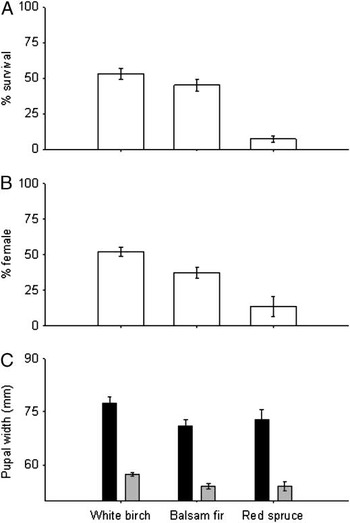
Neither survival, sex ratio, nor pupal width were influenced by crown level (F 2,90−169 ≤ 1.45; P ≥ 0.24). All measured performance parameters, however, were influenced by host tree species (F 2,90−169 ≥ 3.16; P ≤ 0.05) with white birch generally yielding higher survival, more female-biased sex ratios, and larger females and males than the two conifers (Fig. 1). The interaction between crown level and tree species was not significant (F 4,90−169 ≤ 1.75; P ≥ 0.14).
Mean (±1 SE) (A) % survival, (B) % female, and (C) pupal width (females [black] and males [gray]) of whitemarked tussock moth in the absence of virus feeding on white birch, balsam fir, and red spruce. Bars for each tree species represent pooled data from the upper, mid, and lower crown of each tree.

Effect of previrus-ingestion nutrition
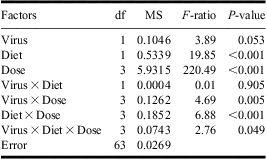
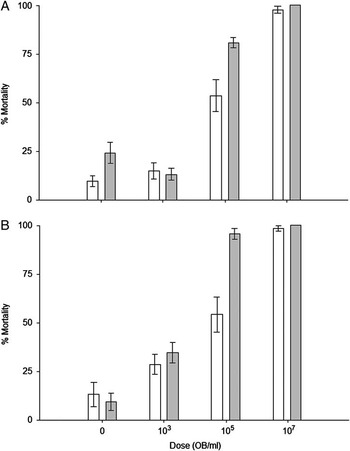
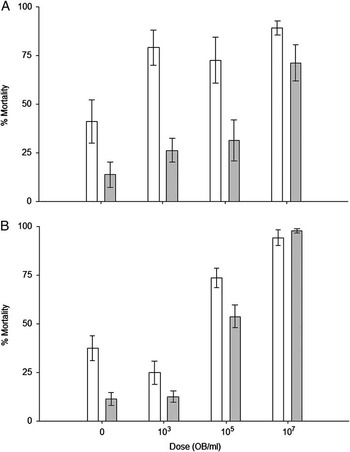
Previrus-ingestion diet and virus dose influenced the mortality of larvae that were subsequently reared on birch trees. Larval mortality generally increased with the dose of virus ingested and was significantly higher among larvae that had been reared on birch than among larvae reared on artificial diet (Table 1; Fig. 2). Mortality of larvae that did not ingest any virus (i.e., control treatment) was also lower when early instars fed on artificial diet rather than birch (Fig. 2), strongly suggesting that artificial diet provided higher quality food. There was no difference in mortality among larvae that ingested OpMNPV rather than OrleSNPV (Table 1; Fig. 2); however, trends were not consistent, resulting in several interactions. Whereas mortality was similar for all larvae that ingested the highest and lowest virus doses, mortality rates of larvae that were infected with 105 OBs/mL were higher for larvae previously fed birch than for those that had fed on artificial diet, resulting in an interaction between previrus-ingestion diet and virus dose (Table 1). Similarly, a slightly higher mortality of larvae that ingested 103 OBs/mL of OpMNPV rather than OrleSNPV, combined with similar mortality rates among larvae infected with the highest dose (Fig. 2), resulted in an interaction between virus and dose (Table 1). In addition, small variations in the effects of virus species, virus dose, and previrus-ingestion diet on larval mortality resulted in a three-way interaction among these factors (Table 1).
Results from a mixed-model ANOVA assessing the independent and interacting effects of virus species (“Virus”, doses ranging from 0 [i.e., control] to 107 OBs/mL), previrus-ingestion nutrition (“Diet”, artificial diet or birch) and virus dose (“Dose”, OB/mL) on mortality of second instar WMTM larvae during the first 3 weeks following the ingestion of OrleSNPV or OpMNPV OBs.
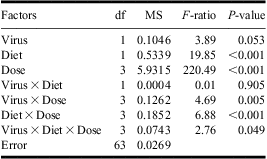
ANOVA, analysis of variance; OB, occlusion bodies; WMTM, whitemarked tussock moth; df, degrees of freedom; MS, mean square.
Percentage (±1 SE) of second-instar whitemarked tussock moth larvae that died during the first 3 weeks following ingestion of (A) OrleSNPV or (B) OpMNPV occlusion bodies (OBs) suspended in 10% sucrose solutions at doses ranging from 0 (i.e., control) to 107 OBs/mL. Larvae were reared on artificial (Bell) diet (open bars) or on birch trees (shaded bars) prior to viral ingestion and developed on birch trees following viral ingestion (n = 10 replicates of 14 larvae).

Effect of postvirus-ingestion nutrition
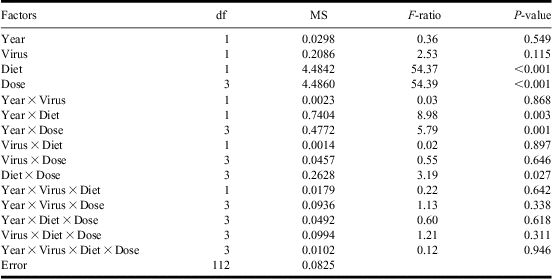
Main effects of virus dose and postvirus-ingestion diet, but not virus species or year, significantly influenced the mortality of larvae that were previously fed artificial diet (Table 2). Larval mortality generally increased with the dose of virus ingested and was consistently higher among larvae fed balsam fir compared with those that were fed birch (Fig. 3). However, although mortality of larvae on birch was consistently lower than that of larvae on balsam fir for low and moderate doses, mortality rates did not differ among diets at the highest dose (Fig. 3), resulting in a significant interaction between diet and virus dose (Table 2). The effect of postvirus-ingestion diet was greater in 2009 than 2010, and the effects of virus dose were variable among years (Fig. 3), resulting in significant interactions between diet and year and between virus dose and year, respectively (Table 2).
Results of a mixed-model ANOVA assessing the independent and interacting effects of year, virus species (“Virus”, OrleSNPV or OpMNPV), postvirus-ingestion diet (“Diet”, birch or balsam fir foliage), and virus dose (“Dose, ranging from 0 (i.e., control) to 107 OBs/mL) on mortality of second-instar WMTM larvae during the first 3 weeks following the ingestion of OrleSNPV or OpMNPV OBs.
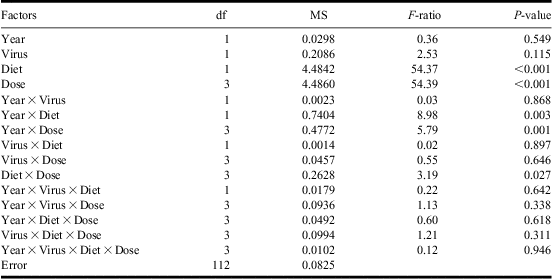
ANOVA, analysis of variance; OB, occlusion bodies; WMTM, whitemarked tussock moth; df, degrees of freedom; MS, mean square.
Percentage (±1 SE) of second-instar whitemarked tussock moth larvae that died during the first 3 weeks in (A) 2009 or (B) 2010 following ingestion of OrleSNPV and OpMNPV occlusion bodies (OBs) suspended in 10% sucrose solutions at doses ranging from 0 (i.e., control) to 107 OBs/mL. Bars for each year–dose combination represent pooled mortality rates from OrleSNPV-inoculated and OpMNPV-inoculated larvae. Larvae were reared on artificial (Bell) diet prior to ingestion of OBs but developed on balsam fir (open bars) or birch trees (shaded bars) following viral ingestion (n = 9 replicates of 15 larvae).

Discussion
Diet had a significant influence on the performance of WMTM caterpillars. In field experiments, larval performance was always higher on birch than on conifers (Figs. 1, 3 controls), although laboratory studies suggested that survival on artificial diet may be the highest of all (Fig. 2). This result is likely explained by differences in nutrients and secondary plant chemicals among the different diets consumed, although these constituents were not measured in the present study. In general, WMTM caterpillars that consumed a relatively high quality diet either before or after ingesting virus particles had lower associated mortality, particularly at low to moderate viral doses.
Several possible mechanisms could explain the observed influence of diet quality on viral infection rates. For instance, Hoover et al. (Reference Hoover, Washburn and Volkman2000) determined that oxidative stress caused by plant defensive compounds previously ingested by gypsy moth larvae damaged the midgut enough to trigger premature sloughing of LdMNPV-infected midgut cells before systemic infection could be attained. Although plant defensive mechanisms such as tannins, alkaloids, and terpenoids have direct and indirect effects on herbivore performance (reviewed in Awmack and Leather Reference Awmack and Leather2002), some evidence indicates that WMTM larvae respond differently than most caterpillars to the presence of plant tannins and other phenols. When Glynn et al. (Reference Glynn, Herms, Egawa, Hansen and Mattson2003) compared the performance of L. dispar and WMTM larvae on black poplar, they found that L. dispar growth rates declined in response to plant defences whereas the growth rates of WMTM larvae were unaffected. Similarly, Karowe (Reference Karowe1989) reported that WMTM larvae reared on artificial diet showed no change in growth rates even when the tannin content of the diet was as high as 8%. By contrast, the growth rate of Malacosoma disstria Hübner (Lepidoptera: Lasiocampidae) was significantly reduced when fed artificial diet containing as little as 0.5% tannic acid (Karowe Reference Karowe1989). Barbehenn and Martin (Reference Barbehenn and Martin1992) suggested that WMTM larvae have evolved a peritrophic membrane capable of “filtering out” high molecular weight phenolic compounds such as tannins, which could enable WMTMs to withstand the damage tannins generally cause to midgut cells. It is difficult to ascertain whether this differing response to plant secondary chemicals influenced interactions between WMTM and its pathogens in the current study because we did not analyse diet chemistry.
Although this explanation can account for the unexpectedly high mortality rates of birch-reared larvae subsequently infected with an intermediate virus dose, it does not explain the comparatively lower mortality rates of artificial diet-reared larvae infected with the same dose. Despite the similar protein contents of birch foliage and artificial diet, the artificial diet with its low tannin levels may have had higher protein availability than the tannin-containing birch foliage because tannins react with proteins and reduce their digestibility (Robbins et al. Reference Robbins, Hanley, Hagerman, Hjeljord, Baker and Schwartz1987). Hence, larvae reared on artificial diet with high protein availability may have been able to cultivate a stronger immune response to NPV infection than larvae reared on birch with comparatively low protein availability (Lee et al. Reference Lee, Cory, Wilson, Raubenheimer and Simpson2006). Alternatively, the artificial diet may have a poor dietary elemental composition compared with birch foliage, which in turn may negatively impact competition for essential elements between the host and its pathogen (Frost et al. Reference Frost, Ebert and Smith2008).
Variations in diet following virus ingestion significantly influenced larval susceptibility to relatively low doses of virus. Larvae fed birch foliage following the ingestion of OBs experienced lower mortality rates than those fed balsam fir foliage, which supports the hypothesis that insect susceptibility to NPV infection is influenced by dietary nutrition (Lee et al. Reference Lee, Cory, Wilson, Raubenheimer and Simpson2006) and host-plant suitability (Shikano et al. Reference Shikano, Ericsson, Cory and Myers2010). From a biocontrol standpoint, this may suggest that more viruses need to be applied on WMTM populations feeding on superior hosts (e.g., birch) than on those feeding on relatively poor hosts (e.g., balsam fir) to achieve the same level of mortality. There may also be other factors that complicate this simple explanation of interactions among host-plant quality, WMTM performance, and pathogen infection. Higher larval survival rates on balsam fir in Nova Scotia than in New Brunswick were associated with differences in larval origin. Caterpillars placed on balsam fir in Nova Scotia were obtained from egg masses collected directly from balsam fir in the field, whereas those used in later experiments in New Brunswick were obtained from populations that had been reared for several generations on artificial diet. Several studies have shown local adaptation by generalist herbivores to immediately available hosts (Fox and Morrow Reference Fox and Morrow1971; Bernays and Minkenburg Reference Bernays and Minkenburg1997). Such genetic variations in the tolerance of WMTM populations to certain host plants may influence interactions between WMTMs and their NPVs.
WMTMs feed on a wide variety of coniferous and deciduous vegetation (Martineau Reference Martineau1984; Rose and Lindquist Reference Rose and Lindquist1997). As newly emerged WMTM larvae often feed on young foliage before “ballooning” to another host plant (Isaacs and van Timmeren Reference Isaacs and van Timmeren2009) and are capable of moving among hosts (Embree et al. Reference Embree, Elgee and Estabrooks1984), their nutrition prior to and following NPV application could negatively influence viral efficacy. For instance, WMTM larvae that initially feed on deciduous vegetation surrounding a balsam fir plantation before dispersing inward may be more resistant to a NPV spray than larvae that fed solely on balsam fir. Such a situation may not be negative, as the success of an augmentative inoculation release, such as that of OpMNPV on young (Douglas fir tussock moth) larvae, relies more on horizontal transmission that will result in a season-long and potentially multiyear control than on immediate, high-level population mortality (Erlandson Reference Erlandson2008). Overall, our study indicates that for the purpose of eradication, sufficiently high doses will cause high mortality in WMTM populations, regardless of the larval dietary history.
Acknowledgements
We thank the staff of Sylvar Technologies Ltd. for the use of their facilities and Dr. Jon Sweeney and two anonymous reviewers for comments on a previous version of this paper. We would also like to thank Dillon Anthony, Colin Baptiste, Drew Carleton, Laura Chase, Maxime Chautard, Blake Edwards, Leah Flaherty, Glen Forbes, Marie-Paule Godin, Roger Graves, Caitlin Tarr, and Kate van Rooyen for their assistance in the field. Funding was made possible by the Atlantic Innovation Fund (AIF), the Canadian Natural Science and Engineering Research Council (NSERC), Forest Protection Ltd. (FPL), and the Nova Scotia Department of Natural Resources (NS-DNR).