I. INTRODUCTION
Potassium erbium fluoride (K0.5Er0.5F2 orKErF4) is an important substance having interesting luminescent properties in the vacuum ultraviolet (VUV) part of the spectral region (Gesland et al., Reference Gesland, Khaidukov, Kirikova, Kirm, Krupa, Makhov, Ouvarova, Queffelec and Zimmerer1999), owing to the interesting properties of erbium connected especially with transition states of its f orbital. This can be used in many interesting luminescent applications. Several forms of mixed erbium–potassium fluorides exist as can be seen in the phase diagram of KF–ErF3 (Aléonard et al., Reference Aléonard, Labeau, Le Fur and Gorius1973).
Ionic liquids are commonly used for preparation of various lanthanide fluorides (Zhang et al., Reference Zhang, Chen, Zhou and Li2008; Bartůněk et al., Reference Bartůněk, Rak, Král and Smrčkova2011, Reference Bartůněk, Jakeš, Král and Rak2012, Reference Bartůněk, Rak, Sofer and Král2013). Ionic liquids are used as solvents persisting at higher temperatures and often as fluorination agents as well. In this work, cubic K0.5Er0.5F2 was prepared by reaction of erbium nitrate with potassium hexafluorophosphate in ionic liquid 1-butyl-3-methylimidazolium chloride (bmim-Cl).
II. EXPERIMENTAL
A. Synthesis
Cubic K0.5Er0.5F2 was prepared by the reaction of Er(NO)3.6H2O with stoichiometric amount of KPF6 in ionic liquid bmim-Cl acting as a solvent. Bmim-Cl was melted previously. The reaction was carried out in the sealed Teflon tube with bmim-Cl at 200 °C for 2 h. Subsequently, the reaction mixture was washed several times with methanol and water to remove the remaining bmim-Cl and other soluble products. The obtained white powder was dried in air and analyzed.
B. Specimen preparation
The sample was prepared by careful grinding in an agate mortar and front-loaded into a specimen holder.
C. AAS analysis, diffraction data collection and reduction
AAS analysis was used to confirm the proposed stoichiometry K0.5Er0.5F2. The atomic ratio of K:Er was obtained to be 1:1.10 with a cumulative error of measurements 6% supporting the well-proposed stoichiometry K0.5Er0.5F2. The remaining small-crystal core consisting of erbium fluoride could explain the excess of erbium. The spectrometer Spectr AA880 was used for AAS analysis.
The diffraction pattern for the title compound was collected at room temperature using an X'Pert PRO θ–θ powder diffractometer with parafocusing Bragg–Brentano geometry and Cu Kα radiation (Ni filter, generator setting: 40 kV, 30 mA). An ultrafast X'Celerator detector was employed to collect X-ray powder diffraction (XRPD) data over the angular range from 5 to 90°2θ with a step size of 0.017°2θ and a counting time of 20.32 s per step.
The software package HighScore Plus V 3.0e (PANalytical, Almelo, the Netherlands) was used to smooth all of the data, to fit the background, to eliminate the Kα 2 component, and the top of the smoothed Cu Kα 1 (λ = 1.5406 Å) peaks were used to determine the peak positions and intensities of the diffraction peaks.
III. RESULTS
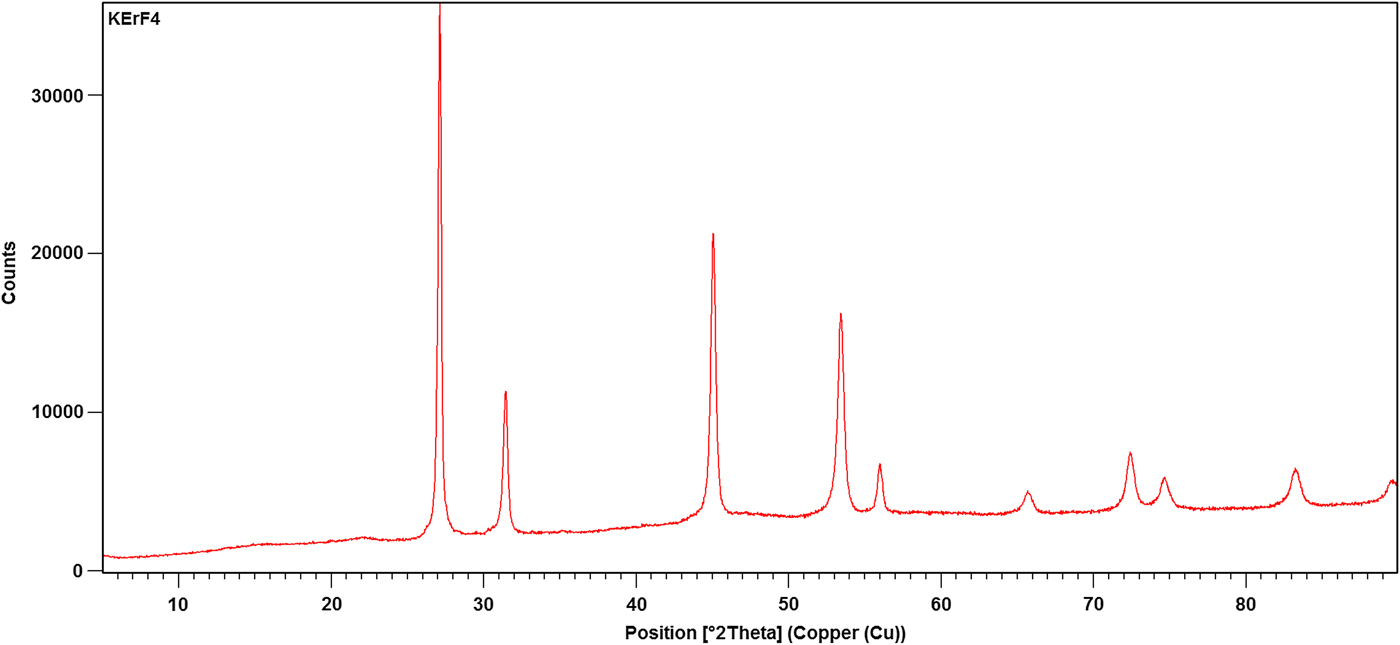
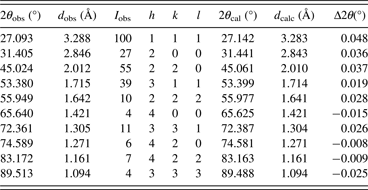
The experimental powder diffraction pattern is depicted in Figure 1. Automatic indexing results obtained by DICVOL04 (Boultif and Louër, Reference Boultif and Louër2004) show that the title compound is cubic with space group Fm-3m and the unit-cell parameters: a = 5.6862(5) Å, unit-cell volume V = 183.85 Å3, and Z = 4 (Table I). The figures of merits are – F10 = 12.7 (0.0262, 30) (Smith and Snyder, Reference Smith and Snyder1979) and M10 = 46.0 (de Wolff, 1968). All of the lines were indexed and are consistent with the Fm-3m space group.
(Color online) XRD pattern of K0.5Er0.5F2.

Sodium, potassium, cerium, and erbium have got the following atomic radii – 2.23, 2.77, 2.70, and 2.45 Å respectively. There are two isostructural fluorides in PDF4+ (ICDD, Reference McClune2012): sodium erbium fluoride (Na0.5Er0.5F2, Card no. 04-013-7403) with a = 5.465 Å and potassium cerium fluoride (K0.5Ce0.5F2, Card no. 04-007-9363) with a = 5.906 Å. The present K0.5Er0.5F2 has a = 5.6862(5) Å, which with respect to the atomic radii is in good agreement with the unit-cell parameters of the two isostructural compounds above.
Indexed X-ray powder diffraction data for the title compound, K0.5Er0.5F2. Only the peaks with I rel of 1 or greater are presented [a = 5.6862(5) Å, unit-cell volume V = 183.85 Å3, and Z = 4, space group Fm-3m]. All of the lines were indexed and are consistent with the Fm-3m space group. The d-values were calculated using Cu Kα 1 radiation (λ = 1.5406 Å).

ACKNOWLEDGMENTS
This work was supported by grant no. P106/12/1276 from the Grant Agency of the Czech Republic and by grant TAČR TA02010781 of the Technological Agency of the Czech Republic.