Background
The issue of teacher confidence in teaching music in primary schools has been widely considered in research (Mills, Reference MILLS1989; Bresler, Reference BRESLER1993; Gifford, Reference GIFFORD1993; Jeanneret, Reference JEANNERET1997; Hennessy, Reference HENNESSY2000; Holden & Button, Reference HOLDEN and BUTTON2006; Seddon & Biasutti, Reference SEDDON and BIASUTTI2008). In this field several aspects were considered such as the level of confidence (Mills, Reference MILLS1989; Bresler, Reference BRESLER1993; Gifford, Reference GIFFORD1993; Hennessy, Reference HENNESSY2000), the factors determining low confidence (Biasutti, Reference BIASUTTI2010), and, in some cases, methods of raising the confidence of the non-specialist music teacher in the classroom (Mills, Reference MILLS1989; Jeanneret, Reference JEANNERET1997; Holden & Button, Reference HOLDEN and BUTTON2006; Seddon & Biasutti, Reference SEDDON and BIASUTTI2008).
Several studies in different countries showed that both trainee and in-service generalist primary teachers lack confidence (Mills, Reference MILLS1989; Bresler, Reference BRESLER1993; Gifford, Reference GIFFORD1993; Jeanneret, Reference JEANNERET1997; Hennessy, Reference HENNESSY2000; Holden & Button, Reference HOLDEN and BUTTON2006; Seddon & Biasutti, Reference SEDDON and BIASUTTI2008). Hennessy (Reference HENNESSY2000) analysed the confidence of English generalist trainee primary teachers to teach the arts, finding that music was the subject in which they had least confidence. This is the current condition also in Italy, as well as in other European countries. As a result of a series of semi-structured interviews with trainee teachers during the four years of their training, Hennessy (Reference HENNESSY2000) reported the following three aspects which influenced the confidence to teach: prior personal experience, the opportunities and support for teaching music during school-based training and the nature of the university-taught courses. A particular issue for music (compared with the other art forms) was to challenge students’ beliefs and attitudes which were in conflict with the practices proposed in training (p. 192). Students often believed that they needed high levels of technical mastery (in playing an instrument and reading music) before they could do anything in music. A creative approach (reflected in the curriculum for primary music in England) required rather different types and levels of musical skills (for instance basic rhythmic and singing ability; listening skills) and understandings (e.g. in structuring creative music-making processes) and educating students in these was a key aspect of their training.
Considering possible variables influencing confidence in music teaching, Biasutti (Reference BIASUTTI2010) studied teachers’ beliefs about music abilities and music learning in primary and secondary teachers. The study adopted a quantitative methodology with two surveys administered to 177 trainee teachers. Results revealed significant differences between primary and secondary trainee teachers in the way they consider music ability and learning. Trainee primary teachers considered musical skills, such as study abilities, performance technical skills and interpretation to be more fixed than secondary trainee teachers. In addition, cognitive characteristics and musical factors affecting music learning were considered more important by trainee primary teachers than secondary trainee teachers (Biasutti, Reference BIASUTTI2010).
Ways of improving the confidence of the generalist music teacher were also addressed by the research, considering mainly the effectiveness of educational courses for initial training and professional development (Mills, Reference MILLS1989; Jeanneret, Reference JEANNERET1997; Holden & Button, Reference HOLDEN and BUTTON2006; Seddon & Biasutti, Reference SEDDON and BIASUTTI2008). This study used a design with pre- and post-assessment conditions and confidence was evaluated asking participants to rank in order curriculum subjects according to their confidence in teaching them from 1 (highest level of confidence) to 8 or 9 (lowest level of confidence). In research involving trainee primary school teachers in England, during their year-long training course, Mills (Reference MILLS1989) assessed the students’ improvements with pre- and post-test conditions. The students’ relative confidence in teaching music, planning appropriate activities and musical literacy were addressed during the activities. Findings indicated an increased percentage of students who developed confidence in teaching music during school experience. Jeanneret (Reference JEANNERET1997) assessed the effects of a music fundamentals course on the level of confidence in teaching music in trainee primary teachers in Australia and in the USA. The tutor provided a strong model for teaching strategies and content, in relation to the literature on motivation, improvement of confidence and academic self-concept. The approach integrated performance, composition and listening activities and the following aspects were evaluated at the beginning and at the end of the course: musical background, beliefs about past and present musical experiences, attitudes to and beliefs about music education, perception of music literacy, confidence to teach music, perception of composition, instructor rating, listening habits and musical preferences. Findings provided evidence that the course had a remarkable impact on trainee teachers’ confidence which was related to trainees’ orientations rather than musical achievement. Holden and Button (Reference HOLDEN and BUTTON2006), in a study with experienced generalist primary school teachers, considered confidence in teaching music. Musical background and attitudes towards professional development opportunities and teaching experience were taken into account. The participants’ opinions, which were collected with a questionnaire survey and a follow-up interview, revealed that initial teacher education programmes did not instruct them to teach music effectively. Participants considered music as a specialist subject requiring expertise and performing ability and stated that greater subject knowledge would increase their confidence. In a case study research, Seddon and Biasutti (Reference SEDDON and BIASUTTI2008) found that the trainee primary teachers’ confidence to teach music grew as a result of an online activity which consisted of learning to play by ear a 12 bar blues. Participants proficiently completed the activity and developed their aural skills.
In the reviewed literature, there is a general agreement that generalist primary teachers tend to have low levels of confidence for music teaching. Music activities based on performance, composition and listening (Jeanneret, Reference JEANNERET1997) and instrumental practice (Seddon & Biasutti, Reference SEDDON and BIASUTTI2008) have been found to improve levels of confidence. However, it is quite difficult to compare the results of the research since the content and the teaching methods were not always reported. It would be interesting and useful to also consider the nature of content and teaching approaches such as cooperative learning and more learner-centred perspectives within teacher education courses. The main problem is that the general didactic model for music teachers in many countries remains teacher centred. This model is based on instruction and practice, with few opportunities for students to become aware of their role in music learning (Biasutti, Reference BIASUTTI2012a). In a teacher-centred approach a given body of knowledge is transferred from the teacher to the student: the teacher selects the content and decides how to achieve the course objectives. The student has a passive role and follows the teacher's instructions in a one-way communication process, with little chance of participating in the learning process or developing a personal perspective (Biasutti, Reference BIASUTTI2012a). In a learner-centred approach students are at the centre of the learning activities and the teacher is a facilitator. Students are engaged in questioning and through cooperative learning activities they develop understanding of their own constructs, becoming active learners. A learner-centred approach facilitates the expression of creativity and divergent thinking since students find their own solutions to the problems that arise.
Another issue concerns the format and the duration of music courses in programmes for educating teachers. These are usually designed to be taught in weekly sessions throughout a semester rather than intensively over a short period. In the previous literature this issue was not discussed.
The aim of the current study is to evaluate an Intensive Programme (IP) that seeks to adopt a creative and learner-centred approach in educating generalist music teachers. During the IP, a mixture of quite conventional teaching was provided e.g. for guitar lessons and lectures, as well as more creative and learner-centred approaches during workshops.
Method
Study purposes
In the current study it was hypothesised that generalist trainee primary school teachers would improve their confidence in teaching music as a result of participating in an IP designed to develop competences among trainee teachers for teaching music in the primary school. The following leading questions were considered:
1. How successful was the IP in addressing the needs of individual students?
2. What did the participants believe they achieved and found most valuable about the IP?
3. What did the participants find most challenging and not valuable about the IP?
4. Did participants believe that their levels of confidence to teach music in the classroom rose as a result of their participation?
The Summer School Project
The International Summer School in Educating Music Teachers (ISSEMT) is an IP dedicated to European students of primary education (teaching ages 5–12) that wish to gain further theoretical and practical knowledge in music education. ISSEMT was held annually for three years and this report regards the first year of the ISSEMT. The IP is part of the Lifelong Learning Programme (LLP), financed by the European Union. Applying for funding for such projects is competitive, and it is necessary to present a proposal for a project and to pass a selection. According to LLP (http://ec.europa.eu/education/erasmus/ip_en.htm), an IP is defined as:
a short programme of study which brings together students and teaching staff from higher education institutions of at least three participating countries. It can last from 10 continuous full days to 6 weeks of subject-related work. An IP aims at:
– Encouraging efficient and multinational teaching of specialist topics which might otherwise not be taught at all, or only in a very restricted number of higher education institutions.
– Enabling students and teachers to work together in multinational groups and so benefit from special learning and teaching conditions not available in a single institution, and to gain new perspectives on the topic being studied.
– Allowing members of the teaching staff to exchange views on teaching content and new curricula approaches and to test teaching methods in an international classroom environment.
These aims were discussed and shared within the three professors of the coordinating team and considered in designing the IP. The planning process of the ISSEMT was developed over about nine months during which the coordinating team worked online for defining all the aspects of the project. There was also one face to face meeting about three months before the ISSEMT. The coordinating team was involved in defining the theoretical framework, objectives and activities. As the three experienced teacher educators came from different countries and teacher training traditions there was much discussion about how to balance the schedule and how to ensure good models of practice – especially relating to the need for developing traditional skills of singing and guitar (for instance) alongside more exploratory and creative processes. Planning processes and differences in backgrounds between professors were evident, but all professors agreed to share the teaching methods.
Participants and professors
The participants attending the ISSEMT were 23 trainee primary teachers studying in universities in Europe. Participants' nationalities were Italy (nine students), Slovenia (six students), the Netherlands (three students), and Austria (five students). Students were selected by their home institution for their strong interest in teaching music in the primary school, strong motivation and English language skills. It was not necessary for students to have an advanced level of musical ability in performance, but they were expected to have basic musical skills aptitudes such as a good sense of rhythm, intonation, some aural skills such as pitch discrimination and listening abilities. They were also expected to be able to read music at a basic level (rhythmic and melodic notation). No specific tests for assessing the musical aptitude of the participants were used.
There were seven professors involved in the ISSEMT, two from the UK, one from the Netherlands, two from Italy and two tutors (for singing and guitar lessons) from Italy. The professors involved in designing and organising the ISSEMT were three (coordinating team), while the other two professors and two tutors contributed with specific expertise (e.g. drama, cultural diversity, singing and guitar, respectively), but they were not involved in the overall designing of the ISSEMT.
ISSEMT Objectives
The ISSEMT aimed to reflect views of current good practice in music education and aimed to not only enable students to find relevant and accessible ideas and ways of teaching, but also offer practice that is inspirational. The students attending the ISSEMT worked in a variety of groupings employing cooperative and collaborative ways of learning. The aims of the ISSEMT were to develop the students’ skills, knowledge and understanding to use a creative and a learner-centred approach in their music teaching.
Main activities
The ISSEMT took place over 11 days and the working time was about 8 contact hours per day. The programme involved:
• Singing and accompanying skills.
• Lectures (soundscape education, development-based music education, teaching music by processes, creativity in music education, planning and assessment).
• Tutorials, one to one meetings with students to discuss their initial needs analysis and personal targets. Also opportunities during the two weeks to discuss any issues arising and final reflections.
• Workshops, based on modelling teaching approaches integrating skills and understanding in practical creative activities (e.g. sound worlds, musical meaning, music and cultural diversity, drama, music with drama, rhythm, improvising and composing, creating arrangements for all abilities, ICT applications) using a range of starting points and frameworks, e.g. stories, poems, art works, word rhythms, movements, patterns, sequences, invented notations and listening exercises.
• Project work, students design a learning unit for a class of primary aged children.
• Open lesson, a final task in which students teach each other a lesson from their own planned unit.
• Teacher briefing, meetings at the end of the day sessions at which the main events of the day are discussed.
The ISSEMT timetable included a lecture almost every day and daily singing and guitar sessions in which students had basic tuition and explored repertoire for the classroom. Most of the schedule was allocated to the practical workshops such as sound worlds, musical meaning, music and cultural diversity, drama, music with drama, rhythm, creating arrangements for all abilities and ICT applications. For instance, in the sound worlds workshop, students designed their own sound walks around the city of Padova and the sound walks were demonstrated and discussed. In the ICT workshops students were instructed in the use of Audacity, and in small groups they developed a project to create a sonic accompaniment to a chosen story.
One aim of the ISSEMT was to give students a more extended cross curricular experience through exploring how music could be combined with other subject areas. The drama workshop, which was focused on storytelling and the relationships between sound/music and expressive communication, was very useful in accomplishing this purpose.
The ISSEMT professors were present most of the time in each other's lessons and workshops making it easy to adapt and make references to content and information in their own lessons. This was important for avoiding overlapping in the content and for building on each other's material and activities. It was also helpful in supporting students’ understanding of spoken language. The didactic material consisted of songs to sing and accompany by guitar, the content of the lectures, music for listening, the ideas for improvising and composing, and the tasks and activities carried out during the workshops.
Teaching methods
In planning the didactic approach of the ISSEMT, methods designed to enhance participants’ understandings of teaching creatively and teaching for creativity were adopted. The distinction among teaching creatively and teaching for creativity was made by the National Advisory Committee on Creative and Cultural Education (NACCCE, 1999). Teaching creatively was defined as the adoption of approaches based on imaginative thinking to make learning more engaging and effective. Teaching for creativity was teaching focused on the development of divergent thinking and creative behaviours in students (Jeffrey & Craft, Reference JEFFREY and CRAFT2004). Weimar (Reference WEIMAR2013) noted that learner-centred teaching necessitates approaching design tasks with creativity. Planning didactic activities with creativity is an intellectual challenge and involves the development of deep learning. Teaching for creativity aims to enhance children's creativity (Runco, Reference RUNCO2007), with learner empowerment as its main objective (Jeffrey & Craft, Reference JEFFREY and CRAFT2004).
During the ISSEMT activities students were stimulated to use their divergent thinking skills in activities such as producing new music or new arrangements for pre-existing music. Teaching creatively and teaching for creativity were framed in a learner-centred approach. Weimar (Reference WEIMAR2013, p. 15) proposed the following five statements for defining learner-centred teaching:
1. It is teaching that engages students in the hard, messy work of learning.
2. It is teaching that motivates and empowers students by giving them some control over learning processes.
3. It is teaching that encourages collaboration, acknowledging the classroom (be it virtual or real) as a community where everyone shares the learning agenda.
4. It is teaching that promotes students’ reflection about what they are learning and how they are learning it.
5. It is teaching that includes explicit learning skills instruction.
A strong emphasis on learning through practice during daily workshops and music-making opportunities was also considered. A social constructivist perspective that informed the content and procedures was adopted, with tutors modelling and demonstrating good primary music teaching practice. A dialogue between professors and students and between the students themselves about the content and procedures was generated.
During the activities several opportunities were made available for peer-led teaching and learning in both the practice of teaching and the sharing of musical expertise. The use of cooperative learning was common during the workshops, where students worked in small groups of four or five. Special attention was paid to the integration of music with other curriculum areas (not just the other arts). Where possible, professors from disciplines other than music brought expertise from their own fields acting as catalysts for cross-curricular approaches. A broad repertoire to include cultural diversity was proposed during the activities, and in order to develop this perspective through music education students were encouraged to share their own songs and stories. The creative use of technology for teachers and for children was also considered, with the use of digital recording and creating soundtracks to accompany stories.
Assessment and data collection
The ISSEMT assessment was based on active participation in the workshops. In addition, the students were evaluated for their project works and open lessons in which they taught each other a lesson applying ideas explored on the course to teaching in a class in primary school.
The evaluation process of the ISSEMT, in which several tools were used, was based on theoretical models described in the assessment literature considering the multidimensional nature of students’ evaluations (Marsh & Bailey, Reference MARSH and BAILEY1993). Alongside the questionnaires, which included both closed and open-ended questions, groups discussed verbally their thoughts about the course organisation and quality of teaching and were asked to rate their feeling of confidence to teach music (Seddon & Biasutti, Reference SEDDON and BIASUTTI2008). In detail, the ISSEMT evaluation was based on the following tools which are described below:
– The evaluation questionnaire for students.
– Ratings for student confidence (time 1 & time 2).
– The discussion groups with students.
– The follow-up survey and interview.
Students were invited to complete the ratings for student confidence without consultation with each other at the beginning and at the end of the ISSEMT. The evaluation questionnaire and the discussion groups with students were proposed at the end of the ISSEMT. Participants were informed that the questionnaires and the discussion groups would remain anonymous. They were also informed that it would take about 25 minutes to complete the questionnaires and 30 minutes for the discussion groups. Seventeen students participated in the follow-up survey and interview after two years and five months.
The evaluation questionnaire for students. This tool was generated for assessing the effects of the training and included both closed (38) and open-ended questions (2). A five-point Likert scale (1 to 5, with 1 = strongly disagree, 2 = disagree, 3 = neutral, 4 = agree, and 5 = strongly agree) was used. Participants were asked to self-evaluate their skills improvement and data were collected regarding the cognitive processes stimulated, the quality of the training, the teaching involvement in the training and the team work. The following scales were proposed:
1. Approaches in music education (items: 1–10).
2. The professors (items: 11–18).
3. The lectures (items: 19–23).
4. The workshops (items: 24–27).
5. General aspects (items: 28–31).
6. The organising staff (items: 32–35).
7. The logistics (item: 36–38).
Regarding the qualitative aspects, two open-ended questions were asked for overall comments about the aspects considered most important and the aspects considered should be improved. The evaluation questionnaire for students was completed at the end of the ISSEMT and is shown in Appendix 1.
Ratings for student confidence (time 1 & time 2). An ordering task for measuring the confidence of the students in teaching music was proposed at the beginning and at the end of the ISSEMT. Students were asked to rank the following subjects (Art, English, First Language, Geography, History, Maths, Music, Physical Education, Sciences) into the order that they felt most confident to teach in the classroom with the most confident at number 1 and least confident at number 9 (Seddon & Biasutti, Reference SEDDON and BIASUTTI2008). The ratings for student confidence are reported in Appendix 2.
The discussion groups with students were conducted in order to collect more data since in the open-ended questions of the evaluation questionnaire for students only a few details were reported by participants. The discussion groups with students sought to elicit the students’ views of the course as well as focusing on their own learning and achievements. Students reflected on what they had gained during the activities and how they would implement their learning as music teachers. Discussion centred on the personal involvement in the activities; the most stimulating aspects of the methods and approaches used; the process of learning; the organisation; and the quality of the activities. Views of the connections between topics, the time management, and the main aspects useful for participants’ professional activity were also collected. The full list of questions is presented in Appendix 3.
The follow-up survey and interview. Interviews were conducted about two years and five months after the conclusion of the ISSEMT. All students were contacted by email asking for an interview face to face or by phone. Participants who could not organise a phone appointment answered via email. A total of 17 interviews were collected. During the interview aspects such as the usefulness of the didactic material provided during the ISSEMT activities, the efficacy of the creative approach to music teaching proposed during the ISSEMT and how attending the ISSEMT contributed in their professional development, were considered. Other aspects focused on how useful the course was for their personal development, in building confidence to teach music and their ability to teach for creativity. Participants were asked also to provide examples how they had used ideas from the course in their teaching (see Appendix 4). The interviews were carried out individually and lasted 7 to 14 min. The interviews were recorded on a MP3 audio recorder and transcribed verbatim. The participants had the possibility to review the transcripts to ensure accuracy.
All data collected with these tools were analysed using both quantitative (statistical analysis for closed-ended questions) and qualitative analysis (for open-ended questions, group discussion and interviews) as reported in the following section.
Analysis and results
The collected data consisted of:
• completed evaluation questionnaires for students (closed and open-ended questions);
• written records of group discussions with students;
• completed ratings for student confidence (time 1 & time 2);
• written records of follow-up survey and interview.Footnote 2
Descriptive statistics and reliability analyses were sought for the quantitative part of the evaluation questionnaire for students and the ratings for student confidence data at time 1 and time 2, while the qualitative data were analysed using an inductive method based on a Grounded Theory approach. The qualitative data collected during the follow-up survey and interview were analysed with content analysis.
Quantitative results of the evaluation questionnaire for students
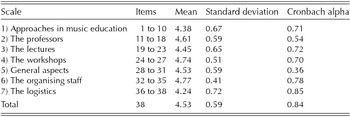
Descriptive statistics (mean and standard deviation) were computed for the quantitative results of the evaluation questionnaire for students. In analysing the closed-ended questions data (rating scale of 1–5), the most successful scale was the organising staff scale (M = 4.77, SD = 0.41) followed by the workshops scale (M = 4.74, SD = 0.51) and the professor scale (M = 4.61, SD = 0.59). The lowest result was reported by the logistics scale (M = 4.24, SD = 0.72). In general, these results indicate a very good level of students’ satisfaction during participating in the ISSEMT.
The reliability of the scales was assessed by measuring the internal consistency of each scale through the computation of Cronbach's alphas. Alpha coefficients ranged from 0.36 to 0.85 and were mostly well above the 0.70 standard of reliability. Only the general aspects scale (0.36) and the professors’ scale (0.54) were below the standard of reliability. The alpha coefficient for the whole questionnaire was 0.85. Means, standard deviations and Cronbach's alphas for the evaluation questionnaire for students are reported in Table 1.
Means, standard deviations and Cronbach's alphas for the scales of the evaluation questionnaire for students.

Qualitative results of group discussions with students and open-ended questions of the evaluation questionnaire for students
Answers to open-ended questions and group discussion transcripts were analysed employing a qualitative approach based on ‘Grounded Theory’ by Glaser and Strauss (Reference GLASER and STRAUSS1967). The ‘Constant Comparative Method’ was employed to examine and to categorise the qualitative data (Glaser & Strauss, Reference GLASER and STRAUSS1967). This method was adopted as a foundation for analysis because it has been fruitfully adopted in earlier qualitative research examining collaborative online learning of trainee primary teachers, collaborative composing and rehearsal strategies (Biasutti, Reference BIASUTTI2011, Reference BIASUTTI2012b, Reference BIASUTTI2013). In this inductive approach the categories emerge from the data by use of inductive analysis rather than coding the data according to prearranged categories. Researchers have to categorise carefully the material and to create the category names directly from data (Charmaz & Henwood, Reference CHARMAZ, HENWOOD, Willig and Rogers2008).
The following five stages were used for analysing the qualitative data (McLeod, Reference MCLEOD1994, p. 85):
1. Immersion. The researcher intensively reads or listen to material, assimilating as much of the explicit and implicit meaning as possible.
2. Categorisation. Systematically working through the data, assigning coding categories or identifying meanings within the various segments/units of the ‘text’.
3. Phenomenological reduction. Questioning or interrogating the meanings or categories that have been developed. Are there other ways of looking at the data?
4. Triangulation. Sorting through the categories. Deciding which categories are recurring and central and which are less significant or are invalid or mistaken.
5. Interpretation. Making sense of the data from a wider perspective. Constructing a model or using an established theory to explicate the findings of the study.
Answers to group discussion were analysed in order to seek validation of the open-ended questions analysis of the evaluation questionnaire for students. The data analysis of the group discussion answers and the open-ended questions of the evaluation questionnaire for students are presented jointly and had the following themes: social and communication, methods, activities, topics, competences and organisation.
Regarding the social and communication theme, the students appreciated the direct communication with professors and the collaboration between students coming from different countries. The friendly environment provided both motivation and enjoyment for the students. Regarding the methods theme, students valued the work in groups and the use of practical activities to support ‘learning by doing’. Participants appreciated also the interdependence of theory and practice, the interdisciplinary approach, the feedback given after the activities and the learner-centred approach adopted during the activities. Regarding the activities theme, students appreciated the workshops very much, which were considered occasions for learning through practice and gaining experience. For the topics theme, some specific contents were considered relevant such as children's songs, drama and cultural diversity workshops, the lectures on development based music education, and planning and assessment in music education, the experience with musical instruments, and the examples of music education in the primary school. Regarding the competences theme, during the ISSEMT the students reported that they felt more confident about music education and teaching music in classroom. One skill developed during the training was creativity. The learning of rhythm, the learning of many ‘practical ideas’ for activities in the classroom, the learning of software programmes, the use of improvisation, ways of interacting with children in music class were other aspects which students considered very important. Regarding the organisation theme, students reported that ‘everything was well organised. The programme was well tuned and the people were kind and helpful’.
Students also provided essential information about how to improve the training. The themes that students considered needing improvement are: social and communication, topics/activities, methods and organisation. Regarding the social and communication theme, the importance of socialising for the whole group and more common free time in which all students could exchange experiences and get to know each other were reported. They also asked for ‘mixed groups’ (with student of different nationalities) and changes of groups during the training since there was the tendency for students less confident in English to stick together in their national groups. Regarding the topics/activities theme students asked to have more workshops on ICT, drama, instrument learning (in particular the guitar), and more variety in the singing lessons. They also asked to have training in specific musical skills (such as piano). Regarding the method theme, they wanted more practical activities and fewer theoretical lectures. Regarding the organisation theme, aspects such as managing different levels of musical ability, financial resources, ISSEMT dates, duration of the lessons and logistics were commented on.
Confidence of students
The results of the ratings for student confidence provided evidence of general improvement. Eleven students reported improvements from 1 to 6 positions. The improvement effect was more relevant for students who, at the beginning of the ISSEMT were least confident to teach music (e.g. from 8 to 2 for student no. 7). Only one student reported less confidence at the end of the ISSEMT, from position 3 to 4. The other 11 subjects rated their confidence in the same position at the beginning and at the end of the ISSEMT (position 1 for nine participants and position 2 for two participants).
T-test statistical analysis was performed in order to verify if differences occurred between time 1 and time 2 for ISSEMT participants. Findings provided evidence of a significant difference between pre- and post- conditions with t(22) = 2.54; p = 0.019. The trend of the confidence improvement was confirmed also by the open-ended questions, in which students reported that they felt more confident in teaching music in the primary school at the end of the ISSEMT.
Results of the follow-up survey and interview
Seventeen participants took part in the follow-up survey and interview about two and half years after the end of the ISSEMT. During the follow-up most of the participants were teaching in schools: 15 participants were working as teachers, while one was still studying and the other one was not yet employed. Out of the 15, 12 participants were primary school teachers, two were secondary school teachers and one was teaching in kindergarten. However, not all participants had the possibility to teach music extensively: eight participants had the possibility to teach music also in supporting colleagues during music lessons and collaborating in interdisciplinary projects. The follow-up survey and interview were analysed with content analysis. A summary of results for each question is reported below. Participants asserted having successfully used the ISSEMT material during their teaching. Several activities were mentioned such as sound exploration and sound walk, musical games, vocal activities and new songs repertoire, guitar, drama, music technology, rhythm activities, improvising, composing and arranging. A student who had not had the opportunity to use the material commented: ‘It was a very good experience – all programmes and material were useful. I have now a full repertoire that is ready. I have only to keep it and to propose to my students’ (Respondent 3). Another stated: ‘Attending the summer school was a huge profit for me. I always think of the things we have learned because they were very useful. I also shared the ideas with my colleagues and they used it as well’ (Respondent 4).
Regarding questions 2 and 3 (‘Tell me more about how you think attending the ISSEMT has contributed to your development as a teacher?’; ‘Was the attending to the ISSEMT also useful for your personal development, as a teacher in general?’) participants reported that the ISSEMT had supported their professional development through: musical skill development, teaching methods and professional development. Learning the guitar, singing and playing classroom percussion instruments were all useful skills for teaching. Also the ability to make music together, musical awareness and the development of musicianship were mentioned. Regarding the teaching methods, the value of the learner-centred approach was recognised, and teaching for creativity and applying an interdisciplinary approach were also mentioned, as were using collaborative methods and group activities in music teaching. Regarding the professional development, team work, curriculum design, confidence development and personal development were reported. Participants asserted:
I would say that it helped me to get another perspective of teaching music. Better one, more positive in general. I’ve learned that teachers can make it really more interesting than they do. (Respondent 17)
I consider myself more independent in teaching. In some ways I understood better how pupils feel. And it was useful for my musicianship too, so I think both were useful and important for me. (Respondent 16)
It increased my personal awareness in teaching music. I feel less unprepared in music, in the sense that, indeed, there is a little of music in everywhere, so there is also within me, beyond self-interest, everyone is able to express something and then have less fear to teach, we can say, the music, because we put it more at the level of children, starting with their experiences and interests . . . so, a little more professional security, of course, also more motivation, I am able to motivate myself and then to transmit it to the others. (Respondent 7)
Improvement in their teaching more generally was also noted:
It was useful also as a general teacher, because contrasting ideas between colleagues is always an excellent occasion. In addition, it was a tool for sustaining the creativity and building personalised teaching paths. (Respondent 7)
Regarding question 4 (‘One of the aims of the ISSEMT was ‘A strong emphasis on teaching for ‘creativity’, do you think the ISSEMT succeeded in this? If yes – can you describe an example from your own teaching?’) participants recognised the value of teaching for creativity as we can see in the following answers:
I think it was very useful because all of us had greater confidence in how to teach creativity. (Respondent 2)
I also recognised that I became more creative in teaching music. I have now more ideas and I am able to improvise in my music lessons . . . An example would be that I always can change my lessons and sometimes when the normal lessons have got boring or the pupils lost concentration I always had an idea about what we could do with music. (Respondent 4)
I think the summer school succeeded in teaching for creativity. There were so many new experiences for us . . . I realise that what is important not just the ‘classical’ music, e.g. singing and playing the instruments, but what we really hear outside at the street, in the park, by the sea or river . . . so, music is not just the instrumental part or a song – it can be everything that we hear. (Respondent 16)
These quotes indicate that participants developed creativity in planning the lessons, and not only in teaching for creativity.
Regarding question 5 (‘In a scale from 0–10 how useful was attending the ISSEMT for you in building confidence to teach music?’) participants reported a mean of 8.7 with SD 1.162. One participant asserted: ‘Before the summer school my confidence rating was 4 and after I think it was much more developed, so about 9’ (Respondent 1).
Discussion
The main evaluation results showed that the learner-centred methods used by professors during the ISSEMT activities produced an effective improvement in the quality of attitudes towards music teaching in primary school. The students appreciated the methodological approach, the practical teaching ideas and the way the course closely related to their educational needs. The students also offered useful suggestions for improving the ISSEMT addressing issues such as social and communication, topics/activities, methods and organisation. In comparing students’ confidence at the beginning and at the end, there was a significant improvement as reported by the statistical analysis. The follow-up survey and interview consolidated this result and demonstrated a definite and stable acquisition of confidence in teaching music. This result supports the findings of other studies, in which a raising of confidence was found at the end of educational musical activities (Mills, Reference MILLS1989; Jeanneret, Reference JEANNERET1997; Seddon & Biasutti, Reference SEDDON and BIASUTTI2008). However, the strengths of the current research are that the follow-up was two years after the end of the ISSEMT and the confidence effects in teaching were still consistent. It would be interesting to clarify in further research what kind of relationship there is between confidence and quality of teaching.
There are several key factors that contributed to the effectiveness of the ISSEMT that could be discussed. The first concerns the activities that were proposed intensively and in a short time. IPs and Master classes are very common in music instrumental learning and in other disciplines such as foreign language education. Usually, music activities in programmes for educating primary teachers are planned throughout a full academic semester or year and learning is gradual. In the current study, the condensed activities during the ISSEMT and the full immersion in music education issues probably enabled focus and facilitated the students’ development of confidence. The IP framework could be a good formula when attempting to change self-perceptions and to build skills for teaching.
There are also other aspects that influenced the results of the current study, such as the strong student motivation since they decided to dedicate almost two weeks of their time for attending the ISSEMT in June, a month in which usually there are still university activities and exams. In addition, bringing students and teachers out of their familiar environment can also facilitate the creation of a strong supportive peer group.
The students’ evaluations indicated that proposing specific approaches based on creativity and on a learner-centred approach is crucial. Professors had to share the philosophy, the didactic approach and to reach a consensus. In addition, for many of the creative workshops two professors working as a team were involved – taking turns to lead the activities, but often engaged in team teaching.
The last issue regards the design process of the IP. Planning time and good communications between the team prior to the IP is necessarily decisive and difficult to achieve. It was important that the process of developing the approach and content continued while the course was running. Ongoing reflection and evaluation enabled the coordinating team to respond and adapt to feedback, and to review the structure and content for future years.
Implications for future developments
In this paper the educational activities proposed during the ISSEMT and the findings of the evaluation process with students were described. Results provided evidence that working intensively with trainee teachers could be successful when trying to reinforce the teachers’ perceptions of self as music teacher. The intensive programme took students and teachers out of their conventional settings allowing them to focus completely on the activities and the ideas. The strong supportive peer group and the learner-centred approach facilitated these processes supporting them in growing in confidence.
The results of this study have implications for the research field on generalist trainee teacher education, and suggest the need for further study about the nature of educational processes. We can wonder if working intensively with trainee teachers could be a better approach than spreading music lessons over time. It could be interesting to verify in further research if intensive programmes are more effective than standard programmes by adopting an experimental design with two groups, and contrasting the effects and the results of the two courses.
Regarding the future developments of the project, students and professors gave several suggestions for improving the ISSEMT. The main goal identified by the coordinating team is to establish a future programme centred on interdisciplinary approaches with a broader arts focus. Several teaching methods could be applied in this framework, such as project based learning where participants can work across all the arts for developing their creativity. While many countries adopt the general class teacher policy, in primary education there remains a lack of opportunities for teachers to strongly develop their abilities and confidence to teach music and the other arts subjects (Hennessy, Reference HENNESSY and Biasutti2010). Projects such as ISSEMT can contribute to teacher educators’ knowledge and practice in addressing this issue.
Acknowledgements
This work was developed within the International Summer School in Educating Music Teachers (ISSEMT) project that was funded by the Italian Agency of Lifelong Learning Programme (ERASMUS – Intensive Programmes No. 2009-1-IT2-ERA10-078 66). We would like to take this opportunity to thank the professors, tutors and all the staff and collaborators of the IP. Author Contributions: Michele Biasutti, was the idea originator, implemented the activities, build the Evaluation questionnaire and the Questions for the final discussion groups with students, collected the data, analysed the data, and finally wrote the paper. Sarah Hennessy implemented the activities, collected the data, revised critically the paper. Ellen de Vugt-Jansen implemented the activities, build the follow-up survey and interview, and collected the data.
Appendix 1. The evaluation questionnaire for students
Male: . . . . . Female: . . . . . . Age: . . . . . .
Please indicate the extent of your agreement/disagreement with the statements by using the following scale:

Please indicate which aspects of the training you consider most important:
. . . . . . . . . . . . . . . . . . . . . . . . . . . . . . . . . . . . . . . . . . . . . . . . . . . . . . . . . . . . . . . . . . . . . . . .
Please indicate which aspects of the training you consider should be improved (aspects not covered by the rating items)
. . . . . . . . . . . . . . . . . . . . . . . . . . . . . . . . . . . . . . . . . . . . . . . . . . . . . . . . . . . . . . . . . . . . . . . .
Other comments
. . . . . . . . . . . . . . . . . . . . . . . . . . . . . . . . . . . . . . . . . . . . . . . . . . . . . . . . . . . . . . . . . . . . . . . .
Appendix 2. Ratings for student confidence
Please, put the following subjects into the order that you feel most confident to teach in the classroom with the one you feel most confident at number 1 and least confident at number 9.
(Art, English, First Language, Geography, History, Maths, Music, Physical Education, Sciences).
[Space with numbered list was provided here]
Appendix 3. Questions for the final discussion groups with students
What are the most important aspects of the training and why?
What do you feel about your personal involvement in the activities?
Are the objectives of the activities clear?
What do you think about the lectures?
What do you think about the workshops?
What do you think about the skills sessions?
What do you think about the organisation of the sessions?
What do you think about the professors?
What do you think about the tutors for skills development?
How was the feedback?
What do you think about the workload?
What do you think about the connections between activities?
What do you think about the time management?
What are the main aspects that will be useful for you in professional activity?
What are your comments about the didactic material?
What do you think about the logistic?
Other suggestions?
Appendix 4. The follow-up survey and interview
A General questions asked by email:
– Are you teaching in a primary school at the moment?
– Do you teach as a primary school teacher?
– Is teaching music one of the subjects you teach? If not, please explain why?
– How many hours per week do you teach music?
B Interview:
– Have you used any of the musical material and the musical activities? Please, describe an example of an activity you used.
– Tell me more about how you think attending the ISSEMT has contributed to your development as a teacher?
– Was attending the ISSEMT also useful for your personal development, as a teacher in general?
– One of the aims of the ISSEMT was ‘A strong emphasis on teaching for ‘creativity’, do you think the ISSEMT succeeded in this? If yes – can you describe an example from your own teaching?
– On a scale from 0–10 how useful was attending the ISSEMT for you in building confidence to teach music?
Michele Biasutti is an Associate Professor at Padova University, where he conducts research in psychology of music and music education. Among his research topics there are the cognitive processes in composition and improvisation, on-line music learning and the education of music teachers. He is proposing an approach to music education based on the development of processes rather than products. He is scientific director of research projects, he is a member of the editorial board of journals and he has published articles in international peer-reviewed journals. He is author of seven books.
Sarah Hennessy is a Senior Lecturer in Music Education at the University of Exeter where she teaches both specialist and generalist primary music courses. She teaches on the MED programme and supervises doctoral students. She also undertakes research into music teacher education and children's musical creativity. She is the Founding Editor of the journal, Music Education Research, and established the International Conference for Research in Music Education (RIME). She is Past president of EAS and an elected member of ISME.
Ellen de Vugt-Jansen is Lecturer at the School of Education (primary education, music and culture education) at Rotterdam University. Her interests are in music in primary teacher education for generalists and creative approaches to teaching and learning. She is a board member of the VLS, the national network for music teachers in the Netherlands.