1. Introduction
We examine the intersection between a number of important topics: environmental sustainability, subsidies and food security. The paper is focused on a context where these interact most acutely – small island developing states (SIDS), and the capture fisheries sector. It brings a fisheries story to a wider audience, which the issues deserve, and allows scrutiny from peers in development economics.
Global wild fish catch reached its maximum limits in the mid-1980s, and has started to decline, mainly because of overexploitation and the depletion of fish stocks (e.g., Pauly et al., Reference Pauly, Christensen, Guénette, Pitcher, Sumaila, Walters, Watson and Zeller2002; Myers and Worm, Reference Myers and Worm2003). The overexploitation of fish stocks started in the North Atlantic and North Pacific, where industrial fishing began in the late 19th and early 20th centuries. It then expanded to the continental shelf and coastal waters of other ocean basins, including those in SIDS, and then to the high and deep seas (Sumaila and Cheung, Reference Sumaila, Cheung, Bourne and Collins2009).
Fisheries are important in developing coastal countries in general, and in SIDS in particular, for a variety of reasons: (i) fish is a source of micronutrients and animal protein for the populations of SIDS; (ii) fisheries are an important source of foreign exchange for many of the SIDS; and (iii) fisheries are a source of income and livelihood to millions of people in these countries, many of whom are employed in small-scale fisheries. According to the Food and Agricultural Organization of the United Nations (FAO), about 4.5 million tonnes of fish are caught in African marine ecosystems, delivering gross annual revenues (first sale) of close to US$5 billion, and supporting the jobs and livelihoods of about 3.6 million people. Fish is a food of excellent nutritional value, providing high-quality protein and a wide variety of vitamins and minerals. FAO figures for 2007 show that fish provides over 25 per cent of animal protein in Asia (excluding China), and well over 21.5 per cent in low-income food-deficit countries. In 2007 the average annual per capita apparent fish consumption in developing countries was 15.1 kg. Despite its under-recording by official statistics for small-scale and subsistence fisheries, fish contribution to animal protein supply is quite high in many developing countries (36 per cent in Cameroon and ranges between 42 and 44.5 per cent in the Democratic Republic of the Congo, Uganda, Egypt and Senegal, and well over 58 per cent in Ghana and 65 per cent in Sierra Leone), thus enhancing food security at the household level.
Overexploitation of fish stocks results in substantial socio-economic loss to fishing enterprises and communities (World Bank and FAO, 2008). It also threatens the long-term survival of marine species, in particular those that are vulnerable to fishing (Hutchings and Reynolds, Reference Hutchings and Reynolds2004). The long-term sustainability (ecological, economic and social) of targeting many fish stocks in the world is in doubt (Pauly et al., Reference Pauly, Christensen, Guénette, Pitcher, Sumaila, Walters, Watson and Zeller2002; Worm et al., Reference Worm, Barbier and Beaumont2006).
At the same time that fish stocks are being overexploited, subsidies are being provided to the fishing sector by many governments around the world. It is generally accepted by fisheries scholars and scientists that fisheries subsidies are a driving factor for the build-up of excessive fishing capacity (Milazzo, Reference Milazzo1998; FAO, 2001; Clark et al., Reference Clark, Munro and Sumaila2005). Subsidies that reduce the cost of fisheries operations and those that enhance revenues make fishing enterprises more profitable than they would be otherwise. For instance, if governments cover some of the fuel cost for fishers, they artificially make fishing more profitable than it would be without the subsidy, thereby making it possible for fishers to go fishing who would not have otherwise found it economically profitable. Such subsidies result in fishery resources being overexploited, as they contribute directly or indirectly to the build-up of excessive fishing capacity (Milazzo, Reference Milazzo1998), thereby undermining the sustainability of marine living resources and the livelihoods that depend on them (Sumaila et al., Reference Sumaila, Khan, Dyck, Watson, Munro, Tyedmers and Pauly2010). In this paper, this type of subsidy is considered a capacity-enhancing or ‘bad’ subsidy because of its negative effect on fisheries sustainability.
The first global estimate of fisheries subsidies was provided by the FAO (1992), which was calculated simply by deducting the estimated total costs from the total revenue from global fisheries to arrive at global estimated annual fisheries subsidies of US$54 billion. The next was an in-depth study by Milazzo (Reference Milazzo1998), which found that annual fisheries subsidies were in the range of US$11–20 billion per year, which was nearly 20 per cent of the landed value of gross revenues of global fisheries. At the regional level, a study by a major international accounting firm conducted for the Asia Pacific Economic Cooperation (APEC, 2000) estimated subsidies by its members at US$8.9 billion, while the OECD (2004, 2005, 2010) and Munro and Sumaila (Reference Munro and Sumaila2002) estimated annual fisheries subsidies of about US$6.4 billion per year for its member countries. WWF, using subsidies reported by APEC, OECD and WTO members, found that officially reported subsidies were US$13 billion per year in 2001 and concluded that the actual global yearly total was at least US$15 billion, and very possibly higher (WWF, 2001).
Following their earlier publications (e.g., Khan et al., Reference Khan, Sumaila, Watson, Munro, Pauly, Sumaila and Pauly2006), Sumaila et al. (Reference Sumaila, Khan, Dyck, Watson, Munro, Tyedmers and Pauly2010) estimated global total subsidies to be between US$25 and 29 billion a year. Using the classification of subsidies described in Sumaila et al. (Reference Sumaila, Khan, Dyck, Watson, Munro, Tyedmers and Pauly2010), the authors concluded that US$16 billion, or about 60 per cent of the global subsidies, can be classified as ‘capacity enhancing’, with another US$3 billion categorized as ‘ambiguous’ subsidies. These estimates show that the developed countries jointly accounted for nearly 70 per cent of the global fisheries subsidies and 65 per cent of the ‘capacity enhancing’ subsidies.
We first present information on current and potential catch, and compute the potential catch losses from the exclusive economic zones (EEZs) of SIDS due to ineffective management. Next, we analyze the food security implications of subsidies and their effect on overfishing. Then we present and analyze the amount and types of subsidies provided by SIDS to their fishing sector separately and collectively, and analyze the effect of fisheries subsidies on overfishing in the EEZs of SIDS.
2. Methods
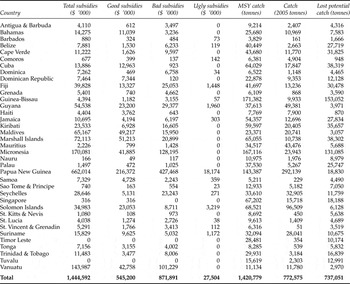
For the purposes of this study, we use the UN definition of SIDS, which includes 51 countries/entities (http://www.un.org/special-rep/ohrlls/sid/list.htm). Note that for this analysis political entities are not counted separately from their parent countries. Hence, American Samoa, which is one of the 14 dependents of countries listed, is combined with the United States. We therefore included 37 SIDS in our analysis, except Bahrain because of lack of data. Of the 37 non-dependent territories/countries, 16 are from the Caribbean, 12 in Oceania, six in Africa and three from Asia (table 1).
Annual subsidies and catch data for SIDS

Notes: All amounts in US$.
Source: Sumaila et al. (Reference Sumaila, Khan, Dyck, Watson, Munro, Tyedmers and Pauly2010) and Srinivasan et al. (Reference Srinivasan, Cheung, Watson and Sumaila2010).
2.1. Potential catch loss in SIDS
Following Sumaila et al. (Reference Sumaila, Cheung and Dyck2012), we applied the catch losses from overfishing reported by Srinivasan et al. (Reference Srinivasan, Cheung, Watson and Sumaila2010). By analyzing trends in landings for 1,066 species of fish and invertebrates in 301 EEZs, Srinivasan et al. (Reference Srinivasan, Cheung, Watson and Sumaila2010) estimated that between 16 and 31 per cent of stocks were overfished from 1950 to 2004. In order to estimate the potential catch losses from overfishing, the authors applied an empirical relationship they derived from catch data and species stock assessments from the US National Oceanic and Atmospheric Administration (NOAA). For 26 stocks in the Northwest Atlantic, the relationship between a species' mean maximum catch Cmax from reported landings and its maximum sustainable yield (MSY) from stock assessment was found to be robust (log MSY = 0.8458 · log (mean Cmax) + 0.3777; R 2 = 0.84, p < 0.001). Given the lack of detailed stock assessments for most of the world's fisheries, Srinivasan et al. (Reference Srinivasan, Cheung, Watson and Sumaila2010) therefore used the relationship they derived with a 50 per cent prediction interval to estimate MSY levels for all stocks identified in their analysis as overfished.
By comparing these MSYs with actual landings, Srinivasan et al. (Reference Srinivasan, Cheung, Watson and Sumaila2010) arrived at estimates of lost catch by mass. They reported that, without overfishing, potential landings around the world in the year 2000 could have been 9.1 million tonnes higher than actual landings (50 per cent prediction interval: 3.6 to 19 million tonnes higher). As a percentage of the potential total catch in the year 2000, the potential gains by region were reported as: 23 per cent in North American EEZs, 19 per cent in African EEZs, 19 per cent in European EEZs, 14 per cent in Asian EEZs, 13 per cent in Oceania EEZs, 11 per cent for the high seas and 7 per cent for South American EEZs.
We determine the current and potential catch from the EEZs of the 37 SIDS using estimated MSYs reported in Srinivasan et al. (Reference Srinivasan, Cheung, Watson and Sumaila2010) and described above. In population ecology and economics, MSY is, theoretically, the largest catch that can be taken from a species' stock over an indefinite period. The MSY is considered by many fisheries scientists as a good target for fisheries catch because it captures the attractive idea of taking the maximum catch possible that can be sustained by the natural growth and life history of the fish. The catch loss, that is, catches foregone due to fishing beyond sustainable levels (i.e., due to overfishing), is calculated by combining MSY data with current catch reported in the Sea Around Us project database (http://seaaroundus.org/).
In brief, MSY for each fishery's stock (taxonomic unit reported in the FAO landings statistics) in the EEZs of SIDS is calculated from the maximum catch of the time-series catch data, smoothed by 5-year running mean (Srinivasan et al., Reference Srinivasan, Cheung, Watson and Sumaila2010). The calculated maximum catches are then converted into MSYs using an empirical equation describing the relationship between observed maximum catches and the theoretical MSY of a stock (see Srinivasan et al., Reference Srinivasan, Cheung, Watson and Sumaila2010, for details). Stocks are considered overfished if maximum catch has already been reached in catch time-series, and the current catch is below 50 per cent of the maximum catch as defined by the FAO of the UN. Catch loss of these stocks are calculated from the difference between the current, which here is the average of the catches from 2000 to 2005, catch and their estimated MSYs.
2.2. Analysis of the food security implications of catch losses in SIDS
The goal of section 2.1 is to estimate catch losses due to the ineffective management of fisheries in SIDS. Here, we provide a general discussion of the food security implications of these losses in catch. Losses of food security from overfishing occur through loss of revenue and income as well as direct loss of food. While the direct food security implications of overfishing would be felt in SIDS, where the losses would be most felt are as a source of income for hundreds of millions of people, of revenues and profits, all of which allow people to access food through the market. The loss of catches will also be missed as a source of healthy, varied and nutrient-rich food – losses in maternal and child health and reductions in disability-adjusted life expectancy through increased risk of coronary heart disease or diseases related to micronutrient deficiency can be expected.
2.3. Fisheries subsidies in SIDS
Subsidies have been defined simply as government financial transfers that help reduce the cost of fishing, e.g., fuel subsidies, or artificially increase revenues to fishing enterprises, e.g., through price support subsidies (Milazzo, Reference Milazzo1998). Subsidies are categorized in this paper into beneficial or ‘good’, harmful or ‘bad’, and ambiguous or ‘ugly’ categories. ‘Good’ or beneficial subsidies help maintain or enhance the growth of fish stocks through the conservation and monitoring of catch rates via control and surveillance measures. Examples of good subsidies are fisheries management programs and fishery research. Harmful subsidies result in the growth of fishing effort, which can lead to outright destruction of the natural resource. Such subsidies include all forms of capital inputs and infrastructure investments from public sources. ‘Ugly’ subsidies are ambiguous, and can lead to either decline or growth in fishing effort, depending on the context and management effectiveness. An example is vessel buyback or decommissioning programs which, if not designed and implemented such that the industry is caught by surprise, will not guarantee that the subsidies will have a positive effect in terms of overcapacity (Clark et al., Reference Clark, Munro and Sumaila2005; Sumaila et al., Reference Sumaila, Khan, Dyck, Watson, Munro, Tyedmers and Pauly2010).
Sumaila et al. (Reference Sumaila, Khan, Dyck, Watson, Munro, Tyedmers and Pauly2010) reports on a global fisheries subsidies database that contains information on all the maritime countries of the world. We pulled subsidies data from this database for SIDS and report them in table 1. This data is first analyzed on its own and then used to explain the potential effects of subsidies on overfishing.
2.4. Potential effects of fisheries subsidies on overfishing in SIDS
We combine data on catch loss with subsidies data to carry out simple regression analysis to help us tease out the effect of subsidies on overfishing. We used regression analysis to test the following hypothesis: (i) high total subsidies means high loss of catch potential; (ii) high levels of bad or harmful subsidies results in high catch loss potential; and (iii) high levels of good subsidies will mean lower levels of catch loss potential.
3. Results
3.1. Potential catch loss in SIDS
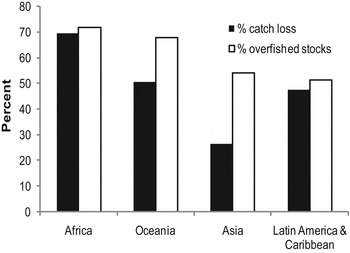
All SIDS in our study registered catch losses, ranging from 9 per cent of the potential catch in the case of the Solomon Islands to 89 per cent for Guinea-Bissau. As a group, SIDS are currently catching only 48 per cent of the potential catch of the EEZs, with Oceania registering the highest loss at 59 per cent of the potential, followed by Latin America and the Caribbean, Africa and Asia of 48 per cent, 47 per cent and 25 per cent, respectively (figure 1). In terms of the proportion of fish stocks that are currently classified as overfished, 27–90 per cent of the fish stocks in SIDS are overfished, with a total of 60 per cent for all the studied stocks in SIDS. Regionally, the proportion of overfished stocks is highest in Africa (72%) followed by Oceania (68%), Asia (54%) and Latin America and the Caribbean (51%) (figure 1).
Percentage of catch loss and overfished stocks in SIDS by region

3.2. Food security implications of catch losses in SIDS
Table 1 lists country-level catch losses using the mid-level MSYs from Srinivasan et al. (Reference Srinivasan, Cheung, Watson and Sumaila2010). As shown earlier, many island states where fish has long been a cultural staple suffer significant losses in catch potential. Table 1 shows that nearly 740 thousand tonnes of fish are lost to SID countries due to overfishing in a year. This loss translates into large losses in healthy, varied and nutrient-rich food. Using a conservative price per tonne of fish of US$1,000 (Sumaila et al., Reference Sumaila, Marsden, Watson and Pauly2007, Reference Sumaila, Cheung and Dyck2012), the estimated loss in revenues from fishing in SIDS comes to about US$740 million a year. Furthermore, using the world average economic and income multipliers of 2.8 and 0.75 reported in Dyck and Sumaila (Reference Dyck and Sumaila2010), this level of revenue loss implies economic and income impacts losses of US$2.07 billion and US$555 million per year, respectively. The food security implications of these numbers cannot be overemphasized.
3.3. Fisheries subsidies in SIDS
The total, good, bad and ugly subsidies for each SIDS are reported in table 1. We see from the table that in total SIDS provide an estimated annual subsidy of about US$1.44 billion, of which US$545, 872 and 28 million are beneficial, harmful and ambiguous subsidies, respectively.
3.4. Potential effects of fisheries subsidies on overfishing in SIDS
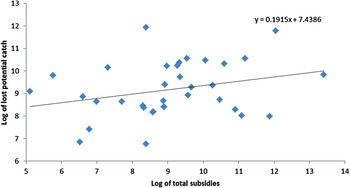
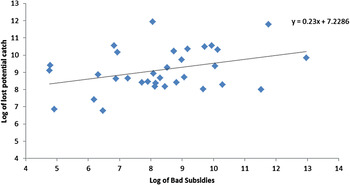
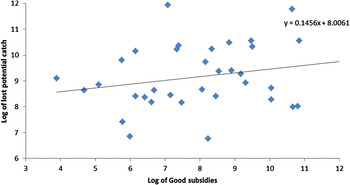
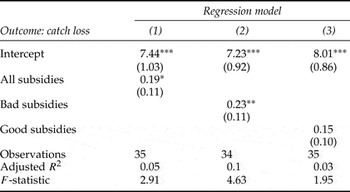
The regression analysis carried out reveals (table 2) that the hypothesis that: (i) high total subsidies result in high levels of catch loss was accepted as the sign of the coefficient of the regression is both in the right direction and significant at the 105 per cent level of confidence (p < 0.105) (figure 2); and (ii) the higher the level of bad or harmful subsidies provided, the higher the potential catch loss, was also accepted at the 5 per cent level of confidence (p < 0.05) (figure 3). As expected, the amount of bad subsidies has a stronger relationship with catch loss than in the case of total subsidies. Finally, our third hypothesis that good subsidies will result in lower losses in catch potential was rejected at even the 10 per cent confidence level (p > 0.1) (figure 4).
Demonstration of the relation between total subsidies and the potential catch loss in SIDS

Demonstration of the relationship between harmful or bad subsidies and the potential catch loss in SIDS

Demonstration of the relationship between beneficial or good subsidies and the potential catch loss in SIDS

Regression model results testing the effect of fisheries subsidies on catch loss in SIDS

Notes: *, ** and *** indicate statistical significance at the p < 0.1, 0.05 and 0.01 level, respectively.
Standard errors are shown in parentheses.
All variables in the above models are expressed as the natural logarithm of their values.
4. Discussion and conclusion
We show that overfishing in SIDS is serious, causing large losses in catch and impacts on the socio-economics of these countries. Currently, SIDS have lost an estimated half of their potential catch because of overfishing. The estimated catch loss and proportion of overfished stocks are higher than average from all the countries in these regions. Previous studies suggest that 16–31 per cent of stocks were overfished over 1950–2004 (Froese and Kesner-Reyes, Reference Froese and Kesner-Reyes2002; FAO, 2009; Srinivasan et al., Reference Srinivasan, Cheung, Watson and Sumaila2010), with an estimated catch loss relative to MSYs of 19 per cent, 14 per cent, 13 per cent and 7 per cent in Africa, Asia, Oceania and South America, respectively (Srinivasan et al., Reference Srinivasan, Cheung, Watson and Sumaila2010).
The SIDS have more than double the proportion of overfished stocks than global estimates and two to three times higher catch loss relative to the MSYs than the values from all the countries in each region. Besides causing the loss of nutrient supply to these countries, the large proportion of overfished stocks affects marine biodiversity and potentially alters ecosystem functioning (Worm et al., Reference Worm, Barbier and Beaumont2006). These may have negative effects on other ecosystem services besides fisheries, e.g., tourism, thus further exacerbating the impacts of overfishing. The SIDS are particularly vulnerable to these impacts because of their strong resource dependency, lack of alternative livelihoods and low adaptive capacity to the impacts (Allison et al., Reference Allison, Perry and Badjeck2009). In particular, it is projected that many of the SIDS are most vulnerable to climate change impacts, partly caused by the negative impacts they have on fisheries productivity (Allison et al., Reference Allison, Perry and Badjeck2009; Cheung et al., Reference Cheung, Lam, Sarmiento, Kearney, Watson, Zeller and Pauly2010).
Our analysis suggests that an important step to reduce overfishing in SIDS would be to reduce bad subsidies. We show that there is a significant and positive relationship between subsidies, specifically bad subsidies, and overfishing in SIDS, which agrees with bioeconomic theory. Thus, reducing bad subsidies is likely to reduce overfishing. However, subsidies explain about 10 per cent of the variation of the catch loss level, while the remaining variance is likely to be dependent on other main overfishing drivers such as the open access and shared nature of fish stocks, rising fish demand and the ineffectiveness of fisheries management measures. Future analysis will evaluate the contribution of other factors to catch loss and overfishing in SIDS. Results from such analysis could help prioritize measures to curtail overfishing problems.
It is worth noting that the results reported in this paper are based on some assumptions, and the analysis itself is a static one. A more comprehensive analysis would be dynamic because, depending on what type of subsidy is being granted, the effect on catches could occur with a time lag. Also, as mentioned earlier in the paper, there are other factors that may affect the degree of overfishing other than the amount of subsidies provided by government. In fact, subsidies explain only 20 per cent of the change in catch; further investigations that include all possible variables that may affect catch would be a useful extension of the current contribution. Finally, it is possible that the volume of subsidy depends on the state of the fishery; future work should test for this possible effect. Clearly there is more work to be done before we fully understand how subsidies are likely to affect fish catch and sustainability. Still, this study has started tackling this difficult task. We demonstrated that ineffective management and overfishing are costing the SIDS highly, resulting in the loss of about 50 per cent of the catch potential in their EEZs, with large consequences on the direct and indirect implications to food security in SIDS. We have also shown that significant amounts of subsidies are provided by the governments of SIDS to their fishing sectors, and that these subsidies are potentially a key reason for the overfishing currently taking place in SIDS.