Research on leader–member exchange (LMX) suggests that high-quality relationships between supervisors and their subordinates have positive impacts on organizations such that employees display positive work attitudes and behaviors, including high levels of job satisfaction, organizational commitment, and citizenship behaviors that benefit organizations (e.g., Gerstner & Day, Reference Gerstner and Day1997; Ilies, Nahrgang, & Morgeson, Reference Ilies, Nahrgang and Morgeson2007; Dulebohn, Bommer, Liden, Brouer, & Ferris, Reference Dulebohn, Bommer, Liden, Brouer and Ferris2012; Zhang, Wang, & Shi, Reference Zhang, Wang and Shi2012). Previous LMX studies have focused on examining the development of dyadic relationships in their early stages and validating the effect of LMX on individual-level outcomes (Graen & Uhl-Bien, Reference Graen1995). However, with the increased interest in the use of multilevel perspectives to study organizations (e.g., Kozlowski & Klein, Reference Kozlowski and Klein2000), researchers have begun to explore the topic of LMX as a group-level phenomenon. Most studies in this area have examined the composition of LMX relationships within groups (e.g., Liden, Erdogan, Wayne, & Sparrowe, Reference Liden, Erdogan, Wayne and Sparrowe2006; Henderson, Liden, Glibkowski, & Chaudhry, Reference Henderson, Liden, Glibkowski and Chaudhry2009; Gooty & Yammarino, Reference Gooty and Yammarino2016) as a source of employee outcomes.
Although the findings from studying the effects of LMX relationship compositions (i.e., LMX differentiation or disparity) are very useful, the practical utility and applicability of these findings may be somewhat limited because supervisors are less likely to make a high differentiation decision across subordinates in real-world business, as such a decision can aggravate subordinates’ feelings of deprivation and perceptions of unfairness (Erdogan & Bauer, Reference Erdogan and Bauer2010; Herdman, Yang, & Arthur, Reference Herdman, Yang and Arthur2017). High differentiation decisions can be detrimental to subordinates’ positive work behaviors such as cooperation, helping behaviors, and information sharing between employees. Because the use of interdependent work structures and team practices in contemporary organizations is regarded as a norm to promote higher work performance, high LMX differentiation is typically less useful for promoting higher collective performance.
This aspect of LMX differentiation research demonstrates the importance of examining the impact of team LMX relationships (instead of LMX differentiation) on group processes or outcomes. This is particularly true when considering the impact of leader–leader exchange (LLX) relationships on the relationship between team LMX and team-driven organizational innovation. High-quality LLX can provide a work context in which a supervisor’s subordinates nurture a climate that is conducive to more innovation-pursuing work behaviors. There have been numerous calls for studies to examine LMX and its consequences in a large organizational context (e.g., Graen & Uhl-Bien, Reference Graen1995; Liden, Sparrowe, & Wayne, Reference Liden, Sparrowe and Wayne1997) because LMX exists within a broad network of exchange relationships in organizations (e.g., LLX) (Graen, Cashman, Ginsburg, & Schiemann, Reference Graen and Uhl-Bien1977; Graen & Uhl-Bien, Reference Graen1995).
In this study, I argue that high-quality LLX has a meaningful impact on promoting collective performance at the group level. Previous studies have suggested that supervisors can secure more resources by maintaining high-quality relationships with their own bosses (Tangirala, Green, & Ramanujam, Reference Tangirala, Green and Ramanujam2007; Venkataramani, Green, & Schleicher, Reference Venkataramani, Green and Schleicher2010; Zhou, Wang, Chen, & Shi, Reference Zhou, Wang, Chen and Shi2012). Based on social exchange theory (Blau, Reference Blau1964), LMX theory suggests that supervisors offer greater access to tangible and intangible resources to subordinates with whom they maintain higher-quality exchange relationships (Graen & Uhl-Bien, Reference Graen1995; Wilson, Sin, & Conlon, Reference Wilson, Sin and Conlon2010; Dulebohn et al., Reference Dulebohn, Bommer, Liden, Brouer and Ferris2012). As supervisors with high-quality LLX can secure more organizational resources, most of these supervisors’ subordinates can be assumed to exploit the resources that they require to complete their work. In terms of pursing innovation, individuals are influenced by various types of tangible and intangible resources that trickle down from the top of the organizational hierarchy.
Accordingly, I examine the interactive effect of the mean levels of within-group LMX and LLX on creating a climate for innovation support that leads to collective performance in work groups. Because organizational innovation is an indispensable tool for organizations’ survival, all employees must generate ideas, processes, or products for improvement. Thus, the high levels of support that can be gained from a high LLX relationship have a positive influence on team performance through employees’ shared perceptions of innovation support. In this study, I contribute to the LMX and innovation literature in three ways. First, I highlight the important role of LLX in promoting team effectiveness by incorporating multilevel perspectives into the research on LMX. Second, this study highlights the need to conduct further research on the impact of aggregate within-group LMX relationships on important team processes and outcomes. Third, this study extends the findings from innovation research by addressing the roles of exchange relationships that are embedded in the broader context of an organizational hierarchy. Using data collected from 590 employees under the supervision of 75 managers, I empirically examine the hypothesized interactive effects of LLX and team LMX in creating a climate for innovation support and fostering team performance at the group level. To do so, I use multisource data with a time-lagged research design to increase the rigor of the study’s findings.
Theoretical Framework and Hypothesis
De!rived from role theory (Graen, Reference Graen, Cashman, Ginsburg and Schiemann1976; Graen & Scandura, Reference Graen and Scandura1987), LMX has developed a heavy reliance on social exchange theory (Blau, Reference Blau1964) in examinations of supervisor–subordinate relationships over the last 40 years (Erdogan & Liden, Reference Erdogan and Liden2002; Kamdar & Van Dyne, Reference Kamdar and Van Dyne2007; Liao, Liu, & Loi, Reference Liao, Liu and Loi2010; Dulebohn et al., Reference Dulebohn, Bommer, Liden, Brouer and Ferris2012). Social exchange theory (Blau, Reference Blau1964) suggests that the parties involved in social exchange relationships develop a sense of mutual obligation and reciprocate their exchange partner’s favor in their preferred ways. LMX studies have found that low-quality exchange relationships are formally agreed, immediate, and balanced reciprocations of tangible assets; moreover, they are based on economic and calculation-based motivations (Dulebohn et al., Reference Dulebohn, Bommer, Liden, Brouer and Ferris2012). In contrast, high-quality exchange relationships are less formal, long-term oriented, and inclusive of tangible and intangible assets, and they are based on feelings of mutual obligation and reciprocity (Gouldner, Reference Gouldner1960; Liden, Sparrowe, & Wayne, Reference Liden, Sparrowe and Wayne1997). Subordinates with high-quality LMX are more likely to develop positive attitudes toward their supervisors and to display positive work behaviors (e.g., organizational citizenship behaviors, helping, cooperation, and information sharing) that benefit their work groups or organizations (Liden, Sparrowe, & Wayne, Reference Liden, Sparrowe and Wayne1997; Ilies, Nahrgang, & Morgeson, Reference Ilies, Nahrgang and Morgeson2007; Dulebohn et al., Reference Dulebohn, Bommer, Liden, Brouer and Ferris2012).
Nevertheless, because LMX exists within a broader network of exchange relationships in organizations, these findings are subject to differing organizational contexts that also shape individual work attitudes and behaviors (Graen et al., Reference Graen and Uhl-Bien1977; Graen & Uhl-Bien, Reference Graen1995). Leaders’ exchange relationships with their own bosses can be a particularly important organizational context that can provide a mechanism to aid our understanding of work processes and work group performance. However, the influence of LLX has not been sufficiently addressed in the literature. Graen et al. (Reference Graen and Uhl-Bien1977) suggest that LLX, which has been described as a ‘linking pin’ between a supervisor and his or her own boss, can be a vehicle through which subordinates can experience fewer severe job problems, receive more attention from supervisors, and achieve greater satisfaction with their supervisors and jobs. Furthermore, in a recent empirical study, Venkataramani, Richter, and Clarke (Reference Venkataramani, Richter and Clarke2014) empirically demonstrate that supervisors who have high-quality relationships with their own bosses can also establish high-quality relationships with their own subordinates because of their better access to a stock of tangible and intangible resources.
Resources in an organizational context refer to the organizational aspects of a job that are functional in achieving work goals (Demerouti, Bakker, Nachreiner, & Schaufeli, Reference Demerouti, Bakker, Nachreiner and Schaufeli2001). Organizational resources are considered capable of reducing job-related problems such as physical and psychological costs and promoting individual success through personal growth, learning, and development. A taxonomy of resource types includes interpersonal/social and material/economic resources (Foa & Foa, Reference Foa and Foa1974) such as money, goods, services, status, and information. Thus, having better access to a stock of organizational resources though heightened levels of exchange relationships can significantly impact individual job success as well as collective performance.
The literature on organizational innovation suggests that resources play a key role in an organization’s ability to pursue innovation (Anderson & West, Reference Anderson and King1998). Innovation can be understood as the intentional introduction or application of ideas, processes, products or services to benefit an organization or society at large (West & Farr, Reference West and Farr1989). Many previous studies have documented the positive impacts of resources on innovation (e.g., Amabile, Reference Amabile1988; Anderson & West, Reference Anderson and King1998; Gajendran & Joshi, Reference Gajendran and Joshi2012). This finding is consistent across many individual-level studies (e.g., Scott & Bruce, Reference Scott and Bruce1994; Gajendran & Joshi, Reference Gajendran and Joshi2012). I suggest that the increased levels of resources attributable to high-quality LMX or LLX can have a positive impact on employees’ perceived support for innovation at the group level. Because innovation can be defined as collective actions that require interdependent work behaviors, such as information sharing, effective communication, and helping (e.g., West & Farr, Reference West and Farr1990; Anderson & King, Reference Anderson and West1993; King & Anderson, Reference King and Anderson1995), more group-level studies on the relationship between group-level processes and innovation-promoting outcomes are needed. Moreover, most group-level LMX studies examining the effect of team LMX relationships have not incorporated important organizational contexts, and group-level LMX studies examining the impact of LLX as a boundary condition are quite rare. Overall, I contend that LLX can be considered a necessary boundary condition for the relationship between average within-group LMX and a climate for innovation support that engenders higher group performance.
LMX and a climate for innovation support
As many researchers have noted, innovation requires an appropriate work environment that provides certain levels of freedom, sufficient resources, appropriate recognition, and effective project management (Amabile, Reference Amabile1988). The effect of leadership on innovation has not received sufficient attention (Scott & Bruce, Reference Scott and Bruce1994), although the role of leadership in nurturing such a work environment is critical. To promote innovative work behaviors by subordinates, supervisors are expected to create an environment that nurtures high levels of perceived innovation support among the subordinates. In a study by Scott and Bruce (Reference Scott and Bruce1994), they found that LMX is a significant source of high levels of perceived innovation support and innovative behaviors among subordinates. Furthermore, Gajendran and Joshi (Reference Gajendran and Joshi2012) have shown that LMX affects team innovation through members’ influence on team decisions. Other individual-level studies have reported similar results (e.g., Basu & Green, Reference Basu and Green1997; Janssen & Van Yperen, Reference Janssen and Van Yperen2004; Volmer, Spurk, & Niessen, Reference Volmer, Spurk and Niessen2012). In the current study, I argue that levels of team LMX, rather than individual LMX, within a work group will have a positive influence in creating a climate for innovation support as experienced by employees (Anderson & West, Reference Anderson and King1998).
A theoretical foundation for a climate for innovation support can be found in the four-factor theory of innovation proposed by West (Reference West1990). The theory includes four dimensions: vision, participative safety, task orientation, and support for innovation. Support for innovation is particularly meaningful in the context of LMX because having access to the tangible and intangible resources needed for innovation is key for employees to nurture their perceptions of innovation support. Thus, the assumption is that team LMX relationships will have a positive impact in creating a climate for innovation support. Consistent with Scott and Bruce (Reference Scott and Bruce1994), subordinates who are successful in developing high-quality exchange relationships with their supervisors are more likely to generalize their perceptions to other members within their work group. Thus, other members are also more likely to develop the perception that they have substantial autonomy, decision-making latitude, and material support. Second, individuals in such work groups are more likely to suggest ideas for efficient work processes and innovative products or services (Gajendran & Joshi, Reference Gajendran and Joshi2012). With greater contributions of innovative ideas, a climate for innovation support is more likely to arise. Finally, as group members contribute more ideas, they will become more active in implementing those ideas (Gajendran & Joshi, Reference Gajendran and Joshi2012). Specifically, a work group will experience higher levels of support, cooperation, and information sharing when most members of the group attempt to contribute creative ideas under higher levels of employee involvement. The long tradition of high-involvement work practices (Guthrie, Reference Guthrie2001) and participative management (Lawler, Reference Lawler1986) research provides evidence for this argument.
Hypothesis 1: Team LMX scores are positively associated with a team climate for innovation support.
LLX as a boundary condition
I expect the relationship tested in Hypothesis 1 to be influenced by other exchange relationships in organizations (Graen & Uhl-Bien, Reference Graen1995; Venkataramani, Green, & Schleicher, Reference Venkataramani, Green and Schleicher2010; Zhou et al., Reference Zhou, Wang, Chen and Shi2012; Venkataramani, Richter, & Clarke, Reference Venkataramani, Richter and Clarke2014). Because the relationships between a supervisor and subordinates are nested within the relationship between the supervisor and his or her own boss (Cashman, Dansereau, Graen, & Haga, Reference Cashman, Dansereau, Graen and Haga1976; Graen et al., Reference Graen and Uhl-Bien1977; Tangirala, Green, & Ramanujam, Reference Tangirala, Green and Ramanujam2007), subordinates’ work environment may be influenced by their supervisor’s relationship with the upline leader. Thus, my expectation is that LLX levels will moderate the relationship between team LMX and a climate for innovation support. Under high levels of LLX, the relationship between team LMX and a climate for innovation support will be more positive, such that subordinates will perceive that they are receiving sufficient support to suggest creative ideas, improve work processes, and develop new products or services. However, the relationship will be less positive under low levels of LLX, such that subordinates will perceive that they need more tangible and intangible support to successfully pursue innovation.
Previous studies have examined the occurrence of resource spillover (i.e., resources from upline leaders will eventually spillover to subordinates with poor LMX relationships) within a work group (van Dijk & De Cremer, Reference van Dijk and De Cremer2006; Sluss, Klimchak, & Holmes, Reference Sluss, Klimchak and Holmes2008). In other words, low-quality subordinates in a high-LLX group will receive more tangible and intangible resources than low-quality subordinates in a low-LLX group because under resource abundance, supervisors are likely to make decisions with little differentiation. In a recent study, Herdman, Yang, and Arthur (Reference Herdman, Yang and Arthur2017) found that the effect of LMX disparity (LMXD) on subordinates’ teamwork is less positive under high levels of LLX than under low levels of LLX. A supervisor’s decision with high LLXD, which leads to highly unequal resource distribution, engenders feelings of relative deprivation (Crosby, Reference Crosby1976; Bolino & Turnley, Reference Bolino and Turnley2009) among subordinates with poor exchange relationships. Accordingly, my expectation is that supervisors will not engage in highly unequal resource distribution when they have access to a stock of resources from high-LLX relationships.
Resource spillover not only reduces the likelihood that subordinates will develop feelings of deprivation but also increases the likelihood that subordinates will perceive high levels of psychological safety (Edmondson, Reference Edmondson1999), as they do not need to engage in fierce competition for better exchange relationships. In turn, this increased psychological safety will lead to higher levels of innovation-promoting work behaviors, such as sharing knowledge, exchanging opinions, and displaying helping behaviors that cause individuals to experience more support from other members of their work groups. Moreover, intangible resources (or psychological support) from supervisors can help develop a climate for innovation support only when sufficient tangible resources are secured (Scott & Bruce, Reference Scott and Bruce1994). Thus, supervisors who provide high levels of psychological support but who are not successful in securing the necessary resources from their upline leaders are unlikely to develop a climate for innovation support.
Hypothesis 2: The association between average levels of LMX and a team climate for innovation support is moderated by LLX. Specifically, the relationship will be more positive under high levels of LLX, whereas the relationship will be less positive under low levels of LLX.
A climate for innovation support and team effectiveness
Previous studies have observed a positive relationship between the work climate and innovation at both the organization and unit levels (Paolillo & Brown, Reference Paolillo and Brown1978; Siegel & Kaemmerer, Reference Siegel and Kaemmerer1978; Abbey & Dickson, Reference Abbey and Dickson1983). As Schneider (Reference Schneider1987) and Schneider, Ehrhart, and Macey (Reference Schneider, Ehrhart and Macey2013) suggest, the workplace climate has the power to shape individual work behaviors. Organizations that pursue innovation are characterized by a strong orientation toward innovative ideas, changes for work process improvement, and support for their members (Siegel & Kaemmerer, Reference Siegel and Kaemmerer1978; Kanter, Reference Kanter1983). These characteristics engender a synergy-creating mechanism that leads to successful work teams (Hackman, Reference Hackman1987; Hoegl & Gemuenden, Reference Hoegl and Gemuenden2001). Moreover, Scott and Bruce (Reference Scott and Bruce1994) also find a significantly positive relationship between individual perceived support for innovation and innovative behaviors of employees, although their study was not conducted at the work-group level.
This study’s conceptualization of team effectiveness is consistent with the stream of studies that model team effectiveness (e.g., Gladstein, Reference Gladstein1984; Hackman, Reference Hackman1987; Denison, Hart, & Kahn, Reference Denison, Hart and Kahn1996). Hackman’s definition of team effectiveness, which is widely used, includes three criteria for effectiveness that are displayed by successful work teams: the group’s actual output, the state of the group as a performing unit, and individual members’ satisfaction with the group experience. Unlike more traditional models of group success that include only performance output, this conceptualization also includes social and personal criteria, as the successful implementation of a capable work group requires satisfaction among group members who recognize that their team is functional and their performance is acceptable (Hackman, Reference Hackman1987). The synergy-creating mechanism of an innovation-supporting climate can be the basis for high levels of team effectiveness. Thus, my expectation is that a positive association exists between a climate for innovation support and team effectiveness.
Hypothesis 3: A team climate for innovation support will be positively associated with team performance.
Based on Hypotheses 1 and 3, I expect that the effect of team LMX on team effectiveness will be mediated by a team climate for innovation support. Moreover, the indirect effect of team LMX on team effectiveness through the climate for innovation support effect will be conditional on the levels of LLX, as Hypothesis 2 suggests.
Hypothesis 4: Team LMX scores affect team performance through a team climate for innovation support.
Hypothesis 5: The indirect effect of team LMX on team performance through a team climate for innovation support is moderated by LLX. Specifically, the relationship will be more positive under high levels of LLX, whereas the relationship will be less positive under low levels of LLX.
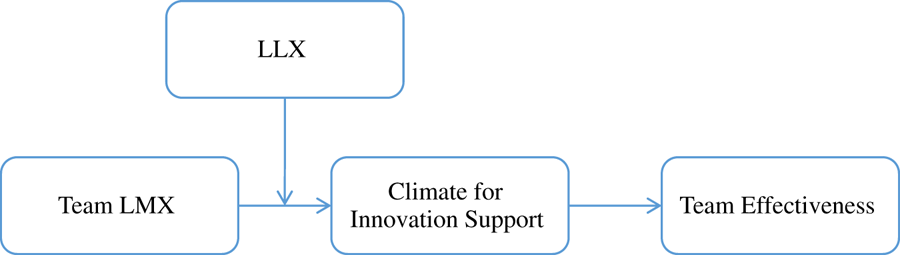
Figure 1 presents a conceptual model of the study. Specifically, the model indicates that team LMX scores affect team effectiveness through a climate for innovation support in work teams. However, this indirect effect will be dependent on the levels of supervisors’ LLX relationships with their upline leader.
Hypothesized model. LLX=leader–leader exchange; LMX=leader–member exchange

Methods
Sample
The data were collected from seven organizations in Mainland China operating in various industries, including the manufacturing, high-tech, healthcare services, and restaurant sectors. The final sample included 540 individuals nested in 75 work groups, and the average group size was 7.87 individuals (with a range from 2 to 19). Of the subordinate respondents, 37.45% were male, and their average organizational tenure was 4.78 years. With regard to age, 31.50% were under 24 years old, 42.40% were between 25 and 34 years old, 16.10% were between 35 and 44 years old, and 8.50% were over 45 years old, with 1.50% of the questionnaires missing responses for age. The highest level of education was junior high school or below for 80.80% of the subordinate respondents, senior high school for 16.60%, and 2-year community college for 0.70%, with 1.90% of the questionnaires missing responses. Of the supervisor respondents, 57.30% were male, and the average tenure was 12.47 years. Regarding age, 8.00% were under 24 years old, 33.30% were between 25 and 34 years old, 42.70% were between 35 and 44 years old, and 16.00% were over 45 years old. The highest level of education was junior high school or below for 21.30% of the supervisor respondents, senior high school for 40.00%, 2-year community college for 30.70%, 4-year college for 6.70%, and a master’s degree or above for 1.30%. Demographic information was obtained from the respondents themselves. Specifically, employees and supervisors reported their own demographic information.
Procedure
With regard to the data collection procedure, the project received IRB approval before data collection. Research assistants were sent to the participating organizations to minimize the burden of survey administration, and the completed surveys were returned to the research assistants to ensure the confidentiality of the responses. Participation was voluntary, as IRB approval requires informed consent of participants, and a two-dollar gift card was given to the respondents as an incentive. To minimize common method variance, a multisource, multiwave study design was used. Specifically, at Time 1, data on LMX were collected from the subordinates, and at Time 2, data on perceived innovation support and team effectiveness were collected from the subordinates, whereas data on LLX were collected from the supervisors. The final sample (540 respondents) includes only the respondents who answered the surveys at both Time 1 and Time 2.
Measures
The measures used in the study were originally written in English, and the questionnaires were translated into Chinese and then back-translated into English to increase the accuracy of the translated questionnaires (Brislin, Reference Brislin1980). The measures used in current study are described below.
Team LMX/LLX
LMX-7 (Graen & Uhl-Bien, Reference Graen1995) was used to measure LLX and the team mean LMX scores. This measure has been used extensively in previous studies (e.g., Scandura & Schriesheim, Reference Scandura and Schriesheim1994; Schriesheim, Castro, & Yammarino, Reference Schriesheim, Castro and Yammarino2000; Gajendran & Joshi, Reference Gajendran and Joshi2012) and includes aspects that are critical to the development of feelings of innovation support, such as tangible resources and psychological support and trust. The subordinates’ responses were used for the measure of LMX, whereas the supervisors’ responses were used for the measure of LLX. The LMX scores from a given work group were averaged to create team-level LMX scores. The response scale ranged from strongly disagree (1) to strongly agree (5). Cronbach’s α was 0.75 for LMX and 0.84 for LLX in the sample.
Climate for innovation support
The measure suggested by Anderson and West (Reference Anderson and King1998) was used to measure a climate for innovation support; it includes four subdimensions of innovation (vision, participative safety, task orientation, and support for innovation). In the present study, the perceived support for innovation dimension was used, both because this dimension captures a major factor in innovation (Siegel & Kaemmerer, Reference Siegel and Kaemmerer1978) and because previous studies have frequently used it (e.g., Howell & Avolio, Reference Howell and Avolio1993; Scott & Bruce, Reference Scott and Bruce1994). The subordinates provided the data for this measure, and the scale ranged from strongly disagree (1) to strongly agree (5). Individual scores from each team member were averaged to create a team-level climate for innovation support score. Cronbach’s α for this measure was 0.85 in the sample.
Team effectiveness
The measure developed by Campion, Papper, and Medsker (Reference Campion, Papper and Medsker1996) was adapted to measure team effectiveness. Five items from the original measure were excluded because those items were considered inappropriate for the present study. Ultimately, four items that measure the quality and quantity of work outcomes were included in the current study. Sample items are as follows: ‘Please indicate the quality of work done by your team,’ and ‘Please indicate how quickly your team responds to problems and opportunities.’ The scale ranged from strongly disagree (1) to strongly agree (5). The measure was also aggregated to the group level. Cronbach’s α was sufficiently high, at 0.89 in the sample.
Control variables
As suggested by previous studies on LMXD (Liden et al., Reference Liden, Erdogan, Wayne and Sparrowe2006; Henderson et al., Reference Henderson, Liden, Glibkowski and Chaudhry2009; Gooty & Yammarino, Reference Gooty and Yammarino2016; Herdman, Yang, & Arthur, Reference Herdman, Yang and Arthur2017), supervisors can make decisions with high differentiation in managing their work relationships with subordinates; under high differentiation, poor LMX subordinates are less likely to benefit from sufficient resources. To separate the effect of resource spillover to poor-LMX subordinates from LMXD, I included LMXD as a control variable in the analysis. LMXD is a group-level construct that indicates the within-group distribution of LMX relationships (Liden et al., Reference Liden, Erdogan, Wayne and Sparrowe2006). It was measured as the coefficient of variation (Harrison & Klein, Reference Harrison and Klein2007). Tenure and education level were also controlled to avoid alternative explanations. Finally, team size was controlled because it has been identified as a significant predictor of many work group processes and outcomes in previous studies (e.g., Colquitt, Noe, & Jackson, Reference Colquitt, Noe and Jackson2002).
Data analysis
Given that the unit of analysis is a work group, it was necessary to test whether the study variables represent group-level properties. Because all of the variables were measured at the individual level, all variables except for LLX were aggregated at the group level to conduct the analysis. Before aggregation, however, it was necessary to check whether the measures showed appropriate group-level properties. Specifically, r wg, intra-class correlation ICC (1) and ICC (2) were calculated to justify aggregation. r wg (James, Demaree, & Wolf, Reference James, Demaree and Wolf1984) is the measure of within-unit agreement. It indicates the level of agreement across multiple judges, and the recommended cut-off is 0.70. ICC statistics are measures of reliability. ICC (1) indicates the extent to which the variability in responses can be explained by group membership, and ICC (2) is a measure of the reliability of the unit-level means. Appropriate values of ICC (1) range from 0.05 to 0.20, and the recommended cut-off for ICC (2) is 0.70 (Bliese, Reference Bliese2000). In terms of LMX, r wg, ICC (1), and ICC (2) were 0.85, 0.26, and 0.73, respectively. Regarding a climate for innovation support, the values for r wg, ICC (1), and ICC (2) were 0.86, 0.31, and 0.78, respectively. Finally, the values for team effectiveness were 0.86 for r wg, 0.37 for ICC (1), and 0.82 for ICC (2). Thus, the use of group-level analysis was considered appropriate.
In terms of the hypothesis tests, I ran a series of hierarchical ordinary least squares regressions using the SPSS statistical package. However, the tests of indirect effects (Hypothesis 4) and conditional indirect effects (Hypothesis 5) were performed with a bootstrap test using the PROCESS software (Hayes, Reference Hayes2013). Throughout the study, unstandardized regression coefficients were reported.
Results
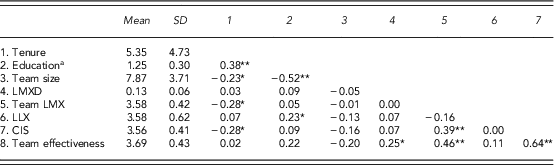
Descriptive statistics including means, standard deviations, and intercorrelations are shown in Table 1.
Descriptive statistics

Note: n=75.
a This variable was measured on an ordinal scale.
CIS=climate for innovation support; LLX=leader–leader exchange; LMX=leader–member exchange; LMXD=LMX disparity.
*p<.05 (two-tailed); **p<.01 (two-tailed).
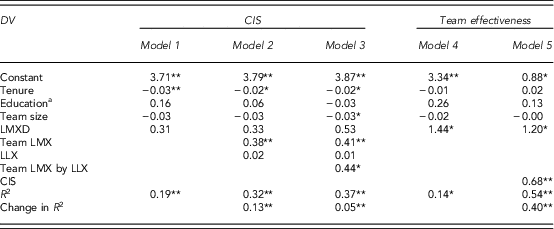
Hypothesis 1 indicates that a positive association exists between team LMX and a climate for innovation support. In Model 1 (Table 2), I included all of the control variables. This model explained 19% of the variance in the dependent variable. In Model 2, I added team LMX and LLX. This extended model explained an additional 13% of the variance. Further, team LMX was a positive predictor of a climate for innovation support (b=0.38, p<.01). Thus, Hypothesis 1 was supported.
The results of hierarchical regression analysis testing of Hypothesis 1, Hypothesis 2, and Hypothesis 3

Note. n=75.
a This variable was measured on an ordinal scale.
CIS=climate for innovation support; DV=dependent variable; LLX=leader–leader exchange; LMX=leader–member exchange; LMXD=LMX disparity.
*p<.05 (two-tailed); **p<.01 (two-tailed).
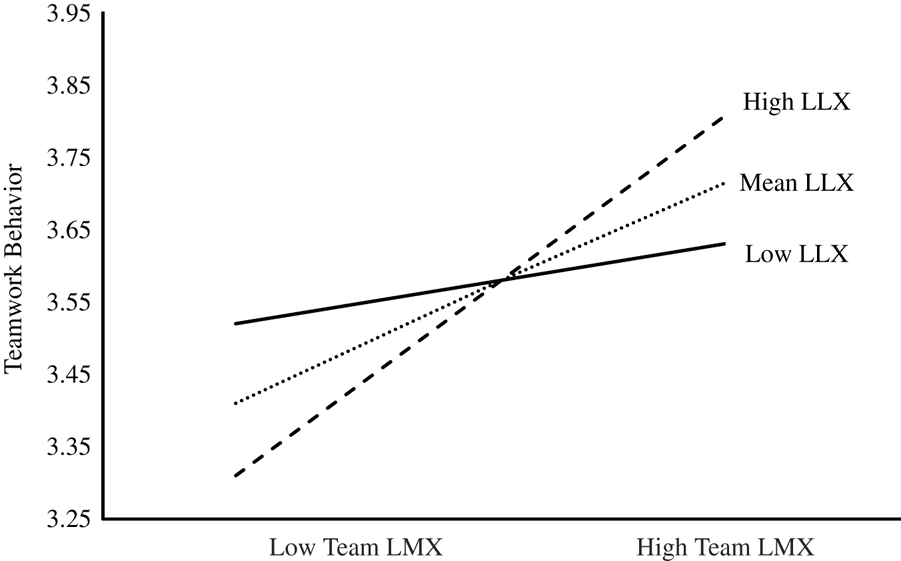
In the subsequent analysis (Model 3), I tested the effect of the interaction between team LMX and LLX in creating a climate for innovation support (Hypothesis 2). Before generating the interaction term, I centered team LMX and LLX by following the procedure suggested by Aiken, West, and Reno (Reference Aiken, West and Reno1991). In Model 3 (Table 2), this interaction term explained an additional 5% of the variance (b=0.44, p<.05). To understand the nature of these moderating effects, I plotted the interaction (Figure 2) by drawing the slope showing the impact of team LMX in creating a climate for innovation support at three different levels of LLX (low, mean, and high LLX). Consistent with the hypothesis, the slopes were more positive at a high level of LLX (1 SD above the mean) than at a low level of LLX (1 SD below the mean). Thus, Hypothesis 2 was supported.
Leader–leader exchange (LLX) as a moderator in the relationship between team leader–member exchange (LMX) and team effectiveness. High LLX=1 SD above the mean. Low LLX=1 SD below the mean

In Hypothesis 3, I argued that there is a positive association between a climate for innovation support and team effectiveness. Because these two variables were measured from the same respondents and collected at the same time, the results when testing Hypothesis 3 were subject to common method variance. Thus, I ran Harman’s single-factor test to check for a possible violation of the suggested cut-off. The results of the exploratory factor analysis revealed that 40.57% of the total variance was explained by one factor, indicating that the majority of the total variance was not explained by a single factor. Model 4 (Table 2), consistent with the previous procedure, includes only the control variables. In Model 5, climate for innovation support was added to the previous model. This predictor was statistically significant (b=0.68, p<.01) and explained an additional 40% of the variance, supporting Hypothesis 3.
To test the indirect effect of team LMX on team effectiveness via climate for innovation support (Hypothesis 4), I adopted the procedure suggested by Preacher and Hayes (Reference Preacher and Hayes2008). In the mediation test with 5,000 hypothetical samples, the indirect effect was 0.27 and the confidence interval (CI) did not include 0 (boot lower CI=0.07, boot upper CI=0.53, two-tailed − data not shown). Thus, Hypothesis 4 was supported. Table 3 shows the bootstrap analysis results from testing the conditional indirect effect (moderated-mediation) of team LMX on team effectiveness at three levels of LLX (low: 1 SD below the mean; medium: mean; high: 1 SD above the mean). The indirect effect was statistically significant for the medium (0.26) and high (0.42) conditions of LLX. In contrast to these findings, the indirect effect was not significant in the low condition of LLX because the 95% confidence interval included 0. Therefore, Hypothesis 5 was also supported.
Bootstrap analysis results for the conditional indirect effect of team leader–member exchange (LMX) on team effectiveness at different levels of leader–leader exchange (LLX) (Hypothesis 5)

Note. n=75.
CI=95% confidence interval (two-tailed). Bootstrap sample size=5,000.
Discussion
Consistent with expectations, the results showed a significant role of LLX as a boundary condition for the relationship between team LMX and subordinates’ shared perceptions of support for innovation. Specifically, the relationship between team-level LMX and the team climate was more positive under the high-LLX condition. Because supervisors who have a high-quality exchange relationship with their own leader can secure more resources and organizational support, they have more to offer their own subordinates, and this increase in resources seems to promote higher levels of team performance and members’ satisfaction with their work group. A work group with abundant resources is more likely to be characterized by high levels of cooperation and coordination such as sharing knowledge, exchanging opinions, and displaying helping behaviors. It has been demonstrated that employees show high levels of satisfaction when they work in a highly cooperative work environment (Hackman, Reference Hackman1987). These supervisors are less likely either to make decisions with severely high differentiation in their relationships or to implement differential resource distribution across subordinates (Sluss, Klimchak, & Holmes, Reference Sluss, Klimchak and Holmes2008) because to do so would aggravate subordinates’ feelings of relative deprivation and compromise their fairness perceptions (Herdman, Yang, & Arthur, Reference Herdman, Yang and Arthur2017), which are detrimental to organizational functioning. However, the relationship was not significant under conditions of low LLX, and the indirect effect of team LMX on team effectiveness was not significant. This finding indicates that high team LMX may not be useful in creating shared perceptions of innovation support among subordinates if needed resources are not offered and subsequently will not have a meaningful impact on team effectiveness.
As previous studies have shown, innovation is by nature a resource-consuming activity (e.g., Amabile, Reference Amabile1988; Anderson & West, Reference Anderson and King1998). Thus, securing sufficient tangible materials and intangible support from supervisors is critical to the development of subordinates’ shared perceptions of innovation support. However, the development of an innovation-supportive climate also requires support from individuals. When the members of a work group must compete to secure the resources needed to complete their work, they are unlikely to develop positive innovation-supporting work behaviors such as knowledge sharing and helping behaviors (e.g., Hoegl & Gemuenden, Reference Hoegl and Gemuenden2001). Therefore, resource spillover to poor-LMX members of a work group can help develop a more supportive work environment.
Implications and limitations
The present study responds to calls for more multilevel studies on LMX (Graen & Uhl-Bien, Reference Graen1995). Although group-level LMX studies are being conducted, organizational contexts are not effectively incorporated into such studies. By combining LLX embedded in a larger organizational context (Graen et al., Reference Graen and Uhl-Bien1977; Sparrowe & Liden, Reference Sparrowe and Liden1997) with aggregate LMX relationships at the group level, this study extends the previous findings from LMX research. Second, this study contributes to the research stream that explores the nature of LLX and its effect on important organizational processes and outcomes. The findings suggest that the impact of high LLX is distinct from the previous group-level study of LLX (i.e., Herdman, Yang, & Arthur, Reference Herdman, Yang and Arthur2017). Previous studies focusing on the distributive form of LMX relationships within work groups have shown that the impact of high LMXD is detrimental when LLX is high. However, the present study, with its focus on aggregate within-group LMX, found a positive impact of team LMX when LLX is high. Thus, high-LLX conditions can provide a more effective work environment when they are viewed in terms of average levels of LMX relationships within a work group. Although studying the topic of LMXD can provide a venue for interesting research questions, it is also important to study the nature and impact of LMX in terms of the within-group means of LMX relationships.
Finally, this study also contributes an explanation of the hypothesized moderation. The emergence of resource spillover is inevitable to avoid subordinates having perceptions of compromised fairness and the resultant relative deprivation. Understanding the role of resource spillover in developing a climate for innovation support is important because it highlights the need to conduct LMX studies at multiple levels of the organizational hierarchy. For example, the finding of positive associations between LMX and perceived support for innovation at the individual level may not help to provide useful implications in pursuing team-level innovation when either LMXD is high or aggregate LMX is low because resource spillover is unlikely to occur.
The door is open for more nuanced findings in future LMX studies. Findings regarding the effect of aggregate LMX relationships within a work group may differ from findings from both individual-level studies and other group-level studies that examine the effect of LMXD. The present study, with climate for innovation support as a process outcome, can provide a good example for understanding the importance of such research questions. Therefore, studies that investigate the role of other interesting organizational contexts as a moderator in a hypothesized model or that test the interactive effect considered in the present study on different work process or outcome variables could provide useful managerial implications. For example, incorporating other types of organizational climate (e.g., safety climates, justice climates) or outcome variables (e.g., career progress, subgroup formation, or upward maintenance tactics) could be useful.
Although this study was carefully conducted, it is not without limitations. First, causal inferences from the findings are unwarranted. The data that were used to test the hypothesized relationships were collected in two separate surveys. However, some of the findings were based on variables collected in a single survey. Second, some of the findings are also subject to the influence of common method variance. Specifically, the three study variables (team LMX, climate for innovation support, and team effectiveness) were collected from the same respondents, and this setup has the potential to provide distorted findings with regard to the hypothesized relationships in the current study. Third, the generalizability of the findings is questionable because the data were collected in China. In future studies, it will be necessary to use data sets collected from Western countries to expand the generalizability of this study’s findings.
Conclusion
For contemporary organizations, the pursuit of innovation is not a matter of choice. Therefore, organizations strive to create work contexts that accelerate organizational innovation. In this study, the development of a climate for innovation support and the resultant team effectiveness were predicted to result from the interactive effects of LLX and team LMX. The findings indicate that the effect of team LMX relationships on the development of a team climate for innovation support and team performance is more positive under conditions of high LLX, whereas the effect is less positive under conditions of low LLX. These findings suggest that supervisors need to cultivate high-quality exchange relationships with their own bosses for their subordinates to be successful in pursuing innovation. The study also highlights the need to conduct more studies on this topic that go beyond the leader–member dyad.
Acknowledgements
This work contributes to the LMX literature by demonstrating the importance of LLX as a boundary condition to promote the positive effect of team LMX relationships on employees’ perceptions of innovation support and, subsequently, on team effectiveness. It contributes to theory development based on management practice in Chinese organizations. As such, it is aligned with the journal’s aim to present research that outlines how context shapes theory and practice. This work is original and has not been published elsewhere, nor is it currently under consideration for publication elsewhere.
Financial Support
This work was supported by Hankuk University of Foreign Studies research fund.
Conflicts of Interest
None.