Introduction
Bereavement is a common life event which demands research attention. The Census of Population and Housing in 2006 revealed that 937,000 adults were registered as widowed in Australia with the great majority being over the age of 55 years (1). There is now substantial evidence of increased mortality during the first 6 months of grief among surviving spouses in the late middle age and retired age bands (Reference Jones2–Reference Schaefer, Quesenberry and Wi4). A November 2008 literature search that interrogated the PsycINFO, Ovid Medline, EMBASE and CINAHL databases using search terms ‘bereavement’ in combination with ‘morbidity’ with or without ‘longitudinal studies', ‘follow-up studies', ‘health’, ‘mental health’, ‘physical health’ and ‘quality-of-life’ revealed no studies on the long-term health impact of bereavement. This finding is supported by a recent major review by Stroebe et al. Reference Stroebe, Schut and Stroebe(5), which, while finding several more recent short-term studies, also revealed no long-term studies of the health outcomes of bereavement over a period comparable with that reported in this study.
Although the association between bereavement and increased health risk has been the subject of study over the past 50 years, there have been major limitations in much of the research because of lack of homogeneity and sample sizes, lack of a priori theory, absence of established health outcomes and retrospectivity in design. Australian and European research groups have stressed the importance of improving methodologies in more detailed cross-sectional and longitudinal designs Reference Stroebe, Schut and Stroebe(5,Reference Bartrop, Porritt, Henderson and Burrows6).
Much of the bereavement literature has been on the scale of large epidemiological studies in Scandinavia Reference Martikainen and Valkonen(7), United Kingdom, continental Europe and the United States (Reference Jones2,Reference Kaprio and Koskenvou3,Reference Mor, McHorney and Sherwood8), as well as on data gleaned from health maintenance organisations (HMOs) in the United States Reference Kaprio and Koskenvou(3). There has been reliance on increased mortality reporting, with the Finnish study Reference Martikainen and Valkonen(7) extending over 5 years and the HMO study Reference Kaprio and Koskenvou(3) between 14 and 23 years. None of the aforementioned studies was able to show lifestyle or shared environment to account for the increased mortality Reference Schaefer, Quesenberry and Wi(4).
Short-term morbidity after bereavement has been researched at intervals since the 1950s Reference Stroebe, Schut and Stroebe(5). These reports have generally included non-specific complaints such as headaches, dizziness, indigestion, chest pain, vegetative symptoms (poor sleep and appetite), dysphoric mood and pain syndromes Reference Stroebe, Schut and Stroebe(5). Other symptoms (yearning, restless behaviour and perceptual phenomena) were more likely to be identified as uniquely grief-related Reference Stroebe, Schut and Stroebe(5).
From 1975 to 1977 inclusive, the short-term effects of bereavement were examined in a bereavement project in Sydney, Australia. Eighty-nine spouses matched for age, sex and race with non-bereaved controls were enrolled, giving a total of 178 study subjects in two cohort studies lasting 6 and 12 months, respectively. Immunological function in a matched cohort of 26 bereaved subjects was examined Reference Bartrop, Luckhurst, Lazarus, Kiloh and Penny(9). There was significant depression of T-cell responsiveness to mitogenic stimulation in the bereaved compared to their controls over the first 8 weeks after bereavement. In another subset, emphasis was placed on an assessment of affective response during a 6-month period following bereavement Reference Bartrop, Hancock, Craig and Porritt(10). There was a statistically significant elevation in dysphoric mood among the bereaved 2 weeks and 6 months after the loss of the partner. Since these studies, other workers have showed changes in immunological function in bereaved spouses Reference Schleifer, Keller, Camerino, Thornton and Stein(11,Reference Irwin, Daniels, Risch, Bloom and Weiner12).
Bereavement is arguably an important research model for the study of health consequences following stressful life events. Bereavement is a good research model because it can be objectively established and has substantial effects on mood and behaviour.
Most research has showed that bereavement can be associated with risk of psychological morbidity. There have been numerous studies of the short-term effects of bereavement up to 1 year following the loss, including articles cited earlier in this paper. However, very little information is available on the impact of bereavement following this relatively short period. If the bereaved continue to be at high risk, then the implications for health services are important. The aim of this study was to investigate retrospectively the health consequences of bereavement for up to 10 years post loss in the 1975–1977 subjects mentioned above. To our knowledge, this work is the first to report on the health sequelae of bereavement over a period as long as 10 years. The strengths of this study include the diagnostic rigour used in evaluating self and medical record reports of illness and the precision with which information was sought and related in time to the original bereavement.
Method
Subjects
For this current follow-up study, the 178 potential subjects who had taken part in the 1975–1977 studies were to be asked for information regarding their health (physical and psychiatric morbidity) in a retrospective survey. The time period covered the years from 1975, 1976 or 1977 until December 1985, giving a potential follow-up time of 11 years. Of these individuals, one was discovered to have feigned bereavement. Accordingly, this subject and his control were excluded. Therefore, the potential study population was 176 subjects comprising 88 bereaved and 88 controls. Only two subjects could not be found: one bereaved and one control. Of the 174 remaining subjects, 11 had died (5 bereaved and 6 controls). Their families gave consent for the authors to obtain their death certificates. Of the remaining 163 subjects, 11 people declined to be re-enrolled. A total of 152 surviving subjects (72 bereaved and 80 controls) therefore agreed to be re-enrolled in the follow-up morbidity study. Although the participants were originally collected as matched cases and controls, because of loss to follow-up we were unable to treat the data as matched in this follow-up analysis.
Data collection
With living subjects, a record of morbidity over the follow-up period was established twice: once in an interview with the subject (‘self-report' data), using a version of the health history approach used by the Australian Veterans' Health Studies (13) project and once using records obtained from their general practitioners, and/or specialists, and/or hospital record(s) as appropriate (‘record’) data. Furthermore, morbidity data which were found in both these sources (matched on both types of disease and time of occurrence) were called ‘confirmed’ morbidity data. All data were collected by medically qualified persons.
A questionnaire was also administered to each subject to obtain sociodemographic variables and other possible health confounding variables. The details of methods of subject recruitment, data collected on surviving subjects, death certificate data and methods of statistical analysis have been published Reference Bartrop, Penny, Jones, Forcier and In Engelman(14).
Statistical analysis
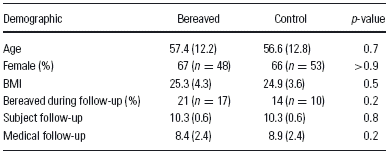
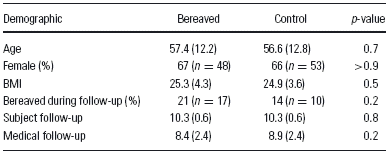
Bereaved and control groups were compared with respect to both pre-existing factors that might confound the effect of bereavement (Table 1) and with respect to morbidity rates during a 10-year post-bereavement follow-up period (Table 2). Comparisons of pre-existing factors were by Mann–Whitney test for quantitative variables and by Pearson chi-square test for qualitative variables. Morbidity rates were treated as Poisson rates because they are calculated from the number of illnesses accrued by the subject in a given category and then standardised through the individual's follow-up period which was calculated from the date of bereavement to the date of interview. In this way, duration of follow-up is held constant. Date of interview is defined separately for subject and their physician, hence subject and medical follow-up periods are reported separately. Poisson regression Reference Breslow, Lubin, Marek and Langholtz(15) has been used to calculate the relative morbidity rates with 95% confidence intervals and p-values.
Subject demographic characteristics
Morbidity rates and relative rates

Morbidity rates were calculated for any illness and according to four a priori categories of morbidity for which there was prior evidence of a specific effect of bereavement (16): mental health (ICD-9 290.0–319.0), circulatory system (ICD-9 390.0 to 450.0), respiratory system (ICD-9 460.0–519.0) and immune system (ICD-9 270.0–279.0).
Results
Subject disposition
The subjects who declined (10 bereaved spouses and 1 non-bereaved control) were prepared to give reasons for their refusal and provide some details about their health. All 10 bereaved declined to participate because they did not wish to relive the experience. Two of them had lost another nuclear family member within the previous 6 months. Six of them had had a recent depressive illness and, of these six, two also had a substance abuse problem: three of the remaining four bereaved who did not suffer a recent depressive illness had a substance abuse problem. The control who declined did so because of the imminent death of a close family member. She maintained that she had been healthy.
Mortality
Only five bereaved and six control subjects had died. The small number of deaths precluded a formal analysis of mortality rates.
Demographic and pre-existing factors
Bereaved subjects and controls were similar with respect to age, sex ratio and body mass index (Table 1). A higher percentage of bereaved subjects had suffered a subsequent bereavement than controls during the follow-up period (Table 1), but this was not statistically significant. Average follow-up periods for bereaved and control groups were quite similar (Table 1).
Table 1 suggests that there is no identifiable source of potential confounding with the effect of bereavement.
Morbidity during follow-up
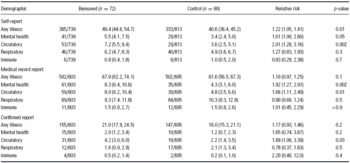
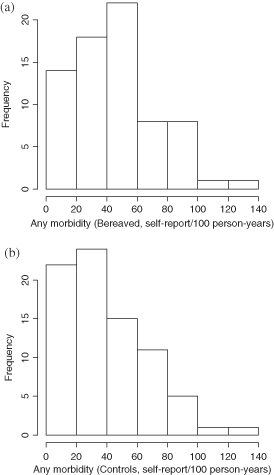
Subject self-reports and medical record reports yielded similar estimates of morbidity rate across any illness, approximately 50–65 illnesses per 100 person-year in bereaved subjects and 40–60 illnesses per 100 person-years in controls (Table 2). Rates of illness that were confirmed by both patient and medical record were lower than rates reported by either patient or medical records alone for both the bereaved (21 per 100 person years) and controls (18 per 100 person years) groups (Table 2). A potential misinterpretation of these statistics could occur if the elevated rate among bereaved subjects was largely attributable to a small number of individuals who experienced extreme morbidity incidence. It can be seen from Fig. 1 that this is not the case, but rather the difference between groups in morbidity rates arises from a general elevation in the distribution of morbidity incidence among the bereaved relative to the controls.
Distribution of total morbidity rates in bereaved and control cohorts: (a) bereaved cohort and (b) control cohort.
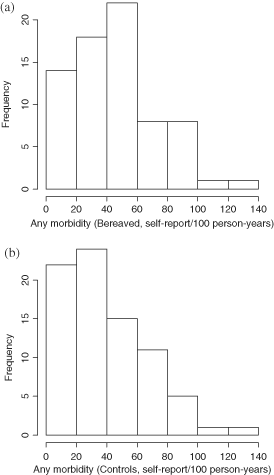
Although total morbidity was elevated among bereaved subjects compared with controls according to all sources, this reached statistical significance only for self-reports with a 22% elevation in morbidity rate among bereaved subjects (relative rate = 1.22) compared with a 10% elevation for medical records and 17% for confirmed reports (Table 2). Mental health morbidity was reported to be elevated among bereaved relative to controls by all three sources, ranging from a 61% elevation by self-report (p = 0.05) to a 92% elevation among medical record report (p = 0.002). Similarly, circulatory system disorder elevation in bereaved subjects ranged from 66% by medical record report (p = 0.01) to 100% by self-report (p = 0.002). There was no clear evidence of elevation in either respiratory or immune system morbidity by any source (Table 2).
Morbidity data sources: self-report compared with medical record morbidity source
As noted earlier, both subjects' recollection of their illness history and data from their medical practitioner(s) records were sought. Of the 1365 illnesses reported, only 22% were reported by both sources (therefore making up the confirmed morbidity data source). Approximately 55% of illnesses reported by subjects were not found in the medical records (record source), and approximately 70% of illnesses present in medical records were not mentioned by subjects. Notably, the fact that the record source reported more illnesses than the subject source suggests, although does not prove, that there was not a general tendency for subjects to exaggerate their illness experience. Concordance rates were similar in bereaved and control cohorts, which argues against any suggestion of differential recall bias by either self-report or medical record.
Discussion
This study sought to document the long-term health outcomes of bereavement and is, to our knowledge, the first to study this question over such a long follow-up period. The data suggest an overall increase in the morbidity of 10–20% in bereaved individuals relative to controls (Table 2). The extent of increase appears to be quite variable across diseases with some indicating no evidence of elevated rates among the bereaved cohort (such as immune disorders), whereas others such as circulatory disorders were reported at rates that approached double in bereaved subjects relative to controls (Table 2).
In the current study, none of the factors listed in Table 1 differed between bereaved and control cohorts. Of course these factors do not represent a comprehensive investigation of potential confounders and there is always the possibility that some critical factor was not addressed. For example, dietary factors could not be measured in this study.
Overall, the increased morbidity observed in this study is consistent with the findings of some research reports with shorter follow-up periods. Klerman and Izen Reference Klerman, Izen and Reichsman(17), in reviewing a representative sample of studies, examined the association between traumatic events and specific conditions, including the impact of loss of a significant person (bereavement or separation from spouse, parent, close relative or friend, or children). Follow-up time was not stated in some of the original studies but, where stated, varied up to 4 years after the loss. Of a total of 18 relevant studies examined, the combined results of 14 such reports revealed increases in disease conditions such as cancer, cardiovascular disease, acute closed angle glaucoma, Cushing's disease, disseminated lupus erythematosus, idiopathic glossodynia, pernicious anaemia, pneumonia, rheumatoid arthritis, thyrotoxicosis, tuberculosis and ulcerative colitis. However, as noted by Klerman and Izen Reference Klerman, Izen and Reichsman(17), many of these studies have methodological deficiencies. There was a general reliance upon subject recall, the use of small, uncontrolled sample sizes, little attempt to remove the confounding effect of anxious and depressive preoccupation as reflected in the reporting of ‘illnesses’ and the rare use of objective criteria to confirm ‘new’ illnesses.
The above methodological issues have led to almost insurmountable difficulties for the review process. Examination of many of the studies reveals a lack of definitive evidence for or against claims of bereavement-associated morbidity Reference Klerman, Izen and Reichsman(17). Many of these methodological problems have been addressed in the current research.
These morbidity data were collected in two ways to ensure data quality: first, using the subjects' reports on their illnesses, and second, using records, either doctors data cards or hospital records as required. The ICD-9 code for each illness was obtained. These two features of the study design make this work currently unique; care therefore needs to be exercised in comparing our findings with other studies. Table 2 indicates relatively poor concordance between patient self-report and medical record reports with confirmed report morbidity rates typically one quarter to one third the magnitude of either self-report or medical record report. Although other studies have sometimes reported higher concordance rates, they have tended to be studies of serious illness over a much shorter recall period Reference Leikauf and Federman(18,Reference Skinner, Miller, Lincoln, Lee and Kazis19). The comparatively low numbers of confirmed reports resulted in a relatively low statistical power in this source. Although it might be attractive to adopt ‘confirmed’ morbidity reports as the definitive source of illness information, we expect that confirmed reports will also underestimate the true morbidity rate. It is also noteworthy that the relative risk estimates for all three sources (Table 2), while differing in detail, all tended in the same direction suggesting that none are particularly biased.
It should be noted that 12 subjects originally enrolled as bereaved subjects were not re-enrolled for this study (11 refused and 1 uncontactable), compared with only 1 control who refused and 1 lost. If this differential recruitment rate has biased the results in any way, it is likely to have reduced the number of illnesses found in the bereaved, because the bereaved who refused did not have good health outcomes as discussed in the Method section ‘Subjects’ and therefore reduced the estimated elevation in morbidity among bereaved subjects relative to controls.
No other study is available for comparison with the results of the long-term follow-up ICD-9 category analysis. The increase in mental disorders at the end of follow-up is notable (e.g. 1.92-fold increase in the bereaved in the record source) and presumably reflects an outcome of an unobserved pathological process. The cardiovascular findings at full follow-up are surprising by their existence and the size of the increase: e.g. 1.6-fold increase in the bereaved according to the record source. Other research has, however, shown a link between life-event stress and survival after acute myocardial infarction Reference Tennant, Palmer, Langeluddecke, Jones and Nelson(20).
Hence, while in a different context, our results are perhaps not completely surprising as this research suggests some link between stress and heart disease. Various mechanisms can be postulated to explain these results. The medical literature has reflected an increasing interest (even priority) in the understanding of psychosomatic mechanisms in the pathogenesis of hypertension, emphasising the importance of neurohumoral responses in the presumed defence reaction Reference Esler, Jennings and Korner(21).
Acute and chronic stress may operate through neural mechanisms, i.e. stimulated cardiac sympathetic nerves to the production of coronary artery spasm, angina pectoris and myocardial ischaemia and conduction disorders. However, a study by Steptoe Reference Steptoe(22) had led to cautious interpretation of the catecholamine hypothesis. Another possible chronic stress mechanism might operate through neurogenic pathways to the development of hypertension.
The links between bereavement stress, hypertension and coronary thrombosis could operate through damaged intimal surfaces, platelet activation and increased circulating plasma lipids. Animal studies do confirm a link between stress and elevated free fatty acids Reference Bassett and Kalsner(23).
Aside from pathways to specific physical conditions, Steptoe et al. Reference Steptoe, Owen, Sabine and Kunz-Ebrecht(24) also present evidence of a connection between loneliness and several measures of cardiovascular function such that more lonely individuals are at greater risk of hypertension and have stronger cortisol responses. O’Connor et al. Reference O’Connor, Allen and Kaszniak(25) have also shown that bereaved individuals have higher resting heart rates and heart rate variability than controls or non-bereaved but depressed individuals. These studies together present evidence of a connection between the fact of bereavement and subsequent cardiovascular morbidity and mortality.
Conclusion
Although it could not be studied directly in our research, it is believed that there is a psychological grieving process in which, eventually, individuals tend to adapt to their new circumstances Reference Klerman, Izen and Reichsman(17,Reference O’Connor, Allen and Kaszniak25).
However, there is a wide range of symptoms associated with grief and there is no consensus as to what is considered a ‘normal’ process nor how that process unfolds over time.
The results presented in this article do add a new dimension to the grief process: long-term physical health sequelae. It is one thing to deal with the emotional experience of bereavement but quite another to be left with long-term health consequences.
Acknowledgements
The authors wish to acknowledge the considerable input of Professor Hugh G. Dickson, Head, Department of Aged Care and Rehabilitation Medicine, Sydney South West Area Health Services, Liverpool Hospital, NSW, and Doctor Rosie Kubb in this project.
This study was approved by the Royal North Shore Hospital Human Research Ethics Committee. The authors thank the Royal North Shore Hospital Grants Committee, as well as the Radiotherapy Department at the Royal North Shore Hospital for their financial support of this work.