Introduction
Triatomines (Hemiptera: Reduviidae: Triatominae) are haematophagous insects, and known vectors of Trypanosoma cruzi, the aetiologic agent of Chagas disease, which is a widespread zoonotic disease in Latin America. Current programmes developed for vectorial control of Chagas disease involve almost exclusively the use of chemicals in and around rural houses (Petherick, Reference Petherick2010). Triatomines are commonly reared in laboratories, sometimes even on a large scale to provide insects for research. There are no standardized model insect lines available for triatomines of interest, and because many research areas are related to insect ecology, it is a common practice to collect wild insects during field studies, thus unintentionally introducing various natural enemies of triatomines into the culture (Fernandes et al., Reference Fernandes, da Silva and Diotaiuti1990; Espino et al., Reference Espino, Gómez, González, Brazil do Santos, Solano, Sousa, Moreno, Windsor, Ying, Vilchez and Osuna2009).
Triatoma virus (TrV) is the only entomopathogenic virus of triatomines identified to dateFootnote 1. TrV, which is currently taxonomically placed within the Dicistroviridae family (ICTVdB, 2002), was first found in Triatoma infestans Klug (Hemiptera: Reduviidae) in domiciliary and peridomiciliary habitats in Argentina (Muscio et al., Reference Muscio, La Torre and Scodeller1987). To date, there is no evidence of TrV infection in humans, and our study on TrV inoculation in mice by both intraperitoneal injection and oral ingestion has indicated that the virus does not replicate in rodents (Querido et al., Reference Querido, Agirre, Marti, Guérin and Sousa Silva2013a).
Due to its horizontal mode of transmission (Muscio et al., Reference Muscio, Bonder, La Torre and Scodeller2000) and high pathogenicity, TrV could potentially be used as a biological pesticide to control triatomines, as initially suggested by Muscio and colleagues (Muscio et al., 1988; Muscio et al., Reference Muscio, La Torre, Bonder and Scodeller1997) and more recently by other researchers (Gordon and Waterhouse, Reference Gordon, Waterhouse, Bonning, Maramorosch and Shatkin2006; Bonning and Miller, Reference Bonning and Miller2010). Thus, this virus is currently under investigation to evaluate its potential as a control agent of susceptible triatomine host populations (see http://www.redtrv.org).
Recent studies have established that TrV prevalence in natural populations can reach up to 20% (Marti et al., Reference Marti, Echeverria, Susevich, Becnel, Pelizza and García2009), with the virus infecting sylvatic Psammolestes coreodes, T. delpontei and T. infestans in the northwestern provinces of Argentina (Susevich et al., Reference Susevich, Marti, Serena and Echeverria2012). TrV was also observed in the insectaries of this same country, causing over 90% mortality in certain triatomine species, such as T. infestans, T. guasayana and T. patagonica. Conversely, TrV infection in wild insects or in captive colonies has not yet been reported outside of ArgentinaFootnote 2. Regarding the potential use of TrV as biocide, and not having information about its existence out of Argentina, one of the main concerns was to establish the geographical distribution of the virus.
It has been observed that triatomine colonies in insectaries may become infected with TrV after infected wild specimens are used for rejuvenating existing colonies (Muscio et al., Reference Muscio, La Torre and Scodeller1987). The viral infection can be asymptomatic and may remain unnoticed during quarantine periods. External symptoms of the infection are rarely observed in naturally infected insects. Therefore, triatomine insectaries are continuously at risk of becoming contaminated with TrV (Rozas-Dennis et al., Reference Rozas-Dennis, La Torre, Muscio and Guérin2000). Under normal conditions, TrV propagation within the insectary most probably depends on rearing procedures, population dynamics, crowding, insect developmental stage, seasonality, and morbidity of the insect host. In wild and captive T. infestans colonies, the viral infection takes between 3 and 5 months to become apparent, and the colonies dwindle and ultimately disappear within less than 8 months (G.A. Marti, personal communication). As far as we know, and with the exception of the Centro de Estudios Parasitológicos y de Vectores (CEPAVE) in La Plata, Argentina, no studies have been performed on the sanitary conditions of insectaries with regard to TrV.
Triatomines defaecate during or immediately after feeding, and the faeces may be found on their prey (skin, hair or feathers), on other insects or, in captivity, on the nylon fabric that covers the rearing containers. As TrV remains infective in the faeces, it becomes a source of new viral infections. Healthy insects may become infected by feeding on surfaces where faeces from an infected insect were deposited, or by ingesting the faeces by coprophagy, which is a common behaviour in triatomines (Baines, Reference Baines1956; Schaub et al., Reference Schaub, Böker, Jensen and Reduth1989). Another possible horizontal source for TrV transmission is cleptohaematophagy (or kleptohemodeipnonism; Ryckman, Reference Ryckman1951), a behaviour that also facilitates the transmission of parasites and symbionts (Schaub et al., Reference Schaub, Böker, Jensen and Reduth1989).
Because population crowding is common under rearing conditions, and this factor was estimated to stimulate the spread of TrV, we decided to screen insectaries. However, this posed the question about the method to be employed to detect the virus, and also the size of the sample to be taken in each of the analysed insectaries. To detect the virus we decided to use the RT-PCR. This decision was taken as the method was already standardized by Marti et al. (Reference Marti, Gonzalez, García, Viguera, Guérin and Echeverria2008). However, what was considered most critical was to establish the minimum number of insects (individuals) representative for each population. For this purpose, we developed a probabilistic model for establishing the minimum number of insects (minimal population) required to give confidence to the results.
In summary, the objectives of this collaborative study were twofold:
● to establish a standard method for sampling and analysing that assures a high confidence in the results, and
● to determine the occurrence of TrV in insectaries belonging to non-explored countries of Latin America.
Materials and Methods
Procedures for rearing triatomines in the insectary
Typical hosts used as blood sources in triatomine insectaries comprise birds (hens or pigeons) or mammals (mice or guinea pigs). Alternatively, artificial feeders may also be employed. The sampling model that we apply in this study was tailored based on what we consider standard procedures for rearing T. infestans colonies, which is the main triatomine species associated with TrV infection.
In general, the procedure is as follows: (a) hens are used as hosts, (b) groups of several tenths (c. 30–50) of insects are maintained in flasks or plastic containers, (c) triatomines are fed once a week, (d) feeding time per flask of insects lasts about 1 h, (e) insects in flasks are sequentially fed the same day and (f) number of hens employed in feeding all insects is one per five flasks. Some quantitative considerations about the rearing procedure are listed in Supplementary material 1 (available online).
Probabilistic model of triatomine sample size (s) estimation for TrV detection
The equation that gives the probability to detect infection in a colony with a total number of insects N, when s of them are analysed, is (see Supplementary Material 2 (available online))
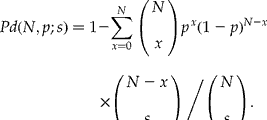 $$Pd ( N , p ; s ) = 1 - { \sum _{ x = 0}^{ N } }\,\left ({\begin{array}{ccc} N \\ x \\ \end{array} }\right ) p ^{ x }(1 - p )^{ N - x }\left ({\begin{array}{ccc} N - x \\ s \\ \end{array} }\right )/\left ({\begin{array}{ccc} N \\ s \\ \end{array} }\right ). $$
In this equation, p is the probability of infection (or initial prevalence of TrV when the colony was settled), and s the sample size.
For large values of N, Pd is almost constant upon changes in this parameter. Nevertheless, in practice, the computation time increases with N since it is included in the binomial equations. Given a certain p value, the sample size s is calculated such that Pd is smaller than a pre-established value of reliability, which generally is greater than 0.95. Finding the value s that satisfies this condition requires an iterative process, which was performed with a simulation program coded in Matlab (The Mathworks, 2011). The program (see Supplementary material 3 (available online)) generates a series of pairs of Pd and s values with their corresponding β values, thus allowing the selection of s values with β>0.95 (using the smallest possible s value that satisfies that condition). There is no specific estimation of p, but we used an approximation of the average proportion of domiciliary- and peri-domiciliary-infected triatomines (0.125 (std. dev. 0.052)) collected from 14 localities of Argentina where we tested the infection with TrV in T. infestans by ELISA (Marti et al., Reference Marti, Echeverria, Susevich, Becnel, Pelizza and García2009). However, to have a complete coverage of the different possible values of s as a function of p, we simulated the model with p values between 0.1 and 0.2 (using a step of 0.01). The values of K and n (with N= K*n) were kept separate, even though they do not affect s, because they play important roles in the triatomine collection protocol (see Supplementary material 4 (available online) for a variation in the sampling protocol).
Sampling triatomines from insectaries
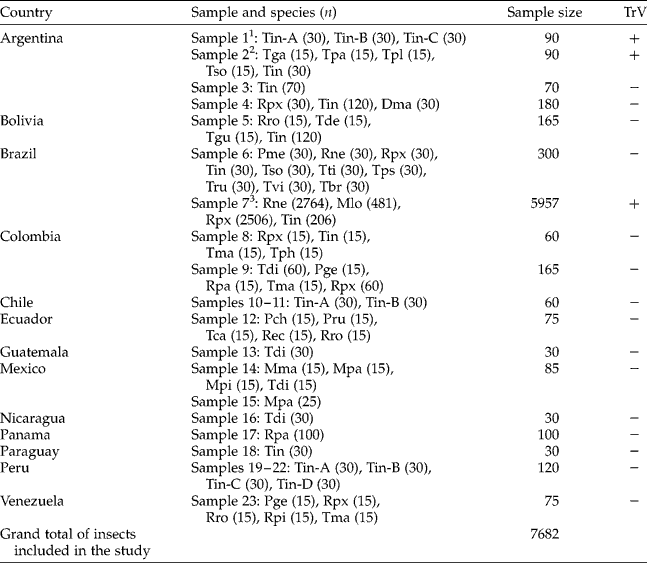
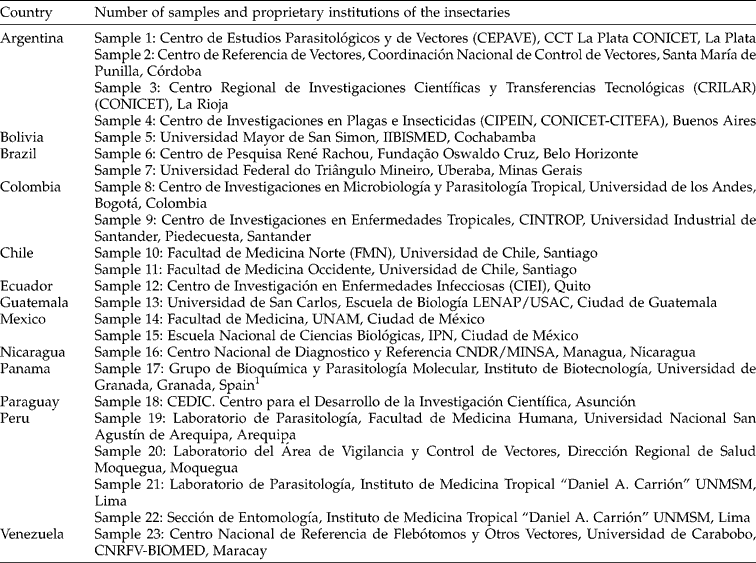
The triatomine insectaries that were sampled in this study had been established for a long time and the insect colonies originated from their own country or other regions. Therefore, each sample represents a specific insectary collection, not the triatomine fauna of each country where the insectary is established. The samples for this survey were collected from October 2010 to May 2013. The researchers responsible for collecting the samples followed a collection and preservation protocol as described in the following section. Insectaries belonging to 13 countries were analysed – four from both Argentina and Peru, two from Brazil, Chile and Colombia, and one from each of the following countries: Bolivia, Ecuador, Guatemala, Mexico, Nicaragua, Paraguay and Venezuela. An additional colony reared in Spain but originally from Panama was also included in the study. The insectaries' identification is given in the appendix 1. In total, the analysed samples included faecal samples from 7682 insects belonging to 32 different triatomine species (Table 1).
Results of the Triatoma virus (TrV) screening

Each sample belongs to a single insectary and some of them are composed of subsamples of different triatomine species. The first column indicates the country of origin of each sample. The second column indicates the species included and within parentheses the number of insects in each subsample. The third column displays the total number of insects used in each sample, and the bottom row is the grand total. The right column displays the results, being positive (+) or negative ( − ) for TrV, as analysed by RT-PCR (see text). Dma, Dipetalogaster maxima; Mlo, Meccus longipennis; Mma, M. mazzottii; Mpa, M. pallidipennis; Mpi, M. picturatus; Pch, Panstrongylus chinai; Pge, P. geniculatus; Pme, P. megistus; Pru, P. rufotuberculatus; Rec, Rhodnius ecuadoriensis; Rpa, R. pallescens; Rpx, R. prolixus; Rro, R. robustus; Rne, R. neglectus; Rpi, R. pictipes; Tbr, Triatoma brasiliensis; Tca, T. carrioni; Tde, T. delpontei; Tdi, T. dimidiata; Tga, T. garciabesi; Tgu, T. guasayana; Tin, T. infestans; Tma, T. maculata; Tpa, T. patagonica; Tph, T. phyllosoma; Tpl, T. platensis; Tps, T. pseudomaculata; Tru, T. rubrovaria; Tso, T. sordida; Tti, T. tibiamaculata; Tvi, T. vitticeps.
1 Subsample Tin-A corresponds to a colony in which the infection with TrV is currently maintained for research purposes and was positive for TrV. Subsamples Tin-B and Tin-C are reared with care to avoid contamination with viral infection, and these two samples were negative for TrV.
2 An analysis of this sample by individual species showed that only the subsample composed of T. infestans was positive for TrV (see text).
3 The details of the subsamples composing this sample are given in Table 2.
Insect collection and preservation methods
Every insectary was requested to identify the triatomine species from which the faecal samples were collected. The faeces were collected by two methods. Method 1 involves extracting the faeces from the insects through abdominal compression on a blotting or film paper. After the faeces had dried out, they were immediately preserved in nylon hermetic bags (Ziploc®; S.C. Johnson & Son, Inc., Racine, Wisconsin, USA) and then sent for analysis. Method 2 involves collecting the papers placed within the rearing flasks and having the papers sent for analysis.
To prevent sample contamination during manipulation, all the instruments (i.e. scalpels or tweezers) used to detach the faeces from the film paper were sterilized with alcohol (90%) and autoclaved.
Sample analyses
The detection of TrV infection was performed using dried faecal samples, which were pooled and analysed by RT-PCR as described by Marti et al. (Reference Marti, Gonzalez, García, Viguera, Guérin and Echeverria2008). Briefly, dried faecal samples were dissolved in PBS, homogenized in TRIzol reagent (Life Technologies, California, USA) and the TrV RNA purified according to the manufacturer's instructionsFootnote 3. The first-round PCR was performed according to the OneStep RT-PCR protocol (Jena Bioscience, Jena, Germany) (Marti et al., Reference Marti, Gonzalez, García, Viguera, Guérin and Echeverria2008). Products of 832 bp were visualized on 1.2 and 2% agarose gels stained with ethidium bromide. The results were compared with the reaction of the purified TrV RNA (as a positive control), faeces from a healthy T. infestans colony from the CEPAVE (as a negative control) and standard molecular markers 100 bp DNA Ladder (Promega, Wisconsin, USA).
Samples 1–6, 8–14 and 17–23 were sent to the CEPAVE Research Center in La Plata, Argentina, and then analysed in the Virology Laboratory of the School of Veterinary Medicine, National University of La Plata (FCV-UNLP), La Plata, Argentina. All RT-PCR-positive samples found in this laboratory were further analysed under a transmission electron microscope to observe the TrV particles (data not shown). This procedure was described in Marti et al. (Reference Marti, Gonzalez, García, Viguera, Guérin and Echeverria2008).
Sample 15 was analysed at the Unidad de Biofísica (UBF, CSIC, UPV/EHU), Leioa, Spain, and sample 16 using the same procedure as described previously.
Sample 7 was analysed at the Centre de Pesquisas René Rachou, FIOCRUZ, Laboratorio de Triatomineos e Epidemiología da Doença de Chagas, Minas Gerais, Brazil. A first RT-PCR analysis was run as described before, but with minor modifications. PCR products were visualized on 1.5% agarose gels stained with ethidium bromide, and their sizes determined by comparison against DNA markers, HyperLadder I (Bioline, London, UK). To confirm the positive results of RT-PCR from Brazil, a second primer pair specific to TrV was used and designed by NCBI/Primer-BLAST: positive sense – 5′-TGCTTCAGCAGGTACTCGTG-3′ (nt 7908–7927) and antisense – 5′-CCGGGAAC AATCTTCAGCCT-3′ (nt 8270–8351), with an expected product of 363 bp.
Results
Triatomine sample size (s) estimation for TrV detection
Results from the probabilistic model showed that the total number of triatomines in the insectary had a very small influence on the required sample size, particularly when the number of insects was high.
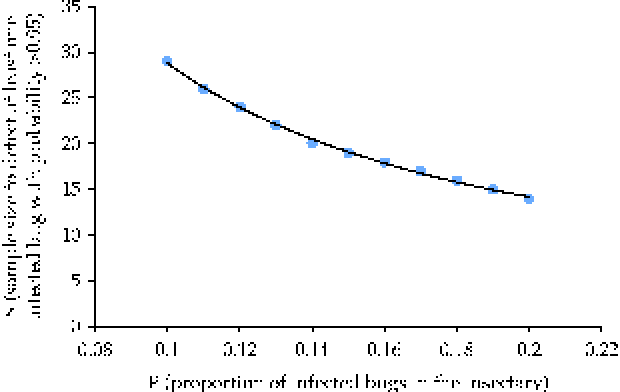
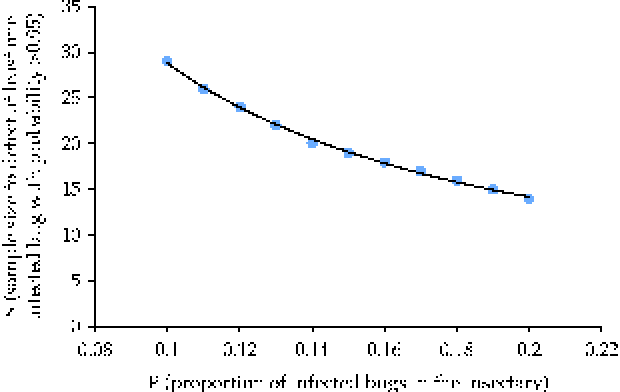
Figure 1 shows the results of the sample size s necessary to detect an infected flask as a function of several p values between 0.1 and 0.2. As mentioned in the Materials and Methods section, we estimated the value of p (the probability that one insect becomes infected after a single feeding) as 0.125. Thus, we applied the probability model using this p value and obtained s= 24 insects.
(colour online) Sample size for TrV detection. The triatomine sample size (s) required per species from each insectary to detect TrV infection by PCR as shown for values of p (the proportion of infected insects in the insectary) between 0.1 and 0.2.
Analysis of triatomine faecal samples
As expected, the results show that the virus is found in some, but not all, insect colonies from insectaries from Argentina. More interestingly, we detected TrV in one out of the two insectaries from Brazil. This finding not only enlarged the area in which the virus could be present in native colonies, but also led to the finding of new species susceptible to infection with TrV.
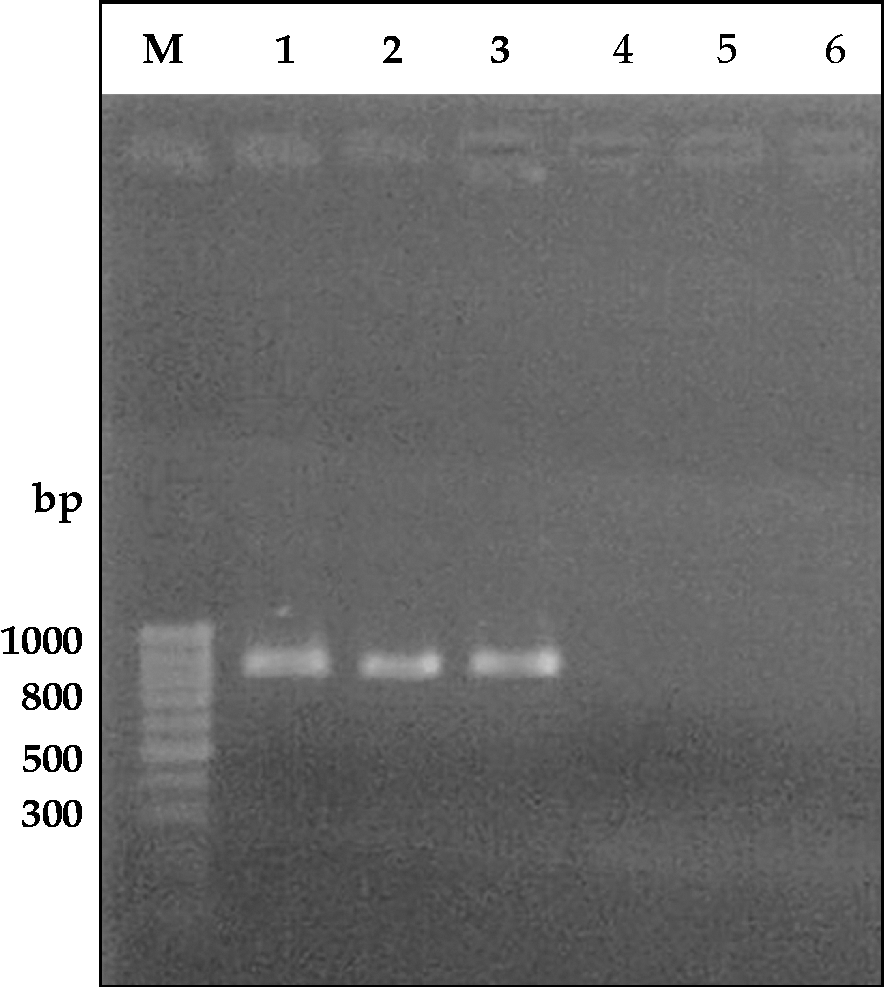
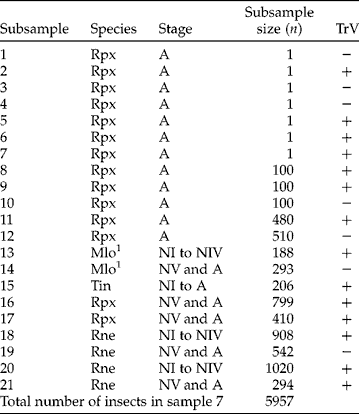
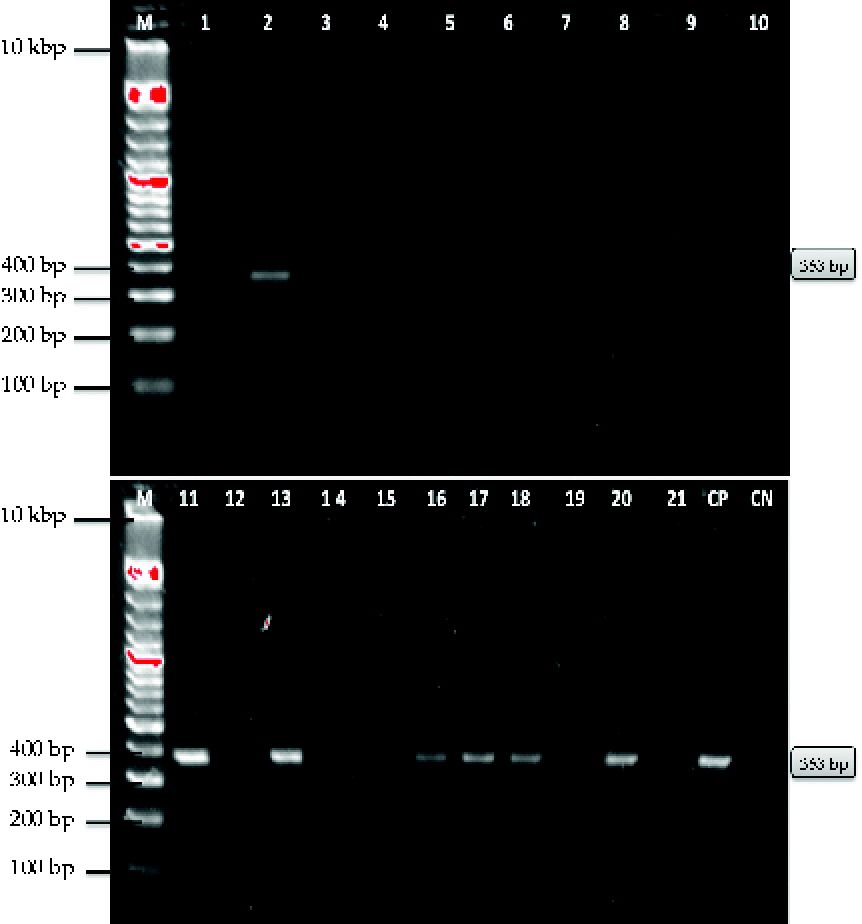
The analysis of the samples by RT-PCR revealed that three out of the 22 samples analysed were positive for TrV (Table 1 and Fig. 2). Samples 1 and 2 were positive and belong to insectaries from Argentina. A further RT-PCR analysis of its components demonstrated that the T. infestans subsamples were positive for TrV, whereas all subsamples composed of the other species (T. garciabesi, T. patagonica, T. platensis and T. sordida) were negative. Following the current procedure employed for TrV isolated from T. infestans (Marti et al., Reference Marti, Gonzalez, García, Viguera, Guérin and Echeverria2008), both positive subsamples were observed under electron microscopy and the presence of TrV particles confirmed (data not shown). The third sample found positive for TrV was sample 7, from Uberaba, Brazil (Table 1), and included faeces from about 5957 bugs belonging to four triatomine species (Rhodnius neglectus, R. prolixus, T. infestans and Meccus longipennis). This sample is composed of 21 subsamples and corresponds to an insect population covering all developmental stages, from first-, fourth- and fifth-instar nymphs to adults (Table 2). The positivity of the 14 subsamples of sample 7 was confirmed by running a RT-PCR with a second primer pair specific to TrV (Fig. 3).
Detection of TrV by RT-PCR in triatomine faecal samples 1–5. Agarose gel (1.2%) stained with ethidium bromide. M: 1000–300 bp molecular ladder. Column 1, positive control (RNA extracted from TrV); column 6, negative control. Columns with a positive reaction are indicated with numbers in bold. Reactions of samples 6 and 8–23 were negative (data not shown). Analysis of sample 7 is displayed in Fig. 3.
Composition of sample 7
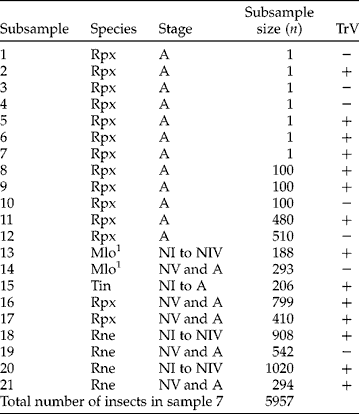
All subsamples belong to the insectary from Uberaba, Brazil (see the appendix 1). The description of abbreviations in column 2 and values in column 4 are given in the legend of Table 1. Column 3 indicates the stage of insects in each subsample: ‘A’ means ‘adults’; ‘NI’, ‘NIV’ or ‘NV’ correspond, respectively, to ‘first’-, ‘fourth’- and ‘fifth’-instar nymphs. Column 5 indicates whether the subsample was negative ( − ) or positive (+) for TrV.
1 This colony came from 20 field insects collected in the cities of Sayula, Usmajac, Tapalpa and Región Ciénega de Jalisco, about 100 km south of Guadalajara, Mexico, and was provided as a gift and exported in 2008 to the CMPTI-UFTM (see the Discussion section).
(colour online) Detection of TrV by RT-PCR in faecal subsamples 1–21 of sample 7 (Uberaba, Brazil). Agarose, 2%. M: 10,000–100 bp molecular ladder. Each individual subsample was analysed with a primer pair with expected product of 363 bp (see text). Lines 1–21 correspond, respectively, to subsamples 1–21 as described in Table 2. Line CP, positive control (infected triatomine faecal samples from the CEPAVE); line CN, negative control. Columns 2, 5–9, 11, 13, 15–18 and 20–21 correspond to positive reactions.
Discussion
In this study, we have developed a theoretical tool to estimate the value of the sampling size for the determination of a viral infection in insect colonies. The sampling size predicted by the model depends on the degree of reliability to be reached, a value that should be established a priori. This method is only appropriate for colonies with a large number of individuals. Although this tool was inspired by the need to evaluate a viral infection, tailored to T. infestans insects, and the model parameters adjusted to most common rearing conditions, mutatis mutandis, it can be adapted to other triatomine species or different insects (e.g. mosquitoes or flies), feeding procedure and even customized to other types of infection, such as bacterial. The mathematical model along with the RT-PCR technique reliably detected the infection of laboratory triatomine colonies with TrV.
The probabilistic model and sampling protocol developed here for determining the risk of triatomine infection by TrV not only predicts that a realistic sampling size can be obtained for both the selection of bugs from insectaries and the cost of PCR processing, but also that the insect sampling effort might be even smaller given the high potential rate of the horizontal transmission of TrV among triatomine insects in laboratory flasks. Additionally, the development of a probabilistic model now provides researchers with the opportunity of developing a dynamic model to estimate the degree of success of the use of TrV in triatomine biological control under field conditions.
The sample size given by the binomial model predicts a feasible number of insects for the selection of bugs from insectaries. This estimate of the size is conservative, assuming that there was no horizontal transmission despite the fact that this is known to occur once an infected bug enters a flask. In the event of a horizontal transmission, the proportion of infected bugs in the insectary would be even higher than our estimation based exclusively on the proportion of infected insects that are introduced into the rearing facility from the sylvatic environment. In such a case, the reliable sample size would be even smaller than the one predicted by our model.
With the exception of the CEPAVE colony in which T. infestans is maintained with TrV for research purposes, all insectaries taking part in this study with different triatomine colonies used and shared animals (hens, pigeons, rabbits, etc.) on which the insects fed. Due to the horizontal transmission, we expected that any causal infection with TrV would be propagated from one colony to another, and would even contaminate the entire insectary. For this reason in our TrV screening, all subsamples belonging to the same colony, and all colonies belonging to the same insectary, were considered to be part of a single sample. This assumption favours the reliability of the method since the number of individuals from which the samples were obtained is much larger than the cut-off predicted by our mathematical model.
It is currently known that 12 triatomine species are susceptible to TrV: R. prolixus, T. infestans, T. delpontei, T. pallidipennis, T. platensis and T. rubrovaria (Muscio, Reference Muscio1988), T. sordida (Marti et al., Reference Marti, Echeverria, Susevich, Becnel, Pelizza and García2009), T. patagonica (Rozas-Dennis et al., Reference Rozas-Dennis, Cazzaniga and Guérin2002), T. guasayana (Rozas-Dennis and Cazzaniga, Reference Rozas-Dennis and Cazzaniga1997), T. maculata, T. dimidiata (González, Reference González2008) and recently in P. coreodes found in bird nests (Susevich et al., Reference Susevich, Marti, Serena and Echeverria2012). With the exception of P. coreodes, all other species were included in the current screening. Our study showed that two samples from Argentina and one from Brazil were positive for TrV. One important finding from our study is that TrV was found from samples collected from Brazil, and TrV host range has expanded to two new species, R. neglectus (an autochthonous Brazilian species) and M. longipennis (a species native to Mexico). Since neither insect nor personnel exchange between the Argentinian and Brazilian insectaries occurred, the possibility for cross-contamination can be discarded. Considering that the samples originating from Mexico were found to be free of TrV, it is then likely that the origin of the infection of the Brazilian colonies is a domestic cross-contamination that may have occurred from insects kept in the same country.
Previous studies have shown that wild triatomines originating from southern Argentina are free of TrV infection (Rozas-Dennis and Cazzaniga, Reference Rozas-Dennis and Cazzaniga2000; Rozas-Dennis et al., Reference Rozas-Dennis, Cazzaniga and Guérin2002); however, Marti et al. (Reference Marti, Echeverria, Susevich, Becnel, Pelizza and García2009) reported the occurrence of TrV in several provinces of northern Argentina but restricted to a few triatomine species inhabiting certain areas of Argentina. The recent detection of TrV in sylvatic insects in Chaco and La Rioja, two northern Argentinian provinces bordering Paraguay and Bolivia (Susevich et al., Reference Susevich, Marti, Serena and Echeverria2012), and our current observation of infection among colonies from Brazil (~1500 km from the Argentinian frontier), suggest that the viral infection is widespread across the South American cone. A more extensive study of triatomines occurring in Brazil could provide more information about the geographical distribution of the virus in this country, and should also help to establish the phylogenetic relationships between Brazilian and the TrV strains found in Argentina.
Conclusions
The mathematical method developed in this study has allowed us to determine the absence of TrV infection in 23 insectaries from 13 countries across Latin America with a reliability of about 95%. The exploratory research also permitted the detection of TrV in several insect colonies reared in Brazil, one of them autochthonous, thus increasing the virus host range to 14 triatomine species.
Supplementary material
To view supplementary material for this article, please visit http://dx.doi.org/10.1017/S1742758413000337
Acknowledgements
This study was partially supported by CONICET (PIP 201101-00007), CICPBA, Agencia Nacional de Promoción Científica y Técnica (PICT no. 2008-0035 and PICT no. 2011-1081) and the National University of La Plata, Argentina. We acknowledge all personnel of the Chair of Virology, College of Veterinary Sciences, National University of La Plata. We thank Dr Werner Apt (FMN, UChile) for providing sample 10; Centro Nacional de Diagnostico y Referencia CNDR/MINSA, Managua, Nicaragua, for providing sample 14; and Dr Ricardo Alejandre Aguilar from the IPN, Mexico, for providing sample 15. We thank Gloria Rojas Wastavino (LBP-DMP-FM, UNAM) and Mariela Puebla-Rojas (FCVyP, UChile) for maintaining triatomine colonies and taking care of the samples. This work has received partial support from the French National Research Agency (grant ANR-08-MIE-007) and Centre National de la Recherche Scientifique (CNRS, UMR 5558). R.S-E. is the recipient of a predoctoral fellowship from the Basque Government, Spain. D.M.A.G. was partially supported by the Gobierno Vasco (GV; MV-2012-2-41; SPE1 1FB001) and MECON (BFU2012-36241) from Spain. All authors acknowledge the supporting institutions of the RedTrV (http://www.redtrv.org): CSIC I-COOP0080 (Spain), GV AE-2009-1-21, Fundación Biofísica Bizkaia and CYTED (209RT0364). All authors declare no conflict of interest.
Appendix 1. Sample origins