Children acquire understanding of their emotional experiences largely through interactions with their caregivers. Emotion socialization is defined as the process by which children learn norms for expressing and regulating emotion, aiding children in identifying their own emotions and understanding the emotions of others. This socialization formatively occurs in the family context, later extending to other social relationships (Eisenberg, Cumberland, & Spinrad, Reference Eisenberg, Cumberland and Spinrad1998; Katz, Maliken, & Stettler, Reference Katz, Maliken and Stettler2012; Morris, Silk, Steinberg, Myers, & Robinson, Reference Morris, Silk, Steinberg, Myers and Robinson2007; Zahn-Waxler, Reference Zahn-Waxler2010).
Multiple emotion-related parenting practices influence the child's developing capacities for emotional expression, understanding, and regulation. Current theoretical models have proposed an array of direct and indirect routes by which emotion socialization takes place, including parental modeling of emotion expression and parental responses to children's emotions (Eisenberg et al., Reference Eisenberg, Cumberland and Spinrad1998; Zahn-Waxler, Reference Zahn-Waxler2010). Social learning theory suggests that modeling of emotional expression and strategies for managing emotion indirectly shape learned behavior patterns (Bandura, Reference Bandura1986) and communicate implicit family norms (Thompson & Meyer, Reference Thompson, Meyer and Gross2007). Children also learn directly from parents’ responses to their displays of emotional state and, in some cases, parental “coaching” to recognize, label, and manage emotions adaptively (Eisenberg et al., Reference Eisenberg, Cumberland and Spinrad1998; Katz et al., Reference Katz, Maliken and Stettler2012; Zahn-Waxler, Reference Zahn-Waxler2010). Warm, supportive, and accepting responses to children's emotion displays are believed to provide an emotional secure base, scaffolding the child's development of adaptive regulation (Fosco & Grych, Reference Fosco and Grych2013; Morris et al., Reference Morris, Silk, Steinberg, Myers and Robinson2007). When parents’ capacities for accepting and responding supportively to children's emotional states are compromised, children are likely to have difficulty navigating the developmental tasks of increasingly independent emotional self-regulation (Morris et al., Reference Morris, Silk, Steinberg, Myers and Robinson2007).
A growing body of evidence suggests that children's social-emotional development is enhanced by adaptive patterns of parental emotion socialization, consistent with theoretical models. Better social, emotional, and behavioral adjustment has been linked to parental modeling of predominantly positive emotions as well as supportive responses to children's displays of negative emotion (Eisenberg, Fabes, & Murphy, Reference Eisenberg, Fabes and Murphy1996, Reference Eisenberg, Cumberland and Spinrad1998, Reference Eisenberg, Losoya, Fabes, Guthrie, Reiser, Murphy and Padgett2001; Malatesta-Magai, Reference Malatesta-Magai, Cicchetti and Toth1991; Ramsden & Hubbard, Reference Ramsden and Hubbard2002). In contrast, parents’ negative emotional expression and nonsupportive responses to negative emotion have been linked to social, emotional, and behavioral problems in children (Eisenberg et al., Reference Eisenberg, Losoya, Fabes, Guthrie, Reiser, Murphy and Padgett2001, Reference Eisenberg, Spinrad, Eggum, Silva, Reiser, Hofer and Michalik2010; Fosco & Grych, Reference Fosco and Grych2013; Klimes-Dougan et al., Reference Klimes-Dougan, Brand, Zahn-Waxler, Usher, Hastings, Kendziora and Garside2007; Maughan, Cicchetti, Toth, & Rogosch, Reference Maughan, Cicchetti, Toth and Rogosch2007; Morelen, Jacob, Suveg, Jones, & Thomassin, Reference Morelen, Jacob, Suveg, Jones and Thomassin2013; O'Neal & Magai, Reference O'Neal and Magai2005; Yap, Schwartz, Byrne, Simmons, & Allen, Reference Yap, Schwartz, Byrne, Simmons and Allen2010). Importantly, these links persist into adolescence and young adulthood (e.g., Klimes-Dougan et al., Reference Klimes-Dougan, Brand, Zahn-Waxler, Usher, Hastings, Kendziora and Garside2007; Morelen et al., Reference Morelen, Jacob, Suveg, Jones and Thomassin2013; Yap et al., Reference Yap, Schwartz, Byrne, Simmons and Allen2010), suggesting that parental socialization of emotion has long-term implications for social-emotional health.
Emotion socialization in the context of maternal mood disorders
Unfortunately, parents’ capacities for adaptive emotion socialization may be compromised by maternal mood disorders. Maternal major depressive disorder (MDD) is a well-established risk factor for disrupted parenting and family dysfunction (Beardslee, Versage, & Gladstone, Reference Beardslee, Versage and Gladstone1998; Foster, Garber, & Durlak, Reference Foster, Garber and Durlak2008; Jameson, Gelfand, Kulcsar, & Teti, Reference Jameson, Gelfand, Kulcsar and Teti1997; Kopala-Sibley et al., Reference Kopala-Sibley, Jelinek, Kessel, Frost, Allmann and Klein2017; Lovejoy, Graczyk, O'Hare, & Neuman, Reference Lovejoy, Graczyk, O'Hare and Neuman2000; Radke-Yarrow, Reference Radke-Yarrow1998). Mothers with depression exhibit variation in parenting practices; a meta-analysis of observational studies found that maternal MDD was linked to more negative parenting, less positive parenting, and higher disengagement compared to nondepressed mothers (Lovejoy et al., Reference Lovejoy, Graczyk, O'Hare and Neuman2000). Parenting in the context of bipolar disorder (BD) has been comparatively less studied; however, existing research suggests that this condition may also contribute to parenting problems, manifesting in more negative communication (Inoff-Germain, Nottelmann, & Radke-Yarrow, Reference Inoff-Germain, Nottelmann and Radke-Yarrow1992; Vance, Jones, Bentall, & Tai, Reference Vance, Jones, Bentall and Tai2008), family conflict (Chang, Blasey, Ketter, & Steiner, Reference Chang, Blasey, Ketter and Steiner2001; Narayan, Chen, Martinez, Gold, & Klimes-Dougan, Reference Narayan, Chen, Martinez, Gold and Klimes-Dougan2015; Romero, DelBello, Soutullo, Stanford, & Strakowski, Reference Romero, DelBello, Soutullo, Stanford and Strakowski2005), and dysfunctional parenting (Calam, Jones, Sanders, Dempsey, & Sadhani, Reference Calam, Jones, Sanders, Dempsey and Sadhani2012).
Although research provides evidence of depression-related disruptions in parenting, relatively little is known about parental socialization of children's emotions in the context of MDD or BD. This represents an important area for future research, particularly given known associations between maternal mood disorder and children's emotional competence. For example, maternal depressive symptoms have been shown to contribute to slower growth in children's emotion regulation (Blandon, Calkins, Keane, & O'Brien, Reference Blandon, Calkins, Keane and O'Brien2008) and, compared to children of nondepressed mothers, children of depressed mothers are more likely to use maladaptive rather than adaptive emotion regulatory strategies when faced with a frustrating task (Silk, Shaw, Skuban, Oland, & Kovacs, Reference Silk, Shaw, Skuban, Oland and Kovacs2006). These deficits in offspring emotion regulation may reflect parents’ difficulty socializing emotion adaptively.
Emotion dysregulation is a cardinal feature of mood disorders, evident during episodes of persistent depressed mood (characteristic of both MDD and BD) and, in the case of BD, elevated manic states (Goodman & Gotlib, Reference Goodman and Gotlib1999; Gross & Munoz, Reference Gross and Munoz1995; Tandon, Reference Tandon2015). Thus, mothers with MDD and BD may struggle to model healthy emotion expression and respond supportively to children's emotion displays. Indeed, evidence suggests that parents with mood disorders model more negative and less positive affect, showing less warmth, lower positivity, and more negativity when interacting with or discussing their children (Feng, Shaw, Skuban, & Lane, Reference Feng, Shaw, Skuban and Lane2007; Gravener et al., Reference Gravener, Rogosch, Oshri, Narayan, Cicchetti and Toth2012; Rogosch, Cicchetti, & Toth, Reference Rogosch, Cicchetti and Toth2004; Zahn-Waxler, Duggal, & Gruber, Reference Zahn-Waxler, Duggal, Gruber and Bornstein2002). In prior research with the current sample, mothers with MDD and BD showed more sadness and anxiety than well mothers during naturalistic interactions with their children, and mothers with MDD were particularly prone to sustained displays of negative affect (Radke-Yarrow, Nottelmann, Belmont, & Welsh, Reference Radke-Yarrow, Nottelmann, Belmont and Welsh1993). Taken together, prior research suggests that maternal mood disorders may shape emotion socialization by biasing affective modeling toward negative emotion, although more research is needed to clarify whether processes differ for mothers with MDD and BD.
A small body of research has considered other emotion socialization practices, including how depressed mothers respond to their children's negative emotions. Maternal depressive symptoms have been linked to more nonsupportive responses to young children's negative emotions across several developmental stages. Among mothers of toddlers, depressive symptoms were linked to self-reported use of nonsupportive (i.e., punishing and minimizing) responses to children's negative emotions, as well as more wish-granting socialization, believed to reflect a maladaptive, overly permissive response style (Premo & Kiel, Reference Premo and Kiel2016); the coexistence of punitive and wish-granting responses implies inconsistency of emotion socialization messages in the context of maternal depression. Similarly, among mothers of preschool-aged children with behavior problems, self-reported depressive symptoms (and other forms of psychopathology) were associated with more nonsupportive responses to children's negative emotions, rated from audiotapes of naturalistic conversation (Breaux, Harvey, & Lugo-Candelas, Reference Breaux, Harvey and Lugo-Candelas2016). Maternal depressive symptoms also uniquely predicted nonresponse to children's negative emotion, suggesting that those struggling with depressive problems are more likely to ignore or neglect their children's emotion displays (Breaux et al., Reference Breaux, Harvey and Lugo-Candelas2016).
In families with school-age children, maternal depressive symptoms showed bivariate associations with maternal self-reported use of nonsupportive response strategies characterized by punishing, minimizing the child's concerns, and/or responding with personal distress (Nelson, O'Brien, Blankson, Calkins, & Keane, Reference Nelson, O'Brien, Blankson, Calkins and Keane2009). Similarly, Silk et al. (Reference Silk, Shaw, Prout, O'Rourke, Lane and Kovacs2011) found that mothers with childhood-onset depression were more likely than never-depressed mothers to report punishing, ignoring, or magnifying responses (i.e., matching the child's negative emotion with equal or greater intensity); furthermore, use of these nonsupportive strategies was prospectively linked to higher internalizing symptoms in their offspring the following year. Notably, pairing punitive responses with personal distress (Nelson et al., Reference Nelson, O'Brien, Blankson, Calkins and Keane2009) or magnification of the child's emotion (Silk et al., Reference Silk, Shaw, Prout, O'Rourke, Lane and Kovacs2011) may communicate ambivalent or contradictory messages regarding the appropriateness of expressing negative emotions, with negative expressiveness modeled by parents but discouraged in children (Mirabile, Reference Mirabile2014).
Although there are now several studies showing a link between parental mood disorders and nonsupportive responses to children's negative emotions, the literature is more mixed with regard to supportive responses. Some studies find no relation between dimensionally assessed depressive symptoms and self-reported supportive responses (e.g., Breaux et al., Reference Breaux, Harvey and Lugo-Candelas2016; Nelson et al., Reference Nelson, O'Brien, Blankson, Calkins and Keane2009). Differences may be more likely to emerge when depression reaches a clinically significant level: Silk et al. (Reference Silk, Shaw, Prout, O'Rourke, Lane and Kovacs2011) found that mothers with diagnosed childhood-onset depression were less likely than mothers without a history of depression to report comforting responses to their children's negative emotion.
To our knowledge, no studies directly assess emotion socialization by parents with BD. However, prior research has found disruptions in related aspects of parenting (e.g., negative communication, conflict; Chang et al., Reference Chang, Blasey, Ketter and Steiner2001; Inoff-Germain et al., Reference Inoff-Germain, Nottelmann and Radke-Yarrow1992; Narayan et al., Reference Narayan, Chen, Martinez, Gold and Klimes-Dougan2015; Vance et al., Reference Vance, Jones, Bentall and Tai2008). One exception to this commonly noted pattern was a study that found that young adult offspring of bipolar parents rated their parents as less rejecting and more emotionally warm than a general population comparison sample (Reichart et al., Reference Reichart, van der Ende, Wals, Hillegers, Nolen, Ormel and Verhurlst2007). Although this study awaits replication, it raises the possibility that offspring of mothers with MDD versus BD may differ in perceived caregiving. That is, for young adult offspring of bipolar parents, emotion socialization may not be impaired, or parenting may be recalled in a positive light.
The few existing studies of emotion socialization in the context of mood disorder focus on early to middle childhood and primarily use maternal self-reports of emotion socialization, known to be affected by mood and motivational factors (e.g., Parent et al., Reference Parent, Forehand, Dunbar, Watson, Reising, Seehuus and Compas2014). Given the dyadic nature of parenting, offspring perceptions may play a crucial role in determining the impact of parental rearing. Other studies have productively leveraged offspring reports of emotion socialization among adolescents and young adults but have not considered patterns of socialization associated with parental depression. Young adult recollections of emotion socialization are an important outcome to consider because of documented links with emotion dysregulation, psychopathology, elevated trait anger, and heightened distress (Buckholdt, Parra, & Jobe-Shields, Reference Buckholdt, Parra and Jobe-Shields2009; Garside & Klimes-Dougan, Reference Garside and Klimes-Dougan2002; Leerkes, Supple, Su, & Cavanaugh, Reference Leerkes, Supple, Su and Cavanaugh2015). Furthermore, given increased individuation from parents and heightened salience of parenting as a developmental task of adulthood, offspring perceptions may be particularly relevant to assess in young adults. Further research is needed employing offspring reports of emotion socialization to clarify links between maternal mood disorders (both MDD and BD) and young adult perceptions of the emotion-related parenting they received in childhood.
Coherence of emotion socialization measures
Different aspects of emotion socialization, such as affective modeling and responses to emotion, are often assumed to interrelate. However, both theory and research call this presumed consistency into question. Previous literature is mixed regarding whether emotion socialization is consistent or inconsistent across domains (Denham & Kochanoff, Reference Denham and Kochanoff2002; Ramsden & Hubbard, Reference Ramsden and Hubbard2002; Shadur & Hussong, Reference Shadur and Hussong2019; Stocker, Richmond, Rhoades, & Kiang, Reference Stocker, Richmond, Rhoades and Kiang2007). At the conceptual level, imperfect control of one's emotional expressions may lead to discrepancies between parents’ implicit and explicit emotion socialization, such that parents model dysregulated emotional expression despite active efforts to teach effective regulation. Indeed, studies have documented associations between high parental negative affect (e.g., irritability, personal distress) and greater use of nonsupportive responses to children's negative emotions. Although such links are coherent when considered in light of parents’ compromised emotional functioning, they may communicate inconsistent messages to children regarding the appropriateness of expressing negative affect (Mirabile, Reference Mirabile2014).
Associations may also differ due to measurement variance: Baker, Fenning, and Crnic (Reference Baker, Fenning and Crnic2011) found that mothers’ self-reported emotional expressiveness was associated with self-reported but not observed responses to children's emotions during a problem-solving discussion, suggesting that self-reported emotion socialization may not map onto observed behavior in predicted ways. Associations may further vary based on timing of assessment across development. Importantly, though prior studies have used retrospective reports of emotion socialization to predict adaptive functioning in adulthood (Garside & Klimes-Dougan, Reference Garside and Klimes-Dougan2002; Leerkes et al., Reference Leerkes, Supple, Su and Cavanaugh2015; Morelen et al., Reference Morelen, Jacob, Suveg, Jones and Thomassin2013), the validity of young adult recollections is not well understood, in families with or without clinical disorder. One unique study documented moderate concurrence (r's = 0.44–0.45) in prospective and retrospective reports of family emotional environment during adolescence (Bell & Bell, Reference Bell and Bell2018), but we are not aware of research assessing the validity of young adults’ retrospective reports of emotion socialization experienced during early and middle childhood. Offspring recollections may reflect true variation in caregiving behavior, differing interpretations of caregiving events, motivational influences on memory, and/or concurrent mood. Given heightened risk for depressive symptoms in offspring of mothers with mood disorder, as well as established effects of mood on reporting behavior (Parent et al., Reference Parent, Forehand, Dunbar, Watson, Reising, Seehuus and Compas2014), the role of concurrent depressive symptoms may be a particularly salient influence on offspring reports in families affected by maternal mood disorders.
Clarifying the coherence between different measures of emotion socialization remains an important and understudied research question, with the potential to inform both basic understanding and translational efforts to intervene with parental emotion socialization behavior. To our knowledge, no studies have leveraged longitudinal data to investigate the association between different dimensions of emotion socialization observed in early childhood and recollected in young adulthood under varying risk conditions. Demonstrating the presence of longitudinal associations is critically important for understanding interrelations among multiple measures of emotion socialization and informing our interpretation of retrospective reports.
The current study
The current study addresses gaps in the literature by (a) investigating recollections of emotion socialization among young adult offspring of mothers diagnosed with BD in addition to mothers with MDD and psychiatrically well mothers; and (b) investigating longitudinal associations between two distinct aspects of parental emotion socialization: maternal affective modeling and responses to emotion. Observed maternal affect (including irritability, sadness, and tenderness) was assessed during naturalistic parent–child interactions in early childhood. Recollections of parental responses to sadness and anger were assessed in young adulthood using Malatesta-Magai's influential model (Reference Malatesta-Magai, Cicchetti and Toth1991) of parental response strategies to children's negative emotions, given evidence that response strategies differ in their facilitation of versus interference with children's adaptive emotion regulation (Klimes-Dougan, Brand, & Garside, Reference Klimes-Dougan, Brand and Garside2001). A previously published paper documented links between maternal mood disorder (particularly MDD) and greater negative affect when interacting with their children in early childhood; however, the current manuscript is the first to investigate recollected responses to children's emotions as they relate to maternal mood disorder and observed affective modeling (Radke-Yarrow et al., Reference Radke-Yarrow, Nottelmann, Belmont and Welsh1993).
We hypothesized that both maternal MDD and BD would be associated with recollections of more nonsupportive (i.e., Punish, Neglect, and Magnify) and fewer supportive (i.e., Reward) responses to childhood negative emotion. Given evidence that parental negative affectivity may co-occur with nonsupportive responses to children's negative emotions (Fabes, Leonard, Kupanoff, & Martin, Reference Fabes, Leonard, Kupanoff and Martin2001; Mirabile, Reference Mirabile2014), we predicted that observed maternal irritability would be positively associated with recalled maternal use of punishing and magnifying responses, and observed maternal sadness would be positively associated with recalled use of neglecting and magnifying responses. We further expected that greater observed maternal tenderness would be associated with recollections of more rewarding responses, because of conceptual links between tenderness and comforting, empathetic responses. Given the long interval between measures, as well as the difference in emotion socialization domain assessed at each age, we expected associations to be modest in magnitude.
Method
Participants
Participants were drawn from a longitudinal investigation of mothers with and without mood disorders and their offspring (Radke-Yarrow, Reference Radke-Yarrow1998). Families were recruited from a large metropolitan area using notices in day-care centers, parenting groups, and clinical settings. Families were eligible to enroll if (a) mothers met diagnostic criteria for major depressive disorder (MDD), BD, or no psychiatric disorder (past or present) at the time of study entry, and (b) they had one toddler-aged sibling (age 1.5 to 3.5 years) and one sibling in early childhood (aged 5 to 7 years); a small number of mothers with minor depression (defined as two to four depressive symptoms, including depressed mood and/or anhedonia, persisting for at least two weeks) were initially enrolled but later excluded. Out of 261 mothers who met preliminary screening criteria, 126 mothers of 248 offspring were found to be eligible following extensive phone screening. Mothers who were not primary caregivers, had had lengthy separations from their children, or met criteria for additional psychiatric disorders (excepting secondary anxiety diagnoses in mothers with mood disorders) were excluded at this stage.
Original participants were predominantly European American (86%; 2% Asian or Asian American, 11% Black or African American; 1% Hispanic or Latina). Most participants were middle to upper-middle class (mean Hollingshead score = 51.08, SD = 14.83; Hollingshead, Reference Hollingshead1975), and 75% mothers were at least college-educated. Study procedures were approved by the National Institute of Mental Health Institutional Review Board and families were paid based on National Institutes of Health guidelines. Informed consent was obtained from all individual participants included in the study.
Families were seen at five assessment waves, timed to capture important stages of development (toddlerhood to early childhood; early to middle childhood; middle childhood to early adolescence; adolescence; young adulthood). The present study uses prospective data from Time 1 (M age = 4.45 years, SD = 2.06), Time 2 (M age = 7.37, SD = 2.10), and Time 5 (M age = 22.16, SD = 2.58). Recruitment at Time 5 was based on 98 families who participated through the Time 3 assessment, when parents were re-diagnosed and mothers with nonqualifying diagnoses (i.e., minor depression or generalized anxiety disorder) were excluded from the longitudinal sample. At Time 3, 42 mothers met criteria for MDD, 26 mothers met criteria for BD, and 30 mothers were psychiatrically well.
The present study includes 131 young adult offspring of 76 mothers who participated in the Time 5 wave of data collection. Of the 131 participants in the current study, 73 (55.7%) were from the younger sibling cohort and 78 (59.5%) were female. Consistent with the original sample, this subsample was predominantly European American and from upper middle-class backgrounds (mean Hollingshead score = 52.71, SD = 13.85; Hollingshead, 1975). Participants in the current study were young adult offspring of mothers with MDD (n = 58 offspring of 34 mothers), BD (n = 32 offspring of 19 mothers), or no mental illness (n = 41 offspring of 23 mothers). Selective attrition was not related to maternal diagnosis or maternal affective modeling; however, more male than female offspring failed to complete the Time 5 assessment.
Procedure
Comprehensive assessments of parents' and children's psychiatric status and psychosocial functioning were conducted at each wave. Lifetime maternal diagnoses were identified at Time 1 using the Schedule for Affective Disorders and Schizophrenia: Lifetime Version (SADS-L, Spitzer & Endicott, Reference Spitzer and Endicott1977), and at Time 3 using the Structured Clinical Interview for Diagnostic and Statistical Manual of Mental Disorders (DSM-III-R) (SCID; Spitzer, Williams, Gibbon, & First, Reference Spitzer, Williams, Gibbon and First1987) and Interval SADS. Ten interviews were coded independently with 100% diagnostic agreement. Core symptoms of MDD and BD have remained consistent from DSM-III-R to DSM-5, although DSM-5 reflects a new conceptualization of BDs as intermediate between schizophrenia and unipolar disorders, resulting in the separation of mood diagnoses into two discrete sections: “bipolar and related disorders” and “depressive disorders” (Tandon, Reference Tandon2015). In the current sample, 29.4% of mothers with lifetime MDD met criteria for a depressive episode within four months of the Time 1 diagnostic assessment. Of mothers with lifetime BD, 57.9% met criteria for a recent depressive episode and 63.2% met criteria for a recent manic or hypomanic episode; 42.1% of mothers with BD met criteria for both depressive and manic/hypomanic episodes within four months of Time 1.
Parent and child affect were rated from semi-naturalistic parent–child interactions at Time 1 and Time 2. At both assessment waves, mothers and their children were observed and video-recorded in a homelike laboratory environment on two half-days, separated by two weeks (a total of approximately five hours of observation). Activities were structured to simulate everyday routines (e.g., playing, preparing and eating lunch) and challenges (e.g., receiving a visitor, enforcing compliance with house rules). At Time 5, young adults reported on their mothers’ typical responses to their negative emotions during childhood. Preliminary analyses were combined across sibling cohorts and focal analyses nested siblings with families.
Measures
Affective modeling
Independent coders coded mothers’ predominant affect based on facial expressions, tone of voice, body language, and verbal statements in one-minute intervals over several hours of parent–child interaction (see Radke-Yarrow et al., Reference Radke-Yarrow, Nottelmann, Belmont and Welsh1993 for more detail). We divided the number of minutes each affect was expressed by total number of coded intervals, resulting in a percentage score for each affect. Mothers were rated on anxious-sad, irritable-angry, downcast, tender-affectionate, joyful, and neutral expressions. Intraclass correlations (ICCs) ranged from .85 to .98. Because percentage scores sum to 100% and are therefore mutually dependent, we selected a subset of affects for focal analyses. Maternal sad-anxious (hereafter sad), irritable-angry (hereafter irritable), and tender-affectionate (hereafter tender) affects were selected because of their correspondence with responses to children's negative emotion defined by Malatesta-Magai (Reference Malatesta-Magai, Cicchetti and Toth1991). Mothers who had depressive or manic/hypomanic episodes in the previous four months did not significantly differ from those without recent mood episodes in expression of sad, irritable, or tender affect at Time 1. Maternal affects were averaged across Time 1 and Time 2 to provide a more robust estimate of affective modeling across early childhood.
Responses to children's emotion
At the Time 5 assessment, young adult offspring reported on recollected maternal responses to negative emotion using the Emotions as a Child Scale, Version 2 (EAC-2; Garside & Klimes-Dougan, Reference Garside and Klimes-Dougan2002). The EAC-2 was adapted from Malatesta-Magai's EAC (Magai, Reference Magai1996) to capture adult offspring's recollections of parents’ emotion socialization behaviors during childhood. Participants were asked to rate on a 5-point Likert-type scale (1 = not at all typical to 5 = very typical) how their mothers typically responded to childhood expressions of sadness and anger. Three items assessed the use of each strategy with each specific affect, for a total of 30 items. In Malatesta-Magai's typology, responses are classified as Reward (i.e., comforting, empathizing, and assisting with problem-solving), Override (i.e., dismissing, minimizing, or distracting from the negative emotion), Punish (i.e., showing disapproval, mocking, or punishing emotional expression), Neglect (i.e., ignoring or not noticing the emotion), and Magnify (i.e., matching the emotion with equal or greater intensity). Override and Reward responses are inversely associated with children's experience of negative emotion and likely to facilitate emotion regulation, whereas Punish, Neglect and Magnify (particularly for anger) are considered nonsupportive responses likely to increase children's negative emotion and interfere with emotion regulation (Klimes-Dougan et al., Reference Klimes-Dougan, Brand and Garside2001, Reference Klimes-Dougan, Brand, Zahn-Waxler, Usher, Hastings, Kendziora and Garside2007). This measure has been shown to have adequate test-retest and internal reliability for caregiving responses to sadness and anger (Klimes-Dougan et al., Reference Klimes-Dougan, Brand and Garside2001; Magai, Reference Magai1996), and has been linked to psychological functioning in adolescents and young adults (Klimes-Dougan et al., Reference Klimes-Dougan, Brand and Garside2001, Reference Klimes-Dougan, Brand, Zahn-Waxler, Usher, Hastings, Kendziora and Garside2007; O'Neal & Magai, Reference O'Neal and Magai2005), providing preliminary evidence of convergent validity.
Response ratings for each strategy were averaged within and across discrete affects, resulting in strategy scores for sadness, anger, and combined negative affect. Scores for sadness and anger were combined to provide a single estimate of mothers’ recollected use of each strategy across negative emotions, with planned follow-up testing of significant results to evaluate differential effects by discrete emotion. This analytic strategy was used to enhance reliability by increasing the number of indicators and to minimize number of outcomes tested in focal models. Internal reliability was acceptable to excellent for Reward (Cronbach α = .90), Neglect (Cronbach α = .83), Magnify (Cronbach α = .78), and Punish (Cronbach α = .70) scales. Internal reliability was low for Override responses (combined Cronbach α = .58), particularly Override Anger (Cronbach α = .17). Given unacceptably low internal consistency and lack of specific Override hypotheses, this variable was dropped from analyses.
Demographic and clinical covariates
Childhood socioeconomic status (SES), offspring sex, and offspring age during the young adult assessment were included as demographic covariates. Because offspring's recollections are likely to be colored by their current emotional state (Parent et al., Reference Parent, Forehand, Dunbar, Watson, Reising, Seehuus and Compas2014), our models controlled for young adult offspring's self-reported depressive symptoms on the Beck Depression Inventory (Beck, Ward, Mendelson, Mock, & Erbaugh, Reference Beck, Ward, Mendelson, Mock and Erbaugh1961), a well-validated, 21-item scale that asks participants to select the sentence most characteristic of their experiences over the past week (e.g., 0 = I do not feel sad; 1 = I feel sad; 2 = I am sad all the time and I can't snap out of it; 3 = I am so sad and unhappy that I can't stand it).
Data analytic plan
Multilevel modeling (MLM) analyses were used to account for the nested nature of sibling data. Specifically, we conducted a series of two-level multilevel models predicting to young adult recollections of emotion socialization strategies (Neglect, Punish, Magnify, and Reward), with Level 1 modeling individual-level predictors (offspring sex, age, and depressive symptoms) and Level 2 modeling family-level predictors (maternal depression status, maternal affective modeling, and childhood SES). Continuous predictors and outcomes were standardized prior to modeling to improve interpretability. In each model, the variance component for the Level 1 intercept was allowed to vary randomly across participants; variance components for all other parameters were fixed. Analyses were conducted using maximum likelihood estimation with the lme4 package (Bates, Maechler, Bolker, & Walker, Reference Bates, Maechler, Bolker and Walker2015) in R (R Core Team, 2016). Nonparametric confidence intervals were computed using the basic bootstrap method to address mild heteroscedasticity of the residuals (Bates et al., Reference Bates, Maechler, Bolker and Walker2015).
Model testing proceeded in stages. The first set of models evaluated our hypotheses that maternal mood disorder would predict more nonsupportive and fewer supportive emotion socialization strategy use. Dummy-codes representing maternal MDD and BD were tested as predictors of recollected maternal responses to emotion, controlling for covariates (childhood SES, offspring sex, offspring age at the young adult assessment, and offspring self-reported depressive symptoms) on the second step. The second set of models evaluated our hypotheses that young adult recollections of emotion socialization strategies would be related to maternal affective modeling during prospectively observed parent–child interactions. Percentage scores for maternal affective modeling (sadness, irritability, and tenderness) were tested as predictors of recollected maternal responses to emotion, controlling for the same covariates on the second step. The third set of models tested unique associations by including maternal mood disorder variables, maternal affective modeling scores, and covariates as simultaneous predictors. Finally, planned follow-up tests of the best-fitting models investigated maternal strategy use separately for sadness and anger, as an exploratory test of functional differences related to discrete emotions.
Model fit was compared using the corrected Akaike information criterion, or AICc, which incorporates a second-order bias correction for use with small sample sizes and reduces the likelihood of overfitting (Burnham, Anderson, & Huyvaert, Reference Burnham, Anderson and Huyvaert2011). Akaike information criterion (AIC), and by extension AICc, minimizes information lost when a given model is used to approximate reality and is preferred to Bayesian information criteria (BIC) for use with ecological data because it accommodates infinite-dimensional models and minimizes prediction error (Burnham et al., Reference Burnham, Anderson and Huyvaert2011; Yang, Reference Yang2005). Significance of individual parameters was defined by 95% confidence intervals excluding zero.
Results
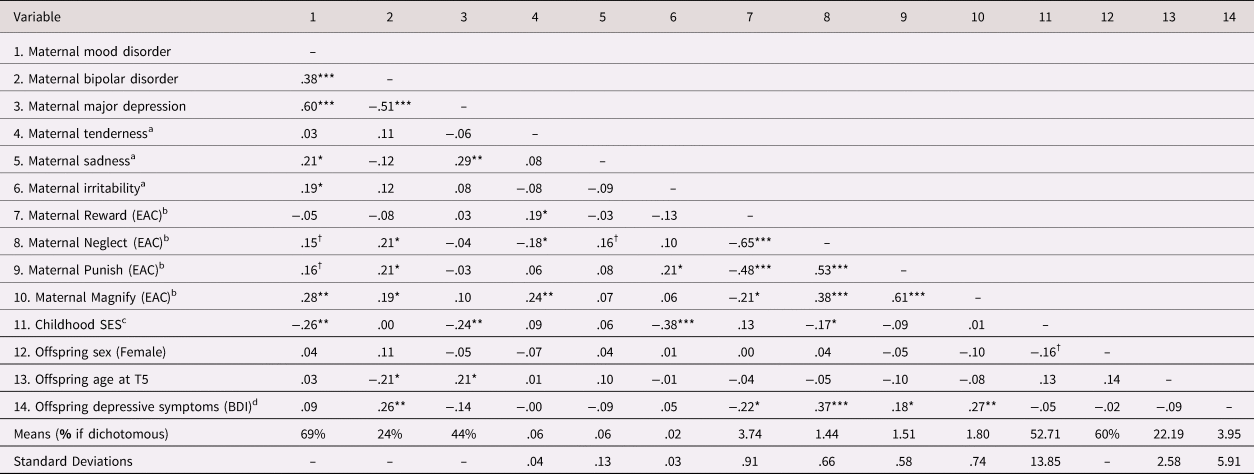
Descriptive statistics and bivariate correlations (not accounting for cohort nonindependence) are presented in Table 1. On average, Reward was the most highly endorsed response (M = 3.74, SD = 0.91, compared with Punish: M = 1.51, SD = 0.58; Neglect: M = 1.44, SD = 0.66; and Magnify: M = 1.81, SD = 0.74).
Descriptive statistics and bivariate correlations

Note: Correlations should be interpreted with caution given nonindependence of sibling data.
a Observed in childhood. Score reflects the proportion of time mother showed a given affect.
b EAC = Emotions as a Child questionnaire, offspring report of parental emotion socialization completed in young adulthood.
c SES = Socioeconomic status.
d BDI = Beck Depression Inventory, self-report of depressive symptoms completed by offspring in young adulthood.
† p < .10, *p < .05, **p < .01, ***p < .001.
Preliminary one-way analyses of variance (ANOVAs) revealed that differences in diagnostic status were associated with observed maternal sadness (F(2, 127) = 6.00, p < .01), but not irritability or tenderness. Post-hoc testing using Tukey's HSD indicated that mothers diagnosed with MDD expressed significantly more sadness (M = 0.10, SD = 0.19) than mothers with BD (M = 0.03, SD = 0.03; p < .05; Cohen's d = 0.51) or no disorder (M = 0.02, SD = 0.02; p < .01; Cohen's d = 0.59), consistent with previously published findings from the larger sample (Radke-Yarrow et al., Reference Radke-Yarrow, Nottelmann, Belmont and Welsh1993).
One-way ANOVAs also revealed significant diagnostic differences in magnifying (F(2, 127) = 6.05, p < .01), punishing (F(2, 127) = 3.48, p < .05), and neglecting responses (F(2, 127) = 3.35, p < .05); rewarding responses were not significantly related to maternal mood disorder. Tukey's HSD indicated that, relative to well mothers, mothers with BD were recalled as using more magnifying (M = 2.05, SD = 0.84 vs. M = 1.50, SD = 0.48; p < .01; Cohen's d = 0.80), punishing (M = 1.73, SD = 0.80 vs. M = 1.38, SD = 0.39; p < .05; Cohen's d = 0.56), and neglecting responses (M = 1.68, SD = 1.02 vs. M = 1.29, SD = 0.43; p < .05; Cohen's d = 0.50). Mothers with MDD were also reported to magnify their children's negative emotions more than well mothers (M = 1.88, SD = 0.77 vs. M = 1.50, SD = 0.48; p < .05; Cohen's d = 0.59). Mothers with BD and MDD did not significantly differ from each other in use of any response strategy.
With regard to coherence across emotion socialization measures, observed maternal tenderness in early childhood was linked to young adult recollections of more rewarding (r = .19, p < .05), more magnifying (r = .24, p < .05), and less neglecting maternal responses (r = −.18, p < .05). Observed maternal irritability in early childhood was associated with more offspring-recollected punishing maternal responses (r = .21, p < .05).
Multilevel model results
Reward
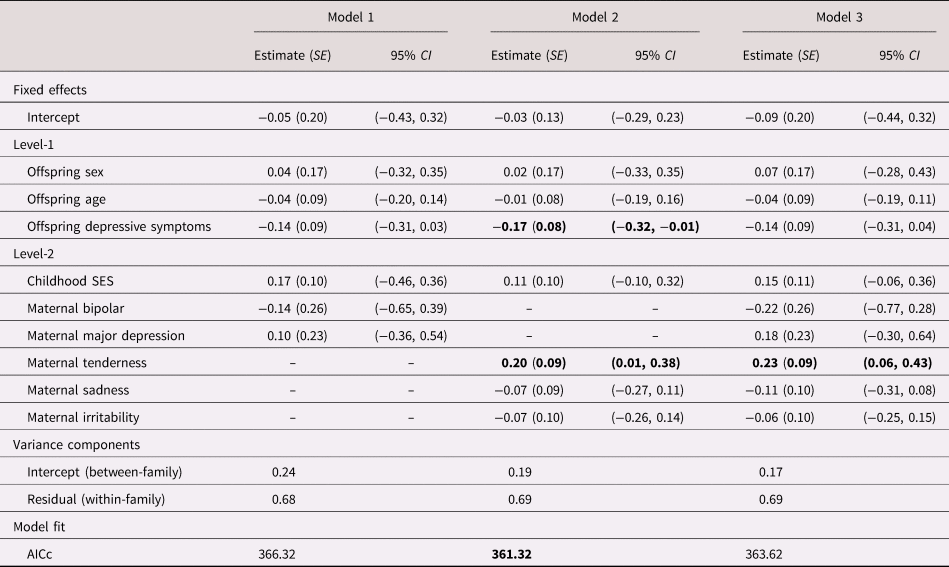
Results of multilevel models predicting maternal use of rewarding responses are presented in Table 2. Regarding model one (i.e., prediction from maternal mood disorder), neither BD nor MDD predicted offspring report of maternal reward, either when entered alone or when controlling for covariates. Results from model two (i.e., prediction from maternal affective modeling) indicated that offspring recollections of rewarding maternal responses to negative emotions were associated with lower concurrent depressive symptoms and more observed maternal tenderness in childhood. The association between observed maternal tenderness and recollected rewarding responses was robust to covariates and to the inclusion of maternal mood disorder in model three. Comparison of model fit statistics indicated that model two was the best-fitting model, consistent with results from significance testing.
Multilevel model predicting maternal reward responses from maternal mood disorder, maternal affective modeling, and covariates

Note: Parameter estimates are unstandardized; however, continuous variables were standardized prior to analyses. SE = standard error. CI = bootstrapped confidence interval. Statistically significant parameters (defined by 95% confidence intervals excluding 0) are in bold. The best-fitting model is bold and underlined.
Planned follow-up tests of this final model examined maternal reward of sadness and anger separately. Results indicated that associations of observed maternal tenderness with rewarding sadness and rewarding anger were similar in magnitude [rewarding sadness: b = 0.18, 95% CI (0.03, 0.34); rewarding anger: b = 0.18, 95% CI (−0.01, 0.37)]. Offspring reports of rewarding responses to sadness were additionally related to lower depressive symptoms in young adulthood [b = −0.25, 95% CI (−0.42, −0.09)].
Neglect
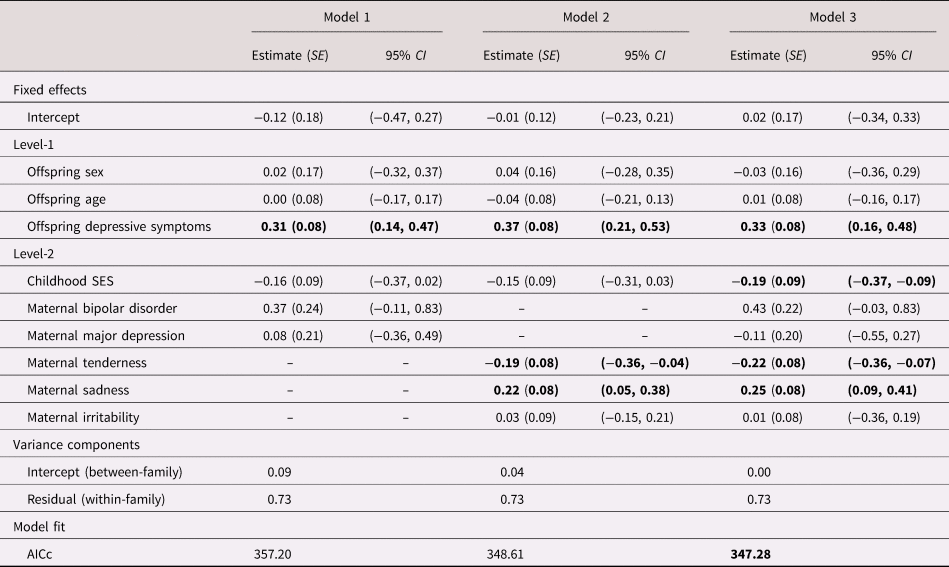
Results of multilevel models predicting maternal use of neglect are presented in Table 3. In model one, BD (but not MDD) predicted higher offspring-reported maternal neglect of negative emotions when maternal diagnostic variables were entered alone [b = 0.56, 95% CI (0.08, 1.07)]; however, this association became nonsignificant when controlling for covariates. In model two, maternal neglect was associated with more maternal sadness and lower maternal tenderness as observed in early childhood. These associations were robust to covariates and to the inclusion of maternal mood disorder variables in model three. Across models, offspring recollection of maternal neglect was positively related to self-reported depressive symptoms. Although maternal diagnostic variables did not significantly predict recollected maternal neglect, comparison of AICc suggested that model three fit slightly better than model two, perhaps because childhood SES emerged as a significant predictor.
Multilevel model predicting maternal neglect responses from maternal mood disorder, maternal affective modeling, and covariates

Note: Parameter estimates are unstandardized; however, continuous variables were standardized prior to analyses. SE = standard error. CI = bootstrapped confidence interval. Statistically significant parameters (defined by 95% confidence intervals excluding 0) are in bold. The best-fitting model is bold and underlined.
Planned follow-up tests of the final model examined neglecting responses to sadness and anger separately. Recalled neglect of sadness and anger were both associated with more observed maternal sadness in early childhood [neglecting sadness: b = 0.23, 95% CI (0.06, 0.39); neglecting anger: b = 0.25, 95% CI (0.08, 0.42)], lower observed maternal tenderness [neglecting sadness: b = −0.26, 95% CI (−0.39, −0.09); neglecting anger: b = −0.16, 95% CI (−0.32, −0.03)], and higher concurrent depressive symptoms [neglecting sadness: b = 0.30, 95% CI (0.16, 0.46); neglecting anger: b = 0.32, 95% CI (0.16, 0.48)]. Recollected maternal neglect of child sadness was additionally related to maternal bipolar diagnosis [b = 0.50, 95% CI (0.10, 0.96)], and maternal neglect of child anger was related to lower SES [b = −0.22, 95% CI (−0.40, −0.03)].
Punish
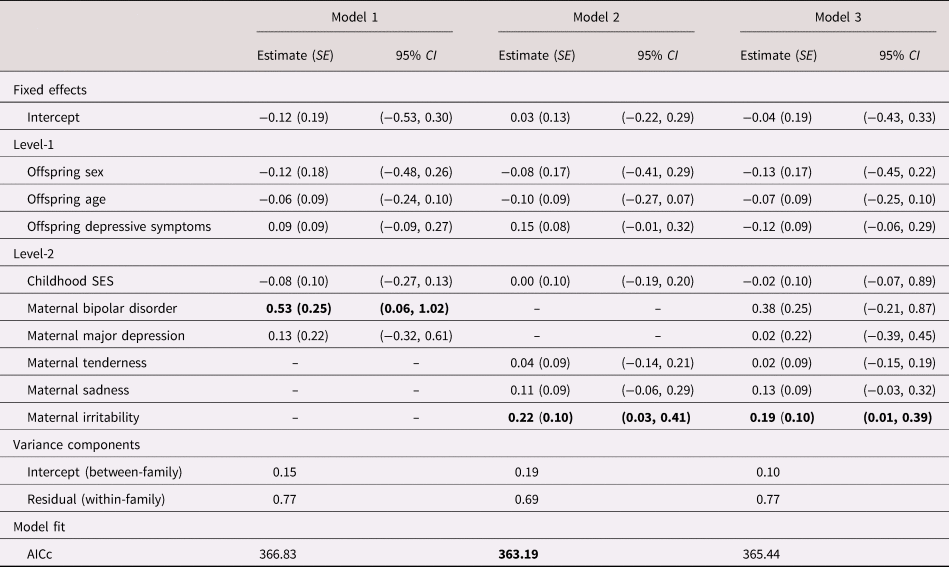
Results of multilevel models predicting maternal use of punishing responses are presented in Table 4. In model one, BD (but not MDD) significantly predicted more offspring-reported maternal punishing of negative emotions and this association was robust to covariates. In model two, observed maternal irritability significantly predicted recollected use of punishing responses to negative emotions. This association was robust to covariates and to the inclusion of maternal mood disorder variables in model three. In contrast, BD no longer significantly predicted punishing responses to emotion controlling for maternal affective modeling. Model fit statistics favored model two, indicating that fit was worsened by including maternal mood disorder. Across models, offspring recollection of maternal punishing was positively related to concurrent depressive symptoms.
Multilevel model predicting maternal punish responses from maternal mood disorder, maternal affective modeling, and covariates

Note: Parameter estimates are unstandardized; however, continuous variables were standardized prior to analyses. SE = standard error. CI = bootstrapped confidence interval. Statistically significant parameters (defined by 95% confidence intervals excluding 0) are in bold. The best-fitting model is bold and underlined.
Planned follow-up tests of the best fitting model examined punishing sadness and anger separately, revealing gender differences. Punishing anger was significantly related to more maternal irritability [b = 0.18, 95% CI (0.01, 0.35)] and child sex [b = −0.36, 95% CI (−0.75, −0.04)], such that male offspring recalled more punishing responses to anger. In contrast, female children reported more punishing responses to sadness [b = 0.35, 95% CI (0.00, 0.70)].
Magnify
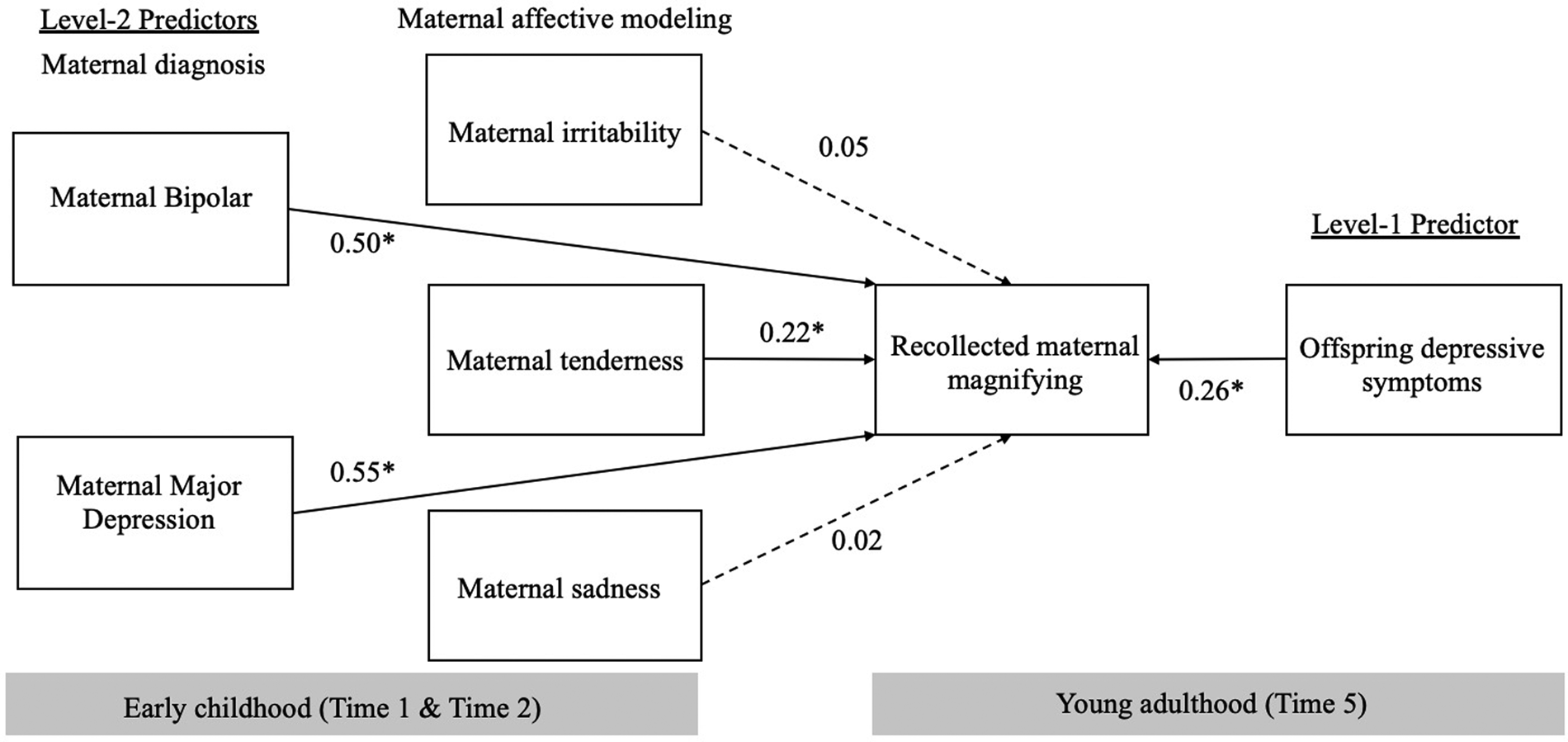
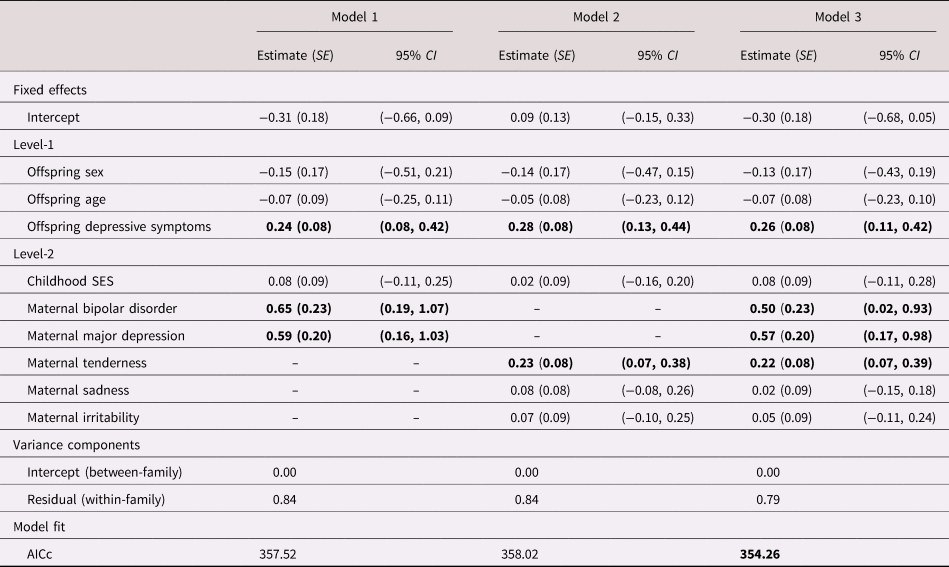
Results of multilevel models predicting maternal magnifying responses are presented in Table 5. In model one, BD and MDD each independently predicted offspring report of maternal magnifying responses, and these associations were robust to covariates (Table 5). Results from model two indicated that offspring reports of maternal magnifying responses were related to more observed maternal tenderness, controlling for covariates. When all predictors were included in model three, maternal magnifying responses were uniquely associated with maternal BD and MDD, observed maternal tenderness, and offspring depressive symptoms (Figure 1). Comparison of model fit statistics indicated that model three was the best-fitting model, suggesting that maternal mood disorder and maternal affective modeling each contributed meaningfully to the prediction of maternal magnifying responses.
Fixed effects from final multilevel model predicting recollected maternal magnifying responses from maternal mood disorder, maternal affective modeling, and covariates.
Note. The figure presents fixed effects only from a multilevel model nesting siblings in families; this model also included a random effect for the intercept. Childhood SES was included as a level-2 predictor but excluded from the figure for clarity. Parameter estimates are unstandardized; however, continuous variables were standardized prior to analyses. *Significant; bootstrapped 95% Confidence Interval excludes 0.00.

Multilevel model predicting maternal magnify responses from maternal mood disorder, maternal affective modeling, and covariates

Note: Parameter estimates are unstandardized; however, continuous variables were standardized prior to analyses. SE = standard error. CI = bootstrapped confidence interval. Statistically significant parameters (defined by 95% confidence intervals excluding 0) are in bold. The best-fitting model is bold and underlined.
Planned follow-up tests examined magnifying sadness and magnifying anger separately. Magnifying anger and magnifying sadness were each significantly associated with maternal MDD [magnifying sadness: b = 0.45, 95% CI (0.03, 0.88); magnifying anger: b = 0.48, 95% CI (0.03, 0.90)] and offspring depressive symptoms [magnifying sadness: b = 0.18, 95% CI (0.03, 0.36; magnifying anger: b = 0.24, 95% CI (0.08, 0.40)]. Magnification of sadness was also related to more maternal tenderness in early childhood [b = 0.29, 95% CI (0.14, 0.45)]. Maternal BD was not significantly related to recalled magnifying of either emotion [magnifying sadness: b = 0.46, 95% CI (−0.01, 0.92); magnifying anger: b = 0.36, 95% CI (−0.13, 0.80)].
Discussion
Parental emotion socialization encompasses several methods by which parents communicate which emotions are acceptable to express, to what degree, and in which contexts. The current study addresses gaps in the literature by measuring multiple aspects of emotion socialization by mothers with MDD, BD, or no psychiatric disorder. This longitudinal study identified (a) links between maternal mood disorder and young adult recollections of emotion socialization, and (b) prospective associations between two distinct aspects of parental emotion socialization, one of which was coded from observed parenting interactions during early childhood (i.e., maternal affective modeling) and one of which was assessed from the vantage point of young adult offspring (i.e., recollected responses to childhood emotions).
Maternal diagnosis and emotion socialization
We hypothesized that maternal mood disorders would be associated with fewer supportive (i.e., rewarding) and more nonsupportive responses (i.e., punishing, neglecting, and magnifying) to childhood expressions of sadness and anger, as reported by young adult offspring. Hypotheses were partially supported, particularly with respect to magnification of negative emotions. Offspring of mothers with both MDD and BD reported elevated magnifying responses to childhood negative emotions, and these associations were robust to covariates. Overall, findings suggest that mothers with MDD and BD struggle to remain regulated when faced with their children's anger and sadness, rendering them more susceptible to contagion of negative emotion.
Associations linking maternal mood disorders with other emotion socialization strategies were less robust. Neither MDD nor BD was related to recollected use of rewarding responses, suggesting that mothers’ use of supportive emotion socialization was resilient to diagnostic status. This is consistent with studies demonstrating nonsignificant associations between dimensionally assessed depressive symptoms and self-reported supportive responses (Breaux et al., Reference Breaux, Harvey and Lugo-Candelas2016; Nelson et al., Reference Nelson, O'Brien, Blankson, Calkins and Keane2009) and extends this finding to a clinical sample of mothers meeting diagnostic criteria for mood disorders.
Young adult recollections of maternal neglecting and punishing responses were higher among offspring of mothers with BD (but not MDD). The association between BD and punishing responses was robust to covariates but declined to nonsignificant when maternal affective variables were included in the model. This may suggest that the link between maternal diagnosis and punishing responses reflects variance shared between BD and maternal irritability; however, these variables were not significantly related using simple correlations. Taken together, findings provide modest evidence that mothers with BD may show greater disapproval toward their children's negative emotion displays.
The association between BD and maternal use of neglect became nonsignificant controlling for covariates. Planned follow-up testing by discrete affect revealed significant associations between maternal bipolar and recollected neglect of sadness; however, results should be interpreted with caution given nonsignificant effects in the focal model. Future research should re-examine this association, as well as the observed link between lower childhood SES and more recollected maternal neglect of childhood anger.
Across models, recollected maternal neglect was consistently associated with current offspring depressive symptoms. One possible interpretation is that current depressive symptoms may bias offspring's memories such that more depressed young adults have a more pessimistic interpretation of maternal behavior, thus recalling more instances of maternal neglect. Alternately, lower maternal emotional involvement in childhood may place offspring at higher risk for depressive symptoms, such that maternal neglecting responses represent a crucial pathway to depressive symptoms in the next generation. In the current study, depressive symptoms were assessed at the same time as maternal responses to childhood emotions, limiting our ability to empirically distinguish between competing interpretations, and possibly over-estimating this relationship due to shared method variance. Future longitudinal research is needed to assess links between maternal BD, neglecting responses to negative emotion, and offspring depressive symptoms over time, and to rigorously investigate the possibility of mediation through maternal emotion socialization behaviors.
In the current study, maternal MDD was not significantly related to offspring reports of neglecting and punishing responses. This contrasts with a small body of research linking nonsupportive emotion socialization to MDD (Silk et al., Reference Silk, Shaw, Prout, O'Rourke, Lane and Kovacs2011) and maternal depressive symptoms (Nelson et al., Reference Nelson, O'Brien, Blankson, Calkins and Keane2009; Premo & Kiel, Reference Premo and Kiel2016), each of which assessed emotion socialization through parents’ self-report. Given that mood is known to influence self-perceptions, depressed mothers may have shown a negative bias in their self-reports, reporting themselves as using neglecting and punishing strategies more often than they did (Parent et al., Reference Parent, Forehand, Dunbar, Watson, Reising, Seehuus and Compas2014). Alternately, in the current study, offspring of mothers with MDD may have recalled their caregiving experiences in a positive light, reporting fewer nonsupportive responses than their mothers actually provided. Confidence in our results is strengthened by prior evidence of moderate concurrence in prospective and retrospective reports of family emotional environment (Bell & Bell, 2018), as well as links between observed and recollected aspects of emotion socialization documented in the current study. Further longitudinal research is needed to assess the validity of offspring recollections and to investigate the predictive significance of both observed and recalled emotion socialization for offspring outcomes over time.
Differences in associations with MDD versus BD may also reflect differences in the disorders themselves. Given that BD involves alternation between depressed and manic mood states, mothers with BD may be more inconsistent in their emotion socialization behavior, providing offspring with more examples of different nonsupportive responses. Furthermore, discrepancies may reflect variation in symptom severity and chronicity. At the time that they enrolled in this study, mothers with BD were more likely to have had a mood episode within the previous four months than mothers with MDD (79.0% vs. 32.8%), which may reflect more severe and/or active psychopathology in the bipolar group. Future research is needed regarding the role of historical and current symptomatology, measured dimensionally as well as categorically, in predicting emotion socialization behavior.
Coherence of emotion socialization
Although findings provide evidence that maternal emotion socialization practices may differ by mood diagnosis, maternal responses to negative emotion recollected in young adulthood were more consistently related to the patterns by which mothers modelled affect in the presence of their young children. Model fit statistics indicated that rewarding and punishing responses were best predicted by maternal affective variables only, whereas neglecting and magnifying responses were best predicted by maternal mood disorder and maternal affective modeling; notably, no significant mood disorder effects emerged in the best-fitting model predicting neglecting. Robust prediction by maternal affective modeling points to variability in emotion-related parenting among mothers with MDD and BD and provides evidence for the coherence of measures tapping multiple aspects of emotion socialization across time.
In particular, results provide preliminary evidence for the validity of young adult recollections of parental response to negative emotions as reported on the EAC, building on evidence of convergent validity in the form of concurrent links reported between recalled responses to negative emotions and psychopathology among adolescents (Klimes-Dougan et al., Reference Klimes-Dougan, Brand, Zahn-Waxler, Usher, Hastings, Kendziora and Garside2007; O'Neal & Magai, Reference O'Neal and Magai2005) and young adults (Garside & Klimes-Dougan, Reference Garside and Klimes-Dougan2002). To our knowledge, this is the first evidence that observations of emotion socialization practices by mothers in early childhood are associated with recollections of emotion socialization by young adult offspring. These associations, though modest in size, are remarkable given differences in methodologies (observations vs. young adult recollections) and aspects of emotion socialization (affective modeling vs. responses to emotion), and the fact that they were assessed more than a decade apart. These findings add to our confidence that the EAC in young adulthood is capturing useful information regarding childhood experiences.
We predicted that observed maternal irritability would be associated with recollected punishing and magnifying responses, observed maternal sadness would be associated with recollected neglecting and magnifying responses, and observed maternal tenderness would be associated with recollected rewarding responses. These hypotheses were partially supported. As expected, maternal tenderness in early childhood predicted more rewarding responses to childhood emotions, suggesting coherence between theoretically adaptive aspects of emotion socialization measured more than ten years apart. Rewarding responses to childhood emotion were also modestly associated with lower depressive symptoms; more longitudinal research is needed to distinguish whether current depressive symptoms bias recollection of rewarding responses, or whether mothers’ supportive responses to negative emotions lay an important foundation for long-term mental health.
Also consistent with hypotheses, observed maternal sadness predicted greater recalled neglect of children's emotions, indicating that mothers who are consumed with depressed mood may find it difficult to respond to the emotional needs of their children. This finding echoes unique associations linking maternal depressive symptoms (including sadness) with nonresponse to children's negative affect in preschool-aged children (Breaux et al., Reference Breaux, Harvey and Lugo-Candelas2016). Furthermore, observed maternal irritability predicted young adult recollections of punishing responses, suggesting that mothers who showed under-controlled frustration toward their children during naturalistic interactions also tended to communicate disapproval of their children's emotion displays. This is consistent with prior research linking parents’ negative emotionality and punitive responses to children's negative emotions in community samples (Fabes et al., Reference Fabes, Leonard, Kupanoff and Martin2001; Mirabile, Reference Mirabile2014), suggesting that this co-occurrence is not unique to clinical populations. In the current study, planned follow-up analyses suggested that the link with maternal irritability was driven primarily by punishment of child anger and differed by child sex: male offspring recollected more punishment of their anger expression, whereas female offspring recollected more punishment of expressed sadness. This fits with a larger literature on gender differences in emotion socialization and may suggest that mothers were attempting to discourage sex-stereotyped emotional expressions or that they responded nonsupportively to more frequent expressions of anger by sons and sadness by daughters (Garside & Klimes-Dougan, Reference Garside and Klimes-Dougan2002; Klimes-Dougan et al., Reference Klimes-Dougan, Brand, Zahn-Waxler, Usher, Hastings, Kendziora and Garside2007).
Some unexpected findings also emerged. Observed maternal tenderness predicted fewer offspring-reported neglecting responses, a finding driven primarily by neglecting responses to children's sadness. Although not predicted, this finding is theoretically consistent with a pattern of maternal emotional unavailability in the face of child distress. Contrary to hypotheses, maternal magnifying responses were significantly associated with more observed maternal tenderness, rather than sadness and irritability. Planned follow-up analyses by discrete emotions indicated that this unexpected finding was specific to magnification of child sadness: mothers who showed high levels of tenderness toward their children were recalled by their offspring as tending to mirror and amplify child distress. Although maternal tenderness is often perceived as positive, this link may suggest a maladaptive tendency to over-empathize with their children's sadness and respond with personal distress. Indeed, magnifying responses to both anger and sadness were associated with young adult depressive symptoms. Future longitudinal research is needed to confirm links between magnifying responses to negative emotion and offspring depressive symptoms over time, as well as to evaluate the potential of magnifying responses as an intervention target for families affected by maternal mood disorders.
Strengths, limitations, and conclusions
This study has several strengths, most notably its use of longitudinal data and diverse measurement strategies to investigate the association between observed emotion socialization in early childhood and recalled emotion socialization in young adulthood. MLM is a promising analytic strategy appropriate for the nested nature of sibling data, correcting standard errors and degrees of freedom to adjust for correlations between sibling pairs. Furthermore, the study employs a unique sample that includes offspring of mothers with major depression as well as BD, a comparatively less studied group.
In addition to these strengths, the current study has limitations to be addressed in future research. Attrition contributed to relatively small sample size, preventing rigorous correction for multiple comparisons; however, our use of omnibus tests and model fit comparison mitigated reliance on significance testing. Participants were predominantly White, upper-middle class, and recruited from one major metropolitan area. Although racial demographics were reflective of the region from which the sample was drawn, the current sample is not representative of the broader clinical population of women with mood disorders in terms of race, education, income, and marital status (Shippee et al., Reference Shippee, Shah, Williams, Moriarty, Frye and Ziegenfuss2011). Sample homogeneity complicates efforts to generalize findings to more diverse samples or to families with paternal depression. Further, groups were defined based on lifetime diagnosis and did not clearly distinguish mothers with active symptomatology. Future research should employ dimensional measurement of depressive and manic symptoms, as well as potential underlying deficits such as emotion dysregulation, consistent with a Research Domain Criteria (RDoC) approach.
Regarding measurement of emotion socialization, different aspects of emotion socialization behaviors were assessed in early childhood and young adulthood (affective modeling vs. responses to child emotion), such that we cannot directly compare observed and recollected emotion socialization. Offspring reports were limited to maternal responses to negative emotions; however, socialization of positive emotions may also be altered in the context of maternal mood disorder, with implications for offspring well-being (e.g., Katz et al., Reference Katz, Shortt, Allen, Davis, Hunter, Leve and Sheeber2014; Yap, Allen, & Ladouceur, Reference Yap, Allen and Ladouceur2008). Future research should address these gaps and examine offspring adjustment outcomes across development, differentiating between offspring mood as a confound versus an outcome of parental emotion socialization.
In conclusion, results suggest coherence in emotion socialization across time, measures, and constructs; as expected, mothers who struggled to regulate their own negative affect were recalled as responding maladaptively to their children's negative emotions, whereas mothers who showed greater tenderness were recalled as responding supportively. The demonstrated link between early childhood observations and young adult recollections provides some preliminary support for the use of retrospective self-reports of emotion socialization. Moreover, this study provides evidence that mothers with both major depression and BD struggle with adaptive emotion socialization, in particular by showing a heightened tendency to magnify their children's anger and sadness. Such findings suggest that mothers with affective illness may benefit from interventions that help parents to respond effectively to children's negative emotions without personally sharing those emotions. The current study represents an important step in our understanding of emotion socialization in the context of maternal mood disorders, with implications for research and clinical practice. Future research should continue to investigate the interrelations of different aspects of emotion socialization, advancing our understanding of adaptive and maladaptive caregiving across the lifespan for parents with and without mood disorders.
Acknowledgments
This research has been supported by the National Institute of Mental Health (NCT00001170), the Catherine T. MacArthur Foundation Research Network on the Transition from Infancy to Early Childhood, Graduate Research Fellowships awarded to the first and second author from the National Science Foundation, and a doctoral fellowship awarded to the first author from the University of Minnesota. The third author is now at the American Psychological Association, Washington, DC. The authors especially acknowledge the families who generously participated in this study, as well as the critical contributions of Anne Mayfield and many research investigators, students, and research assistants who made this study possible.