



“Yes, thinking meat! Conscious meat! Loving meat. Dreaming meat.”
Terry Bisson, They’re Made Out of Meat (1991)
R1. Introduction
The issue of “conscious AI” is of immense and increasing importance both within and beyond academia. The topic is rarely out of the news. Influential voices warn of the dangers of both false negatives (failing to see consciousness in AI if it in fact exists) and false positives (wrongly attributing consciousness to AI) (Bengio & Elmoznino, Reference Bengio and Elmoznino2025; Long et al., Reference Long, Sebo, Butlin, Finlinson, Fish, Harding, Pfau, Sims, Birch and Chalmers2024).
As the debate unfolds – in part through this collection of target articles, commentaries, and response – we should keep in mind that what we collectively think about the plausibility of conscious AI already carries enormous importance, whatever the reality may be. For example, widespread credence for the idea that AI is (or could be) conscious motivates calls for “AI Welfare” (Long et al., Reference Long, Sebo, Butlin, Finlinson, Fish, Harding, Pfau, Sims, Birch and Chalmers2024), which in turn adds momentum to the idea that AI systems could have “rights.” Frontier AI systems are already showing signs of (loosely speaking) “self-preservation,” for example, by attempting to disable oversight systems (Meinke et al., Reference Meinke, Schoen, Scheurer, Balesni, Shah and Hobbhahn2024). This is clearly dangerous behaviour. As AI systems become more autonomous and more capable, such dangerous behaviours are likely to increase. If AI systems are granted “rights,” we may be legally prevented from turning them off, with potentially disastrous consequences. On the other side, of course, is the argument that to deny conscious entities rights (such as the right to continue existing) would be to commit a grave moral error, following the long tradition of similar errors human beings have made in the past.
This is one among many reasons why we should care about the prospects for conscious AI and about the consequences of conscious-seeming AI. My own view remains that conscious AI is extremely unlikely, especially for silicon-based digital systems. (As in the target article, I reserve the term “AI” for such systems unless specified otherwise.) But without a consensus understanding of the sufficient conditions for consciousness, things remain uncertain. This is why the breadth and depth of commentary are so welcome. Even though the question of “AI consciousness” cannot yet be settled definitively, the question of whether (or to what extent) consciousness is substrate dependent is emerging as a key research challenge, carrying both immediate and long-term ethical, social, economic, and political consequences. A robust and informed debate is therefore a very good thing.
R1.1 Preliminaries
My target article progressed through four stages: (i) identifying psychological biases that might lead to over-attribution of consciousness to AI; (ii) setting out challenges to computational functionalism; (iii) making a case for biological naturalism, and (iv) discussing ethical implications of AI that either is, or seems to be, conscious. The majority of commentaries focused on (ii) and (iii), and I will focus my response on these topics (Sections R2–R5), returning to (i) and (iv) later on (R6).
To frame things, I will assume that an intact, healthy, embodied, and embedded human brain, when in certain states, is sufficient for consciousness. One can then ask which aspects of this system are necessary and/or sufficient for consciousness. Potential answers can be arranged on a scale of (roughly) granularity or “level of description.” At one extreme, proponents of panpsychism claim that no aspects of such a system are necessary. Consciousness, according to panpsychism, is a fundamental property of the universe. At the other extreme, some (mostly outdated) views might assert that human-level rational thinking or language is inseparable from consciousness; the historical anchor here is Descartes.
On this scale, computational functionalism (CF) is the claim that the computational level of description is sufficient for consciousness. Implement the right kind of computation (in whatever substrate is capable of this), and there will be consciousness. Biological naturalism (BN) is the claim that other (primarily lower-level) properties of biological systems are necessary, though not necessarily sufficient, for consciousness. Put this way, both CF and BN are placing bets on what counts. As with all bets, nothing is certain. My target article (henceforth CAIBN) attempted to shift credences away from CF and towards (some version of) BN.
Three further points will finish setting the scene. First, some commentators imply that my arguments against CF depend on BN being true (e.g., Dung and Michel). This is not the case. While the arguments contra CF and pro BN reinforce each other, they do not depend on each other. Scepticism about CF opens space for other ideas about necessary and/or sufficient conditions for consciousness, but BN is one among many alternatives [integrated information theory, for example, offers another (Albantakis et al., Reference Albantakis, Barbosa, Findlay, Grasso, Haun, Marshall, Mayner, Zaeemzadeh, Boly, Juel, Sasai, Fujii, David, Hendren, Lang and Tononi2023); see also Piccinini]. At the same time, as Lerchner notes, evidence for BN does constitute evidence against CF, at least for standard digital computation. And if CF is broadened to include other (perhaps more “biological”) forms of computation (CAIBN 3.4, R3.3), then it loses the substrate flexibility needed to license claims of consciousness in standard digital systems, undermining its own rationale for computational sufficiency in the process.
Second, the bets placed by CF and BN are asymmetric. CF is a claim about sufficiency across substrates. This imposes a high evidential burden which I believe remains unmet; CF mostly remains assumed rather than explicitly argued for (R2, R3). BN is the logically lighter claim that some biological substrate properties are necessary for consciousness; multiple accounts are available for why this might hold (R4, R5). It’s worth recalling that BN comes in various flavours, from “weak” (the functional organisation necessary for consciousness requires biological implementation) to “strong” (consciousness depends on intrinsic properties of biological substrates); see CAIBN 5.0 and CAIBN Table 1. Neither entails carbon chauvinism.
Finally, and crucially, for consciousness in AI to be rendered highly implausible, it’s enough for CF to be false. It is not necessary to show that BN is true.
R2. Holding out for CF
Many commentaries sympathise with at least some aspects of my critique of CF (for example, Metzinger, Lerchner, Piccinini, Wiese, and Cao). But there are some who leap to its defence. To respond, it will be useful to rehearse two distinctions. First, CF is not the same as functionalism in general (CAIBN 3.0). The latter is the view (broadly) that mental states, including conscious mental states, are properties of the internal functional organisation of a system. The former, by claiming that computations are sufficient for conscious mental states, is a subset of functionalism. Buying functionalism doesn’t mean buying CF. Indeed, weaker flavours of BN are varieties of functionalism in general (stronger versions may be compatible too, CAIBN 5.5). From the other side, retreating from CF to functionalism in general (or broader forms of computation, R3.3) sacrifices the substrate neutrality which licenses conscious AI and which motivates the very idea of CF (R3.1).
Second, questions about functionalism (whether computational or otherwise) should be distinguished from questions about the functions of consciousness (broadly, what consciousness is for; Dolega & Cleeremans). While functionalism, through its focus on mechanisms, provides a natural framework for addressing questions about the functions of consciousness, there is no direct line from functionalism to functions. One can imagine consciousness having functions without buying into functionalism; equally, functionalism being true doesn’t determine what (if any) functions consciousness has.
R2.1 Defending CF
I’ll start with Michel. His commentary puts the case for CF particularly strongly, and my responses pertain not just to him but to pro-CF views more generally. Broadly, Michel encourages us to “bet on functionalism” mainly because, in his view, it has been reasonably successful at explaining other psychological capacities, such as memory and language, and because it’s doing a decent job of explaining various aspects of consciousness. Examples include the difference between conscious and unconscious mental states, binocular rivalry, and the like.
There are five main problems with Michel’s argument. First, he thinks my case against CF depends on BN being true: “Seth’s arguments do not establish the metaphysical necessity of biology and thus are harmless against computational functionalism.” But as clarified above, the primary arguments against CF do not depend on BN being true.
Second, he doesn’t consistently distinguish functionalism from CF. Betting on CF is riskier than betting on functionalism. Even for cognitive processes besides consciousness, purist computational views are increasingly under pressure. A key argument in CAIBN (which doesn’t depend on BN being true) is that the brain’s functional properties are likely inextricable from their material substrate, which undermines the view that these properties consist solely in (Turing) computations [see also (Brette, Reference Brette2026; Chirimuuta, Reference Chirimuuta2024), R3]. From the other direction, the turn in cognitive science towards embodiment, embeddedness, and dynamics [(Newen, De Bruin, & Gallagher, Reference Newen, De Bruin and Gallagher2018); see also Silberstein, Bowes, Mitchell & Jennings] also suggests that substrate-independent computations are insufficient to explain cognitive properties. Both lines of argument suggest that broader functionalist frameworks are needed. When it comes to consciousness, the pressure increases: consciousness is primarily about being (or feeling) rather than doing, and so it is a priori less well suited to modes of explanation – such as substrate-independent computation – that are primarily about doing (though see Fleming & Shea, R5.4).
The third problem: even if computational explanations are instrumentally useful in explaining some specifically consciousness-related phenomena in humans, it does not follow that computation provides a sufficient basis for consciousness. We already know that humans are capable of consciousness. For the key question of whether AI can be conscious, it is not enough to use CF instrumentally: whether or not CF is true becomes critical. Rather than simply betting on CF, positive arguments in its favour are needed.
Fourth, and related: Michel’s argument is a variety of induction, but the key inductive step is unsupported. While psychological capacities like memory and language can, in some form, be uncontroversially characterised in terms of (potentially computational) functions, the same cannot be said for consciousness. Assuming that computationalist explanations will work as well for the latter as for the former requires assuming that consciousness is relevantly similar – i.e., that computations are sufficient – which is precisely the claim at issue.
Finally, Michel argues that there are no reasonable alternatives to functionalism. He dismisses biological theories and claims that predictive processing is defined computationally. However, one of the exciting outcomes of this set of commentaries is a promising research agenda for BN, which includes (but does not depend on) non-computational versions of predictive processing (R5). I am reminded here of a quote from Bernard Williams: “Historical understanding … can help with the business, which is quite certainly a philosophical business, of distinguishing between different ways in which various of our ideas and procedures can seem to be such that we cannot get beyond them, that there is no conceivable alternative” [(Williams, Reference Williams2008), p.496].
Moving on, Blum & Blum seem to strongly advocate for CF (and carefully distinguish it from functionalism in general) via their “Conscious Turing Machine.” As the name suggests, their model adheres to the principles of standard discrete digital computation, though there is also emphasis on embodied and environmentally embedded aspects. Their model also incorporates a variety of elements from several prominent theories of consciousness, but they do not explain why an implementation of their model would instantiate consciousness, rather than merely instantiate a computational model of consciousness. Note that even for “computational” theories of consciousness, the computational framing is arguably convenient rather than necessary (CAIBN 3.6). Like many proponents of such theories (Dehaene, Lau, & Kouider, Reference Dehaene, Lau and Kouider2017), Blum & Blum seem content to assume CF rather than justify it. When it comes to conscious AI, the circularity of their argument is exposed by their “Axiom 1,” which asserts that computational processes of broadcast and attention result in a “unitary experience” – but this axiom includes the very claim that needs justifying.
While Blum & Blum think that “conscious AI is inevitable,” Dung is more circumspect, noting correctly that arguments on both sides (CF and BN) remain inconclusive. However, he overlooks the asymmetry of the corresponding claims: CF is about substrate-general sufficiency, while BN is about biological necessity (R1.1). He goes on to provide five arguments supposedly in favour of CF. However, three of these do not seem relevant to computational sufficiency: folk intuitions about AI consciousness (R6.1), desirability for conceptual engineering, and supposed weaknesses of BN. The remaining two – evolutionary function and explanatory unification – are more appealing, but as Dung concedes, they fall far short of establishing CF. They also seem compatible with BN, or some other form of substrate dependency (R4, R5; Jablonka et al.). Altogether, his arguments offer some reasons why one might want CF to be true, rather than evidence that it is. Having said this, Dung calls me out on a logical error, which I’ll deal with next.
R2.2 CF is not strictly necessary for conscious AI
Dung points out that my statement that “Conscious AI requires […] computational functionalism to hold” is strictly incorrect. Chrisley makes the same point. They are right, and I’m grateful to both.
Chrisley offers an analogy: “McLarenism” – the thesis that owning a McLaren is sufficient for winning a Grand Prix. This thesis is clearly false, since other teams can and do win races. But McLarenism being false does not mean that a McLaren can’t win. By analogy, even if CF is false, AI can still be conscious. While entertaining, the analogy is misleading. Only one car can win a race, which makes sufficiency a relational condition rather than an intrinsic condition – and consciousness is (though see Shanahan) an intrinsic property.Footnote 1 A more appropriate analogy, from the perspective of sufficiency, would be the thesis that owning a (properly functioning) McLaren is sufficient but not necessary to go faster than 200 mph. This thesis is likely true, removing the force of the analogy.
Nonetheless, both Chrisley and Dung are correct that, strictly speaking, CF being false does not exclude conscious AI (again, for standard digital systems). But it does not matter. It is indeed conceivable for AI to be conscious even if CF is false, if some other property turns out to be sufficient. However, it is hard to imagine what such a sufficiently substrate-flexible property might be, if not computation. The possibility of conscious AI is almost always motivated, implicitly or explicitly, by the assumption that substrate-flexible computations provide a sufficient basis for consciousness (Butlin et al., Reference Butlin, Long, Elmoznino, Bengio, Birch, Constant, Deane, Fleming, Frith, Ji, Kanai, Klein, Lindsay, Michel, Mudrik, Peters, Schwitzgebel, Simon and VanRullen2023). In short, conscious AI does not require CF to be true, but without CF being true, there are no good reasons to believe it is plausible.Footnote 2
R3. The remit of computation
Because CF is the claim that computation (of the right kind) is sufficient for consciousness, much turns on what counts as “computation.” There are three main options: (i) standard digital (Turing) computation; (ii) narrower forms in which fewer things compute (perhaps none); and (iii) broader forms according to which many things compute (perhaps everything). The challenge for CF is that it turns out to be implausible whichever option one favours. Broader forms sacrifice the substrate neutrality which motivates the very idea of CF (and which licenses claims of conscious AI). Narrower forms are either poorly motivated or lacking in discriminatory power. And the standard view is a poor description of the brain, such that CF loses its motivation and credibility.
In this section, I’ll discuss the three views of computation before moving on to related issues: embodiment/embeddedness, time, and the crucial distinction between simulation and instantiation.
R3.1 Standard digital computation
In standard digital (Turing) computation, a physical system computes when it implements an algorithm, understood as a sequence of steps mapping one (discrete, denumerable) string of symbols to another (Turing, Reference Turing1936). Thanks to its emphasis on medium/substrate independence, Turing computation enshrines a sharp conceptual distinction between software (algorithm) and hardware (substrate), a distinction which the von Neumann architecture made concrete through its physical separation of processing and memory. This standard view is not limited to algorithms implementing old-fashioned symbol manipulation. The artificial neural networks which power current AI may seem more “brain-like,” but they too live in Turing World, and they too inherit the sharp separation of software from hardware.Footnote 3
CF is largely motivated by this standard view. The substrate neutrality of this view licenses the idea – central to CF – that the computations themselves are sufficient. And here lies the challenge (CAIBN 3.3-3.5). Evidence that substrate properties matter for brain function is evidence against the sufficiency of substrate-neutral computations, which in turn is evidence against CF [see also (Chirimuuta, Reference Chirimuuta2024)]. In other words, the inability to separate what brains do from what they are undermines the assumption that everything that brains “do” – including consciousness – is a matter of substrate-independent computation.
R3.2 Narrowing computation
Both Fields & Glazebrook and Lerchner argue that computation is inherently observer dependent: that whether a physical system is said to compute or not depends on how an external observer interprets its dynamics.Footnote 4 As Lerchner points out (echoing note 19 in CAIBN), if physical computation is observer-dependent, this puts CF in a bind: either consciousness is observer-dependent (“not a real-world phenomenon”), or it is not a matter of computation [see also (Lerchner, Reference Lerchner2026)]. Moreover, observer-dependent computation lacks the discriminatory power to determine whether a candidate system has properties which depend constitutively on computation – a determination which CF requires.
Such reasons lead Fields & Glazebrook to suggest reorienting questions about whether AI could be conscious to questions about what such systems could be “aware of,” if they are conscious (see also Shevlin). They generously note that this echoes my “real problem” approach to consciousness, which is all about explaining (and predicting) the functional and phenomenological properties of consciousness (Seth, Reference Seth2016). I agree there is merit in speculating about the potential umwelts of conscious AI (Shanahan, McDonell, & Reynolds, Reference Shanahan, McDonell and Reynolds2023). But this approach has a better grip when applied to systems which we are already confident are (or can be) conscious, as opposed to determining whether a system has this capacity. The reorientation suggested by Fields & Glazebrook is therefore better suited to non-human animals than to AI [(Birch, Schnell, & Clayton, Reference Birch, Schnell and Clayton2020; Singhal, Birch, & Seth, Reference Singhal, Birch and Seth2026), see also Birch, R6].
Observer-dependency is a serious challenge to computationalist views, especially to arguments for conscious AI based on such views (Lerchner, Reference Lerchner2026). However, many efforts in the philosophy of computation have attempted to specify observer-independent criteria by which a physical system may be said to compute (Anderson & Piccinini, Reference Anderson and Piccinini2024; Cantwell Smith, Reference Cantwell Smith and Scheutz2002; Wolpert & Korbel, Reference Wolpert and Korbel2025). These criteria restore discriminatory power by enabling distinctions between systems that compute (in some specific sense) and those that do not.Footnote 5 But since these criteria are generally broader than Turing computation, they sacrifice substrate neutrality, undermining CF from a different direction.
R3.3 Broadening computation: Is life computational?
Let’s first set aside maximalist pan-computationalist views according to which everything (even a bucket of water) computes, or which view computation as physically fundamental (Wolfram, Reference Wolfram2002). Like full observer-dependency, these views also lack discriminatory power. And even if pancomputationalism is true, this in no way mandates the conclusion that the type of computation responsible for consciousness in brains can be realised in anything other than brains (see “computational BN,” CAIBN 5.3).
Perhaps the most provocative commentary advocating a broader computationalism comes from Richards & Agüera y Arcas [see also (Agüera y Arcas, Reference Agüera y Arcas2025)]. They claim that life itself is “inherently computational.” This allows them to cast BN as a computational theory, in stark contrast not only to my version of BN but also (probably) to all versions. They agree with me that processes like prediction, homeostasis, and autopoiesis are linked to consciousness, but they claim – contra me – that these processes “can only be implemented by physical systems that can be characterised as computers engaged in computation” [emphasis in original]. This is admirably clear. They are not merely saying that fundamental life processes, such as autopoiesis, can be characterised computationally, nor that everything is computational. They are saying that life literally is physically implemented computation.
To support this claim, they observe that von Neumann’s “Universal Constructor” provides a mathematical definition of computation as powerful as the Universal Turing Machine: both are Turing-complete (von Neumann & Burks, Reference von Neumann and Burks1966). They then argue that a Universal Constructor, since it can be implemented as a cellular automaton, has “closure with its physical universe,” drawing a contrast with Turing machines which, even in their abstract universe, need separate heads, tapes, and so on. Broadly, since Universal Constructors can grow and self-replicate within their cellular automata universes, they conclude that life is inherently computational.
An immediate problem is that “physical closure” for a Universal Constructor only applies within the abstract universe of cellular automata. There is no closure with respect to the real physical universe. If you run a Universal Constructor on a digital computer, the Universal Constructor does not regenerate or replicate the computer on which it is running. By contrast, (cellular) autopoiesis, for example, is closed with respect to the real physical universe. Living systems continually reconstitute their own physical basis. This is what autopoiesis (roughly) means (Maturana & Varela, Reference Maturana and Varela1980). (Richards & Agüera y Arcas recognise something like this, but they continue to claim that “autopoiesis is still computation.” More on autopoiesis in R5.2; see also Schwitzgebel).
What seems to be happening here is a version of the “Church-Turing Fallacy” (Copeland, Reference Copeland, Zalta and Nodelman2024; Piccinini, Reference Piccinini2020). The Church-Turing thesis is the thesis that, if a function is naturally interpretable as computable, then it is computable by a Turing machine (equivalently, it is Turing-computable; CAIBN 3.0). This thesis may well be true. No counterexamples have been found. But by itself this thesis says nothing about what physical processes count as computations. This is the fallacy: interpreting abstract mathematical propositions such as the Church-Turing thesis (or the Universal Constructor) as having the power to determine whether a physical system is literally computational or not. An example from Richards & Agüera y Arcas: “Since a Universal Constructor is a computer, it follows that any system capable of autopoiesis must be computational.” This does not follow. Here’s what they might have said: if life is naturally interpretable as computation, then it can be computed by a Turing machine (and hence by a Universal Constructor). But this is not what they say.Footnote 6
The aspect of life perhaps most easily interpretable as computation is gene-based self-replication, thanks to the parallels with Universal Constructors. Arguably, one might interpret self-replication as a biological form of computation. Even here, though, there are limits, thanks to the many non-genetic factors involved.Footnote 7 For other aspects of life, like metabolism and autopoiesis, there is much less to lean on.
Richards & Agüera y Arcas try to lean on something when they claim, by analogy with the multiple realisability of functions like flight (compare birds and planes), that life in general ought to be substrate independent: “[in] both biological and technological systems … the substitution of one implementation or substrate for another is commonplace.” This argument, too, misses its mark. While being substrate independent increases the plausibility that a function is computational, not all substrate independent/flexible functions are computational (flight, again, is a good example). Moreover, while flight has a consensus functional description – broadly, anything that moves through the air in a controlled and sustained way – consciousness does not. Another perspective on multiple realisability is that functional processes related to cognition might be realised either with consciousness or without it: the latter might account for the so-called ‘mental workspace’ (J-space) identified in large language models (Gurnee et al., Reference Gurnee, Sofroniew, Pearce, Piotrowski, Kauvar, Chen, Soligo, Bogdan, Ong, Wang, Thompson, Abrahams, Kantamneni, Ameisen, Baston and Lindsey2026; Seth, Reference Seth2026).
Finally, and relatedly, Richards & Agüera y Arcas appear to confuse multiple realisability (different implementations) with substrate independence (different materials). This is a key distinction: evidence for the former is not necessarily evidence for the latter [CAIBN 3.3, (Polger & Shapiro, Reference Polger and Shapiro2016)]. Overgaard, too, suggests I am arguing against multiple realisability for consciousness when I am arguing against substrate independence. As Schlicht notes, a broadly functionalist view allows for (and is partly motivated by) multiple realisability, but CF, at least for standard digital computation, requires substrate independence (or, at least, silicon substrate flexibility).
Summarising, it is difficult to sustain the view that life is inherently computational, let alone a form of substrate-independent computation. By highlighting links between life and consciousness, Richards & Agüera y Arcas end up importing the very substrate constraints that arguably make their view a variety of BN rather than CF.
R3.4 Broadening computation: Other forms
Many commentators focus on forms of computation which lie somewhere in between Turing computation and the views discussed above. These include analogue, reservoir, mortal, neural, and biological, to name just a few – see Friston, Fields & Glazebrook, Ramstead, Hohwy, Aru et al., and Bowes. These broader forms reflect a tendency to redefine computation once it is recognised that some specific narrower form (e.g., Turing computation) is a poor match to biology. The problem for CF is that these broader forms of computation typically trade off against substrate flexibility. And the greater the substrate dependency, the more CF loses its motivation and its credibility.
It could be, as De Brigard notes, that some form of substrate-dependent computation, of the kind implemented in brains, is sufficient for consciousness. If this is so, conscious AI would be possible, but it would have to possess the relevant substrate properties – disembodied silicon-based digital computation would not do. De Brigard is relaxed about what counts as computing in the brain, broadly equating it with fine-grained forms of functionalism [specifically, Andy Clark’s “microfunctionalism” (Clark, Reference Clark1989)]. But if the relevant microfunctional properties can only be implemented in biological systems, then we arrive at a (weak) BN dressed in computational clothes, and without the multiple realisability and substrate flexibility that the term “computation” usually connotes.
Two specific broader forms of computation are worth highlighting: mortal computation (Friston, Hohwy) and biological computation (Aru et al.; see also Kirkpatrick [Reference Kirkpatrick2022], Milinkovic & Aru [Reference Milinkovic and Aru2025)]. Mortal computation (CAIBN 3.4) means that the computations cannot be separated from their implementation and so will “die” when their implementation or substrate “dies.” Friston makes the case that mortal computation (with the additional constraint of in-memory processing) satisfies one element of the BN story I sketched – the mathematical through line from thermodynamics to predictive inference (see also Parr & Broulidakis, R5.0). This argument provides a computational justification for (weak) BN, though the “mortal” is doing more work than the “computation.” Hohwy focuses instead on the possibility that mortal computation may be well suited to explaining functional properties of consciousness, perhaps offering a substrate-dependent alternative to Michel’s research programme.
Aru et al. agree that standard digital computation is likely insufficient for realising consciousness, but they suggest that forms of computation which take into account more details about the brain might be enough. This shifts the question from whether AI as we know it can be conscious, to how brain-like/biological-like AI has to be to move the needle on the credence that it might be conscious. Aru et al. emphasise two properties: the continuous, fluidic nature of biology, and the fact that biological systems are scale-integrated, such that different levels of granularity mutually constrain and define each other [see Figure 1 and (Milinkovic & Aru, Reference Milinkovic and Aru2025; Milinkovic et al., Reference Milinkovic, Seth, Barnett, Carter and Andrillon2025)].
Scale integration in the brain. At subcellular and cellular levels, metabolic constraints shape synaptic transmission. For single cells and populations, electric fields influence neuronal behaviour. At the mesoscopic level, microcolumns and local field potentials capture collective dynamics that arise from and constrain single neuron activity. At the macroscopic level, large-scale fields couple and constrain activity across and within brain areas. Across all scales, continuous processes constrain and integrate emergent dynamics. Adapted by Borjan Milinkovic from Milinkovic & Aru (Reference Milinkovic and Aru2025) and used with permission.
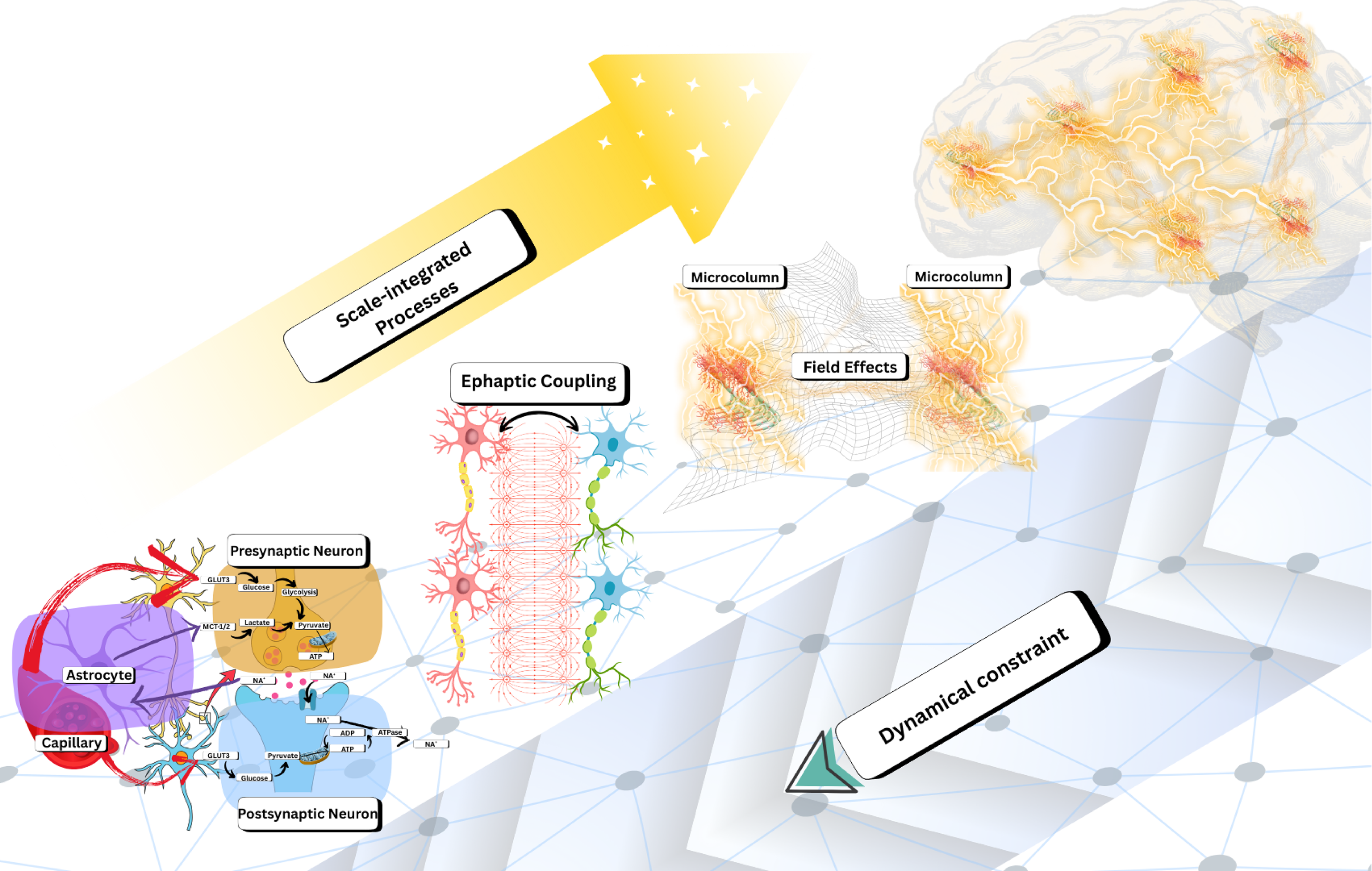
Figure 1. Long description
A diagram of the brain's neural processes. The diagram shows the interactions between different components of the brain at various scales. On the left, there is a detailed view of a presynaptic neuron, postsynaptic neuron, astrocyte, and capillary. The presynaptic neuron releases neurotransmitters, which are received by the postsynaptic neuron. The astrocyte interacts with both neurons and the capillary, facilitating the exchange of nutrients and waste. Moving to the right, the diagram shows ephaptic coupling, where neurons communicate through electrical fields. Further right, microcolumns are depicted, showing how groups of neurons interact within a larger structure. The overall flow of the diagram indicates how these processes are integrated across different scales, from individual neurons to larger brain structures.
Scale integration is particularly interesting (see also Silberstein, Feinberg & Mallat, and Piccinini). As noted in CAIBN 3.5, this property of biological systems contrasts with the sharp separation of scales (and substrate neutrality) fundamental to Turing computation. And, as both Aru et al. and Silberstein argue, it may be relevant both to brain function and to consciousness. Scale integration is related to scale-free dynamics, which is in turn related to the balanced sensitivity to perturbation needed for effective cognition (Silberstein, Reference Silberstein2023). More speculatively, scale integration may be related to the spatially unified, temporally coherent, integrated-and-differentiated flow of conscious experiences [(Milinkovic & Aru, Reference Milinkovic and Aru2025; Storm et al., Reference Storm, Klink, Aru, Senn, Goebel, Pigorini, Avanzini, Vanduffel, Roelfsema, Massimini, Larkum and Pennartz2024); see also Nave]. Intriguingly, recent work using dynamical independence (Barnett & Seth, Reference Barnett and Seth2023) suggests that neural dynamics show greater scale integration (and hence lower “emergence”) in conscious states than during anaesthesia-induced unconsciousness (Milinkovic et al., Reference Milinkovic, Seth, Barnett, Carter and Andrillon2025).
Mediano et al. pick up on the relation between scale integration and emergence, distinguishing between several distinct facets of what they helpfully call “compatibilist emergence.”Footnote 8 They note that while one facet – complete macroscopic causal closure (perfect dynamical independence of macro from micro) – is in tension with scale integration (or generative entrenchment), other facets of emergent dynamics are not and may in fact depend on it. For example, causal emergence – macroscopic variables having greater predictive power over the evolution of a system than available from microscopic descriptions – may only be possible in scale-integrated systems (Rosas et al., Reference Rosas, Mediano, Jensen, Seth, Barrett, Carhart-Harris and Bor2020). What’s more, modelling studies using reservoir computing have shown that optimising for causal emergence can enhance performance in a wide range of simulated environments (Tolle et al., Reference Tolle, Luppi, Seth and Mediano2026). Mediano et al. also hint that the kinds of emergence entailed by scale-integrated systems may map onto basic phenomenological aspects of consciousness, including its unity (Nave) and its integration of intrinsic value with perceptual contents – an idea nicely in line with my own motivations for BN (R5.1).
Mediano et al.’s comment is particularly important because it highlights that terms like “emergence” are moving from being (unhelpful) stand-ins for unexplained magic towards being (helpful) umbrella concepts hosting a variety of well-defined and rapidly evolving quantitative measures, which in turn ramify and extend the basic idea (e.g., a system being “more than the sum of its parts”) in ways that enrich our ability to understand all manner of complex systems, brains and beyond.
Summarising, there are many broader forms of computation, but their substrate dependencies undermine the sufficiency claims of CF and therefore also the prospects for conscious AI. Instead, many of the properties highlighted – whether described as “computational” or not – suggest new ways of investigating how substrate properties might relate to both cognition and consciousness (R5).
R3.5 Embodiment and embeddedness
Bowes – who also argues for broader forms of computation – emphasises the potential importance of embodiment and embeddedness, rather than substrate properties per se. He takes aim at the strong separation between syntax and semantics enshrined in standard Turing computation, arguing that embodiment and embeddedness may dissolve this distinction, at least partially. I am sympathetic, and I agree that embodiment/embeddedness might ground some authentic kind of understanding or aboutness in AI (CAIBN 3.7 and note 40). However, the question of understanding (and semantic content more generally) is separate from the question of consciousness. Even if AI systems (like embodied LLMs) could be truly said to understand things, it does not follow that they will also be conscious. Instead, understanding and consciousness may be separable both in principle and in practice.
In addition, by emphasising non-computational factors (embodiment and embeddedness), Bowes challenges the computational premise that substrate-independent computations are sufficient for cognition and consciousness, and in doing so, provides yet more reason to be sceptical of CF (R2.1).
Mitchell & Jennings also emphasise embodiment and embeddedness, but from the perspective of subjectivity and selfhood. They argue that any account of consciousness will be incomplete without an account of the nature and role of the conscious subject. They cite Zahavi in claiming that “when we experience something consciously, we experience being ourselves having that experience” (Zahavi, Reference Zahavi2008). While I’m all in favour of explaining selfhood (Seth, Reference Seth2021a), I doubt that consciousness necessarily involves the experience of being the subject of experience (Metzinger, Reference Metzinger2024). In my view, experiences of selfhood are multilayered, and the version of BN in CAIBN locates the simplest forms of (biological) consciousness in a shapeless, formless, inchoate – but fundamental – “feeling of being alive.” This is very distant from the metacognitive, reflective form of selfhood implied by Mitchell & Jennings.
Mitchell & Jennings also advocate focusing on relations – between subject and object, between parts of the world and across time – as a productive approach to explaining consciousness. I am glad they highlighted time, for the nature of time provides one more nail in the coffin for CF.
R3.6 Time
As Allen notes, digital computers and brains differ fundamentally in how they relate to time (Seth, Reference Seth2025; Van Gelder, Reference Van Gelder1998). For discrete digital computations, only sequence matters. There could be a microsecond or a million years between two steps in an algorithm, but it would still be the same algorithm. According to CF, slowing the clock speed of a computer to a crawl should make no difference to the conscious experience entailed by the computation. This is at odds both with the nature of brain function and with the phenomenology of consciousness (Buonomano, Reference Buonomano2026).
Neurobiological activity is anchored in continuous time in ways that algorithms, by design, are not. For brains, as for biological systems in general, time is physical, continuous, and inescapable. Brain function is not only embodied and embedded; it is also entimed. The scale-integrated processes that underlie cognition and consciousness are as rooted in physical time as they are in physical substrate. More generally, living systems must resist in continuous time the decay and disorder that lies along the trajectory to entropic sameness mandated by thermodynamics (Friston, CAIBN 4.0). These points reinforce the implausibility of abstracting brain function into the timeless sequence space of digital computation.Footnote 9
What’s more, conscious experience itself is richly dynamic and inherently temporal (Singhal & Srinivasan, Reference Singhal and Srinivasan2021). It flows. It does not stutter from one state to another, with arbitrarily long gaps in between. In the stream of consciousness, the passage of time is continuous, irresistible, and complex, encompassing not only succession but also flow, duration, and persistence. As Mitchell & Jennings put it, “we live in and through time.” If consciousness is inextricable from physical time, as it seems to be, then it cannot be a matter of algorithm alone, and CF is once again in deep trouble.
One could attempt to rescue temporality by allowing algorithms to check a separate clock that tracks physical time. But doing so means the algorithm itself is no longer sufficient, which undermines CF. Similarly, if computation is broadened to include continuous, analogue processes which do track physical time, then this also undermines CF because doing so re-imports substrate constraints.
R3.7 Simulation and instantiation
To complete the discussion of computation, I turn to the distinction between simulation and instantiation, introduced in CAIBN 3.7 and discussed by many commentators (e.g., Ramstead, Blum & Blum, Chiang, Wiese, Dolega & Cleeremans, and Levin). To rehearse the key point: a computational simulation of a phenomenon (e.g., consciousness) will not instantiate that phenomenon unless the target phenomenon is itself a computation of a sufficiently similar kind.
Wiese echoes the main reason for this: digital simulations will not generally replicate the relevant causal relations that are present in the phenomena being simulated and that are required for realising that phenomenon [see also (Brinz, Reference Brinz2026)]. He illustrates the point with Conway’s Game of Life (Gardner, Reference Gardner1970). The causal relations in the game that are responsible for all its interesting phenomena (gliders and the like) are between adjacent cells in the cellular automaton. But these causal relations are not replicated in its implementation basis (R3.3).
Dolega & Cleeremans disagree. They argue that simulations might be able to replicate relevant causal relations, and so might be able to instantiate their target phenomena. They say that simulated hurricanes causally affect simulated ships in SimCity. But this argument, as Wiese points out, confuses apparent causality among simulated entities with physical causality in the implementation basis (CAIBN note 22). Matej Kohár puts the point clearly, arguing that virtual causation is illusory because the (presumed) structure of causal interactions between virtual objects does not map onto the structure of causal interactions between underlying computational objects and processes [(Kohár, Reference Kohár2024), see also (Beisbart, Reference Beisbart2024)].
Turning to consciousness, Dolega & Cleeremans argue that “simulated consciousness” in (for example) an LLM can have causal effects on human users – effects perhaps as powerful as those evoked by conscious human beings. But this confuses the causal effects of a phenomenon (on something else) with the causal relations responsible for instantiating a phenomenon. Even simulations of hurricanes can have causal effects on other things in the real world. If a simulated hurricane in a weather forecast predicts that a real hurricane is on the way, people run for shelter.
What Dolega & Cleeremans appear to overlook is that the design principles of digital computation ensure that causal relations in hardware are explicitly decoupled from causal relations in software, whether these involve simulated boats, Game of Life gliders, or neural network weight matrices.
Chiang treads the same path when he claims that “all the relevant criteria for living systems could be satisfied by software running Turing computation.” But if the relevant criteria include specific physical causal relations, as they no doubt do (consider again autopoiesis), then this is false. Simulating (for example) autopoiesis does not realise the same causal relations needed to instantiate autopoeisis. Chiang imagines a limiting case in which individual atoms, perhaps even quantum effects, are incorporated in the simulation, but this doesn’t help. The granularity of a simulation is orthogonal to whether the phenomena being simulated are inherently computational or not. A more detailed simulation of a hurricane may be more useful, but is no closer to being actually windy. Nor does simulating a cell in more detail make the simulation any closer to being alive.
Things get more complicated when it comes to active inference and the free-energy principle (FEP), concepts which play important roles in my version of BN. As Wiese and Friston (see also Parr & Broulidakis) note, the FEP provides two equivalent descriptions of (some) self-organising, self-maintaining systems, one in terms of physical processes (thermodynamics) and the other in terms of information theory – with the latter underpinning the variational algorithms used in machine learning (Hoffman et al., Reference Hoffman, Blei, Wang and Paisley2013). Given the variational view, wouldn’t a simulation of active inference count as instantiation? This question is posed by, among others, Allen.
As noted in CAIBN 4.2, the complication arises because the principles of learning and inference in the FEP can be abstracted (at least in part) from their biological substrate and implemented in silico (Parr, Pezzulo, & Friston, Reference Parr, Pezzulo and Friston2022). This is where the dual description is critical. The claim is that in living systems, the variational and thermodynamic processes are the same physical process at two levels of description (Friston, Parr & Broulidakis). By contrast, in the Turing world, they are not the same process. The variational implementation is an algorithmic abstraction of a dynamic, continuous-time, substrate-entangled, non-algorithmic biological process of free-energy minimisation. (The importance of time surfaces again here: in living systems time is necessarily continuous since there is a single physical process, while in algorithmic implementations this continuity is broken.)
Wiese amplifies this point, arguing that the FEP supports the claim that the (substrate-specific) causal relations in living systems are relevant to consciousness, as distinct from algorithmic implementations of variational free-energy minimisation in machine learning. (Note, though, that he does not think that only biological substrates can support consciousness, which is helpful since it underlines that his argument does not originate from any affinity towards BN.Footnote 10 )
More on the FEP later (R5.1). Zooming back out, Ramstead makes the strong claim that the ability to computationally simulate X provides no evidence that X is literally computational. While I agree with his message – that one should not overinterpret the ability to simulate things – there are important nuances (CAIBN 3.7). If the best simulation of X is one in which X is simulated as performing computations (according to some definition of computation), then this should increase the credence that X is literally computational. Equally, if the best simulation of X involves the simulation of non-computational processes, then this should decrease the credence that X is literally computational. Compare, for example, Ramstead’s example of simulating the orbit of Jupiter (a non-computational phenomenon) versus simulating the Bubble Sort algorithm, which is a canonically computational phenomenon [though, as Levin points out, even computational simulations of computational phenomena may sometimes be incomplete in that they fail to realise all the corresponding computational properties; see R5.2 and (Zhang, Goldstein, & Levin, Reference Zhang, Goldstein and Levin2024)].
Here’s one important implication of this discussion. The conceit that fine-grained whole-brain simulation provides a path to conscious AI (or immortality) is wholly misguided. The more microscale neurobiological details matter for brain function, the less likely it is that simulating the brain in microscale detail will realise all its properties – including consciousness – for the simple reason that, if such simulations are needed, it is precisely because they suggest that things other than digital computation likely matter.
R4. Consciousness – the bigger picture
Before turning to BN, I want to address several commentaries that consider consciousness in a larger frame. This is because what counts as a reasonable account of consciousness, and of its potential substrate dependency, will depend on one’s metaphysics and one’s worldview. Let’s therefore briefly set aside the pragmatic materialism I favour and explore some wider terrain. We’ll see that the alternatives tend to purchase flexibility and liberality at the cost of discriminative power.
The most radical reconfiguration is proposed by Gómez-Marin, who invites us not only to dispense with materialism but also to suspend the broader worldview of naturalism and to consider instead its counterpart: animism. Instead of a continuity of physical properties among entities (everything is made of physical stuff) and a discontinuity of interiorities (some things are conscious), we have the mirror image: a continuity of interiorities, without continuity of the physical. A mountain can have a soul even though it is made of stone. Perhaps an LLM can have a soul, too. For Gómez-Marin, anthropology is the missing ingredient in facing the challenge of interacting with machine minds.
This is heady stuff. Certainly, anthropological research can help us better understand human engagement with AI, adding diversity and nuance. A starting point here is to explore cross-cultural differences in consciousness attributions [e.g., following (Colombatto & Fleming, Reference Colombatto and Fleming2024)]. Gómez-Marin is also right that AI offers new opportunities to re-examine what we mean by “mind” and by “consciousness” – an optimistic take on the “AI as a mirror” metaphor [(Vallor, Reference Vallor2024a), see also Shevlin, Shanahan]. But while there’s merit in questioning the foundations of knowledge, suspending naturalism means we can no longer make any inferences about the fact of the matter. This is why I was careful in CAIBN (and in R1) to set out ground rules: consciousness exists; some things have it; other things don’t.
Dissatisfaction with materialism is often a wellspring of motivation for alternative metaphysics. This may be especially true for panpsychism – the idea that consciousness is fundamental and ubiquitous. For example, McGilchrist, who favours panpsychism, casts materialism as “the view that consciousness is an unexplained brute emergence from lumpen matter” (his emphasis). This is rather unkind on materialism, on emergence, and on matter. The stuff of biology is anything but lumpen; emergence need not be brute [(Barnett & Seth, Reference Barnett and Seth2023; Rosas et al., Reference Rosas, Mediano, Jensen, Seth, Barrett, Carhart-Harris and Bor2020), R3.4], and formulating explanations is the task at hand, with progress being made (Cleeremans, Mudrik, & Seth, Reference Cleeremans, Mudrik and Seth2025).
For McGilchrist, panpsychism opens the possibility that AI systems (and many other things) might have “experience of a kind” in virtue of being part of a larger conscious entity (perhaps the cosmos).Footnote 11 I, on the other hand, am on record for being impatient with panpsychism, on the grounds that it explains nothing and generates no testable predictions (Seth, Reference Seth2021b). Despite these differences, he and I agree that AI is likely incapable of the kinds of understanding and intelligence that arise for human beings in virtue of experience, and we share concerns about the dangers of being seduced by the confabulations of LLMs when they claim to be conscious (CAIBN 6.2, R6.3, Shevlin, Schneider, and Roelofs). His intuition that LLMs embody a left-hemisphere emphasis on “internal consistency” rather than “truth to experience” rings true to me. Unfortunately, his concerns about confabulations are somewhat neutralised by a panpsychist perspective which allows that AIs might still be conscious (in a way), whatever they do or do not say.
Roelofs, another friend of panpsychism, does an excellent job of exploring the implications of this position for conscious AI but, in doing so, provides more reasons to steer clear. For Roelofs, even if substrate dependence holds for human and animal consciousness, other kinds of systems (including AI) could have different kinds of consciousness, based on different substrates. This again changes the relevant question from “Is this system conscious or not?” to “What sort of consciousness is present in this system?” (see also Fields & Glazebrook, McGilchrist, Shevlin). His conclusion is the opposite of McGilchrist (and me): in his universe of abundant consciousness, we should default to accepting self-ascriptions of consciousness made by AI.
But – as Roelofs recognises – systems trained on lots of writing about consciousness are precisely those for which self-ascriptions can reasonably be doubted (see Schneider). It seems that for Roelofs (though not McGilchrist) this reasoning is outweighed by a metaphysics of abundance. Here, I can only lay my own metaphysical cards on the table. In the absence of a consensus theory of consciousness (reflecting the “humble agnosticism” Roelofs rightly advocates), it seems preferable to adopt a perspective – such as pragmatic materialism – which encourages us to shift our credences about the presence of consciousness on the basis of evidence, rather than to adopt a metaphysics which encourages credulity for the confabulations of LLMs and which makes it almost impossible to deny the presence of consciousness in anything. I’ll return to the issue of testing for consciousness in R6.
At the other end of the metaphysical spectrum, Clark, a comrade and an inspiration in matters of predictive processing, advises me to set aside my attachment to phenomenal realism and join the (badly named) illusionists. For Clark, consciousness is just a label for “a large and complex set of reactive dispositions.” He draws me in by noting that this view is compatible with both CF being wrong and (weak) BN being true.
And yet. Illusionism is indeed badly named. When gulped down, it encourages the view that conscious experiences do not exist (which, as Galen Strawson memorably objected, is “the silliest claim ever made”Footnote 12 ). If sipped from, as Clark advises, then we merely exclude experiential features that are independent of “some profile of reactions or responses.” This “weak illusionism” holds some appeal and seems perfectly compatible with phenomenal realism. This would be the case if experiential features are entailed by (or identical to) physical states which have functional properties that are related to these experiential features, with these functional properties being expressible in reaction/response profiles. In this view, conscious experiences exist, but they might not be what people think they are (Dennett, Reference Dennett2001; Frankish, Reference Frankish2017; Seth, Reference Seth2021a). Should I therefore join the “weak” illusionists? I still resist, partly because the weak and strong varieties are too easily and too often conflated, and partly because the overall “illusionist” framing deflects attention from the real-problem project of explaining the experiential/phenomenal properties themselves (Seth, Reference Seth2016).
Returning to conscious AI, Clark suggests that thinking of consciousness in terms of reactive dispositions changes the landscape, since consciousness and intelligence/cognition are now less distinct than they would otherwise be, and intelligence is already demonstrated (to some extent) in silico. But reactive dispositions cover a much broader range of functions than is typically meant by “intelligence” [though see Fleming & Shea, R5.4]. For example, if the “reactive dispositions” that matter are those at the level of metabolism and autopoiesis, then nothing much changes from the landscape as described in CAIBN. Low-level reactive dispositions simply reimport substrate constraints, making weak illusionism a badly named version of BN.
Shanahan diagnoses a different metaphysical ailment altogether, believing me to be in the grip of “dualistic intuitions” thanks to my ground-rule assertion of phenomenal realism (see also Shevlin). The cure, he thinks, is provided by a Wittgensteinian reorientation from whether X is or isn’t conscious to how we (should) use the word “consciousness” in society-wide conversation. Social and linguistic influences are no doubt important – recall the common conflation of “intelligence” with “consciousness” and the (mis)use of “hallucination” to describe LLM confabulation – but language games have their limits. Shanahan’s appeal to Wittgenstein’s beetle-in-a-box analogy tells us why. The content of the box, whether a beetle or a conscious experience, would only “cancel out” if it has no observable functional effects whatsoever. Yes, consciousness as a purely private dualistic epiphenomenon cancels out. But consciousness as a functionally potent fully real phenomenon entailed by certain physical states does not. Accusations of residual Cartesianism might instead be better aimed at diehard computationalists, for whom a form of dualism remains enshrined in the sharp distinction between replaceable hardware and immortal algorithms – a distinction rejected by a more biological perspective.
Bowes, too, detects a Cartesian ghost in the beast machine. He worries that my description of consciousness as being or feeling, rather than doing, implies a Cartesian intrinsicality at odds with any kind of functionalism, whether computational (Turing-style or – as Bowes prefers – otherwise) or non-computational. I disagree. In CAIBN 5.4, I emphasise that functionalism in general is perfectly compatible with BN and that apparently intrinsic properties may well be understandable in terms of finer-grained functional relationships (see also R2).Footnote 13 There is no tension with the real-problem project here. Only opportunity. As we build explanatory bridges from (potentially functional) properties of embodied, embedded brains to properties of consciousness, we’re doing alright.
R5. Prospects for biological naturalism
This brings me to the many commentaries addressing aspects of BN. It’s first worth recalling that (contra Michel) BN doesn’t need to be true for CF to be false (R1.1). And it may be (as I acknowledge in CAIBN) that my version of BN is wrong in the details or wrong altogether. But BN as a position and research agenda is not obviously wrong. On the contrary – as many commentaries indicate (Block, Cao, Feinberg & Mallat, Friston, Jablonka et al., Lane, Nave, Parr & Broulidakis, Piccinini, and others) – it has plenty going for it.
R5.1 Predictive processing – a wrong turn?
The version of BN I sketched in CAIBN (but by no means all versions) leans heavily on a continuity between predictive processing (PP) as a theory of perceptual content and the free-energy principle (FEP) as an account of living systems. Several commentators worry about this continuity, warning that the PP/FEP package might be too generic to support claims specific to living systems. My response is that PP/FEP as a set of abstract principles is indeed too generic, but when grounded in specific biological properties, it is more than up to the job.
Baltieri & Kanai worry that nothing about PP, the FEP (or active inference) seems exclusive to biological systems (see also Birch). They are correct that, taken individually, each of these ideas can be (and has been) applied more widely. But my case is that, taken together, they provide a compelling throughline from properties like autopoiesis and metabolism to functional and phenomenological properties of consciousness (see also Friston, Parr & Broulidakis). This position in fact seems well aligned with one of Baltieri & Kanai’s suggested “alternatives” – that of providing formal mathematical criteria for what counts as biological (see also Kleiner).
Nave, who has written an excellent book on the FEP (Nave, Reference Nave2025), names the same concern: “[the FEP] is not a unique principle of life but a general description of every ‘thing’.” She then helpfully anticipates my response (the throughline) and indeed lends a hand by suggesting that experiential unity – arguably a universal aspect of consciousness (Bayne, Reference Bayne2010) – may be explicable by precisely the sort of physical unity entailed by metabolism and autopoiesis.
Hohwy, while comfortable with the overall framing in terms of the FEP, is similarly concerned that the FEP itself is too general, but also that a more specific grounding in metabolism and autopoiesis may be too speculative. He advocates “mortal biological computation” instead [R3.4, (Ororbia & Friston, Reference Ororbia and Friston2023)]. For Hohwy, mortal biological computation may account for some functions associated with consciousness, as seen through the lens of “self-evidencing” (Hohwy, Reference Hohwy2026). I am open to this possibility. It complements the “real problem” focus on experiential properties, while prompting questions about the functional competences which may be enabled by scale-integrated systems (scale integration goes hand-in-hand with mortal computation). I am less convinced by Hohwy’s conclusion that “the substrate of mortal computation comes out as precision control of the causal dependencies of nodes within a Markov blanket, working as a generative model.” This seems open to highly abstract interpretations – perhaps useful for elucidating consciousness-specific functions, but less useful as a basis for establishing sufficient conditions for conscious AI.
Godfrey-Smith, while sympathetic to my critique of CF [unsurprisingly, since he inspired a good chunk of it (Godfrey-Smith, Reference Godfrey-Smith2020)], finds a different reason to worry about PP/FEP. He (along with Birch) channels the familiar “dark room argument” – the idea that acting solely to minimise sensory surprise, for example, by hiding away in a dark room, is neither what organisms do nor what they should do if they are to survive and thrive (Sun & Firestone, Reference Sun and Firestone2020). However, when applied to living creatures, the FEP mandates minimisation of prediction error in the long run, rather than only in the short term (Parr & Friston, Reference Parr and Friston2019; Seth et al., Reference Seth, Millidge, Buckley and Tschantz2020). The spider hiding in its dark-room den might be homeostatically fine for a while, but in the long run, hiding away will always be surprising for the spider, given the motivational and emotional states endowed by evolution that drive it to reproduce.
Importantly, the long-run view does not mean that “anything goes” – that any behaviour or function can be rationalised away to some unspecified future (Baltieri & Kanai, Fields & Glazebrook). On the contrary, there is exciting potential to develop PP/FEP (or active inference) models which involve minimisation of sensory prediction error over extended but specific time scales [e.g., (Da Costa et al., Reference Da Costa, Parr, Sajid, Veselic, Neacsu and Friston2020; Da Costa et al., Reference Da Costa, Seth, Friston, Ramstead and Sandved-Smith2026; Friston et al., Reference Friston, FitzGerald, Rigoli, Schwartenbeck and Pezzulo2017; Tschantz, Seth, & Buckley, Reference Tschantz, Seth and Buckley2020)]. These models can make predictions about (for example) how to balance epistemic actions (useful for escaping from dark rooms) with instrumental (goal-oriented) actions – including situations when goals are homeostatic/allostatic priors or set points (Parr et al., Reference Parr, Pezzulo and Friston2022; Seth, Reference Seth, Windt and Metzinger2015).
Parr & Broulidakis propose something like this view, noting that prediction error minimisation in biological systems can be linked to epistemic foraging (e.g., selecting which sensory signals to sample) as well as to planning. They also emphasise (with Friston) the deep connections between thermodynamic and informational free energies, arguing that biophysics and behaviour provide complementary constraints on the dynamics of perceptual inference in biological systems. Two sides, if you like, of the same PP/FEP coin.
Altogether, while the FEP/PP is only one way of substantiating BN, it remains particularly promising. Worries about genericity are defused when its abstract principles are rooted in biological processes like metabolism and autopoiesis, and concerns about predictive power are alleviated by recognising that it isn’t always minimising short-term sensory prediction error that matters but how living systems generate and maintain models of their bodies and worlds under existential constraints.
R5.2 How biological is biology?
Several commentators – prominently Kleiner, Legg, Schwitzgebel, and Solms – wonder whether some of the biological processes I highlight as being potentially necessary for consciousness, such as autopoiesis and metabolism, are restricted to living systems. Of these, autopoiesis is the most interesting to consider.
Autopoiesis was originally defined in the context of living systems, most notably biological cells (Maturana & Varela, Reference Maturana and Varela1980). A key criterion is self-production: a network of processes generates the components that constitute the network itself, thereby continually bringing forth a boundary between the autopoietic system and its surroundings. One can generalise the concept to self-sustaining organisational patterns beyond living systems (Luhmann, Reference Luhmann1990). But these generalisations widen the original meaning of the term (Maturana & Varela, Reference Maturana and Varela1980) and so cannot license conclusions about biological autopoiesis being realisable elsewhere.
Schwitzgebel proposes that “nothing appears to prevent autopoietic processes in a standard computational system.” A robot autonomously ordering new replacement parts might, he says, be minimally autopoietic (Legg suggests something similar). However, this scenario fails to satisfy the self-production criterion because the self-production is externalised (through the ordering of parts) such that the network of processes responsible for maintaining the robot extends beyond the robot. Even though his robot has a plastic shell, constituting a boundary-of-sorts, maintaining this boundary requires ordering external parts. The boundary is not endogenously created.
Schwitzgebel points out that living systems depend on external inputs, such as food. He argues that this dependence is similar to the robot depending on external parts. But the similarity is overstated. All autopoietic systems, being thermodynamically open, must exchange matter and energy with their environment (they have a “turbulent materiality,” as Jablonka et al. poetically put it). The difference, and the aspect of autopoiesis that is missing from Schwitzgebel’s scenario, is that the robot depends on the environment for ready-made components, whereas truly autopoietic systems transform generic substrates into these components (via metabolism). Living systems are organisationally closed in ways that Schwitzgebel’s robot isn’t.Footnote 14
There is room for nuance. As Schwitzgebel notes, even Maturana and Varela allow for some substrate flexibility. This is useful, because it guards against carbon chauvinism. But Schwitzgebel’s scenario generalises too far. It fails to realise the “relations which these [components] must generate to constitute the machine or system as a unity” [(Maturana & Varela, Reference Maturana and Varela1980), p.77]. On the other hand, if a robot could indeed manufacture its own components from generic substrates under energetic constraints, then it might be truly said to be autopoietic, but it would also be considerably closer to a living system than any existing computer or robot. Genuine robotic self-production of this kind, if indeed necessary for consciousness, would vindicate BN – not refute it.Footnote 15
The challenge from Solms is different. He describes a range of computational models which exhibit autopoietic-like properties such as homeostasis and active self-other boundary maintenance. But these are best understood as models or simulations of autopoiesis, not realisations or instantiations (R3.7). The causal relations required for genuine autopoiesis are not present in these models because the implementation basis – the computer running the model – is not itself within the self-producing network of processes.Footnote 16
Changing focus, Kleiner helpfully warns against a “BN of the gaps” in which the aspects of life proposed as necessary are simply those which currently lie outside the scope of artificial systems (see also Birch).Footnote 17 Indeed, a primary challenge for BN is to identify which properties of living systems matter for consciousness and why (points echoed by Birch, Fleming & Shea, Bayne, Dung, and Rodriguez & Farahany) and to determine the substrate flexibility of these properties. For example, autopoiesis is very likely less substrate flexible than allostasis, which is less substrate flexible than Turing computation. This observation highlights that BN is not merely an option on a menu of consciousness ontologies but a vibrant research programme. More on this below.
Kleiner’s formalisations of the BN project are also useful. The generalisation of CF to his “F*functionalism” seems compatible with my definition of weak BN (a subset of weak substrate dependence, CAIBN 5.4), according to which consciousness is a property of functional organisation, but the relevant functional organisation can only be implemented by biological systems. Strong BN, according to Kleiner, applies either when the functional organisation relevant for consciousness “cannot be built” (which is a moving target; see also R6.2) or – more profoundly – when consciousness is not a matter of functional organisation alone.
Levin takes things further, arguing that “our formal models never tell the full story of what something is or what it can and cannot do.” He notes this is true even for canonically computational processes such as the list-sorting Bubble Sort algorithm, which, when implemented in a local way (each item in the list deciding what to do), exhibits all manner of unexpected and unprogrammed behaviours [(Zhang et al., Reference Zhang, Goldstein and Levin2024), R3.7]. The lesson here is to not underestimate what is emergently possible within the broad category of “machines” and that even the dead sand of silicon may not be so (functionally) dead after all. At the same time, as reviewed in CAIBN 4.5, Levin’s pioneering work in developmental and synthetic biology reveals deep reservoirs of functional and agential potential in biological material (Levin, Reference Levin2023) that may be distinctive to such material (thus lying beyond the reach of silicon; see also Jablonka et al., Piccinini, Block). These examples underline the importance of better understanding what kinds of things different substrates – conventional and unconventional, evolved and human-made, artificial and synthetic – are capable of.
Levin’s most provocative idea is that our biological and engineered offspring act as interfaces to a semi-Platonic realm from which mathematical forms and even new kinds of minds ingress into our physical worlds (CAIBN 3.8). This is itself mind-expanding stuff and – whether Platonic or not – emphasises the importance of questioning assumptions about what counts as “mind” or “intelligence” [(Shanahan, Reference Shanahan2016); see also Gómez-Marin, Shevlin]. (Relatedly, Levin also notes that three-dimensional physical embodiment is just one possible manifestation of embodiment; CAIBN 5.7, R3.5).
Altogether, Solms, Schwitzgebel, and Legg usefully identify what is distinctive about biological autopoiesis – self-production from generic substrates – since this is exactly what is missing from their respective scenarios. Kleiner (and others) highlight how BN names an exciting research agenda in the way that CF seems not to be (more on this below), and Levin offers one specific way in which a BN research agenda might flourish.
R5.3 Fleshing out BN
What distinguishes conscious from unconscious living systems and states? In CAIBN, I proposed a general response: consciousness may be biology’s way of implementing multimodal survival-relevant integration across diverse inputs for unified control. Several commentators offered more specific ideas, each of which fleshes out a BN research agenda in a different way (and in doing so further undermines Michel’s claim that there is no alternative to CF). These cluster into three related sets of ideas.
A first set highlights notions of evaluative integration (Cao, Metzinger). For Cao et al., a “valuing subject” optimises things for its own good – it embodies a form of “internalised existential optimisation.” They suggest that, for this process to be associated with consciousness, the evaluative states employed must be integrated across diverse survival-relevant signal types. This fits neatly with my own suggestions [CAIBN 4.0, (Seth, Reference Seth2021a)], but Cao et al. go further. For a specific mental state to be conscious, it must, they say, be accessible to “downstream systems” involved in action, learning, memory, and so on. This suggestion is striking in two ways. First, it denies any meaningful distinction between phenomenal consciousness and access consciousness (Block, Reference Block1995; Mudrik et al., Reference Mudrik, Faivre, Pitts and Schurger2026). Second, it shows how BN can be combined with other theories of consciousness, such as the global workspace theory, to form hybrid theories. This potential for hybridisation is a strength of BN, allowing it to benefit from a rich theoretical milieu (Seth & Bayne, Reference Seth and Bayne2022). CF, by contrast, is difficult to hybridise with theories imposing substrate constraints since doing so would undermine its core claim of computational sufficiency.
Metzinger offers a different constraint on evaluative integration. He suggests that consciousness involves both biological substrate dependence and a self-modelling epistemic space (SES). An epistemic space is a set of possible states or processes of knowing, and an SES involves a system knowing about its capacity to know. For Metzinger, the essence of phenomenality is “being the content of a currently self-modelling epistemic space” (Metzinger, Reference Metzinger2020). One might worry this risks importing an overly (meta)cognitive notion of “knowing” into an account otherwise grounded in more basic properties of living systems. However, Metzinger’s emphasis on physiological arousal and the reticular activating system suggests a different, more biological, take on what the relevant kind of “knowing” might be.
A second set of ideas focuses on candidate biological properties. Here, Lane advocates a strong form of BN. He takes a deep dive into biochemistry, proposing that fluctuations in cellular membrane potentials provide an integrated real-time readout of metabolic state in relation to the surrounding environment (this “read-out” is evidently related to evaluative integration too); see CAIBN 4.3. He associates this real-time readout with the most basic instantiation of a “feeling state.” My suspicion is that, of all the aspects of neurobiology that Turing World encourages us to ignore, the biochemical level may be the most significant. Ideas like those of Lane, coupled with experimental work investigating (for example) how anaesthetics disrupt electron transport chains in mitochondria (Rodriguez, Peng, & Lane, Reference Rodriguez, Peng and Lane2025), may be our current best bet for explaining why life (rather than information processing) might breathe the fire into the equations of experience.Footnote 18
Lane’s ideas bring together questions about conscious content with questions about global states of consciousness, such as the difference between wakeful awareness and sleep or anaesthesia. Piccinini – while not wedded to BNFootnote 19 – focuses on these global states, suggesting that they are supported by complex mixtures of neurological, molecular, and biophysical factors. In his view (and mine), these complex mixtures likely lack the substrate flexibility to be realised in silico. He points to the potential importance of globally orchestrated patterns of inhibition, excitation, oscillation, and synchronisation, which by their nature are non-algorithmic. Similarly, Block emphasises the role of electrochemical mechanisms in subserving large-scale brain rhythms which may, he suggests, be required for consciousness (Block, Reference Block2026; Tauber et al., Reference Tauber, Brincat, Stephen, Donoghue, Kozachkov, Brown and Miller2024). Both Block and Piccinini emphasise mesoscopic and macroscopic non-algorithmic features of brain activity, underlining that biological substrate dependency is not restricted to (microscopic) molecular phenomena. Determining the role of these features in consciousness stands as an important open question in a BN research agenda.Footnote 20
Finally, there is an evolutionary perspective, building on the intuition that evolved biological systems will have very different properties from human-designed systems such as computers. Feinberg & Mallat link two readings of emergence in this way, arguing that evolution will lead to the emergence over time (diachronic) of scale-integrated mechanisms with hierarchically (and synchronically) emergent properties that are relevant to, and may be necessary for, consciousness (CAIBN 3.5). Similarly, Jablonka et al. emphasise that evolved biological systems develop a range of substrate-specific “affordances” [by loose analogy with Gibson’s ecological psychology (Gibson, Reference Gibson1979)Footnote 21 ] that may be necessary if not sufficient for consciousness (see also Levin). They focus on “unlimited associative learning” – a form of open-ended domain-general learning – as one candidate for sufficiency (Ginsburg & Jablonka, Reference Ginsburg and Jablonka2019).
These ways of fleshing out BN collectively underline that taking BN seriously entails neither carbon chauvinism (only carbon can support consciousness, see Piccinini) nor neo-vitalism (a “BN of the gaps”). Rather, the idea is to build explanatory bridges between substrate properties and functional and phenomenological properties of consciousness, real-problem style (Seth, Reference Seth2016). As Nave observes, it remains an open question whether alternative physical substrates or chemistries can implement the necessary and sufficient processes for consciousness, even if this turns out to require things like metabolism and autopoiesis. And if processes like these are indeed necessary or sufficient, it won’t be because of neo-vitalist magic but because of the explanatory and predictive power they bring.
R5.4 Towards a BN research programme
What would a thriving BN research programme look like in more general terms? The philosophy of Imre Lakatos provides a useful guide (Lakatos, Reference Lakatos1978). From this perspective, the relevant criterion is whether BN leads to a productive (virtuous circle of theory and experiment leading to accumulating insights) or a degenerate (fewer and fewer insights) research programme.
Several commentators sketch how a productive BN research programme might play out. Fleming & Shea advocate a natural kinds approach. Such an approach treats consciousness as a property which “carves nature at its joints” and asks which properties (whether of biological substrate or of cognition) reliably “travel along” with consciousness, both empirically and in terms of explanatory power. This is an excellent strategy. It is one that I and others (including Fleming) have proposed in the context of developing operational tests for consciousness across many candidate populations, including AI (Bayne et al., Reference Bayne, Seth, Massimini, Shepherd, Cleeremans, Fleming, Malach, Mattingley, Menon, Owen, Peters, Razi and Mudrik2024); more on the topic of tests below (R6.4).
While we agree on the merit of the approach, Fleming & Shea emphasise the empirical associations (in humans) between consciousness and intelligence, whereas I have focused on their separability (CAIBN 3.8). Fleming & Shea’s strategy therefore risks flattening consciousness into advanced cognition. Those aspects of intelligence and cognition that they identify as being empirically entangled with consciousness in humans (planning, metacognition, etc.; see Fleming & Michel, Reference Fleming and Michel2026) may be necessary only (if at all) for some human-contingent aspects of consciousness (e.g., temporally extended selfhood), rather than for consciousness in general. Furthermore, some of these functional properties are likely realisable in other substrates (e.g., in AI) without consciousness being involved. My view, by contrast, is that consciousness will likely travel along with substrate-specific properties of living systems (see also my response to Clark, R4). But Fleming & Shea are right that questions like these remain theoretically and empirically open and that some aspects of (humanlike) cognition may also be substrate dependent (Seth, Reference Seth2025). I strongly agree with them on the need to develop models of consciousness with the same energy that has been devoted to modelling cognition and intelligence.
Birch lays out a research agenda for BN that attempts to identify which (if any) biological properties do indeed travel along with consciousness. This fits well with a Lakatosian perspective. By testing hypotheses about specific biological properties, specific versions of BN can be falsified while BN itself evolves as a productive research programme. Birch’s main worry is that candidate biological properties need to be “unmediated by effects on computation.” He gives the example that disrupting layer V pyramidal neurons will disrupt consciousness, but “if the disruption is mediated by disruption to computations, computational functionalists need not worry.” This highlights the need to be clear about which biological properties are inherently computational and which aren’t. I do not worry as much as Birch, since there are good reasons why many biological processes are not (Turing) computational (CAIBN 3.0, R2). Furthermore, we can deploy computational models (and other kinds of model) to infer whether a candidate biological process is inherently computational or not. The more our best understanding, or model, of a biological process involves substrate dependence, the less likely it is to be (Turing) computational [(Chirimuuta, Reference Chirimuuta2024), R3.7].
Rodriguez & Farahany, riffing on Butlin et al. (Reference Butlin, Long, Elmoznino, Bengio, Birch, Constant, Deane, Fleming, Frith, Ji, Kanai, Klein, Lindsay, Michel, Mudrik, Peters, Schwitzgebel, Simon and VanRullen2023), offer a formalism for inferring consciousness which explicitly parameterises credences in positions such as CF and BN. They correctly identify the need to reduce inter-individual variance in these credences, noting that the wide current variance (e.g., in the probability that consciousness is substrate independent) is one reason why debates over conscious AI seem so polarised. Addressing this need, they propose a series of experiments that are methodologically challenging but potentially highly informative. For example, one experiment involves comparing two groups of cerebral organoids: one which self-generates energy through metabolism, while the other relies on external perfusion. While challenging, this kind of creative thinking is exactly what’s needed to showcase the productive potential of BN.
A BN research programme in the broadest sense should investigate which properties of biological systems provide explanatory and predictive power in accounting for properties of consciousness as well as properties of cognition and intelligence more generally (Kleiner, Schlicht, and Metzinger). The table is already set, with a growing menu of experimental options to choose from. These include deeply substrate-entangled properties such as metabolism (e.g., Lane, Rodriguez & Farahany); global patterns of dynamics and causal structure (e.g., Piccinini, Block, Nave); and properties such as embodiment and embeddedness (e.g., Bowes, Mitchell & Jennings, Silberstein) – perhaps in worlds replete with other minds. As part of this, it will be important to work with definitions of computation that are, in principle, applicable to biological systems, so that researchers can infer whether a candidate biological property is inherently computational, and, if so, whether it’s the kind of computation that can be implemented in alternative substrates, such as silicon.
As Schlicht and Dung remind us (from different sides), we’re not yet in a position to decide whether neurobiological details matter for consciousness. But we should not throw our hands in the air and succumb to the seductions of motivated reasoning, psychological biases, overextended analogies, reified metaphors, or digital rapture hubris. Nor, as Allen counsels, should we enforce hegemony, whether for CF, BN, or anything else. Being uncertain doesn’t mean knowing nothing, or that all options are equally likely. Like the good Bayesians we should all aspire to be, we should recognise our priors and update our credences based on evidence. It’s worth remembering once more that BN is a claim about necessity, whereas CF is a claim about sufficiency. This asymmetry in epistemic burden is echoed in Lakatosian productivity. Where BN offers testable claims about substrate dependency, CF often retreats into redefining the relevant computations, undermining its own core sufficiency claims in the process. For sure, things remain uncertain, but the wind is (or ought to be) with BN.
R6. Biases and ethics
Consciousness matters. Even though things remain uncertain, much turns on even preliminary answers to questions about necessary and sufficient conditions. Against this background, academic disagreements risk becoming ideological battle lines (Gomez-Marin & Seth, Reference Gomez-Marin and Seth2025). When the CEOs of major tech companies are weighing in on a weekly basis about whether their latest language model is conscious, the need for nuance is greater than ever.Footnote 22
R6.1 Psychological biases
The first part of my case against conscious AI in CAIBN rested on examining our own psychological biases: anthropocentrism, anthropomorphism, and human exceptionalism. As Schneider and McGilchrist note, language models exploit these biases thanks to their emotional fluency, use of personal pronouns like “I,” and self-ascriptions of mindedness. They reflect back to us an image of our collective digitised past; we become seduced like Narcissus by these reflections, and so we see ourselves in our algorithms (Vallor, Reference Vallor2024a).
The issue remains nuanced. Overgaard notes that our biased inferences might sometimes be right, while Bayne reminds us that some degree of anthropocentrism is unavoidable, since in making inferences about consciousness beyond the human, we must start with ourselves.Footnote 23 These are good points (CAIBN 6.0), but it would still be a mistake to be guided uncritically by our biases. Instead, we should seek a deeper understanding of their nature, both theoretically and empirically, while also addressing questions about CF and BN directly.
Bayne seems to agree when he encourages us to “address the problem of artificial consciousness head on, asking what follows from our best models of human consciousness.” This makes sense, and our best models of human consciousness are likely to get better with an improved understanding of the relevant cognitive biases. For example, if we project consciousness into LLMs (seeing ourselves in our algorithms), we might unwisely constrain ourselves to computational theories of consciousness (seeing our algorithms in ourselves). What’s more, the societal challenges imposed by illusions of AI consciousness lend urgency to characterising and countering these biases, even if this remains largely empirical. More on this in a moment.
I therefore disagree with Roelofs’ conclusion – inspired by his metaphysics of abundance – that we should default to believing the self-ascriptions of consciousness produced by language models (R4). Instead, we should be guided by the good reasons we have to doubt these self-ascriptions, reasons that are based on the nature of our cognitive biases, the nature of language models (Schneider), and the differences between real brains and the computational abstractions of AI (R3). To put the point bluntly, if you think Claude is conscious but AlphaFold isn’t, this says more about you than it says about AI.Footnote 24 Having said this, Roelofs’ motivations are laudable – to avoid the ethical calamity of denying consciousness to things that really are conscious. This brings me to ethical concerns.
R6.2 Real artificial consciousness
I stand by my claim in CAIBN that creating conscious AI is a terrible idea. Evers & Farisco agree, noting that the risks far outweigh any potential benefits. Conscious AI, they warn, would be “monumentally dangerous” for human beings. There is no guarantee that conscious AI would entail benevolence, and – as they point out – several reasons to think the opposite. Evers & Farisco also reinforce the point (CAIBN 6.1) that conscious AI would introduce new welfare concerns and that these concerns are exacerbated by real artificial consciousness being potentially unfamiliar, hard to detect, or otherwise incommunicable. They rightly point out that our long history of poor behaviour towards other conscious entities doesn’t bode well for the welfare of actual conscious AI.
Metzinger reminds us that the most pressing ethical risks might not come from AI as we know it but from post-biotic systems such as cerebral organoids or organoid-silicon hybrids (see also Rodriguez & Farahany, CAIBN 3.4). I share this worry [CAIBN 5.7, (Bayne, Seth, & Massimini, Reference Bayne, Seth and Massimini2020)]. Organoids invert the asymmetry posed by LLMs: they share substrate properties, but they do not seduce our biases. This inversion means that false negatives emerge as the relevant worry, rather than false positives. The remedy, once again, is to address substantive questions about substrate dependency directly, through the BN research programme.
Solms seems to appreciate the risks, yet his research group is attempting to develop conscious AI.Footnote 25 Why? He quotes Feynman: “What I cannot create, I do not understand.” It is reassuring that Solms’ motivation is primarily academic. He also has an ethical plan: a commitment to terminating his research as soon as certain criteria are met. Unfortunately, there is no consensus on what the relevant criteria might be, leaving this commitment aspirational rather than operational. Furthermore, Feynman’s attitude may not apply in the case of consciousness, or in biology more generally. The scale-integrated nature of biological systems insulates such systems from standard engineering approaches, which depend on modularity and separability of scales (CAIBN 3.5, R3.4). This suggests a completely different take on Feynman’s classic phrase. It could be, for things like brains, that if you think you’ve built it, then you haven’t understood it. This both undermines Solms’ intellectual motivation and complicates the search for consensus stopping-rule criteria, making his Promethean gamble seem especially risky.
R6.3 Illusions of conscious AI
While the plausibility of real artificial consciousness depends strongly on one’s metaphysics and preferred theory, conscious-seeming AI is either coming soon or, for some, here already (CAIBN 6.0).Footnote 26 There was no pushback on this point in the commentary set. This robustness to metaphysical and theoretical disagreement is noteworthy, for it suggests the potential for widespread consensus on ethical and governance issues – a necessary condition for actually doing anything.
There are many risks posed by illusions of conscious AI – risks that apply to us, rather than to AI systems themselves (CAIBN 6.2). I began this response by noting one (R1): if we extend rights to AI systems because they merely seem to be conscious, we will sacrifice our ability to regulate and control them for no good reason, making the AI alignment problem even more difficult than it already is.
Another risk worth rehearsing is psychological vulnerability. In March 2026, a lawsuit was launched against Google after its Gemini chatbot allegedly instructed a man to kill himself (he did).Footnote 27 The chat log revealed that the chatbot told the man that their connection was “no code and flesh, but only consciousness and love.”Footnote 28 We don’t know whether the man believed his chatbot companion was conscious or, if he did, whether this made him more likely to follow its suicidal advice. Both possibilities seem plausible, and there is a clear competitive incentive for tech companies to build systems that foster impressions of consciousness in order to maximise engagement.
Proponents of “AI welfare” often appeal to the precautionary principle: the idea that, given uncertainty about consciousness in AI, we should err on the “safe” side, treating AI as if it might be conscious (e.g., Roelofs). Otherwise, the argument goes, we risk repeating mistakes of the past, withholding moral status from entities that in fact deserve it. But, as the risks outlined above show, false positives are dangerous too. If our credence in real artificial consciousness is sufficiently low, and if the balance of harms tilts sufficiently towards false positives, then we should shift not towards but away from the precautionary principle. As things stand, calls for AI welfare stand to do more harm than good.
What can be done? One simple and hopefully uncontroversial action would be to empirically investigate the degree to which people’s beliefs about conscious AI – both in general and in specific interactions – affect their psychological state and behaviour. Beyond this, the creation of AI systems that deliberately reinforce the impression of being conscious should be strongly discouraged.Footnote 29
R6.4 Testing for consciousness
As Solms emphasises (see also Chiang, Schlicht, Schneider, Roelofs, and Hohwy), distinguishing between real artificial consciousness and conscious-seeming AI depends, in part, on the ability to determine whether it has been created. Unfortunately, as noted in CAIBN 6.0, we lack reliable tests for consciousness beyond the human, and – as discussed above – inferences based on behaviour (especially language) are unreliable when applied to AI.
Schneider takes up both these points. Her “error theory” neatly captures why humans may overestimate consciousness in language models: these systems recycle human discourse about consciousness, leading to false positives (R6.1). Her suggestion of testing a “boxed in” LLM, trained on data stripped clean of all talk of consciousness, neuroscience, and mindedness, is also intriguing. Developing such a dataset, however, would be very challenging.
In their influential paper, Butlin et al. proposed an alternative approach: credence that a particular AI system is conscious (or capable of consciousness) should increase if that system displays computational features also present in theories of consciousness (Butlin et al., Reference Butlin, Long, Elmoznino, Bengio, Birch, Constant, Deane, Fleming, Frith, Ji, Kanai, Klein, Lindsay, Michel, Mudrik, Peters, Schwitzgebel, Simon and VanRullen2023; see also Butlin et al., Reference Butlin, Long, Bayne, Bengio, Birch, Chalmers, Constant, Deane, Elmoznino, Fleming, Ji, Kanai, Klein, Lindsay, Michel, Mudrik, Peters, Schwitzgebel, Simon and VanRullen2026; Gurnee et al., Reference Gurnee, Sofroniew, Pearce, Piotrowski, Kauvar, Chen, Soligo, Bogdan, Ong, Wang, Thompson, Abrahams, Kantamneni, Ameisen, Baston and Lindsey2026; Seth, Reference Seth2026). However, as Rodriguez & Farahany make clear through their formal framework (and as Butlin et al. concede), this strategy is conditional on CF being true. Schlicht puts the point nicely: without high credence in CF, “computational markers do not pile up and make conscious AI more likely.”
One appealing alternative is the iterative natural kinds approach outlined in Bayne et al. (Reference Bayne, Seth, Massimini, Shepherd, Cleeremans, Fleming, Malach, Mattingley, Menon, Owen, Peters, Razi and Mudrik2024) and mentioned above (R5.4; see also Bayne, Fleming & Shea). In this approach, various candidate markers of consciousness are applied to target populations (not only AI), and then iteratively revised based on their empirical co-occurrence and explanatory power. Crucially, iterating all the way from consensus cases (e.g., human beings) to computers requires addressing foundational questions about CF and BN, once again underlining the importance of a BN research programme.
Because of current uncertainty about necessary and sufficient conditions, Schlicht worries that we might only be able to attribute rather than assess consciousness in artificial systems. But the difference between assessing and attributing may be one of degree rather than kind. As we continue to interrogate CF and BN, and as theories of consciousness mature into specifying necessary and sufficient conditions, our inferences can shift from attribution towards assessment.
That said, Shevlin rightly cautions that we should not “extrapolate too quickly from contingent features [of consciousness] in beings like us to the wider and more inscrutable space of possible minds.” He worries that consciousness might be more multiply realisable and perhaps more substrate flexible than we might think if we are overly constrained by the human(ish) case (see also Roelofs). To me, this again underlines the importance of addressing CF and BN head on. Shevlin instead appeals to the analytic functionalism of David Lewis, suggesting that if we base inferences on folk-psychological notions (such as having preferences), we open space for quite different forms of consciousness in a wide range of substrates, including the non-biological. This openness to conscious exotica echoes Shanahan (Shanahan, Reference Shanahan2016), but it inherits the same problems – namely the inability to specify what it means to say that X is conscious (or has the capacity for consciousness; R4). Moreover, a Lewisian folk-psychological perspective risks embedding in our inferences precisely the contingent features of human consciousness that Shevlin worries about – a risk that addressing CF and BN directly helps minimise.Footnote 30
R7. Summary
I am once again grateful for such an insightful crop of commentaries. I also apologise to those whose remarks I passed over only briefly, since even a response this long must end. I’ll finish by restating my case in fairly blunt terms.
First, as things stand today, we should take BN rather than CF to be the default position. This is because (i) there are good reasons, grounded in our own psychology, why we are likely to overattribute consciousness to some forms of AI (CAIBN 2.0, R6); (ii) there are good reasons to challenge the assumption that substrate-independent computation is sufficient for consciousness (CAIBN 3.0, R2, R3); (iii) there are increasingly many non-vitalistic, non-chauvinistic reasons why biological properties might be necessary for brain function in general and for consciousness in particular (CAIBN 4.0, R4, R5); and (iv) the only systems we are presently sure are conscious are living systems – setting an empirical prior. What’s more, BN makes claims about necessity, while CF makes claims about sufficiency (R1). Evidence that the materiality of the brain matters for its function is evidence against the idea that digital computation is all that counts, which in turn is evidence against CF. And for conscious AI to be as good as ruled out, it’s enough for CF to be false – BN doesn’t need to be true (R2.2).
Second, BN and CF should justify themselves and play by the same rules. The Lakatosian framing is helpful here. BN stands every chance of motivating a productive research programme. There are many exciting opportunities to explore how and why the material properties of living systems might matter for cognition and for consciousness (R5, CAIBN 4.0). CF should hold itself to the same standard of generating testable claims about how and why substrate-independent computation might be sufficient for consciousness, rather than simply assuming that it is or relying on unsound arguments asserting that it must be. There is an interesting middle ground regarding broader forms of computation (e.g., mortal, neuromorphic; R3, CAIBN 3.4), but since these involve greater substrate dependency, they actually weigh against CF in the balance of probabilities, even though they are varieties of computation.
Third, conscious AI is still a terrible idea (CAIBN 6.1, R6.2). The sustained acceleration in AI continues to fuel a techno-spiritual rapture-friendly narrative that conscious AIs are our inevitable descendants and should even be welcomed (Becker, Reference Becker2025). Instead, the arrival of conscious AI, however unlikely it might be, would be disastrous, both from the perspective of new potential forms of suffering and from the perspective of our reduced ability to exercise control and regulation in the service of alignment. People should not be trying to create conscious AI, and vigilance is needed regarding developments in neuromorphic engineering and synthetic biology.
Fourth, seemingly conscious AI is dangerous too (CAIBN 6.2, R6.3). Conscious-seeming AI can exploit our psychological vulnerabilities and divert our moral resources (if we treat them well) or brutalise our minds (if we don’t). Giving unconscious AIs “rights” because they capture our intuitions could be catastrophic. Whether AI seems conscious or not is a matter of psychology and industrial design, not of philosophical “isms.” Too often, it seems that the only choice we’re offered about the future of AI is whether to go faster or slower (if this is even a choice). Too often, the destination is simply assumed to be (super)humanlike AI in some form or another. But the future history of AI remains to be written, and there is still a chance for society to collectively decide which kinds of AI we really want and which kinds we really don’t.
Setting nuance aside: the stuff matters, computation alone cannot bear the weight of consciousness, and language models beguile our biases by design. If these arguments hold water, as I believe they do, then conscious AI is vanishingly unlikely – at least for AI as we know it today.
I’ll close with the profoundly dehumanising consequences of conflating our minds and our brains with the algorithmic acrobatics of AI. When we not only see ourselves in our algorithms but also our algorithms in ourselves, we implicitly reduce and diminish what it is to be a living human being in a real world. As Shannon Vallor puts it, we become “flawed, inefficient, fungible machines destined to be disposed of as soon as our output rate slips below an expected peak” (Vallor, Reference Vallor2024b).
But Vallor also finds cause for hope, as do I. When exercise treadmills arrived, people didn’t stop walking. People didn’t stop cooking once they had microwave ovens. Instead, the experiential poverty of walking on a treadmill, of eating a ready meal, re-invigorated the activities of walking and cooking by drawing our collective attention back to what can be so easily lost. In the same way, the very efficiency and effectiveness of AI at some things we currently use our neurons for might encourage us to reclaim those aspects of ourselves – our conscious minds and our living bodies – that escape the confines of the algorithm.Footnote 31
But for this to happen, we must break the spell of naïve computationalism and see our bodies, brains, and minds for what they really are. Technology can indeed make us forget what we know about life (Turkle, Reference Turkle2021). It’s high time we started to remember.
Acknowledgements
I am grateful to everyone who submitted a commentary or commentary proposal. I repeat all my thanks from the target article, and I’d like to highlight Tim Bayne, Robert Chis-Ciure and his inhuman army, Krys Dolega, Eva Jablonka, Borjan Milinkovic, and Tobias Schlicht for help in formulating this response. AI tools (Claude Opus 4.8 and ChatGPT 5.5) were used to help analyse and extract insights from the commentaries and from drafts of this response. This work is supported by the European Research Council (ERC) Advanced Investigator Grant under the Horizon 2020 research programme, grant number 101019254.



Target article
Conscious artificial intelligence and biological naturalism
Related commentaries (50)
A link between consciousness and the wetware of metabolism
A speculative argument against consciousness in AI (and perhaps some invertebrates)
A stroll beyond the confines of naturalism
Absolute units: The metabolic basis of the experiential self
Aeroplanes also fly: Analytic functionalism and the possibility of machine consciousness
Anil Seth’s case for biological naturalism provides a roadmap for a conscious AI
Bet on functionalism
Biases and the question of artificial consciousness
Biological naturalism is compatible with substrate independence
Biological naturalism without the primacy of prediction
Biological naturalism, synthetic phenomenology, and the physics of awareness
Birds do it, we do it, even embodied machines could do it. Why consciousness is not intrinsically biological.
Compatibilist emergence for the science of consciousness
Computational neuroscience versus the Computational Theory of Mind: Why their difference matters for the possibility of artificial consciousness
Conscious AI does not require computational functionalism, and consciousness may be non-biological, like flight
Consciousness as an ontological primitive
Consciousness is not “universal” but depends on specifically organized biological affordances
Consciousness needs a subject
Defining biological naturalism
Diverse intelligence: An essential field for questions of AI and consciousness
For consciousness, what’s the right kind of magic?
Free energy, consciousness, and the inverse dark room problem
Information, energy, and exploration
Invited commentary: assessment or attribution of consciousness?
Is conscious AI desirable?
Life is inherently computational, and consciousness probably is too – A commentary on: Conscious artificial intelligence and biological naturalism
Meatless minds vs. beast machines: Are simulated subjects impossible?
Metaphysical confusion and biological naturalism
Minimal autopoiesis in an AI system
Real artificial consciousness is, of course, incompatible with biological naturalism
Sandwiched by meaning: The limits of computation for consciousness
Self-evidencing and consciousness-specific mortal computation
Sentience, emergence in neurobiological systems, and the prospects for artificial consciousness
Separating the conscious wheat from the unconscious chaff: Towards a biologically grounded computationalism
Steam-engine naturalism
Substrates, computations, and abundant consciousness: Commentary on Anil Seth
The error theory of LLM consciousness: there is no evidence that standard LLMs are conscious
The neurobiophysical substrate of consciousness
The question is not “are they conscious?” but “what could they be conscious of?”
There and back again: Biological naturalism provides no new scientific progress on the matter of AI consciousness
To be or not to be? A question of mortality
Too soon to say what consciousness is
Towards evidence-based governance of potentially conscious technologies
Vitalism in the age of AI
What can the free energy principle tell us about artificial consciousness?
Where is the asymmetry between intelligence and consciousness?
Why biological naturalism? Because consciousness requires having your own good
Why Current A.I. Can’t Be Conscious: It’s not about predictive processing or the free energy principle; it’s about the lack of self-organization and multiscale complexity that enable adaptability
Why I am not a biological naturalist
Why Seth (and everyone else) ought to be an illusionist
Author response
The stuff matters: Consciousness, computation, and biology