





Highlights
What is already known?
In recent years, several popular methods have emerged in the literature to estimate the sample mean and standard deviation from the five-number summary; some of these methods rely on the assumption of normality, while others do not. To address this issue, Shi et al.Reference Shi, Luo and Wan 18 and Balakrishnan et al.Reference Balakrishnan, Rychtář and Taylor 19 recently proposed tests for detecting skewness under three common scenarios, respectively.
What is new?
We propose a novel skewness test,
$T_3$
 , that leverages the five-number summary and sample size, using a ratio-based statistic for improved sensitivity to skewness. Our approximate formula for significance thresholds, supported by extensive simulations, demonstrates that
$T_3$
 maintains proper type I error control while consistently achieving higher power compared to the methods in Shi et al.Reference Shi, Luo and Wan
18
and Balakrishnan et al.Reference Balakrishnan, Rychtář and Taylor
19
Potential impact for RSM readers
The proposed new test has the potential to detect data skewness more accurately compared to existing methods based on the five-number summary, thereby supporting more transparent estimator selection in research synthesis. These results suggest that
$T_3$
 may be particularly well suited for meta-analytic applications where only the five-number summary is available.
1 Introduction
In the past several decades, meta-analysis has been widely used to synthesize data from multiple studies for decision making, especially in evidence-based medicine. With accumulated evidence, more reliable information and convincing conclusions can be drawn for scientific research in many different fields. To combine results from different studies, the sample mean and standard deviation are the two most commonly used statistics in meta-analysis for reporting normal data. In contrast, when the data are skewed, researchers may opt to report the whole or part of the five-number summary that consists of the minimum value a, the maximum value b, the first quartile
$q_{1}$
 , the third quartile
$q_{3}$
 , and the sample median m. Additionally, there are three common scenarios in the literature for reporting the five-number summary as follows:

where n is the sample size of the study. Given that full datasets are not always available, a key question is how to estimate individual means and standard deviations from these summary quantities and, further, the global treatment effect.
In order to meta-analyze a collection of studies in which both the sample mean and the sample median are reported, a few new methods have recently emerged that convert the five-number summary back to the sample mean and standard deviation. These methods can be briefly categorized into normal-based methodsReference Alba, Fernández-Durán and Gregorio-Dominguez 1 – Reference Shi, Luo and Weng 4 and non-normal-based methods.Reference Hozo, Djulbegovic and Hozo 5 – Reference Tang, Tong, Zhang and Chu 13 When the data come from a normal distribution, the normal-based estimators consistently perform best.Reference Balakrishnan, Rychtář, Taylor and Walter 11 However, they may not work well when the underlying data are non-normal, in which case non-normal-based methods are preferred. Therefore, it is crucial to evaluate the normality of data before conducting a meta-analysis. For complete data, various methods for testing normality have been proposed in the literature. To name a few, the most popular methods include the Kolmogorov–Smirnov test (LillieforsReference Lilliefors 14 ), the Shapiro–Wilk test (Shapiro and WilkReference Shapiro and Wilk 15 ), the Jarque–Bera test (Jarque and BeraReference Jarque and Bera 16 ), the histogram test, and the Q–Q plot test. However, these testing methods are not suitable for studies that report only the five-number summary. To further illustrate this issue, one may refer to Altman and Bland,Reference Altman and Bland 17 in which the authors stated in their brief note as follows: “When authors present data in the form of a histogram or scatter diagram then readers can see at a glance whether the distributional assumption is met. If, however, only summary statistics are presented—as is often the case—this is much more difficult.”
To address this need, Shi et al.Reference Shi, Luo and Wan
18
and Balakrishnan et al.Reference Balakrishnan, Rychtář and Taylor
19
recently proposed methods for detecting the skewness of data that utilize the whole or part of the five-number summary, together with the sample size. For scenario
$\mathcal {S}_{1}$
 , both Shi et al.Reference Shi, Luo and Wan
18
and Balakrishnan et al.Reference Balakrishnan, Rychtář and Taylor
19
adopted
$T_{1}^{S}=(a+b-2m)/(b-a)$
 as the test statistic. In the case of scenario
$\mathcal {S}_{2}$
 , both Shi et al.Reference Shi, Luo and Wan
18
and Balakrishnan et al.Reference Balakrishnan, Rychtář and Taylor
19
adopted
$T_{2}^{S}=(q_{1}+q_{3}-2m)/(q_{3}-q_{1})$
 as the test statistic. Regarding scenario
$\mathcal {S}_{3}$
 , Shi et al.Reference Shi, Luo and Wan
18
constructed a max-type test statistic as

Balakrishnan et al.Reference Balakrishnan, Rychtář and Taylor 19 considered the test statistic

where

Unlike
$T_{3}^{S}$
 , which is a max-type statistic,
$T_{3}^{B}$
 can be viewed as a weighted combination of numerators and denominators of
$T_{1}^{S}$
 and
$T_{2}^{S}$
 , respectively. Moreover, Shi et al.Reference Shi, Luo and Wan
18
and Balakrishnan et al.Reference Balakrishnan, Rychtář and Taylor
19
also provided approximate formulas for calculating the critical values. Nevertheless, as shown in Figures 4 and 5 of Shi et al.,Reference Shi, Luo and Wan
18
the simulation results in their paper indicate that
$T_{3}^{S}$
 with approximated critical values is conservative for all sample sizes and, in some settings, may even be less powerful than
$T_1^S$
 . Taken together, it is evident that their skewness test for scenario
$\mathcal {S}_{3}$
 is not yet optimal and requires further refinement, which serves as the primary motivation for this study. For
$T_{3}^{B}$
 , the simulation studies presented in Section S2 of the Supplementary Material show that this test has difficulty controlling the type I error rate with small sample sizes.
Motivated by these observations, we construct a new test statistic using the ratio of two tails, which is known to be more sensitive to the skewness of data. Our new test under scenario
$\mathcal {S}_{3}$
 not only yields more accurate control for the type I error rate across all sample sizes, but also provides a higher power than
$T_{3}^{S}$
 and
$T_{3}^{B}$
 in a wide range of settings, especially when the underlying data are not severely skewed. Therefore, the proposed method is better suited for detecting skewness in meta-analytic studies and guiding the selection of appropriate estimation approaches for subgroup analysis of normally distributed and skewed data. By serving as an auxiliary tool for pre-meta-analysis exploratory analysis of distributional characteristics, it helps researchers select mean and standard deviation estimation suited to the specific features of the summary data, thereby producing more accurate and reliable results.
2 A new skewness test for scenario 𝒮3
For ease of presentation, let
$X_{1}$
 ,
$X_{2}$
 ,
$\ldots $
 ,
$X_{n}$
 be a random sample of size n from the normal distribution with mean
$\mu $
 and standard deviation
$\sigma $
 , and
$X_{(1)}\leq X_{(2)}\leq \cdots \leq X_{(n)}$
 be the corresponding order statistics. For simplicity, we let
$n=4Q+1$
 with Q being a positive integer. The five-number summary can then be represented as
$a=X_{(1)}$
 ,
$q_{1}=X_{(Q+1)}$
 ,
$m=X_{(2Q+1)}$
 ,
$q_{3}=X_{(3Q+1)}$
 , and
$b=X_{(n)}$
 . Lastly, by standardization, we let
$X_{i}=\mu +\sigma Z_{i}$
 for
$i=1,2,\ldots ,n$
 , or equivalently,

where
$Z_{1}$
 ,
$Z_{2}$
 ,
$\ldots $
 ,
$Z_{n}$
 are independent random variables from the standard normal distribution, with
$Z_{(1)}\leq Z_{(2)}\leq \cdots \leq Z_{(n)}$
 being the order statistics.
To address the limitations of the test statistics
$T_3^S$
 and
$T_{3}^{B}$
 under scenario
$\mathcal {S}_{3}=\{a, q_{1}, m, q_{3}, b; n\}$
 , we introduce a new test statistic that integrates the five-number summary in a unified manner. By Lemma S1 in the Supplementary Material, we have
$E(b-q_3)=E(q_{1}-a)$
 for normal data, showing that
$\lambda = E(b-q_3)/E(q_1-a)$
 can serve as an effective measure of data skewness. Accordingly, we recommend testing the following hypotheses:

If the null hypothesis is rejected, we then conclude that the data are significantly skewed and, consequently, not normally distributed.
To construct the test statistic, we take the sample ratio
$(b-q_3)/(q_1-a)$
 as a proxy of
$\lambda $
 . The sample ratio approaches one when the underlying distribution is symmetric. For testing whether
$\lambda =1$
 under scenario
$\mathcal {S}_{3}$
 , our new proposal for the test statistic is as follows:

Note that, by invoking (2.1), the above test statistic can also be expressed as

Since the right-hand side of (2.3) is a function of the order statistics of the standard normal distribution, it follows that the null distribution of
$T_{3}$
 depends only on the sample size n, but not on the parameters
$\mu $
 and
$\sigma $
 . Additionally, it is noteworthy that the test statistic
$T_{3}^{S}$
 in Shi et al.Reference Shi, Luo and Wan
18
is to compare the difference between the quantile distances, whereas our new test statistic
$T_{3}$
 is to compare the ratio between the quantile distances. This serves as another distinction between the two types of test statistics.
The null distribution of the test statistic
$T_{3}$
 is presented in Theorem S1 in the Supplementary Material, based on properties of order statistics.Reference Ahsanullah, Nevzorov and Shakil
20
,
Reference Reiss
21
Unlike
$T_3^S$
 in (1.1) and
$T_3^B$
 in (1.2) whose null distributions remain unknown, Theorem S1 in the Supplementary Material shows that the null distribution of the ratio-based test statistic
$T_3$
 can be explicitly derived; however, it is noted that the formula in the theorem involves several integrals and may not be readily accessible for practitioners. To obtain the critical values of
$c_{3,\alpha /2}(n)$
 for practical use, we apply the sampling method to numerically compute
$c_{3,\alpha /2}(n)$
 for
$n=4Q+1$
 with Q up to 100 and
$\alpha =0.05$
 , and present them in Table S1 in the Supplementary Material, computed from 1,000,000 simulations. For ease of implementation, an approximate formula for the sample size adjusted critical values is also provided as follows:

Figure S1 in the Supplementary Material shows that the approximation accuracy of
$c_{3,0.025}(n)$
 is well guaranteed. Lastly, we note that the approximate formula in (2.4) is also applicable for any sample size n with non-integer Q. For example, when
$n=11$
 with
$Q=(11-1)/4=2.5$
 , the critical value will be given as
$c_{3,0.025}(11) \approx 3.23/\log (11^{1.25}-3.1)+8.45/(11+1.5)= 1.8176.$

The simulated meta-analyses in Section S3 of the Supplementary Material were designed to evaluate two related issues: 1) whether using our new test to guide the estimator selection helps improve the estimation in meta-analysis compared with the benchmark methods and 2) how different skewness tests perform in the test-guided procedure for meta-analysis. Our findings show that the skewness test-guided approach produces pooled estimates that closely approximate those of the ideal case, where the true underlying distribution is known. In most scenarios, this strategy reduces bias and mean squared error for pooled effects, increases coverage probabilities, and yields narrower confidence intervals compared to methods that do not account for skewness. We have further applied our new test to real datasets in Section S4–S5 of the Supplementary Material to highlight the utility of the skewness test as a diagnostic tool for both guiding estimator selection and interpreting meta-analytic results.
3 Conclusion and discussion
For clinical studies with continuous outcomes, meta-analytic approaches typically require the sample mean and standard deviation from each included study. However, some studies report alternative summary statistics, such as the minimum, maximum, median, and the first and third quartiles, especially when the outcome distribution is skewed. To better detect the skewness of data and thereby select more appropriate methods for converting the five-number summary back to the sample mean and standard deviation, we propose a novel skewness detection test,
$T_{3}$
 , which utilizes the five-number summary and sample size. The new test statistic is constructed as the ratio of
$b-q_3$
 to
$q_1-a$
 , providing enhanced sensitivity to data skewness. Numerical simulations demonstrate that, compared to Shi et al.,Reference Shi, Luo and Wan
18
our new test appropriately controls the type I error rate while consistently achieving higher statistical power across all unimodal distributions. Given that the test statistic can be easily computed and interpreted without specialized software, it is particularly well suited for clinical researchers and evidence synthesis practitioners who may lack formal training in mathematical statistics. Accordingly, we recommend the use of
$T_{3}$
 under scenario
$\mathcal {S}_{3}$
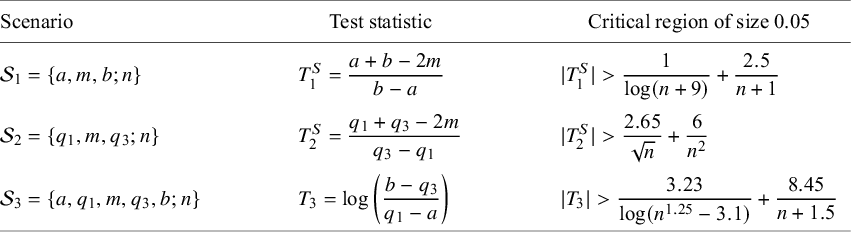
 to detect the skewness of data from the five-number summary within a meta-analytic framework. Lastly, Table 1 summarizes the best test statistics for the three common scenarios, with the first two adopted from Shi et al.Reference Shi, Luo and Wan
18
and the last one following formula (2.2) of the present work.
Summary table of the skewness tests under the three common scenarios

Table 1 Long description
The table consists of three columns: Scenario, Test statistic, and Critical region of size 0.05.
* Row 1: Scenario S sub 1 equals {a, m, b; n}. The test statistic T sub 1 super S equals the fraction with numerator a plus b minus 2 m all over denominator b minus a. The critical region is the absolute value of T sub 1 super S is greater than the sum of 1 all over log (n plus 9) and 2.5 all over n plus 1.
* Row 2: Scenario S sub 2 equals {q sub 1, m, q sub 3; n}. The test statistic T sub 2 super S equals the fraction with numerator q sub 1 plus q sub 3 minus 2 m all over denominator q sub 3 minus q sub 1. The critical region is the absolute value of T sub 2 super S is greater than the sum of 2.65 all over square root of n and 6 all over n-squared.
* Row 3: Scenario S sub 3 equals {a, q sub 1, m, q sub 3, b; n}. The test statistic T sub 3 equals log of the fraction with numerator b minus q sub 3 all over denominator q sub 1 minus a. The critical region is the absolute value of T sub 3 is greater than the sum of 3.23 all over log (n to the 1.25 power minus 3.1) and 8.45 all over n plus 1.5.
Numerous methods exist for estimating the mean and standard deviation from summary data, some assuming normality and others accommodating non-normality. In contrast, the present work proposes a testing method based on the five-number summary, helping researchers select appropriate estimators and thereby enabling more reasonable meta-analysis. As such, it serves as an exploratory data analysis tool in the pre-meta-analysis stage. Based on our numerical results, we recommend routinely checking summary data for skewness prior to meta-analysis to guide estimator selection. If significant skewness is detected, subgroup analysis should be conducted to improve rigor and transparency. The proposed test can be applied to the overall meta-analysis or to predefined subgroups, and it detects true skewness more reliably than informal visual inspection.
High-quality meta-analysis represents the highest level of evidence in evidence-based medicine. By improving data diagnostic tools, our approach can indirectly reduce the risk of misleading conclusions derived from skewed five-number summary data, which have substantial implications for clinical practice and public health decision-making. However, it is important to acknowledge a limitation: the proposed statistic primarily captures differences in tail heaviness. When skewness mainly arises from a shift of central mass (e.g., mild skewness with nearly symmetric tails), the test’s power may decrease. Therefore, results should be interpreted cautiously in such scenarios.
In addition, the conventional significance level of 0.05 is adopted in this article, although other levels can also be taken. The choice of significance level reflects a trade-off between type I error control and statistical power. A smaller level, such as 0.01, offers stricter control of the type I error but may reduce statistical power and increase the risk that some truly skewed studies are incorrectly classified as non-skewed. Applying methods designed for non-skewed data to truly skewed studies may introduce bias in the estimated means and standard deviations, thereby affecting the meta-analytic results. Conversely, using a larger significance level, such as 0.1, increases the ability to detect the skewness of data but also raises the risk of incorrectly classifying non-skewed studies as skewed. In such cases, methods intended for skewed data may be unnecessarily applied, potentially leading to a loss of efficiency in both study-level estimation and subsequent meta-analysis.
In future work, we will incorporate kurtosis features to develop a more comprehensive testing framework that addresses the current limitation regarding central mass shifts. By combining skewness and kurtosis diagnostics, the forthcoming framework aims to provide an even more robust and sensitive tool for assessing distributional assumptions in meta-analysis. We believe that this line of research will further strengthen the evidence base for systematic reviews and healthcare decision-making. Furthermore, although our numerical results show that the proposed test performs better than Shi et al.Reference Shi, Luo and Wan 18 and Balakrishnan et al.Reference Balakrishnan, Rychtář and Taylor 19 for unimodal distributions, a rigorous theoretical justification is not yet available. Hence, establishing the theoretical superiority of the proposed test remains a promising direction for future work.
Acknowledgements
The authors would like to thank the editor, the associate editor, and two reviewers for their valuable suggestions, which considerably improved the manuscript.
Author contributions
Conceptualization: S.F. and T.T.; Formal analysis: S.F., H.L., and J.S.; Methodology: S.F., H.L., S.N.C., and T.T.; Supervision: S.N.C.; Writing—original draft: S.F.; Writing—review and editing: H.L., J.S., S.N.C., and T.T.
Competing interests
The authors declare that no competing interests exist.
Data availability statement
The R code used for the simulations and real-world data examples can be found at https://zenodo.org/records/21047915.
Funding statement
S.F.’s research was supported by the National Social Science Foundation of China (23BTJ061), the Humanities and Social Science Project of Ministry of Education of China (21YJC910003), the Natural Science Foundation of Henan Province (262300421873), and the Postgraduate Education Reform and Quality Improvement Project of Henan Province (YJS2026AL016). H.L.’s research was supported by the National Natural Science Foundation of China (12171310), the Shanghai “Project Dawn 2022” (22SG52), and the Basic Research Project of Shanghai Science and Technology Commission (22JC1400800). S.N.C.’s research was supported by the Research Matching Grant Scheme (RMGS-2022-11-08 and RMGS-2023-15-07) from the Research Grants Council of Hong Kong. T.T.’s research was supported by the General Research Fund of Hong Kong (HKBU12300123 and HKBU12303421) and the Initiation Grant for Faculty Niche Research Areas of Hong Kong Baptist University (RC-FNRA-IG/23-24/SCI/03).
Supplementary material
The supplementary material for this article can be found at https://doi.org/10.1017/rsm.2026.10111.


 Open access

