INTRODUCTION
The recent proliferation of transboundary protected areas (TBPAs) represents one of the most exciting developments in environmental conservation, confirmed by the growing number of TBPAs worldwide: there are now approximately 227 complexes in over 100 countries (Lysenko et al. Reference Lysenko, Besancon and Savy2007). Although the need for transnational biodiversity conservation provides the primary impetus for TBPAs, the explosion of interest also reflects promised benefits in other realms; TBPA supporters cite a range of objectives beyond environmental protection including economic gain, social harmony and the promotion of peace (de Villiers Reference De Villiers1999; Sandwith et al. Reference Sandwith, Shine, Hamilton and Sheppard2001; Hanks Reference Hanks2003; Mittermeier et al. Reference Mittermeier, Mittermeier, Kormos, Sandwith and Besancon2005).
The extent to which the various objectives are articulated when building support for a TBPA depends on the areas to be protected and on the needs and attitudes of the stakeholders (Hanks Reference Hanks2003). Not surprisingly, development schemes in southern Africa frequently emphasize some degree of poverty alleviation and TBPAs in the region often place a priority on generating economic activity. Although Africa's protected areas provide a wide variety of economic benefits (see for example Turpie et al. Reference Turpie, Lange, Martin, Davies and Barnes2004), the TBPA paradigm envisages tourism as the primary vehicle; supporters assume TBPA status will heighten the international profile of the protected area and facilitate tourist movement across borders.
The assumption that TBPAs can enhance tourism seemingly arose without empirical basis, and several appeals have been made for assessing their performance in this regard (Murphree Reference Murphree and Child2004; Sandwith & Besancon Reference Sandwith and Besancon2005; Swatuk Reference Swatuk2005). Accordingly, the objective of this paper is to assess the tourism performance of the Kgalagadi Transfrontier Park (KTP), a 3.6 million hectare park straddling the South Africa-Botswana border. Inaugurated in May 2000, the KTP is the oldest transfrontier park in Africa, but more importantly, is widely seen as the ‘prototype’ (Hanks Reference Hanks2003) or ‘reference point’ (Ramutsindela Reference Ramutsindela2004) for other TBPAs in the region.
Specifically, this paper assesses two management objectives outlined in the Bilateral Agreement (1999) between Botswana and South Africa, namely (1) ‘to encourage the full realisation of the economic potential of the Parks. . .’ and (2) ‘to develop joint promotional campaigns that will stimulate the two-way flow of tourists. . . and taking steps to facilitate the freedom of movement within the KTP’.
We examined Park data on visitation and occupancy before and after the creation of the KTP. In order to understand possible causes of tourism trends, visitation data was supplemented with a visitor survey conducted on the South African side of the KTP.
Kgalagadi Transfrontier Park
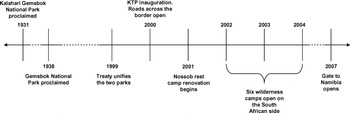
The KTP straddles the border between South Africa and Botswana, with the Namibian border constituting the Park's western edge. The Park came into official existence on 7 April 1999 with the unification of South Africa's 9591 km2 Kalahari Gemsbok National Park and Botswana's 28 400 km2 Gemsbok Park, marking the realization of Africa's first formally recognized transfrontier park. For over five decades prior to 1999, conservation authorities of the adjacent parks had informally cooperated in the management of the area. Therefore the logistical transformation of the Park from de facto to official integration required no significant costs (L. van Rooyen, personal communication 2005) and has incurred only marginal, if any, additional operating costs since its inauguration (P. Daphne, personal communication 2006). There have been several major tourism interventions in the Parks since their creation (Fig. 1).
Timeline indicating notable events in the KTP (Kgalagadi Transfrontier Park). Not to scale.

The KTP is dominated by two vegetation types, Kalahari duneveld and Kalahari Plains thornveld, and sustains a number of species with considerable tourism appeal, including big cats, raptors and ungulates. The climate is extreme, with temperatures ranging from -10° C to > 40° C (South African National Parks [SANParks] 2004a). Annual rainfall averages 200–350 mm, but is highly variable (Mills & Haagner Reference Mills and Haagner1989).
The Park has five entrance gates, three in Botswana and two in South Africa. The Botswanan side can only be accessed by four-wheel drive vehicles. Once inside the KTP, with advance arrangements visitors may travel freely without a passport or visa, unless they wish to enter from one country and exit through the other.
There are no new access roads into the South African side of the Park but a pre-existing border gate with Namibia that had been closed since the early 1990s was reopened in late 2007. This entrance was still closed at the time of the survey. Botswana built one access road into the Park for the opening of the KTP and soon after also opened another from an existing road.
Infrastructure for tourism differs substantially between the two sides of the Park. The only tourism facilities in Botswana are basic, unfenced campsites. The South African side has three large rest camps each containing a campsite, chalets, a petrol station and a shop. All three rest camps pre-dated the KTP, though there was extensive renovation of one camp (Nossob) during 2001. During the period 2002–2004 a further five eight-bed wilderness camps and a 30-bed tented camp were developed. These increased the total number of beds in the Park from 175 to 279. According to the tourism manager, the opening of the KTP was not a major stimulus for these developments (F. van Tonder, personal communication 2005).
The cost of visiting the Park has changed over time as a result of local inflation, pricing policies and in response to fluctuations in the exchange rate. However, prices have remained broadly comparable to the other major South African parks.
With regard to tourism, the legal framework ratified by South Africa and Botswana prior to the inauguration of the KTP stipulates that entrance fees are split evenly, but all other revenues remain in the country of origin.
METHODS
Visitation rates
All visitation data for the South African side of the Park were provided by SANParks and for Botswana by Botswana's Department of Wildlife and National Parks. The former were published by financial year (April–March), while the latter are recorded by calendar year.
Certain tourism statistics for South Africa were not published uniformly over time; some years had occupancy rates while others had numbers of bed- and camping-nights sold. For continuity, years with occupancy data were converted into bed- and camping-nights by multiplying the total number of bed and camping-nights available in that year by the occupancy rate.
Two sets of values, one for South Africa and one for Botswana, present visitation to the KTP as a proportion of visitation to all of the country's national parks. The calculation uses KTP visitation as the numerator and visitation to all parks with available visitor numbers over the entire period as the denominator. Thus, if a new park opened subsequent to the first data point it was excluded from the sum of total visitation, meaning that changes in the proportion are not simply the result of an increase in the total number of parks.
Data on foreign visitor arrivals into South Africa came from South African Tourism (2007) and simple year-on-year growth rates were calculated accordingly.
KTP visitor survey
The visitor survey (Appendix 1, see Supplementary material at URL http://www.ncl.ac.uk/icef/EC_Supplement.htm) conducted on the South African side of the KTP focused on four primary characteristics: mode of travel, visitor demographics, reasons for visitation and overall trip itineraries within and outside the Park. Questionnaires were designed to be completed by one member of each vehicle on behalf of all individuals in the vehicle. Age (adult or child) and nationalities were recorded for each individual, but other information was recorded at the group level.
A KTP gate attendant distributed a questionnaire to the driver of every vehicle entering the South African side of the Park between 15 October and 15 November 2005. Blank questionnaires and receptacles for completed questionnaires were available at every rest camp as well as the gate.
As part of the survey, respondents rated factors influencing their decision to visit the KTP from 1 (lowest) to 5 (highest). For surveys that had certain choices rated but other choices blank, the blank was replaced with a score of one. Additionally, there were two open-ended questions (Appendix 1, see Supplementary material at URL http://www.ncl.ac.uk/icef/EC_Supplement.htm) on visitor satisfaction that were intended to separate the degree to which expectations of the transboundary aspect of the Park were met from general ideas on how to improve the Park. However, owing to the similarity of the questions, respondents often answered both questions similarly. Therefore the two questions were analysed together.
Survey data was entered into a spreadsheet. Proportions were generated using Excel and significance tests using Statistica (StatSoft 2008).
Study limitations
In this study, visitor numbers and length of stay were used as a proxy for tourism performance, though these do not necessarily mirror the income of the Park as average per person expenditure may have increased with the increase in higher-end accommodation. Time-series data of Park income, expenditures and pricing structures were incomplete for South Africa and unavailable for Botswana. Nevertheless, it would be extremely difficult to determine if increases in income were indicating real changes in value or merely reflecting price increases that simply reduced consumer surplus.
In terms of the visitor survey, a research moratorium in Botswana prohibited directly surveying visitors on the Botswana side of the Park, thus preventing a fully representative sample population. Though a relatively small proportion of all visitors, visitors never entering South Africa were absent from the sample and it is possible that visitors travelling in one side and out the other were under-sampled.
Furthermore, the time of year and duration of the survey may have skewed the sample population, especially because the survey did not coincide with any of the South African school holidays when visitation, primarily domestic, is most intense. Despite repeated attempts, it was not possible to obtain visitation data for Botswana's parks after 2003.
RESULTS
Visitor numbers to the KTP over time
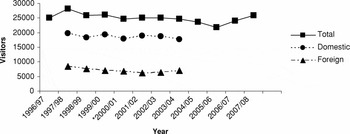
From 1997–1998 the number of visitors to the South African side of the KTP declined very slightly until 2005–2006, but visitor numbers have increased more recently (Fig. 2). The proportions of domestic and international visitors remained relatively steady over the period for which data are available (1997–1998 to 2003–2004; Fig. 2). During the period from 1999, the year prior to the KTP's inauguration, to 2003, the average yearly growth rate of foreign visitor arrivals to South Africa nationally (calendar year) was 2.6% (range: –1.4–11.1%) (South African Tourism 2007), while it was 0.1% (range: -8.7–7.0%) for foreign visitation to the South African side of the KTP (financial year).
Annual visitor numbers to the South African side of the Kgalagadi Transfrontier Park. *Year Park inaugurated.

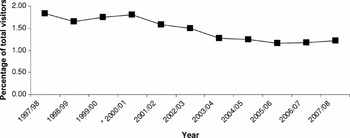
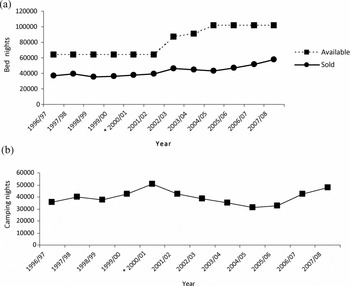
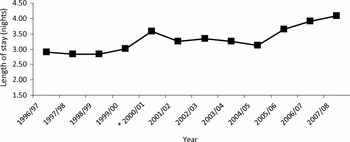
The proportion of visitors to all of South Africa's national parks that visit the KTP has tended to decrease gradually, albeit levelling off in recent years (Fig. 3). Bed nights sold increased as bed capacity of the Park increased, although not at the same rate, with the result that occupancy rates had not caught up to pre-2002 levels by the year 2007–2008 (Fig. 4a). Camping nights sold decreased after 2000, but recovered again from 2005 (Fig. 4b). The average length of stay increased from just under three nights in the year 1996–1997 to over four nights in 2007–2008 (Fig. 5).
Annual visitor numbers to the South African side of the Kgalagadi Transfrontier Park as a percentage of visitors to all 14 parks with complete time-series data over this period. *Year Park inaugurated.

Annual (a) number of bed-nights available and sold in the Kgalagadi Transfrontier Park, and (b) camping nights sold in the Park. Camping availability remained constant. *Year Park inaugurated.

Average length of stay of visitors in the Kgalagadi Transfrontier Park. *Year Park inaugurated.

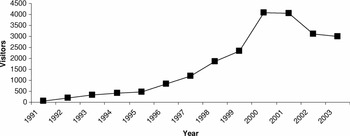
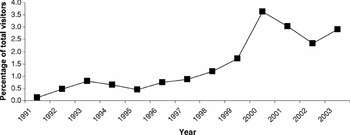
Visitor numbers to the Botswana side of the Park climbed steeply from 1991 until 2000, but decreased to a slightly lower level thereafter (Fig. 6). Visitation to the Botswana side of the KTP as a proportion of visitation to all of Botswana's established parks increased every year after 1995 until 2000, followed by a prominent two-year decline in 2001–2002, with visitation rebounding in 2003 (Fig. 7). Foreign visitor arrivals into Botswana nationally could not be obtained.
Annual visitor numbers to the Botswana side of the Kgalagadi Transfrontier Park.

Annual visitor numbers to the Botswana side of the Kgalagadi Transfrontier Park as a percentage of visitors to all seven of Botswana's national parks with complete time-series data over this period.

KTP visitor survey
Participation rate and demographics of survey population
Based on the number of vehicles exiting the Park and the number of completed (or partially completed) questionnaires collected, approximately 60% of visitors participated in the survey, giving a total of 296 groups representing 767 individuals. Just over half the groups (51%) comprised entirely SADC (Southern African Development Community) residents (95% of those groups were entirely South African), 43% of groups were entirely international residents and 6% were mixed local/international groups.
In 2003–2004, the most recent year differentiating foreign from South African visitors to the South African side of the KTP, South Africans comprised 71.9% of total visitors. Because 53.9% of survey individuals were South African, we distinguished SADC visitors from international groups in the analysis.
Frequency of cross-border visits
SADC groups were more likely than international groups to be travelling in four-wheel drive vehicles (64% versus 28%; χ2 = 32.45, p < 0.001). Less than 3% of either group travelled in tour vehicles.
Six of the 291 groups (2%) that entered from South Africa indicated that they had spent time on the Botswana side of the Park. Eight groups that entered the Park from Botswana came into the South African side during the course of the survey. Twelve of those 14 cross-border groups consisted entirely of SADC residents, with one mixed local/international group and one international group. Nine of the 14 groups stated that the ability to cross the border in the Park encouraged them to extend their visit to the neighbouring country beyond the Park. Therefore, in total, 3% of all groups surveyed were inspired by the transfrontier Park to extend their trip to visit the adjoining country.
The derived value of 2% of visitors entering South Africa who ventured into Botswana may be artificially low, assuming the survey population under-represents the proportion of South Africans visiting the Park annually, because SADC residents appear more likely to visit both sides of the Park. However, a coarse analysis of South African Police Service data confirmed a low rate of border crossing in the Park. Based on first and second quarter data from 2005, a total of 14 071 guests visited the Park, with 1672 individuals registered as departing into Botswana. A police official in the Park (K. Jacobs, personal communication 2005) estimated that roughly 30% of those individuals were non-tourist local residents. Therefore, approximately 8% of tourists entering from South Africa travelled into Botswana.
The importance of visiting the KTP and reasons for visit
SADC groups stated that visiting the KTP was a significantly greater part of the reason for their entire trip than international groups (87% versus 40%; p < 0.01, Mann-Whitney U-test). Most international groups reported a longer and more diverse trip itinerary outside of the KTP.
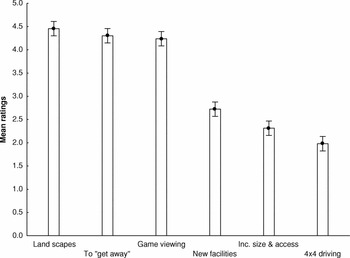
There was a significant difference in the mean ratings of the factors that influenced respondents’ decision to visit the Park (ANOVA F5,1466 = 201.78, p < 0.001) (Fig. 8). The disparity between the top three and bottom three factors was particularly conspicuous, with the top three reasons consisting of characteristics that have not changed markedly since the Park's creation, while the bottom three characteristics have.
Mean ratings of reasons for visiting the Kgalagadi Transfrontier Park (1 = not important, 5 = very important). Bars denote standard error.

Were tourists satisfied with the KTP?
There was a substantial range of comments, both positive and negative. Two comments, broadly categorized, were mentioned by more than 10% of respondents, namely concern over the quality (particularly) and extent of the road system (n = 71) and discontent with the abundance of wildlife (n = 36).
Three quite stereotyped comments regarding the transfrontier aspect of the Park were recorded, namely the desire for access to Namibia (n = 6), frustration with the distribution of information about the transfrontier features of the Park (n = 4) and remarks about the inability to enter Botswana because of the need for four-wheel drive (n = 3).
DISCUSSION
Taken alone, visitor numbers, at least on the South African side, suggested that the TBPA has not made an impact on the tourism value of the Park, and in fact that tourism growth in the Park has not performed as well as national parks generally in South Africa. SANParks attributed this decline in visitation in their 2003–2004 and 2004–2005 annual reports (SANParks 2004b; SANParks 2005) to the condition of the access road into the South African side of the Park, a problem that apparently persisted during the period of the survey given that 71 groups complained of road conditions, including those inside the Park.
However, the fact that there appears to be an increase in the average length of stay suggests there has actually been a steady growth in tourism despite the fairly stable visitor numbers. The increase was driven largely by an increase in the number of bed-nights sold; camping tourism has been a bit more erratic. The Botswana side also showed sustained growth, at least until 2001; visitor numbers increased as did the Park's share of Botswana's national park visitors. It is hard to interpret the dip subsequent to 2001 without a longer-term dataset, although 2003 showed that visitation was still quite substantially above 1999 levels.
Determining the relationship between these trends and the establishment of the TBPA is more difficult, however. Trends in visitor numbers from the Botswana side and in bed-nights sold on the South African side both started before the establishment of the TBPA. Indeed, it had already been noted in the 1999–2000 SANParks annual report (SANParks 2000) that there was a need for more beds in the Park, because hut occupancies were between 80% and 85% from 1997–1998 until 2001–2002, indicating limited capacity. Growth rates in bed-nights sold increased again only well after the establishment of the TBPA in 2005–2006. There was no immediate response to the establishment of the TBPA, but it is possible that there was a lag period before the impact of the changes took effect. SANParks considers current occupancies to be high again (J. Stevens, personal communication 2009), approximating 60%.
Given the almost maximal occupancy rates prior to the establishment of the TBPA, the initial increase in tourism use of the Park is almost certainly attributable to the establishment of new accommodation facilities at that time. It is therefore only the relatively recent increase in the tourism growth rate that could potentially be attributed to the TBPA, but the extent to which the transfrontier aspect of the Park actually played a role can only be deduced from the responses of visitors surveyed. These results suggest that the increased size and access was less important than the new facilities which expanded the tourism capacity of the Park during peak periods, and that neither of these factors was particularly important compared with the nature attractions of the Park. It is interesting to note that the increased size of the Park did not seem to dramatically influence the guests’ decision to visit, suggesting that an increase in area without an increase in the diversity of attractions offered, as is the case here, has probably not been sufficient to increase the tourism performance of the Park. It is important to note that the KTP did not enjoy additional marketing support after its opening (L. van Rooyen, personal communication 2005) and that the transboundary features of the Park did not figure prominently in the tourism upgrades that occurred around the time of the inauguration (F. van Tonder, personal communication 2005). SANParks officials acknowledge that the KTP has not excelled at enhancing its existing tourism product, for example by adding new activities (J. Stevens, personal communication 2009).
Additional objectives of the Bilateral Agreement (1999) for the KTP were to ‘stimulate the two-way flow of tourists’ and ‘facilitate the freedom of movement within the KTP’. Nevertheless, police data and data from the visitor survey both suggest a low rate of transnational movement within the Park, implying that the possibility to cross into the adjacent country has seldom encouraged groups to extend their visit to the neighbouring country within or beyond the Park. The economic activity generated by those few that do visit both sides is undoubtedly welcome, but relatively small in magnitude. Although the survey itself only covered a small time frame, the results indicated that visitors entering Botswana may be more likely to travel into South Africa than visitors entering South Africa are to travel to Botswana. Explanations for the tendency of visitors not to cross into the adjoining country include the Park's physical deterrents (size and terrain), as well as some stated confusion about the procedures and regulations required to travel to both sides of the Park.
As revealed in the survey, international tourists reported that less than 50% of the reason for their entire trip was visiting the KTP, and that there were many other locations they intended to visit. These tourists may have been less inclined to increase their stay than local tourists, because it came at the expense of seeing other attractions. Additionally, the requirement of a four-wheel drive vehicle to visit Botswana excludes many potential visitors. Again, this is particularly relevant for international tourists who, the survey shows, were much less likely to be driving a capable vehicle. Because the Park's biota is relatively homogenous, sufficient incentive for visitors to overcome these obstacles may not exist.
The KTP, however, is still in its infancy. South Africa and Botswana are implementing an integrated tourism plan focusing on more sophisticated cooperation and the assimilation of conservation and economic objectives. Therefore, as the Park becomes more well-known and as planned infrastructure improvements are completed, visitation patterns may change.
CONCLUSIONS
To our knowledge, this study is the first to assess the tourism performance of a TBPA. It appears that the creation of the KTP alone did not trigger an increase in tourism to either side of the Park, nor did it instigate a significant amount of cross-border visits. The increase in tourism that has been observed is likely owing primarily to the increase in facilities in the Park.
In particular, four broad findings from this assessment of the KTP have implications for other TBPAs. First, simply enlarging a park, though clearly a conservation objective, does not necessarily enhance its tourism appeal. Second, a major marketing point of TBPAs is the possibility of cross-border visits. In the case of the KTP, the terrain is a formidable barrier to entry into Botswana, and procedural barriers were also encountered, though to a much smaller degree. Other TBPAs in the region have even more road construction and border-crossing challenges to overcome. Third, TBPAs require adequate tourist infrastructure to allow growth. The South African side of the KTP was relatively well developed in this respect, but its shortage of accommodation during the first couple of years of the KTP precluded the possibility of significant expansion during that time. Fourthly, TBPAs are an innovative concept, but do not inevitably lead to innovative tourism strategies. The opening of the KTP spurred few changes to the Park, and managers acknowledge that a country-centred approach persists. Park employees and tour operators need to be sufficiently informed about all attractions within a TBPA (regardless of the country) and have sufficient incentives to advertise and exploit them.
Every protected area complex is unique and therefore the somewhat discouraging start to the KTP does not necessarily jeopardize the strength of the TBPA paradigm. However, findings from the KTP justify a greater degree of caution when outlining promises of early economic gains. To allow for more robust conclusions as to if and when a TBPA is likely to enhance tourism, further research is required in other parts of the world and for other African TBPAs when they become sufficiently mature. TBPA initiatives often involve diverse stakeholders, incorporate the chronically underprivileged and hinge on delicate relationships in volatile locations; they should not be further complicated by unrealistic expectations.
ACKNOWLEDGEMENTS
We are grateful to M. Ramutsindela, SBF, SANParks and Jaap Arntzen for their assistance with the survey and data provision, as well as to James Blignaut for comments on an earlier draft.