Introduction
In recent years, the discourse on workplace diversity have become more and more widespread (Austin & Pisano, Reference Austin and Pisano2017). Diversity at work refers to the various levels of differences between individuals who construct a team, and relates not only to overt characteristics (such as gender) but also to cognitive, or psychological styles, as well as differences in beliefs values and abilities (Harrison, Price, & Bell, Reference Harrison, Price and Bell1998; Hoever, Van Knippenberg, Van Ginkel, & Barkema, Reference Hoever, Van Knippenberg, Van Ginkel and Barkema2012).
Although diversity at work was found to contribute to team’s creativity and productivity, when it comes to diversity in the context of disability, employers’ interests in the subject remain relatively limited (Foster & Fosh, Reference Foster and Fosh2010; Scott et al., Reference Scott, Jacob, Hendrie, Parsons, Girdler, Falkmer and Falkmer2017). Neurodiversity refers to atypical neurological development as a natural human variation that should be respected, just as other human differences in a diverse workforce (Ortega, Reference Ortega2009). There is a debate in the literature as to whether neurodiversity should be regarded as a disorder, or rather as a neurodivergent condition with a particular vulnerability (Jaarsma & Welin, Reference Jaarsma and Welin2012). One neurodivergent condition is autism spectrum disorder (ASD), characterized by persistent deficits in social communication and interaction and by restricted or repetitive behaviours, interests, or activities (American Psychiatric Association, 2013). Although these deficits may present barriers to the participation of people with ASD in the workforce, studies have highlighted their productive contribution along with unique and valuable qualities, such as attention to detail, reliability, integrity, and consistent accuracy in performance (Hendricks, Reference Hendricks2010; Gal, Landes, & Katz, Reference Gal, Landes and Katz2015).
The right of any vulnerable population to work is anchored in the Universal Declaration of Human Rights of the United Nations (Article 23) which states that: ‘everyone has the right to work, to free choice of employment, to just and favourable conditions of work and to protection against unemployment … [and] to equal pay for equal work (UN General Assembly, 1948).’ Yet, recognizing the vulnerability of those with neurodivergence, including ASD, promotes group-specific rights that are needed to ensure they are treated with equality (Jaarsma & Welin, Reference Jaarsma and Welin2012). Respecting such a right requires providing support such as accommodations and adjustments in the working place. Reasonable adjustments are defined in the Victorian Equal Opportunity Act (2010) as changes to the work environment that allow people with disability to work safely and productively. Examples for reasonable adjustments given in the Victorian Equal Opportunity Act include adaptations for physical challenges and barriers such as providing a person who needs a wheelchair with accessible ramp, and also for adaptations that address cognitive and emotional barriers such as modifying work instructions and providing flexible working hours and breaks. The perception and implementation of accommodations and reasonable adjustments for individuals with ASD in the employment context has remained vague, thus far, as research in this area has been scarce. Hence, the current study aimed to learn from employers who experienced the successful employment of people with ASD, and to deepen understanding of the workplace accommodations that they perceive as necessary, reasonable, and possible.
Literature review
The prevalence of ASD has increased dramatically in recent decades and is diagnosed among one in 68 eight-year-old children in the United States (Baio et al., Reference Baio, Wiggins, Christensen, Maenner, Daniels, Warren and Dowling2014). Prevalence levels are lower in adults (11:1000; Brugha et al., Reference Brugha, Spiers, Bankart, Cooper, McManus, Scott and Tyrer2016), but are expected to rise over the next decades (Howlin et al., Reference Howlin, Arciuli, Begeer, Brock, Clarke, Costley and Guastella2015). The current 4th ed. of the Diagnostic and Statistical Manual of Mental Disorders-5 defines three ASD severity levels (American Psychiatric Association, 2013), which are established on the basis of the degree of impairment and on the degree of support an individual with ASD requires: support (severity level 1), substantial support (severity level 2), and very substantial support (severity level 3). Those in level 1 usually do not have intellectual disabilities, however, they have difficulty initiating social interactions, respond atypically or unsuccessfully to the social overtures of others, and may appear to have a decreased interest in social interactions. In addition, their behaviour may be inflexible, they may have difficulty switching between activities, and problems with organization and planning. Without support in place, all these deficits cause noticeable impairments (American Psychiatric Association, 2013) and may have implications upon their participation at work (Hagner & Cooney, Reference Hagner and Cooney2005).
Indeed, the employment rate of those with ASD is low in mainstream workplaces, in comparison to people without disabilities and even in comparison to individuals with other disabilities (Cederlund, Hagberg, Billstedt, Gillberg, & Gillberg, Reference Cederlund, Hagberg, Billstedt, Gillberg and Gillberg2008; Taylor & Seltzer, Reference Taylor and Seltzer2011; Scott, Falkmer, Girdler, & Falkmer, Reference Scott, Falkmer, Girdler and Falkmer2015).
Most of the research concerning the vocational rehabilitation of people with ASD focusses on personal characteristics such as treating the individual’s deficits in order to help him or her integrate into the working world (Hillier et al., Reference Hillier, Campbell, Mastriani, Izzo, Kool-Tucker, Cherry and Beversdorf2007). Such difficulties include communication and navigating social interactions, adapting to new job routines, time management, organizational problems, and maintaining attention (Muller, Schuler, Burton, & Yates, Reference Muller, Schuler, Burton and Yates2003; Hedley, Uljarević, Cameron, Halder, Richdale, & Dissanayake, Reference Hedley, Uljarević, Cameron, Halder, Richdale and Dissanayake2017). Nevertheless, according to Lopez and Keenan (Reference López and Keenan2014), the most common barriers to job retention among people with ASD are external, mainly a lack of understanding on the part of employers and colleagues regarding ASD.
Although broad understanding of the necessary support is still lacking, particularly with regards to accommodations and reasonable adjustments of the environment that support the implementation of the basic human right to work, some studies have considered employers’ perspectives on hiring people with ASD who do not have intellectual disabilities.
Employment of people with ASD may serve, however, as an advantage for employers. First, people with ASD who are cognitively able are often motivated to engage in mainstream employment in the open labour market (Hendricks, Reference Hendricks2010; Baldwin, Costley, & Warren, Reference Baldwin, Costley and Warren2014). According to Scott et al. (Reference Scott, Jacob, Hendrie, Parsons, Girdler, Falkmer and Falkmer2017) they demonstrate above standard performance compared with their counterparts, exhibiting greater attention to detail, high work ethics, and high quality work. Others have pointed out qualities such as reliability, integrity, and consistent accuracy in performance (Hendricks, Reference Hendricks2010; Gal, Landes, & Katz, Reference Gal, Landes and Katz2015).
Second, studies have highlighted the importance of ‘cognitive team diversity’, which refers to the extent to which the thinking styles, skills, knowledge, beliefs, and values are perceived differently by team members, and was found to be an important moderating factor in contributing to team creativity (Dahlin, Weingart, & Hinds, Reference Dahlin, Weingart and Hinds2005). Others have categorized diversity at work by surface-level and deep-level diversity, the first representing overt characteristics such as age and gender, while the second represents psychological characteristics such as attitudes, beliefs, and personality (Harrison, Price, & Bell, Reference Harrison, Price and Bell1998). Positive impacts on innovation, creativity, and improved productivity have been ascribed to both surface-level and deep-level diversity and particularly to cognitive team diversity (Men, Fong, Luo, Zhong, & Huo, Reference Men, Fong, Luo, Zhong and Huo2017). Such traits may present advantages for employers of those with ASD as their employment may deepen the team’s deep-level diversity and specifically, cognitive team diversity.
Third, investigation of the costs and benefits associated with employment of people with ASD in the open labour market has showed that their employment does not incur additional costs above those associated with any new employee (Scott et al., Reference Scott, Jacob, Hendrie, Parsons, Girdler, Falkmer and Falkmer2017). However, the need for job modifications and environmental adaptations for the successful integration of employees with ASD, employed in positions in the open labour market, have been stressed (Davidson, Reference Davidson2010; Hedley et al., Reference Hedley, Uljarević, Cameron, Halder, Richdale and Dissanayake2017), highlighting the critical role of the employers in creating an accessible work environment for employees with ASD (Hagner & Cooney, Reference Hagner and Cooney2005; Lopez & Keenan, Reference López and Keenan2014).
The organizational justice climate as a theoretical framework
The corporate culture of an organization comprised its values, attitudes, and norms (Schur, Kruse, & Blanck, Reference Schur, Kruse and Blanck2005). Corporate culture plays an important role in the integration of diverse populations in the workplace since organizations that authentically embrace values such as diversity are motivated to create a culture in which people with disabilities can work and succeed (Stone & Colella, Reference Stone and Colella1996; Gilbride, Stensrud, Vandergoot, & Golden, Reference Gilbride, Stensrud, Vandergoot and Golden2003). One aspect of corporate culture is ‘justice climate’, which includes beliefs regarding justice in an organization (Rupp, Bashshur, & Liao, Reference Rupp, Bashshur and Liao2007). An organization’s justice climate has three dimensions: inter-personal justice, procedural justice, and distributive justice that are acted on by different parties in the organization. Interpersonal justice concerns the general treatment that employees receive from those with authority over them. Procedural justice concerns policies and procedures, such as how requests for accommodations are handled, and, finally, distributive justice represents a class of behaviours relating to outcomes such as the actual provision of workplace accommodations and its perceived fairness as an allocation of resources (Rupp, Bashshur, & Liao, Reference Rupp, Bashshur and Liao2007; Cropanzano & Molina, Reference Cropanzano and Molina2015).
Justice climate has been linked to job attitudes and performance and may be of particular importance for people with disabilities (Liao & Rupp, Reference Liao and Rupp2005; Rupp, Bashshur, & Liao, Reference Rupp, Bashshur and Liao2007; Schur, Kruse, Blasi, & Blanck, Reference Schur, Kruse, Blasi and Blanck2009). Others have concluded that a positive affective state of an employee is related to a higher perception of procedural and distributive justice (Mao, Wong, Tao, & Jiang, Reference Mao, Wong, Tao and Jiang2016). Moreover, the provision of accommodations and the procedures related to it affect the perception of fairness and justice in the organization both of employees with and without disabilities. Specifically, when a disability is invisible, as in the case of ASD, employees without disabilities might question accommodations and the justice they represent (Colella, Reference Colella2001; Snyder, Carmichael, Blackwell, Cleveland, & Thornton, Reference Snyder, Carmichael, Blackwell, Cleveland and Thornton2010). Hence, use of the justice climate framework to examine accessibility of the working environment may illuminate not only the inclusion of employees with ASD in the workforce but new theoretical and practical aspects of management in the organization in general. The justice climate, therefore, strongly relates to employers’ views regarding the inclusion of diversity in the workforce both from a personal and organisational point of view.
A focus on the central role of the employer in the inclusion of individuals with ASD in the workforce and the provision of accommodations generated the following research questions:
1. How do employers in the open labour market perceive the employment of individuals with ASD (without intellectual disabilities)?
2. What environmental factors act as facilitators or barriers to the successful performance and integration of high functioning individuals with ASD into the mainstream workplace from the employers’ perspective?
3. What do employers consider an accessible working environment for high-functioning individuals with ASD?
Methods
Sample and procedures
This study was conducted using a qualitative phenomenological approach in order to reveal the perceptions of employers regarding the employment of employees with ASD and the reasonable adaptations required. This approach was chosen in order to explore in depth the multidimensional process of a phenomenon that lacks both the research and tools needed to examine the specific difficulties and adaptations required for these workers.
The study was approved by the Ethics Committee of the Faculty of Social Welfare and Health Sciences at the University of Haifa, as well as by the Ministry of Social Affairs and Social Services in Israel. Purposeful and criterion sampling was used to select the participants who best represented the population experiencing the phenomenon under study and were able to relate and describe it (Creswell, Reference Creswell2003; Reference Creswell2007).
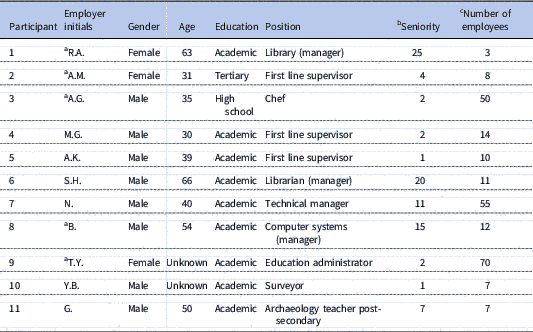
The study included 11 employers (eight men and three women) of individuals with ASD, who do not have intellectual disabilities. Mean age of the participant was 45.8±13.7 years old. The employees participated in a job placement programme run by one of two organizations that provide supported employment services in Israel, and who responded to a call to participate in the study. The employers who participated in the study were the direct supervisors of the employees, and therefore in daily contact with them. Inclusion criteria included employers in the free labour market, with experience at employing workers with ASD for at least 6 months during the past year, with a minimum of 10 hr per week (Table 1). As shown in Table 1, the employers’ selection represents various labour domains, such as education, sales, tourism, and information communication technology. Approximately half of the employers have had rich experience with few employees with ASD, either currently or in the past.
Demographic characteristics of the study participants (the positions delineated were categorized according to the O * net site)

a Have had rich experience with few employees with ASD, either currently or in the past
b Seniority – in current workplace (in years)
c Number of employees – under the employer’s responsibility
Initial contact with the participants was made by the coordinators of the two programmes followed by a meeting between the employers and the first author. In-depth interviews, lasting 45–90 min, were conducted with each employer and recorded with their permission. Anonymity and confidentiality were assured through the coding of identifying details, and the participants were told that they may withdraw from the study at any stage. Employers’ selection also took into consideration ethical issues such as anonymity of employees and on-going support provided by the programme’s coordinator, in case any sensitive issues emerged during or after the interviews, which might affect the employees. No such incident occurred.
Following the interviews, four employers participated in a focus group which discussed results from the individual interviews to promote trustworthiness of the data analysis.
Research tool
An interview manual was developed based on preliminary research, which included (a) a review of research literature on the topic, (b) information gathered from a focus group conducted with social workers involved in the integration of individuals with ASD into mainstream employment, and (c) exploratory interviews conducted with employees with ASD and employers of people with ASD. The interview guide’s questions referred to a variety of issues relevant to the experience of employing people with ASD (e.g., descriptive daily experience and routines, the adaptation of the work tasks assigned to them, the challenges they face in performing the job, potential enabling and limiting factors). The open-question format of the manual provided a flexible semi-structured framework that invited the interviewees to lead the interview according to their perspectives while enabling the researcher to maintain conceptual focus and relate to the relevant issues to be studied. For example, ‘Can you describe the job demands and the daily routine on the job?’; ‘Do you identify any barriers that affect your employee with ASD?’; ‘What kind of adjustments have you provided the employee with ASD?’; ‘Please describe the accommodation process and its outcome?’
Method for data analysis
The in-depth interviews were analysed by examining the thematic content of the participants’ descriptions regarding their experiences, feelings, thoughts, and perceptions. Dedoose software (Dedoose, 2016, version 7.0.23) for qualitative data analysis was used. In line with the qualitative research approach, the analytic process included the following stages (Corbin, Reference Corbin2015): (a) excerpts from the interviewees’ responses grouped into units communicating like meanings; (b) these meaning units were grouped under thematic headings (categories); (c) the findings were triangulated with results from the focus group, and field notes recorded by the interviewer. A mapping analysis of the interviews was conducted to reveal similarities and divergence between the interviewees’ responses, and to search for potential meanings, differing perspectives, and various means of relating to the phenomenon being studied (Creswell, Reference Creswell2007). The three researchers also conducted brainstorming and text interpretation sessions.
The trustworthiness of the study was ensured by a thick and rich description of the participants, the contexts, open conceptual discussions, the researchers’ familiarity with the examined phenomena, and a peer-reviewed process of data analysis. In addition, the credibility of the study was further enhanced by sharing the data and its analysis with the focus group, and by comparing the findings with the limited literature available.
Results
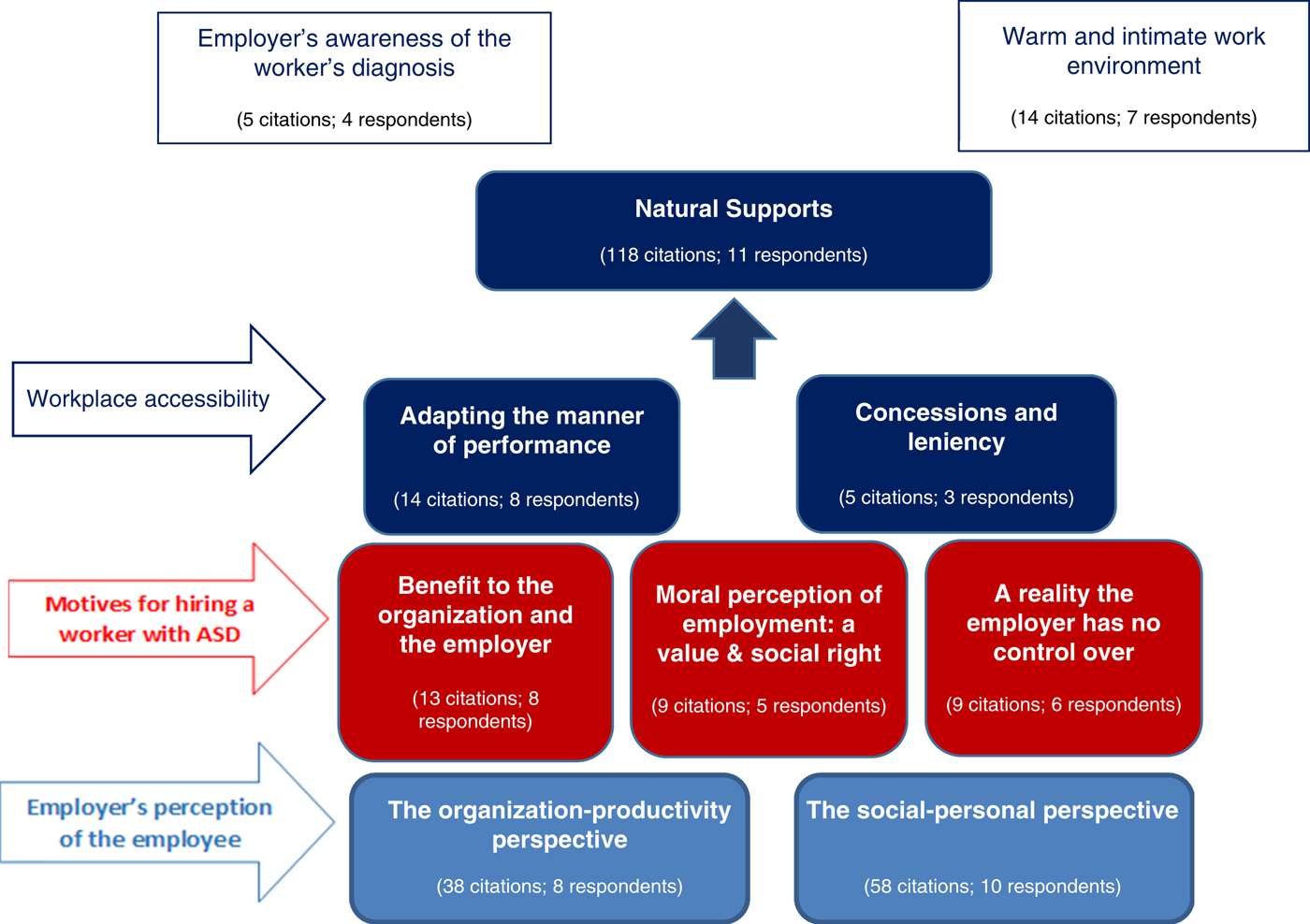
As typical to qualitative phenomenological research, the interviews yielded a rich qualitative data set, plentiful with dilemmas and practical examples, although a small sample of employers participated in the study. Three main themes emerged from the interviews: (1) employers’ perception of employees with ASD; (2) their motivation to employ an individual with ASD; and (3) the accessibility of the work environment (i.e., which adaptations they considered to be reasonable). Figure 1 summarizes the main themes.
1. The employer’s perception of the employee with ASD
The interviews with the employers raised two different voices, sometimes from the same employer, expressing their perceptions of the employee: (1) a productive-organizational voice and (2) a social-personal voice.
The productive-organization voice emphasizes that the most important principal defining the employer’s attitude is the employee’s productivity and qualifications for the job, as N.G., the manager of a company expressed:
The only significant goal for us is to make a profit, and for that job performance and the product that the worker produces, every worker, are the things that are most important to me … You can say many pretty things, but the company’s goal is to be profitable – N.G.
N.G. perceived the productivity of his worker with ASD to be equivalent to that of his other employees, with accommodations if necessary:
When an employee, regardless of who, every employee, is in alignment with this goal… that’s good, and if not… then we take care of it from the extreme approach that the employee will no longer work for us, to investing in resources to make him into a more efficient, better employee for our company – N.G.
The productive-organizational voice focusses on the employee’s productive contribution to the organization. However, employers were ready to match the employee’s organization role with his/her personality characteristics as long as doing so would serve the organization. A department manager in a government ministry, A.B, described how the organization enjoyed the employee’s advantage:
He is meticulous; he can work using procedures at work that are very organized and consistent. And he does his job very well. And really, as a result of his work, a large inventory of all sorts of things that we didn’t even know we had, eventually they were catalogued and now they can be found, and of course they can now be used for other business processes – A.B.
Other personal qualities that contribute to the employee’s productivity as described by the employers included: reliability, initiative for learning and curiosity regarding relevant areas of interest, and finally, commitment to the organization and to the performance of the job.
In contrast to the productive-organizational voice, the identified social-personal voice focusses on the worker as a person who first of all has different needs and then, by extension, requires adaptations to the work environment. The social-personal voice aligns with an inclusive organizational cultural norm that has recently begun to permeate the labour market. Hence, the study findings highlight the importance of the employer’s previous experience in employing people with disabilities. For example, T.I., the administrator of an educational centre for children with special needs, explained:
I am a trained social worker, and I have been working in the area of rehabilitation for 15 years. In my previous job, actually, the goal of a rehabilitation program was to place people in the job market… – T.I.
Later on, she referred to the organizational culture at her current workplace:
I definitely agree with the agenda of ‘Gxx,’ who employs people with special needs. It’s part of the culture – T.I.
The inclusive norms of the employing organization were also mentioned by some of the participants as part of their overall perception regarding the diversity of workers in general. For example, N.G. revealed an egalitarian approach to diversity, in the sense that all are ‘equal in their diversity’:
I can say half-jokingly that all my employees have special needs… which does not distinguish anyone, it relates to everyone: flexible working hours, flexibility in choosing the workplace, that is, where I sit and how I organize my work environment – N.G.
The social-personal voice is manifested by citations of employers who see how they have benefited from the employment of a worker with disabilities and from developing more sensitive interpersonal interactions with them. The employer T.I. described proudly how she was flexible and authorized a day-off work for her employee, who wanted to avoid joining a team-building retreat. A.K. articulated his personal benefit:
I do not think they are like other people … On the one hand, it sounds a little like a stigma, but on the other hand this is what helps me be more restrained, tolerant and caring… – A.K.
2. Motivations for employing individuals with ASD
Supervisors’ productive-organizational and social-personal perceptions of employees with ASD seem to impact their motivations to hire employees with ASD. Indeed, the employers identified three types of motives for hiring an employee with ASD.
The first motive is pragmatic and describes a reality that is not under the control or dependent on the choice of the supervisor. This motive is clear in the case of a supervisor who serves as a salaried employee at the workplace; for example, A.K. stated:
I have no choice, I would say that I have no choice … I am not the one who chooses to work with one person or another – A.K.
Another practical consideration for hiring an employee with ASD is complying with the recent regulations to address the quota set for workers with disabilities in public service. This opened an additional position, as described by Y.B., a department manager in a governmental offices, who said:
The truth is that we were blessed that he came to us, since another authorized position was added to the department. So the manpower that I did not have previously, I now have – Y.B.
The second motive for hiring an employee with ASD is a moral one, which includes for example the right of every person to work and the employers’ recognition of the diversity of all people. This position was expressed by T.I., who expressed the motive for hiring as follows:
The person, his personality and then his color, his religion, his nationality, his disability … Besides, I think that every one of us has one limitation or another, some physical, some not – T.I.
The moral motive is also reflected by M.G.’s comment:
I know … that A [the employee]…worked in four or five places. He likes to cook, he likes to bake, he began to work at the grocery store in his parents town, he wasn’t successful, and then in two bakeries, he didn’t succeed because he worked too slowly. So, my conscience would not allow me to be the one that further deepens this rift by saying ‘listen, you don’t fit in.’… that is not the right thing to do… there is a person behind it. - MG
The third motive for hiring an employee with ASD described by all the participants is the hiring of the worker based on their appreciation of the benefit and the added value it holds for the workplace and the colleagues. A.G., a hotel chef, described the social contribution involved in employing employees with ASD:
In a way, it helps to break down prejudices about certain things. That if someone, a cook, thought that someone would not be able to do something, so today they see that they are exactly like them. It creates a healthy competition… knowing how to respect one another…to broaden their horizons a little – A.G.
The benefit for an organization in employing an individual with ASD is described below by the owner of a pet shop, also based on the advantages available through the unique personal characteristics of people with ASD:
He does a very good job. The quality of his work is no worse than that of other employees. And work that another employee might not have actually been willing to do… He feeds the animals; he takes care of the store. Not everyone can do it, that’s the truth – A.M.
In summary, the employers ‘comments reveal that hiring a worker with ASD is derived from blend of motives based on human and social values. It may be successful when it contributes to the productivity of the workplace and adds value to it, but it may require workplace accommodations and support.
3. Accessibility of the workplace: What are natural supports?
The main themes

The employer’s perception of the employee with ASD as a person with the potential to be productive but who often needs special attention inevitably raises the question of what accommodations/accessibility options are necessary and reasonable. The study participants presented two opposing approaches to the accessibility of the job and the workplace for an employee with ASD.
According to the first approach, accessibility consists of adapting the manner in which the job is performed (rather than the job’s content) to the specific needs of the employee’s (abilities, strengths/weaknesses, and expectations). This employer perception, which is consistent with the productivity-organizational voice, does not necessarily negate the social-personal voice if it also recognizes the right of the person with ASD to have a meaningful job and of the obligation of the organization to make adaptations that will enable the person to actualize that right.
This perception was expressed by most of the participants. G, the director of a university archaeology laboratory, related to this point:
It should be real work…not something invented for someone with special needs, or however you define it, to do….If it isn’t real work, it won’t have sustainability. Secondly, the job should be at a level that people can do it, but I think it should be a job that takes into account the possibility that the person can develop…I think these are conditions that are very important to consider before you begin develop the accessibility of the job – G.
A.K., the manager of a store that is part of a large national chain, also recognized the rights of people with disabilities but expressed a different approach to achieving them. Specifically, A.K. views accessibility as a way of providing concessions and demonstrating leniency:
I have to, first of all, be lenient with her about problems, mistakes, for [doing] things I would not have overlooked had it been someone else – A.K.
According to this approach, the employer is displaying benevolence. In this view, adaptations are seen as concessions that are provided on the basis of the limitations of the individual, and the employer is reducing the level of productivity that he or she would usually expect.
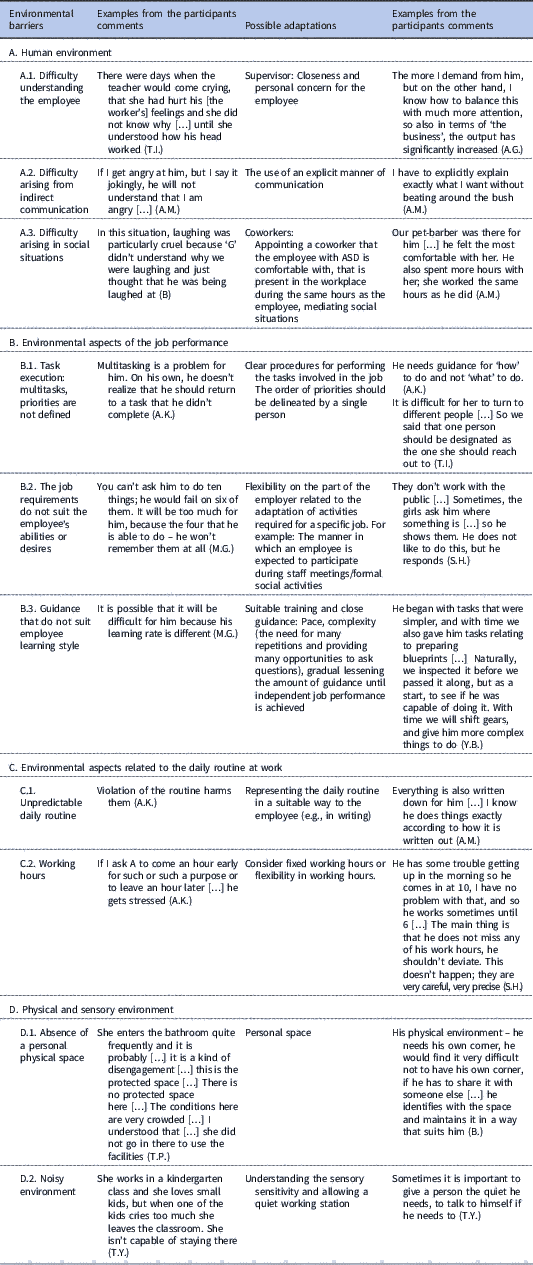
The supervisors also named specific accommodations that they considered required for various environmental barriers (Table 2). Many of these accommodations can be considered natural supports, that is strategies that workers and managers use on a regular basis with all of their colleagues in the workplace, regardless of whether or not they have a disability. Natural supports are sustainable, cost-effective, and often benefit all employees (Storey & Certo, Reference Storey and Certo1996). Table 2 lists the environmental barriers and the accommodations made by the employers together with examples, categorized into a number of areas: (1) the human environment – the behaviour and patterns of communication adopted by the employer and the coworkers, (2) environmental aspects that relate to the performance of the job, (3) environmental aspects related to the day-to-day routine at work, and (4) the physical and sensory environment.
Environmental barriers posed by the work environment and possible accommodations

In addition to the accommodations described in Table 2, the employers’ responses reveal two factors that facilitate the integration of an employee with ASD into a work environment. The first is related to the characteristics of the workplace; most of the employers that referred to this issue described the employee’s work environment as intimate and supportive. For example, T.P. described the overall atmosphere of the educational centre that she manages as follows:
This is a place that, all in all, is very much like a family… unlike other schools, we kiss the children in the morning. There is a feeling of a kind of familiarity here and the communication between the employees is informal, which apparently allows them [employees with ASD] to feel relatively comfortable – T.P.
The second factor concerns the disclosure of the ASD diagnosis. The employers were aware of the diagnosis and referred to the question of whether or not it was preferable that they prepare the other employees in advance (with the approval of the employee) so they will be aware of the unique characteristics displayed by the employee with ASD. Their responses suggested they were not certain as to whether it was advantageous to be aware of the employee’s diagnosis in advance, and to prepare the other workers so that they could facilitate his or her integration into the workplace. Some of the employers indicated that they felt it was important to make the other workers aware of the special status of the employee with ASD and that knowing the situation in advance would help them assimilate and accept his or her unconventional behaviours.
I also made sure to explain to everyone that they should be aware of his very special status, and then when they hear him say something, they are able to immediately step back and not get excited about the things he said, because sometimes it can sound, to someone who is unaware of the situation, like a lack of sensitivity – I.B.
Other employers related to another aspect of this dilemma, namely, that they wished to treat employees with ASD as any other employee, with strengths and weaknesses. Therefore, they believe that other workers should not be aware of the diagnosis, to allow things to naturally unfold.
We didn’t do any kind of preparatory activity. I can say that I told one or two people from the workplace that we were going to take on [the employee with ASD] and that was that … there was no … that is to say, all the things that happened, happened naturally, as it would [naturally]. I got criticized a bit afterwards, that is to say, we have a level of middle managers who didn’t think it was the right way to do it. They thought there should be a preparatory discussion, and that the workplace should have first been adapted … We purposely didn’t do it that way and it’s good that we didn’t. I think that letting things happen naturally was the right way – N.G.
The comment of N.G. summarized both sides of the dilemma and the ambivalence the participants felt regarding this issue. In his case, he was criticized by mid-level management for not discussing the situation with his other employees before the new employee began working. His remarks also illustrate the difference between the perspective of the more senior level of management that make the choice to hire a specific employee and that of managers at lower levels who are left to cope with the issues involved in working with the employee on a daily basis.
Discussion
Integration into the working world represents a challenge in the lives of people with ASD (Hurlbutt & Chalmers, Reference Hurlbutt and Chalmers2004). Employers of a neuro-diverse workforce often encounter a lack of knowledge and difficulties in removing the existing barriers and in implementing accommodations systematically (López & Keenman, Reference López and Keenan2014), but at the same time, are also often sensitive to the needs of their employees and motivated to find solutions for the challenges they encounter.
The current study, which was conducted to learn about work barriers and potential accommodations from the experience of employers of individuals with ASD revealed three main themes, which emerged from the interviews: (1) employers’ perceptions of employees with ASD; (2) their motivation to hire an employee with ASD; and (3) the accessibility of the work environment (i.e., which adaptations they consider to be reasonable). The findings within the three identified themes reflect the values, attitudes, and norms of the organizations as described by the supervisors, and indicate that the contribution of the physical, organizational, and human environmental characteristics of the workplace is significant to the integration of this population as much as the individual’s personal characteristics. The results, which suggest the importance of the work environment that serves to either inhibit or facilitate the inclusion of people with ASD in the open labour market, further support previous research (Davidson, Reference Davidson2010; Baldwin, Costley, & Warren, Reference Baldwin, Costley and Warren2014; Lopez & Keenan, Reference López and Keenan2014; Lorenz, Frischling, Cuadros, & Heinitz, Reference Lorenz, Frischling, Cuadros and Heinitz2016), yet understanding accessibility in light of the organizational justice climate, as will be presented in the following section may facilitate its understanding and implementation within the organization.
The provision of workplace accommodations as ‘interpersonal justice’
Two main aspects of interpersonal justice which were revealed in the current study were: attitudes and perceptions related to employee’s competency and knowledge regarding the characteristics of people with ASD.
The employers interviewed demonstrated motivation and positive attitudes towards hiring people with ASD while focussing to a considerable extent on employee’s qualities and competency in performing the job itself; hence representing the productivity-organizational voice. Similarly, earlier studies show that successful integration of an employee with a disability into the workplace, and specifically the provision of workplace accommodations are related to the employer’s focus on job performance rather than the disability, along with a flexible and personal management style (Gilbride et al., Reference Gilbride, Stensrud, Vandergoot and Golden2003; MacDonald-Wilson, Fabian, & Dong, Reference MacDonald-Wilson, Fabian and Dong2008; Gewurtz & Kirsh, Reference Gewurtz and Kirsh2009). Such a management stand by employers, along with a moral stand that includes the right of every person to work and of value in workforce diversity presented in the current study, may promote a perception of interpersonal justice within the organization.
The employer’s knowledge regarding the employee’s disability and his or her unique characteristics may affect interpersonal justice (Schur, Kruse, & Blanck, Reference Schur, Kruse and Blanck2005; Santuzzi & Waltz, Reference Santuzzi and Waltz2016). The current study highlights a gap that exists between the employers’ knowledge of the diagnosis and their understanding of the consequences of the disability on the employee’s functioning, as manifested in their ‘social-personal’ voice. For example, the employers in the study referred mainly to the social-communication difficulty experienced by people with ASD, such as their difficulty in understanding humour and in coping with social situations, probably because these difficulties are tangible and observable to the employer. In contrast, they related less to other characteristics of this population, mentioned in the Diagnostic and Statistical Manual of Mental Disorders-5 (American Psychiatric Association, 2013) that might affect their performance, such as strict limited range of interests, repetitious behaviour, and differences in sensory processing. With respect to the latter, employers related mainly to their employees’ reactions to noise and not to the influence of other types of sensory stimuli, such as sensitivity to light. It seems that the employers participating in the current study are not adequately aware of the wide variety of sensory differences among people with ASD and their functional consequences at the work setting (American Psychiatric Association, 2013; Landon, Shepherd, & Lodhia, Reference Landon, Shepherd and Lodhia2016). This lack of awareness may be critical in the workplace as it may affect the consideration of required workplace accommodations (i.e., ‘escape’ space), as supported by others (Davidson, Reference Davidson2010; Morris, Begel, & Wiedermann, Reference Morris, Begel and Wiedermann2015; Hedley et al., Reference Hedley, Uljarević, Cameron, Halder, Richdale and Dissanayake2017; Nicholas et al., Reference Nicholas, Hodgetts, Zwaigenbaum, Smith, Shattuck, Parr and Stothers2017).
The provision of workplace accommodations as ‘procedural justice’
The employers participating in this study described the difficulties faced by employees and referred intuitively to possible adaptations. However, none of the employers described existing official organizational policy or procedure in providing accommodations, namely, procedural justice. Foster and Fosh (Reference Foster and Fosh2010) showed that the absence of formal procedures resulted in a lack of initiative and responsibility among employers or other relevant personnel to secure the needed workplace accommodations. Furthermore, accommodations were perceived as a personal problem of the employee rather than their legal right or as the responsibility of the organization in which they were employed.
The participants in this study were accompanied by support services provided to facilitate the integration of people with ASD into the workplace. Thus, it is reasonable to assume that such support greatly influenced the employers’ conduct towards the employee, and specifically their attitude towards making accommodations. However, in the business world, the absence of formal support for the employee emphasizes the need for organized formal protocols to support employees at large and specifically those with ASD with the accommodations they require. Such procedures would also contribute to the transparent procedural justice of the organization.
The provision of workplace accommodations as distributive justice
The implementation of accommodations for employees with ASD is also related to the distributive justice of an organization. The findings of this study established four key areas in which accommodations were provided: physical and sensory environment, human environment, environmental aspects related to the daily routine at work, and environmental aspects of the job performance. Contrary to the belief that providing accommodations places a heavy financial burden on employers, most of the accommodations revealed in the current study (presented in Table 2) do not involve direct expenses since they relate to communication, daily routine, and job performance. Only a few physical accommodations mentioned by employers require a one-time financial investment and limited effort. Nevertheless, other researchers have argued that nonphysical accommodations are often more complex and long term. Such accommodations are usually denied or ignored despite their minimal to nonexistent cost, possibly because they require a sustained effort and represent a continuous process lead mostly by a dedicated supervisor or a peer (Harlan & Robert, Reference Harlan and Robert1998; Bruyere, Erickson, & VanLooy, Reference Bruyere, Erickson and VanLooy2004). However, the importance of providing these adaptations is consistent with the findings of other researchers who have stated that people with ASD have unique needs and abilities compared with other populations with disabilities, and that they need adaptations to address their unique characteristics (Fast, Reference Fast2004; Hillier & Galizzi, Reference Hillier and Galizzi2014; Hedley et al., Reference Hedley, Uljarević, Cameron, Halder, Richdale and Dissanayake2017; Nicholas et al., Reference Nicholas, Hodgetts, Zwaigenbaum, Smith, Shattuck, Parr and Stothers2017).
Limitations and contributions
By its nature as an exploratory qualitative-phenomenological study, the current study revealed rich data from 11 selected cases of employers. The in-depth interviews brought up personal successful experience, illuminated by examples of the multidimensional process, which is hard to grasp in a quantitative study. However, data from such a small sample calls for caution in generalization and lays the groundwork for subsequent comprehensive quantitative studies.
The current study’s findings reinforce three theoretical aspects of the phenomena examined: (a) understanding of the inclusion of a neuro-diverse workforce; (b) the contribution of the concept of justice to the organizational climate and to the inclusion process; (c) unfolding the various dimensions of nonphysical workplace accessibility for employees with a nonvisible disability such as ASD (i.e., social communication). This exploratory study also sets the basis for forming quantitative research tools in order to fully understand the workplace accessibility for neurodivergent employees, from all parties involved: employers, employees, support service providers, and policymakers.
The practical implications for management concern the three dimensions of organizational justice described earlier. Distributive justice in the organization might be challenging, particularly with regard to nonphysical disabilities. These, as in the case of ASD, are likely to be invisible and thus accommodations may be perceived as less justified, by coworkers or by supervisors (Snyder et al., Reference Snyder, Carmichael, Blackwell, Cleveland and Thornton2010). In order to allocate fair accommodations and promote distributive justice within the organization, supervisors require knowledge and understanding of the employees’ strengths and needs related to their disability. In light of the employers’ lack of knowledge regarding ASD found in the current study, the mediating support of professionals along the process is important.
Procedural justice is related to the perceptions regarding fairness of procedures and policies in the organization. Providing opportunities for the employees to voice themselves characterizes fair procedures (Cropanzano & Greenberg, Reference Cropanzano and Greenberg1997; Cropanzano & Molina, Reference Cropanzano and Molina2015). The four domains of accommodations presented in the current study may serve employees and their employers in openly negotiating the needed adaptations and accommodations, thereby promoting procedural justice. Moreover, establishing a clear and just policy of accommodation may affect the perceptions of fairness by coworkers and in the organization as a whole (Colella, Reference Colella2001).
In addition to the formal outcomes and procedures represented by distributive and procedural justice, individuals judge the way they are treated by others, using social or communicational criteria forming interpersonal justice (Bies, Reference Bies2001). Acknowledging the significance of barriers to the ASD population posed by the human environment, presented in the current study, may enhance the fair implantation of the recommended accommodations. Furthermore, the conceptual and evidence-based knowledge regarding workplace accommodations presented in the current study may reduce the need to rely on grace and interpersonal relationships with an employee with ASD and serve to anchor workplace accommodations within the corporate culture. Thus, all dimensions of justice climate, including interpersonal procedural and distributive justice will ensure the provision of an employee’s accommodations and may also facilitate intentions to establish a diverse workforce.
Acknowledgements
This work was supported by the Israel National Insurance Institute. The authors cordially thank the employers who participated for their time and willingness to share their experiences, as well as the cooperation of the support service providers ‘Beit Ekstein’ and ‘Avneiderech’. The study was conducted as partial fulfilment of the requirements for the Doctoral degree in Occupational Therapy.
About the Authors
Mrs. Michal Waisman has 23 years of experience as an occupational therapist and is a doctoral student in the Department of Occupational Therapy at the University of Haifa. Her research concerns the influence of environmental factors on performance and self-efficacy of adults with ASD working in the competitive working market.
Naomi Schreuer, PhD, Occupational Therapist, has 30 years of expertise in Occupational Therapy and is currently the chair of the Department of Occupational Therapy, Faculty of Social Welfare & Health Sciences, University of Haifa. Her clinical expertise includes ergonomic, back to work, and accessibility consultation. Her research emphasizes the importance of supportive social, physical, and technological environments for facilitating participation of people with disabilities at large, and mostly at work and educational contexts.
Eynat Gal, PhD, OTR, is a faculty member at the Department of Occupational Therapy, Faculty of Social Welfare & Health Sciences, University of Haifa, Israel, and also the co-director of the Autism Spectrum Disorders laboratory. Dr. Gal is also a member of the National Committee of Occupational Therapy in Israel. She is the co-principle investigator of national grants for adapting work environments to people with disabilities. Dr. Gal’s research interests include ASD, work rehabilitation, and sensory processing. She has numerous publications, grants, and conference presentations, mostly on the topic of autism.