


It is an us-against-them world, or so economists and psychologists tell us. For decades now, they have documented a manifestation of social identity known as in-group bias (e.g., Tajfel et al. Reference Tajfel1971; Tajfel Reference Tajfel1981; Shayo Reference Shayo2009). The basic idea is that we humans tend to evaluate the views or activities of our own group and its members more favorably than those of outsiders.
Because judges are humans, it is not altogether surprising that various cognitive biases, including in-group bias, affect their decisions—or, at least experimental data show as much (e.g., Guthrie, Rachlinski, and Wistrich Reference Guthrie2001; Sonnemans and van Dijk Reference Sonnemans2012; Wallace and Kassin Reference Wallace2012; Wistrich, Rachlinski, and Guthrie Reference Wistrich2015). We ask whether judges, in their actual decisions, fall prey to in-group bias.
We raise this question because experiments, although internally valid, “cannot by themselves establish that the effect would be similar in a different setting” (Spamann Reference Spamann2015, 143). Known as external validity, this limitation may be especially acute in experiments on judges. Because the experiments must be conducted outside the courtroom using abbreviated case vignettes,Footnote 1 judges and scholars alike seem to think experiments are too artificial to capture the real courtroom environment (see, e.g., Bordalo, Gennaioli, and Shleifer Reference Bordalo2015; Wistrich et al. Reference Wistrich2015).
This and other concerns with drawing inferences from experiments on judges suggest the need for observational studies that make use of data that judges, not researchers, create.Footnote 2 Such studies are not easy to execute, but neither are they impossible (see, e.g., Shayo and Zussman Reference Shayo2011). More to the point, we think they are crucial: although observational data cannot expose the underlying mechanisms of decision-making, they can lend external support to experimental findings and triangulate on the processes judges use to reach their decisions. Put somewhat differently, a convergence of experimental and observational results would suggest the importance of new research programs devoted to evaluating how in-group and other cognitive biases influence judicial behavior.
In an effort to assess convergence, we explore ideological in-group bias among Supreme Court justices in freedom-of-expression cases. We focus on ideology because a long line of literature tells us that it is a major driver of US Supreme Court decisions (e.g., Pritchett Reference Pritchett1941; Schubert Reference Schubert1965; Epstein and Knight Reference Epstein1998; Segal and Spaeth Reference Segal2002), and an equally entrenched literature demonstrates that ideological or partisan in-group bias exists in the populace (e.g., Fowler and Kam Reference Fowler2007; Rand et al. Reference Rand2009; Haidt Reference Haidt2012; Huber and Malhotra Reference Huber2017). What we do not know is whether judges favor litigants whose actions comport with their own political or ideological commitments.Footnote 3
We analyze freedom-of-expression cases for several reasons (see Sec. II). One is that they lend themselves to a crisp evaluation of experimental versus observational results because experiments have unearthed ideological in-group bias in the First Amendment context. A second reason is that expression cases generate clear predictions about the behavior we should observe if justices (do or do not) fall prey to in-group bias. To see why, consider traditional accounts of judging on the Supreme Court. On these, we expect Supreme Court justices to vote in line with their ideological preferences over the underlying legal issue in the case with the goal of moving the law (precedent) toward their most preferred position (Epstein and Knight Reference Epstein1998; Segal and Spaeth Reference Segal2002). In First Amendment cases, this insight almost always translates into the hypothesis that liberal justices are more likely to embrace free expression, and conservatives, regulation (e.g., Schubert Reference Schubert1965; Richards and Kritzer Reference Richards2002; Bartels Reference Bartels2009; Epstein et al. Reference Epstein2013). Now consider in-group bias. Because of its focus on the ideological grouping of the litigants’ activities, messages, or views—rather than the cases’ underlying First Amendment issue—this approach offers an equally clear alternative hypothesis: that shared ideological values with the speaker’s message (expression) may be equally if not more important in explaining the justices’ decisions than their attitudes toward the First Amendment. In other words, conservative justices will not always favor regulating expression, and liberals will not always protect it. Their votes instead will depend on the ideological grouping of the expression, with conservatives more inclined to sympathize with, say, a pro-life advocate’s complaint about restrictions on protests near abortion clinics than with gay-rights supporters who want to express their views outside a military recruitment center (and liberals, the reverse).
Our analysis of the justices’ votes in cases touching on freedom of expression lends some support to predictions generated by both traditional ideological and in-group-bias accounts. Just as traditional accounts anticipate, liberal justices are (overall) more supportive of free-speech claims than conservative justices. But, just as experiments on in-group bias predict, both liberal and conservative justices tend to turn back regulation of expression when the expression conforms to their values and uphold it when the expression and their preferences collide.
From these findings, we suggest that scholars can, and should, develop deeper and more realistic conceptions of judicial behavior by assessing the extent to which other cognitive biases identified in experiments figure into the choices judges make. In the conclusion, we offer several potential avenues for so doing with observational data.
I. In-Group Bias and Judging
Of all the manifestations of social identity, in-group bias (or favoritism) may be among the most central—and best documented. More than 4 decades ago, social scientists noticed the tendency of individuals to favor members of their own group over outsiders (Tajfel et al. Reference Tajfel1971; Tajfel Reference Tajfel1981), and today there is a very substantial literature on the subject across the neurosciences and social sciences (e.g., Chen and Li Reference Chen2009; Gutsell and Inzlicht Reference Gutsell2012; Iyengar and Westwood Reference Iyengar2015). The result is an impressive array of (mostly) experimental evidence showing that people tend to be more helpful, more willing to allocate resources, and more supportive of policies advocated by members of their own group (also referred to as an enclave, clustering, matrix, or team).
These findings, we hasten to note, hold regardless of whether the grouping is seemingly inconsequential (a preference for paintings by Klee or Kandinsky; e.g., Hewstone, Rubin, and Willis Reference Hewstone2002; Rand et al. Reference Rand2009) or especially salient—such as race, class, and, of relevance to our research, partisanship and ideology (e.g., Fowler and Kam Reference Fowler2007; Haidt Reference Haidt2012; Huber and Malhotra Reference Huber2017). Numerous studies demonstrate, for example, that Democrats and liberals positively evaluate Democrats and liberals (their in-group) and hold congruently negative attitudes toward Republicans and conservatives (their out-group); the reverse is true for Republicans and conservatives (e.g., Haidt and Hetherington Reference Haidt2012; Iyengar, Sood, and Lelkes Reference Iyengar2012; Iyengar and Westwood Reference Iyengar2015).Footnote 4 Research also shows that liberals are more accepting of Republican-type policies, such as limits on welfare, if the policy proposal comes from their own group (e.g., Cohen Reference Cohen2003). Overall, the evidence for in-group bias (sometimes called “affect polarization”) is so strong that debates in the study of political behavior focus not on its existence but rather on whether in-group bias is on the rise (i.e., do Democrats and liberals evaluate Republicans and conservatives more negatively today than they did, say, 10 or 20 years ago, and vice versa; see, e.g., Rogowski and Sutherland Reference Rogowski2016).
Are judges immune from this and other cognitive biases? No, or at least not according to experiments conducted on thousands of state, federal, and foreign judges. Not only do the experimenters find that judges—no less than other humans—favor insiders and disfavor out-groups (e.g., Wistrich et al. Reference Wistrich2015); they also show that judges harbor implicit bias against black defendants (Rachlinski et al. Reference Rachlinski2009), rely on the affect heuristic to respond more favorably to litigants with whom they sympathize (e.g., Wistrich et al. Reference Wistrich2015), succumb to “belief perseverance” in their consideration of evidence (Wistrich, Guthrie, and Rachlinski Reference Wistrich2005), fall prey to hindsight bias when assessing probable cause (e.g., Rachlinski, Guthrie, and Wistrich Reference Rachlinski2011), and use anchoring and other simplifying heuristics in making numerical estimates (e.g., Sonnemans and van Dijk Reference Sonnemans2012).
Despite the weight of the experimental evidence, students of judicial behavior have tended to ignore it in their theoretical and observational studies. The neglect might reflect concerns about the experiments, especially about their external validity. Although the experimenters took great pains to develop realistic vignettes, by necessity they conducted their studies outside of the courtroom (usually at judges’ conferences) and so cannot establish whether their findings transport to the place where judges actually do their work. (And this is why, as we noted earlier, observational studies are crucial: in the best of all worlds, there will be convergence between data generated in experiments and by the real world, thereby establishing internal and external validity.)
But we suspect another reason for the inattention to experimental results on in-group (and other types of) bias: the results conflict with standard operating procedure in attitudinal (e.g., Segal and Spaeth Reference Segal2002) and rational choice (e.g., Epstein and Knight Reference Epstein1998) studies of judicial behavior. Under that procedure, scholars focus not on the ideological messages, views, or activities of the parties—the concerns of in-group bias—but rather on the judges’ ideological preferences toward the underlying legal issue in the case. This was as true of pioneers in the field, including Pritchett (Reference Pritchett1941) and Schubert (Reference Schubert1965), as it is of today’s scholars. Not once in their extensive analysis of the behavior of federal judges did Epstein, Landes, and Posner (Reference Epstein2013) attend to the judges’ preferences over the ideological grouping of the litigants; their focus was solely on the issues presented in the litigation. Likewise, in their studies trained on the First Amendment in particular, Richards and Kritzer (Reference Richards2002) and Bartels (Reference Bartels2009) hypothesized (and found) that the justices’ attitudes would affect their votes, such that liberals prefer greater protection for speech, and conservatives, greater regulation. But the researchers’ statistical models, however comprehensive, do not account for a possible interaction between the justices’ ideology and the ideological message embedded in the expression.
We could go on; most modern-day studies of judicial behavior run along similar lines. But there are some notable exceptions. Long ago, Spaeth (Reference Spaeth1972) offered a version of in-group bias, based on the psychological work of Rokeach (Reference Rokeach1968), when he hypothesized that Supreme Court votes reflect the justices’ attitudes toward not only the primary issue in the case (the “situation”) but also the parties (the “object”). Baum’s (Reference Baum2013) analysis of takings-clause cases linked changes in ideological patterns of voting to the group membership of litigants. And more recently, Baum (Reference Baum2017, 77) provides data to show that the “justices responded differentially to free expression claimants on the basis of where those claimants stood ideologically.” Closely related, although trained on partisanship rather than ideology, Lloyd (Reference Lloyd1995) demonstrates that Republican (Democratic) judges are more likely to uphold reapportionment plans devised by Republican (Democratic) legislatures, even after controlling for the judge’s ideology (see also Cox and Katz Reference Cox2002).
To be sure, the goal of these studies was somewhat different from ours. They focused more on describing the ideological valence of the decisions under analysis than on assessing the specific psychological mechanism of in-group bias via causal inferences from observational data. Even so, their results remain consistent with the existence of ideological “us against them” judging.
II. Relating In-Group Bias to the First Amendment
With these studies and the experimental evidence in mind, we aim to conduct a full-blown test of ideological in-group bias in the judicial context. To do so, we focus on the votes of US Supreme Court justices in cases implicating the First Amendment’s guarantees of freedom of speech, press, assembly, and association.
Although many areas of the law are ripe for assessing the role of in-group bias in judging—and we identify several in the article’s conclusion—freedom of expression is especially appropriate. First, from a long and distinguished line of literature we know that legally relevant case facts affect the Court’s decisions (see, e.g., Kort Reference Kort1957; Segal Reference Segal1984; George and Epstein Reference George1992; Bartels Reference Bartels2009), and so selecting a particular area of the law was a matter of necessity to avoid omitted-variable bias. The First Amendment’s expression guarantees were a natural choice because we could look to existing studies for relevant facts and doctrine (e.g., McGuire and Caldeira Reference McGuire1993; Richards and Kritzer Reference Richards2002; Bartels Reference Bartels2009).
Second, a focus on free expression allows us to assess the extent of convergence between laboratory and real-world data because, as we mentioned earlier, there is clear experimental evidence for in-group bias in the First Amendment context. Most famously, Kahan et al. (Reference Kahan2012) asked subjects to watch a video of a political demonstration. Half the subjects were told that the demonstrators were conveying a pro-life (conservative) message by protesting outside an abortion clinic; the other half were told that the demonstrators were conveying a pro-gay-rights (liberal) message by challenging the military’s “don’t ask, don’t tell” policy outside a military recruitment center. If the subjects who self-identified as liberal were more devoted to freedom of expression than conservatives (and the conservative subjects, more committed to regulation of expression), as many studies in political science demonstrate (e.g., Sniderman et al. Reference Sniderman1989; Davis and Silver Reference Davis2004; Lindner and Nosek Reference Lindner2009), then the liberals should have responded positively to both protests, and the conservatives, negatively to both. Instead, liberals perceived the pro-life (out-group) protest as violent and the anti-military (in-group) protest as peaceful; conservatives had the opposite reaction. The study’s authors suggest that their experimental results are consistent with Supreme Court decisions in abortion-protest litigation, in which the conservative justices tend to side with the protestors, and liberals, with the government (see, e.g., Madsen v. Women’s Health Center, 512 U.S. 753 [1994]). Whether large-scale and actual decisional patterns match up with their suggestion and experimental evidence is a question we designed the analysis in Section IV to address.
The final reason for our focus on the First Amendment is related. As the Kahan et al. (Reference Kahan2012) study suggests, the expression context allows for a crisp test of the relationship between conventional (ideological) approaches to judging, which draw attention to the justices’ ideological attitudes toward the legal issue embedded in the case, and ideological in-group-bias accounts, which emphasize the ideological enclave of the message, views, or activities of the litigants. Beginning with the conventional accounts, scholars of judicial behavior, like students of political behavior, have long equated liberal justices with a commitment to the First Amendment guarantees of speech, press, assembly, and association (e.g., Pritchett Reference Pritchett1948; Schubert Reference Schubert1965; Rohde and Spaeth Reference Rohde1976; and too many others to list). Indeed, and as the Richards and Kritzer (Reference Richards2002) and Bartels (Reference Bartels2009) studies lay bare, virtually all empirical research conducted since the 1940s has characterized justices, votes, and outcomes in First Amendment cases as falling along a single left-right dimension—such that “liberal” is associated with a reading of the First Amendment that limits regulation of expression, and conservative, with restrictions on expression.Footnote 5
Following from this long line of literature is a clear hypothesis: conservative justices should favor regulation of First Amendment guarantees (anti-expression), and liberals should oppose regulation (pro-expression). In-group bias offers an equally clear alternative: it expects the justices to respond to the ideological content of the speech rather than a commitment to expression or its regulation. That is, their votes will not be pro- or anti-expression based on their policy preferences over the direction of First Amendment precedent but rather pro- or anti-expression based on the ideological direction of the message contained in the expression.
Figure 1 provides the basic schematic. The rows divide justices into liberal and conservative categories based on their policy preference; the columns divide expression into liberal and conservative categories based on the grouping of the message. In cell 1, a liberal justice confronts a case coming from a liberal enclave—for example, Kahan et al.’s pro-gay-rights message embedded in the demonstration against the military’s “don’t ask, don’t tell” policy. Because the justice’s ideology and the message’s ideological grouping are liberal, both in-group bias and conventional accounts of judging would predict a pro-expression vote. Cell 2 is where the divergence between the two approaches becomes evident. Again, suppose the justice is liberal but this time encounters conservative expression, say, the pro-life content in Kahan et al.’s experiments.Footnote 6 The conventional account would continue to predict a pro-expression vote, while in-group-bias theory offers the opposite prediction: because the expression is right of center, the liberal justice should cast an anti-expression vote.
Reconceptualizing judicial votes in the First Amendment context, with predictions from in-group-bias theory.

For conservative justices, the predictions work in much the same way—only in reverse. Starting with cell 3, imagine a conservative justice deciding whether to allow the pro-gay-rights demonstrators to express their anti-military message. This message falls into a liberal enclave, and so in-group bias would predict an anti-expression vote. The conventional account offers the same prediction but only because the justice is conservative and not because the message is in a liberal cluster.Footnote 7 For cell 4, the expectations depart, as the abortion-protest scenario illustrates.Footnote 8 A conservative justice, under the conventional account, should vote against the expression claim. In light of in-group bias, though, the possibility of a pro-expression vote looms large, as the speech’s conservative grouping (a pro-life message) and the justice’s conservative ideology converge.Footnote 9
III. Data and Method
To assess these predictions, we used the US Supreme Court Database to identify all suits implicating freedom of expression that the Court resolved (after argument) between the 1953 and 2014 terms.Footnote 10 This amounts to 530 cases, or 4,644 votes cast by 33 justices (from Black to Kagan). (Table A1 in the appendix provides all summary statistics.)
For each case, we coded the justice’s vote (the dependent variable in our study) as for (=1) or against (=0) the free-expression claim. For 85.5% of the votes (3,973/4,644), our coding matches the database’s direction variable; in other words, “liberal” in the database is a pro-expression vote, and “conservative,” a vote against expression. In the remaining 14.5%, there was a legal provision or issue other than the First Amendment that the database coded, and that coding led to a different determination on direction than had the database focused on free expression. Again, consider cases in which pro-life advocates challenged restrictions on protests near abortion clinics. The database could have plausibly coded these as presenting either a First Amendment or a privacy issue. It chose the latter,Footnote 11 and, as a result, a win for the protestor is a “conservative” decision (“anti-female in abortion,” to use the database’s terminology). Of course, had the database coded abortion-protest cases as First Amendment disputes, it would have identified an outcome favoring the protestor as “liberal” (pro-expression).
To ensure consistency with our interest in the First Amendment, we rechecked the coding of these multiple issue/legal provision cases and, following the database’s protocols, made alterations as necessary (e.g., characterizing a win for a pro-life protestor as a pro–First Amendment expression outcome rather than an anti-female-privacy decision). Although others have taken the same approach in their studies of free expression (e.g., Epstein and Segal Reference Epstein2006; Baum Reference Baum2017), we understand that these recodings, however small in number, could affect any inferences we make, and so we conducted analyses using only those cases in which our coding of the decision’s direction is the same as the coding in the US Supreme Court Database.Footnote 12 We also looked separately at cases that involved only the First Amendment and no other legal provision. Because we report the results of these (and other robustness) tests in Section V (see, esp., tables A3 and A6), suffice it to note here that they do not change our conclusions in any meaningful way.
The independent variables (also listed in table A1) come in three flavors. At the justice level, we used the Segal-Cover scores to measure ideology (Segal and Cover Reference Segal1989).Footnote 13 The case-level variables are also mostly self-explanatory.Footnote 14 For example, Pro-expression Lower Court, a standard variable in the judicial behavior literature, captures the justices’ tendency to reverse the decision of the court below.Footnote 15 The variables Federal Law through As Applied Challenge are controls for case facts designed to facilitate statistical comparisons. Federal Law controls for the Court’s tendency to defer to the federal government (and the solicitor general; e.g., Black and Owens Reference Black2012) relative to state and local governments. Expressive Speech, Written Speech, and Association Claim attend to the possibility that (at least some) justices will be more protective of forms of expression explicitly mentioned in the First Amendment (e.g., Bartels Reference Bartels2009). The final control, As Applied Challenge, encodes whether the claim is that an otherwise valid law is being unconstitutionally enforced (=1) or that the law is facially unconstitutional (=0).
More novel are, first, the law variables (Liberal Law and Conservative Law). These follow from an insight, developed in the literature on judicial self-restraint, that contemporary justices have been neither uniform activists nor committed restraintists. That is, liberal justices tend to invalidate conservative laws, and conservative justices, liberal laws (e.g., Howard and Segal Reference Howard2004; Lindquist and Cross Reference Lindquist2009). For our study (as in all the others), conservative laws are actions taken by government that tend to restrict liberal speech (e.g., restrictions on flag burning); liberal laws are the reverse (e.g., restrictions on anti-abortion expression).Footnote 16 The omitted category is neutral laws—those that apply equally to liberal and conservative speakers, such as restrictions on campaign financing.Footnote 17
Second and more relevant to our concerns is the Liberal Speech variable. The idea here is to assess the ideological grouping of the speech’s content; for instance, and to continue with our running examples from Kahan et al.’s (Reference Kahan2012) study, under this scheme we coded anti-abortion expression as falling under a “conservative” grouping (=0), and pro-gay-rights speech, under a “liberal” grouping (=1).Footnote 18 Other examples of liberal expression in our data set include association with communist groups and challenges to HUAC (House Un-American Activities Committee) hearings, pro-union speech, anti-war protests, and challenges to obscenity laws. Conservative messages include commercial speech, right-to-work expression, challenges to anti-discrimination statutes (in the context of freedom-of-association claims), and restrictions on religious speech. More generally, we followed the Supreme Court Database’s protocols (for the decisionDirection variable) to code whether the expression tended to promote liberal organizations or causes or whether it was more closely aligned with conservative groups or causes. As a reliability check, the first two authors independently coded this and all other variables for all cases decided since 2005; there was almost no disagreement in the coding decisions.Footnote 19
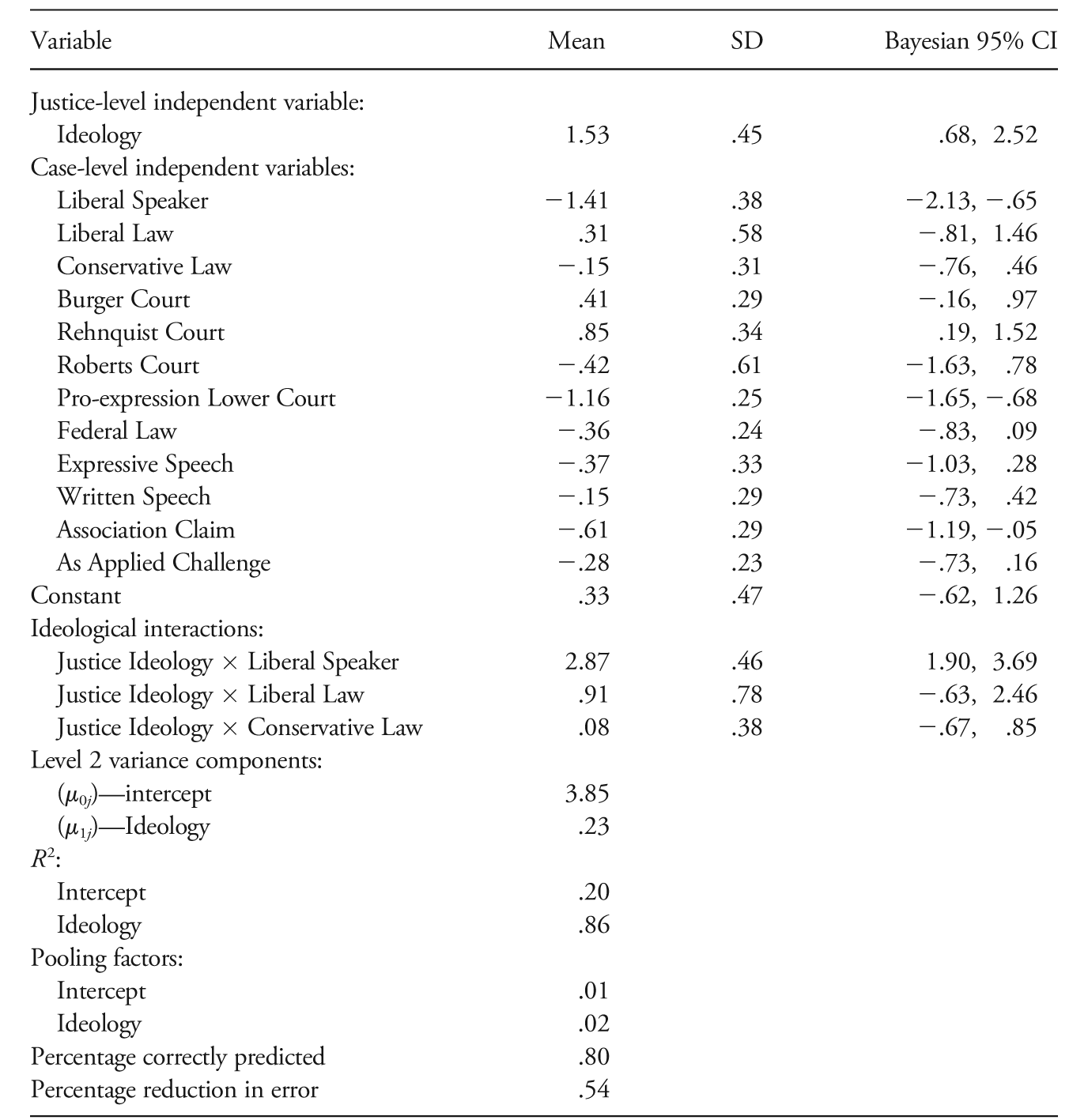
From the Liberal Speech variable, we should be able to gain leverage on judging in the First Amendment context. For example, a negative sign on Liberal Speech would suggest that conservative justices are less likely to support speech when the speech is coming from a liberal enclave (e.g., in favor of gay rights) than when the expression is conservative (e.g., against abortion). Of even greater importance is the interaction of Justice Ideology × Liberal Speech. From an empirical standpoint, a positive coefficient would indicate that any gap between liberal and conservative justices in their support for free expression grows when the speech falls in a liberal cluster. Such a result would be consistent with the presence of in-group bias.
IV. Estimation and Results
Because our observations are individual justice votes (i) nested within specific cases (j), we employ a multilevel model. This method is useful for attending to any unobserved heterogeneity between cases that might bias our estimates; it also enables the baseline probability of a pro-expression vote to vary between cases. Finally, because we predict that the effect of ideology will depend on case-level variables, our approach allows for the coefficient on Justice Ideology to vary due to cross-level interactions.
The structure of our model is as follows, with the justice-level equation (1) and case-level equations (2) and (3).


We used Bayesian simulation via Markov chain Monte Carlo to estimate the model, with table 1 displaying the posterior distributions.Footnote 20 To summarize them, we provide means, standard deviations, and Bayesian credible intervals, which are roughly analogous to the coefficients, standard errors, and confidence intervals estimated in classical statistics.
Two-Level Model of Pro-expression Votes in First Amendment Cases, 1953–2014 Terms

Note.—CI = credible intervals.
Starting with model fit, the statistics show, first, that 80% of the votes are correctly predicted, corresponding to a 55.2% reduction in error. Next, the high R-squared value for the random coefficient Ideology implies that the in-group-bias account does a good job explaining how the effect of Ideology changes based on case facts. The implication here is that the cases’ unobserved attributes influence the likelihood of a pro-free-speech vote (although they will explain only the baseline probability of support for expression in a case and not the between-justice differences in voting). Finally, the fact that the pooling factors are all close to 0 indicates very little between-case pooling in the intercept or in the effects of Ideology on votes, suggesting that the multilevel approach is more appropriate than a pooled analysis.Footnote 21
Turning to the estimates of primary interest, note that Ideology is not a significant predictor of votes—indicating no meaningful difference between liberal and conservative justices for conservative expression. The gap only emerges when the speech falls into a liberal grouping, as indicated by the positive Justice Ideology × Liberal Speech. That is, the difference between liberal and conservative justices grows larger when the speech originates from a liberal enclave. Notice too that Liberal Speech is negative and significant, suggesting that conservative justices are less likely to support liberal speech than conservative speech.
As with many statistical analyses, the coefficients themselves do not provide a complete picture of the substantive effects. To examine their magnitude, we display, in figure 2, the changes in the predicted probability of a justice voting in favor of free speech based on the ideological direction of the challenged law as well as the speech’s ideological grouping.Footnote 22
Changes in the predicted probability of a justice voting in favor of free expression based on the law’s ideological direction and the expression’s ideological grouping. The vertical axis is the predicted probability of voting in favor of free expression; the horizontal axis is the justice’s ideology, from most conservative to most liberal. The solid lines are the predicted probabilities; the dashed lines are 95% Bayesian credible intervals.

As we can see, and regardless of the whether the law is liberal or conservative, when the speech falls under the liberal ideological grouping (the solid black line), the effects match predictions from the standard ideological-issue model: liberal justices are highly likely to defend the speech, while conservative justices are highly likely to support regulating it (.92 probability for the most liberal justices vs. .12 for the most conservative justices for liberal laws).Footnote 23 But, crucially, this pattern does not hold when the speech is conservative (the solid light gray line in the middle panels). Again (and regardless of the ideology of the law), the gray line is nearly flat, indicating that even the most liberal justices are nearly as (un)likely to support speech over regulation as the most conservative justices (.52 vs. .45 for liberal laws).Footnote 24 This significantly smaller gap between liberal and conservative justices suggests that when either faces a conflict between their ideological preferences on the First Amendment versus their response to the ideological grouping of the expression, they place significant weight on the latter. The results, in other words, mirror layperson behavior in the Kahan et al. (Reference Kahan2012) study, converge with experimental findings of us-against-them judging (Wistrich et al. Reference Wistrich2015), and match up with Baum’s (Reference Baum2017) descriptive observational studies. More to the point, the findings provide confirmation of in-group bias in adjudicating First Amendment claims.
Even so, we do not want to suggest that standard ideological approaches are meritless or that in-group bias is the sole determinant of voting. In the first place, following from the conventional understanding, very liberal justices are always more likely than very conservative justices to support free-expression claims, as figure 2 shows. What our results imply instead is that ideology plays a more complex role. On the one hand, conservative justices do not turn into free-speech champions even when the speech is coming from a conservative enclave. On the other hand, the difference for conservative justices between supporting speech 45% of the time when the speech is conservative versus 12% when the speech is liberal is quite large (and the variable is statistically significant, of course). The difference for liberal justices is similarly substantial: from 92% support for liberal speech to 52% support for conservative speech. Second, our emphasis on in-group bias does not, and should not, rule out other explanatory factors; in fact, table 1 makes clear that legal and institutional variables also influence voting. The suggestion here is that in-group bias is an important piece of the puzzle, but it is not the only one.
V. Robustness Checks
We conducted several checks on the analysis presented in table 1: substituting the Martin-Quinn measures for the Segal-Cover scores (see n. 13), estimating a three- instead of a two-level model (see n. 14), recoding campaign finance laws as liberal laws (see n. 17), omitting the chief justice dummies, adding a civil liberties dummy, and subtracting the case-fact variables. In all the models, Liberal Speech and Justice Ideology × Liberal Speech yield values consistent with those in table 1.
We also took four deeper cuts at the data. First, recall that we recoded the dependent variable for 15% of the votes because the Supreme Court Database had focused on an issue other than free expression (see Sec. III). To assess the effect of this step on our findings, we discarded all the votes we recoded and reestimated the models. The results do not change in any meaningful way, as we report in table A6 in the appendix.
Still, these recodings, however negligible, could have affected our conclusions by introducing the possibility of framing—in this context, lawyers or justices picking and choosing among legal issues to manipulate votes.Footnote 25 This possibility led us to conduct a second major check on the data: a search for framing effects. To begin the process, we reasoned that framing could affect our results only if the relevant actors were able to recast the issue or legal provision—as in pro-life protest cases (which raise questions of privacy and freedom of expression). Because the US Supreme Court Database identifies cases in which there are multiple issues, legal provisions, or both, we were able to cull out “pure” First Amendment cases: those that raised only the First Amendment and so could not be reframed. It turns out that for 87% of the cases in our data set, the First Amendment was the primary issue and the primary legal provision, and for almost 50% there was no other legal provision or issue to frame, meaning they were pure First Amendment disputes. Nonetheless, we reestimated the models in table 1 including only the pure cases. Table A3 in the appendix houses the results; they are entirely consistent with table 1.Footnote 26
The third major check we conducted was to recode the Liberal Speech variable to focus on the speaker rather than the speaker’s message (see n. 18). For the reasons suggested in Kahan et al. (Reference Kahan2012) and many other studies, we think a focus on the ideological grouping of the speech most closely parallels the in-group-bias literature. But because reasonable people could disagree over this choice (e.g., Pettys Reference Pettys2015; see n. 19), we reestimated the models using the ideological enclave of the speaker.Footnote 27 The results, presented in table A5 in the appendix, are almost identical to those depicted in table 1.
In sum, none of the first three checks calls for a change in the inferences we drew from table 1. Nor did the fourth and last assessment: reestimating the models separately for each chief justice era.Footnote 28 Although there are suggestions in the political behavior literature that in-group bias (affective polarization) among American voters has increased over time (e.g., Iyengar and Westwood Reference Iyengar2015), we do not find a similar effect for the justices.Footnote 29 Comparing the (liberal) Warren Court era of the 1950s and 1960s and the (conservative) Rehnquist Court years of the 1980s and 1990s, we find equally substantial gaps in the probability of liberal and conservative justices supporting liberal messages and, again, much smaller—and sometimes even reverse—gaps when the speech comes from a right-of-center grouping. In other words, the results match the pooled analysis with little time trend. As for the most recent era, the Roberts Court, Liberal Speech and Justice Ideology × Liberal Speech are large and correctly signed (in line with table 1), but only Liberal Speech is significant. This likely reflects the relatively small number of votes cast by the Roberts justices (N = 373 in 42 cases).
VI. Extensions
Despite the many checks we ran on the results, we realize that ours is just a first step toward assessing whether in-group and other cognitive biases affect judging. Many more are needed, with two sets coming directly to mind. The first reflects our interest in in-group bias. We can imagine more studies focused on the timely topic of the First Amendment’s guarantees of speech, press, and association, although for a different set of judges. For the US Supreme Court’s 1953–2014 terms, we identified 530 freedom-of-expression cases; between 1953 and 2012, US district court judges resolved over seven times as many (3,861).Footnote 30 Comparing our results for the US Supreme Court with apex courts in other countries too would be worthwhile.Footnote 31 To the extent that in-group bias is a feature of human cognition, our findings should transport to other societies—and experiments on foreign judges suggest as much (e.g., Sonnemans and van Dijk Reference Sonnemans2012; Rachlinski, Wistrich, and Guthrie Reference Rachlinski2015). Whether observational results converge remains to be seen.
Analyses of other areas of the law too would be useful because it is hard to imagine that ideological in-group bias is cabined to free expression. By way of example, consider federal taxation, an issue seemingly far afield from the First Amendment. Although standard ideological accounts of judging (see, e.g., Schubert Reference Schubert1965), not to mention of public opinion (e.g., Lupia et al. Reference Lupia2007; Franko, Tolbert, and Witko Reference Franko2013), portray liberals (or Democrats) as pro-tax and conservatives (or Republicans) as anti-tax, in-group bias offers a different hypothesis: liberal justices will not always support the government, and conservatives will not always favor the taxpayer; rather, their votes will depend on the target of the tax deficiency notice, with conservatives more likely to support corporate targets (as ideological anti-tax allies), and liberals, individual taxpayers. A preliminary test of this prediction shows promise,Footnote 32 and the same may hold in other areas of the law as well.Footnote 33
Exploring relevant enclaves other than ideology presents yet another possibility under the rubric of in-group bias. Do Jewish judges who prefer a strong separation between church and state nevertheless rule in favor of a weaker wall when the government aids a Jewish group? Are even very conservative female judges more likely to hold for a criminal defendant if the defendant is a woman? Is it possible that judges who almost always favor the federal government over the states have emotional responses to cases involving their home state? Hints in the judicial behavior literature suggest that these kinds of biases exist (e.g., Brent Reference Brent1999; Boyd, Epstein, and Martin Reference Boyd2010; Parker Reference Parker2011; Abrams, Betrand, and Mullainathan Reference Abrams2012), but more direct and expansive tests are needed.
All these recommendations pertain to in-group bias. A second set would shift toward other biases unearthed in the experiments on judges. These include but are not limited to the biases of confirmation, belief, and hindsight, as well as motivated cognition—or the ability of our reasoning processes to lead us to conclusions consistent with our preferred outcomes (see n. 25). Sood (Reference Sood2015), for example, demonstrates that lay experimental participants are more likely to suppress evidence from a (presumably illegal) search when the underlying offense is selling marijuana to terminally ill cancer patients than when it is selling heroin to high school students. Experiments on actual judges reinforce this basic finding (see, e.g., Wistrich et al. Reference Wistrich2015).
Further assessments of the extent to which this and other cognitive biases figure into judging pose their share of challenges. But meeting them would move us closer to the chief aim of most studies of judicial behavior: the development of a deeper, more realistic conception of judging.
Appendix
Description of Variables in the Statistical Model

Note.—The modal category is in boldface. The omitted categories are for Court, the Warren Court; for law, neutral; and for speech, verbal. N = 4,644.
Cross-Tabulation of the Raw Data, 1953–2014 Terms (%)

Two-Level Model of Pro-expression Votes in Only “Pure” First Amendment Expression Cases, 1953–2014 Terms

Note.—N = 2,196 votes in 251 cases. CI = credible intervals.
Logistic Regression of Pro-expression Votes in First Amendment Expression Cases, 1953–2014 Terms

Note.—Pooled logit model. We also estimated a logit that clusters on cases. The results (available on our website) do not change in any meaningful way.
Two-Level Model of Pro-expression Votes in First Amendment Expression Cases, 1953–2014 Terms

Note.—The difference between this and table 1 is that we substitute Liberal Speaker for Liberal Speech—meaning the focus here is on the ideological grouping of the speaker rather than the speech. This table excludes cases in which there were multiple speakers of liberal and conservative ideologies, as well as lawyers as speakers. Including lawyers as conservative or liberal speakers does not change the results (available on the project’s website). N = 4,197 votes in 479 cases. CI = credible intervals.
Two-Level Model of Pro-expression Votes in First Amendment Expression Cases, 1953–2014 Terms, Using Only Cases in Which the Coding of the Direction of the Decision Is the Same as in the US Supreme Court Database
Note.—N = 4,112 votes in 470 cases. CI = credible intervals.



