1. Introduction
The dispute settlement system of the World Trade Organization (WTO) is widely touted as one of the most legalistic institutions on the international stage. Indeed, it is celebrated as one of the few instances in which power politics has been supplanted by an institution in which ‘right perseveres over might’ (Lacarte-Muró and Gappah, Reference Lacarte-Muró and Gappah2000: 401). Yet, this greater legalism has undoubtedly affected the relative ability of WTO Members to use the dispute settlement system. After all, the more complex the system becomes, the more that legal capacity – namely, the resources required to monitor and enforce rights and obligations – is required to use it. In this sense, the lack of legal capacity is not just a problem for the individual Member, but for the Membership as a whole, since trade violations that go unchallenged risk undermining confidence in the liberal trading regime more generally.
A sizable number of studies single out legal capacity as an explanation for the variation we see in WTO Members' use of dispute settlement. These studies, however, have relied on indirect proxies, such as per capita income, the logic being that wealthier countries are more endowed with legal capacity than poorer ones. While this is broadly intuitive, it nonetheless misses the fact that, in terms of experience with dispute settlement, and investments in the resources needed to support litigation, even developed countries are a heterogeneous bunch, let alone developing ones. This calls into question the validity of these measures. To get more directly at legal capacity, we designed and administered a survey to all WTO Members. We then constructed an index of legal capacity using responses to five questions concerning their professional staff, bureaucratic organization at home, bureaucratic organization in Geneva, experience handling general WTO matters, and involvement in WTO litigation. In comparing our index to existing measures, we find that they are only weakly correlated, casting doubt on the literature's understanding of the importance of legal capacity. When taken together with the comments of Members in our interviews, the implication is that the literature has failed to grasp the full importance of legal capacity in WTO dispute settlement.
This Article is organized as follows. Section 2 questions the efficacy of existing measures of legal capacity. Section 3 presents our survey, detailing the questions asked and the responses received. Section 4 describes the construction of our legal capacity index and compares it with existing measures. Section 5 delves into some of the responses given in the semi-structured interviews we conducted. Section 6 comments on the limitations of our study. Section 7 concludes.
2. Existing measures of legal capacity
Gaining a better understanding of whether and how legal capacity matters is important for at least three reasons. First, to the extent that differences in legal capacity are influential in shaping the use of WTO dispute settlement (and for deterring protection in the first place), a proper measure is crucial if governments are to evaluate their institutional shortcomings, and seek assistance in the form of WTO-related technical assistance (Shaffer, Reference Shaffer2006). For example, Members need to assess whether to modify traditional diplomatic career rotations to retain WTO expertise, whether to create a specialized trade agency and a specialized unit for dispute settlement, and how to improve inter-agency coordination with the private sector on dispute settlement.
Second, WTO Members have engaged in intensive discussions over the review and potential amendment of the WTO's Dispute Settlement Understanding (DSU). If legal capacity is an important factor in determining effective use of the system, Members may also wish to consider procedural alternatives which are tailored for smaller Members that have less legal capacity, such as the creation of a small claims procedure (Nordstrom and Shaffer, Reference Nordstrom and Shaffer2008) or the strengthening of legal aid mechanisms.
Third, the issue of differential legal capacity raises questions about the role of WTO jurisprudence. Many commentators applaud and encourage the further legalization of the WTO dispute settlement system through the accumulation of case law, including the requirement of greater factual evidence for establishing violations of WTO commitments. For example, developments in WTO jurisprudence appear to require more factual evidence to show that a country has discriminated against foreign products, which requires a determination of whether the domestic and foreign products in question are ‘like products’ or are in a competitive relationship. Likewise, jurisprudence appears to require more factual evidence to demonstrate the effect of one WTO Member's subsidies on the competitive position of producers in another. These developments can be viewed as part of the maturation and growing sophistication of the WTO legal system, enhancing its legitimacy. Yet they could also increase the advantages of those having greater legal capacity so that concerns over ‘power politics’ are supplanted by concerns over the distribution of the resources needed to litigate.
Motivated by questions along these lines, scholars have used proxies for legal capacity which, while broadly intuitive, require a leap of faith. As Francois et al. (Reference Francois, Horn and Kaunitz2008: 11) write, ‘[i]t is very common in studies … to include some measure of legal capacity. Unfortunately, there are no direct measures of legal capacity, so instead some form of proxy variable has to be used.’ Scholars rely primarily on three proxies for WTO-related legal capacity: (1) per capita income or gross domestic product (GDP), (2) the number of professional staff in a Member's delegation in Geneva, and (3) existing indexes of either bureaucratic quality or governmental efficiency.
A commonly used measure is either per capita income or aggregate GDP.Footnote 1 These proxies, however, are problematic. Take, for example, per capita income; the logic behind this variable is that poorer countries are less endowed with legal capacity. However, some of these countries' economies are relatively large and boast highly educated elites employed by trade bureaucracies (Horn et al., Reference Horn, Nordstrom, Mavroidis, Mavroidis and Sykes1999), as in the case of Brazil and India (Shaffer et al., Reference Shaffer, Ratton-Sanchez and Rosenberg2008). Other studies use GDP as a proxy for a Member's ability to absorb the costs of WTO dispute settlement (Bown, Reference Bown2005; Besson and Mehdi, Reference Besson and Mehdi2004). The problem here is that GDP can reflect other reasons for using (or not using) the dispute settlement system, such as a Member's ability to retaliate for non-compliance.
Alternatively, other studies use the size of a Member's delegation in Geneva as a proxy for legal capacity (Francois et al., Reference Francois, Horn and Kaunitz2008; Sattler and Bernauer, Reference Sattler and Bernauer2008; Bown, Reference Bown2005; Guzman and Simmons, Reference Guzman and Simmons2005; Besson and Mehdi, Reference Besson and Mehdi2004; Horn et al., Reference Horn, Nordstrom, Mavroidis, Mavroidis and Sykes1999). The WTO publishes an annual phone directory for internal use which lists each Member's delegates in Geneva.Footnote 2 As Horn et al. (Reference Horn, Nordstrom, Mavroidis, Mavroidis and Sykes1999: 15) observe, ‘the idea is that countries with larger representations are better informed about developments in the trading system, including the [dispute settlement] system’. Basing the measurement of legal capacity on such data, however, is also problematic. To start with, there may be problems with the accuracy of the numbers because some delegates have portfolios that include United Nations (UN) agencies, while others are dedicated full time to WTO matters. More importantly, the numbers tell us nothing about the quality of a Member's personnel and institutions. A delegate with six years of WTO-related experience is likely to be more informed than one with six months. Similarly, a delegate with six years of experience related specifically to WTO dispute settlement is likely to be more capable of filing submissions in litigation than one whose portfolio is limited strictly to diplomatic matters. Beyond the full time staffers themselves, Members that have specialized institutions for handling disputes, and that coordinate well with the private sector, are also likely to be able to mobilize more effectively to litigate over trade obligations. In short, it is doubtful that a count of those assigned to a Member's Geneva delegation informs us sufficiently about legal capacity, a point that is born out by this measure's weak correlation with our own.
Finally, previous studies have used the bureaucratic quality and efficiency of a Member's institutions as a proxy. Francois et al. (Reference Francois, Horn and Kaunitz2008) use the World Bank Worldwide Governance Research Indicators Dataset for Government Efficiency, multiplied by the logarithm of GDP, to obtain a figure for a Member's aggregate legal capacity. Guzman and Simmons (Reference Guzman and Simmons2005), in contrast, use the International Country Risk Guide's (ICRG) subjectively coded variable, bureaucratic quality. This bureaucratic quality index, which was developed by the Political Risk Services Group and is widely used in political science (e.g., Knack and Rahman, Reference Knack and Rahman2007), assesses whether a government's bureaucracy is ‘autonomous from political pressure’ and has an ‘established mechanism for recruitment and training’, such that it has ‘the strength and expertise to govern without drastic changes in policy or interruptions in government services’.Footnote 3 The measurement of bureaucratic quality ranges from 0–4, with high values denoting better bureaucracies. The problem is that neither of these measurements speaks directly to trade-related capacity, let alone capacity for WTO dispute settlement. Not surprisingly, this measure, too, only weakly correlates with our index of legal capacity.
Needless to say, problems with these measures have only confounded the debate in the literature. On the one hand, for example, Horn et al. (Reference Horn, Nordstrom, Mavroidis, Mavroidis and Sykes1999) find little evidence that legal capacity matters, using either per capita income or the size of a Member's Geneva delegation, the latter of which fares little better in Bown (Reference Bown2005). On the other hand, Busch and Reinhardt (Reference Busch and Reinhardt2003) use per capita income and find that legal capacity does matter, much like Guzman and Simmons (Reference Guzman and Simmons2005), who additionally employ a count of embassies abroad, a Member's non-military government expenditure, and the index for bureaucratic quality. Using these measures, Guzman and Simmons (Reference Guzman and Simmons2005) conclude that there is ‘strong evidence that developing countries are constrained by their capacity to launch litigation’ (p. 559). Francois et al. (2008) report results in line with those of Guzman and Simmons, but doubt that legal capacity, as opposed to levels of development, is really the key (p. 19). To advance this debate, a better measure of legal capacity is clearly needed.
3. Surveying the WTO Membership on legal capacity
To more directly measure legal capacity, we prepared and distributed a 21-page survey to the full membership of the WTO. From May 2005 through May 2007, we surveyed the delegations of each of the (then) 150 Members, including (by email) those Members that did not have offices in Geneva. The survey included 48 questions on issues ranging from bureaucratic staff and organization to a Member's prior experience in dispute settlement.
Before designing the survey, we had to determine the types of questions relevant for creating a quantitative measure. We went to Geneva to interview a large sample of representatives responsible for WTO dispute settlement matters. We started these interviews with open-ended questions concerning their experiences with the WTO dispute settlement system and their views regarding the challenges that their government faced. We did so in order to avoid imposing our format (and our hypotheses) on the interviewees. We nonetheless covered a series of topics, including information regarding: staff in Geneva and at home, coordination between the Geneva and home capital bureaucracies, the use of in-house and external lawyers, the general procedure for handling potential cases, relations with the private sector, sources of funding for bringing cases, and the use of technical assistance programs, among others.
We then created a first draft of the survey on which we received comments from colleagues, many of whom had little knowledge of the WTO but nonetheless were experienced with surveys. We were particularly concerned about the wording of our questions in order to minimize ambiguities. The problem that questions will be understood differently by respondents is an ever-present challenge. In our case, moreover, we had to translate the survey into French for delegates of West African countries.
Following extensive revisions of the initial draft, we did our best to minimize the problem of disparate interpretations of survey questions in two additional ways. First, we pre-tested the questions on a sample of representatives from WTO missions and revised those questions that they found ambiguous, which also led us to add and eliminate other questions. Second, one of us was present where possible when the survey was completed. We were thus able to clarify a question's meaning, if necessary, in consistent verbal terms.
Each Member's representative with responsibility for following matters before the Dispute Settlement Body (DSB) completed the survey.Footnote 4 For those Members who most frequently participate in dispute settlement, this representative was typically a lawyer. In other cases, the representative was a delegate on diplomatic rotation, though typically one who specializes in economic affairs.
We generally did not have to provide additional guidance concerning a question's meaning. However, given the vast differences in terms of the respondents' experience with dispute settlement, we did have to explain some questions for those Members who had never participated in WTO dispute settlement and/or those who had recently arrived in Geneva and were unfamiliar with the system.Footnote 5 In other words, the very issue on which we were gathering information – namely, legal capacity – was made salient to us by virtue of the fact that some Members were able to complete the survey quickly, while others were unsure of why the question was being asked.
Our 48-question survey was divided into five sections. The first three sections consisted largely of objective questions concerning professional staff (numbers, experience, and specialization), other sources of legal counsel, and receipt of training and attendance of meetings. The fourth and fifth sections posed subjective questions concerning a Member's experience using dispute settlement, as well as its reasons for not using dispute settlement. The full survey is available on our websites.Footnote 6
Section I (entitled Mission, Home Agency, and Staff) posed questions regarding the number of ‘professional staff’ in the mission and the home capital ‘dedicating at least fifty percent of their time to WTO-related matters’.Footnote 7 We used the figure of 50% of dedicated time because for many missions, especially missions from smaller countries, representatives handle both UN and WTO matters. In sub-section A (entitled Geneva-Based Mission), we asked for the number of professional staff in the Geneva mission for each of the years 1995, 2000, and 2005 to check for developments over time. Since some developing countries, particularly poorer countries in Africa, have no Geneva-based mission, but handle WTO-related matters in Brussels (the headquarters of the European Commission), we inquired in sub-section B (entitled Staff Elsewhere in Europe) for information concerning the number of these personnel dedicating at least 50% of their time to WTO-related matters.
In sub-section C, entitled Home Capital, we asked how many professional staff that dedicated at least 50% of their time to WTO-related matters were located in the lead agency in the capital, as well as how many such professional staff were in the home country overall. We then queried if the Member had ‘a specialized WTO dispute settlement division’, and, if so, how many professional staff it had. In sub-section D (entitled General Staff Questions), we inquired about the experience and legal background of the professional staff. To get at experience, we asked for ‘the longest cumulative amount of time’ that any single current member of the government's professional staff dedicated to WTO (and, if applicable, prior-GATT) matters had served, and inquired if turnover of WTO-related professional staff was a problem for the government (rated on a 1–5 basis). We also checked whether support from the home capital was adequate, and whether the Member faced coordination problems among government agencies, each rated on a 1–5 basis. Finally, we asked what percentage of professional staff had a law degree, and if the lead person on WTO dispute settlement had one.
In Part II (entitled Other Sources of Legal Counsel), we inquired whether the Member had used private lawyers in WTO disputes (whether hired by the government or private industry) as a complainant or respondent. In sub-section B (entitled The Advisory Centre on WTO Law), we asked if the Member had relied on the Advisory Centre on WTO Law (ACWL) for legal representation, and in what context (i.e., in consultations, as a complainant or as a respondent), and in sub-section C (entitled Other Legal Counsel) if the government had used a list of other sources (such as the WTO secretariat, UNCTAD, and NGOs). In sub-section D (entitled Financing of Legal Representation), we checked what proportion of the cost of external legal assistance for the government's disputes was financed by private firms or trade associations (ranging on a 1–5 basis, from none to all).
In Part III entitled Training and Experience, we pursued questions regarding staff participation in training sessions on WTO dispute settlement and the sources of such training. We then posed questions regarding participation in WTO meetings. We gave a list of 23 councils and committees and asked the representative to check which ones the Member attended on a regular basis. The responses showed that most Member delegations had someone attending meetings of the DSB, but that there was significant variation in terms of the Member's ability to send a representative to attend most other WTO committee meetings.
Part IV (Reasons WTO Dispute Settlement Not Used) and Part V (Reasons for Use of WTO Dispute Settlement) posed questions regarding the reasons that a Member used (or did not use) the WTO dispute settlement system, and their experiences with it, as regards formal consultations, informal negotiations, third party participation, and the advantages of the largest WTO Members. We gave a list of responses that had emerged from the existing literature and our previous interviews, and asked Members to rank their responses in terms of the most important three. As we report below, we then categorized which responses focused more on legal capacity and which on power-oriented (or market-size) explanations.
In all, 52 WTO delegations out of the (then) 150 WTO Members completed our survey. Most importantly, the survey respondents comprise the full range of Members, both in terms of income and geographical diversity, including all major users of the dispute settlement system and a broad representation of those who have never used it, including a large number of least developed countries. Of the 52 countries responding, ten fall within the World Bank's ‘low income’ classification, 16 are ‘lower middle income’, 14 are ‘upper middle income’, and 12 are ‘high income’ countries. There are nine respondents from the East Asia and Pacific region, nine from Europe and Central Asia, nine from Sub-Saharan Africa, 17 from Latin America and the Caribbean, four from South Asia, and two from the Middle East and North Africa. In sum, there are no important missing countries from our survey. This is not to say that our survey sample is fully representative. That said, and given the demands on delegates' time, and the difficulty of reaching many of them, some of whom have no representative in Geneva, we believe we have a highly respectable response rate on the part of Members covering all regions and income classifications. Our descriptive results below are clearly conditional on the particular sample we have drawn, and although we do not believe that there are likely to be major biases, we must register at least a degree of caution in assuming them to apply to the whole membership of the WTO.
4. A new measure of legal capacity
Before turning to the specifics of our new legal capacity measure, it is worth highlighting that the survey responses indicated that a lack of legal capacity weighs heavily on the minds of developing country representatives. We asked each delegation whether there had been potential WTO complaints that its government had considered filing, but chosen not to file. We followed that with a checklist of ‘main considerations that led your government to choose not to file [such] cases’, and then with a checklist regarding ‘the main considerations that motivate your government to reserve rights as a third party, instead of filing its own complaint’, asking them to check the top three reasons in order of importance. In response, 56% of the respondents cited the ‘high cost of litigation’ or a ‘lack of private sector support’ as reasons for not pursuing a complaint.Footnote 8 An additional 10% cited ‘training for future disputes’ as the rationale for third party intervention instead of an independent filing. If we combine these responses, it indicates that 67% of respondents chose these legal capacity-oriented factors to explain why they intervened as a third party instead of filing their own complaint.Footnote 9 By way of comparison, a smaller proportion (49%) of the respondents cited responses that reflected inadequate market power as a reason for not filing (i.e. checking ‘lack of remedy other than suspension of concessions’, ‘lack of credible ability to suspend concessions’, or ‘external political pressures’).Footnote 10
Similarly, when we asked each delegation about the sources of advantage in WTO dispute settlement for the most powerful Members and to check the top three reasons in order of importance, legal capacity explanations predominated over market power ones. Eighty-eight per cent of the respondents answered that the advantages held by the largest Members comes from reasons that reflect greater legal capacity: i.e., the ‘number and legal sophistication of government officials’, ‘experience of government officials with WTO dispute settlement’, their greater ability to afford the ‘high cost of WTO litigation’, and ‘greater private sector support’. This stands in contrast to the 48% who thought that the advantages of powerful Members derive from considerations related to market power: i.e., ‘reliance on suspension of trade concessions’, the ‘ability to apply external political (non-legal) pressure’, and the ‘lack of retrospective remedies’. Overall, the survey responses indicate that Members view legal capacity as the most significant factor that shapes how they use the WTO dispute settlement system.
To turn to our new measure of legal capacity, our legal capacity index is based on five of the questions from the survey. The combined index sums the standardised values of the following five questions from which we derived a Legal Capacity Score:
1. Does your government have a specialised WTO dispute settlement division? If so, how many professional staff does this division have? Of the 40 developing countries answering this question, 28 responded negatively, while all developed countries responded positively.Footnote 11 Moreover, of the 12 developing countries responding affirmatively, two had one professional staff, four had two, one had three, two had five, two had six to seven, and one had eight to ten. None had 21 or more. In contrast, two of 11 developed countries responding to this question had 21 or more professional staff, and none reported having fewer than five.
2. What is the longest cumulative amount of time that any single current member of your government's professional staff dedicated to WTO matters (including, prior to 1995, GATT matters) has served, in years? Of the 40 developing countries responding to this question, 25% reported a figure of six years or less, whereas no developed country reported a figure under ten years. Fifty per cent of developing countries reported a figure of between eight and ten years, with the remaining 25% reporting a figure of between 11 and 29 years. In contrast, 60% of the 11 responding developed countries reported a figure of between 20 and 25 years.
3. Is turnover of your WTO-related professional staff a problem for your government? Of the 41 developing countries responding to this question, 41.5% answered ‘definitely yes’, 17.1% answered ‘probably yes’, and 19.5% answered ‘maybe yes/maybe not’. Only 9.8% answered ‘definitely not’, while 12.2% answered ‘probably not’. By comparison, of the 11 developed countries responding to this question, only 18.2% answered ‘definitely yes’ with an identical percentage answering ‘probably yes’.
4. What proportion of the cost of external legal assistance for your government's WTO disputes have private firms or trade associations financed? Of the 28 developing countries responding to this question, 21% answered ‘none’, 7% answered ‘a small proportion’, 11% answered ‘a moderate proportion’, 18% answered ‘a large proportion’, and 43% answered ‘all’. By contrast, of the seven developed countries responding to this question, 29% answered ‘none’ and 71% answered ‘all’.
5. Which meetings of standing WTO councils and committees do the members of your mission's professional staff attend regularly, or close to regularly? Please check all that apply [out of a list of 23 bodies, which we sum into a total count]. Of the 41 developing countries responding to this question, 21% attend fewer than ten councils and committees, and 7% attend six or fewer; 41% attend 15 or fewer, while 27% attend 23. Of the 11 developed countries responding to this question, 64% attend 23, and none attends fewer than 13.
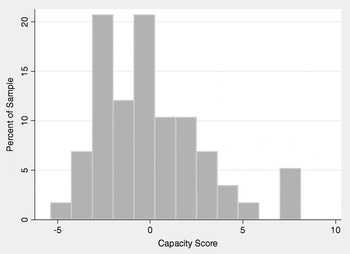
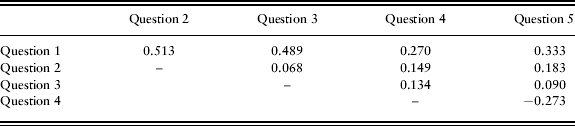
To compile our index, we standardized (i.e., subtracted the sample mean and divided by the sample standard deviation) the response for each of the five questions.Footnote 12 Four of the questions contribute positively to this measure, but higher values of the turnover question subtract from it. The resulting variable, Legal Capacity Score, ranges on a continuous scale from −5.4 to 8.1, with higher values denoting better legal capacity. In the survey sample, the mean is 0 and the standard deviation is 2.8. Figure 1 depicts the distribution of Legal Capacity Scores across the 52 responding Members. Table 1 reports the bivariate correlations among the index's component questions.
Distribution of legal capacy across survey sample

Correlations among component questions
We chose these five survey questions for our index because they provided reliable data that closely tapped into the aspects of legal capacity that earlier proxies had failed to capture – namely, experience, continuity of representation, institutional specialization, and private sector coordination. Moreover, these indicia correspond with the information we received from our interviews (see below). We did not include the data on the size of the delegation in Geneva because that figure is already available and because we can substitute the new figure for attendance at WTO meetings which goes more directly to participation in the system. We also did not include the data for overall WTO-related staff because of concerns over the accuracy of these data. Many responding delegates expressed that they could not obtain reliable figures for total staff working on WTO-related matters in the home capital.
The first question concerns the existence and size of a WTO dispute settlement division; it provides information regarding the extent to which a Member has developed institutional capacity tailored for dispute settlement. Where a Member has a specific WTO dispute settlement division, it is typically based in the home capital, with one or more representatives coordinating from Geneva.
The second question gets at the cumulative experience in the WTO (and, if applicable, the GATT) of a single representative in the government. Of course, a delegation could include an individual with considerable experience but have no supporting professional staff, so this measure is insufficient in itself. A better measure of experience would be to sum the total experience of the whole of a Member's professional staff dedicated to WTO matters. This figure, however, cannot be easily obtained in an accurate manner. We thus narrowed our question to generate a figure which could be obtained more readily. It turned out that smaller developing country Members tended to benefit from less continuity of representation, which this figure reflected.
The third question also addresses the issue of institutional continuity, but from a different angle, asking whether turnover of professional staff is a problem (rated on a scale of 1–5). Some delegations have high turnover based on traditional diplomatic rotation. Other delegations address this institutional challenge by creating trade and economic-focused career tracks. The downside of this question is that the response is a subjective one, such that respondents may have different criteria for evaluating whether staff turnover is a problem. We nonetheless included the responses in our index because they parallel those received for the other questions, while providing information on a different aspect of institutional capacity.
Responses to the fourth question provide information on a Member government's relations with the private sector for purposes of filing cases before the WTO. This tells us the extent to which firms and trade associations have financed external legal assistance, and thus gets at a number of important aspects of WTO dispute settlement. Our interviews consistently show that Member governments perceive WTO dispute settlement to be expensive. The prospect of potentially paying a half million to a million US dollars (or more) in legal fees can be difficult to justify in intergovernmental decisions involving the Treasury Ministry. If the private sector agrees to cover all or a large portion of these legal fees, then the government is more likely to file a case in Geneva. Moreover, a trade ministry can benefit from the support of the private sector in making the argument for pursuing a WTO complaint within intra-governmental decision-making processes. Finally, WTO dispute settlement typically requires close cooperation between the government and the affected private sector to build the factual file for a case, since the private sector typically has greater information about transgressions of trade obligations. Government bureaucracies who fail to win private-sector cooperation are thus at a disadvantage.
The fifth question provides information regarding a Member's regular participation in a list of 23 WTO councils and committees. It thus offers information as to a Member's experience and engagement with the system as a whole, providing a better indication of the overall quality of its staff. Although this measure reflects the overall number of professional staff in a Member's Geneva delegation, it provides better information about actual participation rates of delegates in the overall WTO system. Council and committee meetings are directly and indirectly linked to the monitoring of compliance with WTO obligations. Potential and actual trade disputes are regularly discussed in many of them, and informal resolutions are recorded in some of them, such as before the Committee on Sanitary and Phytosanitary Measures and the Committee on Technical Barriers to Trade.Footnote 13
So how do the previous proxies used for legal capacity correlate with our measure? The answer is: not much. Our measure correlates only modestly, not highly, with a Member's World Bank income category (r=0.431; regression R 2=0.19) and with the size of its Geneva delegation as listed in the June 2005 WTO Directory (r=0.452; R 2=0.20). Similarly, the International Country Risk Guide's subjectively coded variable, Bureaucratic Quality, used by Guzman and Simmons (discussed above), again correlates positively, but not too strongly (r=0.455; regression R 2=0.21) with our Legal Capacity Score. While we cannot identify specific countries due to the terms of consent for our survey, the list of governments with the highest levels of Legal Capacity Score reflects the conventional wisdom.
5. Member interviews concerning legal capacity
The responses to the questions that make up our Legal Capacity Score are also born out in the interviews we conducted. They complement the quantitative data we gathered, giving a more direct feel for the numbers aggregated from the survey responses. When we presented this study to a broad range of delegates in Geneva, moreover, it was confirmed that the quotations we highlight resonate with their experience.
The representatives from developing countries we interviewed stated that they confront serious challenges due to a lack of legal capacity. For example, a representative who handled dispute settlement from one of the larger Asian countries said that ‘lack of resources is our main problem’. The representative stressed the Member's lack of personnel, experience, and legal knowledge, exacerbated by linguistic challenges owing to the fact that only English, French, and Spanish are official WTO languages.Footnote 14 Regarding the creation of a specialised dispute settlement unit, this representative stated that ‘we have considered it, but unfortunately do not have it’. Thus, he handles complaints ‘alone’. It is ‘too much’, he said. ‘I can take you back in my office and show you the files.’ He raised his hands to indicate that the stack is a few feet high.
As a representative from another Asian country responded, ‘the largest Members have experience and numbers that are difficult to match for smaller Members, which give them an edge in playing procedural games, and in bringing cases that attempt to influence the outcome of negotiations and interpretations’.Footnote 15 Likewise, a smaller Central American delegation official stressed that ‘our mission faces many problems’, including ‘a lack of participation in WTO meetings, a lack of follow-up on issues, a lack of legal support, and a lack of human resources’.Footnote 16
Our interviewees revealed that the problem is not just in Geneva. A number of representatives noted the lack of support from the home capital, where only a few personnel handle all WTO matters. A representative from a Caribbean country stated that developing country delegates often feel ‘on their own’ in Geneva.Footnote 17 ‘We need better instructions, quicker instructions, more detailed instructions’, she said. In the words of a representative from one of the smaller Members in Asia, the support it received from the capital was clearly ‘inadequate’, and its personnel were ‘overstretched’.Footnote 18 Even one of the largest developing countries explained that support from the capital on dispute settlement ‘is bad’.Footnote 19 The official commented that his country, which is relatively active compared to other Members, takes decisions on disputes on an ‘ad hoc basis’ with little legal assistance from the home capital or the private sector. He concluded, ‘we offer a good case for how things should not be done at the WTO’.Footnote 20 A number of delegates noted the disadvantage of being geographically distant from Geneva, including the challenge of capital officials being in a distant time zone.
Similarly, interviewees cited the difficulty of participating as a third party in WTO complaints because of lack of support from the home capital. A Latin American country cited one occasion on which it could not file a third party submission in time because the approval from capital took too long.Footnote 21 This same Latin American representative noted that even when they ‘get third party submissions from capital’, ‘they are not in the proper form’ and do not make a ‘proper argument’ for panels.Footnote 22 He complained that ‘they are written in a totally ineffective form, they are not clear, and it can be difficult to understand the substance of the argument’. Yet another Latin American representative stated that, even when it received approval to be a third party, the lack of clear guidance constrained its ability to participate effectively.Footnote 23 In the representative's words, ‘we receive “guidelines” but not concrete decisions’, which limits the ability to participate in a meaningful way in an organisation where legal details matter. Sometimes the Geneva mission can only obtain a general approval to participate as a third party, but cannot obtain approval of a written position within the time delay set by the panel. As a result, when faced with an important case involving systemic issues, this country only put forward a vague general position, and did so orally, rather than submit a written position regarding the appropriate legal interpretation of the relevant WTO provisions. In a legalized dispute settlement system, this representative noted, vague third party general policy declamations are meaningless.Footnote 24
In sharp contrast, frequent users of the dispute settlement system indicated that they received either ‘excellent’ or ‘good’ support from the home capital (the two top rankings on a 1–5 scale).Footnote 25 One wrote in the space provided for comments: ‘Fully integrated…; in most cases seamless operationally.’Footnote 26 Another wrote: ‘All meetings at WTO or on WTO matters are covered by instructions from [capital]; and [capital]-based officials attend WTO or informal meetings.’Footnote 27
Many of our developing country interviewees cited problems with inter-agency collaboration as a complementary challenge. As a representative from a smaller Asian Member stated, ‘technically we are supposed to have intra-ministerial collaboration, but it is not functioning and has not been active’.Footnote 28 He maintained that there was a ‘lack of knowledge’ and ‘lack of interest’ in WTO matters in the home capital that made coordination among ministries a problem. A mid-sized Asian country offered the example of when it asked for assistance from the capital to identify non-tariff barriers that its exporters faced, barriers that the representative could raise and have addressed before the relevant WTO committees. He reported, however, that he ‘could not get the information because of lack of coordination in the capital’.Footnote 29 In contrast, delegates of frequent WTO complainants indicated that coordination among government departments is ‘definitely not’ or ‘probably not’ an issue (the two top rankings on our 1–5 scale). One major user wrote in the space for comments: ‘If anything, we have to deflect interest from other government departments.’Footnote 30
For many developing countries, the problem is not just a lack of support from the home capital or lack of coordination between ministries, but a lack of experience and expertise in any ministry. Many developing country representatives interviewed for this study saw the main problem to be that of diplomatic rotation, where personnel circulate within a governmental ministry (such as the Ministry of Foreign Affairs) as part of traditional civil service career paths. A mid-sized Latin American country noted that five years appears to be the maximum time that people stay on WTO matters and then leave for a better job, whether within government, to the private sector, or to an international organisation.Footnote 31 A representative from a smaller Latin American country noted how the ministry assigns people to Geneva postings for two to three years, after which they will leave for an unrelated post.Footnote 32 An official from an Asian country similarly indicated that ‘turnover is a major problem because the [ministry] also handles trade promotion issues, and these professionals often get assigned to foreign posts with minimal contact with WTO issues’.Footnote 33 Yet another Asian country representative noted how its officials shift ministries, including between federal and state ministries, possibly being sent off to something ‘like the rural development department’ where their WTO technical training offers no use.Footnote 34 In contrast, delegates from the most frequent WTO complainants marked that turnover of professional staff is ‘probably not’ a problem for the government (the second highest ranking on a 1–5 scale).
Although some commentators may suggest that legal capacity should not be an issue because private lawyers and the ACWL are available, our interviewees indicated, on the contrary, that a WTO Member needs legal capacity to make effective use of private law firms and the ACWL. Interviewed outside lawyers who work with developing countries on WTO matters were also quick to stress the lack of continuity of personnel and lack of support for cases from the home capital as problems.Footnote 35 They noted how they see good people in the mission who suddenly have to leave because their term is up and they are replaced by someone who will take at least a year ‘to learn the ropes’. They further explained that this lack of continuity undermines the expertise that has been developed.
6. Limitations of survey studies
All survey questions face the risk that individual respondents will interpret them differently or provide inaccurate responses. This risk can be more acute where the sample is small, as it is with a list of WTO Members. Nonetheless, we have taken pains to ensure that our questions were properly understood (and accurately translated), and that our priors were not hardwired into the survey. For example, although legal capacity factors were listed earlier in the list of options for some questions, we do not believe that the order had any significant effect on responses, since interviewees answered the survey in our presence and we observed them carefully go through the different options. They did not simply list the responses in order of appearance.
The major limitation of our survey is that we have agreed to keep the respondent Members' identity confidential as a condition to obtaining their responses. We are trying to have delegates agree that we can list the respective Member's name beside its Legal Capacity Score so that other scholars can use our legal capacity index in the future. We nonetheless note that the list of governments with the highest Legal Capacity Score accords quite well with the conventional wisdom on this subject.
Of course, our survey provides only a snapshot of a Member's legal capacity as reported to us at a moment in time. Only future work will be able to say whether the level of these resources changes rapidly, though we are doubtful. Indeed, with few exceptions, our suspicion is that these data will generally offer an accurate depiction for years to come. While we agree that the distribution of power is likely to change more slowly than the distribution of legal capacity, this is unlikely to allay concerns over the severe disadvantages developing countries face in a legalized WTO system.
Along these lines, another concern is that legal capacity may be endogenous. In other words, rather than legal capacity leading to more participation in dispute settlement, it could be that more participation in dispute settlement encourages a greater investment in legal capacity. For example, Francois et al. (Reference Francois, Horn and Kaunitz2008: 12) insist that ‘it may well be that countries have large delegations partly in order to handle the many disputes they invoked’.Footnote 36 They suggest that the number of WTO disputes could drive the development of WTO legal capacity, rather than vice versa. In this view, developing countries may have little legal capacity because they have no disputes.
Yet those participating in our study cast doubt on the latter interpretation. While experience with dispute settlement helps to build legal capacity, our informants also explicitly stated that they had disputes that could have resulted in WTO complaints, but they chose not to bring them precisely because they lacked legal capacity. Moreover, measuring legal capacity matters because legal capacity could be a deterrent to protectionism, such that if a Member has such capacity, it will be less likely to face trade barriers in the first place. We take up this prospect in a follow-on paper.
Finally, it can be argued that respondents are assessing their lack of legal capacity in relation to the lesser value they place on opening export markets because the size of their trade is small. In other words, the costs of WTO litigation could well be the same across all WTO Members, but smaller developing countries might anticipate fewer benefits from litigation, and thus invest less in legal capacity. This could be a significant part of the explanation. We note that whatever the explanation is for a developing country Member's lack of legal capacity, that Member will be much less able to use the dispute settlement system to its advantage, including in bargaining to induce settlement.Footnote 37 Even more important, with greater legal capacity, the Member is more able to deter its partners from introducing new measures adversely affecting its exports. It is also important to keep in mind that greater legalization of the WTO dispute settlement system can increase litigation costs, and thus reduce such Members' ability to use the system effectively.
7. Conclusion
Legal capacity is among the most salient variables in empirical studies of WTO dispute settlement. Yet for all the attention it has received, few measures do the variable any justice. Per capita income, or the number of permanent delegates in Geneva, are well rehearsed in the literature, but hardly seem up to the task. Similarly, measures of general bureaucratic quality are too broad. This Article reports on a new measure, one derived from the first-ever survey of WTO Members focused solely on legal capacity. Specifically, we construct an index using Members' responses to five questions concerning their professional staff, bureaucratic organization at home, bureaucratic organization in Geneva, experience handling general WTO matters, and involvement in WTO litigation. Importantly, our index is only weakly correlated with any of the proxies used in the literature, suggesting that legal capacity has not been given a fair hearing in the literature to date. Our extensive interviews of Members further suggest that legal capacity is the main constraint limiting their access to dispute settlement, and that more legal capacity would help them participate in all aspects of WTO dispute settlement. The implication is clear: the greater legalization of the multilateral trade regime poses asymmetric challenges for developing countries, perhaps allaying some concerns over the distribution of economic power, but raising new ones over the distribution of legal capacity.