


Introduction
Obsessive-compulsive disorder (OCD) affects roughly 1%–2.5% of the general population (American Psychiatric Association, 2000). Fear of contamination features prominently in approximately half of all cases of OCD (e.g. “I avoid using public toilets because I am afraid of disease or contamination”; Rasmussen and Eisen, Reference Rasmussen and Eisen1992). Cognitive models for anxiety disorders emphasize the key role of cognitive appraisals in increasing the subjective sense of anxiety, in turn motivating safety-seeking behaviours (Rachman, Reference Rachman1997, Reference Rachman1998, Reference Rachman2004, Reference Rachman2006; Salkovskis, Reference Salkovskis1985, Reference Salkovskis1999). For example, cognitive appraisals focusing on fear of physical harm (e.g. “I fear that I will get seriously ill”), fear of mental harm (e.g. “I fear that I will be lose control of my mind”), or fear of social harm (e.g. “I fear that I will be rejected by other people”) can result in fear of contamination (Rachman, Reference Rachman2006).
There have been reports of a different type of contamination, one that may be experienced without physical contact (Fairbrother and Rachman, Reference Fairbrother and Rachman2004; Rachman, Reference Rachman2006). This phenomenon, first identified by Rachman Reference Rachman(1994), is called “mental contamination”. This psychological sense of contamination involves an internal, emotional feeling of dirtiness that may be evoked by unwanted thoughts and images, as well as by memories of negative events such as sexual assaults. The primary source of mental contamination is an experience involving humans (e.g. violators or perpetrators) as opposed to substances (e.g. dirt or bodily fluids). For example, feelings of mental contamination may develop following experiences of ill treatment, sexual assault, domination, degradation, manipulation, betrayal, or humiliation (Rachman, Reference Rachman2006). Rachman, Radomsky, Elliott and Zysk Reference Rachman, Radomsky, Elliott and Zysk(2012) reported that introducing the element of betrayal boosts the magnitude of mental contamination. They also demonstrated that mental contamination can be aroused in some perpetrators of non-consensual acts involving betrayal.
Mental contamination is thought to be common; in a study of 177 people with OCD symptoms, 46% of them experienced mental contamination, and mental contamination was highly correlated with severity of the OCD (Coughtrey, Shafran, Knibbs and Rachman, Reference Coughtrey, Shafran, Knibbs and Rachman2012). The study also indicated that nearly half of the 54 participants who had moderate to severe OCD and were receiving treatment reported mental contamination. However, until recently, mental contamination in patients with OCD has been neither recognized nor treated.
Unwanted sexual experiences and mental contamination
Researchers have found that thoughts related to sexual trauma are particularly strong predictors of mental contamination (Fairbrother and Rachman, Reference Fairbrother and Rachman2004; Fairbrother, Newth and Rachman, Reference Fairbrother, Newth and Rachman2005; Olatunji, Elwood, Williams and Lohr Reference Olatunji, Elwood, Williams and Lohr2008; Berman, Wheaton, Fabricant and Abramowitz, Reference Berman, Wheaton, Fabricant and Abramowitz2012). For example, Fairbrother and Rachman Reference Fairbrother and Rachman(2004) found that 60% of a sample of non-clinical female participants who experienced sexual assault at least 3 months prior to interviewing reported experiencing at least one symptom of mental contamination when they deliberately recalled the sexual assault. “Sexual assault” was defined as unwanted sexual touching of any kind, from fondling, grabbing, or kissing to various types of sexual intercourse. The researchers also found that symptoms of mental contamination related to symptoms of Post-Traumatic Stress Disorder (PTSD).
The criteria employed to classify an event as a sexual assault or an unwanted sexual experience vary across studies (Acierno, Kilpatrick and Resnick, Reference Acierno, Kilpatrick, Resnick, Saigh and Bremner1999). The US Department of Health and Human Services (2009) indicated that unwanted sexual experiences can indeed be verbal or visual – anything that forces a person into unwanted sexual contact or attention. Examples of this are victims of voyeurism (being watched by someone else whilst naked or engaging in private sexual acts) and exhibitionism (being forced to see someone else's genitals or sexual act). “Rape” is defined as being physically forced or psychologically coerced into engaging in vaginal, anal, or oral penetration by one or more persons, or by a foreign object. In contrast, sexual assault includes a wide range of victimizations (e.g. grabbing, fondling, and verbal threats), separate from rape/attempted rape (Bachman and Saltzman, Reference Bachman and Saltzman1995). In the context of Japan, Sasagawa et al. Reference Sasagawa, Konishi, Ando, Sato, Takahashi, Ishi and Sato(1998) investigated the statistics on unwanted sexual experiences for 946 Japanese women, classifying unwanted sexual experiences that Japanese women often encounter into four main categories:
-
(a) Verbal sexual assault: being abused or harassed verbally;
-
(b) Visual sexual assault: being forced to look at a sexual object;
-
(c) Forcible touching/frottage: forced touching, fondling or grabbing of any part of one's body (e.g. sexual organs, buttocks, breast, or mouth); being forced to touch the offender's body;
-
(d) Rape/attempted rape: forced engagement in sexual intercourse; vaginal, anal, or oral penetration by the offender. These criteria include threats and attempts at rape that were not carried out, but which involved some physical contact (e.g. being made to take off one's clothes or being pushed onto a bed).
Note that (a) and (b) do not involve physical contact, while (c) and (d) do involve physical contact.
It is clear that there are various types of unwanted sexual experiences. However, it remains unclear which types of unwanted sexual experiences evoke the strongest feeling of mental contamination. There may be unwanted sexual experiences that would not lead to mental contamination. With this knowledge, clinicians can assess who is at risk for mental contamination, and deliver appropriate warnings regarding mental contamination to victims who have had unwanted sexual experiences associated with a high risk of mental contamination.
A previous study demonstrated that simply imagining unwanted sexual experiences that involved direct contact (i.e. unwanted sexual touching, and various types of sexual intercourse) can evoke fear of mental contamination (Fairbrother and Rachman, Reference Fairbrother and Rachman2004). However, it is unclear whether mental contamination could be evoked by recalling unwanted sexual experiences that did not involve direct contact (e.g. verbal or visual sexual assault). Individuals recalling experiences of rape or forcible touching that involved direct contact with offenders may induce stronger feelings of dirtiness than those recalling unwanted sexual experiences that did not entail direct contact, as individuals who encountered rape or forcible touching experienced the fear of contact contamination with the offender, as well as mental contamination.
Cognitive factors in mental contamination
Cougle, Lee, Horowitz, Wolitzky-Taylor and Telch Reference Cougle, Lee, Horowitz, Wolitzky–Taylor and Telch(2008) found that mental contamination, as measured by the Mental Pollution Questionnaire (MPQ), was associated with an inflated responsibility (Salkovskis et al., Reference Salkovskis, Wroe, Gledhill, Morrison, Forrester and Richards2000), thought-action fusion (TAF; Shafran, Thordarson and Rachman, Reference Shafran, Thordarson and Rachman1996), and symptoms of depression and OCD. Individuals with an inflated sense of responsibility feel the need to have absolute control over their mental life, and are prone to experiencing feelings of mental contamination after having an unwanted repugnant thought for which they feel responsible (Cougle et al., Reference Cougle, Lee, Horowitz, Wolitzky–Taylor and Telch2008). TAF symptoms refer to a set of cognitive biases involving faulty causal relationships between one's own thoughts and external reality (Shafran et al., Reference Shafran, Thordarson and Rachman1996). These symptoms are related to the MPQ because mental contamination and TAF symptoms may co-occur among individuals who attach too much importance to thoughts (Cougle et al., Reference Cougle, Lee, Horowitz, Wolitzky–Taylor and Telch2008).
Rachman Reference Rachman(2006) discussed the fact that the cognitions associated with external provocations of mental contamination resemble some of the cognitions associated with PTSD, as proposed by Ehlers and Clark Reference Ehlers and Clark(2000). For example, appraisals concerning one's responsibility for the traumatic event (e.g. “It was my fault”), and appraisals concerning others violating personal rules (e.g. “Others have not treated me fairly”) lead to PTSD (Ehlers and Clark, Reference Ehlers and Clark2000). Radomsky and Elliott Reference Radomsky and Elliott(2009) asked participants to imagine a non-consensual kiss at a party as it was described on an audiotape, in order to provoke mental contamination. The researchers then measured participants’ degree of mental contamination and their cognitive appraisals of the situation – e.g. personal responsibility for the occurrence, immorality of the offender's character, or perceived violation. As a result of hierarchical regression analyses, three appraisal variables emerged as unique predictors of feelings of mental contamination beyond symptoms of fear of physical contamination, as well as specific and general sensitivities. While this study asked female participants to imagine a non-consensual kiss as it was described on an audiotape, mental contamination can be evoked using other techniques. As previously discussed, deliberate recalling of unwanted sexual experiences evoked symptoms of mental contamination (Fairbrother and Rachman, Reference Fairbrother and Rachman2004). However, it remains unclear whether mental contamination is exacerbated by cognitive factors when female participants deliberately recall actual distressing, unwanted sexual experiences.
Aims
This study investigates how unwanted sexual experiences may evoke mental contamination, and attempts to determine which cognitive appraisals could predict mental contamination. For this purpose, female participants were asked to recall their most distressing unwanted sexual experiences. The central research goals were:
-
(a) To investigate which types of unwanted sexual experiences evoke the strongest mental contamination;
-
(b) To test the hypothesis that different cognitive appraisals – personal responsibility, immorality of the offender's character, and perceived violation – of an unwanted sexual experience differentially predict mental contamination.
Method
Participants
To recruit participants, information about the study was provided via handouts and oral presentations in university lecture rooms, in a group setting. Prospective participants were asked to contact the researchers to request a questionnaire. Participants were 257 Japanese female undergraduates (age range: 18–28 years; average age = 18.45, SD = 1.51). Of these prospective participants, the 148 who had experienced one or more unwanted sexual experiences completed the full questionnaire; this was the data used for analysis. One week after receiving the questionnaire, participants were asked to return it to the researchers.
Measures
Indices of mental contamination. The Mental Contamination Report (MCR), developed by Elliott and Radomsky Reference Elliott and Radomsky(2009), assesses participants in terms of subjective units of distress (SUD) regarding feelings of dirtiness (one item); urge to wash (five items regarding rinsing the mouth, brushing the teeth, washing the face, washing the hands, and taking a shower); internal negative emotions (INE; seven items regarding shame, guilt, humiliation, fear, sadness, and self-perception as cheap and sleazy); and external negative emotions (ENE; five items regarding anxiety, distress, anger, and disgust towards the offender's physical appearance or behaviour).
Three appraisal variables were also assessed using the MCR by asking participants to give ratings for feelings of (1) responsibility for the unwanted sexual experience (“How responsible did you feel for the events?”); (2) perceived violation (“How violated did you feel by this offender's behaviour?”); and (3) immorality of the offender's character (“How morally wrong would you rate the offender's character?”). Each of these three questions was assessed via one item. Items were answered using SUDs on a scale of 0 to 100, for which 0 represented “not at all” and 100 represented “completely”.
Obsessive washing for contact contamination. The Obsessive Compulsive Inventory (OCI; Foa, Kozak, Salkovskis, Coles and Amir, Reference Foa, Kozak, Salkovskis, Coles and Amir1998) is a 42-item self-report measure designed to assess symptoms of OCD. We used the washing compulsion scale, a subscale of OCI used to measure obsessive washing based on fear of contact contamination. The OCI–washing compulsion scale (OCI–washing) consists of eight questions about how often the participant has engaged in obsessive washing behaviour in recent weeks. The validity and reliability of the OCI was reviewed by Foa et al. Reference Foa, Kozak, Salkovskis, Coles and Amir(1998). The OCI was translated into Japanese (Iyo, Shimizu, Tanno and Kobori, Reference Iyo, Shimizu, Tanno and Kobori2010), and the internal reliability (Cronbach's alpha) was found to be .82 (Ishikawa, Kobori and Shimizu, Reference Ishikawa, Kobori and Shimizu2012).
Anxious and depressive personality traits. In order to measure anxious and depressive personality traits, we used the Japanese version of the Substance Use Risk Profile Scale (SURPS–J), which was developed to assess four personality dimensions that are linked to different motivations for drug use and abuse (Omiya, Kobori, Tomoto, Igarashi and Iyo, Reference Omiya, Kobori, Tomoto, Igarashi and Iyo2011). Whilst this study did not examine any connection between drug use and sexual assault, this instrument was chosen because it can assess for anxiety sensitivity and depressive personality traits with only a few items. It also has established validity and reliability (Omiya et al., Reference Omiya, Kobori, Tomoto, Igarashi and Iyo2011). The original version of the SURPS was created by Woicik, Stewart, Pihl and Conrod Reference Woicik, Stewart, Pihl and Conrod(2009). We used two subscales: (i) anxiety sensitivity (five items), which addresses the fear of symptoms of psychological arousal, such as feeling dizzy (Reis, Peterson, Gursky and McNally, Reference Reiss, Peterson, Gursky and McNally1986); and (ii) hopelessness (seven items), which has been identified as a risk factor for depression (Joiner, Reference Joiner2001).
PTSD symptoms. The Impact of Event Scale-Revised (IES-R) has 22 questions and is designed to cover the DSM-IV criteria for PTSD (Weiss and Marmar, Reference Weiss, Marmar, Wilson and Keane1997). The tool asks about intrusive thoughts, nightmares, intrusive feelings and imagery, dissociative-like re-experiencing of traumatic events, avoidance, and hyperarousal. We used the Japanese version of the IES-R, the IES-R-J, which was developed by Asukai et al. Reference Asukai, Kato, Kawamura, Kim, Yamamoto and Kishimoto(2002). In order to measure PTSD symptoms specifically stemming from each distinct type of unwanted sexual experience, we asked participants to complete this questionnaire on the basis of their memories within one month from the occurrence of the traumatic event. The reliability and validity of the IES-R-J were verified by Asukai et al. Reference Asukai, Kato, Kawamura, Kim, Yamamoto and Kishimoto(2002).
Procedure
The study procedure was approved by the ethics committee of the Chiba University Graduate School of Medicine. The questionnaire procedure is detailed below:
-
(1) All participants completed the SURPS-J and OCI-washing.
-
(2) Participants were asked to complete the MCR for the first time, MCR (pre-recall).
-
(3) In order to induce mental contamination, participants who had had one or more unwanted sexual experiences were asked to recall what had happened, and to describe only their most distressing experience (no additional unwanted sexual experiences) on the questionnaire, in 100 words or less. Participants who had never had an unwanted sexual experience were not required to do anything else after filling out the questionnaire. These participants took only the MCR (pre-recall), and were thanked for participating.
-
(4) Participants were then asked to classify just the most distressing unwanted sexual experience into one of four categories: verbal sexual assault, visual sexual assault, forcible touching/frottage, or rape/attempted rape. These four categories were based on those identified by Sasagawa et al. Reference Sasagawa, Konishi, Ando, Sato, Takahashi, Ishi and Sato(1998), as these were found to be typical of unwanted sexual experiences for Japanese women.
-
(5) After participants had recalled and described their most distressing unwanted sexual experiences, they took the MCR again, MCR (post-recall).
-
(6) Participants who had recalled their most distressing unwanted sexual experiences were asked to complete the IES-R-J.
After completing the last step of the study, all participants were fully debriefed about the study's goals and mental contamination, and were thanked for participating. All participants who completed and returned a questionnaire were given 500 Japanese yen ($USD 5). All participants were urged to contact the researcher if they experienced any distress following their participation in the study, and were informed that the researcher could refer them to sources of support.
Results
Of the 148 participants who reported their most distressing unwanted sexual experience, 24 reported verbal sexual assault, 22 reported visual sexual assault, 86 reported forcible touching/frottage, and 16 reported rape/attempted rape.
Descriptive statistics, Cronbach's alpha, and correlation coefficients
Scores of feelings of dirtiness were based on responses to one question on the MCR. Score of urge to wash were based on the average of an aggregate measure of five items on the MCR (α = 0.80). Scores of INE were based on the average of an aggregate measure of seven items on the MCR (α = 0.78). Scores of ENE were based on the average of an aggregate measure of five items on the MCR (α = 0.81).
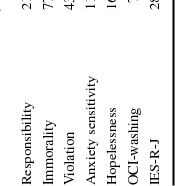
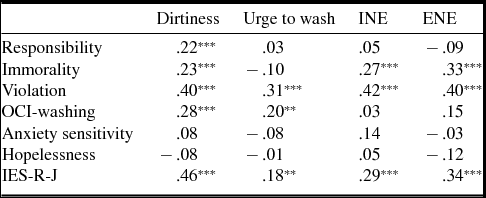
Cronbach's alpha was 0.88 for OCI-washing, 0.88 for IES-R-J, 0.56 for anxiety sensitivity, and 0.65 for hopelessness. The means and standard deviations for the indices of mental contamination, appraisal variables, anxiety sensitivity, hopelessness, OCI-washing, and IES-R-J are shown in Table 1. In addition, Table 2 presents the correlation coefficients between cognitive appraisals, OCI-washing, anxiety sensitivity, hopelessness, IES-R-J, and indices of mental contamination.
Mean scores and standard deviations for variables

Correlation coefficients between variables

*p < .05. **p < .01. ***p < .001.
Indices of mental contamination and unwanted sexual experiences
To evaluate the effects of treatment on symptom change, we conducted a 2 (Time: before and after remembering the unwanted sexual experience) by 4 (Group: verbal sexual assault, visual sexual assault, forcible touching/frottage, and rape/attempted rape) repeated measures MANOVA with feeling of dirtiness, washing urge, INE, and ENE as the four dependent variables. The results showed a significant group effect (F (12, 429) = 1.96, p < .05), time effect (F (4, 141) = 22.08, p < .001), and group by time interaction (F (12, 429) = 3.03, p < .001).
Follow-up analyses of repeated-measures ANOVA were then carried out, followed by multiple comparisons using Bonferroni's method. The analyses were conducted with time (before and after remembering the unwanted sexual experiences) as a within factor and the four groups (verbal sexual assault, visual sexual assault, forcible touching/frottage, and rape/attempted rape) as a between factor, with feelings of dirtiness, the urge to wash, INE, and ENE as dependent variables.
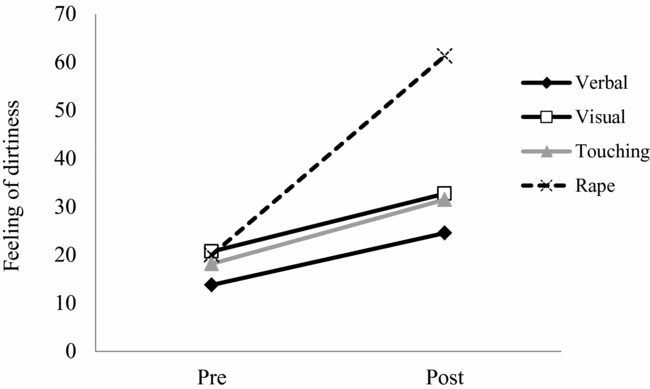
With feelings of dirtiness as the dependent variable, the main effects for time (F(1, 144) = .50.13, p < .001, η2 p = .26), group (F(3, 144) = 3.60, p = .02, η2 p = .07), and the interaction between time and group (F(3, 144) = 5.31, p = .01, η2 p = .10) were all significant. Post-hoc simple main effect analyses were guided based on data exploration. Post-hoc simple main effect analysis for time revealed significant differences between pre-recall and post-recall scores in the verbal sexual assault (p = .05), visual sexual assault (p = .04), forcible touching/frottage (p < .001), and rape/attempted rape (p < .001) groups. Simple main effect analyses for group revealed that the post-recall scores for the rape/attempted rape group differed significantly from the post-recall scores for the verbal sexual assault (p < .001), visual sexual assault (p = .01), and forcible touching/frottage (p < .001) groups. This result means that mental contamination increased in all groups that recalled unwanted sexual experiences; however, the rape group reported the highest levels of post-recall feelings of dirtiness (see Figure 1).
Pre-recall and post-recall scores of feelings of dirtiness

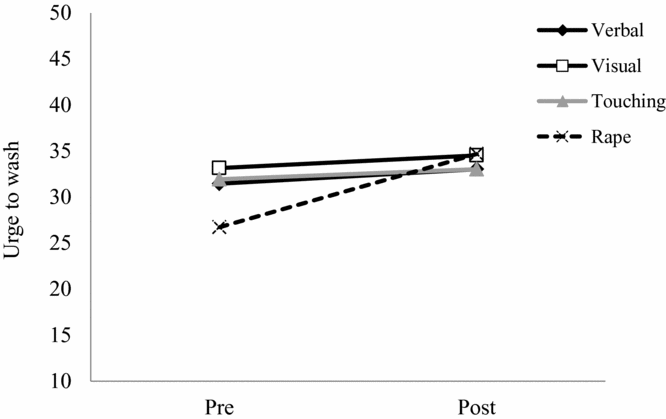
With the urge to wash as the dependent variable, an interaction between time and group was significant, (F(3, 144) = 2.79, p = .03, η2 p = .07). Post-hoc simple main effect analysis revealed a significant difference between pre-recall and post-recall scores only in the rape/attempted rape group (p = .02). This result means that only the rape group reported higher post-recall levels of urge to wash, while all other groups experienced no change in the urge to wash after recalling their experiences (see Figure 2).
Pre-recall and post-recall scores of urge to wash

With INE as the dependent variable, a main effect for time was significant (F(1, 144) = 60.42, p < .001, η2 p = .30). With ENE as the dependent variable, a main effect for time was significant (F(1, 144) = 49.12, p < .001, η2 p = .26). These results mean that recalling unwanted sexual experiences evoked both INE and ENE.
Cognitive appraisals that exacerbate mental contamination
Finally, we examined whether the three different types of cognitive appraisals would show incremental validity and explain further variance in the indices of mental contamination (beyond obsessive washing due to fear of contact contamination or anxious and depressive personality traits). To this end, we computed four hierarchical regression analyses (N = 148). In each of these hierarchical regression analyses, variables in Model 1 were scores on OCI-washing, participants’ current ages, and pre-recall scores for dependent variables. Variables entered into Model 2 were anxiety sensitivity and hopelessness. Variables entered into Model 3 were perceptions of responsibility for the unwanted sexual experience, perceived violation, and immorality of the offender's character.
In terms of feelings of dirtiness, a hierarchical regression analysis revealed that scores for OCI-washing (β = .33, p = .01) and dirtiness (pre-recall) (β = .23, p = .02) predicted feelings of dirtiness (post-recall) in Model 1 (R 2 = .21, ΔR 2 = .21, ΔF(3, 144) = 12.03, p < .001), but age did not. Anxiety sensitivity and hopelessness did not account for unique variance in Model 2 (R2 = .26, ΔR2 = .05, ΔF(3, 140) = 2.70, p = .07). Cognitive appraisals of responsibility (β = .22, p = .02), and perceived violation (β = .36, p = .01) accounted for unique variance in feelings of dirtiness, but appraisal of immorality of the offender's character did not do so in Model 3 (R2 = .41, ΔR2 = .15, ΔF(3, 137) = 15.55, p < .001).
In terms of the urge to wash, a hierarchical regression analysis revealed that urge to wash (pre-recall) (β = .23, p = .01) predicted urge to wash (post-recall) in Model 1 (R2 = .34, ΔR2 = .34, ΔF(3, 144) = 24.46, p < .001), but age and OCI-washing scores did not. Anxiety sensitivity and hopelessness did not account for unique variance in Model 2 (R2 = .41, ΔR2 = .07, ΔF(4, 140) = 3.52, p = .03). Scores indicating a cognitive appraisal of perceived violation (β = .21, p = .03) did account for unique variance in urge to wash (post-recall), but appraisal of responsibility for the unwanted sexual experience and immorality of the offender's character did not in Model 3 (R2 = .47, ΔR2 = .06, ΔF(3, 137) = 3.70, p = .03).
Regarding INE, a hierarchical regression analysis revealed that INE (pre-recall) (β = .50, p < .001) predicted INE (post-recall) in Model 1 (R2 = .29, ΔR2 = .29, ΔF(3, 144) = 18.93, p < .001), but age and OCI-washing scores did not. Anxiety sensitivity and hopelessness did not account for unique variance in Model 2 (R2 = .33, ΔR2 = .04, ΔF(4, 140) = 2.16, p = .06). Appraisal of perceived violation (β = .41, p < .001) accounted for unique variance in INE (post-recall), but appraisal of responsibility for the unwanted sexual experience and immorality of the offender's character did not in Model 3 (R2 = .52, ΔR2 = .19, ΔF(3, 137) = 16.84, p < .001).
Finally, a hierarchical regression analysis for ENE revealed that ENE (pre-recall) (β = .37, p < .001) and OCI–washing scores (β = .18, p < .04) predicted ENE (post-recall) in Model 1 (R2 = .21, ΔR2 = .21, ΔF(3, 144) = 11.98, p < .001), but age did not. Anxiety sensitivity and hopelessness did not account for unique variance in Model 2 (R2 = .23, ΔR2 = .02, ΔF(4, 140) = 1.19, n.s.). Appraisal of perceived violation (β = .41, p < .001) and immorality (β = .16, p = .02) accounted for unique variance in ENE (post-recall), but appraisal of responsibility did not in Model 3 (R2 = .41, ΔR2 = .18, ΔF(3, 137) = 17.06, p < .001).
Discussion
This study aimed to investigate the types of unwanted sexual experience that evoke mental contamination, and the cognitive appraisals that exacerbate mental contamination.
Recalling unwanted sexual experiences and mental contamination
With feelings of dirtiness as the dependent variable, simple main effect analysis for time revealed that the degrees to which participants felt dirtiness significantly differed before and after deliberately recalling verbal sexual assault, visual sexual assault, forcible touching/frottage, or rape/attempted rape. These findings support the notion that mental contamination can be caused by deliberately recalling an unwanted sexual experience (Fairbrother and Rachman, Reference Fairbrother and Rachman2004; Fairbrother et al., Reference Fairbrother, Newth and Rachman2005). This study also demonstrates that feelings of dirtiness can be evoked by deliberately recalling sexual assault, including forms that entail no physical contact, such as verbal and visual sexual assault.
Furthermore, the findings indicate that the degree of mental contamination can differ depending on the type of unwanted sexual experience. In terms of feelings of dirtiness, the post-recall scores of the rape/attempted rape group were higher than those of any other group. This means that stronger feelings of dirtiness were evoked in individuals who had experienced rape/attempted rape. Recalling a rape experience would exacerbate what were already strong feelings of mental contamination.
The present study also indicates that individuals who recalled experiences about rape/attempted rape felt an urge to wash, which individuals recalling other types of unwanted sexual experiences did not feel. These findings indicate that individuals recalling experiences related to rape felt more intense feelings of dirtiness than individuals recalling other types of unwanted sexual experience. The urge to wash was evoked to a significant extent in only the participants recalling rape/attempted rape. Thus, the present study makes a valuable contribution to existing knowledge by offering evidence that women who experienced rape/attempted rape are at greater risk for more severe mental contamination than those who had other types of unwanted sexual experiences.
The degree of mental contamination did not differ between victims of visual sexual assault, verbal sexual assault, and forcible touching. This indicates that victims of visual or verbal sexual assault that did not entail direct contact may suffer mental contamination to the same degree as victims of forcible touching involving direct contact with offenders, although victims of rape would feel stronger mental contamination than all three of these groups.
Mental contamination and cognitive appraisals
Hierarchical regression analyses demonstrated that cognitive appraisals predicted the indices of mental contamination under examination in this study. The present study used a procedure different from that used by Radomsky and Elliott Reference Radomsky and Elliott(2009) to test the relationships between mental contamination and cognitive appraisal. Radomsky and Elliott Reference Radomsky and Elliott(2009) used experimentally controlled stimuli to evoke mental contamination, asking participants to imagine a non-consensual kiss as described on an audiotape. This procedure made for high internal validity, permitting the researchers to control for extraneous variables. In contrast, asking female participants to recall their most distressing unwanted sexual experiences – the procedure used in the present study – made for high ecological validity (Neisser, Reference Neisser1976). Thus, by asking female participants to recall their most distressing unwanted sexual experiences, this study substantiates the hypothesis offered by Radomsky and Elliott Reference Radomsky and Elliott(2009).
Using the results of hierarchical regression analysis, a cognitive appraisal of perceived violation predicted all of the indices of mental contamination under examination in this study. This is consistent with Ehlers and Clark's Reference Ehlers and Clark(2000) cognitive theory of PTSD, whereby a perception that others have violated interpersonal rules unfairly can lead to PTSD. Recent theoretical work highlights the possibility that mental contamination affects PTSD symptoms via maladaptive cognitions related to sexual trauma (Rachman, Reference Rachman2004). Appraisal of perceived violation was not the only predictor for indices of mental contamination; appraisals of responsibility for the unwanted sexual experience predicted feelings of dirtiness, and appraisals of immorality of offender's character predicted ENE (e.g. distress and anger). As mentioned previously, this finding provides preliminary support for Radomsky and Elliott's Reference Radomsky and Elliott(2009) hypothesis – that an appraisal of responsibility and immorality predicts indices of the mental contamination – using a different procedure. While cognitions about responsibility that lead to general OC symptoms often focus on taking responsibility for any harm that may occur in the future. (e.g. “If I take sufficient care, I can prevent any harmful accidents from occurring”; Salkovskis et al., Reference Salkovskis, Wroe, Gledhill, Morrison, Forrester and Richards2000), we found that appraisals of responsibility for past trauma (e.g. “It was my responsibility that the incident happened”) specifically predicted feelings of dirtiness in mental contamination. This appraisal leads to guilt, along with PTSD (Ehlers and Clark, Reference Ehlers and Clark2000). In this way, responsibility may exacerbate mental contamination.
However, findings of the present study were at times inconsistent with Radomsky and Elliott's Reference Radomsky and Elliott(2009) findings. They found that appraisals of immorality predicted both feelings of dirtiness and the urge to wash, while appraisals of responsibility predicted feelings of dirtiness, urge to wash, and INE. However, in the present study, appraisals of responsibility predicted only feelings of dirtiness, and appraisals of immorality predicted only ENE. These differences may be due to the cultural background of the two samples (Japanese vs. Canadian) or the manipulation employed to evoke mental contamination (recalling one's most distressing unwanted sexual experience vs. imagining a non-consensual kiss). However, there is another factor – morality – that may account for the above inconsistency. The scenario used by Radomsky and Elliott Reference Radomsky and Elliott(2009) included information about the moral character of the offender, thereby making it comparatively easy for participants to appraise the offender's immorality. On the basis of these conditions, appraisals of immorality varied distinctly: when participants in the present study were asked to recall their own most distressing unwanted sexual experiences, the morality of the offender could not be controlled. This procedural difference could have caused the aforementioned inconsistency in results. However, our study found that appraisals of perceived violation predicted mental contamination much more clearly and reliably than did appraisals of responsibility or immorality.
An additional contribution of this study was its demonstration of the convergent validity of the MCR and the IES-R-J, with significant correlations for feelings of dirtiness, urge to wash, INE, and ENE.
In conclusion, the present study demonstrates that an individual is at the greatest risk of mental contamination if she has experienced rape/attempted rape, and if she makes a cognitive appraisal of violation regarding the incident.
Future research and clinical implications
The finding that recalling unwanted sexual experiences can evoke mental contamination implies that women who often remember or ruminate on unwanted sexual experiences in their daily life may be at greater risk for mental contamination. This finding may support Conway, Mendelson, Giannopoulos, Csank and Holm's Reference Conway, Mendelson, Giannopoulos, Csank and Holm(2004) finding that students who reported experiencing sexual abuse were more likely to report ruminative thinking. Furthermore, PTSD severity has been correlated with degree of rumination on the traumatic event (Ehlers, Mayou and Bryant, Reference Ehlers, Mayou and Bryant1998; El Leithy, Brown and Robbins, Reference El Leithy, Brown and Robbins2006), with rumination strengthening associations between the cognitive and emotional elements of memories. In cases of mental contamination, rumination on trauma may intensify feelings of dirtiness and the urge to wash, as well as increase depressive affect. Additional research investigating the relationship between mental contamination and ruminative thinking in instances of sexual assault is necessary to find out more about this effect.
The present study and that conducted by Radomsky and Elliott Reference Radomsky and Elliott(2009) show that mental contamination can be predicted by cognitive appraisals of unwanted sexual experiences. Addressing these appraisals through established methods has been demonstrated to have a strong effect in reducing feelings of contamination (Clark, Reference Clark2004; Rachman, Reference Rachman2003). In addition, Steil, Jung and Stangier Reference Steil, Jung and Stangier(2011) demonstrated that cognitive restructuring and imagery modification were effective in reducing feelings of contamination in adult survivors of childhood sexual abuse. These results may pave the way for treating contamination-related OCD (particularly involving mental contamination).
Limitations
The present study has several limitations. The present study could not discriminate between unwanted sexual experiences in adulthood and childhood. Given recent findings that mental contamination is positively associated with exposure to childhood trauma such as sexual abuse (Berman et al., Reference Berman, Wheaton, Fabricant and Abramowitz2012), further research is needed to clarify whether adulthood or childhood trauma trigger greater degrees of mental contamination. In addition, there may be some memory bias in measuring IES-R-J, because participants were asked to recall their responses during the month following the event.
In conducting hierarchical regression analysis, we did not control for the age at which the event occurred. Further research should investigate the relationship between mental contamination and the age at which the event occurred.
The present study did not ask whether participants were afraid that they might contract unwanted characteristics from the perpetrator (i.e. morphing; Rachman, Reference Rachman2006). The fear of morphing may affect the greater feeling of dirtiness and washing urge. Further studies are needed in order to clarify the relationships between mental contamination and fear of morphing.
In addition, we did not investigate whether these women developed any intrusive thoughts or urges as a result of their experiences. In participants who recalled an experience of rape or forcible touching, their feelings of mental contamination may have involved both distress caused by recalling experiences of physical contact with offenders and distress caused by recalling unwanted sexual experiences. There would therefore be an overlap between contact contamination and mental contamination caused by recalling their most distressing unwanted sexual experiences.
The present study did not specify the relationship between the participant and the perpetrator (e.g. friend, family member, or a stranger); different relationships may or may not have an effect on mental contamination. Mental contamination could also be evoked by betrayal (Rachman, 2009) or the perpetration of an immoral act (Rachman et al., Reference Rachman, Radomsky, Elliott and Zysk2012); these two possible causes were outside the scope of this study, which was limited to unwanted sexual experiences. However, the unwanted sexual experiences could arguably be classified as instances of betrayal.
Acknowledgements
This research was supported by the Japan Research Foundation for a Safe Society (107).



Comments
No Comments have been published for this article.