

Introduction: Assessing Japan's financial crisis management
In 2009, with the blow of the global financial crisis (GFC) after the Lehman shock, Japan's gross domestic product (GDP) contracted 6.3%, the starkest drop among the advanced countries.Footnote 1 This outcome was striking because the GFC emanated from the United States, not from Japan or Asia, and very few Japanese banks were exposed to so-called toxic financial assets, unlike those in Europe. The Japanese government responded to the crisis by implementing several fiscal stimulus packages to boost the economy only to produce a temporary uptick in growth without any lasting effects or tangible advances by Japanese businesses. Until December of 2012, the Japanese economy did not show any signs of revival. Of course, the country's continuing plight is largely attributed to the triple disaster of the earthquake, tsunami, and nuclear plant meltdown in northeastern Japan in March 2011.Footnote 2 Nonetheless, Japan's anemic recovery from the GFC was already a challenge prior to the time of the triple disaster, as slow economic recovery raised concerns about a double-dip recession in the fourth quarter of 2010, and dropped Japan from the second largest economy in the world to the third in 2010 with China's successful stimulus and recovery next door.
How did the Japanese government respond to the GFC since fall 2008? What factors determined the effectiveness of the Japanese government's actions? And how can we assess Japan's financial crisis management? In the framework piece for this special issue project on Japan's crisis management, Sakaki and Lukner define crisis management broadly including four inter-related phases: (1) prevention and mitigation, (2) preparedness, (3) response, and (4) recovery and learning. This paper analyzes Japan's financial crisis management during the GFC with the focus on the third and fourth phases of crisis management, with particular attention to the country's preparedness since the 1990s ‘lost decade’ when Japan went through a series of financial crises. The paper also discusses the way in which the Japanese government tackled the economic and financial interdependence that triggered a precipitous downturn in the Japanese economy from the fourth quarter of 2008.
I argue that financial crisis fatigue constrained the Japanese government's actions in various ways despite its leaders’ willingness to engage actively to manage the crisis. The Japanese state depleted its ability to tackle economic crisis in several aspects after having been mired in financial crises for more than a decade. Fiscally, the country's massive public debt and continuing government revenue shortage made it difficult and politically divisive to generate a large fiscal stimulus package. It took then-Prime Minister Aso more than six months after the Lehman shock to ultimately install a large fiscal stimulus package in April 2009 against the opposition of pro-fiscal consolidation group within the Liberal Democratic Party (LDP) supported by the Ministry of Finance (MOF). The political nature of its allocation cast doubt on its effectiveness, and once the LDP lost the Lower House election in August 2009, a reverse course followed. The country's prolonged recession also constrained the Bank of Japan (BOJ) in conducting Japan's monetary policy, after the bank had long implemented the so-called ‘zero real interest rate policy’. These actions were also hampered by the fact that crisis-fatigued banks, corporations, local governments, and consumers were slow to act on or unresponsive to the government's ‘stimulus’ to invest or spend to boost the economy. Globally and regionally, the Japanese government sought to manage economic interdependence by extending financial help to international institutions and Asian countries in distress, but without actually managing to insulate Japan itself from the global crisis. In short, financial crisis fatigue occurs as actors lose crisis-solving ability due either to resource constraints arising from past crises or to defensive learning from repeated crises in the past. It therefore suggests the importance of understanding crisis management in the context of previous decisions, policies, and experiences. In Japan's case, fiscal stimulus packages and financial promotion became recurrent parts of the country's economic scene as the outcome of a prolonged series of financial crises since the early 1990s. The financial crisis fatigue that resulted from the accumulation of these past crises vastly slowed Japan's economic recovery from the massive downturn from the GFC, despite significant resource and attention invested in this particular crisis's management.
This paper consists of three parts. Following this introduction, I outline the GFC's impact on Japan in the aftermath of the Lehman shock, and summarize existing discussion about why the GFC hit Japan so hard. Here, I also discuss the measures taken to tackle the financial crisis, with emphasis on pre-2011 programs and commitments, and discuss Japan's slow recovery. In a third section, I assess the constraints on Japan's financial crisis management capability emerging from the country's financial crisis fatigue. In short, I argue that financial crisis fatigue's economic, political, and psychological effects have weighed heavily on Japan's abilities to tackle the crisis from government actions to Japanese businesses and consumers’ responsiveness to the economic stimuli.
The global financial crisis and Japan: crisis and response
Economic downturn
Until the early fall of 2008, the Subprime Mortgage Crisis in the United States involving many financial institutions in Europe was felt in Japan as though it was someone else's problem. The Japanese economy had just gone through 69 consecutive months of economic growth since 2002 mostly under the ‘reformist’ Prime Minister Koizumi, and its growth streak hit its peak in October 2007. This boom gave some credence to the discussion of economic ‘decoupling’ of the Japanese and Asian economies from that of the United States and Europe (EIU, 2008). As the Lehman Shock in the middle of September 2008 triggered global credit crunch and accelerated the market contraction in the United States, however, the situation changed dramatically. Due to the precipitous drop of exports and liquidation of Japanese shares by foreign investors, the Japan's GDP shrank at a seasonally adjusted annualized rate of 12.1% in the fourth quarter of 2008. The country's economic contraction continued into 2009 as Japan recorded the severest retrenchment of its economy with a 6.3% drop in GDP for the year. The Nikkei 225 Index, the Japanese equivalent of the Dow Jones Industrial Average, plummeted 42% from 10 September to 27 October 2008, and on 28 October, the daily low of the Nikkei Index sank below the 7,000 level after the previous day's closing of 7,162, a 26-year low. The rising Japanese yen since October 2008 put further pressure on Japan's exports and accelerated unwinding of the $1.2 trillion of yen carry trade. In September 2008, the Japanese mega financial institutions looked as though they would be taking over the world by purchasing a large stake of Morgan Stanley (by Tokyo Mitsubishi UFJ Financial Group) or the Asian branch of bankrupt Lehman Brothers (Nomura). A month later, however, they were forced to raise funds to fend off their core capital.
The Japanese economy's rapid deterioration after the Lehman shock was largely attributed to Japan's close integration with the rest of the world, where ‘the collapse in external demand and financial spillovers . . . plunged the economy into the most severe recession in decades’ (IMF, 2009). On the export side, the Japanese economy increased its reliance on exports in the 2000s, with the country's level of exports as a percentage of GDP rising from 11% in 2000 to 16% in 2007 (Kojima, Reference Kojima2009, 19). The intensified export dependence also revealed the utter weakness of Japan's domestic demand in the post-bubble economy, as the contribution of exports to Japan's economic growth grew from less than 10% in the late 1980s to 73% in the ten years prior to 2008 (Ueda, Reference Ueda2009). Making things even more challenging, the financial crisis hit the manufactured products that Japan exported the most, including automobiles, electronics, IT-products, and machinery. Not only did manufactured products constitute 90% of Japanese exports, much of which went to the United States and Europe, but they were also highly income-elastic items prone to be affected by income decline (Kawai and Takagi, Reference Kawai and Takagi2009). The damaging impact of Japanese export decline to these advanced countries was also exacerbated by Japan's new trade structure that utilized a substantially regionalized production network. As the market for final products shrank significantly in the United States, trade of parts and intermediate goods within Asia contracted multiple times (Sommer, Reference Sommer2009: 4). The rising yen, particularly from fall 2008 in the aftermath of the Lehman shock through early 2009 when the United States and European economies began to show some signs of recovery, made exports even more difficult. Finally, contraction of key Japanese industries such as the automobile industry had another multiplier effect through their subcontracting arrangements, which worsened Japan's unemployment rate from 3.8% in October 2008 to 5.0% in April 2009 (Sharma, Reference Sharma2010: 214). In addition, East Asia experienced a severe economic contraction starting in the fourth quarter of 2008 with more advanced and open economies such as South Korea, Taiwan, and Singapore being hit more markedly and seeing their trade balances deteriorate (ADB, 2008). An export push to Asia that contributed to Japan's economic recovery between 2002 and 2007 was unavailable, making it crucial for the Japanese government to boost the country's domestic demand.
On the financial side, it was not the infamous Collateralized Debt Obligations or Mortgage-Backed Securities that impaired the Japanese financial institutions. Rather, it was foreign net selling of Japanese stocks that triggered the Japanese equity market's precipitous fall (Sheard, Reference Sheard2009). Following the financial reforms and restructuring of the 2000s, foreign investors had increased their presence in Japan's equity market raising their stock holdings from 18.8% of stocks listed on the five largest stock exchanges in Japan in 2000, to 27.6% in 2007. Furthermore, in the same year, 65% of Japan's annual stock transaction value was attributed to foreign investors (Shirai, Reference Shirai2009). Even though Japanese financial institutions were in relative good health without exposure to toxic assets, Japan's financial market could be said to have experienced ‘collateral damage’ when ‘share prices tumbl[ed] fast largely because foreign hedge funds [had] been forced – by the need to meet margin calls and redemptions – to liquidate positions [in Japan]’ (EIU, 2008). Because Japanese banks tend to hold a high proportion (more than 50%) of their Tier 1 capital in the form of equity holding, the decline of equity share prices put pressure on the banks’ capital position (Ueda, Reference Ueda2009), thereby sparking fear of a domestic credit crunch.Footnote 3
Financial crisis management and recovery
As the evidence above shows, the Japanese economy was in dire straits by the end of 2008. Although the financial crisis did not originate from Japan, it affected its society at large in the form of increasing economic hardships from unemployment, stock market collapse, and corporate bankruptcies. The mounting challenges from the GFC in the latter half of 2008 forced the Japanese government to engage in financial crisis management. The Japanese government tackled the GFC's domestic challenges by applying fiscal stimulus packages, monetary easing, and other financial measures to prevent a financial panic and credit crunch. Majority party leadership − first by the LDP, then by the Democratic Party of Japan (DPJ) − was the lead agent in formulating and implementing the fiscal measures using supplementary budgetary allocation through the legislature. The MOF and the Financial Services Agency (FSA) implemented financial measures. The BOJ handled monetary measures.
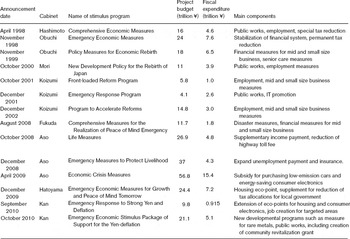
Japan's economic stimulus in response to the global economic downturn in the late 2000s started under the Fukuda cabinet (26 September 2007–24 September 2008) in a sequence of three economic stimulus packages (Table 1). The first package announced in August 2008 contained ¥11.7 trillion (US$127 billion)Footnote 4 for responding to high commodity prices and everyday hardships. The same cabinet also decided on a second stimulus package of ¥26.9 trillion (US$290 billion) to take effect in October 2008 under the newly formed Aso cabinet (24 September 2008–16 September 2009) with mostly non-spending measures such as toll road fee reductions and loan promotions for small businesses. At the same time, tax rebate measures including supplementary income payments were announced to begin in March 2009. The year's third and final stimulus package was presented in December 2008 containing ¥37 trillion (US$400 billion) for the employment safety net. Much of the large sum from the three stimulus projects (¥63 trillion out of ¥75.6 trillion) was designated to financial measures such as loan guarantees and expansion of the government's stake in government-affiliated financial institutions in support of small and medium-size businesses (EIU, 2010; Takayama, Reference Takayama2009). In total, Japan's 2008 fiscal stimulus amounted to ¥10.9 trillion (US$117 billion).Footnote 5
Main economic stimulus programs since 1998

Source: Cabinet Office, Japan, Shakai Jitsujo Deta Zuroku: Seifu no koremade no omona Keizaitaisaku [Data of the Social Reality: Main Economic Measures taken by the Government thus far] www2.ttcn.ne.jp/~honkawa/5090.html, and Takayama (Reference Takayama2009).
In early 2009, the Aso cabinet put forward additional measures in the FY2009 supplementary budget that included a larger fiscal stimulus package of ¥15.4 trillion (US$167 billion) within the total stimulus program of ¥56.8 trillion unveiled on 10 April 2009. The fiscal stimulus package included green projects, infrastructure projects, and employment projects (Cabinet Office, 2009a; Abidin, Reference Abidin2010: 5). This April package, constituting 3% of Japan's GDP, was the largest fiscal stimulus package in Japan's postwar history, and more than double the size of the 1998 package under Prime Minister Obuchi. It also included incentives to increase domestic demand, such as ‘eco points’ to motivate consumers to buy energy-saving home appliances. All in all, the government promised to spend the equivalent of almost one-third of the government's FY2009 general budget for this package.
After the LDP's electoral loss in August 2009, the following two DPJ cabinets were led respectively by Prime Minister Hatoyama (17 September 2009–8 June 2010) and Prime Minister Kan (9 June 2010–2 September 2011). The Hatoyama cabinet announced in its supplementary budget a ¥7.2 trillion (US$80 billion) fiscal stimulus package including poverty alleviation and employment support in December 2009 (Cabinet Office, 2009b). Despite some new fiscal allocations to the package, the main emphasis was reallocation and the use of non-expenditure items to stimulate employment and support the social safety net and green economy. Under Prime Minister Kan in 2010, prior to the March 2011 triple disaster, the Japanese economy began to show signs of a double-dip recession. To lift economic growth, the government launched another set of fiscal stimulus packages in October 2010 with around ¥6 trillion (US$64 billion) of fiscal commitment to assist employment, economic growth, local economies, economic reform, and the social safety net (Cabinet Office, 2010a).
Meanwhile, the MOF utilized more than ¥200 trillion through the Fiscal Investment and Loan Program to ensure credit access among small and medium enterprises (SMEs) (MOF, 2009). Legislation with specific duration also passed in November 2009 to promote loans to SME. It was designed to require banks to modify loan conditions to make it easier for SME to access credit, and allow the FSA to monitor progress and penalize banks that failed to be transparent in their SME lending records.
On the monetary side, the BOJ's policies became the most crucial for stimulating the economy. As the Lehman shock hit Japan, the BOJ moved to stabilize Japan's financial system in three areas: policy interest rate reduction, market stabilization measures, and corporate finance support (Shirakawa, Reference Shirakawa2008). In the first area, the BOJ gradually lowered its policy rate from 0.5% to 0.3% on 31 October 2008, then down to 0.1% in December 2008, and ultimately to between zero and 0.1% in October 2010. During the previous recession, the BOJ implemented so-called ‘zero interest rate policy’ (1998–2006) to guide the Japanese economy's recovery. At the same time, the BOJ implemented other unconventional expansionary policy measures in the form of so-called quantitative easing to facilitate corporations’ access to funds and stimulate demand. The BOJ resumed similar practices after December 2008, first by expanding the amount of annual BOJ purchases of Japan government bonds (JGBs) from ¥14.4 trillion to ¥16.7 trillion. Later, the BOJ resumed purchases of commercial papers (CP) and corporate bonds to inject liquidity into the market, and set up a mechanism to purchase less-than-most-secure bonds without collateral (BOJ, 2009a). By October 2010, the BOJ announced its ‘Comprehensive Monetary Easing’ program with (a) a zero to 0.1% policy rate target, (b) a medium and long-term time horizon for price stability, and (c) an enhanced asset purchase program (BOJ, 2010).
In sum, the Japanese government implemented a series of economic measures to boost the economy from summer 2008 through 2010 with new budgetary commitments totaling ¥39.5 trillion and packages with a total sum extending beyond ¥180 trillion (Table 1).Footnote 6 The Japanese ministries, including the MOF and the FSA purposefully allocated credit to SMEs and local communities to support their businesses, and provided support to marginalized workers against job loss. The BOJ kept its policy interest rate near zero to stimulate the economy, and went beyond conventional monetary policy through untraditional monetary expansion measures.
The Japanese government also had to tackle the crisis globally, as Japan's high level of economic interdependence was dragging its economy down. Here, bolstering the IMF's crisis management capacity with less stringent conditionality became crucially important for Japan as a part of global financial crisis management. The Japanese government acted swiftly and decisively on the IMF front with Prime Mininster Aso initially moving in the midst of the global financial instability in early November 2008 to announce Japan's full support for the IMF by committing US$100 billion from its ample foreign exchange reserves.Footnote 7 Alluding to the medium-term goal of preventing future financial crises, nonetheless, Aso emphasized the reform of international financial institutions as necessary. The reform proposals included further review of IMF lending facilities, such as flexible lending facilities without structural performance criteria and lending for financial prevention purposes (Yosano, Reference Yosano2009; Yoshida, Reference Yoshida2009). On the regional front, the Japanese government took an active role in securing East Asia's financial stability by strengthening the regional emergency funding mechanism known as the Chiang Mai Initiative (CMI). As the ASEAN+3 governments − ASEAN plus Japan, China, and Korea − that constituted the CMI faced the fear of the GFC's regional expansion, they implemented ‘multilateralization’ (i.e. regionalization) of the CMI, which had already been agreed to in 2007, by reaching consensus on the mechanism's voting share and voting rules. The Japanese government agreed to shoulder 32% of the US$120 billion CMIM (Chiang Mai Initiative Multilateralized) reserve pool, the highest share that equaled the contribution by China including Hong Kong.
The Japanese government also engaged bilaterally to support regional Asian economies through currency swaps and foreign aid. When the South Korean government faced a severe liquidity crisis in fall 2008 and turned to the US Federal Reserve for a $30 billion currency swap line, Japan and China came to Korea's rescue by each pledging increased bilateral swap lines to Korea in their own currencies: the Japan–Korea swap (yen and won) was increased from an equivalent of $3 billion to an equivalent of $20 billion, while the +3 countries announced the establishment of a new China–Korea swap equivalent to $26 billion (yuan and won) (Grimes, Reference Grimes2009). The Japanese government also redirected foreign aid as Prime Minister Aso unveiled a ¥1.5 trillion (US$16 billion) ODA plan with emphasis on Asia in January 2009 at the World Economic Forum meeting, and this total was later increased to ¥2 trillion at the time of G20 London Summit in April. In sum, the Japanese government's external actions in response to the regional and global crisis were swifter and more forthcoming than those in its domestic response.
Thanks largely to the April 2009 stimulus measures, the Japanese economy emerged from the recession with positive growth from the second quarter of 2009. Government support saved 500,000 jobs, boosted consumer demand and bolstered the operations of financial markets and corporate finance (EIU, 2010). Japan's economic upsurge did not last long, however, and growth slowed again in the second half of 2010, raising fear of double-dip recession. In fact, the assessment of the April 2009 stimulus's tangible economic impact was at best mixed,Footnote 8 and, comparatively speaking, Japan's economic recovery in the aftermath of Lehman shock was slower than that of the United States or Europe in 2009 and 2010, once Japan's deflationary economy is taken into consideration (Cabinet Office, 2011). By early 2011, the United States, Germany, and France had all returned to their GDP levels at the time of the Lehman shock, while Japan was the only country still struggling to reach its pre-crisis level two and a half years later (Cabinet Office, 2011, 9). While other Asian economies were enjoying V-shape recoveries by early 2010, partially thanks to their respective stimulus measures and export market reemergences (World Bank, 2010), the Japanese economy began to show signs of distress as some of the fiscal stimulus measures were phased out. What hindered Japan's recovery? What does this tell us about Japan's financial crisis management?
Politics under financial crisis fatigue
Crises present opportunities for reform and new direction because the breakdown of old relationships ushers in the creation of new relationships (Gourevitch, Reference Gourevitch1986; Sakaki and Lukner, this collection). Analysis of modern era economic crises indicates that financial crises are most often long-lasting and profound because the afflicted country's financial institutions become damaged (Reinhard and Rogoff, 2009). Many countries that recently went through major financial crises such as the Latin American debt crisis or Asian Financial crisis experienced major transformations of political regimes, institutions, and policies (Haggard and Kaufman, Reference Haggard and Kaufman1995; McIntyre et al., 2008). Japan, too, went through a long series of financial crises from the early 1990s through the early 2000s, which resulted in slow but striking changes in the country's financial institutions and its regulatory framework (Amyx, Reference Amyx2004). The so-called ‘convoy system’ of government protection of banks gave away to arms’ length financial regulations, and protected financial industries were exposed to competition through the ‘big bang’ financial liberalization of the late 1990s (Toya, Reference Toya2006).
It is conceivable that the repeated financial crises and prolonged economic downturn during the last 20 years of back-to-back ‘lost decades’ had a positive impact in making the Japanese financial sector more prudent. But it is important to note the costs sustained by these crises: that is, the stress of dealing with financial and economic woes extended over a period of time causes fatigue among the actors involved to the extent that they lose responsiveness to measures implemented to manage the crisis. Furthermore, depleted crisis management resources induce not only immediate constraints on measures to be taken to resolve the crisis but also divisive political response among actors fighting over their priority and share. In this manner, measures to manage financial crisis taken by the Japanese government and their impact on the Japanese economy, I argue, were considerably compromised by Japan's financial crisis fatigue.
Japan's financial crisis fatigue manifested mainly in three ways. The first was quite straightforward: a shortage of resources and policy options. Japan's dire fiscal position and persistent near-zero interest rate monetary policy constrained the Japanese government's options for stimulating the economy. In relation, the second manifestation was the divisive politics associated with this shortfall. Limited fiscal resources and disagreement over unorthodox stimulus measures prolonged the time the Japanese government took to assemble crisis management measures and led to policy inconsistency over time. The third manifestation of the fatigue was the slow or diminished response by Japanese society to the government's measures to revive the economy. After having experienced various stimulus measures that failed to initiate a major economic boost, important economic agents such as banks, firms, and consumers began to respond sluggishly to any stimuli extended by the state.
Resource and policy constraints
Resource constraints, the first symptom of financial crisis fatigue, are strikingly visible in the Japanese central government's fiscal position. The Japanese government tackled a series of financial crises since the domestic economic bubble burst in the early 1990s, and the post-1998 stimulus packages in particular had high public expenditure components (Table 1). These large expenditures, together with dwindling tax revenues in the weak economy, rapidly increased Japan's gross public debt from below 90% of GDP in the mid-1990s to 175% in 2005, and eventually to 194% in 2009, a level much higher than all other OECD economies.Footnote 9 As the Japanese economy regained economic growth after 2002, the Koizumi cabinet began to deal with ballooning public debt as a part of its reform program and pledged to balance Japan's general budget by 2011 (Cabinet Office, 2006). It was under this austere fiscal environment that the Aso cabinet began its push for its fiscal stimulus package in October 2008.
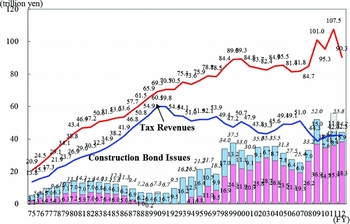
Understandably, it took the Aso cabinet a while to install large fiscal measures.Footnote 10 At the time when proposals for fiscal stimulus measures began to float within the LDP, party leadership was quite divided between the group that supported fiscal consolidation from the Koizumi program and those who put priority on stimulating the deteriorating economy, possibly even with deficit financing (Asahi Shimbun, 18 October 2008; Economist, 6 December 2008). Once the Aso government finally launched the fiscal stimulus package in April 2009 at the time that the Japanese government was sinking into the economic abyss (thus affecting Japan's tax revenue even more negatively than in October 2008), the country's finance minister had to acknowledge the fact that more than 50% of the central revenue for the Japanese government in FY 2009 (starting in April 2009 and ending in March 2010) would have to come from deficit bond issues rather than tax income (Asahi Shimbun, 11 April 2009). The impact of the largest postwar fiscal stimulus package on the further deterioration of Japan's fiscal balance was quite visible (Figure 1). Even before the stimulus package's actual effect on Japanese economic recovery became clear, there was already concern about the excessive amount of JGB issued, which could lead to the bonds being downgraded (Asahi Shimbun, 12 June 2009).
Japan's fiscal balance 1975–2012
Notes: 1 FY1975−2010: Settlement, FY2011:4th Revised budget, FY2012: Draft budget.
2 Ad-hoc deficit-financing bonds (approx. ¥1 trillion) were issued in FY1990 as a source of funds to support peace and reconstruction efforts in the Persian Gulf region.
3 Reconstruction bonds (approx. ¥11.6 trillion) are issued in FY2011, which are used as a temporary means until when the financial resources are secured by the revenues including the special tax for reconstruction. Measures and projects for reconstruction from the Great East Japan Earthquake, expected to be implemented within the first five years (FY2011−FY2015), would be financed by reconstruction bonds issuance.
4 General Account Primary Balance is calculated based on the easy-to-use method of National Debt Service minus Government Bond Issues, and is different from the Central Government Primary Balance on an SNA basis.
Source: Ministry of Finance, Japan, www.mof.go.jp/tax_policy/summary/condition/003.htm.

It is worthwhile to note that Japan's dire fiscal position did not profoundly affect the Japanese government's regional and global actions in support of financial crisis management. The Japanese government swiftly committed a large fund to the IMF and expanded its ODA commitment to Asia, because much of the funds to support these actions came from extra-budgetary sources. Japan's IMF commitment of US$100 billion was already indicated to the IMF as early as September 2008, and was publicly announced in November of the same year. This quick action was made possible because the domestic law governing the Foreign Exchange Fund Special Account (gaitame tokkai) allowed the MOF to allocate Japan's accumulated foreign exchange reserve from one set of foreign exchange reserve holdings of US treasury bills into an IMF deposit by simply relabeling. This obviously incurred little political cost and no budgetary cost (Holroyd and Monami, Reference Holroyd and Momami2012: 214). In the case of foreign aid to East Asia, too, the budgetary consideration was limited. The majority of Japan's official development assistance (ODA) allocated to East Asia was committed in the form of yen loans that did not derive from the central budget. Moreover, many East Asian economies began by the mid-2000s to repay the yen loans extended to them a few decades earlier, so that the Japanese government started to accrue a net inflow of ODA loans from the region, adding to the country's ODA resources. Finally, the Japanese government also supported the CMIM through its commitment of swap lines, which did not have fiscal ramifications.
Secondly, the BOJ also displayed a symptom of financial crisis fatigue as its policy options were limited. After having finally raised its policy interest rate in spring 2006 from virtually zero, the BOJ was quite reluctant to go back to the zero-interest rate policy in the face of the post-Lehman economic collapse, because such policy would once again deprive the BOJ of its traditional monetary policy instrument. Even after lowering the rate to 0.1% in December 2008, the BOJ insisted that having a positive interest rate was important and that BOJ purchases of risk assets as a measure of expanding money supply should be planned with caution (BOJ, 2008). It was not until a year later, in December 2009, when the Dubai crisis made the double-dip recession look real and put further upward pressure on the yen, that the BOJ began to express the need for proactively tackling deflationary pressure and further stimulating the Japanese economy.
Moreover, in comparison to the US Federal Reserve, Bank of England, and European Central Bank, the BOJ was reluctant to adopt aggressive quantitative easing during the GFC. When central banks engage in quantitative easing by purchasing private assets, the assets on the central balance sheet expand. Such expansion, which was very pronounced for the Fed and ECB between 2007 and 2009, did not take place for the BOJ (European Central Bank, 2009: 87). Not only was the BOJ cautious in expanding its purchasing amount, it was also quite reluctant to accept risky assets with credit ratings lower than B- on its balance sheet, and many BOJ purchases had very strict durations and ceilings (Vollmer and Bebenroth, Reference Vollmer and Bebenroth2012: 68–9). In response to the question of whether the BOJ had done enough to stimulate the post-Lehman economy, one BOJ official emphasized its commitment by noting that the BOJ had contributed tremendously to boost the Japanese economy since 1998.Footnote 11
Fiscal politics
The Japanese government's piecemeal approach to managing the drastic economic downturn in the latter half of 2008 and 2009, which has been blamed for Japan's anemic recovery (Sheard, Reference Sheard2009), emerged from the politics of distribution and redistribution fought through the political transition between 2008 and 2009. Intra- and inter-party politics in the context of the country's mounting fiscal difficulties constrained the political leadership and limited its ability to pursue a consistent solution to the crisis.
The Aso cabinet came into office at the height of uncertainty following the collapse of Lehman Brothers only eight days earlier, and Aso himself was very motivated to address the crisis head-on. He was the third of three LDP prime ministers, within three years following Prime Minister Koizumi (2001–2006) whose terms barely lasted one year each. With a Lower House election breathing down the LDP's neck under dwindling public support, Aso took office vowing to recover the LDP's hold on majority party status. For that to be possible, the key was effectively dealing with the ongoing crisis.Footnote 12 But after enacting stimuli in October and December consisting largely of financial measures with relatively small fiscal outlays, Aso became ensnared in fiscal politics. On the one hand, the stringent conditions placed on fiscal expenditures by the Koizumi administration and supported by the MOF constrained the LDP and made it difficult for the party to go back to its old pork barrel politics to regain rural popularity that was lost under Koizumi's reform (Kabashima and Gill, Reference Kabashima and Steel2010). On the other hand, as Japan's economy went into tailspin from October through December 2008, calls for more spending mounted.Footnote 13 Facing imminent election within a year, Aso and the LDP found an opportunity in the fiscal stimulus for political gain (Park, Reference Park2010). Their April 2009 stimulus package included a significant public works component and direct payments to every person in Japan, to boost the country's short-term recovery. But the medium- to long-term measures in promotion of economic growth were targeted to certain sectors such as green economy, healthcare, and agriculture (EIU, 2010), and looked more like pork than effective economic stimulus (Asahi Shimbun, 11 April 2009).
The DPJ questioned these items, and some of these projects were overturned after the DPJ scored its historic first electoral victory in late August 2009. As Prime Minister Hatoyama came into office, the DPJ attempted to keep its electoral promises and policy priorities that focused more on citizen welfare through social spending than on public works.Footnote 14 From the onset, however, the DPJ faced a worsened fiscal situation due to the large expenditures of the April 2009 fiscal stimulus package and the shrinking tax revenue from the deteriorating economy. In order to keep the party's promises under these tight fiscal constraints, the DPJ suspended ¥2.7 trillion (US$30 billion) worth of government expenditure from the April package and reallocated it to other purposes within the second supplementary budget for FY 2009. In these ways, politics made the crisis management inconsistent and fragmented.
Fatigued economy
It was important to motivate Japan's economic actors to invest, produce, and consume by the fiscal and monetary stimulus in order for the Japanese economy to start growing again. But financial crisis fatigue was widespread among businesses’ and consumers’ reactions to the government's crisis management. Major banks, large firms, and consumers were all helped by the economic stimulus packages to some extent, but none of them responded to the stimulus in a way that supported Japan's long-term economic recovery.
The major banks that emerged from restructuring in the early 2000s were not badly hit at first by the GFC. They all welcomed the financial measures implemented to stabilize Japan's financial system, as well as the expansionary monetary policy that would help their balance sheets. But the banks contributed little to economic recovery, because they were not lending much to productive sectors. After finally getting back on their feet with public funds injections and a series of mergers and restructurings for several years between 1998 and the early 2000s, the mega banks became extremely risk averse during the GFC due to financial crisis fatigue.Footnote 15 Ironically, perhaps even luckily, such risk averseness enabled the banks to altogether avoid the plight imposed by toxic financial assets, but it also made them hesitant to extend credit to less-than-safe ventures, particularly after the Lehman shock. They could not find good customers, however, because Japan's blue chip companies that were facing global market contraction and suffering from overcapacity were not borrowing. Despite legislation promoting bank lending to SMEs, the banks were reluctant to take risks.Footnote 16 Consequently, much of the excess savings was channeled back to the government as the banks expanded their purchases of JGB, the very funding source that allowed the Japanese government to implement its fiscal stimulus in the first place (Shimizu, Reference Shimizu2011: 145–6; Takayama, Reference Takayama2010).Footnote 17
Large firms were hit suddenly and severely by contracting exports and declining domestic demand in the GFC. Japanese manufacturing firms had suffered from overcapacity in the past when demand abruptly decreased first in the early 1990s, again around 1998, and another time after the US dot-com bust in the early 2000s. After a slow but steady rise from 2002 to 2006, these firms finally adjusted their past excess capacity and were about to expand on the cusp of the Lehman shock. Yet this time, too, the firms were hit by excess capacity in inventory, production, and the labor force (BOJ, 2009b; Japan Center for Economic Research, 2009). Furthermore, with financial crisis fatigue making them weary of repeated long and costly adjustments, the firms quickly reined in investment, inventory, and employment. Manufacturers had very gloomy expectations in light of the prospect of zero or even negative growth in demand both domestically and in their main export markets such as the United States and Europe. The BOJ's Diffusion Index of Business Sentiment shows that the business outlook among large manufacturing sector corporations dropped to an all-time low of minus 58 in March 2009 (BOJ, 2009b). With excess capacity on the one hand, and very pessimistic market and business sentiment on the other, Japanese firms were in no mood to expand capital investment or hiring, and thus were uninterested in borrowing money from banks, even if rates were ultra-low.Footnote 18
Finally, Japanese consumers never regained confidence in the economy to spend, despite the windfall of the supplementary income payments in the form of tax rebates provided by the Aso government in 2009. The Japanese consumer confidence indicator collected by the Cabinet Office showed its lowest point in January 2009, and due to financial crisis fatigue, it took at least one year until confidence returned to its 2003 level (Cabinet Office, 2010a). A follow-up survey on the use of Aso's tax rebates reveals that only about one-third of the rebates distributed were used toward consumption (Cabinet Office, 2010b: 10). Increased domestic demand that Japanese corporations were counting on to replace the drop in exports to advanced economies never emerged. Local municipalities were not in good shape to absorb the funds for special stimulus projects, either. Japan's Board of Audit (2011) reported that only 45% of the projects funds distributed to municipalities from the series of stimulus packages in 2009–10 had been executed as of fall 2011, and some of the funds were used to purchase foreign bonds instead, raising concern about the funds’ effectiveness and wastefulness.
In sum, Japan's financial crisis fatigue slowed Japan's reaction to the imported financial and economic crisis, and created divisions in the crisis management approach, policy inconsistencies, and unresponsiveness to economic stimulus.
Conclusion
The past series of financial crises taught valuable lessons to the Japanese government and businesses, which, as a result, seemed relatively well-prepared for future financial crises. Nevertheless, the Japanese government's financial crisis management ability was highly limited when the country faced an externally triggered financial crisis in 2008–09. As the GFC hit Japan somewhat unexpectedly on both the trade and financial fronts, the Japanese government was slow to act, and the Japanese society did not respond positively. On the one hand, the government was constrained by fiscal and monetary policies of the past that tied the government's hands in various ways, from zero-interest rates to large public debt. With these constraints, Japan's political leaders could not agree on or implement decisive measures. When the LDP under Aso's leadership overcame the fiscal restraints to provide the largest stimulus package of the postwar period in April 2009, its contents were driven by political needs, not the needs of localities. Once the DPJ took office in September 2009, some elements of the package were reversed, creating piecemeal and inconsistent programs. On the other hand, various actors in Japanese society, including banks, large corporations, consumers, and municipalities were haunted by the past crises and became unresponsive to the stimulus. Consumers were reluctant to spend, corporations were averse to investing and borrowing, and banks had no one except the government to finance. Given such conditions, the large stimulus packages had little impact on Japan's medium-term economic recovery.
About the author
Saori N. Katada is Associate Professor at School of International Relations and the Director of the Political Science and International Relations (POIR) Program at University of Southern California. She is the author of Banking on Stability: Japan and the Cross-Pacific Dynamics of International Financial Crisis Management (University of Michigan Press, 2001). She also published four edited and co-edited books and numerous articles on the subject of trade, financial, and monetary cooperation in East Asia, as well as Japanese foreign aid. She is also a recipient of Japan Foundation Research grant and National Endowment for the Humanities Fellowship. She has her Ph.D. from University of North Carolina at Chapel Hill (Political Science), and BA from Hitotsubashi University (Tokyo). Before joining USC, she served as a researcher at the World Bank in Washington, DC, and as International Program officer at the UNDP in Mexico City.