Introduction
In the field of crisis management, the experience feedback is not limited to a simple transcription in manuals or a definition of general procedures, because it includes the context, conditions, observations and new information that affect on how to behave with situations. In other words, an efficient experience feedback process must help to record every experience that led to the adoption of significant corrective actions regarding decision-making behaviors. The practices of crisis management, also, incorporate every time new adapted behaviors for new problems, even if the context seems the same as the context of other cases.
In addition, we must organize and trace information of the best practices, which can help in future situations and enrich the capital of experience feedback. A good system for decision-making support should show the positive and negative aspects of actions, provide real-time aides for future situations, give the opportunity to evaluate and validate each new experience according to its context. The effect of context is not only important at the moment of crisis management, but also during debriefing in order to restitute the situation step by step. It helps to validate a new experience and learn from it.
Several methods, systems and procedures proposed in the state of the art suffer from being too specific. These limits come from the non-consideration of random events and changing contexts. Then we must take into account the evolution of the situation.
Two more significant aspects to be considered are the time and space. In fact, crisis situation deals with human injuries, which are getting worse and may lead to death. So the time aspect is the cornerstone of emergency decisions. Adding to the accident place, an emergency department has to deal with hospitals to route injured; central emergency service with logistics (materials and rescuer vehicles), Media, and parent's injury reception.
In addition to that, the specificity of each crisis situation and the particularities of its context lead us to adopt the analogical reasoning. In fact, analogical reasoning responds to what we seek, because its aim is not to infer a rule from specific information. The objective is rather to examine similarities, differences and relationships between several objects. It then further categorizes and draws permanent traits between objects. The categorization is central to the development of such a system, especially concerning the description of the context and problem-solving.
In this paper, we present a system “Crisis Clever System” (CCS) that exploits these notions by handling experience feedback and providing a support decision-making in crisis management.
Crisis management
Crisis management is a special type of collaborative approach in which the actors are subject to an uninterrupted stress. It requires succeeding because the consequences are important (human and economic losses). Crisis differs from an emergency situation by its destabilizing effects (Lagadec, Reference Lagadec1991) “emergency plus destabilization”. An emergency is an event for which intervention procedures are known. Special requirements are clearly identified, and roles and responsibilities are clearly divided. Crisis management is also a field of study concerned with the perception of the environment critical towards decision-makers (Situation awareness). Decisions have to be made in a complex and dynamic context.
A variety of approaches has been identified to deal with a crisis and can be classified into three categories (Lagadec, Reference Lagadec1991; Smith and Elliott, Reference Smith and Elliott2006):
In the first category, we can note the model presented by Mitroff et al. (Reference Mitroff, Pauchant, Finney and Pearson1989), it is a model of identification. One of their axes identifies “internal” or “external” characteristics while the others highlight the “Technical/Economic” or “Human/Social/Organizational” dimensions. The second category focuses more on a set of points that characterize the crisis as a result of events and behaviors. The possible effects caused by this situation in terms of pressure on people assumed to manage it, its consequences on the environment and the difficulty adopting adequate responses to many concerns. The last category includes approaches, called synthetic. It aims to give general definitions for the crisis in terms of threats against the objectives of stakeholders and in terms of critical choices when stakeholder face with the surprising events in the crisis situations.
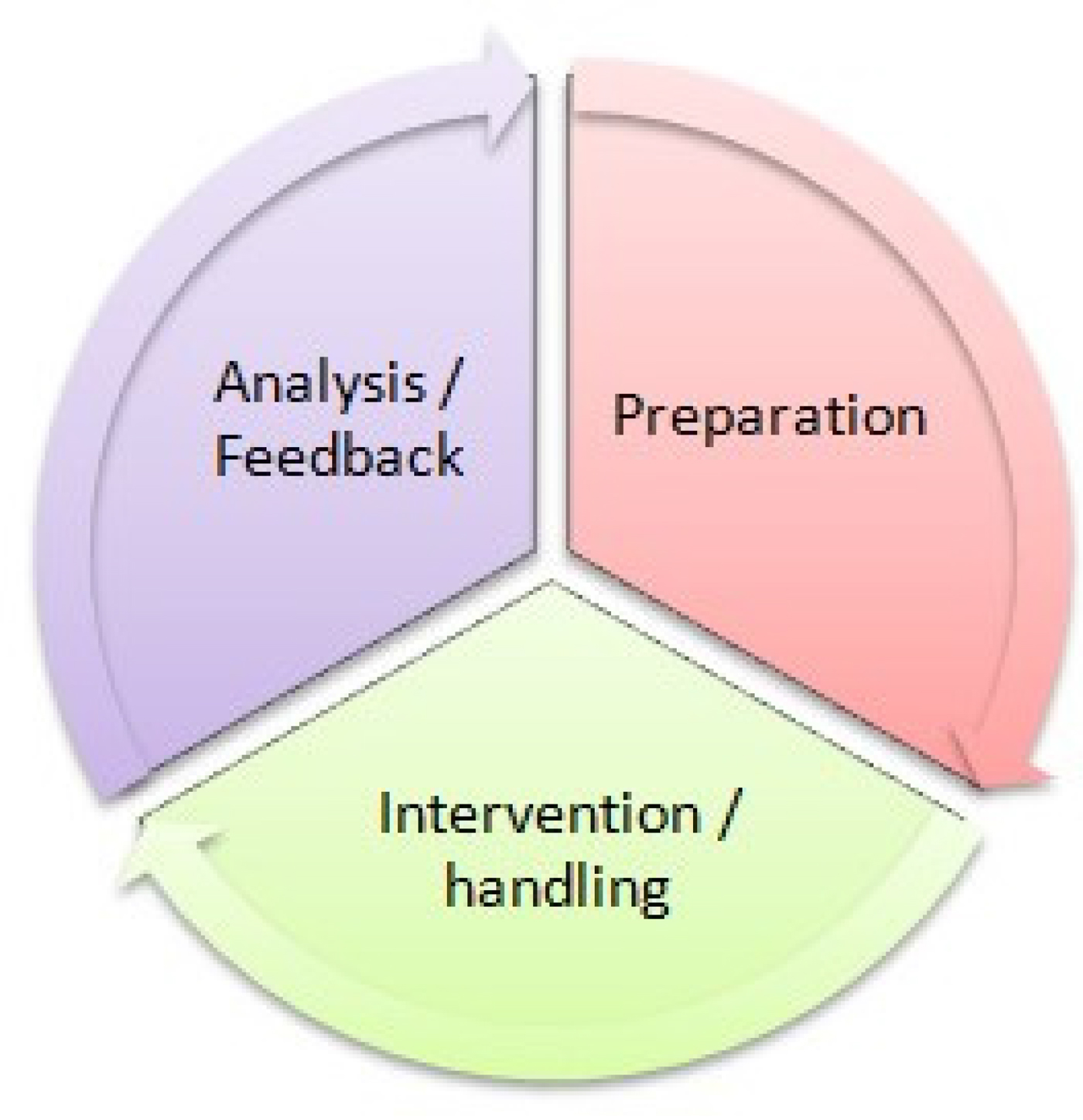
The authors have identified a set of common phases in the management of crisis situations (Lagadec, Reference Lagadec1991; Johnson, Reference Johnson2000; Oomes, Reference Oomes2004); to summarize, we can identify a cycle of three major phases (Fig. 1):
• Preparation: classification of situations, training and exercises, script episodes, identification of critical sites, structuration and computerization of library resources and definition of roles and tasks for structuring feedback.
• Intervention/handling: the phases from alert to system stabilization. It consists of four basic steps:
✓ Identification of the situation.
✓ Logistics and implementation of emergency on site.
✓ Evacuation, reception and support for victims in health services.
✓ Drafting of a comprehensive review.
• Analysis/Feedback: learning from real-life situations. This assessment is critical in order to improve the response strategy. It will therefore help us describe the types of situations more precisely and enrich the feedback structure.
Phases of Crisis management.

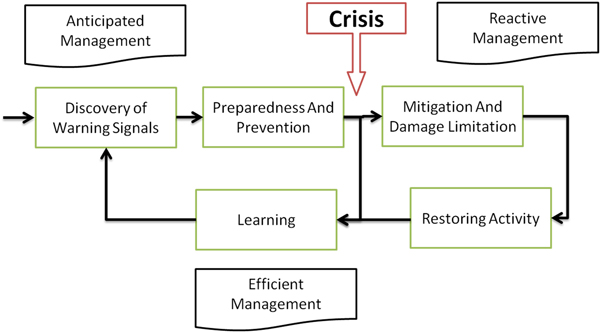
Explorations of the state of the art in crisis management help to identify three management styles (Fig. 2):
• Anticipated Management: crisis management can only be successful if the leader is proactive, which means that the best way to manage a crisis is to be prepared from before; after, it is often too late. It consists in taking the most appropriate measures to deal with the crisis. These measures aim to reduce the probability of errors during the risk assessment.
• Reactive Management: management decisions are taken absolutely and only in response or reaction to a problem or opportunity, no action is decided in order to prevent problems or create opportunities and very rarely is anything planned or initiated by the manager.
• Efficient Management: preventive management takes into account the dimension of learning from experience. Identifying any gaps in crisis management procedures, and in the organization improve: safety, traceability, access to data, information, etc.
Crisis management styles.

A crisis is a very trying period in which all skills are mobilized and put to the test. It must use this experience to bounce back and improve future interventions. It must give the most of the lessons. Teams should provide the means and the time to make an experience feedback, which will help to understand the origin of problems crossed and evolution of its impacts, identify gaps in procedures of crisis management, and the gaps in the organization of interventions.
In each phase of crisis management (Fig. 1) and for efficient management, using experience feedback is a very important key in order to deal with crisis situations. In our work, we use knowledge engineering and management to face the problems of the three phases described above, and to provide a decision-making support system that insures an efficient management of encountered crisis situations.
Decision making
Aristote (1972) defines decision as thinking resulting from an individual or collaborative deliberation A decision is: try to face a change or start to change something (Reed, Reference Reed2010). The mechanism that leads us to a decision is called the decision-making process.
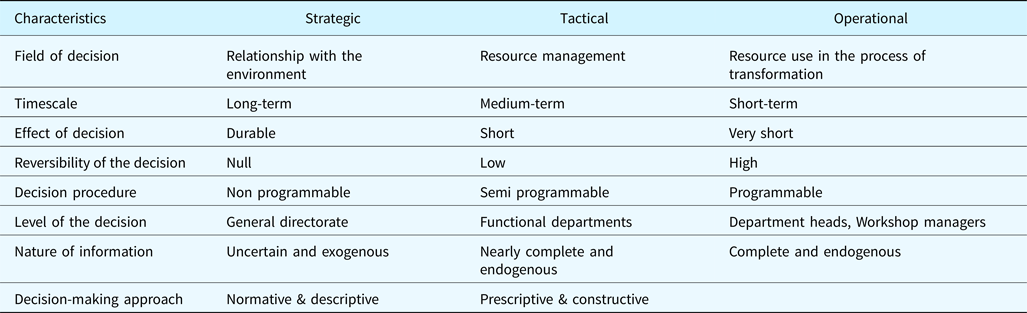
Decision making is a complex cognitive process of selecting a type of action from among various alternatives. Each process of decision making produces a final choice. The result can be an action or an opinion of choice (Bouyssou et al., Reference Bouyssou, Dubois, Pirlot and Prade2006). In general, there are three different levels of decision to be taken in an organization (Table 1):
• Strategic decisions: binding on the organization over a long period. Strategic decisions are often made by the highest hierarchical level, for instance by the manager or by the State. These decisions are rare and unique.
• Tactical decisions: engage the organization in the medium term. Tactical decisions are taken by the team responsible or subsidiary. These decisions are infrequent, unpredictable.
• Operational decisions: commit the organization in the short term. Operational decisions are taken by the executors. These decisions are frequent and highly predictable.
Characteristics of decision levels

We considered in our work the tactical and operational levels. Indeed, we deal with resource management and short-term decisions. Several approaches are developed to provide response for the operational and tactical level. The nature of available information helps to formalize these problems. The best-known method in this field is decision tree (Rennard et al., Reference Rennard, Humbert and Duymedjia2009) and a set of other approaches derived from it. Methods based on scenarios are also developed to support as much as possible all the alternatives (Cablé et al., Reference Cablé, Nigro and Loriette2011), (Bouyssou et al., Reference Bouyssou, Dubois, Pirlot and Prade2006). These methods have given birth to a generation of software named (Interactive Systems for Decision Support) known also by decision support systems (DSS). These systems and methods have given satisfactory results in many domains.
However, a decision in some cases must take into account a large number of parameters (Roy and Bouyssou, Reference Roy and Bouyssou1993) and the environmental dynamics. A set of reflection in this regard have given rise to the notion of dynamic decision- making (DDM) (Busemeyer and Pleskac, Reference Busemeyer and Pleskac2009). DDM situation takes place in an environment that changes over time either due to the previous actions of the decision maker or due to events controlled by the decision maker.
The MicroWorlds (Gonzalez et al., Reference Gonzalez, Vanyukov and Martin2005) have been developed to meet the needs of aid in situations treated by DDM. These tools are dedicated to simulate real-life; these tools bring an important contribution to their ability to compensate for the time and space in a virtual environment. Research in dynamic decision making is mostly laboratory-based and uses computer simulation tools (Naweed et al., Reference Naweed, Hockey and Clarke2013). These tools become analog to real-life situations and help investigators to study DDM by compressing time and space while maintaining experimental control.
In the real world people are more interested, using DDM, in processes such as goal setting, planning, perception, expectations, comprehension processes and decision support dealing with real situations (Endsley and Robertson, Reference Endsley and Robertson2000; Feng et al., Reference Feng, Teck-Hou and Ah-Hwee2009; Stanton et al., Reference Stanton, Salmon, Walker and Jenkins2009). The levels considered in our work are the tactical and operational levels. Indeed, we deal with resource management and short-term decisions.
Decision making in crisis situations
Dealing with crisis, the decisions makers do not have enough time neither to think over decision to take nor simulate the environment. The time becomes more important and the actors deal every time with special situations. The crisis is a collaborative situation characterized by contradictions and failures, big tensions and disagreements that make individuals and groups hesitant; Rules and ordinary institutions procedures are not suitable (defined at a strategic level) or even sometimes out of step with new opportunities that arise from changes, However, a clear statement on the adequacy and effectiveness of new ways can be defined (Freund, Reference Freund1976). At this stage, there is an important gap between strategic, tactic and operational decision level.
Decision makers attempt to identify or anticipate potential events that may occur, also the important moment, or incidents, that may trouble an effort to develop actions and measures. These ones are intended to avoid other incidents to evolve into a current crisis (Smith and Elliott, Reference Smith and Elliott2006). These elements are attached to the crisis context.
However, the classic methods of decision making (support), just as methods based on routines are characterized by their rigidity. They indeed do not take into account the dynamicity of some situations. They are based on the hypothesis “The problem is formal and static in time”. In the field of DDM, the MicroWorlds are very useful for learning, preparation and analysis, but very limited for decision support in real-time, partly because they require a lot of time for setting the new contexts. In consequence we are interested in exploring methods and techniques based on experience and studies in the field of situation awareness. Crisis management techniques must indeed take into account experience evolutions and dynamic contexts (environment).
A lot of research work has been done about the influence of context during the reasoning and decision-making process. A non-integral perception of the environment may lead to limited choices. This process is strongly influenced by the information received. In consequence, any useful information will interact with inferential processes during (Van der Henst, Reference Van der Henst and Guy2002) decision-making processing. Tulving and Thompson (Reference Tulving and Thompson1973) were the first to draw attention to this phenomenon; they introduced the concept of specific encoding (the success of recovery depends on the proximity between encoding and context). An inefficiency context representation and perception may influence the actor's point of view and build inappropriate decisions. The understanding of the context is very important for the decision makers. The context of each crisis situation is different because crises are different from each other. Therefore the experience of the actor may be decisive to find an analog situation and thus help to find a suitable solution and prevent problems that may occur.
About the usefulness of the experience
According to Gentner and Toupin (Reference Gentner and Toupin1986), the analogy (Reed, Reference Reed2010), is based on a general and calculated similarity between a source and a target. There are three kinds of similarities: attribute similarities, similarities between low-order relationships and between high-order relationships. To make the analogy, we need to match our current situation (called target) with another past situation (called source) based on the similarities of high rank. Commonly, in crisis situation the similarity among situations can be estimated using metrics and considering that cases are represented as attribute-value pairs (the number of victims, localization, accident type, homogeneity, etc).
Case-based reasoning (CBR) is the most popular method based on the reuse of lived experiences (Sankar and Simon, Reference Sankar and Simon2004). CBR comes from works about analogy and the access and representation of experiences (Kolodner, Reference Kolodner1993). It is used to solve problems by finding similar cases in the knowledge base and adapting the cases. The use of past experience represents a major asset for decision systems. At first glance CBR seems a perfect method to treat the issue of decision support during a crisis. But it seems that the characteristics of the crisis and the limits of CBR present a barrier to use it in its present classical form. We can identify three main reasons for this limitation (Cordier et al., Reference Cordier, Mascret and Mille2009):
• The model of case “too well-structured and therefore too constrained” must be fully described, often in a static and rigid structure, which limits the expandability of CBR systems to solve unplanned problems. Continuous case representations may suit better for evolving situations such as crisis situations.
• CBR systems are usually designed to solve a particular problem. How is it possible to create a system that can solve many problems, even when the designer did not anticipate them?
Ollagnier-Beldame et al. (Reference Ollagnier-Beldame, Brassac and Mille2014) propose an approach to solve these limits; this approach is based on “traces of interaction” as sources of knowledge for CBR systems. In this approach the case base is built dynamically from the traces of interaction and it helps to take into account a new context. But the limit of non-possibility to use many cases (or parts of cases) from different contexts for the same problem is still present. In fact, the problem in crisis management is not only a linear dimension, but for strategic reasons, it mobilizes parallel and complex contexts. Normally, during the crisis management other information appears. Decision makers can remember information or be interrupted by an event. It can change partially the situation and consequently the reasoning of decision makers. And this may lead to change partially a context (thus decision maker's goals) and the case to be treated. Obviously this is more likely to occur during interactions.
Notion of trace
The basic meaning of Trace, in old French, is “path that someone or something takes”. As an extension of this connotation, in computer science, a trace usually concerns the interactive activities between the system and the actors (Li, Reference Li2013).
The notion of trace takes a particular definition depending on the application domain. These definitions generally aim to give a specification of trace depending on its source or its objectives (Mille and Prié, Reference Mille and Prié2006):
• Trace to exploit experience of actors (users).
• Trace to exploit the experience of system.
• Trace of interaction between users and system.
• Trace of interactions between users or between systems.
We are interested in our work to specify a way to trace the experience of the actors in crisis management [digital trace (Mille and Prié, Reference Mille and Prié2006)]. The purpose is to make our system learn from experience. Experience is a kind of knowledge, therefore trace experience is a discipline that requires stages not very different from those of knowledge management such as discovering, modeling, storing and maintaining experience (Sun and Finnie, Reference Sun and Finnie2005). The different stages of knowledge discovery, collection and management lead to gaining and maintaining experience.
The study of trace and TBS (Trace-based system), through problem-solving and decision support, has emerged in a movement of more complex technologies based on AI (too formal and complicated in implementation). The issue of the conceptualization of traces of tasks and experience is at the interface of decision support system, their representation and processing are far from new. The problem is not only how to analyze traces but also how to really complement and exploit traces to improve the learning of these systems. This problem has been widely recognized and several works have been proposed in this context. We mention the tracking of project memory (Bekhti et al., Reference Bekhti, Matta and Chaker2011). The aim in these works is traces classifications of the design project achievements, in order to have a knowledge aggregation and to thus provide a representation of handled knowledge, directives and competences organization as well as negotiation strategies and cooperative problems solving. The traces are also used to feed knowledge-based system (KBS) (Cordier et al., Reference Cordier, Mascret and Mille2009).
The notion of trace is not only used to trace the experience of the studied domain, but also to monitor how the user uses the system. The aim is to give the system the possibility of adaptability to the behavior and the preferences of users. In this context Champin et al., (Reference Champin, Prié and Mille2003) represent a global approach which shows a number of levels; observation level, the experience reuse level and two levels of experience modeling and the user interact with the whole system within a computer environment. Another interesting dimension in using systems is enabling users to go back to previous states. In this case trace reply mechanism (Zarka et al., Reference Zarka, Cordier, Egyed-Zsigmond and Mille2011) has to be implemented in which each modeled trace consists of groups of observed elements. These observed elements can affect each other or one can affect all others synchronously.
Related works
Several propositions try to design decision support systems for crisis managers. The evaluation of many proposals notes gives rather inconclusive results. The approaches that attempt to design a “perfect” system can be found in the works of Turoff, French, Hale, Carver and Kim. These systems tend to follow the prescribed protocol and do not consider deviations from actual activity. Our work tends to respond to real activities by exploiting a collection of field experiences (Hale, Reference Hale1997; Turoff et al., Reference Turoff, Chumer, De Walle and Yao2004; Carver and Turoff, Reference Carver and Turoff2007; French and Turoff, Reference French and Turoff2007; Kim et al., Reference Kim, Sharman, Rao and Upadhyaya2007).
Other systems and models are proposed around this thematic (Johnson, Reference Johnson2000; Oomes, Reference Oomes2004; Schoenharl et al., Reference Schoenharl, Madey and Szabô2006; Smith and Elliott, Reference Smith and Elliott2006; Sell and Braun, Reference Sell and Braun2009); they aim at representing the operational, organizational and communication level, these solutions offer generic treatments or rigorous techniques adapted to specific situations. The more used techniques and methods are based on workflow modeling, geographic information systems, multi-agent and rule-based systems.
Other works using case-based reasoning and knowledge ontology were recently presented; their limit is that there is a big restriction in the definition of many concepts in cases. This type of definition is not adapted to the dynamic specificity of crisis situation (Otim and Hall, Reference Otim and Hall2006; Chakraborty et al., Reference Chakraborty, Ghosh, Ranjan, Garnaik and Debnath2010; Moehrle, Reference Moehrle2012).
The main contribution of our system is the consideration of actors experience, and the capacity of our system for adaptation and learning from past situations. The goal is to predict future situations using techniques of traceability of the experience feedback, so as to be better aligned with decision-making needs. We develop techniques in order to handle the use of experience feedback (Matta et al, Reference Matta, Loriette, Sediri, Nigro, Barloy, Cahier and Hugerot2012) to promote decision making. Our first attempt solutions are to represent the experience feedback using, on one hand, experience and situation representation-based methods (Kolodner, Reference Kolodner1993; Aich and Loriette, Reference Aich and Loriette2007) on the other hand, a knowledge engineering approach (Matta et al., Reference Matta, Ermine, Aubertin and Trivin2002; Sediri et al., Reference Sediri, Matta, Loriette and Hugerot2012) in order to define a decision-making environment.
The basic principles of our approach
In the informal field of crisis, the principle of reasoning from similar situations seems the best technique to be used; in fact the actors express their knowledge through a set of real-life situations. Moreover, in our work, we need to represent a feedback of these situations. This experience is generally owned by the actors of the emergency sector, under the form of documents and reports prepared or produced as a result of such intervention. Knowledge Engineering provides techniques to represent expertise in problem-solving (Schreiber et al., Reference Schreiber, Wielinga, Akkermans, Walter and Anjewierden1994; Richard, Reference Richard1998; Ermine, Reference Ermine2002; Reed, Reference Reed2010). These techniques allow highlighting key points as objectives or justifications for one or other of actions of the experts. Several techniques of interview issued from knowledge management and engineering are used to communicate with experts in order to understand and represent rules and concepts used in crisis management experiences.
The cooperative aspect must be considered, including coordination, communication and cooperative problem solving, in order to specify several actors with different objectives who are involved in crisis management (Schmidt and Simonee, Reference Schmidt and Simonee1996). In our work, we studied the dimensions of coordination and communication conducted by a single type of actor: the Emergency Department. Cooperative decision making in a crisis where other types of actors are involved (the prefecture, fire-fighters, police,) is not studied in this work. We present in this paper only the communication representation.
Another aspect of this work is decision making. An efficient decision support environment has to take into consideration the characteristics of crisis situations (Turoff et al, Reference Turoff, Chumer, De Walle and Yao2004), the status of people supposed using it and, space and time dimensions. To sum up, firstly the provided information has to be precise; the decision maker in crisis situation has no tolerance or time to spend for things unrelated to the management of crisis. Secondly, the context must be understood and the experience reused; understanding and learning what happened before, during, and after the crisis is extremely important for the improvement of the system capacities. Thirdly, everything in a crisis is an exception, thus less generalization is recommended. Finally, the information exchange and its validity in timeliness are required, in fact the crises require for many hundreds of individuals with different roles to be able to exchange information which is critical to those who may risk lives and resources, these information must be the most up-to-date and notified by alerts. Decision making in this context covers two aspects:
• Modeling formalized or non-formalized preferences of the decision maker.
• Analyzing the solutions and evaluating their consequences.
We offer to represent the experience feedback using on one hand experience-based and situation representation methods and on the other hand knowledge engineering methods, in order to define the specifications of a system as a decision-making support environment. We also aim at studying scenario representation to promote learning from this type of situations. In a clearly explained situation but not necessarily completely formalized, the decision support is an activity which helps to get some answers to the questions posed by an actor in a decision process (Simon, Reference Simon1973; Roy and Bouyssou, Reference Roy and Bouyssou1993).
To summarize, the different aspects considered in this work are:
• Representation of the context of the situation: environmental information on and available resources.
• Dynamic representation of the problem solving considering the evolution of situation.
• Successes and failures pointed on each intervention as well as rules and concepts.
• Identification of the types of situations and criteria for recognition of these situations.
• Representation of the communication between the actors within the spatial dimension (various locations).
• Coordination in actions as well as human and material logistics.
Experience feedback: collect and modeling
Knowledge engineering provides techniques to represent expertise in problem-solving (Matta et al., Reference Matta, Ermine, Aubertin and Trivin2001). These techniques allow highlighting key points as objectives or reasons for such actions of the experts. Several techniques of interview issued from knowledge management and engineering are used to communicate with experts in order to understand and represent rules and concepts used in crisis management experiences.
Knowledge engineering techniques
Knowledge engineering is a technique (approach) of Artificial Intelligence, it collects and structures reasoning aimed to formalize the problem solving (process followed by one or more experts to solve a problem) in various fields. Knowledge is the key feature of this approach and it can be defined as information or data used in a given context (knowledge and skills), it can be individual or collective, tacit or explicit. This approach consists of: collecting knowledge from possible sources (documents, experts…), analyzing it, and finally build a model such as a framework that will facilitate the capitalization and reuse of this knowledge (Schreiber and Wielinga, Reference Schreiber and Wielinga1996).
Since the 1990s, knowledge engineering is no longer seen as a process of transfer of knowledge extraction, but as a modeling process (Studer et al., Reference Studer, Benjamins and Fensel1998). Collaborative work of many researchers gave rise to robust methodologies at an industrial scale. Among others there is CommonKADS (Schreiber et al., Reference Schreiber, Crubézy and Musen2000). It is a basic methodology for the development of a KBS, including its knowledge model with four levels (strategy, task, inferences, and domain). CommonKADS is seen as a major contribution to the field of knowledge engineering (Studer et al., Reference Studer, Benjamins and Fensel1998).
In this method, particularly the subject of tacit knowledge is often mentioned. During different phases with experts in crisis management, we did not meet really a problem with unspoken knowledge (Bruaux et al., Reference Bruaux, Kassel and Morel2003). The problem is the never expressed knowledge (which may be obvious for experts at least). The difficulty is to express “what seems obvious” to the interviewee, and be sure “to understand what must be understood” (a typical problem of communication). The great barrier to the use of CommonKADS, within the design phase and implementation, is its formal framework based on an ontological approach and its CML language (Schreiber et al., Reference Schreiber, Wielinga, Akkermans, Walter and Anjewierden1994), too rigorous for fields such as crisis management. But, it is very useful for the phases of the formulation and development of models.
CommonKADS methods are extended in order to deal with heterogeneous information resources. Fensel et al. (Reference Fensel, Van Harmelen, Klein and Akkermans2000) suggest to model concepts as ontology in order to provide a semantic access to the large numbers of heterogeneous, distributed, and semi-structured documents typically found in large company intranets and the World-Wide Web.
MASK (derived from MKSM) is another popular method, which provides a solid basis for the collection and structuring of knowledge (Ermine, Reference Ermine2002). Using this method, knowledge engineers provide “book of knowledge”. MASK provides a guide to collect and model the knowledge and skills of an expert.
With MASK, knowledge is seen as a set of information that supports a particular meaning in a given context. Knowledge can be seen as:
• A container for the information, meaning and context.
• A global system, with three perspectives: structure, function, and evolution.
MASK provides asset for knowledge engineers, because it fills gaps in the classical transcription of knowledge, at the same time it is based on the knowledge modeling, which meets the characteristics of this type of method. The modeling is done mainly with experts. The cycle of interviews allows so, an intensive mobilization in the modeling.
Knowledge collect and modeling for crisis
During this project, we worked with the hospital of Troyes, located in the region “Grand-Est”, one of the 13 regions in metropolitan France. Like in any other hospital, emergencies are handled by an emergency department, called SAMU (“Service d'Aide Médicale d'Urgence”, i.e. Emergency Medical Department). The Samu, is the center of medical regulation of the emergencies of a territory. This department answers the requests for urgent medical aid (AMU). The regulating doctor of the Emergency medical department regulates the resources of urgent care from which he/she receives constantly the availability and directs the patients to the services the most adapted to their cases.
Results of our work are based on several meetings with actors in this emergency department; the emergency doctors, assistants and the specialists who have experience in real crisis situations and training. First interviews were general and helped to identify the main problems and discover the domain. Next ones aimed at describing specific situations like a road accident, an intervention on an infirmary establishment because of a fire alarm and a nuclear accident.
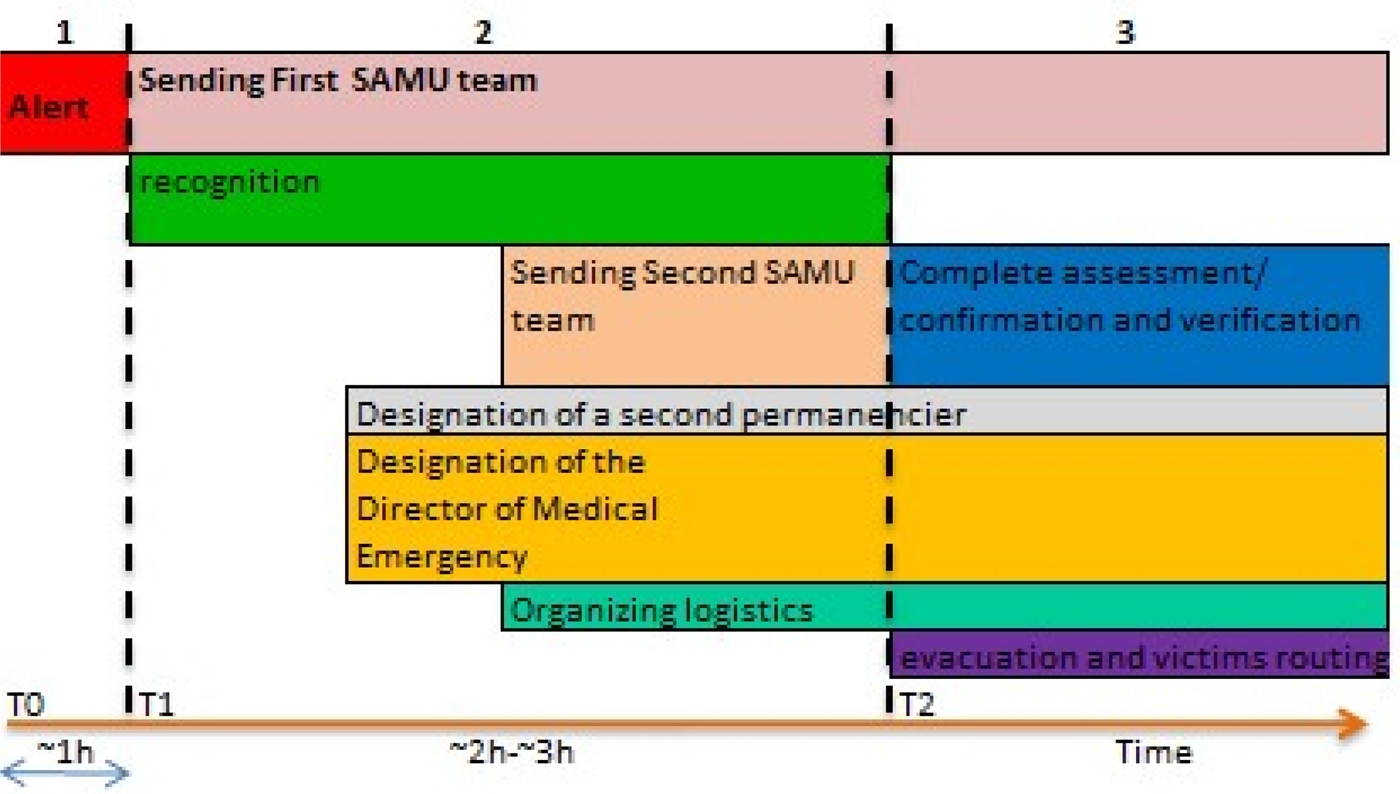
We exanimate also the three intervention plans: white, red and ORSEC plans. The ORSEC plan organizes the help at the departmental level, under the authority of the Prefect (State's representative in a department). The red plan makes part of specific provisions, peculiar to certain risks, planned by the plan ORSEC. It is under the authority of the Prefect of the department, and is initiated by him, in case of event susceptible to cause a high number of victims. The white plan is a specific emergency sanitary plan to plan the fast and rational implementation of the essential means in case of victims influx in a hospital. These plans (white, red and ORSEC) could be triggered independently. However, the white plan is frequently raised with the red plan; in this case the white plan is used to deal with victims evacuated by the application of red plan (Fig. 3). Our study focuses mainly on the red plan. It is based on four concepts: firstly, the means organization; dealing with resources for other emergencies, actors organization and, victims evacuation. Secondly, lead disasters by an overall management and at the same time by victims support. Thirdly, installation of an advanced medical post and first aids and finally, a double command: one on the disaster site for emergency operations, the other in emergency committee in the hospital for reinforcements and logistics.
Intervention in crisis situations, red plan application by SAMU.

Space dimension
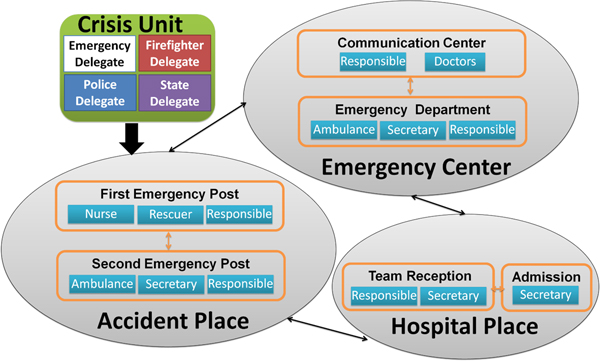
The space (place) is a major dimension of crisis management; the representation of the organization of actors in relation to the space will help, in one hand, to clarify the type of existing communication and vision that each actor has of the situation. On the other hand it makes more clearly the manner in which we make sense of crisis events and issues around problems associated with managing the acute phases of a crisis, as well as dealing with its location, setting, victims destination and its aftermath. Three main places have been identified (Sediri et al., Reference Sediri, Matta, Loriette and Hugerot2013):
• The Crisis cell: the place of the control and the orchestration of the intervention, its most important roles are to manage the material and human resources. The link with outside and the responsibility of emergency department (the rear base) is done by the communication center.
• Crisis site: the area affected by the event, it includes actors such as the first medical team and advanced medical and other professionals.
• Emergencies/hospitals: these services receive victims and their families and ensure their follow-up. The rear base, depending on the distance of crisis site and or available places and required specialties for each victim, achieves the choice of the orientation of the victims.
Several actors of emergency department are involved in crisis situation: doctors, first aids rescuers, assistants, secretaries, etc. According to the workplace and situation's state, each actor is in contact with other professional of the domain such as police, state services, government delegates, etc. (Fig. 4). So, the communication and organization dimensions have to be considered to represent this type of situations.
Actors organization seen from the space dimension.

Time dimension and experience feedback model
For better organization of the actor tasks, the time dimension is very important in crisis management not only in terms of life-preserving as a final objective, but it has also a major importance on each episode during the intervention. It must be considered so as to provide (Sediri et al., Reference Sediri, Matta, Loriette and Hugerot2013) to decision makers an empirical and control environment in which they can have an overview of what happens in terms of tasks and actions duration, what must be done or what should be done immediately, etc.
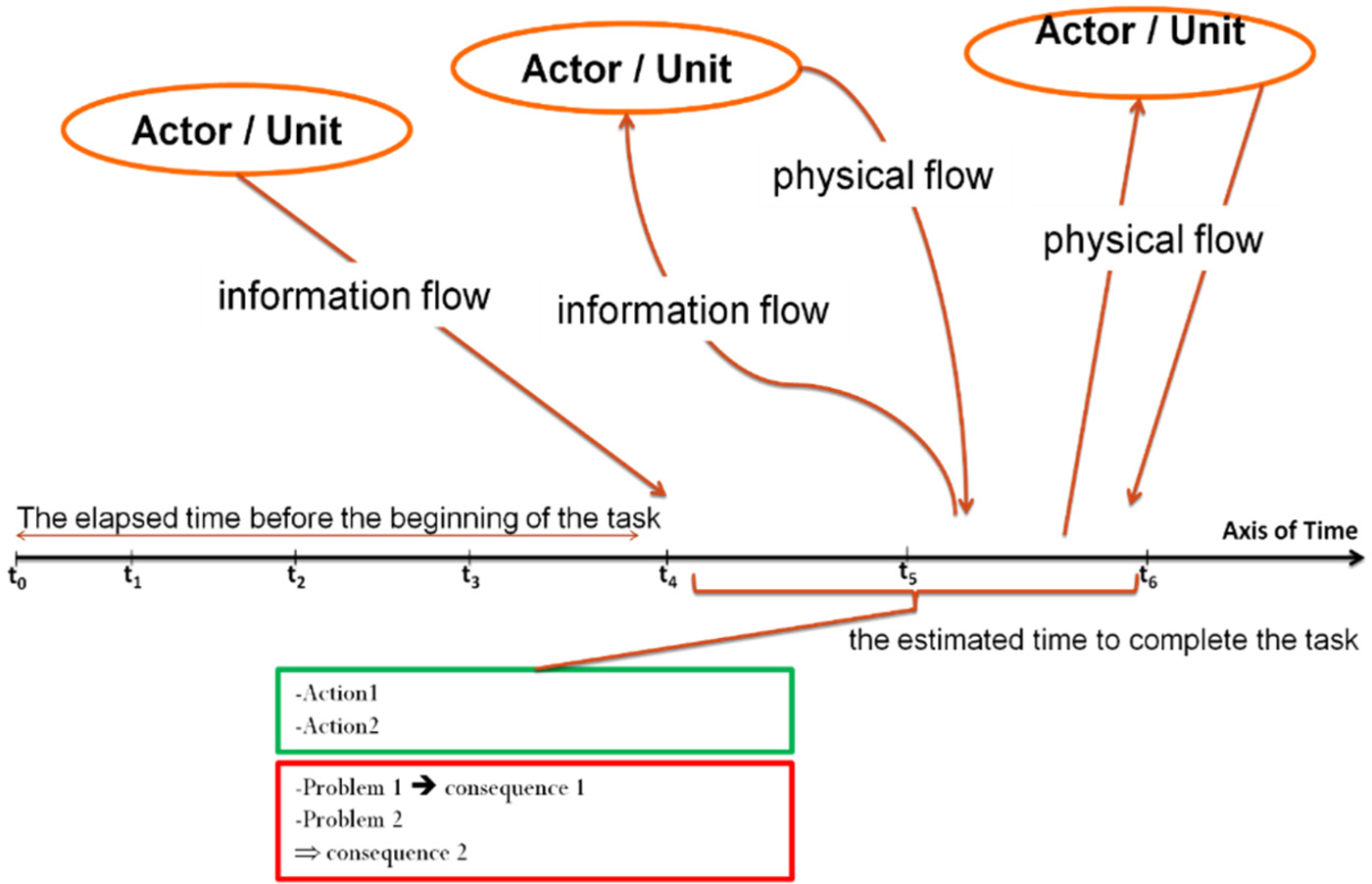
Experts identify different types of situations to represent. We work with them for acquiring experience and definition of common structures (Sediri et al., Reference Sediri, Matta, Loriette and Hugerot2012) to represent this experience. They are looking forward to promote the reuse of this experience and acquiring a future one. Thus, we propose a structure that includes, chronologically, actor tasks and faced problems during an intervention (Fig. 5).
Crisis Experience feedback Model.

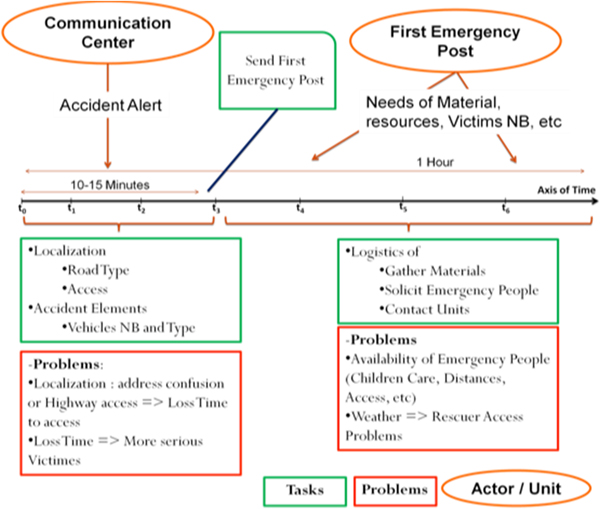
The aim of this structure is to represent the different communication links established during the crisis intervention and nature of its exchange. In addition, we represent the experiences; by representing several tasks and associated problems as well as consequences of the non-respect of duration of tasks attended and its recommendations. This structure allows organizing a live crisis by the time and the actors. The aspect related to the context is implemented by the events, which organize the sequence of actions to do. Definition and organization of a group of actions (tasks) is made by the time, the events and the data available on the situation. So, actions and data together show the potential impact reaching a goal of decision makers with the consequence that can be produced. We present (Fig. 6) an example of an applied model of experience feedback for the responsibility of emergency department (tasks and faced problems on a timeline) facing a road accident case.
Example of Model of experience feedback of the responsible of emergency department tasks and faced problems on a time line (road accident case).

Using the cycle recommended by MASK method (Interview Modeling and Validation of model), our model is tested with the experience collected in the other crisis situations; the expert validates the model each time.
The framework of decision-making support system using experience
We described in section 4 the features of crisis situations and in section 7.3 paragraph B, the organization of actors during the management of crisis. To guide decision makers in crisis situations we can consequently act at two levels. The first one concerns the perception of the context as an important element in the reasoning process (Van der Henst, Reference Van der Henst and Guy2002). This can be made by providing additional and useful data with less ambiguity about context, using the quick and automatic research in Geographic Information Systems (GIS) and situation bases defined after. The second one concerns guiding the process of decision making (Richard, Reference Richard1998; Reed, Reference Reed2010), as a cognitive process. We aim at guiding the reasoning process during each phase of the crisis using available cases in the situation base.
Information processing in dynamic situations can be distinguished by a number of dimensions from decision making in the normally used static task environments. First, because the environment changes, time is an inherent dimension of the decision-making process. Second, strategies can be used that benefit from feedback. Third, time pressure can be defined from the evolving situation itself rather than by some external criterion (Kerstholt, Reference Kerstholt1995).
CSS: a system of state/event
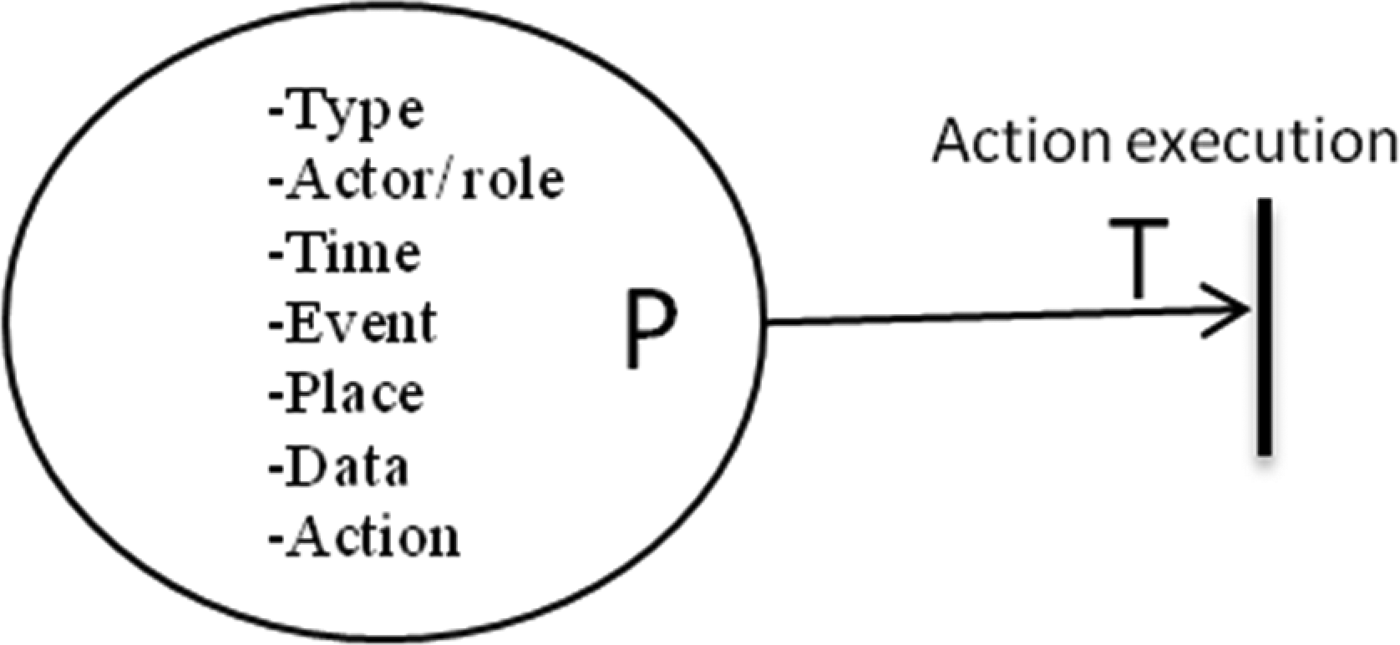
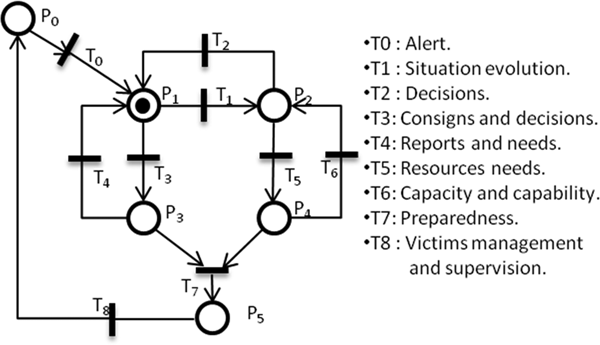
For a better understanding of the intervention and decision-making steps, we may represent emergency department crisis management as a set of couples of states and events using a basic Petri network (Aich and Loriette, Reference Aich and Loriette2007). Each state of the system matches a crisis stage; it is represented by a place of a Petri network (Fig. 7):
• Type: it is a sort of index referencing an episode of a crisis situation. It indicates the main class (category) of the current situation (e.g. road accident, fire, etc). Providing this index helps the system to do research by keywords, it allows recognition of such situations through previous ones and keeping the link with central events of crisis.
• Actor/role: is the concerned person or unit in each system state (crisis stage).
• Time: is the moment to do an action by the concerned actor according to the place's type.
• Event: the received events allow the system to be adapted to all random events, the goal is to avoid the unique focus on time of tasks.
• Data: is the available data for concerned actor in each moment, this piece of information is related to the characteristics of crisis situations, localization, weather and victims.
• Action: is the action to execute considering previous elements.
• Place: is the actor location.
Petri network's State and transition of crisis situation.

The starting point of our proposition is based on the communication of the events and the tasks. All these elements are important to determine the following tasks to do or the decisions to make. Their definition on our situation structure helped us to identify a set of system states, transitions and conditions between them. Representation of these elements inside the same structure for all actors is difficult. Indeed, a concrete structure is relatively complex considering the time and the space dimensions (Fig. 6). It makes its interpretation difficult. The transcription of a Petri network allowed us to see these elements in the form of a state/transition graph (Fig. 8) more simply and, especially better defined. Transitions represent the interactions between actors and events that can change the system state and parts. The places (states) represent the major interactions between the system parts.
Petri network of crisis management – P: Actors/unit – T: event/tasks/exchanges (P0: the stable system. – P1: Communication Center. – P2: Emergency department. – P3: Intervention Teams. – P4: hospitals. – P5: Victims” evacuation).

Situation organization in a data base
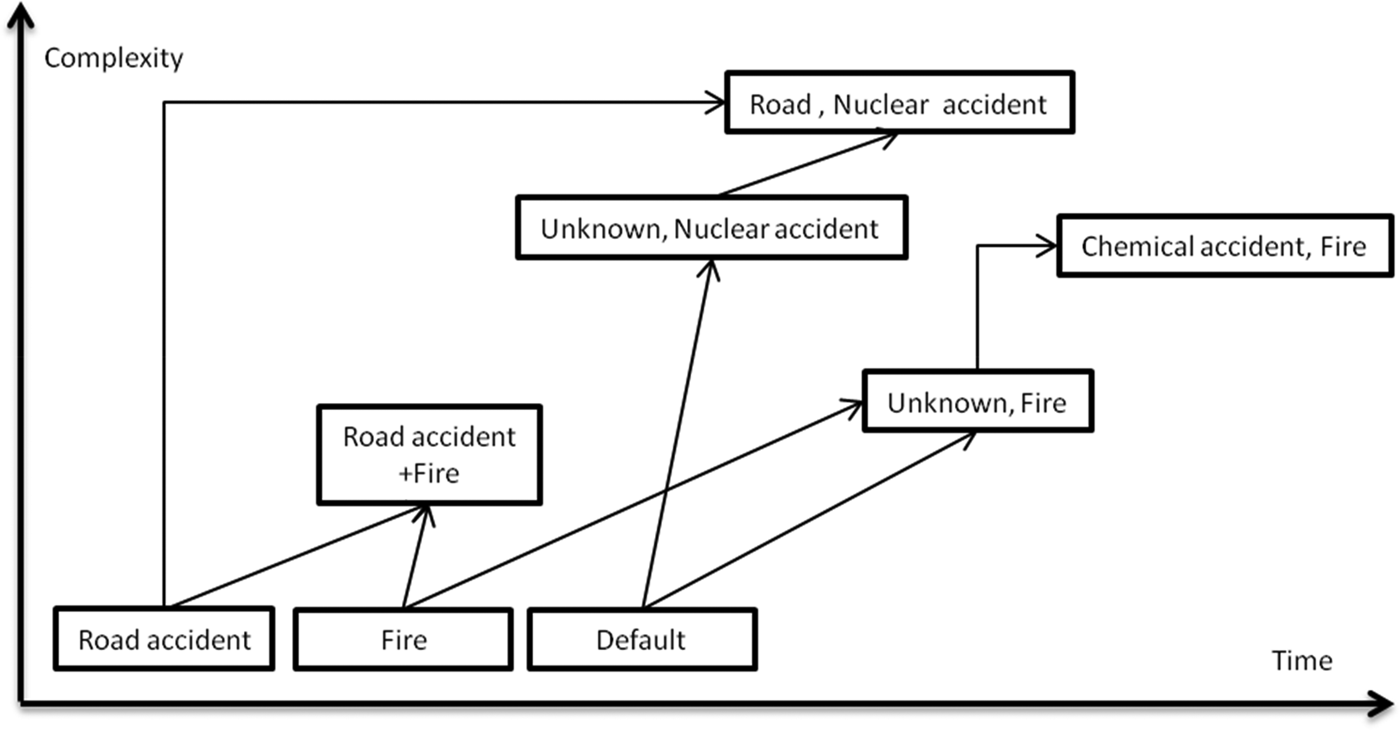
A crisis situation can incorporate several elements and characteristics related to others crisis, for example, a road accident can generate a disaster situation, specially a chemical accident when a tanker transporting a chemical substance is implicated. Then, representing the situation as a road accident is not enough. Thus respecting this classic classification will require each time to add related elements that emerge. So, the result is a few number of cluttered situations seen that there are elements to ignore or add during each use.
As we cited above, we seek by using the technique of analogy, to categorize and draw invariants between objects (representations of objects, situations, abstractions, relationships…) and rules. The categorization is central to the development of this system, especially concerning the description of the context and problem solving for future situations (Fig. 9).
Learning experience in the system and adaptation to new contexts.

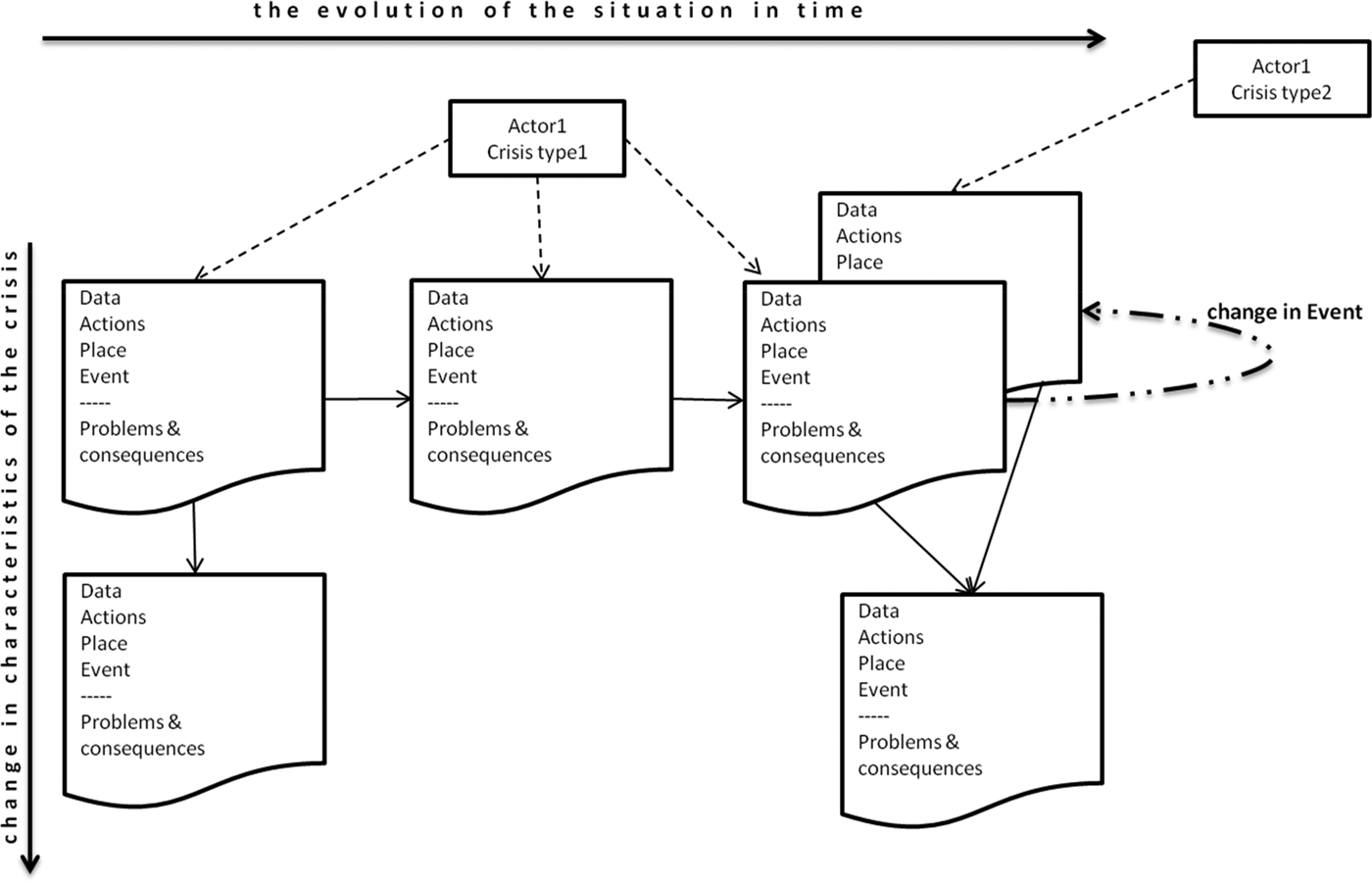
Then our approach uses another alternative, the idea is to create a new index for each important event (indicator) in order to define a new case, which is a complete, or part of a situation. This representation will allow the CCS to rebuild such situations using many combination possibilities. The search within the cases is made using the perceived indicators. For the interests of speed and system efficiency the solution space (similar situations) must not be too large. Thus, the index corresponds to the most discriminating value as possible.
The situation base is organized by actor's role. Each situation points for each actor's role in the important moments of the crisis (episode) in the form of time intervals (Fig. 10). For each case we defined three parts; set of characteristics (data), set of tasks (actions) to do and the problems involved if the task is not completed. An episode is any part of a crisis case that corresponds to a group of tasks and data performed by an experience. Exploration of episodes of a situation occurs, widthwise, by the evolution in time. The exploration of episodes, in depth, is done by the change within the characteristic of crisis. The perception of a random event generates a search in episodes of other situations and incorporate a new context in the current context.
Structuring situation by episode.

Interaction between the system and actor
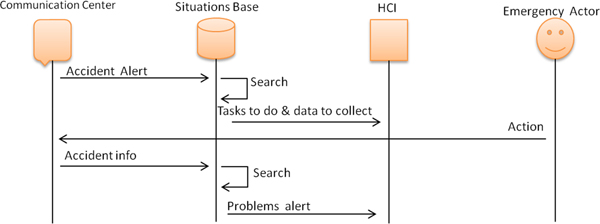
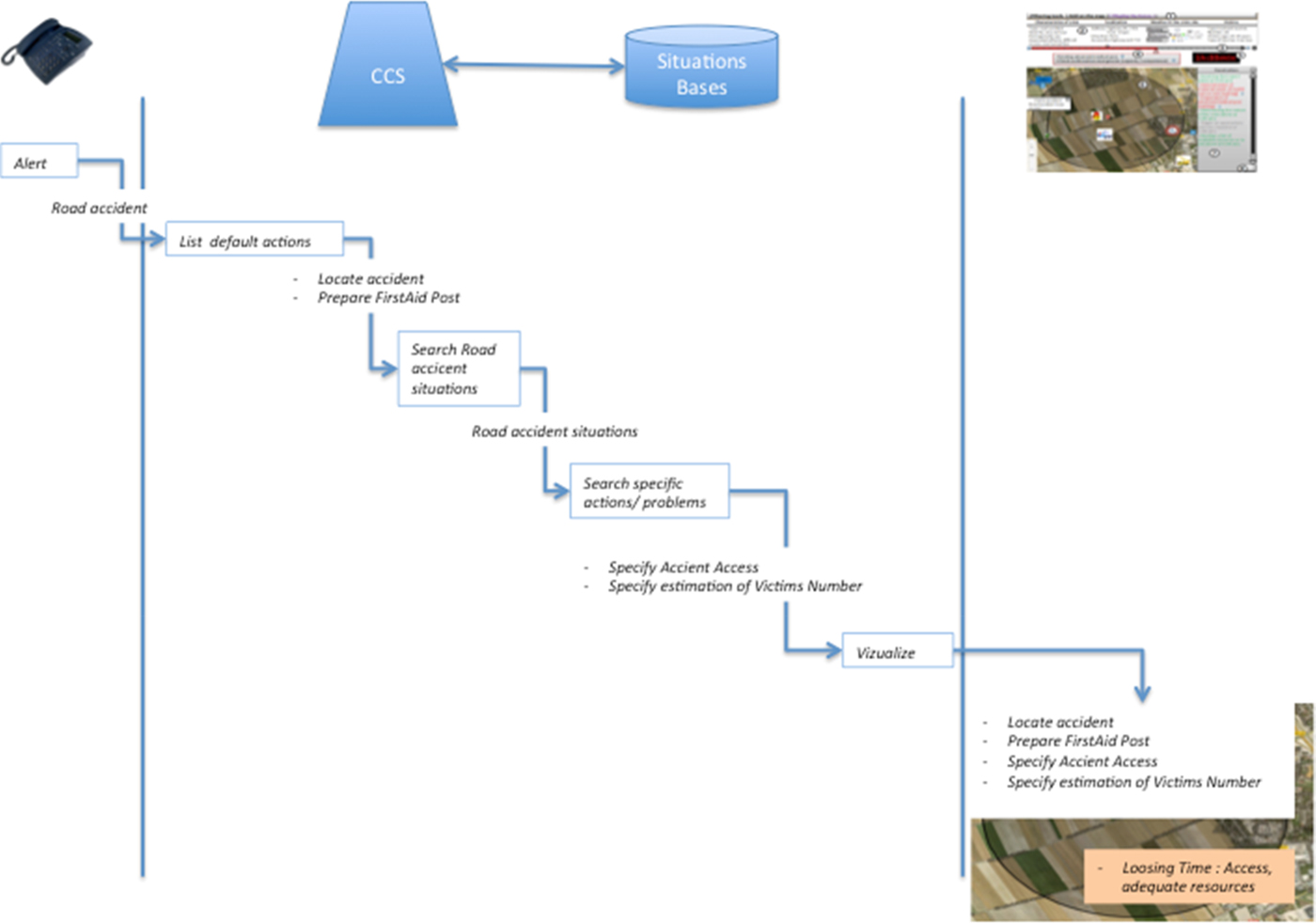
The following diagram (Fig. 11) provides a scenario to explain the interaction between CCS and emergency actor. The main actor is represented in the right of diagram, secondary actors in the left. The goal is to describe how the actions occur between the actors (emergency actor and communication center), the CCS interface's (HCI) and the situation base. The vertical dimension of the diagram represents time (time augments downward).
• Step 1: A warning is communicated from the communication center about a serious road accident.
• Step 2: This information launches directly a situation retrieval in the base, using situation parameters which are represented as database fields (accident place, accident type, contributors, involved environment, etc.). Accident type will be identified (for instance in our case, a road accident)
• Step 3: The system sends accident type related information, tasks to do and data to collect, respecting time thread (Fig. 11)
• Step 4: The emergency officer must complete the information and complete the tasks on time.
• Step 5: If the data are not collected or if a task is not done in time, the system looks for the likely consequences that may occur and sends a warning (alert) to the actors. For instance, if the crisis procedure is not launched, the emergency department will have a serious organization problem (lack in rescuers number, delay of communication with government actors, etc.).
Interaction between the system and actor.

Implementation structure of situations-base
When we reach the stage of modeling and storage of data, the trivial solution coming to our mind is the use of a relational database. This is the method most commonly used to store permanent information within relational database management systems.
The relational model consists in storing information in the very precisely defined schema (attributes, tuples) associated with different constraints inside, or between, tables for example, primary keys, foreign keys. This rigorous schema avoids redundancy in the data, and allows easily manipulating data with SQL queries and joins.
But this model has a limit: its schema is static. We take for example our application; a crisis is defined by type, gravity, involved, homogeneity, and the episodes (Episode1 from 0 to 15 min: number of victims, action to do: A1, A2, A3) (Fig. 12).
Structuration of a crisis.

We can of course create a table named “crisis” with these attributes (columns: type, gravity, homogeneity); a second table named “episodes” related to the “crisis” table by the attribute type (columns: the episode number, number of victims, time interval and action list).
The question that arises is how to define a schema for the “crisis” and episodes, which can both store a car accident and fire characterized by: in addition to that we cited before, the wind direction, type of injury, number of people with burns of the first degree, second degree and third degree.
It is very difficult to do, we can create an endless number of columns for the “crisis” table and “episodes”, sometimes being forced to add new columns for new types of crisis, or list is used as the Entity Attribute Value (EAV) model to the detriment of the respect of the original relational model and performance because of the very important number of joins to retrieve the data.
From these observation limits of the relational model (and other constraints related to the incorporation of the episode situation in other situations and storage of heterogeneous data) another choice is necessary, this choice is aimed to answer these limits: it is to use NoSQL database (Han et al., Reference Han, Haihong, Le and Du2011). We were particularly interested in document-oriented NoSQL databases. This type of database stores objects, called documents. Documents are organized into collections. Inside the same collection, documents may have different structures. From the point of view of queries, this type of database does not allow joins. But they offer flexibility in data representation, and performance in queries inside big databases. This type of data is particularly well adapted to increasing volumes of data, like a database of crisis situations.
The choice of the Maps’ system
The maps of emergency interventions represent an essential tool; they show main information such as the locations, the networks of streams and rivers, and the locations of man-made features such as trails, roads, towns, boundaries, and buildings. They also show what the crisis site is like and distances between useful crisis management stakeholders. All of these are important considerations in emergency planning. It makes easier to decide where to go and where to position means.
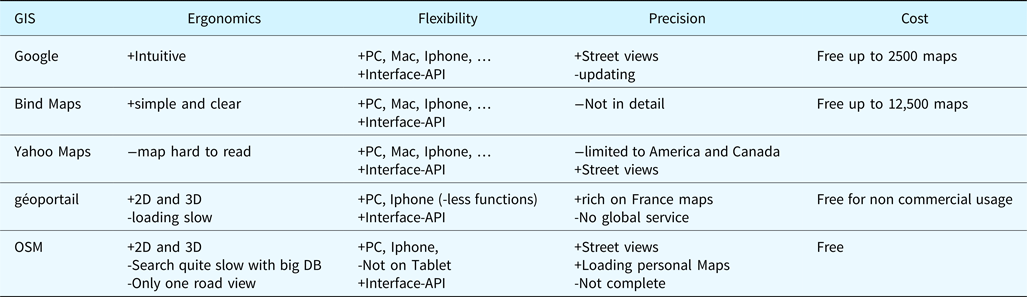
Therefore our system is fitted with interactive maps allowing actors to zoom to a custom scale for a detailed view of a specific area of interest associated with several information essentially related to the localization of risk places, human/materials resources, emergency, rescuers means and services information. So, we identified a number of risk places and their characteristics in the AUBE's State. Further, used GIS should allow defending more positions and information on maps. A comparison was made (Table 2) for the choice of the most suitable GIS system for our users and our final CCS.
Comparison of Map's systems management

All the following criteria are very important and they determined our choice:
• The interface of GIS should be user-friendly. Users from medicine domain who do not currently use software must use it.
• The geographic information should be precise. The exactness of the geographic information of the GIS may be considered as the most important feature for this project.
• The GIS should be flexible enough to have an interface with other systems. We need to integrate rule-based and information search systems to GIS.
• The service should allow us to personalize the map. Several actors from several domains (doctors, secretaries, etc.) will use the system.
• The cost of the services should be free.
• The provider of GIS must allow having the data and mapping locally (offline availability).
Google Maps is the most adapted GIS in terms of functionality and accuracy. But, the problem is that we cannot have maps locally. So we need a permanent Internet connection with the remote Google Maps API (Application Programming Interface). As there is the risk of losing the connection in a crucial moment of the crisis, it is preferred to have as much as possible data and maps locally. The OpenStreetMap (OSM) then became our preferred choice; it is also a system under a GPL license and is supported by a large community.
Traceability of the experience feedback
To promote the learning of system, traceability provides a collection of experiences to be reused to deal with future situations. We trace each managed situation regarding its context, its particularity and modification of some old experience.
The new experience is not directly stored in our database situation. At the end of each crisis, the system allows users to validate the new experience and the changes they have made. This functionality is provided by the capability of the system to replay situation using the generated log of the temporary area.
During the crisis we keep the wholes changes in this area. During the validation step, the situation in the temporary area is replayed. In comparison with the already existents situations:
• If the changes are at the level of events, the situation in the temporary area will be stored in the base situation.
• If it is an addition to the characteristics or actions (tasks) of crisis, one episode is created at the appropriate level of the old situation.
• If it is a delete of action (tasks) or in characteristics, in this case the system asks the user “will these actions/characteristics be useful in future situations?”
○ If the answer is Yes: the deletion is canceled and the actions/tasks in question are moved in depth.
○ If the answer is No: deletion is performed permanently.
Human machine interface of CCS
A better interface must respect several criteria; among others we present most important (Luzzardi et al., Reference Luzzardi, Dal Sasso Freitas, Cava, Duarte and Vasconcelos2004; Christian Bastien and Scapin, Reference Christian Bastien and Scapin2009):
• Good guidance: facilitate learning and use of a system (user easily know at any time where he/she is in a sequence of interactions and possible actions).
• Good prompting: avoid obliging the user to learn a series of commands and protecting him/her from errors.
• Grouping the similar items in the same place.
• Reply and quick reaction of the system. For the establishment of user confidence and satisfaction, the system must respond clearly if the command is passed or not.
• Content legibility for easy reading.
• Respect the technical words and the terminology of the user or the system domain.
• Use shorter entries for better reminding.
• Required actions to accomplish tasks should be minimal.
• Insure the minimal density; items that are not related to the current task should be removed.
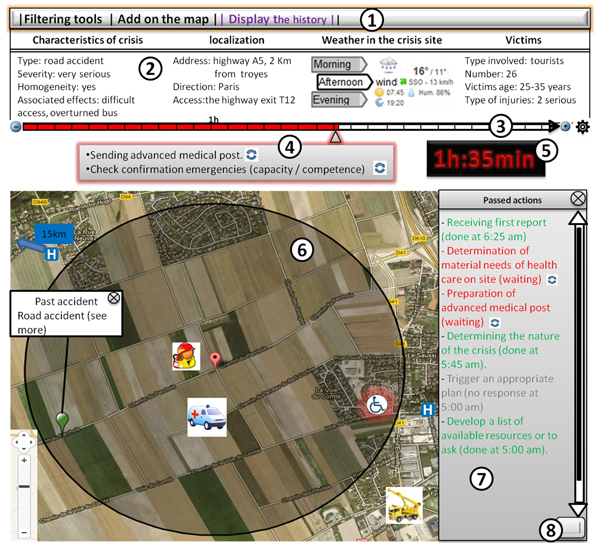
In this section we present the specification of the visual representation of the functionalities of our system. We based on the needs of users in terms of functionality and interaction. The following list describes the numbered items in Figure 13.
(1) The horizontal menu: this menu allows the user to define the items to show or to hide on the map. These elements are generally emergency locations, risk sites and resources. It helps also to personalize the maps by changing or adding other items. The element (number 7) of this menu is used to display the history of communications, problems or actions as shown
(2) The data to be provided on the crisis: this is a dynamic list of data. It reminds the user data to be collected on the situation. These data refer to characteristics of the crisis, location of the crisis and the victims. The weather is updated automatically through a web service. This area is very important to show the evolution of situation context elements.
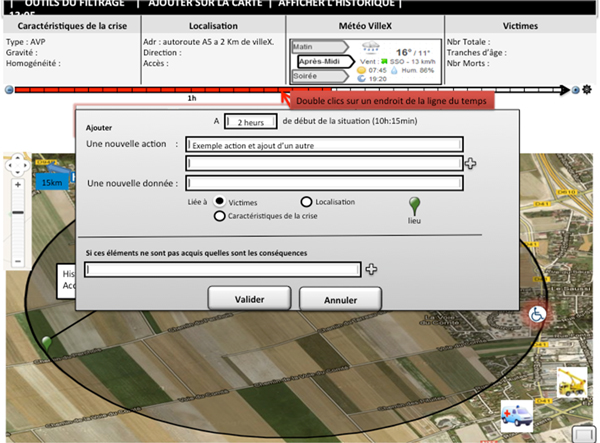
(3) Timeline: it allows monitoring the state of actions and what is urgent. By a double click on this line, the system provides also the possibility to add other data to be collected or actions to do for the current situation. By clicking on the setting icon, we can also view on this line the communications as well as the problems in the same way of actions. The default value (5 min) of the timescale is changeable by a zoom presented in the start and the end of the timeline.
(4) Current actions to do: the content of this item presents the action to do immediately. The existing icon in front of each action allows changing the state of the action (waiting, done or no response). Once the time for action is expired an alert is triggered.
(5) Timer: it displays elapsed time since the beginning of the crisis.
(6) The site map of the crisis: it provides an overview of the site of the crisis, the user can easily see deployed means, risk sites and the nearest resources.
(7) History of actions: this item is displayable from horizontal menu (view history). It serves to review the history of actions and change their status. Displaying the history of communication and problems is also possible from the same menu. Actions are also annotated by their occurring state (achieved, waiting results, etc.)
(8) Button to display user exchanges: this button allows showing the exchanges between the users and displaying new incoming information.
A view of the CCS interface.

Example
As we noted above, CCS is defined with an emergency department of Aube in our city. Firstly, we identified different types of crisis, they deal with: road accident, train accident, explosion, city fire, dangerous materials transport accident, etc. Then, we interviewed emergency doctors and secretaries that play several roles in the emergency department: responsible, parents’ victims welcoming, communication, materials and human resources responsible, etc. Our questions were based on the emergency representation structure we defined (Figs. 6, 7).
In fact, we identified: the space organization (places, actors, functions and roles) and the time organization (actions, problems, communication and information needed). These elements have been structured as a base of situations represented thanks to events and states in XML format. Adding to that, we defined a default situation, in which we put the main procedure to do which contains basic actions to do for every situation: that is, sending emergency first post to identify the means needed, gathering related means (human resources and materials), communicating to the government emergency responsible, etc.
Given an alert about an accident (for instance a road accident), CCS system searches at first in the default situation actions to do related to the current period (for instance before 15 min). Then CCS searches in the situation base, similar situations (road accident), then actions already identified will be completed by those identified in similar situations. Related problems are also added (Fig. 14).
Example of CSS use.

For each new incoming event (new information, result of action, etc.), the system searches related actions and problems in the situation base. For instance, the first post sends information about the number of victims and their gravity situation. The system searches similar situations in the situation base, at the second period, actions about gravity of victims treatment and lists of actions about logistics (emergency actors to mobilize, materials to send), etc., that is, if the number of victims is high, actions can be also: “communicate events to government responsible”, or if accident information gathered alert about safety problems, corresponding actions found will ask firefighters and police help, etc.
If there is a new action to do or new data to consider, the system allows keeping track of new information. At debriefing time, the situations can be replayed and actors have to validate or refuse the new action or data. They have to add related problems and they can comment on these actions and data (Fig. 15). The system adds all these new elements in the situation base, either as new events or as new states.
Adding a new action.

Conclusion
We show in this paper, our results on analyzing crisis management. Our approach aims mainly at identifying the experience feedback and representing it. We have defined a decision-making environment for crisis management, related to the emergency activity. We provide also the specification of the interface of the system to promote decision support. Finally, we have defined how the experience is traced in our system and how it helps to manage future situations and enrich the capital of experience feedback.
The real-time aids for future situations, given the opportunity to evaluate and validate each new experience according to its context. The context and random events are treated too in our work, they are not only important in the time of crisis management, but also its reproduction during debriefing to relive the situation step by step, it helps to validate a new experience and learning from it. The replay of a situation motivates the debriefing and analysis of the effectiveness of decisions taken.
The learning process following the analogy facilitates the categorization of memory situation (reasoning by analogy is thus seen as an organizer of the experiment). It allows the future application of this analogy to other situations. Reasoning by analogy allowed us to abstract categories from various situations encountered (categorization), and thus transform specific experiences prototypical representations or diagrams (abstraction and mapping) that will allow us to address similar situations more easily.
The system is already developed and used by SAMU 10 (Aube Emergency Department). It has been tested in exercises and is currently being integrated into their information system. This will then exploit the traceability.
 Sophie Loriette is an Associate Professor in the Institute Charles Delaunay, University of Technology of Troyes, France. She received the PhD degree in computer science in 1994, from the University Pierre and Marie Curie, Paris, France. Her research focuses on artificial intelligence. She has worked on a variety of topics including knowledge-based systems, case-based reasoning, and knowledge representation. She has been involved in several projects related to recognition and anticipation of dynamic situations, in various application domains such as driving assistance (electric wheelchairs, cars) or crisis management.
 Nada Matta, Professor at the University of Technology of Troyes. I study techniques in knowledge engineering and management and specially to handle cooperative activities as product design, crisis management, etc. Currently, I am Director of department of “Human, Environment and ICT”. I assumed several responsibilities as: Director of “Scientific group of supervision, and security of complex systems” for 5 years and Director of department of “Information Systems and Telecom” for 2 years. I did my PhD in knowledge engineering and Artificial Intelligence at University of Paul Sabatier in collaboration with ARTEMIS. http://matta.tech-cico.fr/en
 Mohamed Sediri, Searcher & Computer engineer, my research subject is “Traceability and the use of experience feedback of crisis management for decision maker support”.In 2010, I had a master's degree in computer science “information systems engineering” from Cadi Ayyad University (Marrakech Morocco) and bachelor's degree in computer science in the same university (2008).I am interesting in knowledge engineering and its possibilities to deals with the development of information systems in which knowledge play main role, also the intersection of computer science and knowledge management in order to deals with knowledge as a key resource in modern organizations.
 Alain Hugerot is an Emergency Medecine Physician since 1992, Director Extra-Hospital Emergency Service SAMU 10 and Care Unit at Hospital Simone Veil, Troyes ,France. Also Director of the Center for Emergency care in catastrophic situations or CNBRE Crisis. Certified Paris XIII 1993 Avicennes et Paris XIV 1994 Créteil , Master Global Security 2004 University Technology Troyes. Associed researcher 2018, UTT France. He work on unconventionnal situations and human behavior under stress, crowd panic and human factors in dynamic events and crisis management. Associed in several projets National Research Agency France during the last years.