Posttraumatic growth (PTG) is defined as the positive psychological adaptations that can occur following a traumatic event (Tedeschi & Calhoun, Reference Tedeschi and Calhoun2004). The concept of PTG is not new. For instance, ancient or age-old philosophical musings have placed a high value on the transformative effects of suffering, such as developing a greater appreciation for life and relationships, and a newfound personal resilience (Tedeschi & Calhoun, Reference Tedeschi and Calhoun2004). Moreover, clinicians such as Frankl (Reference Frankl1963), Maslow (Reference Maslow1954), and Yalom (Reference Yalom1980), wrote about ways in which adversity presented opportunities for positive growth. With the recent influence of positive psychology, the scientific study of positive human functioning and flourishing, this trend continues (Seligman & Csikszentmihalyi, Reference Seligman and Csikszentmihalyi2000).
Although much research has focused on the negative or pathological consequences of trauma, the possibilities for experiencing personal growth following exposure to highly difficult circumstances are receiving considerable attention (Shamia, Thabet, & Vostanis, Reference Shamia, Thabet and Vostanis2015). This view of distress-induced positive growth is a departure from contemporary views of trauma as solely debilitating. Several researchers have noted positive benefits and growth following politically motivated acts of violence (Ai, Cascio, Santangelo, & Evans-Cambell, Reference Ai, Cascio, Santangelo and Evans-Campbell2005; Hobfall et al., Reference Hobfoll, Hall, Canetti-Nisim, Galea, Johnson and Palmieri2007; Poulin, Silver, Gil-Rivas, Holman, & McIntosh, Reference Poulin, Silver, Gil-Rivas, Holman and McIntosh2009). This study sought to examine PTG among survivors of political violence.
The Existential Reality of Trauma Experience
Breslau and Kessler (Reference Breslau and Kessler2001) reported that approximately 75% of individuals incur some form of trauma within their lifetime. The experience of a traumatic event has been linked to a myriad of physical and psychological health conditions. Studies controlling for variables, such as victim demographics and injury type, have found an increase in chronic pain, cardiovascular, gastrointestinal, genitourinary, respiratory, and musculoskeletal conditions following distressing experiences like criminal victimization or direct or indirect exposure to terrorism (D'Andrea, Sharma, Zelechoski, & Spinazzola, Reference D'Andrea, Sharma, Zelechoski and Spinazzola2011; Flett, Kazantzis, Long, MacDonald, & Millar, Reference Flett, Kazantzis, Long, MacDonald and Millar2002; Holman et al., Reference Holman, Silver, Poulin, Andersen, Gil-Rivas and McIntosh2008; Ullman & Siegel, Reference Ullman and Siegel1996). One of the most frequently cited conditions is posttraumatic stress disorder (PTSD). As the name implies, this is a stress condition induced by a trauma. Other documented mental health issues include the occurrence of major depressive disorder, generalized anxiety disorder, panic disorder, dissociation, and substance abuse disorders following trauma (Kessler et al., Reference Kessler, Anthony, Blazer, Bromet, Eaton, Kendler and Zhao1997; Stuewe, Lanius, & Frewen, Reference Steuwe, Lanius and Frewen2012).
The negative effects of a traumatic experience can have an impact long after the event. Individuals can experience nightmares, intrusive memories, and intense physiological reactions months and even years after the initial trauma exposure (D'Andrea et al., Reference D'Andrea, Sharma, Zelechoski and Spinazzola2011). Breslau and Kessler (Reference Breslau and Kessler2001) found that one-third of a sample of 1,000 people had significant symptoms of PTSD at least 10 years following a traumatic event. Barth, Kopfmann, Nyberg, Angenendt, and Frommberger (Reference Barth, Kopfmann, Nyberg, Angenendt and Frommberger2005) found that of traffic accident victims interviewed 5 years after their trauma, 24% still had clinically significant PTSD. They also had significant ongoing occupational and relational impairment. Similarly, Koren, Arnon, and Klein (Reference Koren, Arnon and Klein2001) found that among traffic accident survivors, half who had early symptoms of PTSD, had significant symptoms even 4 years later.
Posttraumatic stress and PTG appear to be interrelated, that is, a certain level of stress is necessary in order for growth to occur. Joseph (Reference Joseph2011) reports a curvilinear relationship between growth and stress, as stress increases, so does growth. However, when stress levels are too high, growth will eventually diminish. This high level of stress may indicate a diagnosis of PTSD. But, when PTG is established it may reverse posttraumatic stress. Those reporting positive benefits from an event early on, continue to sustain this perspective as time passes. Manne et al. (Reference Manne, Ostroff, Winkel, Goldstein, Fox and Grana2004) found that breast cancer survivors’ PTGI scores increased over an 18-month period, supporting the contention that time also may have a mediating effect on PTG.
The experience of PTG does not infer that an individual no longer feels distress related to the trauma. An individual's struggle with the aftermath of the experience can produce a mixture of negative and positive experiences (Tedeschi & Calhoun, Reference Tedeschi and Calhoun2004). However, predicting that an individual is likely to develop PTG in response to a traumatic event is difficult (Konvisser, Reference Konvisser2013). Besides, perceived quality of life (QOL) and resilience with trauma experience would be important to the levels of PTG among trauma survivors. The World Health Organization defines QOL as an individual's subjective evaluation of physical health, psychological state, social relationships, and environment (WHO, 1995). Resilience has also been equated with constructs such as thriving (Park, Reference Park1998), hardiness (Maddi, Reference Maddi2005; Tsuang, Reference Tsuang2000), sense of coherence (Nygren, Jonsen, Gustafson, Norberg, & Lundman, Reference Nygren, Jonsen, Gustafson, Norberg and Lundman2005), self-efficacy (Conner & Davidson, Reference Connor and Davidson2003), and inner (or ego) strength (Garmezy, Reference Garmezy1991). Resilience is most commonly described as an individual's ability to cope with or move through challenging experiences. These relationships require study in the context of trauma from politically motivated violence.
Posttraumatic Growth (PTG) with Disability from Political Violence
Politically motivated acts of violence refer to threats aimed at civilian populations to obtain a political agenda (Ganor, Reference Ganor1998). A prominent feature of this type of warfare is its non-discriminating nature, where anyone, anywhere, may feel like a potential target. The psychological result is erosion in one's sense of security and safety where anticipatory anxiety and fear occurs (Konvisser, Reference Konvisser2013).
Yet, positive transformations have been documented following incidences of terror (Helgeson, Reynolds, & Tomich, Reference Helgeson, Reynolds and Tomich2006; Joseph, Linley, & Harris, Reference Joseph, Linley and Harris2005; Pargament, Smith, Koenig, & Perez Reference Pargament, Smith, Koenig and Perez1998; Shiri, Wexler, Alkalay, Meiner, & Kreitler, Reference Shiri, Wexler, Alkalay, Meiner and Kreitler2008a; Reference Shiri, Wexler, Alkalay, Meiner and Kreitler2008b; Zoellner & Maercker, Reference Zoellner and Maercker2006), combat (Waysman, Shwarzwald, & Solomon, Reference Waysman, Shwarzwald and Solomon2001), sexual assault (Frazier, Conlon, & Glaser, Reference Frazier, Conlon and Glaser2001), adverse health situations such as myocardial infarct (Leung et al., Reference Leung, Alter, Prior, Stewart, Irvine and Grace2012), and HIV (Murphy & Hevey, Reference Murphy and Hevey2013). The PTG phenomenon highlights areas in which growth occurs such as improved relationships with others, an openness to greater possibilities and an appreciation of life, heightened personal strength, and spiritual growth, which can be a conduit to greater QOL and wellbeing (Armeli, Gunthert, & Cohen, Reference Armeli, Gunthert and Cohen2001; Shiri, et al., Reference Shiri, Wexler, Alkalay, Meiner and Kreitler2008a; Tedeschi & Calhoun, Reference Tedeschi and Calhoun1996).
Study Context
This study followed survivors of politically motivated acts of violence occurring in Jerusalem during the Second Intifada (also known as al-Aqsa Intifada) that occurred from 2000 to 2004. The Second Intifada was a sustained period of politically motivated acts of violence in Israel over the course of 4 years in which both Palestine and Israel experienced casualties. During this time, over 100 suicide bomber attacks occurred in Israel, resulting in about 1,000 deaths and 5,000 injuries to Israeli civilians (National Security Studies Center Terrorism Database, 2007). Many of these incidents involved explosive devices in closed spaces (e.g., suicide bombers on autobuses), and as a result, there were numerous fatalities and serious injuries. Those who survived had to undergo extensive rehabilitation that involved both medical and psychological interventions (Schwartz et al., Reference Schwartz, Tsenter, Shochina, Shiri, Kedary, Katz-Leurer and Meiner2007; Reference Schwartz, Tuchner, Tsenter, Shochina, Shoshan, Katz-Leurer and Meiner2008).
In our previous studies, we documented PTG among survivors of politically motivated violence in the short-term (Shiri et al., Reference Shiri, Wexler, Alkalay, Meiner and Kreitler2008a; Reference Shiri, Wexler, Alkalay, Meiner and Kreitler2008b). We have found that resilience and PTG hold inverse relationships, that is, greater stress reactions were followed by greater PTG (Shiri et al., Reference Shiri, Wexler, Alkalay, Meiner and Kreitler2008a; Reference Shiri, Wexler, Alkalay, Meiner and Kreitler2008b). However, the long-term inter-relationship between these variables in victims of politically motivated acts is unknown. The aim of the current study was to explore the interconnections between QOL, posttraumatic stress, resilience, and levels of PTG among survivors of terror attacks who were hospitalized at a major metropolitan hospital in Jerusalem 10 years following injury. The specific research questions are as follows: 1. What is the relationship between PTG and participant demographic variables and medical history? 2. What is the relationship between PTG, participant demographic variables and medical history, QOL, posttraumatic stress, and resilience?
Methods
Participants and Setting
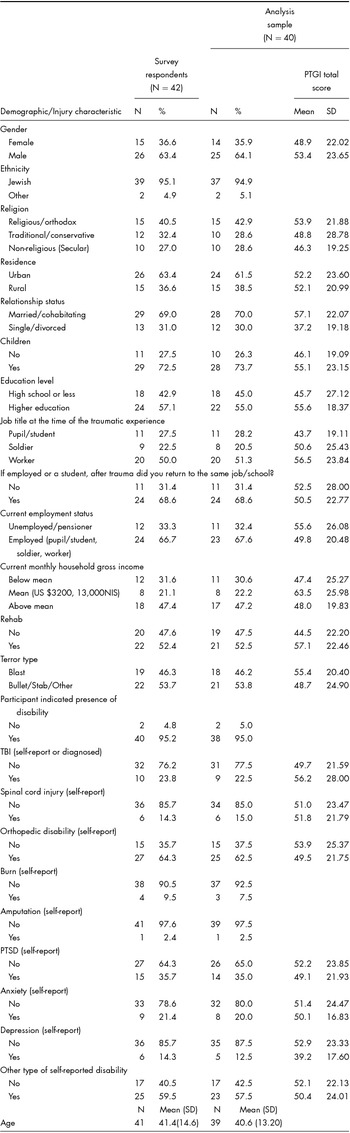
Survivors (N = 182) who were hospitalized in a rehabilitation department of a large comprehensive medical centre providing physical and psychological care in Jerusalem, between the years 2001 and 2004, were identified and recruited for study participation. In total, 42 (23%) of these individuals completed a survey. Descriptive data for the survey respondents are presented in the left-hand side of Table 1. Participants were predominantly male (63.4% versus 36.6%), with a mean age of 41, employed or in school (66.7%), and resided in an urban (63.4%) versus rural (36.6%) area. The majority of participants were Jewish (95.1%) and were either married or cohabitating (69%). Most of the participants suffered from orthopaedic lesions (64.3%), followed by traumatic brain injury (23.8%) and spinal cord injury (14.3%). Other injuries included burns, amputations, and more (see Table 1).
Description of survey respondents and participants in analysis sample along with summary of PTG for the categorical variables considered in univariate analyses

Measures
The participants self-reported their demographic characteristics: sex (male and female), ethnicity (Jewish, Arab, or other), type of injury, and a host of other socio-economic variables (see Tables 1 and 2). They then completed measures of PTG, subjective impact of events, QOL, and of resilience. These are described next.
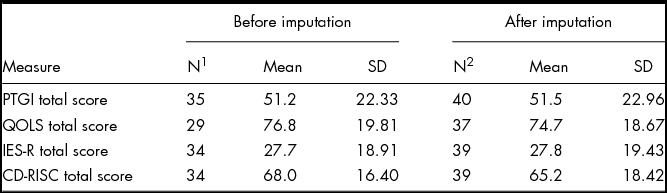
Summary of PTGI, QOLS, IES-R, and CD-RISC total scores for participants in the analysis sample before and after imputation

1 Participants in the analysis sample with no missing responses on the selected instrument.
2 Participants in the analysis sample with at least 75% of items completed on the selected instrument.
The Posttraumatic Growth Inventory (PTGI). The Posttraumatic Growth Inventory (PTGI) (Tedeschi & Calhoun, Reference Tedeschi and Calhoun1996) is a 21-item measure of five indicators of recovery following trauma: relating to others, new possibilities, personal strength, spiritual change, and appreciation of life. For each statement, respondents were asked to indicate on a six-point scale, the degree to which the change reflected in the question was true in their life as a result of the crisis/traumatic event. Individual responses ranged from 0 (I did not experience this change as a result of my crisis) to 5 (I experienced this change to a very great degree as a result of my crisis), with total scores ranging from 0 to 105. The higher the score, the higher the sense that growth has occurred. PTGI scores typically ranged between 40 and 70. A previous study reported an internal consistency of 0.96 and item correlations range from r = .59 to .82 for scores from the PTGI (Osei-Bonsu, Weaver, Eisen, & Vander Wall, Reference Osei-Bonsu, Weaver, Eisen and Vander Wall2012).
The Impact of Events Scale—Revised (IES-R). The IES-R is a 22-item self-report scale used to assess subjective distress caused by traumatic events (Weiss, Reference Weiss, Wilson and Keane1997). Subjects were instructed to identify a specific stressful life event and then rate it on a five-point scale, ranging from 0 (not at all distressing) to 4 (extremely distressing) that each difficulty has been during the past 7 days. The IES-R yielded a total score ranging from 0 to 88, with lower scores indicating less distress. Scores from the IES-R achieved high internal consistency ratings from α = .79 to .91 in a previous study (Weiss, Reference Weiss, Wilson and Keane1997).
The Quality of Life Scale (QOLS). The QOLS (Burkhardt & Anderson, Reference Burckhardt and Anderson2003) is a 16-item measure with six aspects that include: material and physical wellbeing; relationships with other people; social, community, and civic activities; personal development and fulfilment; recreation and independence. It is scored on a six-point scale ranging from 1 (Terrible) to 7 (Delighted), with a total possible score ranging from 16 to 112, higher scores indicate greater QOL. Scores from the QOLS are internally consistent (α =.82 to .92) and reliable with test–retest assessment (Anderson, Reference Anderson1995; Neumann & Buskila, Reference Neumann and Buskila1997; Burckhardt, Woods, Schultz, & Ziebarth, Reference Burckhardt, Woods, Schultz and Ziebarth1989).
The Connor-Davidson Resilience Scale (CD-RISC). The CD-RISC is a 25-item measure of personal coping (Connor & Davidson, Reference Connor and Davidson2003). Respondents were asked to rate on a five-point scale, ranging from 0 (not true at all) to 4 (true nearly all the time) the degree to which they agree with statements as they apply to the past month (Connor & Davidson, Reference Connor and Davidson2003). The total score ranged from 0 to 100, with higher scores indicating greater resilience. Scores from the CD-RISC achieved an overall alpha reliability score of .89 in a previous study (Singh & Xiaonan, Reference Singh and Xiaonan2010).
Procedure
The study was approved by the ethical committees (i.e., Internal Review Boards) of both Hadassah University Hospital and Virginia Commonwealth University. All participants provided informed consent in compliance with the ethical standards of the relevant national and institutional committees on human experimentation and with the Helsinki Declaration of 1975, as revised in 2008.
Data collection occurred between 2013 and 2014, 8 to 12 years post injury, where 182 individuals were contacted and 42 (23%) participated. Participants were informed that the study was confidential and there was no identifying information on the questionnaire. All participants were contacted by phone 10 days after the initial contact. At this follow up contact, those who indicated that they had not yet completed the questionnaire, were tagged to receive another reminder following 10 additional days.
Data Analysis
Sample characteristics were described using counts and percentages for nominal data and means and standard deviations (SD) for continuous data. The dependent variable used in this analysis was PTG as measured by the PTGI total score. Predicting variables of primary interest were victims’ current levels of QOL, posttraumatic stress, and resilience. General linear models were used to assess the univariate relationship between PTGI and the primary independent variables of resilience, QOLS and IES-R total scores, as well as several of the demographic/disability characteristics. Statistical significance was set at α = .05, with marginal significance considered at α = .10. Due to the exploratory nature of this study, no adjustments were made for multiple comparisons. Participants were retained for analyses if they completed at least 16 (75%) of the 21 items contained in the PTGI instrument. In total, 40 of the 42 participants satisfied this requirement, with 35 participants completing all 21 items on the PTGI and five participants completing between 16 and 20 items. For all instruments, individual item responses were imputed for subjects who completed at least 75% of the items within a given instrument. Imputation was performed using the k-Nearest Neighbour (k-NN) method, where missing item values were calculated from the median item response of the k = 5 nearest neighbours, found by minimizing the Euclidean distance between observations over the set of items within the instrument.
Multivariable models were fit separately for each of the primary predictor variables in order to assess their relationship with resilience while adjusting for potentially confounding demographic/injury characteristics. Demographic and injury characteristics that demonstrated at least marginal significance (p < .10) were considered for inclusion as additional covariates in the initial multivariate models. The multivariable model for each primary predictor was then reduced using manual backwards selection with statistical significance (p < .05) required for covariate retention.
Results
Relationship Status Influences
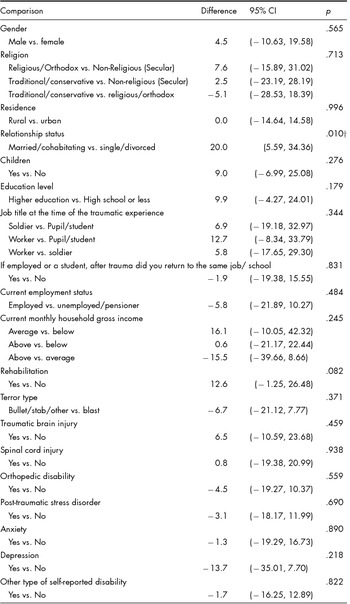
Demographic characteristics of the N = 40 participants in the analysis sample are summarized in the right-hand side of Table 1, with PTGI, QOLS, ISE-R, and CD-RISC total scores summarized before and after imputation in Table 2. Average PTG (measured by PTGI total score) is summarized across each of the categorical independent variables in Table 1, with estimated group differences summarized in Table 3. Of the categorical variables considered, relationship status was the only predictor found to be significantly related to PTG (p = .010). On average, PTG was 20.0 units greater in married/cohabitating participants as compared to those who identified as single/divorced. Additionally, although not statistically significant, rehabilitation was associated with a marginal increase in PTG (p = .083). Average PTG was 12.6 units greater in participants who attended rehabilitation as compared to those who did not (95% CI: -1.3, 26.5).
Summary of the univariate relationships between categorical predictor variables and PTG along with estimated mean differences in PTG

†indicates significance (p < .05).
Quality of Life and PTG
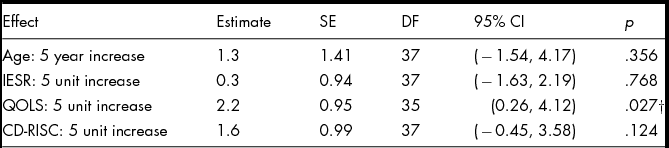
Univariate analyses of the relationship between the primary predictor variables (QOLS, IES-R, and CD-RISC) and PTG revealed that QOLS was significantly and positively related to PTG (p = .027). In particular, a five unit increase in QOLS was associated with an increase of 2.2 (95% CI: 0.3, 4.1) units in PTGI (see Table 4). There was not a significant relationship between PTG and IES-R (p = .77) or CD-RISC (p = .124); however, a five unit increase in total resilience was associated with a nominal increase of 1.6 units in total PTG (95% CI: -0.4, 3.6).
Univariate relationships between PTG and continuous predictor variables

†Indicates significance (p < .05).
Demographic Factor Influences
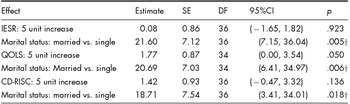
Multivariable models were fit separately for each of the primary predictor variables in order to assess their relationship with PTG while adjusting for the demographic/injury characteristics that attained at least marginal significance (p < .10) in the exploratory univariate analyses (Table 3). Therefore, all initial models included the primary predictor variable as well as the demographic characteristics of relationship status and rehabilitation. In all cases, rehabilitation was removed from the model, leaving only the primary predictor and relationship status. The final multivariable models are summarized in Table 5. We note that the inclusion of relationship status slightly diminishes the effect of the primary predictor variable in each model but that the positive effect of marriage/cohabitation remains large and significant in each case. In particular, we see that while QOLS was significantly related to PTG in the unadjusted model (p = .027, see Table 4), the effect of QOLS is only marginally related to PTG (p = .050) after adjusting for relationship status (see Table 5).
Relationships between PTGI and the primary predictor variables adjusted for relationship status

†Indicates significance (p < .05).
Discussion
Relationship status predicted PTG. PTG was significantly greater for participants who were married or in a relationship with a partner compared to those who were single or divorced. This might be explained by the fact that marriage can have a protective effect for wellbeing (Carr, Freedman, Cornman, & Schwartz, Reference Carr, Freedman, Cornman and Schwarz2014; Carr & Springer, Reference Carr and Springer2010). Han, Park, Kim, Kim, and Park (Reference Han, Park, Kim, Kim and Park2014) state that not just having a relationship but its quality contributed to an individuals’ life satisfaction. Positive relationships also have been found to be a necessary feature to experience wellbeing, often providing a basis for one's sense of meaning and purpose (Huppert & So, Reference Huppert and So2013; Lyubomirsky, Sheldon, & Schkade, Reference Lyubomirsky, Sheldon and Schkade2005).
Social support is a key factor in recovery. Although we do not know how supportive these relationships are, it is presumed participants of this study have probably benefitted from a primary relationship in which psychological and physical support may have been available during the recovery process. Family members, particularly spouses, and partners often are involved in the processing of a traumatic event, and deeper interpersonal relationships could be a result of these efforts (Barskova & Oesterreich, Reference Barskova and Oesterreich2009). Having supportive relationships is a significant protective factor for posttraumatic stress, resulting in higher levels of psychological wellbeing (Bonnano, Brewin, Kaniasty, & Greca, Reference Bonanno, Brewin, Kaniasty and Greca2010; Brewin, Andrews & Valentine, Reference Brewin, Andrews and Valentine2000; Holland & Holahan, Reference Holland and Holahan2003; Peterson, Park, Pole, D'Andrea, & Seligman, Reference Peterson, Park, Pole, D'Andrea and Seligman2008). Sarason, Sarason and Gurung (Reference Sarason, Sarason, Gurung, Sarason and Duck2001) found that such support assisted recovery and overall QOL in cancer patients, by reducing stress and improving the cognition of individuals as they cope with physical, mental health, and existential challenges. Social support also is reported to reduce the probability of illness and speed up physical healing. In a meta-analytic study of 103, studies of PTG following a traumatic event (e.g., traumatic brain injury, cancer, spinal cord injury, and heart disease), social support was significantly related to PTG (Prati & Pietrantoni, Reference Prati and Pietrantoni2009).
Findings of this study indicated a marginal relationship between PTG and participation in a rehabilitation program. This was an unexpected result since recovery through rehabilitation is intended to facilitate optimal functioning so that the individual may return to his/her community and experience opportunities for inclusion and enhanced QOL (WHO, 2004). Previous research demonstrates that higher levels of QOL often result in reduced mental health challenges such as depression, and higher levels of positivity in trauma survivors (Hegelson, Reynolds, & Tomich, Reference Helgeson, Reynolds and Tomich2006; Israel-Cohen, Uzefovsky, Kashy-Rosenbaum, & Kaplan, Reference Israel-Cohen, Uzefovsky, Kashy-Rosenbaum and Kaplan2015; Joseph, Reference Joseph2011). Perhaps personal and cultural factors as well as established support networks influence support-seeking behaviours.
Study results indicate a nominal relationship between PTG and resilience (see also Mahdi, Kususanto, & Sahabuddin, Reference Mahdi, Kususanto and Sahabuddin2014), suggesting that PTG and resilience should be viewed as two independent constructs (Westphal & Bonanno (Reference Westphal and Bonanno2007). However, Tedeschi and Calhoun (Reference Tedeschi and Calhoun2004) argued that a connection might form between PTG and resilience despite their differences and as part of a return to healthy functioning.
Implications for Rehabilitation Research and Practice
Rehabilitation counsellors’ are uniquely suited to assist individuals in their recovery from trauma, to promote healing and growth. Politically motivated acts of violence can generate individual as well as community crises resulting in injuries, disabilities, deaths, and displacements (Martz, Reference Martz and Martz2010). As a profession, our specialized training in psychosocial and vocational issues enable us to respond to the myriad of stressors these conflicts create from the psychological, to the physical to the economic as well as social. Our concentration in counselling techniques allows us to assist individuals in coping with the fears and stressors in the aftermath of the traumatic event, as well as aide individuals who have been injured with adjustment to disability. Our training in vocational rehabilitation interventions also shift the focus away from trauma and pathology to provide economic stability as well as social inclusion and is thus a valuable intervention post-trauma (McDonald, Reference McDonald and Martz2010). As a grounding philosophy, we recognize the uniqueness and worth of each individual, and within our rehabilitation practice, we focus on human strengths, health, quality of life, hope, coping and resilience following disability (Chou, Chan, Phillips & Chan, Reference Chou, Chan, Phillips and Chan2013; Tansey, et al., Reference Tansey, Kaya, Moser, Eagle, Dutta and Chan2016). These actions, along with facilitating client relationships during this process, have the potential to assist with PTG and thus, more successful rehabilitation interventions. Additionally, considering the central role that social support plays in rehabilitation and recovery (Frain, Bishop, & Bethel, Reference Frain, Bishop and Bethel2010), rehabilitation counsellors should also include partners/family members in the process to enhance goal development and achievement and assess any difficulties that may require family or couples counselling (Schnurr, Lunney, Bovin, & Marx, Reference Schnurr, Lunney, Bovin and Marx2009).
In summary, Joseph (Reference Joseph2011), in conjunction with Tedeschi and Calhoun (Reference Tedeschi and Calhoun2004), supports the need to reconfigure the current conceptualization of trauma to one that views post-traumatic stress as a natural process that can be associated with PTG. Such a perspective of trauma adopts a less medical orientation and facilitates a recovery that is self-determined and within the power of the individual to effect. Transformative change includes personal, psychological, and relationship aspects toward a positive affirmation that extend beyond prior levels of functioning (Joseph & Linley, Reference Joseph and Linley2006; Joseph, Linley, & Harris, Reference Joseph, Linley and Harris2005; Joseph, Reference Joseph2011). PTG impacts mental health improves positivity and assists individuals to flourish.
Suffering and growth are ubiquitous concepts of psychological, philosophical, and social discourse, as well as, many of the world's major religions and cultures. The mechanisms and comprehension of how one responds to trauma and adversity, whether or not one succumbs or learns to thrive, is essential in contemporary reality. The potential for politically motivated acts of violence is a global, international phenomenon that impacts diverse populations. Adaptive responses and supports that foster openness, growth and resilience contribute to indices of wellbeing and QOL and the ability to determine new meaning and an existence in which community members flourish within challenging contexts.
Several considerations and limitations are important for the interpretation of this study. Personal factors in response to trauma are interrelated (Brewin et al., Reference Brewin, Andrews and Valentine2000) so that it is difficult to isolate a single event, as well as, other aspects/experiences in life that may lead to growth. Another limitation is that baseline data on the trauma survival were not available for analysis that may have underpowered the study's ability to detect PTG growth over time. Additionally, multiple statistical analyses were run due to the exploratory nature of the research, increasing the risk of a Type I error. Finally, relationship status was a significant factor for PTG in this study; however, the duration of these relationships is not known, future research should expand upon this finding with an exploration on the quality and depth of a current relationship.
Conflicts of Interest
None.