Mastitis is a major health problem in Indian dairy animals and across the globe. It is also a cause of public health concern due to the possibility of excess antimicrobial usage (Gelalcha et al., Reference Gelalcha, Agga, Dego and Dego2021; Sharma et al., Reference Sharma, Manimaran, Kumaresan, Sivaram and Rajendran2021; Preine et al., Reference Preine, Herrera, Scherpenzeel, Kalmus, McCoy, Smulski, Rajala-Schultz, Schmenger, Moroni and Krömker2022). Amongst intramammary infections (IMI), subclinical mastitis (SCM) causes greater economic losses than clinical mastitis (CM) due to higher prevalence, difficulty in detection, reduced milk yield and quality and potential source of infection for herd mates (Sinha et al., Reference Sinha, Thombare and Mondal2014; Krishnamoorthy et al., Reference Krishnamoorthy, Goudar, Suresh and Roy2021), and since about 25–30% of chronic SCM cases may develop into CM (Barlow et al., Reference Barlow, White, Zadoks and Schukken2009). Since SCM is due to several patho-physiological and environmental factors, understanding these risk factors in particular geographical areas is important for its control. Several researchers have investigated the possible risk factors for SCM in India and elsewhere (Sharma et al., Reference Sharma, Singh and Bhadwal2011; Bangar et al., Reference Bangar, Singh, Dohare and Verma2015; Krishnamoorthy et al., Reference Krishnamoorthy, Suresh, Saha, Govindraj, Shome and Parimal2017), and have done so for both Zebu and crossbred (Holstein-Friesian × Zebu) cows (Abebe et al., Reference Abebe, Hatiya, Abera, Megersa and Asmare2016; Kitila et al., Reference Kitila, Kebede and Wakgari2021). Parity, stage of lactation (SOL), season and milk yield were found to be some of the important risk factors for IMI, and in India breed and stress were additionally recognized as being associated with high somatic cell count (SCC), which is an indirect indicator of SCM at individual cow and herd level (Sharma et al., Reference Sharma, Singh and Bhadwal2011). Mastitis pathogens are the most important risk factor to determine the disease outcome and Staphylococcus spp., Streptococcus spp. and E. coli were the most common causative agents of SCM in Indian dairy cattle (Sharma et al., Reference Sharma, Singh and Bhadwal2011; Preethirani et al., Reference Preethirani, Isloor, Sundareshan, Nuthanalakshmi, Deepthikiran, Sinha, Rathnamma, Prabhu, Sharada, Mukkur and Hegde2015). Significant variation among existing reports on prevalence rate of SCM in Indian dairy cattle is probably due to variations in methodology for diagnosis (Bangar et al., Reference Bangar, Singh, Dohare and Verma2015). The standard diagnostic methods like direct milk culturing and SCC estimation are infeasible in practice under Indian dairy production conditions, thus evaluating the performance of indirect diagnostic tests such as California mastitis test (CMT) and electrical conductivity (EC) in different breeds and husbandry routines needs to be done before these tests can be used for routine surveillance and monitoring of SCM (Hegde et al., Reference Hegde, Isloor, Prabhu, Shome, Rathnamma, Suryanarayana, Yatiraj, Prasad, Krishnaveni, Sundareshan, Akhila, Gomes and Hegde2013). These authors reported involvement of different pathogenic risk factors between organized (eg research farms) and non-organized (field conditions) dairy enterprises and indicated the requirement for different management strategies for SCM in south India.
When multiple diagnostic tests or markers are available for an individual disease, use of combinations to maximize the accuracy of disease diagnosis is a common practice (Pepe and Thompson, Reference Pepe and Thompson2000; Xu et al., Reference Xu, Fang, Rong and Wang2015). However, there are very few studies of combined diagnostics methods for SCM detection in India. Mastitis risk factors are never definitive and it is impossible to evaluate all the potential risk factors in a herd in a single study (Souza and Brito, Reference Souza and Brito2011). Bulk milk SCC (BMSCC) is a frequently used parameter to estimate SCM prevalence at herd level (DeLong et al., Reference DeLong, Lambert, Schexnayder, Krawczel, Fly, Garkovich and Oliver2017), however, no studies were conducted to understand the relationship of BMSCC with prevalence of SCM and other udder health indicators in Indian dairy animals. Considering the major economic loss due to SCM, the present study was conducted to estimate the prevalence of SCM in indigenous and HF crossbred cows and to assess the risk factors in these breeds under organized and non-organized farming conditions. The study also evaluated the comparative efficacy of indirect diagnostic tests and relationship of BMSCC with SCM under different farming conditions.
Materials and methods
Study area
The study was conducted in an organized research farm at the Livestock Research Centre, Southern Regional Station of the Indian Council of Agricultural Research (ICAR)-National Dairy Research Institute (NDRI), Bengaluru urban district and villages from Devanahalli taluk of Bengaluru rural district of Karnataka under non-organized dairy farming conditions. Further details of locations are provided in the online Supplementary File. The experiment was conducted as per the guidelines and approval of the Institute Animal Ethical Committee.
Study animals and their managements under organized dairy farming conditions
A total of 45 lactating HF crossbred (Holstein Friesian × Bos indicus of local non-descript breeds) having 60–70% of Holstein Friesian blood level and 43 Deoni (Bos indicus) cows were used. These experimental cows were maintained under loose housing system and fed as per requirement through institute grown seasonal green fodders, dry fodder (2–3 kg of finger millet straw) and commercially available concentrate feed (Nandini gold™ containing 16–18% crude protein, 70–72% TDN, 2.5–3.5% fat, 5.5–6% crude fibre, 1–1.5% acid-insoluble ash and 10–11% moisture, M/s Karnataka Milk Federation, Bengaluru). About 3–5 kg of concentrate feed was divided in equal proportion and fed twice a day.
Deoni cows were milked by hand milking after partial suckling for one minute by their calves. Bucket type machine milking was used for crossbred cows with residual milk removed by hand milking at the end of machine milking to ensure complete removal of milk from udder. The milk yield (kg) was recorded by electronic weigh balance. The average milk yield of Deoni and HF crossbred cows during the study period was 3.6 (range 3.2–4.3) and 12 (range 10.7–13.8) kg per cow per day, respectively.
Study animals and their management under non-organized (field) dairy farming conditions
Management practices in Devanahalli taluk are described in the online Supplementary File. The study area contained 180 dairy co-operative societies (DCS) purchasing milk from local farmers. To select the villages and number of samples from each village, we collected DCS information on number of farmers (members), number of milking animals and daily milk procurements (in litres). Based on the latter two criteria we calculated wet average (per day) of each DCS and classified them into high, medium and low categories each containing 60 DCS, using the 33-percentile cut off level. The average number of lactating animals under each DCS category was 65, 102 and 93 respectively. The daily milk procurement (in litres) was 860, 854 and 542 and wet average (in litres) was 15, 8 and 6, respectively. Among each category, two villages were randomly selected for screening and estimation of point prevalence of SCM. The sample size was calculated using sample size calculator (https://www.calculator.net/sample-size-calculator.html?type=1&cl=95&ci=10&pp=40&ps=53&x=0&y=0) at 95% confidence level with 10% of marginal error and assumption of 40% prevalence rate of SCM based on existing study (Krishnamoorthy et al., Reference Krishnamoorthy, Suresh, Saha, Govindraj, Shome and Parimal2017). Accordingly, 111, 100 and 117 (total of 328) lactating animals from high, medium and low categories were screened for SCM using differential electrical conductivity (DEC) and CMT methods. Age, parity and stage of lactation of all animals maintained under field conditions were registered for risk factor analysis.
Collection of milk samples
SCC has been considered as a standard diagnostic method for SCM and threshold level of 200 × 103 cells/ml is most commonly used in dairy animals (Schukken et al., Reference Schukken, Wilson, Welcome, Garrison-Tikofsky and Gonzalez2003). SCC was estimated using a DeLaval cell counter (M/s DeLaval, Sweden) and cows with composite milk SCC of ≥200 000 cells/ml were considered as SCM, whilst cows without any abnormality in milk or udder tissue, with no systemic signs of disease and with SCC of ≤200 000 cells/ml were considered as healthy (Hallolli et al., Reference Hallolli, Sharma, Manimaran, Kumaresan, Sivaram, Bagath, Jeyakumar, Prakash and Rajendran2020).
Aseptic technique was used for sampling, as detailed in the online Supplementary File. A total of 557 individual cow level composite milk samples from all functional quarters were collected at fortnightly intervals from apparently healthy Deoni (43 cows; 235 samples) and HF crossbred (45 cows; 322 samples) cows during three different seasons (summer: March–June; winter: November–February and rainy: July–October) at morning milking for estimation of individual cow milk SCC. An average of 7.75 (range 3–12) milk samples from 41 HF crossbred cows and 6 milk samples (range 2–11) from 39 Deoni cows were collected at 10–11 time points for estimation of new intramammary infections. The minimum and maximum intervals between repeated sampling were 14 and 60 d, when more than one sample was collected in an animal from different seasons. An average of 27 HF crossbred cows (range 22–36) and 21 Deoni cows (range 16–23) were sampled at each time point. Quarter level samples from these cows (920 Deoni quarters and 1357 HF crossbred quarters) were screened using CMT and DEC methods. Information was collected from farm records about selected animals age, parity, lactation stage, test day milk yield, previous lactation milk yield and mastitis treatment history in current and previous lactations.
Composite milk samples from SCM positive HF crossbred cows (N = 34) were collected at monthly intervals during the study period (September–November; 20, 6 and 8 cows, respectively) and were processed within two hours for bacteriological examinations. One composite milk sample was collected from each cow and each milk sample was processed in three plates (MacConkey agar, Edwards agar and Mannitol salt agar).
Diagnostic tests
The CMT was performed as per manufacturer's recommendation (Immucell Corporation, Portland, USA) and CMT score of 0 was considered as healthy and CMT score ≥1 including trace were considered as SCM positive. The DEC of milk samples was determined using a commercial mastitis detector (Draminski™ 4Q, Draminski S.A., Gietrzwałd, Poland). A DEC of ≤50 units (the difference between the highest quarter and all the others within-cow), was considered as healthy, whereas a difference of ≥50 units was considered as an SCM affected quarter. Cows diagnosed with SCM at quarter level (one or more) by CMT or DEC were also considered as SCM at cow level to compare with SCC. DEC was not done for crossbred cows maintained under field conditions. A new case of SCM was defined as a cow with a new elevated SCC (>200 000 cell/ml) after showing lower SCC level (≤200 000 cells/ml) during earlier sampling. The first sample from each cow was considered as the baseline sample and these animals were not treated for clinical mastitis or any other diseases using antibiotics three weeks before inclusion and first sampling of this study. Bulk milk SCC (BMSCC) was estimated at fortnightly intervals after thorough mixing of milk in cans using plunger.
Milk culturing
About one ml of composite milk sample collected from SCM positive cows was added into 9 ml of nutrient broth and incubated at 37°C for 24 h. Culture positive samples were inoculated in selective media for coliforms, Streptococcus sp. and Staphylococcus sp. (MacConkey agar, Edwards agar and Mannitol salt agar respectively), at 37°C for 24 h. Bacterial isolates were identified on the basis of morphological characteristics of the colony and Gram staining. All chemicals used in this study were procured from Himedia, Mumbai (India).
Bacterial DNA isolation and pathogen identification using 16s rRNA method
Single colonies of suspected coliforms (n = 2), Streptococcus sp. (n = 2) and Staphylococcus sp. (n = 6) were picked from their respective culture plates and re-inoculated in respective selective media before DNA isolation using Quick-DNA™ Fungal/Bacterial Miniprep Kit (Zymo Research Corp, USA) as per manufacturer's recommendation. The DNA quality was evaluated on 1.0% Agarose gel and the same was confirmed through single band of high-molecular weight DNA observation. Then the fragment of 16S rDNA gene was amplified using 27F and 1492R universal primers. A single discrete PCR amplicon band of 1500 bp was purified before sequencing of PCR amplicon with forward and reverse primers (BDT v3.1 Cycle sequencing kit on ABI 3730xl Genetic Analyzer). The consensus sequence of 16S rDNA gene was aligned and used for BLAST analysis with NCBI GenBank database. Based on maximum identity score of first ten sequences, the organisms were identified through nucleotide homology and phylogenetic analysis.
Statistical analysis
The risk factors associated with SCM were analysed separately using bivariate (chi square test) and multivariate logistic regression models. The significant (P ≤ 0.2) variables in bivariate model were selected as candidates for multivariate analysis. However, among the age and parity, only parity was included in multivariate model due to its more practical application than age under Indian dairy farming conditions and to avoid collinearity problems. The performance of CMT and DEC methods was analysed by receiver-operating-characteristic (ROC) curve analysis considering SCC as reference test. Sensitivity, specificity and accuracy of CMT and DEC methods compared to milk SCC were calculated as per Hallolli et al. (Reference Hallolli, Sharma, Manimaran, Kumaresan, Sivaram, Bagath, Jeyakumar, Prakash and Rajendran2020). BMSCC were correlated with SCM prevalence rate and other udder health indicators using linear regression method. Values are expressed as mean ± se and P ≤ 0.05 was considered as significant. All the analysis was done using statistical software package SPSS version 20 (SPSS for windows, V20.0; M/s SPPS Inc., Chicago, IL, USA).
Results
Prevalence of SCM in dairy cattle maintained under organized and non-organized dairy production conditions
Data are shown in Figure 1. In the organized farm, the cumulative prevalence of SCM was approximately 31 and 65% in Deoni and HF crossbred cows, respectively. Under field conditions an SCM prevalence rate of approximately 55% was observed (Fig. 1a). The point prevalence ranged from 23 to 40% in Deoni and 52–74% in HF crossbred cows (Fig. 1b) in organized farm. Based on repeated sampling-based milk SCC estimation, we found 23 and 31% of new IMIs in Deoni and HF crossbred cows, respectively in the organized farm.
Cumulative (1a) and point (1b) prevalence of SCM in lactating dairy cows under organized and non-organized production conditions. CMT, California mastitis test; DEC, Differential electrical conductivity (which was not done for crossbred cows under field conditions); SCC, milk somatic cell count with cut-off value of 200 × 103 cells/ml was used to diagnose subclinical mastitis affected cows.

SCM prevalence rate was significantly (P < 0.05) correlated to BMSCC (Fig. 2a) and herd average milk SCC (Fig. 2b) in Deoni cows. However, prevalence of SCM was significantly (P < 0.05) correlated only with herd average milk SCC in organized (Fig. 2c) and non-organized (Fig. 2d) production conditions, but not correlated with BMSCC in crossbred cows maintained under both the production conditions. Summary statistics of SCM prevalence rate (%), SCC in healthy and SCM affected cows, BMSCC and herd average SCC in dairy farm and field conditions is presented in Table 1.
Relationship between BMSCC (2a) and herd average (2b) with SCM prevalence rate in Deoni cows (significant P < 0.05) maintained under organized production conditions. Herd average SCC with SCM prevalence rate (2c and 2d) in crossbred cows (significant P < 0.05) maintained under organized and non-organized production conditions.

Results of multivariate analysis of potential risk factors for SCM in Deoni cows in organized farm

SOL, Stage of lactation; Ref*, Reference category.
P value <0.05 is statistically significant from reference category.
Risk factors associated with SCM in lactating Deoni and crossbred cows maintained under organized and non-organized dairy production conditions
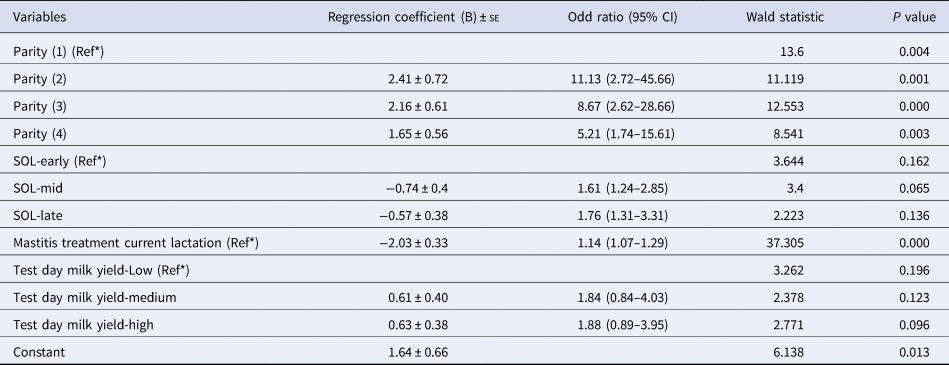
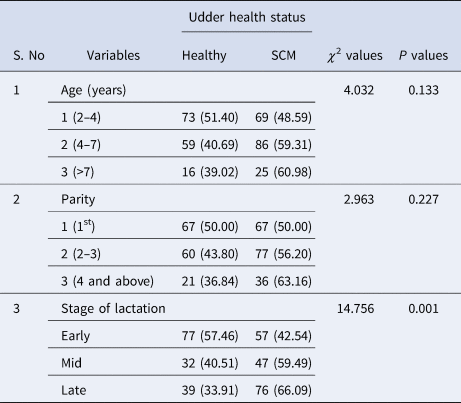
The least-squares mean of log SCC was significantly (P = 0.001) different between Deoni and HF crossbred cows in linear mixed model (4.49 ± 0.20 and 5.96 ± 0.19, respectively). Therefore, the risk factors were analysed separately for these breeds. Chi square values revealed age, parity, SOL, mastitis treatment history in previous lactation, test day milk yield and previous lactation yield were associated with SCM in Deoni cows, but not always to a significant extent (Supplementary Table S1). In HF crossbred cows, age, parity, SOL, mastitis treatment history in current lactation and test day milk yield similarly had an influence on SCM that did not always reach significance (Supplementary Table S2). Multivariate analysis revealed SOL (P = 0.001), previous lactation milk yield (P = 0.01) and test day milk yield (P = 0.04) in Deoni (Table 1) and parity (P = 0.001) and mastitis treatment history in current lactation (P = 0.001) in HF crossbred cows (Table 2) as risk factors of SCM. SOL was significantly (P = 0.001) associated with SCM in HF crossbred cows maintained under field conditions by both the bivariate (Table 3) and multivariate methods (OR: 2.1 during late lactation than reference period of early lactation; data not presented).
Results of multivariate analysis of potential risk factors for SCM in HF crossbred cows in organized farm

SOL, Stage of lactation; Parity, 1–1st parity, 2–2–3rd parity, 3–4–5th parity, 4-≥6 parity; Ref*, Reference category.
P value <0.05 is statistically significant from reference category.
Bivariate analysis of risk factors for SCM in HF crossbred cows under field condition

Figures in parentheses of udder health status are percentage of samples.
P value<0.2 is considered as statistically significant.
Comparative efficacy of CMT and DEC with SCC
The CMT was observed to be more efficient than DEC for differentiating healthy cows from SCM affected cows (Fig. 3a and 3b). The mean AUC ± se for CMT (0.82 ± 0.02, 95% CI 0.78–0.85) was significantly (P = 0.001) higher than DEC (0.69 ± 0.02, 95% CI 0.65–0.74).
Performance (3a) and area under the curve value (AUC; 3b) of CMT and DEC compared to milk SCC test.

Identification of mastitis pathogens by bacteriological culture and16s rRNA-based methods in SCM affected HF crossbred cows maintained under organized dairy production conditions
Mixed infection by Staphylococcus sp. and Streptococcus sp. was observed in more samples (20 out of 34 samples: 59%; average SCC of 1163 × 103 cells/ml), followed by Staphylococcus sp. alone in 11 out of 34 samples (32%; Avg. SCC of 1284 × 103) and coliform alone in two samples (6%; Avg. SCC of 488 × 103). Streptococcus sp. alone was not found in any samples and one sample was found to be culture negative. Molecular method-based confirmation in selected samples revealed presence of Staph. aureus, Staph. epidermis and Staph. chromogenes among Staphylococcus sp. suspected group, Klebsiella pneumonia and Shigella flexneri from Coliform sp. suspected group, Enterococcus mundtii and Lactococcus formosensis from Streptococcus sp. suspected group.
Discussion
Cumulative prevalence rate of 31% SCM in Deoni and 65% in HF crossbred cows was observed in this study. Several researchers reported a similar prevalence rate of SCM in India (Mukherjee and Dash, Reference Mukherjee and Dash2003; Patel and Tripathi, Reference Patel and Tripathi2018; Hallolli et al., Reference Hallolli, Sharma, Manimaran, Kumaresan, Sivaram, Bagath, Jeyakumar, Prakash and Rajendran2020) and in other countries with similar breeds of zebu and HF crossbred cows and management conditions (Mdegela et al., Reference Mdegela, Ryoba, Karimuribo, Phiri, Loken, Reksen, Mtengeti and Urio2009; Rahman et al., Reference Rahman, Bhuiyan, Kamal and Shamsuddin2009). Although the machine milking-based management of HF crossbred cows in the organized farm could be one of the reasons for higher incidence of SCM in this study (Bhakat et al., Reference Bhakat, Mohammad, Mandal, Mandal, Rai, Chatterjee, Ghosh and Dutta2020), the possible immunogenetic role for lower and higher resistance of HF crossbred and Deoni cows, respectively, cannot be ruled out (Sharma et al., Reference Sharma, Manimaran, Kumaresan, Sivaram and Rajendran2021). A similar trend of more prevalence of SCM in crossbred cows (Bos indicus × Zebu) than local cows in other countries supports the possible role of genetic susceptibility (Biffa et al., Reference Biffa, Debela and Beyene2005; Sori et al., Reference Sori, Zerihun and Abdicho2005). The observed similar trend of higher rate of new IMIs in HF crossbred cows based on milk SCC needs further characterization and bacterial isolation to clearly define new IMIs along with non-infectious causes to make any conclusive statement about new IMIs in these animals. We also reported earlier that lesser milk SCC in Deoni than HF crossbred cows could be due to lesser prevalence of SCM in Deoni cows (Hallolli et al., Reference Hallolli, Sharma, Manimaran, Kumaresan, Sivaram, Bagath, Jeyakumar, Prakash and Rajendran2020). The observed similar trend of SCM prevalence of 55–65% in HF crossbred cows maintained under organized and non-organized farming conditions supports the previous findings (Preethirani et al., Reference Preethirani, Isloor, Sundareshan, Nuthanalakshmi, Deepthikiran, Sinha, Rathnamma, Prabhu, Sharada, Mukkur and Hegde2015) and our earlier study revealed similar trend of clinical mastitis (25 to 27%) among these animals under organized and non-organized dairy production conditions (Sharma et al., Reference Sharma, Manimaran, Kumaresan, Sivaram and Rajendran2021).
BMSCC followed over a period of time is one of the important tools to monitor the udder health status at herd level. BMSCC from different seasons revealed the average BMSCC of 490 × 103 and 703 × 103 cells/ml (data not presented) in Deoni and HF crossbred cows, respectively. Gianneechini et al. (Reference Gianneechini, Concha, Rivero, Delucci and López2002) and Plym-Forshell et al. (Reference Plym-Forshell, Østerås, Aagaard and Kulkas1995) also reported similar range of BMSCC with 30–51% SCM prevalence rate as observed in our study. The higher prevalence rate of SCM in HF crossbred cows could be the reason for more BMSCC, but several researchers have reported that the relationship between IMI rate and BMSCC is not always tight and varies with breed, herd size and type of pathogens (Schukken et al., Reference Schukken, Wilson, Welcome, Garrison-Tikofsky and Gonzalez2003; Olde Riekerink et al., Reference Olde Riekerink, Barkema, Kelton and Scholl2008; Archer et al., Reference Archer, McCoy, Wapenaar and Green2013). Lievaart et al. (Reference Lievaart, Barkema, Hogeveen and Kremer2009) observed variation of BMSCC between sampling and also suggested that average test-day SCC is a more appropriate parameter than BMSCC to assess herd level SCM situation, as also observed in this study.
Sarker et al. (Reference Sarker, Parvin, Rahman and Islam2013) identified only four out of eight risk factors including history of previous clinical mastitis as one of the associated risk factors for SCM in bivariate analysis, as observed in this study. A lower level of acquired immunity and limited memory system by innate immune cells against invading pathogens in udder could be the reasons for more chances for mastitis in cows with previous mastitis history (Jamali et al., Reference Jamali, Barkema, Jacques, Bourget, Malouin, Saini, Stryhn and Dufour2018; Rowe et al., Reference Rowe, Tranter and Laven2018). Breen et al. (Reference Breen, Bradley and Green2009) reported that increasing parity and previous milk SCC were significantly associated with higher SCC as observed in HF crossbred cows. Studies indicated lower cytological cure rate among the cows which had more bacteriological cure rate and suggested that bacteriological cure alone is not sufficient to reduce the inflammation in the affected udder quarter (Schmenger and Krömker, Reference Schmenger and Krömker2020). Therefore, mastitis treatment in current lactation could be an important risk factor for SCM. Nobrega and Langoni (Reference Nobrega and Langoni2011) and others (Saravanan et al. Reference Saravanan, Das, De and Panneerselvam2015) also reported no significant influence of season on milk SCC in Deoni and HF crossbred cows but a significant influence of breed as observed in our study. Srinivas (Reference Srinivas2019) observed significant variations in the THI between months in a year but it was within the normal range (ie <80°F) in the study area and even no significant difference was observed between preceding years (2016 to 2019), indicating a uniform weather pattern in the study area. Rajashekara (Reference Rajashekara2019) also reported comparatively more rainfall during summer season with lesser humidity could be a reason for lesser stress to animals in Bengaluru region. Therefore, the lower possibility of environmental stress could contribute to the lack of seasonal effects on milk SCC in these dairy animals.
Better efficacy of CMT compared to DEC was reported by several researchers, as observed in our study (Preethirani et al., Reference Preethirani, Isloor, Sundareshan, Nuthanalakshmi, Deepthikiran, Sinha, Rathnamma, Prabhu, Sharada, Mukkur and Hegde2015; Iraguha et al., Reference Iraguha, Hamudikuwanda, Mushonga, Kandiwa and Mpatswenumugabo2017). In contrast to the present findings, more efficacy of DEC than CMT in our earlier study (Hallolli et al., Reference Hallolli, Sharma, Manimaran, Kumaresan, Sivaram, Bagath, Jeyakumar, Prakash and Rajendran2020) could be due to using more than one CMT solutions. Therefore, variation in quality of CMT solution cannot be ruled out and it is noteworthy that have studies have not mentioned the manufacturers details, though CMT is being used commonly in India and in other countries.
The observed larger standard deviation of SCC among SCM affected cows compared to healthy cows under both organized and field farming conditions indicated that milk SCC was not normally distributed during 6–7 time point of repeated sampling. This could be due to variation in mastitis pathogens (major and minor), parity, stage of lactation and other factors (ten Napel et al., Reference ten Napel, de Haas, de Jong, Lam, Ouweltjes and Windig2009). These workers also reported that regulation of somatic cell numbers per millilitre rather than the total number of cells in uninfected cows could be the reason for normal distribution. In general, major mastitis pathogens cause the greatest increase in milk SCC while minor pathogens cause only a moderate increase (Souza et al., Reference Souza, Brito, Moreira, Brito and Silva2009). Schepers et al. (Reference Schepers, Lam, Schukken, Wilmink and Hanekamp1997) reported that Staph. aureus was responsible for the highest milk SCC, just as observed in our study, although only small number of samples were analysed. Several researchers reported that Shigella flexneri, Enterococcus mundtii and Lactococcus formosensis are lesser known, emerging mastitis pathogens (Rodrigues et al., Reference Rodrigues, Lima, Higgins, Canniatti-Brazaca and Bicalho2016; Wu et al., Reference Wu, Hou, Zhang, Ma, Zhang, Kan and Zhao2016; Vasquez-Garcia et al., Reference Vasquez-Garcia, Silva, Queiroz, Godoy, Fernandes, Sousa and Franzolin2017). Staph. epidermidis and Staph. chromogenes are coagulase negative Staphylococcus sp. (CoNS) and important minor pathogens of milk due to poor hygienic milking practices (Vasquez-Garcia et al., Reference Vasquez-Garcia, Silva, Queiroz, Godoy, Fernandes, Sousa and Franzolin2017). Several studies from India also reported more prevalence of Staph aureus than CoNS in SCM as also observed in this study (Sudhan et al., Reference Sudhan, Singh, Singh and Soodan2005; Joshi and Devkota, Reference Joshi and Devkota2014). Among CoNS, Staph epidermidis and S. chromogenes are the predominant mastitis pathogens (Vanderhaeghen et al., Reference Vanderhaeghen, Piepers, Leroy, Can Coillie, Haesebrouck and de Vliegher2015). Although only a limited number of Streptococcus sp. suspected samples were processed by 16s rRNA method, we found ‘other streptococci’ such as Enterococcus sp. and Lactococcus sp. which are believed to be less prevalent atypical Streptococcus sp and no reliable information is available about their frequency and distribution with IMI (Hogan et al., Reference Hogan, Gonzales, Harmon, Nickerson, Oliver and Pankey1999; Reinoso et al., Reference Reinoso, Dieser, Calvinho, Bogni and Odierno2010). Moreover, difficulty in species level discrimination of Streptococcus organisms using routine biochemical methods, warrants the use of 16srRNA-based analysis for more exact identification (Jayarao et al., Reference Jayarao, Dore and Oliver1992; Preethirani et al., Reference Preethirani, Isloor, Sundareshan, Nuthanalakshmi, Deepthikiran, Sinha, Rathnamma, Prabhu, Sharada, Mukkur and Hegde2015). Although identification of Klebsiella pneumonia among Coliform sp. suspected culture plates is expected due to its lactate utilization property, identification of Shigella flexneri is an unexpected finding as it is believed to be a non-lactose fermenting bacterium. On the other hand, Dekker and Frank (Reference Dekker and Frank2015) reported that MacConkey agar is a suitable media for Shigella sp. and some strains of Shigella may ferment lactose and produce gas. Moreover, E. coli and Shigella share extensive genetic similarity (80–90%) and thus distinguishing them is often a challenge in the clinical microbiology laboratory. Based on our results and other observations, we propose that lesser known and emerging mastitis pathogens require16s rRNA-based method for their identification in milk samples of SCM affected cows.
In conclusion, based on the present findings of cumulative prevalence rate and new intramammary infection rate, we can state that indigenous (Deoni) cows had lesser prevalence of SCM than crossbred cows and these breeds also have different risk factors for SCM. SCM prevalence among HF crossbred cows was similar under different farming conditions, where CMT can be used for SCM diagnosis with excellent accuracy. Further, lesser known and emerging mastitis pathogens require molecular (eg 16s rRNA based) diagnostic methods for their identification in milk samples.
Supplementary material
The supplementary material for this article can be found at https://doi.org/10.1017/S0022029923000389.
Acknowledgements
Authors are thankful to the Director, ICAR-NDRI and the Head, SRS, ICAR-NDRI for providing needful facilities. Authors are also thankful to the in-charge veterinarian and staff of LRC, SRS of ICAR-NDRI and officers of BAMUL, particularly the Deputy Manager, veterinarians and staff at Devanahalli camp office for their support and assistance.