Children with congenital heart disease (CHD) are at higher risk of neurodevelopmental disabilities than the general population. Reference Morton, Ishibashi and Jonas1–Reference Wernovsky6 Adverse neurodevelopmental outcomes have been associated with innate patient factors, clinical comorbidities, hospital course complexity, and approaches required for cardiac medical and surgical management. Reference Rollins, Newburger and Roberts7–Reference Mahle, Lu and Ohye12 In 2012, the American Heart Association along with the American Academy of Pediatrics published a Scientific Statement recommending periodic surveillance, screening, evaluation, and re-evaluation for children with CHD at risk for neurodevelopmental disabilities or delay. Reference Marino, Lipkin and Newburger13 The scientific statement defined those at highest risk for worse neurodevelopmental outcomes and provided recommendations regarding the timing and tools for screening and formal evaluation. While a few centres had already begun to promote neurodevelopmental services for children with CHD, the statement served as a catalyst for a significant number of centres to either initiate or formalise their programmes. Variations in cardiac neurodevelopmental programmes across centres of different sizes, resources, and geographic locations have not been previously characterised.
The Cardiac Neurodevelopmental Outcome Collaborative is a multicentre, multidisciplinary group that aims to identify and facilitate implementation of best practices of neurodevelopmental services for individuals with CHD or paediatric acquired heart disease. 14 Member centres are located in North America and Europe, and represent the majority of paediatric heart centres with formal cardiac neurodevelopmental follow-up programmes. The Cardiac Neurodevelopmental Outcome Collaborative aims to optimise neurodevelopmental outcomes in individuals with congenital and paediatric acquired cardiac disease through clinical, quality improvement, and research initiatives. In order to better fulfil these aims, the Cardiac Neurodevelopmental Outcome Collaborative Steering Committee designed and distributed a survey to characterise the infrastructure, resources, practices, and needs of member centres. The survey revealed variation in the approaches to cardiac neurodevelopmental follow-up that are reported here.
Materials and methods
Study design
The members of the Cardiac Neurodevelopmental Outcome Collaborative Steering, Database, Research, and Quality Improvement Committees designed an administrative survey to assess the characteristics and goals of cardiac neurodevelopmental programmes and services across member institutions of Cardiac Neurodevelopmental Outcome Collaborative. This administrative project was determined by the institution distributing the survey not to require IRB review. Each active member institution in Cardiac Neurodevelopmental Outcome Collaborative, as of November, 2017, was invited to participate in the survey (29 centres). The survey was first distributed in November, 2017 and remained open with multiple reminders sent to site leaders until May, 2018.
Data collection
The 31-question survey was piloted by Cardiac Neurodevelopmental Outcome Collaborative Steering Committee members and implemented electronically through the resources of the Mission-Based Management Information System housed at the University of Utah. Through this system, responses were blinded to centre. Survey participants were encouraged to solicit multiple members of their multidisciplinary teams to accurately answer the questions, although a single survey was sent to each centre allowing for only one response per centre. Some questions relied on estimation. For example, the question regarding clinic volume was, “Approximately how many individuals with CHD or paediatric acquired heart disease in the following age ranges are undergoing neurodevelopmental and/or neurocognitive evaluations annually at your centre?” Questions were designed to capture the extent of typical practice. For example, the question regarding testing instruments was, “At your centre, how often do you administer the following tests (from the attached Cardiac Neurodevelopmental Outcome Collaborative recommended battery) on children at ANY TIME between birth and 5 years of age (responses for any use of the evaluation during that timeframe regardless of how many visits are routine at your centre)?”
Statistical analysis
Responses were reviewed by the first author for accuracy and completeness and analysed using descriptive statistics (percentages, median and range) and graphical methods, as appropriate. Analyses were conducted using GraphPad Prism (Graph Pad Software, San Diego, CA) and R Statistical Computing.
Results
Centre responses
A unique survey response was received from 23 centres (79% response rate). The majority of the respondents were from North America (20 United States, 2 Canada) with one European centre responding. Multidisciplinary team members completing the survey included cardiac intensivists, nurse coordinators, psychologists, neuropsychologists, cardiologists, neurologists, developmental paediatricians, and quality managers. The median estimated surgical volume at the responding centres was 550 cases per year (IQR, 375–650, range 170–900).
Routine scheduling and volume
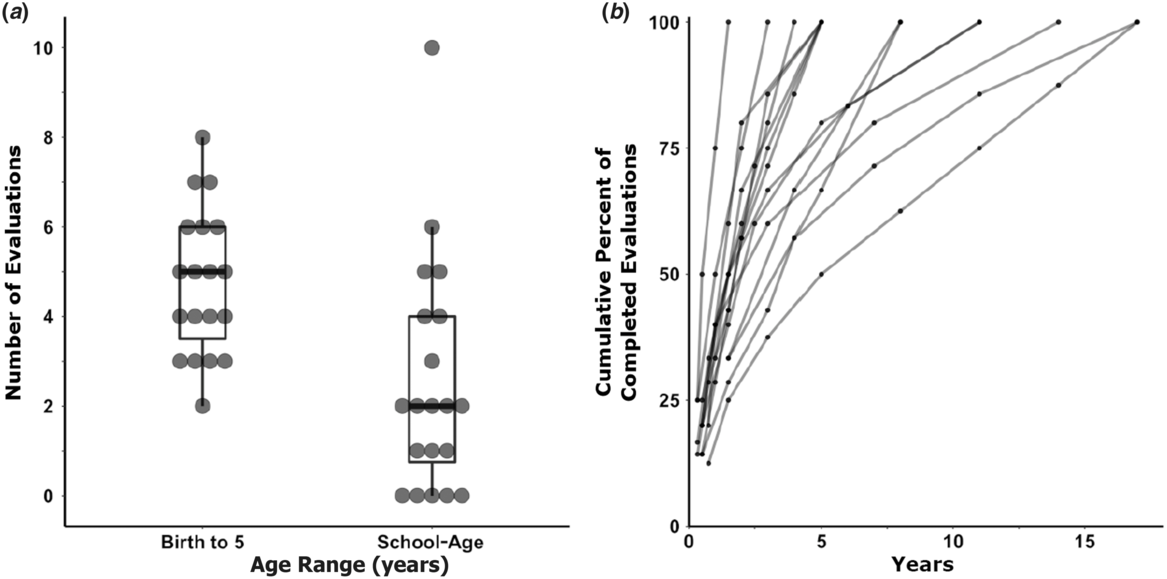
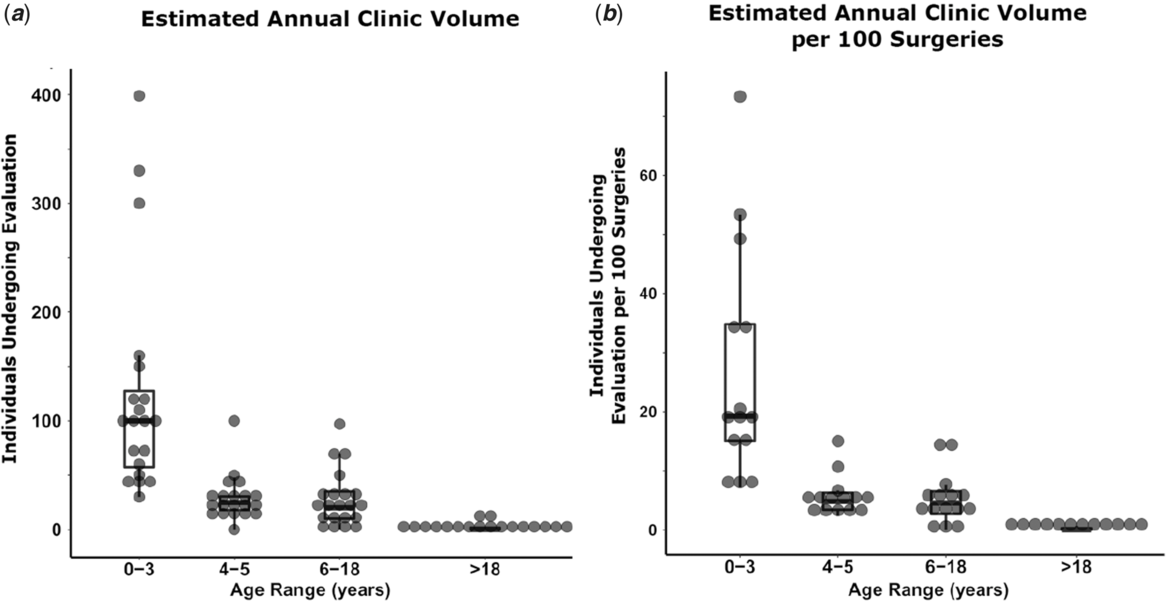
The timing and schedule of neurodevelopmental evaluation and/or screening was highly variable across centres, with the majority of resources supporting evaluations in the younger age groups (Figure 1). Centres reported more anticipated visits between birth and 5 years of age (median 5, range 2–8) than 5 to 18 years (median 2, range 0–10) (Fig 1a) with 53% of centres lacking consistent or programmatic follow-up for evaluations after 5 years of age. Most clinics were multidisciplinary, with the majority stating that either a psychologist (19) or developmental paediatrician (11) was responsible for making mental and behavioural health diagnoses, and rarely a psychiatrist (3), paediatrician (2) or neurologist (2). Estimated annual clinic volume for cardiac neurodevelopmental evaluations ranged from 85 to 428 visits with 68% of anticipated visits at any given centre involving children <3 years of age and only 16% involving children >5 years of age (Fig 2). Seven centres (30%) reported performing evaluations for patients older than 18 years of age, but the percentage of visits for those >18 years in relation to total neurodevelopmental visits at those seven centres was 3%.
Routine neurodevelopmental evaluations planned. The number of anticipated routine evaluations for a typical child followed in a centre’s neurodevelopmental follow-up clinic is shown as a tally for the age ranges of 0–5 years and 5–18 years, including the median and interquartile range ( a ). The time to reach 100% completion of the routine evaluation schedule at each centre is plotted in years ( b ).

Clinic volume. The estimated number of unique individuals evaluated annually at each centre’s neurodevelopmental clinic is shown as a total ( a ) and normalised for estimated centre surgical volume ( b ).

Routine testing
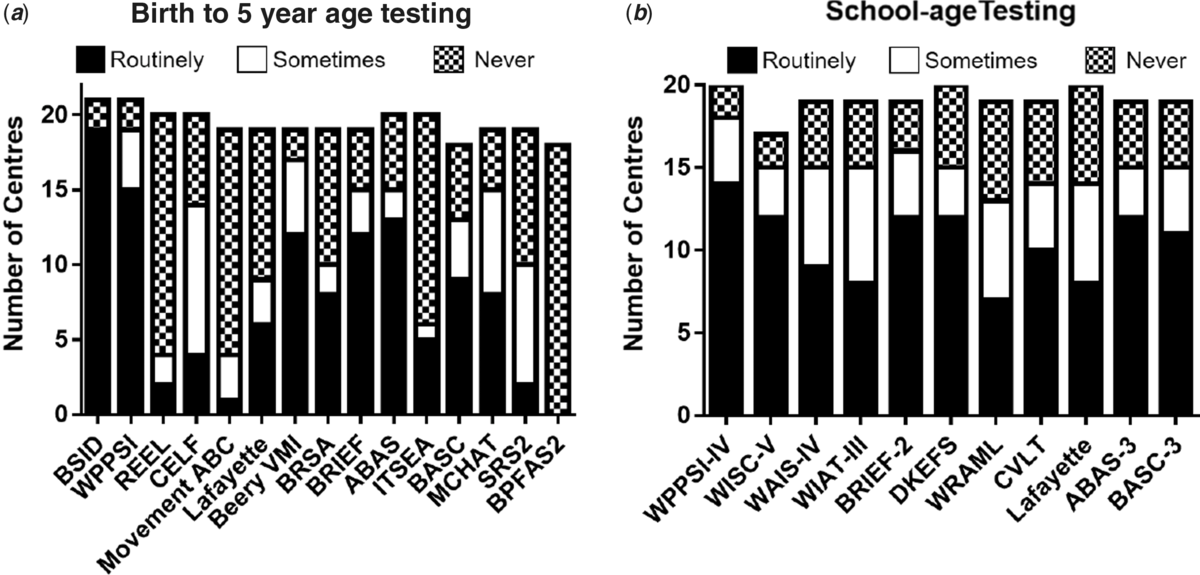
The number of centres using specific standardised developmental and psychological measures is shown in Figure 3. Nearly all centres use the Bayley Scales of Infant and Toddler Development (Bayley-III) in the birth-to-3 age range, with the Wechsler Preschool and Primary Scale of Intelligence (WPPSI-IV) and the parent-completed Adaptive Behavior Assessment System (ABAS-3) being the two next most commonly used through age 5 years. Measurement of Intellectual Functioning with the Wechsler scales (WPPSI-IV or WISC-V) was the most commonly used test in the preschool and school-age range with a large majority of centres also collecting parent report of executive dysfunction with the Behavior Rating Inventory of Executive Function (BRIEF-2). Centres were less consistent with measurement of other skill areas in school age, such as memory, academic skills (e.g. visual motor integration, processing speed, and language), behavioural/emotional functioning, and fine and gross motor skills (Fig 3). The lack of consistency may reflect differences in time allocated for the evaluation or varying personnel, expertise, and financial resources available at any given institution, but might also be due to use of other available tests to examine these areas not asked about in this survey. According to the survey, time, staffing, and cost were the three most common reasons a centre would be unlikely to incorporate additional standardised tests.
Testing protocols. The number of centres who routinely, sometimes, and never perform tests from the recommended battery of CNOC testing are shown for the birth to 5 year age range ( a ) and school-age children ( b ). Birth to 5 year age testing includes Bayley Scales of Infant and Toddler Development (Bayley), Wechsler Preschool and Primary Scale of Intelligence (WPPSI), Receptive-Expressive Emergent Language test (REEL), Clinical Evaluation of Language Fundamentals (CELF), Movement Assessment Battery for Children (ABC), Visual Motor Integration (VMI), Bracken School Readiness Assessment (BRSA), Behavior Rating Inventory of Executive Function (BRIEF), Adaptive Behavior Assessment System (ABAS), Infant Toddler Social and Emotional Assessment (ITSEA), Behavioral Assessment System for Children (BASC), Modified Checklist for Autism in Toddlers (MCHAT), Social Responsiveness Scale (SRS), Behavioral Pediatrics Feeding Assessment Scale (BPFAS), Wechsler Intelligence Scale for Children (WISC), Wechsler Adult Intelligence Scale (WAIS), Wechsler Individual Achievement Test (WIAT), Delis–Kaplan Executive Function System (DKEFS), Wide Range Assessment of Memory and Learning (WRAML), California Verbal Learning Test (CVLT).

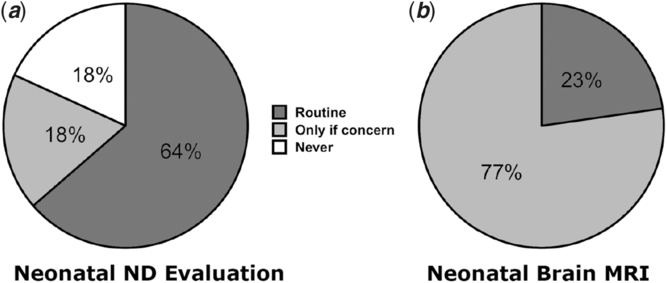
For hospitalized neonates with CHD, routine neonatal brain magnetic resonance imaging was rare (23% of centres) but routine neonatal evaluation was common (64% of centres; Fig 4). Most frequently, centres reported routine occupational, physical, and speech therapy in-patient neonatal evaluations (47% of respondents). Formal consultation with a developmental paediatrician for neonates was rarely reported (1 centre). Standardised measures used to assess hospitalised infants included the Test of Infant Motor Performance (TIMP, 2 centres), Alberta Infant Motor Scale (AIMS, 1 centre), the NICU Network Neurobehavioral Scale (NNNS, 2 centres), the Hammersmith (1 centre), and the Bayley-III (3 centres).
Neonatal testing. Centres who routinely and selectively perform neonatal neurodevelopmental (ND) evaluation ( a ) and brain magnetic resonance imaging ( b ).

Discussion
Here we report the approaches of 23 cardiac neurodevelopmental follow-up programmes focussed on the needs of children with CHD and paediatric acquired heart disease. While the approaches are highly varied, most centres have concentrated their resources on younger ages using common, standardised assessment measures. In contrast, fewer programmes have programmatic infrastructures to follow children into school age, and it is rare to find programmes that are providing consistent resources for transition to adulthood or adult patients. It is essential that we better understand the reasons for this variability, improve consistency by addressing barriers to care, and then evaluate the quality and impact of the neurodevelopmental evaluation.
A robust literature describes the prevalence and impact of neurodevelopmental disabilities for children with CHD, including recent reviews. Reference Morton, Ishibashi and Jonas1,Reference Ringle and Wernovsky2,Reference Wernovsky and Licht8,Reference Marelli, Miller, Marino, Jefferson and Newburger15 Unfortunately, despite many improvements in CHD care since the 1990s, gains in neurodevelopmental outcomes over time have remained small. Reference Gaynor, Stopp and Wypij10 The Level of Evidence stratification in the 2012 American Heart Association/American Academy of Pediatrics recommendations demonstrates that we have a strong understanding of who is at risk, but provides less detail on how to best prevent neurodevelopmental injury and support the best neurodevelopmental and psychosocial outcomes programmatically. Reference Marino, Lipkin and Newburger13 As a result, current approaches rely on our understanding of the importance of medical home models along with surveillance, screening, evaluation, and re-evaluation to detect and intervene upon neurodevelopmental delays. Reference Marino, Lipkin and Newburger13 While the essential components of a cardiac neurodevelopmental follow-up programme have been previously described, Reference Brosig, Butcher and Butler16 our results demonstrate that the implementation of available recommendations varies widely. Our findings highlight key areas that need further development. Specifically, most centres have concentrated resources on detecting problems at younger ages, while additional programmatic development and infrastructure are needed to follow patients across their development, into school age, and especially into adolescence and adulthood where supports are scarce.
In preterm infants, early developmental intervention has been shown to improve motor and cognitive outcomes, Reference Spittle, Orton, Anderson, Boyd and Doyle17 while developmental care interventions in the intensive care unit may improve short-term hospital outcomes as well as brain function at 8 years. Reference McAnulty, Duffy, Butler, Bernstein, Zurakowski and Als18,Reference Symington and Pinelli19 While neonatal follow-up programmes have been in place longer than cardiac neurodevelopmental programmes, the balance of programmatic functions including clinical support, quality assurance/audits, and provision of robust longitudinal data for research continues to be debated along with how neonatal follow-up programmes should augment the care provided by the medical home. Reference Moddemann and Shea20,Reference Sauve and Lee21 Furthermore, data regarding which components of these follow-up clinics are of highest value is lacking. While extrapolating from the premature infant literature may be a starting point, it is important to recognise that the developmental trajectory, variation in presentations, and the neurodevelopmental and medical needs of children with CHD are different from those born prematurely. In addition, the majority of neonatal programmes do not follow patients through school-age years and adolescence, which is increasingly becoming a focus of the cardiac neurodevelopmental programmes and Cardiac Neurodevelopmental Outcome Collaborative as our cardiac survivours age. Therefore, the value of different aspects of cardiac-specific neurodevelopmental programmes and how they influence outcomes requires its own assessment. Empirically supported interventions for some of the neurodevelopmental difficulties often seen in CHD, namely attention-deficit/hyperactivity disorder, learning disabilities, anxiety, and chronic health stress are well described. Reference Evans, Owens, Wymbs and Ray22–Reference Chambless and Ollendick24 How any given cardiac neurodevelopmental programme can best identify needs of those within its heart centre population and refer for appropriate treatments to modify outcomes, however, requires further study.
Our experience reviewing the approaches of cardiac neurodevelopmental follow-up programmes suggests that most centres have invested in early assessment, but resources for school-age, adolescent, and young adult patients are lacking. While this survey did not assess resource availability, anecdotally, we have found that many programmes are expressing the need to build their programmes in a stepwise fashion due to limited resources. To this end, it appears many have chosen to start with younger ages, planning to build their programmes as they longitudinally follow a cohort, as school age and adolescent follow-up has been an expressed interest. Even within the younger ages, however, assessment timing and frequency varies. Specifically, centres differ in their approach to perioperative in-patient assessment and duration to the first out-patient follow-up. Regardless, our data suggest that appropriate surveillance, screening, evaluation, and re-evaluation for school-aged children and adults are not currently available in the majority of cardiac neurodevelopmental programmes and therefore are dependent on the medical home. Whereas we did not quantify the frequency with a specific survey question, a few programmes mentioned employing school liaisons, while others expressed that school outreach remains a future interest that is currently difficult to fund, as their services cannot be billed to insurance.
As paediatric heart centres strive to provide the highest value care, supporting the diagnosis and treatment of longer-term comorbidities associated with the natural and surgical history of CHD must not be overlooked. While many centres have invested in developing neurodevelopmental programmes, the local variations in resources, infrastructure, and staffing have led to variable programmatic approaches. Our description of the variation was limited by a selection bias of motivated and invested centres of relatively high surgical volume. The high surgical volume (median 550, range 170–900) from centres with neurodevelopmental programmes responding to this survey is clearly skewed when considering approximately 80% of programmes reporting to the Society of Thoracic Surgeons report 250 or fewer cases per year. Reference Pasquali, Li and Burstein25 Variation in neurodevelopmental screening, therefore, is likely much higher than what we describe. Poised to address this variability, Cardiac Neurodevelopmental Outcome Collaborative was established to be a multicentre, multidisciplinary collaboration committed to optimising neurodevelopmental outcomes in CHD. Future research and quality improvement studies should help better understand the benefits and limitations of neurodevelopmental follow-up in CHD, elucidate and address potential barriers to care, and estimate the individual and societal costs/risks of under evaluating neurodevelopmental disabilities in CHD. The Cardiac Neurodevelopmental Outcome Collaborative has organised a more consistent approach for capturing and comparing outcome data through a clinical registry. We aim to investigate what aspects of neurodevelopmental programmes provide the largest improvement in neurodevelopmental outcomes, medical outcomes, and quality of life, so that scarce resources can be allocated accordingly. Comparing variations in approach and associated outcomes across collaborative centres will allow for establishment of best practices.
Conclusions
In response to clinical need Reference Wernovsky26 and published guidelines, many centres have established formal cardiac neurodevelopmental follow-up programmes. Centres vary considerably in their approaches to routine screening and objective testing, with many centres focussing their resources on evaluating younger age patients. Further work is needed to understand the highest value aspects of cardiac neurodevelopmental follow-up programmes and barriers to providing appropriate care.
Acknowledgements
This work represents the efforts of the Cardiac Neurodevelopmental Outcome Collaborative which is supported by its Institutional Members (https://www.cardiacneuro.org/institutions/).
Financial support
This work was supported by the local resources of individual institutions.
Conflicts of interest
None.
Ethical standards
Not Applicable.