No one ever told me that grief felt so like fear (Lewis, Reference Lewis1961, p. 39)Footnote 1
Few experiences are as painful as the loss of a loved person. Attachment theory (Bowlby, Reference Bowlby1980) suggests that human beings instinctively seek close relationships to protect them from threat. Like childhood abuse by a caregiver, the loss of an important person can be frightening, because it challenges the assumption that loved ones will reliably provide protection from harm. Although most people eventually recover from bereavement, others may remain unresolved with respect to loss. One group of individuals, who have been identified through research using the Adult Attachment Interview (AAI; George, Kaplan, & Main, Reference George, Kaplan and Main1984, Reference George, Kaplan and Main1985, Reference George, Kaplan and Main1996), are considered unresolved because they appear disorganized and disoriented when speaking about a significant death. Main and Hesse (Reference Main, Hesse, Greenberg and Cicchetti1990) have theorized that these individuals have experienced overwhelming fear following the loss, because it occurred at an early age, was sudden or violent, or was otherwise traumatic. As a result of their fear, they have defensively excluded aspects of the loss experience from consciousness and failed to fully reorganize their view of themselves and their relationships (Bowlby, Reference Bowlby1980; Hesse & Main, Reference Hesse and Main1999; Main & Hesse, Reference Main, Hesse, Greenberg and Cicchetti1990). Because these individuals appear mentally disorganized regarding the loss of an important person, they also may have difficulty relating to other significant people in their lives. There is strong evidence that childhood abuse contributes to later problems in family relationships (e.g., Ehrensaft et al., Reference Ehrensaft, Cohen, Brown, Smailes, Chen and Johnson2003), but the extent to which unresolved bereavement experiences lead to marital and parenting difficulties remains unclear. Although it has been more than two decades since Bowlby (Reference Bowlby1980) predicted that disordered mourning could result in “a bereaved person's capacity to make and to maintain love relationships becoming more or less seriously impaired” (p. 137), this is the first study to test this hypothesis across key family relationships. The current study examined how women with unresolved loss relate to their husbands and their preschool children, from both outside observers’ and the women's own perspectives.
Our current, limited understanding of the relationship implications of unresolved/disorganized (hereafter, unresolved) responses to bereavement derives from research using the AAI (George et al., Reference George, Kaplan and Main1984, Reference George, Kaplan and Main1985, Reference George, Kaplan and Main1996). This semistructured, hour-long interview inquires about childhood and current relationships with caregivers (attachment relationships) and potentially traumatic experiences such as loss and childhood abuse. Within the AAI system, individuals are considered unresolved if they display disorganized or disoriented reasoning or speech while describing the death of a significant person (Main, Goldwyn, & Hesse, Reference Main, Goldwyn and Hesse2003). Lapses in reasoning may include signs of disbelief that the person is dead, or an irrational sense of being responsible for the death. For example, one woman in the current study seemed uncertain of the reality of her mother's death: “There's still a part of me that doesn't quite believe that she's really gone. And I'm still waiting. Part of me is still waiting for her to come out” (italics added). Discourse lapses may include long unmarked pauses, unusual attention to detail, or odd eulogistic descriptions of the deceased. The AAI also classifies individuals according to their overall way of thinking about attachment (also called their mental representation, state of mind, or working model of attachment), based on the coherence of their discourse across the entire interview (e.g., secure, preoccupied, etc.).
Unresolved Loss: Links With Marital and Parenting Adaptation
We suggest that the AAI can be conceptualized as an observational measure of postbereavement functioning. For unresolved individuals, direct questions about loss in the context of the heightened attachment stress created by the interview are thought to overwhelm their defensive coping abilities, triggering unintegrated memories of loss, which then disrupt their normal speech and reasoning (Hesse & Main, Reference Hesse and Main1999). We suggest that other situations that activate unresolved individuals’ attachment or caregiving systems (behavioral systems geared toward receiving and providing protection from threat), such as stressful marital or parenting interactions, also could evoke feelings of vulnerability and memories of past losses. Our proposed model departs from prior work (e.g., George & Solomon, Reference George and Solomon1996; Hesse & Main, Reference Hesse and Main1999; Main & Hesse, Reference Main, Hesse, Greenberg and Cicchetti1990) by suggesting that not only parenting, but also marital relationships, can trigger loss-related memories and emotions for an unresolved individual. In the marital relationship, for example, conflict between spouses can engender feelings of vulnerability in both partners. For a woman with unresolved loss, this experience of feeling vulnerable herself, or of needing to provide support to her distressed husband, may trigger memories of her past loss, which had also left her feeling vulnerable and frightened.
Bowlby (Reference Bowlby1980) proposed that the threat of loss should lead to anxiety, actual loss should lead to sadness, and both situations should arouse anger as a defensive response. Because unresolved loss in the AAI implies a failure to accept fully a loss as real (Bowlby, Reference Bowlby1980; Main et al., Reference Main, Goldwyn and Hesse2003), we suggest that unresolved individuals should experience anxiety and anger in response to loss reminders. If a woman with unresolved loss experiences fear and anger during family interactions, she may attempt to repress these feelings, just as she repressed the original frightening experience of the loss. Consumed by her own efforts at self-protection, she then may appear less positive, responsive, and engaged during marital and parent–child interactions. However, in cases where her attachment and caregiving systems are particularly stressed, such as when family members’ demands are perceived as too great, or the situation itself feels especially demanding or challenging (e.g., interacting with a partner or child in a stressful situation and under the observation of strangers), the woman's repressive coping efforts may be overwhelmed. Dissociated emotions connected to the unresolved loss, such as fear and anger, may emerge suddenly and be directed toward her living partner or child (see Fearon & Mansell, Reference Fearon and Mansell2001; George & Solomon, Reference George and Solomon1996; Lyons-Ruth & Block, Reference Lyons-Ruth and Block1996, for similar proposed models of these processes among traumatized mothers and their children). As Bowlby (Reference Bowlby1980) suggested, when painful emotions regarding loss have been repressed, they eventually will be misdirected toward those who are living. Therefore, under conditions of stress, we should expect to see unresolved women direct anger and anxiety toward their husbands and children, while also showing decreased positive emotion and collaboration with them.
Observational Research on Unresolved Loss and Family Adaptation
Direct associations with unresolved loss on the AAI
Previous couple-focused research using the AAI has grouped individuals with unresolved loss and childhood abuse together, rather than distinguishing between these two experiences. These studies have found that individuals with both unresolved trauma (loss and/or abuse) and insecure working models of attachment display less positive behavior toward their romantic partners, including affection and humor, and more negative behavior, including controlling tendencies, than individuals who are insecure but not unresolved (Creasey, Reference Creasey2002a; Creasey & Ladd, Reference Creasey and Ladd2005). Because this research has combined unresolved loss and abuse into a single category, it remains unclear whether unresolved loss specifically is linked to marital difficulties.
To date, three studies have examined links between unresolved loss and observed parenting behavior (Abrams, Rifkin, & Hesse, Reference Abrams, Rifkin and Hesse2006; Jacobvitz, Hazen, & Riggs, Reference Jacobvitz, Hazen and Riggs1997; Schuengel, Bakermans-Kranenburg, & Van IJzendoorn, Reference Schuengel, Bakermans-Kranenburg and Van IJzendoorn1999); all have focused on parenting during infancy. This research has found that mothers with unresolved loss tend to display frightened (i.e., anxious) and frightening (i.e., angry or threatening) behaviors when interacting with their infants.
Findings related to disorganized and controlling child attachment behavior
A second body of research also suggests that unresolved loss is indirectly linked to difficulties in current close relationships. Mothers’ unresolved loss as assessed on the AAI has been linked to disorganized attachment in their infants (e.g., Schuengel et al., Reference Schuengel, Bakermans-Kranenburg and Van IJzendoorn1999) and to controlling behavior in their school-age children (e.g., George & Solomon, Reference George and Solomon1996). These child difficulties, in turn, have been linked to observed conflict in marital relationships (Owen & Cox, Reference Owen and Cox1997), as well as to parenting difficulties. Specifically, mothers of disorganized infants and controlling children tend to have less positive interactions (i.e., display less affection, sensitivity, and structuring behavior) with their children in infancy and during the school years (e.g., DeMulder & Radke-Yarrow, Reference DeMulder and Radke-Yarrow1991; Easterbrooks, Biesecker, & Lyons-Ruth, Reference Easterbrooks, Biesecker and Lyons-Ruth2000; Stevenson-Hinde & Shouldice, Reference Stevenson-Hinde and Shouldice1995). Mothers of disorganized infants and controlling children also display more hostile, intrusive, helpless, and withdrawing behavior than other mothers display (see Lyons-Ruth, Bronfman, & Atwood, Reference Lyons-Ruth, Bronfman, Atwood, Solomon and George1999, for a review).
Although maternal unresolved loss has been linked directly to frightened and frightening behavior toward infants (e.g., Schuengel et al., Reference Schuengel, Bakermans-Kranenburg and Van IJzendoorn1999), there has been no investigation of how mothers with unresolved loss parent children who have matured beyond infancy. As children develop, they bring new demands to parenting, including language learning, moral reasoning, and discipline. Children's increasing needs for guidance can place new stresses on mothers. Parenting their children under the watch of laboratory observers therefore may be especially challenging for mothers of preschoolers. The present study examines unresolved mothers’ interactions with their preschool-age children. It does so using the well-established constructs of authoritative and authoritarian parenting style (Baumrind, Reference Baumrind1967), which combine the dimensions of warmth and structure that have been examined separately in prior attachment studies. Authoritative parents are engaged with their children; they combine warmth and responsiveness with structure and age-appropriate limit setting. In contrast, authoritarian parents display more negativity and controlling behavior with their children. Authoritative parenting has been linked to positive outcomes in children's school achievement and peer relationships, whereas authoritarian parenting has been associated with worse outcomes in these domains (Maccoby & Martin, Reference Maccoby, Martin and Hetherington1983; Parke & Buriel, Reference Parke, Buriel and Eisenberg1998). Because maternal unresolved loss and infant disorganization have been associated with more helpless and fearful (e.g., George & Solomon, Reference George and Solomon1996; Schuengel et al., Reference Schuengel, Bakermans-Kranenburg and Van IJzendoorn1999), as well as less structured and supportive parenting (e.g., Stevenson-Hinde & Shouldice, Reference Stevenson-Hinde and Shouldice1995), it seems likely that mothers with unresolved loss will appear less authoritative when interacting with their preschool children than mothers without unresolved loss. We also expected unresolved mothers to appear more authoritarian during these interactions because unresolved loss and infant disorganization have been linked to threatening and intrusive parenting in prior studies (e.g., Carlson, Reference Carlson1998; Schuengel et al., Reference Schuengel, Bakermans-Kranenburg and Van IJzendoorn1999).
Self-Report Findings
Observational findings suggest that women with unresolved loss may be experiencing emotional and behavioral difficulties in their family relationships. Several studies also have found an association between unresolved status and self-reported individual and relationship problems. Because this research generally has used clinical samples selected for their self-reported mental health problems (e.g., Fonagy et al., Reference Fonagy, Leigh, Steele, Steele, Kennedy and Mattoon1996; Manassis, Bradley, Goldberg, & Hood, Reference Manassis, Bradley, Goldberg and Hood1994), the findings may not generalize to community samples. Furthermore, nearly all of this clinical research included individuals who were unresolved with respect to past sexual or physical abuse and those with unresolved loss experiences. There is some evidence that individuals with unresolved childhood abuse, rather than those with unresolved loss experiences, may be responsible for the higher levels of self-reported distress in the unresolved group (Creasey, Reference Creasey2002b; Crowell et al., Reference Crowell, Treboux, Gao, Fyffe, Pan and Waters2002). Individuals with unresolved childhood abuse experiences may be more likely to report distress in their lives and relationships, at least in part because childhood abuse is a risk factor for chronic life stress and traumatization, which in turn are linked to mental health problems (e.g., Banyard, Williams, & Siegel, Reference Banyard, Williams and Siegel2001).
In fact, most studies of middle-class community samples, who appear more likely to have experienced bereavement than childhood abuse, suggest that unresolved women tend to report no more, and often even fewer, individual and relationship problems than other women report. For example, mothers who remain unresolved following the stillbirth of a child do not report higher levels of anxiety (specifically, posttraumatic stress) symptoms than mothers who are not unresolved (Turton, Hughes, Fonagy, & Fainman, Reference Turton, Hughes, Fonagy and Fainman2004). Other research has failed to find links among maternal unresolved trauma (combining loss and abuse) and maternal depressive or posttraumatic stress symptoms (e.g., Bosquet & Egeland, Reference Bosquet and Egeland2001; Lyons-Ruth & Block, Reference Lyons-Ruth and Block1996), although one study identified a trend for middle-income mothers of disorganized children (generally expected to be unresolved with respect to loss) to report fewer mental health symptoms than other mothers reported (e.g., Barnett et al., Reference Barnett, Hunt, Butler, McCaskill, Kaplan-Estrin, Pipp-Siegel, Solomon and George1999).Footnote 2
In the parenting domain, researchers have identified a trend for mothers of disorganized children to report fewer and less intense problems than mothers of nondisorganized children (e.g., Barnett et al., Reference Barnett, Hunt, Butler, McCaskill, Kaplan-Estrin, Pipp-Siegel, Solomon and George1999). To date, only three studies (Moss, Rousseau, Parent, St-Laurent, & Saintonge, Reference Moss, Rousseau, Parent, St-Laurent and Saintonge1998; Spieker & Booth, Reference Spieker, Booth, Belsky and Nezworski1988; Stevenson-Hinde & Shouldice, Reference Stevenson-Hinde and Shouldice1995) have included both self-report and observational measures of parenting; all found that despite displaying more parenting problems, mothers of disorganized infants and controlling children reported just as much or less parenting stress than other mothers reported.
Taken together, these findings suggest that there may be a discrepancy between the observed and self-reported functioning of women with unresolved loss. Bowlby (Reference Bowlby1980) originally proposed that disordered mourning results from “the defensive exclusion of unwelcome information” (p. 140), and suggested that when information is too painful for individuals to accept, they will exclude it from consciousness defensively. This concept of defensive exclusion is similar to the psychoanalytic notion of repression. Repressors are individuals “who often believe they are not upset, despite evidence to the contrary” (Weinberger, Reference Weinberger and Singer1995, p. 341). Consistent with this, repressors do not report negative experiences on questionnaires. If women with unresolved loss are engaging in defensive exclusion, or repression, regarding painful loss experiences, they also may defensively exclude negative thoughts and feelings regarding their ongoing close relationships.
Aims and Hypotheses
The present study had two goals. The first was to investigate how women with unresolved loss appear to outside observers under conditions that stress their attachment and caregiving systems. In these situations, attachment theory assumes that women should reexperience the vulnerability and fear associated with their unresolved loss, which should challenge their coping abilities. Therefore, compared to women without unresolved loss, they should display less positive emotion and behavior, including less collaborative problem solving with their husbands and less authoritative parenting with their children. Women with unresolved loss also should display more loss-specific negative emotion and behavior, including anxiety and anger, as well as conflict with their husbands and authoritarian parenting with their children.
The second goal was to explore a predicted discrepancy between how women with unresolved loss describe themselves and their relationships and how observers describe their family interactions. Some of the theoretical and empirical work conducted to date suggests that women with unresolved loss may be defensively excluding threatening information about themselves and their relationships. Therefore, we conducted an exploratory test of this hypothesis. We predicted that, despite displaying more difficulties, women with unresolved loss would not report more individual, marital, or parenting difficulties than women without unresolved loss would report. We also predicted that unresolved women would show more problems than they would report on questionnaires, but that there would be no such discrepancy for women who were not unresolved.
Method
Participants
This study included women who had experienced at least one significant lifetime loss, which could include the death of a parent, child, relative, friend, or other close person with whom the woman had regular contact (Main et al., Reference Main, Goldwyn and Hesse2003). Out of 81 women administered an AAI, only 1 woman had not reported a significant loss, and she was excluded from the sample. Eighty women, their husbands, and their first-born preschool children participated in the study. The participants were part of a larger longitudinal project examining family functioning during the first child's transition into kindergarten (Cowan, Cowan, Ablow, Johnson, & Measelle, Reference Cowan, Cowan, Ablow, Johnson and Measelle2005). Eighty-five percent of the participants were Caucasian and 15% were African American, Asian American, or Latino American. Children were 5 years old, and the median ages of the mothers and fathers were 36 (SD = 4.63) and 38 years (SD = 5.35), respectively. The parents’ joint median annual income was $81,000 (SD = $46,473), indicating a relatively affluent sample.
Procedures
Each woman first was administered the AAI (George et al., Reference George, Kaplan and Main1985), following which she and her husband were videotaped discussing a current marital problem. In a second visit to the laboratory, mother–child interactions were observed. During that visit, women also filled out questionnaires on their own individual functioning, couple communication patterns, and parenting beliefs and practices.
Measures
Unresolved loss
The AAI (George et al., Reference George, Kaplan and Main1985) assesses an individual's state of mind with respect to attachment, focusing on her childhood and current relationships with her own parents and her perception of their effects on her past and current functioning. The interview also contains a series of questions regarding important loss experiences (e.g., what the circumstances of the death were; how old the speaker was at the time; and what she felt about the loss at the time). Each loss experience receives a score on a 1 to 9 scale, denoting the degree to which it appears to be “unresolved;” ratings are based on lapses in reasoning or discourse. If a speaker has experienced more than one loss, her transcript is assigned the highest of her individual unresolved loss scores. Scores between 6 and 9 automatically qualify for an unresolved classification, a score of 5 leaves the classification decision to the discretion of the coder, and scores below 5 suggest that the speaker is not unresolved about loss. Childhood experiences of physical or sexual abuse are coded in a similar fashion; speakers may be rated as unresolved with respect to loss, abuse, or both experiences.
As mentioned, because lapses in speech and reasoning are generally confined to the specific discussion of loss and abuse experiences and are not found in the remainder of the interview, each transcript assigned to the unresolved category is also given a secondary, alternate classification to represent the speaker's overall state of mind with respect to attachment (e.g., unresolved/secure, unresolved/dismissing of attachment, etc.). Individuals who are classified as secure describe their attachment experiences coherently and remain collaborative with the interviewer. Individuals with a dismissing state of mind seem to keep their attachment-related memories at bay, usually by idealizing their childhood experiences or by showing a lack of memory for them. Preoccupied speakers appear mentally entangled in their attachment experiences, for example, by failing to remain on topic or taking excessively long conversational turns. Finally, cannot classify speakers show contradictory mental representations, such as appearing both preoccupied and dismissing at different points of the interview or failing to show any strategy at all. These classifications appear to be unrelated to intelligence, memory, or verbal abilities (cf. Hesse, Reference Hesse, Cassidy and Shaver1999). In the current study, the alternate attachment classifications were combined into secure and insecure (dismissing, preoccupied, and cannot classify) groups to minimize the number of statistical tests and to maximize power to detect group differences. Cannot classify participants who were not unresolved were included in the not unresolved/insecure group because analyses revealed that they did not differ significantly from not unresolved/dismissing or preoccupied individuals on observed marital or parenting behavior, with the exception of observed marital conflict, on which, surprisingly, they and their husbands displayed significantly less marital conflict than the dismissing and preoccupied groups displayed.
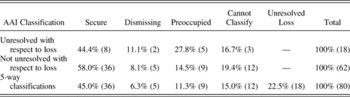
The AAI transcripts were coded by two raters who were certified as reliable coders by Main and Hesse. For the current study, the two coders also achieved reliability with Hesse on 15 transcripts (these transcripts were part of the larger longitudinal study and included both wives’ and husbands’ AAIs), with an average interrater agreement of 84% on the unresolved versus not unresolved classifications, 78% on the secure versus insecure classifications, and 71% on the dismissing, secure, preoccupied, unresolved, and cannot classify classifications. Of the 80 women who had experienced loss, 18 (23%) were classified as unresolved with respect to loss and 62 (77%) were classified as not unresolved. This distribution is consistent with that of other studies of nonclinical, middle-class samples (e.g., Abrams et al., Reference Abrams, Rifkin and Hesse2006; Schuengel et al., Reference Schuengel, Bakermans-Kranenburg and Van IJzendoorn1999). Unresolved women were equally likely to be alternately classified as secure or insecure (44 vs. 56%, respectively), χ2 (1) = 1.05, p = .31; see Table 1 for the distribution of AAI classifications in this sample. A chi-square analysis suggested that the overall distribution of AAIs differed significantly from the distribution derived from a meta-analysis of nonclinical samples, χ2 (3) = 12.07, p < .01 (see van IJzendoorn & Bakermans-Kranenberg, Reference van IJzendoorn and Bakermans-Kranenburg1996). Follow-up analyses revealed that there was a significantly lower percentage of dismissing participants in the current study (6 vs. 16%, respectively), χ2 (1) = 5.11, p < .05. Although the meta-analysis did not provide specific data on the cannot classify group, the percentage of cannot classify participants in the current study was relatively high (15%). However, this rate is consistent with other Bay Area studies of community samples that focused on attachment in infancy (e.g., Solomon & George, Reference Solomon, George, Solomon and George1999).
Distribution of women's unresolved loss and attachment classifications

In the current sample, six women (33%) were unresolved with respect to the death of a parent, five (28%) of a grandparent, three (17%) of a close friend, two (11%) of a cousin, and two (11%) of a sibling. Women's average age at bereavement for these losses was 18, with a range of 4–34 years. Two women with unresolved loss and three not unresolved women were also classified as unresolved with respect to childhood physical or sexual abuse. Thus, experiences of unresolved abuse were evenly distributed across the two groups of women (those with and those without unresolved loss). Women's unresolved status was not significantly correlated with demographic variables such as income or education.
Observed relationship quality
Marital
Each couple participated in a videotaped marital conflict discussion based on procedures developed by Gottman and Levenson (Reference Gottman and Levenson1986). Couples chose a topic of disagreement from a list of issues (e.g., division of labor, sexual relationship, money management, etc.) and were asked to spend 10 min trying to make progress on resolving their conflict. Trained coders rated the interactions, using 5-point scales. Two couple-level codes were used: level of observed conflict (a sum of the wife's and husband's negativity scales, which were moderately correlated at r = .44, p < .001); and collaborative problem solving (a sum of the teamwork and the cohesiveness codes, which were highly correlated at r = .74, p < .001). Couples who engaged in collaborative problem solving gave importance to each partner's views and displayed a willingness to work toward a mutually agreeable solution to their problem. Four individual-level codes for the women also were used: positive emotion, sadness, anger, and anxiety. Ratings on the individual and couple-level codes were z scored for comparison across dimensions. All of the marital interaction codes were based on Malik and Lindahl's (2000) System for Coding Interactions in Dyads (SCID), with the exception of the anger and anxiety codes, which were adapted from the parenting style codes (see below). Interrater reliabilities (intraclass correlations [ICCs]) on these scales ranged from .58 to .85, with a median of .71.
Parenting
Parenting style was assessed with observers’ ratings of mothers and children working and playing together in 40-min sessions in the laboratory playroom. Two observers rated each mother's behavior on eight parenting style codes, each based on a 5- or 7-item Likert scale: warmth, pleasure, happiness, anxiety, anger, sadness, engagement, and structure (see Cowan et al., Reference Cowan, Cowan, Ablow, Johnson and Measelle2005, for details). Ratings on each of these dimensions were z scored to create composite scores and for comparison across dimensions. This study used a composite scale of positive emotion (warmth, pleasure, and happiness) and three separate negative emotion scales: anxiety, anger, and sadness. In addition, two composite parenting style indices were used: authoritative (a parent who scores high on this scale is warm, structuring, engaged, and appropriately demanding of the child, whereas a parent who scores low on this scale is less positive and more disengaged during the interaction), and authoritarian (a high score represents a parent who is more negatively controlling with the child, i.e., displays both high negative emotion and structuring behavior), whereas a low score represents a parent who is warm and engaged but less structuring and demanding during the interaction (see Baumrind, Reference Baumrind1967 for a detailed description of the parenting styles on which these codes were based). As expected, these two scales were relatively independent in this sample (r = −.11, ns). ICCs of the parenting scales ranged from .71 to .89, with a median of .75.
Self-reported functioning
Individual: The Brief Symptom Inventory (BSI)
The BSI (Derogatis & Melisaratos, Reference Derogatis and Melisaratos1983) was used as an index of psychological distress. Participants indicated which of 53 symptoms they had experienced in the past 4 weeks, as well as how much discomfort that problem caused, using ratings from 0 (not at all) to 4 (extreme). Four scales were used in this study: a total anxiety scale to assess all forms of anxiety in women's lives, which was a sum of the BSI anxiety, obsessive compulsive, and phobic anxiety indices (α = .80); the hostility index; the depression index; and the global severity index, a measure of the frequency and intensity of total psychological symptoms and the BSI's single best indicator of psychological distress. Internal reliabilities on these scales for outpatient populations range from α = .77 to .85 (Derogatis & Melisaratos, Reference Derogatis and Melisaratos1983).
Marital
Women were administered the Couple Communication Questionnaire (Cowan & Cowan, Reference Cowan and Cowan1982), which included a list of 16 strategies for approaching marital problems. Women were asked to endorse strategies they and their husbands tend to use (e.g., “we talk about it to clarify the problem,” “we delay action,” etc.). Two scales were used based on their conceptual similarity to two of the marital observation scales: total conflict (α = .78) and collaborative problem solving (α = .57). For the sample as a whole, women's self-reported and observed levels of marital conflict were positively correlated (r = .34, p < .01), as were their self-reported and observed levels of collaborative problem solving (r = .41, p < .001).
To assess women's views of their own levels of anger in the marital relationship, we also examined their responses to the statement: “I express anger to my partner: ___” Women were asked to choose one of five responses ranging from “almost never” to “very frequently.” Women's self-reported levels of anger were associated with their observed levels of anger in their marital interactions at a marginally significant level (r = .20, p = .08). The questionnaire did not inquire about expressions of anxiety or sadness in the marital relationship.
Parenting: The Ideas About Parenting Questionnaire (IAP)
The IAP (Heming, Cowan, & Cowan, Reference Heming, Cowan, Cowan, Touliatos, Perlmutter and Straus1991) includes 93 items that assess parenting practices and beliefs. Mothers were asked to indicate the extent of their own agreement or disagreement with each item (e.g., “Too much cuddling spoils a child”). Using factor analysis, two scales were created that reflect authoritative and authoritarian parenting (α = .56 and .73, respectively), the two dimensions of parenting style assessed in the mother–child interactions. Mothers who scored high on authoritative parenting described themselves as warm and responsive, as well as limit-setting in their parenting approach. In contrast, parents who reported more authoritarian beliefs endorsed harsh limits in childrearing. For the sample as a whole, women's self-reported authoritative parenting practices were not significantly associated with the degree of authoritative parenting they displayed (r = .13, p = .26). Their self-reported and observed levels of authoritarian parenting behaviors were positively correlated at a marginally significant level (r = .19, p = .09).
The 36-item revised parenting stress index (Loyd & Abidin, Reference Loyd and Abidin1985) assessed self-reported parenting difficulties. Parents indicated the extent of their agreement or disagreement with statements describing themselves as stressed and their child as difficult to manage (e.g., “I feel trapped by my responsibilities as a parent”). The measure reliably distinguishes parents who have known stressors in childrearing (e.g., children with developmental delay, oppositional defiance, difficult temperaments) and parents who do not have these stressors (Abidin, Reference Abidin, Zalaquett and Wood1997).
Data analyses
Data analyses focused on differences between women with and without unresolved loss. Because the effects of unresolved loss have been found to differ according to overall attachment security (e.g., Schuengel et al., Reference Schuengel, Bakermans-Kranenburg and Van IJzendoorn1999), and because insecure adult attachment has been linked to marital and parenting difficulties (e.g., Cohn, Silver, Cowan, Cowan, & Pearson, Reference Cohn, Silver, Cowan and Cowan1992; Creasey, Reference Creasey2002a), we also tested for main and interaction effects of overall attachment security (secure versus insecure, with unresolved women assigned their alternate attachment classification). All analyses controlled for the presence or absence of unresolved abuse to ensure that unresolved loss, rather than unresolved abuse experiences, were responsible for any group differences.
Results
Observational findings
Marital observations
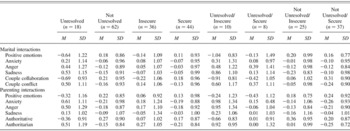
Mean scores for each of the variables as a function of unresolved loss status and attachment security are presented in Table 2. Two-way mixed model analyses of covariance (ANCOVAs), with unresolved loss and maternal attachment security as factors and unresolved abuse as a covariate, revealed several main effects for unresolved loss, no main effects for attachment security, and no interaction effects. As a group, women with unresolved loss displayed significantly less positive emotion, F (1, 75) = 8.52, p < .01, partial η2 = .10, more anger, F (1, 75) = 3.85, p = .05, partial η2 = .05, and more sadness, F (1, 75) = 5.84, p < .05, partial η2 = .07, when working on marital problems with their husbands, compared to women without unresolved loss. There were no significant group differences in the level of anxiety women displayed. Women with unresolved loss and their husbands displayed significantly less collaborative problem solving, F (1, 75) = 10.58, p < .01, partial η2 = .12, and significantly more conflict, F (1, 75) = 5.23, p < .05, partial η2 = .07, than women without unresolved loss and their husbands displayed.Footnote 3
Group means and standard deviations for observed marital and parenting interactions (standardized scores)

We found that most women showed at least some mild nervousness in starting these videotaped marital conflict discussions, as might be expected when discussing personal aspects of their relationships in a laboratory setting. As a result, the majority (64%) of participants were rated as displaying at least a low level of anxiety (1 on the 0–4 rating scale) in these interactions. Therefore, it seemed important to compare women with no or low anxiety (ratings of 0 to 1) with those who showed low-moderate to high levels of anxiety (ratings of 1.5 to 4); within this latter group, the women's anxiety persisted throughout the discussion. A chi-square test found that 67% of unresolved women showed persistent anxiety (ratings higher than 1.5) during their marital discussions, compared to 34% of women who were not unresolved, χ2 (1) = 6.19, p = .01).
Parenting observations
To test the hypothesis that unresolved loss would be associated with observed emotional difficulties during parenting interactions, we conducted two-way mixed model ANCOVAs (with unresolved loss and attachment security as factors, unresolved abuse as the covariate, and mothers’ emotions as dependent variables). The analyses revealed main effects for attachment security and unresolved loss, and an interaction effect for women's anger.
Compared to secure women, women with insecure attachment representations displayed significantly more anger, F (1, 75) = 4.60, p < .05, partial η2 = .06, and showed a trend toward displaying more anxiety, F (1, 75) = 3.48, p = .07, partial η2 = .04, as they worked with their children on challenging tasks. Attachment security was not significantly related to the level of sadness mothers displayed in these parenting interactions.
Women with unresolved loss showed less positive affect, F (1, 75) = 5.14, p < .05, partial η2 = .06, more anxiety, F (1, 75) = 8.72, p < .01, partial η2 = .10, and more anger, F (1, 75) = 6.04, p < .05, partial η2 = .08, with their preschool children, compared to women who were not unresolved. There was not a significant group difference in the level of sadness the mothers displayed. These effects for unresolved loss remained the same, even after controlling for the effects of insecure attachment described above.
There was an interaction effect between unresolved loss and attachment security for mothers’ anger, F (1, 75) = 3.94, p = .05, partial η2 = .05, but not for the level of anxiety or sadness mothers expressed with their children. Follow-up pairwise comparisons revealed that unresolved/insecure women displayed significantly more anger (M = 0.95, SD = 1.34) compared to both nonunresolved/insecure women (M = −0.13, SD = 0.84) and nonunresolved/secure women (M = −0.21, SD = 0.90; p < .01). The difference between unresolved/insecure women and unresolved/secure women was not statistically significant. That is, when examining interaction effects, it was the lack of resolution of loss rather than security of attachment that was implicated in the expression of anger toward their children.
In examining authoritative and authoritarian parenting styles, we found that two-way mixed model ANCOVAs revealed one main effect for attachment security, main effects for unresolved loss, and one marginally significant interaction effect. Women with an insecure attachment classification were more authoritarian (i.e., negatively controlling) toward their children than women classified as secure (M = 0.27, SD = 1.05, M = −0.21, SD = 0.84, respectively; F (1, 75) = 5.44, p < .05, partial η2 = .07). Differences between secure and insecure mothers on authoritative behavior were not significant.
Women with unresolved loss were significantly less authoritative (i.e., less warm and structuring and more disengaged) with their children, F (1, 75) = 6.49, p = .01, partial η2 = .08, than women who were not unresolved. They were also significantly more authoritarian, or negatively controlling, in parenting style, F (1, 75) = 5.90, p < .05, partial η2 = .07 (see Table 2 for means). Controlling for the effects of insecure attachment produced the same results. These results suggest that, within a 40-min play and work session, mothers with unresolved loss appeared both disengaged and negatively controlling with their young children.
There also was a trend toward a significant interaction effect for authoritative parenting, F (1, 75) = 3.32, p = .07, partial η2 = .05. Follow-up pairwise comparisons revealed that unresolved/insecure women appeared significantly less authoritative with their children compared to nonunresolved/insecure women (M = −0.66, SD = 0.83, M = 0.36, SD = 0.95, respectively, p < .01).Footnote 4
Self-report findings
Self-reported individual functioning
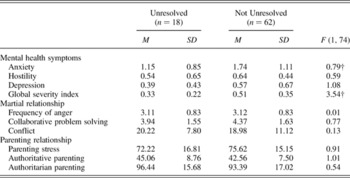
Two-way ANCOVAs examining group differences on self-reported mental health symptoms, controlling for unresolved abuse, detected trends for main effects for unresolved loss, no main effects for attachment security, and no interaction effects. Women with unresolved loss showed a marginally significant trend toward reporting fewer anxious symptoms, F (1, 74) = 3.79, p = .06, partial η2 = .05, and less overall psychological distress, F (1, 74) = 3.54, p = .06, partial η2 = .06, than did women without unresolved loss. There were no group differences in self-reported levels of hostility and depression (see Table 3).
Group means, standard deviations, and analysis of covariance results for self-reported individual, marital, and parenting adaptation

Note: There are missing mental health data for one not unresolved woman, marital relationship data for three not unresolved women, and parenting data for two unresolved women and three not unresolved women.
†p ≤ .10.
Self-reported marital functioning
Two-way ANCOVAs, controlling for unresolved abuse, revealed no main effects on self-reported marital quality for unresolved loss or attachment security, and no interaction effects. There were no significant differences between women with and without unresolved loss in their reports of frequency of anger with their husbands, level of marital conflict, or the degree to which they and their husbands tend to work collaboratively to resolve disagreements (see Table 3).
Self-reported parenting
Unresolved status was not related to parenting stress or authoritative and authoritarian parenting beliefs. There were no main or interaction effects for attachment security (see Table 3).Footnote 5
Unresolved status as a moderator of differences between observed and self-reported functioning
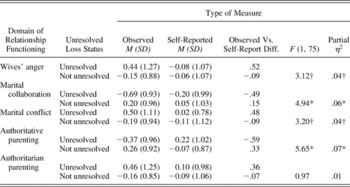
To examine whether differences between women's levels of observed and self-reported marital and parenting adaptation varied as a function of unresolved loss status, we conducted a series of multivariate analysis of variances, using type of measure (self-report vs. observation) as a within-subjects factor and unresolved loss status as a between-subjects factor. The appropriate measures of self-reported and observed family functioning (i.e., self-reported and observed marital collaboration) were used as dependent variables. We first standardized (z scored) the self-report variables to compare them to the already standardized observational variables, and to compute a relative distance from the mean for each participant on both observed and self-reported functioning. The results of the moderator analyses are presented in Table 4. Overall, as predicted, unresolved women displayed a higher average number of problems than they reported on questionnaires, but there was no difference between the observations and self-reports of women without unresolved loss. Specifically, there was a marginally significant trend for unresolved women to display more anger toward their husbands than they reported, but there was no difference between observed and self-reported anger within the not unresolved group. Unresolved women also displayed significantly less collaboration and showed a trend toward displaying more conflict in their marriages than they reported, whereas there was no difference between observations and self-reports for women without unresolved loss. In their parenting, unresolved women appeared significantly less authoritative than they described themselves as being, but again there was no measure difference within the not unresolved group. This same pattern held for authoritarian parenting, but the interaction effect was not significant for this one measure of family functioning.
Group means, standard deviations, and MANOVA results examining interaction of unresolved loss status and measure of family functioning (standardized variables)

Note: There are missing self-reported marital relationship data for three not unresolved women and self-reported parenting data for two unresolved women and three not unresolved women.
†p ≤ .10. *p ≤ .05.
Discussion
Observed marital and parenting interactions
We discuss the marital and parenting observational findings together, because the results were remarkably similar across these two domains. As predicted, when women appear mentally disorganized regarding an important past loss, they also appear less positive and less engaged in their current key family relationships. Specifically, compared to women who were not unresolved about the loss of a significant person, women with unresolved loss showed less positive emotion and collaborative problem solving with their husbands, and less positive emotion and authoritative (supportively engaged) parenting with their young children. One explanation of this pattern, derived from attachment theory (e.g., Fearon & Mansell, Reference Fearon and Mansell2001; Hesse & Main, Reference Hesse and Main1999; Lyons-Ruth & Block, Reference Lyons-Ruth and Block1996), is that stressful interactions with loved ones trigger feelings of fear and vulnerability that are associated with an unresolved woman's memories of loss. As a result, she attempts to muster her defensive coping strategies, which then limits her ability to engage positively with family members.
In particularly stressful situations, such as during challenging interactions with a partner or child while being observed by researchers, an unresolved woman's coping resources may be overtaxed (George & Solomon, Reference George and Solomon1996). When this happens, negative emotions of anxiety and anger, which she was attempting to repress, may surface and be directed toward her husband or child. Consistent with this prediction, women with unresolved loss showed more anxiety and anger with their husbands and children, more conflict with their husbands, and more negatively controlling (i.e., more authoritarian) behavior with their children during problem-solving tasks in the laboratory. Prior research has found that women with unresolved loss appear more frightened (i.e., anxious) and frightening (i.e., angry or threatening) when interacting with their infants (Abrams et al., Reference Abrams, Rifkin and Hesse2006; Schuengel et al., Reference Schuengel, Bakermans-Kranenburg and Van IJzendoorn1999). This study extended these findings by identifying higher levels of anxiety and anger in unresolved women's interactions with both their preschool-age children and their husbands.
Women with unresolved loss also displayed significantly more sadness when discussing relationship problems with their husbands, a finding that was not specifically predicted. Although the women's sadness may derive from their unresolved losses, the fact that they did not show higher levels of sadness with their children suggests the possibility that their sadness with their husbands might result from the higher levels of conflict and lower levels of mutual support in their marriages.
To our knowledge, this is the first study to identify links between unresolved loss and observed marital strain. The marital findings are particularly troubling because research suggests that conflict and negativity are risk factors for both marital dissatisfaction and divorce (Gottman, Reference Gottman1994). Anger and negativity within parents’ marital relationship also predict aggression in their children, just as authoritarian parenting does (e.g., Cowan et al., Reference Cowan, Cowan, Ablow, Johnson and Measelle2005). Thus, it is possible that the children of unresolved mothers may be struggling socially and academically, not only because of difficulties in their relationships with their mothers, but also because of distress in their parents’ marital relationships. In this way, unresolved loss in a parent may be a mechanism for the transmission of anger and interpersonal conflict across generations. This is an important area for future research.
As other investigators have reported (e.g., Schuengel et al., Reference Schuengel, Bakermans-Kranenburg and Van IJzendoorn1999), unresolved loss appears to explain relationship difficulties over and above any negative effects of insecure attachment. In the parenting domain, interaction effects suggested that women with both unresolved loss and insecure attachment representations displayed more anger and authoritarian behavior toward their children than women who were insecure but not unresolved. Although there were no significant interaction effects in the marital domain, there was a similar trend for unresolved/insecure women to appear less positive and more negative toward their husbands than insecure women appeared. Prior research has found that romantic partners who are unresolved regarding either loss or abuse experiences and also insecure are more negative and domineering than insecure individuals during conflict interactions (e.g., Creasey, Reference Creasey2002a; Creasey & Ladd, Reference Creasey and Ladd2005). It is possible that, if the current study had included a larger sample of unresolved/insecure women, it might have detected significant group differences between unresolved/insecure and insecure women in the marital interactions.
Having a secure or insecure state of mind regarding attachment did not predict significant differences in marital functioning in this study. However, there was an overall pattern for insecure women to display less positive and more negative emotions and behaviors than secure women in their marital conflict interactions. Other researchers (e.g., Cohn et al., Reference Cohn, Silver, Cowan and Cowan1992; Creasey, Reference Creasey2002a; Crowell et al., Reference Crowell, Treboux, Gao, Fyffe, Pan and Waters2002) have found links between insecure attachment and less positive and more negative behavior in romantic relationships; however, these prior studies have not focused on patterns theoretically related to unresolved loss. In the current study, we examined emotions and behaviors that we hypothesized would be linked to unresolved loss specifically, rather than to insecure mental representations of attachment more generally. This may explain why, particularly within the marital context, we did not observe significant differences between the secure and insecure groups.
Self-report findings
Self-reported individual functioning
Despite their observed difficulties, there were no mental health symptom measures on which women with unresolved loss, as a group, reported more problems than women without unresolved loss. In fact, there was a consistent pattern for women with unresolved loss to report fewer mental health problems, although these differences reached only marginal significance (p = .06) for anxiety and overall symptom severity.
The anxiety finding is noteworthy because unresolved loss on the AAI is thought to result from overwhelming fear following loss, which then leads to defensive exclusion of loss-related memories and emotions (Main & Hesse, Reference Main, Hesse, Greenberg and Cicchetti1990). Women with unresolved loss may be particularly likely to defend against feelings of anxiety because this emotion is so closely tied to their frightening memories of loss. This is also consistent with the finding that when individuals with a repressive coping style are asked to imagine their response to bereavement, they are less likely to report feelings of anxiety than are nonrepressors (Weinberger, Reference Weinberger and Singer1995).
Marital and parenting self-reports
When women with unresolved loss were asked directly about their marital and parenting relationships, they did not report significantly more problems than women without unresolved loss reported. Despite showing more anger and conflict when trying to resolve a disagreement with their husbands, unresolved women described themselves as displaying the same level of anger and conflict as women without unresolved loss described. Similarly, although their marital relationships appeared less collaborative, unresolved women did not report this on questionnaires. In their parenting relationships, unresolved women were observed to be significantly less warm and structuring and more negatively controlling with their preschool children, but their endorsements of authoritative and authoritarian parenting practices did not differ significantly from those of women without unresolved loss. As previous research on mothers of disorganized infants has found (e.g., Barnett et al., Reference Barnett, Hunt, Butler, McCaskill, Kaplan-Estrin, Pipp-Siegel, Solomon and George1999), women with unresolved loss did not report more parenting stress, but they did display more anxiety and anger during challenging tasks with their children in the laboratory. Observers saw unresolved women as faring worse in their relationships, but questionnaires did not detect these differences.
We also found that unresolved loss status moderated differences between observed and self-reported levels of family functioning. Specifically, women with unresolved loss were significantly different in their self-reported and observed levels of positive behaviors: they appeared less collaborative with their husbands and less authoritative with their children than they reported, but women without unresolved loss displayed and reported approximately the same levels of these behaviors. There were also marginally significant trends for unresolved women to appear more angry and conflictual with their husbands than they reported, whereas there were no differences for women without unresolved loss. This same pattern, although not statistically significant, held up for authoritarian parenting. These results suggest that women with unresolved loss tend to overreport their level of positive functioning and underreport their level of negative emotion and behavior in their family relationships. Coupled with prior research findings (e.g., Barnett et al., Reference Barnett, Hunt, Butler, McCaskill, Kaplan-Estrin, Pipp-Siegel, Solomon and George1999; Stevenson-Hinde & Shouldice, Reference Stevenson-Hinde and Shouldice1995), these results support Bowlby's (Reference Bowlby1980; see also Horowitz, Bonanno, & Holen, Reference Horowitz, Bonanno and Holen1993) contention that unresolved loss is associated with a tendency to defensively exclude painful feelings. Our results suggest that unresolved loss may be linked to an even broader tendency to inflate positive experiences while also avoiding negative thoughts and feelings regarding close relationships.
We note that prior attachment research (e.g., Pianta, Egeland, & Adam, Reference Pianta, Egeland and Adam1996) has found that women with a dismissing state of mind tend to report fewer mental health problems than other women (secure or preoccupied). Therefore, in pursuing the defensive exclusion hypothesis, an important question is how unresolved individuals might differ from dismissing individuals in their self-report patterns. Although the small number of dismissing women in the current study (n = 5) prevented statistical comparison of the unresolved and dismissing groups, based on Bowlby's (Reference Bowlby1980) model of mourning, we speculate that women with unresolved loss and those with a dismissing model of attachment may be similar in their avoidance of threatening information and emotions. However, we propose that, whereas individuals with a dismissing state of mind about attachment may acknowledge some distress but dismiss its effects, those who are unresolved may not be consciously aware of their own distress, particularly as it relates to loss and vulnerability. Consistent with this proposal, George and Solomon (Reference George and Solomon1996) found that, when asked about their caregiving of their children around separations and other attachment-related stresses, dismissing mothers acknowledged negativity or risks for their children, but denied their children's needs for care or comfort. Unresolved mothers, in contrast, appeared dysregulated and helpless when asked to describe how they managed attachment-related stresses. We suggest that dismissing individuals may engage in a more moderate process of defensive exclusion that they are able to maintain, even under conditions of stress. In contrast, individuals with unresolved loss may engage in a more extreme form of defensive exclusion that tends to break down under heightened attachment stress. In this way, unresolved individuals may experience a failure of their defensive coping abilities when their attachment and/or caregiving systems are highly activated, much as disorganized infants do following the stress of separation from their caregivers during the strange situation. This proposed distinction between dismissing and unresolved individuals fits Bowlby's (Reference Bowlby1980) original contention that normal and pathological mourning processes fall on a continuum, and that pathology is defined by the scope, intensity, and duration of defensive processes. Some studies suggest that denial sometimes may aid in coping with the effects of bereavement (e.g., Bonanno, Reference Bonanno, Stroebe, Hansson, Stroebe and Schut2001). Perhaps only denial in its most extreme form is detrimental to relationship health.
Of course, there also are other strong alternatives to the defensive exclusion hypothesis. For example, differences between self-report and observational measures may reflect a general pattern for unresolved individuals to engage in self-enhancement on questionnaires. In that case, we would interpret the findings as suggesting that unresolved individuals tend to be more biased (but not necessarily engaging in defensive exclusion regarding painful emotions) in their own descriptions of their family relationships. Women who experience unresolved loss also may have different perspectives than other women as to what constitutes normative marital or parenting experiences. For example, they may have experienced relatively high levels of anxiety or anger in their childhood family relationships and their current relationships may appear normal as a result. Or, the discrepancies between behavioral and self-reported vulnerability in family relationships may be because of, at least in part, methodological differences between the measures. The self-report measures asked women to describe their general way of relating to their husbands and their children, rather than to focus on their emotions and behaviors in the study's specific videotaped interactions. Differences between observational and self-report findings therefore may reflect differences in unresolved individuals’ recall, perhaps because of preoccupation with the unresolved loss, rather than defensive exclusion. One way to test this possibility would be to administer self-report measures focusing on the same marital and parenting interactions that yield observational assessments of vulnerability, and to examine whether women with and without unresolved loss differ. Finally, the lack of group differences on the self-report questionnaires may be related to the modest internal reliabilities of some of these measures. Alternative measures may show more consistency between unresolved women's levels of self-reported and observed functioning, which would provide evidence against the defensive exclusion hypothesis.
Limitations and Directions for Future Research
This study produced strong and remarkably consistent findings across two different family domains, but there were several limitations to this research. Although 18 women with unresolved loss on the AAI constitutes a relatively large sample of women with this classification, it represents a relatively small sample in statistical terms, thus reducing the power to detect significant group differences. We should note that this did not constitute a problem for finding differences in the observational measures, but a larger sample may find significantly lower levels of self-reported distress in unresolved women as well. A larger sample also would provide the opportunity to examine subgroup differences (e.g., unresolved/insecure versus unresolved/secure individuals), an important area for further study. Finally, this sample contained a relatively small percentage of nonunresolved/dismissing women. As we have discussed, the dismissing classification has been associated with a tendency to report fewer mental health problems (e.g., Riggs & Jacobvitz, Reference Riggs and Jacobvitz2002). The relatively small percentage of dismissing women in this study may be explained by the fact that these participants were drawn from a larger study that involved extensive assessments of parents’ functioning during their children's transition to kindergarten. Perhaps dismissing women may be less likely than other women to volunteer for this type of research. Further research is needed to determine whether the self-report patterns observed here will replicate with a larger sample of dismissing women.
It also should be noted that this was a correlational study, with unresolved loss status, self-reports, and observational measures of individual and relationship adaptation collected simultaneously. Although our analyses suggested that unresolved loss was significantly related to observed difficulties across family domains, over and above any effects of demographics, insecure attachment, or self-reported distress, only longitudinal research can explore the causal role of unresolved loss in relationship problems.
Despite these limitations, this study identified important differences between women with and without unresolved loss, and it suggested areas for further investigation. For example, the current study, like prior research (Schuengel et al., Reference Schuengel, Bakermans-Kranenburg and Van IJzendoorn1999), focused on women; we do not know whether men with unresolved loss display similar difficulties across their marital and parenting relationships. It also will be important to examine whether a spouse's attachment security (including their unresolved loss status) can influence the marital and parenting behavior of an unresolved partner. Past research (e.g., Cohn et al., Reference Cohn, Silver, Cowan and Cowan1992) suggests that, when partners with insecure working models of attachment are married to secure spouses, their marital relationships benefit. It remains to be seen whether a secure partner can have similar buffering effects for a partner with unresolved loss.
Conclusions
This study suggests that when women have difficulty resolving the loss of an important person, they also have difficulty relating to their husbands and young children. During discussions of losses of significant people in the AAI, brief slips in language or reasoning, frequently very subtle and lasting only a few seconds, were linked to observable problems in women's family interactions. However, when directly asked to describe their individual and family functioning, women with unresolved loss did not report significantly more difficulties than nonunresolved women reported, and they endorsed less anxiety and overall distress. Unresolved women also displayed more problems in their relationships than they reported on questionnaires, but there was no difference between the observations and self-reports of women without unresolved loss. These findings suggest that researchers and clinicians interested in the effects of unresolved loss should include direct family observations in their work. Simply asking women with unresolved loss about their individual and relationship functioning may fail to detect problems when they exist.
Unresolved loss also may account for some observed, but previously unexplained, difficulties in marital and parenting relationships. Those seeking to treat conflict and emotional dysregulation in families might use the AAI to investigate whether a parent's unresolved loss experience may partly explain these family difficulties. Children of unresolved parents may be at particular risk for problems because of the negativity they are likely to experience from their parents and also because of the anger and conflict they are likely to observe between their parents. Thus, unresolved loss may have negative implications not only for current family functioning, but also for the next generation's ability to achieve positive close relationships.