Introduction
The Mexican ecological reserve ‘Biosfera Sierra de Huautla’ or Sierra de Huautla Biosphere Reserve (SHBR) is considered as one of the most important ecological reserve zones in Mexico. The reserve comprises 60,000 ha and it is situated towards the southern region of the State of Morelos in Mexico (10°32.317′N, 98°55.956′W; 1298 m a.s.l.) (Valenzuela-Galván et al., Reference Valenzuela-Galván, Mariano, Osorio-Berinstain and Urbina2006). The temperative during the rain period ranges between 20 and 29°C. Such features are considered to be crucial factors for the large biodiversity in this region (Rzedowski, Reference Rzedowski1978). Predominant vegetation is characterized by a tropical dry forest and secondary vegetation and possesses an important variety of plants with enormous potential for use in traditional medicine. There are also some temperate woodland areas mainly comprising Encino trees. Some typical sub-caducifolia medium forest features are also present, mainly in some of the most humid gorges. An interesting fact is that more than 20,000 people from about 29 communities within the reserve inhabit such rough terrain in the south and southwest of the State of Morelos.
In the SHBR a total of 1025 vascular plant species have been recorded and about 401 medicinal plant species have been reported, including some used for controlling infectious diseases.
Some species of wild medicinal plants from the SHBR are used to treat a number of ailments in local communities (Maldonado, Reference Maldonado1997; Maldonado et al., Reference Maldonado, Ortiz and Dorado2004; Dorado et al., Reference Dorado, Maldonado, Arias, Sorani, Ramirez and Valenzuela2005). Moreover, plants from the SHBR e.g. Chenopodium ambrosoides are used as traditional remedies to cure both human and cattle diseases, (Maldonado et al., Reference Maldonado, Ortiz and Dorado2004). Livestock production in the SHBR is mainly extensive and such activity covers 23.3% of the total area, taking place mainly in surrounding communities. Animal production in this area includes cattle, donkeys, horses, mules, goats and sheep (Dorado et al., Reference Dorado, Maldonado, Arias, Sorani, Ramirez and Valenzuela2005).
Gastrointestinal nematodiasis is considered to be one of the main diseases affecting sheep and cattle production. Such diseases are caused by different genera and species of nematodes (Cordero, Reference Cordero del, Cordero del and Rojo Vázquez1999). Haemonchus contortus is one of the most pathogenic agents affecting the sheep industry around the world, mainly in tropical areas (FAO, 2001). Regular chemical anthelmintic drug administration to the animals is the traditional method of control of gastrointestinal nematodiasis; however, the imminent presence of anthelmintic resistance in the parasites to such drugs in addition to other problems, e.g. low nutritional regime, have motivated workers around the world to look for novel parasitic control alternatives (Ketzis et al., Reference Ketzis, Vercruysse, Stromberg, Larsen, Spiridoula-Athanasiadou and Houdijk2006).
Recently, the scientific study of compounds obtained from plants has been considered as an important source of natural products as potential alternatives for the control of a number of human and animal diseases, environmental pollution, agriculture, etc. (Lara & Marquez, Reference Lara and Márquez1996).
Some species of the Bursera genus (Burseraceae) have been used as antiparasitic remedies in traditional medicine in the State of Morelos (Maldonado, Reference Maldonado1997; Monroy-Ortíz & Castillo, Reference Monroy-Ortiz and Castillo2000). On the other hand, the species Prosopis laevigata (locally known as ‘Mezquite’) is frequently used in the State of Puebla (northeast Morelos) as a natural remedy to cure several gastrointestinal disorders, including internal parasitosis (Hernández et al., Reference Hernández, Canales, Caballero, Durán and Lira2005). The present research aimed to evaluate the in vitro nematicidal activity of organic extracts from various plants from the SHBR, processed with different solvents (n-hexane, acetone, ethanol and methanol), against the ovine parasitic nematode Haemonchus contortus infective third-stage larvae (L3).
Material and methods
Plant material
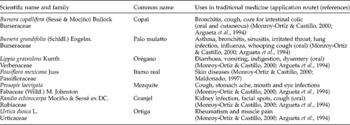
A screening of the SHBR looking for selected plants was carried out in July 2005. Some of the selected plants were taxonomically identified as Bursera copallifera, B. grandifolia, Lippia graveolens, Passiflora mexicana, Randia echinocarpa, Urtica dioica and Prosopis laevigata. These seven species were prepared in a botanical press to be deposited in the Plant Collection of the Centre of Environmental Education and Research Sierra of Huautla or Centro de Educación Ambiental e Investigación Sierra de Huautla (the Spanish acronym being CEAMISH). This research centre forms part of the Autonomous University of the State of Morelos (the Spanish acronym being UAEM). The identification key record and the common name of the plants, as well as the medicinal properties attributed to them are summarized in table 1.
List of medicinal plants selected for the in vitro anthelmintic evaluation against Haemonchus contortus infective larvae: scientific names, common names and uses in traditional medicine.

Plant extract preparation
Selected plant material was processed in the phyto-chemical bioactive principles laboratory of the Faculty of Chemistry and Engineering, CEAMISH–UAEM. The process consisted firstly of the separation of leaves, stems and aerial parts, then the different parts of the plants were dried for 30 days under shade at room temperature. The plant parts were macerated with the following solvents: n-hexane, acetone, ethanol and methanol, respectively, in order of raising polarity (Kuklinski, Reference Kuklinski and Kuklinski2000). The extract maceration was performed for 3 days and this process was carried out twice. Solvents were totally eliminated from extracts using a rotaevaporator (Buchi 205) in which extracts were processed during a specific period of time, depending on the boiling point of each of the solvents used. Extracts were completely dried using a cold air gun (HG-301A). Therefore, no toxicity due to residues of solvents in the final extracts was expected.
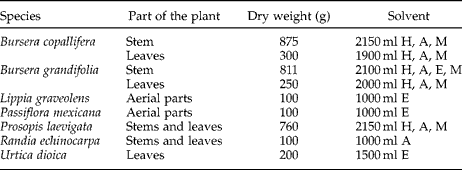
The plant species used in the present study and the parts of the plant used as well as the dry weight and the solvent used are summarized in table 2.
List of plant species selected for evaluation of nematicidal activity against Haemonchus contortus infective larvae.
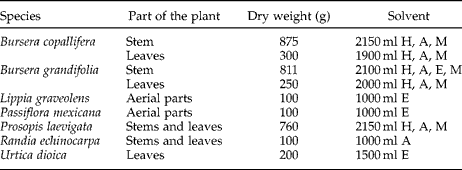
Aerial parts = flowers, leaves and branches. A, acetone; E, ethanol; H, hexane; M, methanol.
Haemonchus contortus infective larvae (L3)
A short haired, cross-breed, 4-month-old male sheep was artificially infected with 350 H. contortus L3 per kg of body weight using an isolate obtained from a sheep from Jonacatepec, Morelos, Mexico. Faecal cultures in a plastic bowl were prepared mixing rubber foam particles with the faeces and adding tap water to maintain an adequate humid microenvironment. Faecal cultures were mixed daily with a wooden spoon and incubated for 6 days to promote egg hatching and the development of infective larvae (Liébano-Hernández, Reference Liébano-Hernández2004).
The Baermann funnel technique was used to recover the H. contortus L3 population from faecal cultures (Campos & Bautista, Reference Campos and Bautista1989). Once the larvae were recovered, they were filtered and washed by spinning down with 40% sucrose solution (3500 rpm for 5 min) to separate the thick detritus from larvae, afterwards they were resuspended in sterile distilled water. Finally, the larvae were unsheathed with 0.18% sodium hypochlorite for 6–8 min at room temperature (25–30°C) and rinsed and resuspended in sterile water (Ramírez et al., Reference Ramírez, López, Mendoza de Gives, Liébano and Vázquez2006).
Anthelmintic activity: in vitro bioassay
The anthelmintic bioassay was based on the technique described by López-Arellano et al. (Reference López-Arellano, Flores, Mendoza de Gives, Bravo de la Parra, Herrera-Rodríguez, Liébano-Hernández, Vázquez-Prats and Várgas-Urióstegui2002). The confrontation of the nematode larvae and the corresponding extract was run on 24-well cell culture plates. Each extract was dissolved in Tween 20, 3% (v/v) to obtain a concentration of 20 mg ml− 1. Five hundred and fifty microlitres of the corresponding extract were deposited in a well of the cell plate and 50 μl of a larval suspension containing 600 unsheathed H. contortus infective larvae were deposited in the corresponding well. Three wells of the plates were considered as three replicates per treatment. Plates were incubated at room temperature (25–30°C) for 72 h. Samples were taken at 24, 48 and 72 h of incubation. Ten 5 μl drop aliquots were taken from the corresponding wells and deposited on a slide for observation under the microscope (4 × and 10 × objectives). Criteria of evaluation were based on the means of live and dead larvae in the different treatments. The effect of the corresponding plant extract on the viability of the H. contortus larvae was expressed as the larval mortality percentage and it was adapted from the formula used by López-Arellano et al. (Reference López-Arellano, Flores, Mendoza de Gives, Bravo de la Parra, Herrera-Rodríguez, Liébano-Hernández, Vázquez-Prats and Várgas-Urióstegui2002):

where XA = live larvae recovered from corresponding control (Tween 20, 3%) and XB = live larvae recovered from corresponding plant extract.
The average number of live larvae was considered in every treatment as the variable of study. Three additional wells containing only the same amount of larvae in Tween 20, 3% v/v were considered as negative controls and were used to record the natural mortality due to causes other than the lethal effect of the plant extracts. The larval mortality in the plant extract treatments was adjusted considering the natural mortality data from the negative control. In order to compare the mortality caused by the plant extract effect, piperazine was used as an example of a potent nematicide and was considered as a positive control of comparison as a standard of reference.
Statistical analysis
Data were transformed angularly using the following formula: arcsine√Yi (Jerrold, Reference Jerrold1999) and the ANOVA test was used to compare the means of the different treatments followed by the Tukey test used as a complementary statistical method to determine the treatment which was different from the other treatments (SAS, SAS Institute, release 9.1.2; Cary, North Carolina, USA).
Results
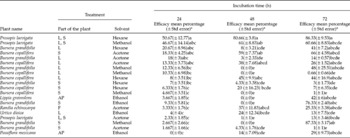
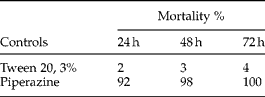
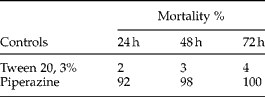
Results of the plant extract efficacy in relation to the solvent used and the percentage of H. contortus infective larval mortality after exposure to the different extracts are shown in table 3. The acetonic extract from B. copallifera stems exhibited 18, 59 and 66% nematicidal activity after 24, 48 and 72 h post-exposure, respectively. On the other hand, P. laevigata hexanic extract from stems and leaves combined showed 51, 81 and 86% nematicidal activity at the same exposure times. Bursera copallifera and B. grandifolia hexanic extracts from leaves showed a moderate nematicidal activity (40%). The mortality percentage obtained in negative controls is shown in table 4.
List of plant extracts evaluated in vitro against Haemonchus contortus infective larvae (L3), and efficacy mean percentage at three incubation times.

AP, aerial parts; F, flower; L, leaves; S, stem.
* a,b,c,d,e, Those with a different letter are significantly different for Tukey test (P < 0.05). Incubation time 24 h (P < 0.0001, ANOVA V. C. 57.6848); incubation time 48 h (P < 0.0001, ANOVA V. C. 51.19693); incubation time 72 h (P < 0.0001, ANOVA V. C. 48.70747).
Results of the unsheathed Haemonchus contortus infective larvae mortality percentage in control groups.
The remaining plant extracts used exhibited very low or even no nematicidal activity.
Discussion
The use of nematicidal bio-products obtained from plants is an alternative control method that could partially replace the use of chemical anthelmintic drugs against cattle and sheep parasites. This is the first attempt at using B. copallifera and P. laevigata against H. contortus. In the present study, encouraging results were achieved with acetonic and hexanic extracts obtained from these two plants. It is important to mention that the bio-products used in this study were non-purified plant extracts. The purification of such compounds could lead to a potentially higher nematicidal effect. The utilization of different plant species and different extraction methods or even the simultaneous use of two or more plant extracts could be evaluated in order to get the best results. The medicinal activity of plants has been frequently supported by empiric knowledge based on animal behaviour in which animals consume herbs to self-cure. During the 1970s a peculiar behaviour of chimpanzees in Hawaii was studied (Rodriguez et al., Reference Rodriguez, Aregullin, Nishida, Uehara, Wrangham, Abramowski, Finlayson, Towers and Thiaburine1982). Interestingly, the primates desperately looked for a specific plant to feed on and to share with their progeny. This plant was analysed and taxonomically identified as Aspilia mosambiscencis which belongs to the Compositae family. After a number of studies, A. mosambiscencis showed extraordinary in vitro nematicidal, bactericidal and fungicidal activity (Rodriguez et al., Reference Rodriguez, Aregullin, Nishida, Uehara, Wrangham, Abramowski, Finlayson, Towers and Thiaburine1982). Later on, other anti-tumour curative activities were attributed to this plant species (Koshimizu et al., Reference Koshimizu, Oigáis, Huffman, Nishida and Takasaki1993). There are only a few studies which have evaluated the nematicidal activity of plant extracts against ruminant parasitic nematodes. The principle of the use of plant extracts against insects and/or nematodes is based on the production of metabolites with biocidal activity in response to self-defence of plants against natural enemies, including some predators. Within the wide group of products obtained from plants and fruits, different bio-compounds with different pharmacological activities have been identified. Many of them act as a nitrogen reserve source or as a natural strategy against predator organisms through enzyme production, e.g. pineapple or papaya (Carretero-Acame, Reference Carretero-Acame2002). The main compounds obtained from plants include flavonoids, terpenic substances, sesquiterpenic lactones and terpenoids and condensed tannins (Molan et al., Reference Molan, Duncan, Barry and McNabb2003, Paolini et al., Reference Paolini, Bergeaud, Grisez, Prevor, Dorchies and Hoste2003, Hoste, Reference Hoste2004; Romo de Vivar, Reference Romo de Vivar2006). Other sulphurated compounds, e.g. from garlic Allium sativum, have shown anthelmintic activities (Das et al., Reference Das, Khan and Soorana1995). This activity has also been observed with Tagetes spp. (marigold, cempazuchitl or death flower) (Argueta et al., Reference Argueta, Cano and Rodarte1994) and Chenopodium ambrosoides (Epazote) (Pérez et al., Reference Pérez, Teudosio, Domínguez and Olivares2001).
On the other hand, some tree bark appears to have a high amount of tannins. In one study published by Paolini et al. (Reference Paolini, Fouraste and Hoste2004) three tree species Rubus fructicosus, Quercus robur and Coylus avellana showed a significant inhibitory effect against both Haemonchus contortus and Trichostrongylus colubriformis infective larvae (L3) and adult worms. Recently, in France, Bahuaud et al. (Reference Bahuaud, Martínez-Ortíz de Montellano, Chauveau, Prevot, Torres-Acosta, Forraste and Hoste2006) evaluated the effect of four ethanolic extracts from different tanniferous plants on the unsheathing of H. contortus and T. colubriformis infective larvae. The plants used included two tree species, Castanea sativa and Pinus sylvestris and two bushy plants, Erica erigena and Sarothammus scoparius. The results showed that the Castanea tree extract did not produce any change in the normal larval unsheathing in both species of nematodes. In contrast, the pine tree extract delayed the unsheathing process in comparison to the control. Similarly, the Erica erigena extract delayed the unsheathing of H. contortus but had no effect on T. colubriformis. Finally, the C. sativa extract led to the total inhibition of the unsheathing process of the nematodes under study. On the other hand, in research published by McGaw et al. (Reference McGaw, Van de Merwe and Elfo2007), 24 plants were used in South African ethno-botanical medicine. Seventy plant extracts (aqueous, methanolic and hexanic) were evaluated to determine their possible anthelmintic, antibacterial and cytological activity. Lethal effect (70%) against Caenorhabditis elegans was found with Hippobromus pauciflorus at 0.5 mg ml− 1. Meanwhile, in Pakistan (Iqbal et al., Reference Iqbal, Lateef, Nisar, Jabbar and Shoaib2006) a research work was conducted to investigate the anthelmintic effect of the plant Swertia chirata either in vitro or in vivo in sheep. The results showed that methanolic extract of the whole plant produced the immobilization of the H. contortus infective larvae (almost 100%) under in vitro conditions. In another study, the oral administration of S. chirata (in powdered form) in sheep produced an important reduction (almost 60%) in the egg per g of faeces parameter (Iqbal et al., Reference Iqbal, Lateef, Nisar, Jabbar and Shoaib2006). The imminent presence of anthelmintic resistance in the parasites leads workers from around the world to search for non-chemical alternatives for control of ruminant parasitic nematodes. The Mexican flora, particularly the flora from the SHBR, offers a wide variety of plants with an enormous potential for use in the control of diseases caused by nematode parasites, not only in animals but also, in other plants and even in humans.
Acknowledgements
The authors wish to thank the botanist/biologist Juan Carlos Juárez, from CEAMISH (Centro de Educación Ambiental e Investigación de la Sierra de Huautla, Universidad Autónoma del Estado de Morelos, México) for his kind support in the selection, sampling and taxonomical identification of the plant material. This research received financial support from CONACYT-SAGARPA-2004-CO1-78.