Ventilator-capable skilled nursing facilities (vSNFs) are influential in the regional epidemiology of antimicrobial resistance. Reference Lin, Froilan, Lolans and Bell1–Reference Clegg3 Such specialized facilities care for a distinct resident population that requires chronic respiratory care such as mechanical ventilation, and vSNFs contribute increasingly to the regional spread of multidrug-resistant organisms (MDROs) such as carbapenem-resistant Enterobacterales (CRE) and Candida auris. Reference Prabaker, Lin and McNally4 However, the optimal methods to control MDRO transmission in vSNFs, and the human factors that impact the implementation of such methods, remain unclear. Reference Hayden5,Reference Lee, Lee, Lee and Park6
During 2017–2019 in the Chicago metropolitan area, 9 vSNFs participated in a quality improvement project (Chicago PROTECT) to control the spread of CRE. Reference Lin, Froilan, Makhija and Bensen7 Led by public health authorities and academic epidemiologists, the facilities implemented a CRE prevention bundle that included staff CRE education, a hand hygiene campaign with promotion of alcohol-based hand rub, contact precautions (glove/gown) for care of CRE-colonized residents, and 2% chlorhexidine gluconate (CHG) impregnated wipes for routine resident bathing.
Critical to the success of implementing infection control interventions is understanding the beliefs that motivate healthcare personnel behavior. Prior qualitative studies have discovered determinants (eg, knowledge, memory, attention, values) for levels of adherence to infection prevention interventions (eg, hand hygiene) among healthcare personnel in a variety of healthcare settings. Reference Lyles, Moore and Weiner8,Reference Squires, Linklater and Grimshaw9 To better understand barriers to infection control efforts in vSNFs, we conducted a qualitative study to understand the experiences of healthcare personnel in implementing CRE-focused infection control measures.
Methods
Study setting
This study was conducted at a for-profit, 245-bed vSNF in the Chicago, Illinois, metropolitan area. This facility had 4 patient floors and provided intermediate, subacute rehabilitation for adult residents with a range of ongoing clinical issues; 1 floor was dedicated to the care of chronically ventilated residents. The staff was composed of a facility administrator, director of nursing, assistant director of nursing, and nursing staff as well as certified nursing assistant staff. During the study period, we regularly observed an average of 8 nurses and 11 certified nursing assistants who worked during the day on the floors with 7 managing staff on site, who were available for interviews. At the time of the interviews, this facility had received 1 year of MDRO education (in the form of small group and one-on-one educational sessions about germ theory and the fundamentals of MDRO transmission and prevention) and implementation of a CRE prevention bundle as a part of their participation in Chicago PROTECT.
Participants
We targeted 3 professional groups for enrollment: management, nursing, and certified nursing assistants. Nursing and certified nursing assistants were all directly engaged in frontline resident care. Management participants included “frontline managers” who performed a mix of administrative and frontline duties (eg, nursing managers and certified nursing assistant managers) and “administrative managers” who did not provide frontline resident care.
Any healthcare personnel working in these professional groups were eligible to participate. Advertisement fliers and word of mouth were utilized to recruit healthcare personnel for study. To ensure a representative sample, interested individuals who did not work with ventilated residents and had worked at this vSNF for <6 months were ineligible. All participants in this study had taken part in CRE education as a part of Chicago PROTECT.
Healthcare personnel who opted in and confirmed their availability for the full length of the interview were scheduled. Verbal consent was given prior to the start of the interview. Participants were informed that the study focus was healthcare personnel experiences related to infection control activities, and they were compensated for their time with a $20 gift card. The project was approved by Rush University Medical Center’s Institutional Review Board.
Methodology
The study had a focused qualitative design based on the principles of ethnographic research to characterize experiences and perceptions within a defined cultural group. Reference Squires, Linklater and Grimshaw9 The semistructured interviews were conducted on site during breaks or outside work shifts by a doctoral-candidate medical anthropologist (K.R.R.) over 8 weeks between September and November 2018. An interview guide (Appendix A online) was developed based on themes drawn from 2 weeks of unstructured preliminary observations at the facility. Although the primary focus of the semistructured interviews was to identify healthcare personnel experiences during an infection control intervention, contextual and work history questions were also included. Throughout the interviews, participants used the terms “germs,” “superbugs,” and “MDROs” variably, sometimes interchangeably. This variability is reflected in participant quotations. All interviews were recorded with participant permission.
Analysis
Recorded interviews were transcribed using TranscribeMe! (www.transcribeme.com) academic research transcriptions service. Transcribed interviews were anonymized and analyzed using qualitative analysis software MAXQDA (Boston, MA) following thematic coding guidelines. Reference Hammersley and Atkinson10 First, the interviewer identified key themes and phrases. After iterative review among all authors, a comprehensive list of thematic clusters was developed. To ensure data saturation, elicited themes were compared against coded transcripts. Themes were finalized by consensus and were presented to the intervention research team.
Results
We conducted >11 hours of semistructured interviews with 17 healthcare personnel participants: management (n = 5), nursing (n = 6), and certified nursing assistants (n = 6). Management subcategories included frontline managers (n = 2) and administrative managers (n = 3). The average length of an interview was 40 minutes (range, 23–73). Participants had long-term familiarity with their facility, colleagues, and residents; most participants had worked at the facility for >12 months, and almost half of the participants had worked in their professional field for >10 years (see Online Supplement A for further characteristics).
When asked to describe the vSNF that they worked at, healthcare personnel used descriptors such as “family” and “teamwork,” emphasizing that “everyone helps.” Overall, participants mentioned their desires to provide a home-like environment for residents. The following themes characterize our findings: (1) germs were perceived to be “everywhere,” “invisible,” and “threatening”; (2) motivation and dedication to keeping oneself clean and preventing infection was high; and (3) healthcare personnel found infection control measures valuable but also experienced structural challenges to adherence.
Theme 1: Germs are perceived to be “everywhere,” “invisible,” and “threatening”
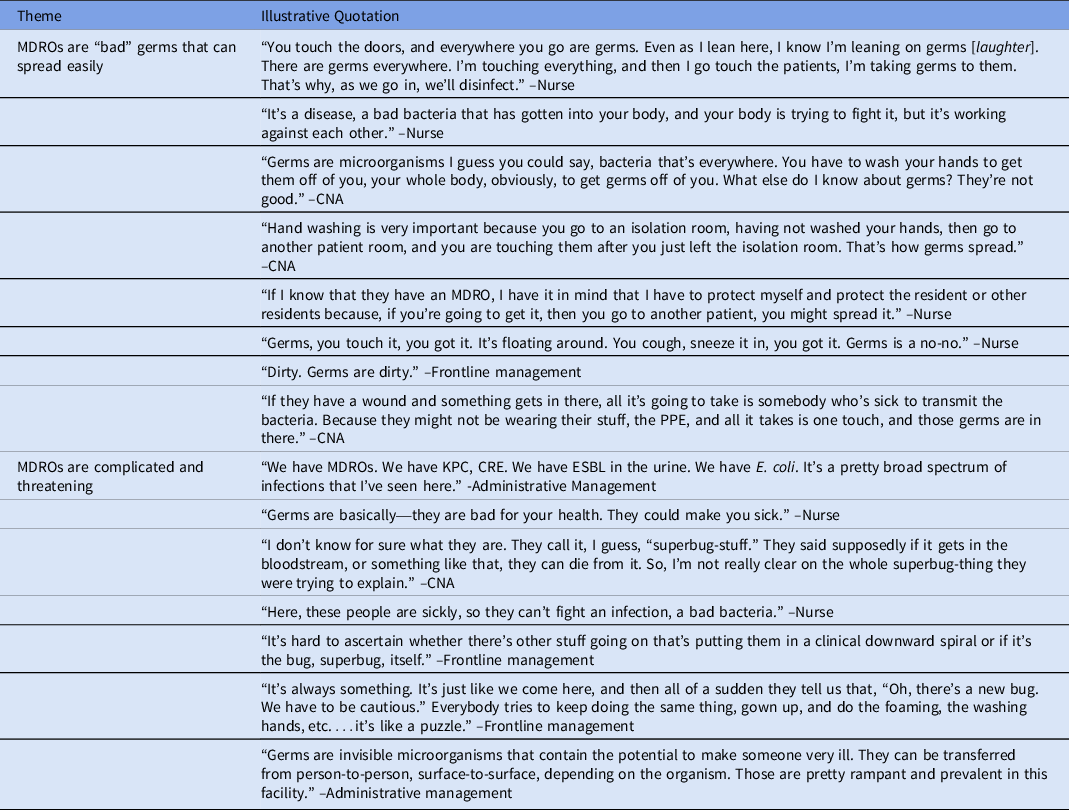
In response to questions about their perception of germs, healthcare personnel described “bad” germs that could spread easily (Table 1). Some participants related the concept of “germs” to bacteria, MDROs, or infection, at times recognizing the link between the spread of germs and the acquisition of an infection. Some participants specifically linked germs with fears surrounding highly resistant bacteria (ie, germs as “invaders”). Most participants labeled germs as threatening. Based on the consensus among participants regarding the dangers of germs, we found that the perception of germs generally captured a sentiment that germs are invisible, threatening, can spread easily, and can cause infection in themselves, their residents, and their loved ones at home.
Healthcare Personnel Quotations Related to Perceptions of MDROs

Note. MDRO, multidrug-resistant organism; KPC, Klebsiella pneumoniae carbapenemase; CRE, carbapenem-resistant Enterobacterales; ESBL, extended spectrum beta-lactamase; CNA, certified nursing assistant; CHG, chlorhexidine gluconate; PPE, personal protective equipment.
Theme 2: Motivation and dedication to keeping oneself clean and preventing infection were high
Following participants’ acknowledgement of the severity of spreading MDROs in their facility, the interviewer asked about personal approaches to keeping themselves, their residents, and their families at home healthy. Although this study did not focus on personal hygiene, it became clear in the course of interviews that healthcare personnel in all job categories had put considerable effort into their personal hygiene habits both at work and transitioning from work to home. Self-protection from MDROs such as using antibacterial wipes and hand sanitizer were commonly mentioned (Supplement B online). A nurse spoke about her process transitioning from work to home:
“I have a disinfectant [spray] in my car. I spray my seat down. I spray it down before I actually get in the car, and then when I get out the car, I actually spray it again just to make sure. Then when I get home at the door, I take my shoes off. Before I even enter my room, I take my clothes off… I put my uniforms in a separate bag and wash them separately from my other clothes… Yeah. That’s what I do.”
Other participants mentioned the individuals they were protecting through their personal hygiene routines, such as their children, grandchildren, or their favored residents (see Online Supplement B). A nurse shared, “I take my shower and change my clothes immediately [once I get home] because I have my 2-year-old granddaughter there.” The nurse also showed concern for her residents. She said, “These people, they have low resistance, so you know that germ is going to have a bigger impact on them than it would us [workers].” Healthcare workers in this study had much to share regarding their ideas about personal hygiene and protecting those around them that they cared about.
Theme 3: Healthcare personnel found infection control measures valuable but also experienced structural challenges to adherence
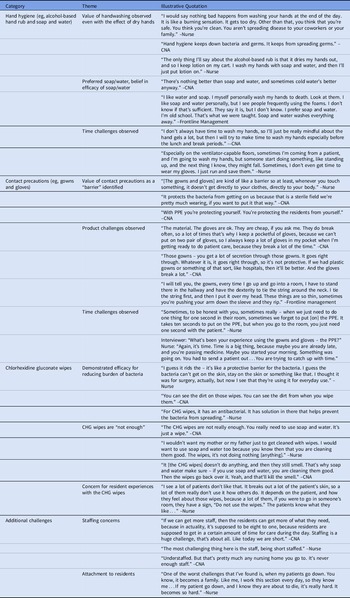
Infection control measures (eg, hand hygiene, contact precautions, and CHG wipes) and quality improvement programs focused on infection prevention of CRE were familiar to all participants. Participants spoke about their support of infection control measures (Table 2), demonstrating knowledge surrounding the “barrier” provided by contact precautions and the “antibacterial” qualities of CHG wipes. Support for hand hygiene (ie, the general idea of hand hygiene being important) was high. “I stay [at this facility] because it’s clean. They have a lot of teamwork and a lot of people working [together], and that’s real important,” a certified nursing assistant said. Participants conveyed their interest and investment in doing whatever was necessary to keep clean and prevent infection.
Representative Interview Quotations of Healthcare Personnel Experiences Implementing Infection Control Measures Associated with a Carbapenem-Resistant Enterobacterales Prevention Bundle

Note. CRE, carbapenem-resistant Enterobacterales; CNA, certified nursing assistant; CHG, chlorhexidine gluconate; PPE, personal protective equipment.
When asked about experiences following infection control measures implemented as part of a quality improvement project, numerous structural challenges were listed in the responses provided (Table 2). Primarily, staffing, and resources were implicated. Related deficiencies were mentioned among frontline personnel including running out of alcohol-based hand rub while on the floor with residents and having to rush into resident rooms before personal protective equipment could be donned. Concerns over the efficacy of specific infection prevention strategies (eg, preference for soap and water over CHG wipes) were also present. Despite initial enthusiasm about the possibility of limiting the spread of infection and keeping residents and healthcare personnel clean, the challenges that arose limited healthcare personnel’s ability to achieve desired goals for their facility and adherence to the infection control measures presented as a part of the CRE control intervention.
Discussion
This qualitative study was conducted to understand the experience of healthcare personnel involved in the implementation of a 2-year project focused on preventing CRE infections in a vSNF. Healthcare personnel demonstrated a functional understanding of the significance and transmissibility of germs such as MDROs (theme 1), and they described self-protection routines intended to protect themselves and their families from the spread of MDROs (theme 2). Participants expressed motivation and support for infection control, but they reported structural challenges to adherence and mixed beliefs regarding the effectiveness of some infection control methods (theme 3). In particular, healthcare personnel reported that time pressures and understaffing challenged engagement with infection control measures.
vSNFs care for chronically ill residents with medical requirements, such as chronic mechanical ventilation, who are similar to patients in hospitals. Concomitantly, the risk of MDRO spread in such nursing homes has exceeded levels of risk historically associated with hospitals. Reference Pacilli, Kerins and Clegg2,Reference Prabaker, Lin and McNally4,Reference Lin, Lyles-Banks and Lolans11 However, infection prevention measures developed to prevent infection need to be implemented with sensitivity to the social environment of the skilled nursing home setting. In contrast with more medicalized spaces of care such as hospitals, nursing homes aim to operate as home-like environments for residents who are perceived as “family.” Reference Stone, Herzig and Pogorzelska-Maziarz12–Reference Brossard16 As such, healthcare personnel may hesitate to implement infection control measures if such measures are associated with hospital-level medical care.
Effective education in nursing homes is challenging because many frontline personnel experience high rates of job change and often do not have an extensive background in science education. Reference Squires, Linklater and Grimshaw9,Reference Koo, McNamara and Lansing17,Reference Zimmerman, Gruber-Baldini, Hebel, Sloane and Magaziner18 In the context of a quality improvement intervention that featured small-group and one-on-one educational sessions focusing on the epidemiology and control of CRE, we found that front line and management healthcare personnel in vSNFs achieved adequate understanding of germ theory concepts and antibiotic resistance (eg, recognizing the threat that MDROs represent, even if the bacteria are not visible). Their knowledge manifested in elaborate personal hygiene routines that personnel independently developed to keep themselves, their loved ones, and their residents clean. Previous studies have demonstrated that healthcare personnel are concerned with the risk to themselves, Reference Wolf, Lewis, Cochran and Richards19,Reference Albrecht, Croft, Morgan and Roghmann20 highlighting underlying universal fears of contagion. Reference Douglas21
Although self-protective measures were consistently described by healthcare personnel, adherence to measures to prevent infections among residents was heterogeneous. For example, healthcare personnel were instructed to perform hand hygiene before and after resident care, but they observed that hand hygiene adherence was substantially higher after resident care than before resident care. Reference Lin, Froilan, Makhija and Bensen7 This pattern of hand hygiene adherence suggests that healthcare personnel are highly motivated to prevent self-acquisition of MDROs (hand hygiene after touching a resident) but less motivated to prevent resident acquisition of MDROs (hand hygiene prior to touching a resident). Taken with the data presented here, our findings suggest that self-protection is a concern and a prime motivator for all frontline healthcare personnel.
Structural challenges related to perceived lack of time, staffing, and resources further complicated full adherence to infection prevention measures. This led to work-around behaviors such as reusing gloves or deciding not to wear a disposable gown during resident interactions. The provision of adequate resources has been shown to be linked to nursing home staff satisfaction. Reference Lyles, Moore and Weiner8,Reference Wolf, Lewis, Cochran and Richards19,Reference Dumyati, Stone, Nace, Crnich and Jump22,Reference Mayer, Stone and Leecaster23 Furthermore, recent descriptive studies of global nursing home care show that staff are regularly overwhelmed and have high rates of burnout and job turnover. Reference Rodriguez15,Reference Yamamoto-Mitani, Saito, Takaoka, Takai and Igarashi24–Reference Jones, Krein, Harrod and Mody26 The economic drivers of nursing home care are well established, and supply shortages and high levels of staff turnover are not new findings. Reference Diamond27 However, by describing the structural challenges experienced by healthcare personnel, we can see the dependent relationship between organization level challenges and individual adherence to infection control measures.
Furthermore, challenges to implementing infection control measures could reflect healthcare personnel’s mixed beliefs about the effectiveness of infection prevention interventions. For example, a persistent belief in the superiority of soap and water compared with alcohol-based hand rub or CHG wipes led to inconsistent explanations of the cleaning routines expected of frontline healthcare personnel. Although education about germ theory and MDROs appeared to be successful in improving knowledge, healthcare personnel held opinions about appropriate cleaning that likely reflect prior experience and possibly beliefs related to what residents expect in a home-like setting. Educational efforts aimed at shifting understandings of the effectiveness of alcohol-based hand rub or 2% chlorhexidine bathing compared to the use of unmedicated soap and water would benefit from acknowledging and addressing beliefs among healthcare personnel in nursing homes. Reference Saint, Howell and Krein28
This study was conducted at a single vSNF in a region with endemic MDRO transmission; thus, our findings may have limited generalizability to regions with different MDRO epidemiology. However, given that vSNFs generally care for the sickest chronically ill nursing-home residents, the experiences described by the healthcare personnel at our study vSNF are likely to reflect challenges that other vSNF personnel will encounter in combatting antimicrobial resistance.
Understanding the motivations and perceptions of healthcare personnel provides a foundation for improving infection control interventions. Although healthcare personnel in a vSNF infection control education, adherence to specific intervention measures was mixed, in part due to structural challenges with supplies and staffing. Self-protection was a strong motivator for healthcare personnel, and such insight can inform the design of future infection prevention interventions.
Acknowledgments
We thank the managers, nursing staff, and certified nursing assistants who participated in this project. K.R.R. thanks the Departments of Anthropology at Washington University in St Louis and Case Western Reserve University for their institutional support.
Financial support
This project received funding through the CDC Prevention Epicenter Program Cooperative (agreement no. U54CK000481) and the Safety and Healthcare Epidemiology Prevention Research Development (SHEPheRD, contract no. 200-2011-42037).
Conflicts of interest
M.Y.L. has received research support in the form of contributed product from OpGen and Sage Products (now part of Stryker Corporation), and he has received an investigator-initiated grant from CareFusion Foundation (now part of BD). R.A.W. has participated in clinical trials where study hospitals or nursing homes received contributed product from Sage Products, Molnlycke, Clorox, or Medline. Neither R.A.W. nor his hospital received product, funding, payments, or any other form of compensation.
Supplementary material
To view supplementary material for this article, please visit https://doi.org/10.1017/ice.2021.265
Appendices
Appendix A. Abbreviated Semi-Structured Interview Guide
-
1. Tell me about what you do here at ___________ (institution name).
-
a. How long have you worked here?
-
b. Before this job, were you working in a similar field (e.g. another skilled nursing facility)?
-
-
2. Describe working at _____________ (institution name).
-
a. Walk me through a normal day/shift for you at __________ (institution).
-
b. What challenges are there to working at ______________ (institution)?
-
-
3. Germs (e.g. bacteria, viruses, yeasts) are organisms that can cause infections. Can you tell me what kind of infections affect residents at your facility?
-
a. From what you’ve seen, how do germs spread from resident to resident?
-
b. From your perspective, what are ways to stop germs from spreading?
-
-
4. Some germs (e.g. bacteria, viruses, yeasts) are hard to treat because they are resistant to almost all available antibiotics. These hard-to-treat germs are sometimes called ‘superbugs’. Common ‘superbugs’ include ‘CRE’ (carbapenem-resistant Enterobacteriaceae*) and ‘MRSA’ (methicillin-resistant Staphylococcus aureus). ‘CRE’ are sometimes also called ‘KPC’ or ‘NDM’. Have you worked with residents who are affected by ‘superbugs’?
-
5. How does ________ (institution) work to control the spread of ‘superbugs’?
-
a. What methods/practices are used to stop the spread of ‘superbugs’?
-
b. What has been your experience using/performing the following:
-
i. Hand hygiene?
-
ii. Personal protective equipment (PPE; like gowns and gloves)?
-
iii. Chlorhexidine bathing of residents?
-
iv. Cohorting residents?
-
-
c. What is your impression of the way other staff members use:
-
i. Hand hygiene?
-
ii. Personal protective equipment (PPE; like gowns and gloves)?
-
iii. Chlorhexidine bathing?
-
-
d. What do you do to protect yourself from bringing superbugs (resistant germs) home?
-
-
6. Is there anything you’d like to add that we haven’t covered?
-
7. Do you have any questions for me or about this study?
*Notes. Now carbapenem-resistant Enterobacterales.