Perspectives on Politics opened for business on June 1, 2002, with myself as editor and two Ph.D. students as part-time assistants.1
The managing editor, Lisa Burrell, joined us in July 2002, and another student assistant joined soon thereafter.
The book review editors, Susan Bickford and Greg McAvoy, were already working with Lee Sigelman, editor of the
American Political Science Review; they and their student assistants moved to join
Perspectives for its first issue, published in March 2003. The journal has now published four issues and we are hard at work on the fifth.
This report covers submissions and, where possible, their disposition from June 1, 2002, through July 31, 2003.2
My first report to the APSA Council, dated April 5, 2003, covered June 1, 2002 through March 31, 2003. This report supercedes that one, since it includes the period covered in the earlier report (with more complete data and better analyses) and it encompasses the first full year of operation. From now on, reports will cover the period August 1–July 31 of the following year.
Structure of Perspectives on Politics
Perspectives on Politics has a somewhat different editorial structure and review process from the usual academic journal, in keeping with the American Political Science Association's effort to create a journal that publishes distinctive types of articles.3
There is not a large editorial board; instead, we have five associate editors (one for each of the major subfields of the discipline) who are deeply involved in defining
Perspectives' substantive foci and in creating the journal's decision-making procedures. They also participate in the pre-review process and help solicit submissions, as described below. The journal's pre-review process, and its overall model for receiving and reviewing papers, is more like that of an acquisitions editor for a university press than that of a typical journal editor. That is, the associate editors and I welcome short proposals and invite individuals to submit articles, in addition to receiving draft manuscripts over the transom. I turn down many drafts and proposals before review on the grounds that they are inappropriate for the journal's distinctive profile or are of demonstrably poor quality. Many proposals receive a substantive response suggesting ways to develop the paper so that it fits
Perspectives' mission, improves its quality, and boosts its appeal to a wide readership. Some draft articles receive the same kind of response, usually in considerable detail.
4 That is, from one to three single-spaced pages of comments.
Additionally, we solicit brief essays from journalists, actors in the public arena, political scientists working outside the academy, and others whose experience or insights will, I hope, be of great interest to members of our discipline. (Such pieces are published in the “Perspectives” section, reserved for short, incisive essays that get in, make a point, and get out.)5
Seventeen percent of the authors of “Perspectives” essays or proposals are not political scientists. Most of them are responding to my solicitations.
I also solicit review essays about collections of syllabi or other “texts,” and both the book review editors and I solicit book review essays. After consulting with me, the associate editors invite submissions and develop symposia for the journal. In order to avoid conflicts of interest, the book review editors do not accept proposals to review particular books. We do on occasion consider proposals for wider-ranging book review essays. Book reviews are not refereed; review essays are, as described below.
Most, although not all, manuscripts that have been submitted after an initial round of revision get reviewed (and some manuscripts are reviewed without any preliminary revisions). Manuscripts go through the standard double-blind review process. We generally seek three readers for each paper, at least one of whom is an expert in the topic and at least one of whom is knowledgeable about the subfield but not centrally involved in the same segment of it. If manuscripts cut across subfields or disciplines, we seek reviewers from the various relevant arenas. We invite authors to recommend referees, without guaranteeing that we will use their suggestions. If one review of a paper is negative and the others strongly and persuasively positive, I sometimes accept the paper or ask the author to “revise and resubmit,” with detailed comments about what changes seem necessary. If the first two reviews are negative, I reject the paper without waiting for the third review.6
The associate editor from the relevant subfield also reviews the referees' reports and, if warranted, helps me revise the letter of instructions to the author.
I occasionally send a paper out to a new reviewer after it has been resubmitted in response to the initial round of reviews, but I often do not even send it back to one of the initial reviewers, relying instead on the associate editors for most final decisions.
Book review essays, syllabi review essays, most commentaries in symposia, and most essays solicited from non–political scientists are also reviewed. In such cases, reviewers often know the author of the essay (but not vice versa); they are asked for comments to improve the paper rather than for a bottom-line decision about publication.
This introduction is necessary to make sense of the data below, since our categories do not exactly match those of a standard academic journal. Two final prefatory notes: First, we do not categorize all papers by approach, as does the APSR.
Perspectives considers three types of review essays: on collections of syllabi, on books and articles, and on other media such as films.
In this and subsequent tables, proposals for which we have received papers appear only under Articles, Perspectives, or Review Essays, whichever column is appropriate. The proposals column includes only proposals for which we have not yet received papers.
Six of these papers cut across subfields; they could equally well have been identified with international relations, political theory, methods and philosophy of social science, or public law.
This point has one major exception: some papers are categorized as “Methods and Philosophy of Social Science.” Papers that are not primarily in that subfield are not categorized by method.
Articles using highly technical methods or distinctive specialized vocabularies are not appropriate for
Perspectives on Politics; instead, we seek manuscripts that are accessible to virtually all political scientists, as well as articles with a mix of methods. Second, we seek manuscripts that cut across conventionally defined subfields of the discipline or even across disciplinary lines. For purposes of this report, we have categorized papers according to a primary subfield, but note that these groupings are, intentionally, very inexact.
11 We solicit or accept articles from social scientists outside the discipline of political science. These go through the standard review process but are tracked as submissions from “Other Social Scientists,” not in terms of our discipline's subfield categories.
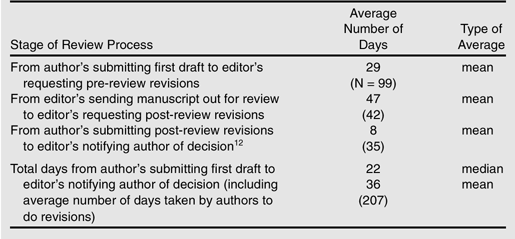
We calculated this row and the next one using the turnaround times of only manuscripts for which we have made decisions. But in the first two rows, which focus on earlier steps in the review process, our calculations include manuscripts about which decisions have not yet been made so that we can use the full amount of information available. That is why the average total turnaround time is estimated at less than the sum of the partial turnaround times; each percentage is calculated using a different subset of manuscripts.
Submissions
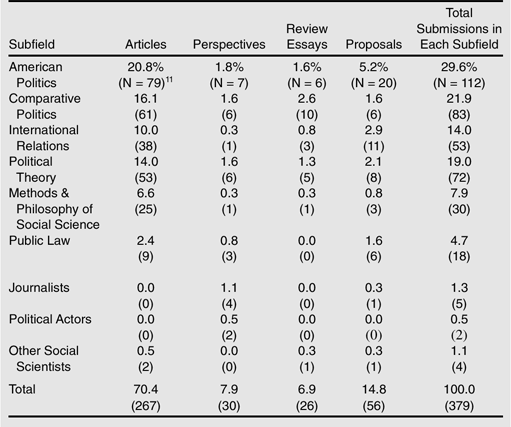
The number of papers, essays, and proposals submitted serves as the starting point for analyzing the results of this process. See Table 1.
In addition, we have issued 74 solicitations that have not (yet) yielded submissions.
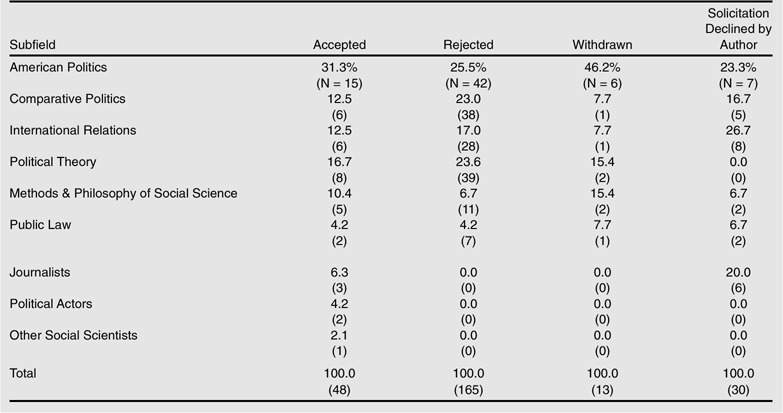
In Table 2, we have divided the results of Table 1 by subfield within political science (the first six rows) and by the other categories of writers (the next three rows). The final row repeats Table 1.
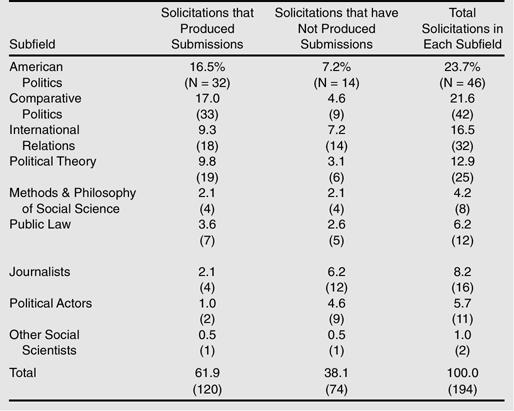
Table 3 shows the array of solicitations and responses to them, by subfield in political science (first six rows) or type of non-political-science author (last three rows). Note that the 120 submissions that the solicitations have so far yielded are included in Tables 1 and 2.
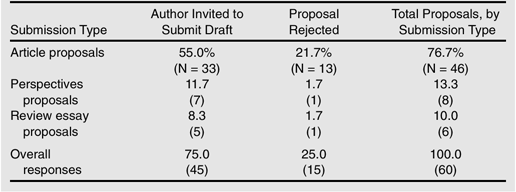
Finally, in this initial set of tables, Table 4 shows the editorial responses to proposals for manuscripts sent to the journal.
The data in these four tables provide an overview of the material with which we have worked in the first year of Perspectives on Politics. So far, of course, I have no trends to report or comment on. But there are nevertheless a few important points to note. Within the six subfields of political science, American politics (including articles that cut across American politics and some other subfield) has the highest proportion of submissions overall and among articles. Public law and methods/philosophy of social science have the lowest proportions—the former probably because the field is very small and the latter perhaps because it is especially difficult to write an article in that field in a style appropriate for Perspectives.
Our solicitations have not done enough to offset the perhaps inevitable imbalances among submissions. The high proportion of solicitations in American politics is explained by several factors: (1) many of these are for journalists or public actors, inviting essays for the “Perspectives” section; (2) we have developed three symposia in this field, and our plans for symposia in other fields have not progressed this far yet; and (3) at least for this editor, it is easier to identify people who might respond favorably to a solicitation in the field of American politics than in other fields. But we editors of Perspectives have taken note of these imbalances, and we plan to encourage and solicit submissions with an eye toward evening distribution across subfields over the final two years of my editorship. (I also frequently urge scholars of American politics to make their manuscripts more comparative as they are revising; some do so eagerly, but this is not a common move among scholars in this field.)
Processing
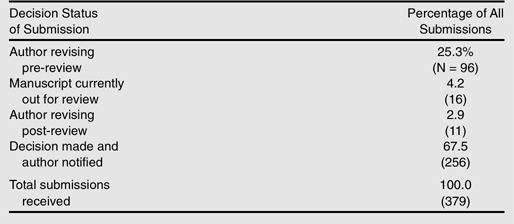
In the introduction of this report, I described how we respond to papers and proposals. Table 5 demonstrates how manuscripts fit into the different steps of this process.
As Table 5 shows, we have made decisions on two-thirds of the submissions received so far; a majority of those are rejections before review. (It is worth noting again that many pre-review rejections occur because the article is not appropriate for the distinctive mission of Perspectives.) We have sent detailed suggestions for revision to a quarter of those who submitted proposals or manuscripts, or whose papers have been reviewed. At any one time, only a small fraction of submissions to the journal are under review.
We have been developing our capacity to track these data during Perspectives' first year, so we lack complete records for the time between stages of early submissions. However, Table 6 shows the relevant data for a large majority of the submissions since June 2002. Note also that the number of items in each row varies, and that the table includes no articles that are pending at any stage in the process.
We take particular pride in the first row of Table 6. My letter proposing pre-review revisions (on a quarter of the manuscripts received) follows an evaluation by at least one associate editor, two graduate student assistants to the editor, and me, as well as a discussion of each plausible paper among the students, the managing editor, and me. So a great deal of careful work goes into that innocuous-sounding first stage.
This is perhaps an opportune moment to thank reviewers for responding promptly to our requests for assistance; as the second row shows, with very few exceptions, their comments have been reasonably prompt (as well as usually detailed and extremely helpful).
The final row in Table 6 is somewhat misleading, since it does not show the huge variance around the average (one can get a hint of it by comparing the median and the mean days for turnaround). On the one hand, I reject some papers within a few days of receipt; on the other hand, authors sometimes take many months to respond to our suggestions for pre-review (or post-review) revisions. So the data in the bottom row arguably obscure as much as they reveal.
Overall, we work very hard to send a substantive response back to authors within a brief period of time.
Outcomes
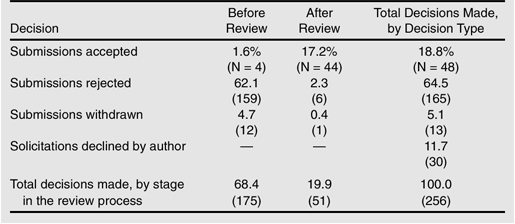
All of the report up to this point leads up to the final two sets of tables, which show the results of the editorial process. Table 7 reports the overall outcomes so far for several types of decisions.
Tables 8 and 9 provide information that enable one to better interpret Table 7. Table 8 shows acceptance rates for all submissions according to the subfields of political science (first six rows) or the alternative categories of author (next three rows). The final row of Table 8 (Total) corresponds to the final column (Total decisions made, by decision type) of Table 7.
We have also accepted one article by “Other Social Scientists” (a pair of economists).
Six of these articles are brief contributions to a single symposium; they are not stand-alone articles, although each was reviewed and an editorial decision was made on each.
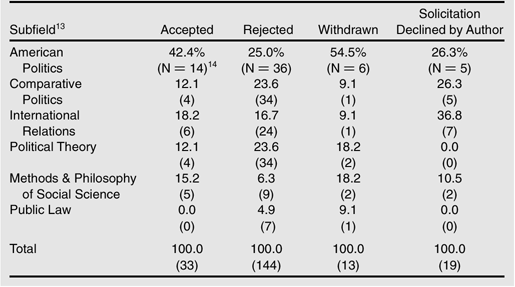
Table 8 gives information for all submissions, including review essays and “Perspectives” essays; Table 9 provides the same information for only articles, either as stand-alone pieces or as parts of a symposium. Therefore it probably provides the information in which most academic political scientists will be most interested.
Our rejection rate for articles is reasonably even across the four largest subfields—marginally higher for American politics and noticeably lower for international relations. Our acceptance rate, however, is distinctly higher for American politics than for the other subfields. Again, this is partly an artifact of how we categorized articles that cut across two or more subfields, especially since the absolute numbers on which these percentages are based are very low. It is also partly a result of publishing one symposium with six brief articles. Nevertheless, Table 9 again reminds the editors of Perspectives to try to ensure that all subfields are sufficiently represented, and it should galvanize authors in those subfields to accept our solicitations and to send articles or proposals.
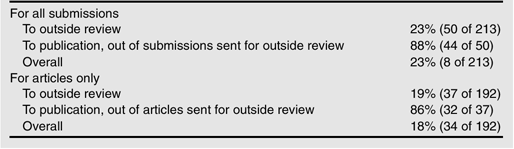
Table 10 summarizes the results of all decisions made so far by the editors of Perspectives.
Publication
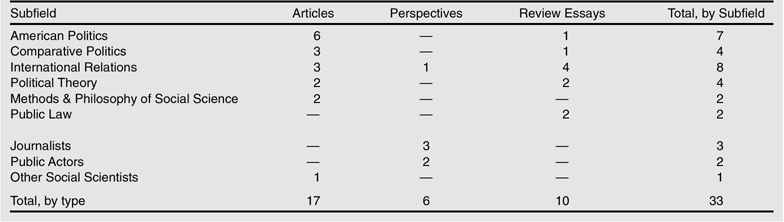
Table 11 shows the published results of everything I have described up to this point. It covers the first three issues of Perspectives, in March, June, and September 2003. It provides raw numbers, not percentages, since the totals are so low.
Again, we see a reasonable distribution across the four subfields that one would expect to contribute most of the articles to Perspectives, along with a hint that American politics will predominate absent careful attention to subfield distributions within each issue, or at least each volume.
Book Reviews
As the editor for the APSR previously reported,15
the book review office received nearly 1,800 books from September 2001 through August 2002, of which they planned to review 453 (26.5%). Here we report data from September 1, 2002, through July 31, 2003, in order not to double-count any books or reviews across the two reports.
16 For subsequent reports, information for book reviews will be on the same cycle as information for papers, proposals, and solicitations.
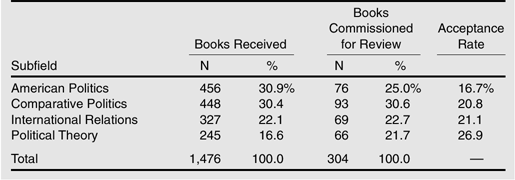
As Table 12 shows, the book review editors received nearly 1,500 books during this time. The volume of books received for the full year will be comparable to other years (between 1,600 and 1,800). The distribution of books across subfields is fairly typical, although there can be substantial year-toyear variation. (Last year, the book review office received nearly 150 more books in comparative politics than this year.) The book review editors give first priority for review to singly- or co-authored works published by university presses. They also consider singlyor co-authored works by other presses, as well as edited volumes with a strong thematic focus.
The acceptance rate this year is down slightly from the previous year. The proportion of books reviewed is generally higher in the subfields of international relations and political theory because the books received are primarily singly- or co-authored scholarly works. (By contrast, in the subfield of American politics and, to some extent, in comparative politics, many of the books received are textbooks, nonscholarly works, or books from other disciplines.)
The number and percentage of reviews published in comparative politics were slightly higher this year than last. This is a byproduct of the large number of comparative books that the book review office received last year—a trend that we do not expect will continue.
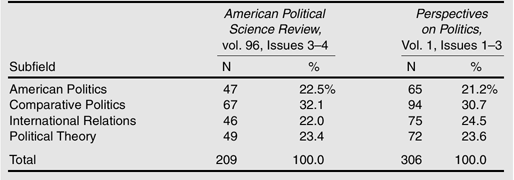
Table 13 shows the number and subfield proportions for book reviews published in the last two issues of the APSR that included the book reviews, and in the first three issues of Perspectives on Politics. There are no changes in the distribution by subfield, nor do we plan any. Perspectives also does not expect to increase the number of book reviews. Instead, we intend to have at least one review essay (or set of review essays) in each issue—and are aiming for two in many issues. We are taking care to select books and other texts that will be of wide interest and are, we anticipate, of very high quality.
Conclusion
Like everything else in Perspectives on Politics, we are inventing reporting procedures as we go along in order to ensure that they are appropriate to the journal's distinctive mission and profile. We welcome queries that were not answered above and suggestions for topics to include in future reports.
More generally, the editors and staff of Perspectives are pleased with the journal's accomplishments during its first year of operation. We are eager to continue and improve what we have begun, and we look forward to your reactions, questions, reviews, and— above all—manuscripts.
Note that the book review editors use the four standard substantive subfields, so books in methods and public law are incorporated within those subfields, as are books by non-political scientists.