Introduction
Liver cancer affects over 42,000 people and claims the lives of over 31,000 each year in the USA based on recent estimation.Reference Siegel, Miller and Jemal1 Conventionally, partial hepatectomy or liver transplant will be performed if liver cancer is still at an early stage.Reference Mazzaferro, Regalia and Doci2,Reference Ringe, Pichlmayr, Wittekind and Tusch3 For unresectable liver cancer, the treatment options include ablation, embolisation, target therapy, immune therapy, chemotherapy and radiotherapy.Reference Bruix, Han, Gores, Llovet and Mazzaferro4–Reference Wang, De Baere, Idée and Ballet6
With radiation therapy, the goal is to deliver a sufficient dose to the planning target volume (PTV) while limiting the dose to surrounding normal tissue and organs at risk (OAR). Intensity-modulated radiation therapy (IMRT) employs multi-leaf collimator (MLC) motion to modulate the beam intensity, which has demonstrated its ability to achieve better PTV coverage while maintaining better normal tissue sparing when compared to conventional 3D conformal radiotherapy technique. In addition to MLC modulation, volumetric-modulated arc therapy (VMAT) extends the technique by employing continuously rotating gantry and dynamic machine dose rate. Therefore, VMAT provides faster delivery of 3D dose distribution and improved efficiency compared to IMRT.
IMRT and VMAT are well suited for liver cancer because OARs such as spine, kidney and stomach can potentially be spared. However, there are limited dosimetric comparisons available in the literature between IMRT and VMAT for liver cancer. Kuo et al.Reference Kuo, Chiu and Shih7 demonstrated comparable homogeneity for the PTV while achieving better conformality and significant lower monitor unit (MU) for VMAT, in comparison to IMRT. Yin et al.Reference Yin, Ma and Gao8 showed that better conformity can be achieved by VMAT versus IMRT, with similar OAR sparing, lower MU and shorter treatment time. Later, Gong et al.Reference Gong, Yin and Xing9 reported that better homogeneity, conformity and OAR sparing with shorter delivery time could be achieved using VMAT in comparison with IMRT. However, at the same time, Park et al.Reference Park, Kim, Chie, Choi, Ye and Ha10 showed similar homogeneity, conformity and OAR sparing with shorter treatment time when compared to IMRT. These results are shown again in Chen et al.Reference Chen, Wang and Meng11 study, where VMAT demonstrated similar homogeneity, conformity and OAR sparing with shorter treatment time when compared to IMRT.
With the improvement of plan optimisation and dose calculation algorithms in today’s treatment planning systems, an updated dosimetric comparison between VMAT and IMRT is needed. The purpose of this study is to perform dosimetric analysis for 10 liver cancer patients with both VMAT and IMRT plans, using dosimetric parameters that include HI, CI for PTV coverage and doses to normal tissue volumes for OAR sparing. A delivery efficiency test is also provided by calculating MU and delivery time for each plan.
Materials and Methods
Ten patients with liver carcinoma previously treated with 6-field step-and-shoot IMRT or single-isocentre double-arc VMAT are randomly and retrospectively selected for this study, which was approved by the Institutional Review Board. Each patient received a total dose of 54 Gy in 1·8 Gy fractions. Patient CT scans used for structure contouring were acquired using a 2·5 mm slice thickness. The PTV and OARs for each patient were contoured by radiation oncologists.
For each original IMRT or VMAT plan for each patient, a corresponding VMAT or IMRT treatment plan was generated using Varian’s Eclipse treatment planning system (version 15·6). Similar optimisation constraints used for the original plan were used for the corresponding VMAT or IMRT plans. All plans were normalised so that 95% of the PTV received 100% of the prescribed dose. Cumulative DVHs for PTV and OARs (spine, kidney and stomach) were generated for dosimetric evaluations and comparisons.
All dosimetric parameters were statistically analysed using mean values, standard deviations and p-values for determining the significance. The homogeneity index (HI) = (D5%−D95%)/Dprescribed and conformality index (CI) = VD99%/VPTV were calculated for all plans. For efficiency comparison, total MU and beam on time (BOT) per fraction were evaluated.
Results and Discussion
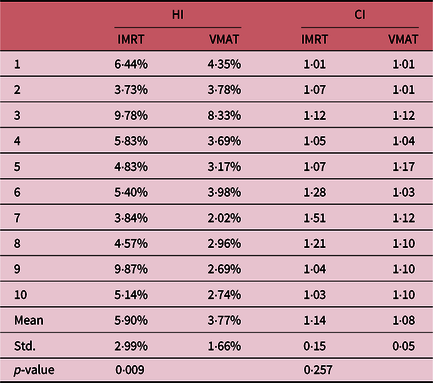
Dosimetric analysis for 10 pairs of IMRT and VMAT plans was performed and listed. Both IMRT and VMAT plans were able to achieve similar PTV conformality and normal tissue sparing. Compared to IMRT, VMAT plans showed significant differences (p < 0·01) in the HI and insignificant differences with p-values of 0·257 in CI. For IMRT, the mean HI was found to be 5·90% whereas, for VMAT, it was found to be 3·77%. The mean CI was found to be 1·14 and 1·08 for IMRT and VMAT, respectively. The dosimetric comparisons of HI and CI using IMRT and VMAT for the PTV showing all 10 plans are shown in Table 1.
Dosimetric comparison of HI and CI for the PTV

Abbreviations: PTV, planning target volume; HI, homogeneity index; CI, conformity index; IMRT, intensity-modulated radiation therapy; VMAT, volumetric-modulated arc therapy.
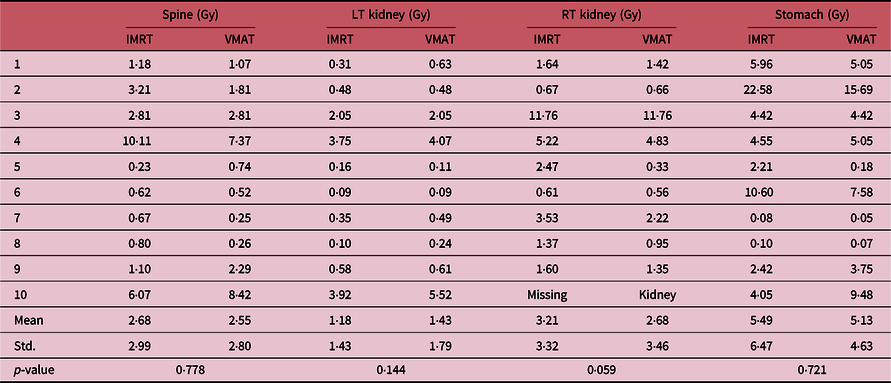
Doses to normal tissue volumes showed insignificant differences in normal tissue sparing for VMAT compared to IMRT. The average mean spine, left/right kidney and stomach doses were 2·68, 1·18/3·21 and 5·49 Gy for IMRT and 2·55, 1·43/2·68 and 5·13 Gy for VMAT, with p-values of 0·778, 0·144/0·059 and 0·721, respectively. The comparison of IMRT and VMAT for all three OARs, showing all 10plans are shown in Table 2.
Dosimetric comparison of OAR doses for each plan

Abbreviations: OAR, organs at risk; IMRT, intensity-modulated radiation therapy; VMAT, volumetric-modulated arc therapy.
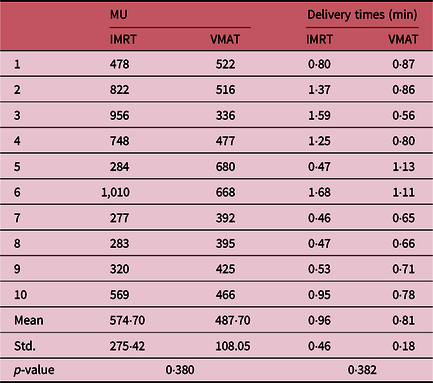
VMAT required marginally fewer mean total MU and shorter mean BOT per fraction. The mean total MU per fraction showed an insignificant difference with a p-value of 0·38. For IMRT, the mean total MU per fraction was found to be 575 MU whereas, for VMAT, it was found to be 488 MU. On the other hand, the mean BOT per fraction was found to be 0·96 and 0 81 minutes for IMRT and VMAT, respectively. The differences were insignificant with p-value of 0·38 as shown in Table 3.
Comparison of MU and treatment delivery times for each plan

Abbreviations: MU, monitor unit; IMRT, intensity-modulated radiation therapy; VMAT, volumetric-modulated arc therapy.
Our findings of similar conformality of target coverage are in agreement with more recent studies from Park et al.Reference Park, Kim, Chie, Choi, Ye and Ha10 and Chen et al.Reference Chen, Wang and Meng11, but in disagreement with an earlier study from Kuo et al.Reference Kuo, Chiu and Shih7 and Yin et al.Reference Yin, Ma and Gao8 who advocated VMAT is superior to IMRT for PTV conformality. Superior conformality observed by Gong et al.Reference Gong, Yin and Xing9 was in disagreement with our finding, however, superior heterogeneity was in agreement with our finding for VMAT compared to IMRT, while other studies showed similar heterogeneity for PTV.
Similar OAR sparing for VMAT compared to IMRT found in our study agreed well with most of the other studies other than Gong et al.Reference Gong, Yin and Xing9, who advocated VMAT associated with active breathing coordinator was superior for OAR sparing when compared to IMRT. In our study, VMAT required marginally fewer mean total MU and shorter mean BOT per fraction with no statistically significant differences when compared to IMRT when only partial gantry angles that correspond to PTV and OAR were used, while other studies showed significant shorter MU and BOT for VMAT, in comparison to IMRT.
In this study, the angles for each field or partial arcs in new plans were selected based on corresponding angles of the original VMAT or IMRT plans to create more equivalent plans. Additionally, stylistic differences in optimisation among treatment planners, which might be a possible limitation may have introduced variations not accounted for in this study.
Conclusion
For radiation therapy treatment of liver carcinoma, VMAT provided only marginally better target coverage homogeneity when compared to IMRT. Both IMRT and VMAT plans were able to achieve similar conformality and normal tissue sparing. Treatment time was also only marginally shorter with VMAT versus IMRT. Similar OAR sparing was achievable with either technique. Following these findings, our patients are currently being treated with either VMAT or IMRT technique in our practice depending upon LINAC availability. Varian TrueBeam with arc delivery technique is used for both IMRT and VMAT; whereas Varian Trilogy is used only for IMRT.
Acknowledgements
None.