Nomenclature
- HMV
-
hypersonic morphing vehicle
- LPV
-
linear parameter-varying
- LQR
-
linear quadratic regulator
- SMC
-
sliding mode control
- RBF
-
radial basis function
- NPTSM
-
nonsingular predefined-time sliding mode
- PTC
-
predefined-time controller
- FxTO-FTC
-
finite-time controller with a fixed-time observer
- RMSE
-
root mean square error
1.0 Introduction
Hypersonic morphing vehicle (HMV) is an advanced aerospace vehicle capable of large-scale aerodynamic configuration modifications, enabling multi-mission operations across a broad flight envelope, which has garnered significant research attention [Reference Ajaj, Beaverstock and Friswell1]. However, during flight, changes in the aerodynamic configuration can lead to alterations in parameters such as aerodynamic centre position and moments of inertia. These changes can also generate complex unsteady aerodynamic effects and dynamic characteristics. Furthermore, the presence of intricate external disturbances, parameter perturbations, actuator saturation [Reference Qiao, Meng, Wang, Ke and Sun2] along with stringent demands for elevated control performance specifications, collectively pose profound challenge to the design of control system [Reference Chu, Li, Gu, Du, He and Deng3, Reference Parancheerivilakkathil, Pilakkadan, Ajaj, Amoozgar, Asadi, Zweiri and Friswell4].
Effective control algorithms have been applied to morphing vehicles. These methods can primarily be categorised into two major categories: linear methods and nonlinear methods. The linear methods mainly include proportional–integral–derivative (PID) control [Reference Shao, Zhou, Ma and Bin5], Linear parameter-varying (LPV) control [Reference Wen, Liu, Sun and Zhu6] and Linear quadratic regulator (LQR) control [Reference Bai and Dong7]. The nonlinear methods mainly include feedback linearisation control [Reference Gong, Wang, Dong and Zhong8], backstepping control [Reference Huang, Jiang and Li9] and sliding mode control (SMC) [Reference Zhang, Wang, Tang and Bao10–Reference Zhang, Huang and Nie13]. Among these control algorithms, SMC excels in hypersonic morphing vehicle control by offering robustness against nonlinearities, time-varying dynamics and aerodynamic uncertainties caused by rapid shape changes, thus emerging as one of the most promising approaches.
To ensure exceptional transient performance across a broad range of flight conditions, particularly during morphing phases, the control system must maintain stabilisation while precisely adhering to the commanded attitudes. In Refs. [Reference Yao, Jahanshahi, Moroz, Bekiros and Alassafi14, Reference Yu, Li and Zhang15], the authors designed a finite-time integral sliding mode surface to achieve the convergence of tracking errors within a finite time. In Ref. [Reference Zhang, Wang, Tang and Bao10], the authors established a terminal adaptive finite-time sliding mode control to accommodate varying aerodynamic characteristics. However, the convergence time of finite-time method is contingent upon the initial tracking errors [Reference Zhang, Wang, Tang and Bao16]. Fixed-time sliding mode control achieves faster convergence in both the reaching and sliding phases compared to finite-time control [Reference Zhang, Wei, Wu and Cui17]. In Ref. [Reference Zhang, Pu, Zhang, Cui and Wang18], the authors developed a new nonsingular fixed-time sliding mode manifold for morphing aircraft by arctan function, ensuring the settling time of sliding mode control was unrelated to the initial states. Nevertheless, tuning the fixed-time is quite challenging because the complex relationship between convergence time and controller parameters [Reference Ju, Wei, Xu and Wang19]. As a result, predefined-time control emerged, which can ensure tracking errors regulate to the neighbourhood of zero within a finite-time explicitly given by the designer [Reference Jiménez-Rodríguez, Muñoz-Vázquez, Sánchez-Torres, Defoort and Loukianov20–Reference Xiao, de Ruiter, Ye and Sun26]. In Ref. [Reference Chen, Chen, Zhang, Xiao and Cao27], the authors designed a predefined-time controller combined with neural networks to achieve spacecraft attitude stabilisation. In Ref. [Reference Wang, Wang, Liu, Chen, Wu and Zheng28], a backstepping-based predefined-time control scheme was designed for the aerial refueling phase of the receiver aircraft. Drawing on the advantages of it, we present a predefined-time method to meet high-control performance requirements of hypersonic morphing vehicle.
There are a large number of studies on the mitigation of uncertainties, among them disturbance observer-based control are frequently employed to boost the robust performance of the control system [Reference Chen, Sun and Zhu29, Reference Castillo, García, Sanz and Albertos30]. Several advanced disturbance observers that ensure finite-time convergence of estimation errors are available. Zhang [Reference Zhang, Zong, Dou, Tian and Liu31] applied a finite-time disturbance observer to hypersonic vehicle compensating external disturbances. In Ref. [Reference Li, Gong, Yang, Xiao and Ran32], a fixed-time disturbance observer was proposed to strengthen the convergence rate of estimation errors. In Ref. [Reference Ye, Zou, Sun and Xiao33], a practical control method using a predefined-time observer was created, which accurately estimated the spacecraft’s velocities and external disturbances. Moreover, benefiting from the radial basis function (RBF) neural networks’s strong approximation ability [Reference Yang and Liu34], many studies have attempted to apply them in the design of observers. In Ref. [Reference Lv, Wang and Kao35], a fixed-time neural network disturbance observer was constructed to address the lumped disturbance of hypersonic reentry vehicles including model uncertainties and possible actuator failures. Cheng [Reference Cheng, Zhang, Jiang and Simani36] introduced a prescribed-time leader-follower formation control approach for heterogeneous multi-agent systems, utilising a distributed fixed-time observer based on neural networks to promptly acquire the position and velocity data of the leader.
Accurate attitude tracking typically requires greater actuator deflections, which heightens the risk of input saturation [Reference Ding, Wang, Bai and Cui37]. As a result, we need to adopt methods to alleviate the input saturation phenomenon. Common anti-saturation approaches can generally be categorised into a one-step method and anti-saturation compensator method. The one-step method can ensure that the control input always remains within the boundary limits; however, this will compromise the control performance of the control system [Reference Hu, Karimi, Wu and Guo38, Reference Liu, Yue, Shi and Sun39]. The anti-saturation compensation approach, on the other hand, alleviates actuator saturation without compromising controller performance [Reference Shao, Tang, Xu, Wang and Zheng40, Reference Ding, Yue, Liu, Dai and Chen41]. In the absence of actuator saturation, the controller is capable of ensuring the system meets the desired performance. The auxiliary compensator only works to mitigate the effects of saturation when the actuator is in saturation. Therefore, the anti-saturation compensation approach is a more suitable option for a morphing vehicle that demands high-control performance.
Inspired by the above discussions, a predefined-time neural network disturbance observer-based anti-saturation controller is proposed for the HMV attitude system. It guarantees state errors regulate to the small residual sets near zero within a user-defined time and has strong robustness dealing with multisource uncertainties. The primary contributions of this work are as follows:
-
(1) A predefined-time sliding mode controller is proposed. Compared to the controller in Ref. [Reference Lu, Wang, Wang and Chen21], the designed sliding mode manifold employs a piecewise function to eliminate fractional power terms with negative exponents, thereby avoiding the singularity issue. Compared with the controller in Ref. [Reference Zhang, Wang, Tang and Bao16], the upper bound of the time it takes for convergence, which is guaranteed by the suggested controller, is solely determined by a constant value.
-
(2) A disturbance observer incorporating an RBF adaptive law is developed using the predefined-time technique. Owing to the robust approximation capability of the RBF neural network, the error state and lumped disturbance are estimated with high precision within a user-defined time, regardless of the initial system states.
-
(3) A predefined-time anti-saturation compensator is proposed to diminish the influence of saturation-related challenges. The predefined-time approach offers enhanced flexibility in tuning the convergence rate, thereby enabling the modification of the control input saturation condition.
The remainder of the paper is structured as follows: Section 2 presents the attitude dynamics model and its control-oriented model of the HMV. In Section 3, the predefined-time anti-saturation control scheme and the stability verification process are discussed. In Section 4, simulations are carried out to validate the efficacy of the designed controller. Ultimately, the concluding remarks of this paper are presented in Section 5.
Notation.
 $\left\| \cdot \right\|$
refers to the Euclidean norm,
 $\left| \cdot \right|$
refers to the absolute value. For a vector
 $\boldsymbol{x} \in {{\mathbb R}^{\mathrm{m}}}$
,
 $\mathrm{sgn}(\boldsymbol{x}) = {\left[ {{\mathop{\rm sgn}} \left( {{x_1}} \right), \cdots ,{\mathop{\rm sgn}} \left( {{x_{\mathrm{m}}}} \right)} \right]^{\mathrm{T}}} \in {{\mathbb R}^{\mathrm{m}}}$
,
 $\mathrm{sig}{( \boldsymbol{x} )^r} = {\left[ {{{\left| {{x_1}} \right|}^r}{\mathop{\rm sgn}} \left( {{x_1}} \right), \cdots ,{{\left| {{x_{\mathrm{m}}}} \right|}^r}{\mathop{\rm sgn}} \left( {{x_{\mathrm{m}}}} \right)} \right]^{\mathrm{T}}} \in {{\mathbb R}^{\mathrm{m}}}$
.
 ${\left\| \textbf{A} \right\|_F}$
denotes the Frobenius norm, where
 $\textbf{A}$
is a matrix.
 ${\boldsymbol{I}_{{\mathrm{m}} \times {\mathrm{m}}}}$
is an identity matrix of
 ${\mathrm{m}}$
dimension.
2.0 Problem formulation
In this section, we will introduce the attitude dynamics model of the hypersonic morphing vehicle and present its control-oriented model.
2.1 Dynamic model of hypersonic morphing vehicle
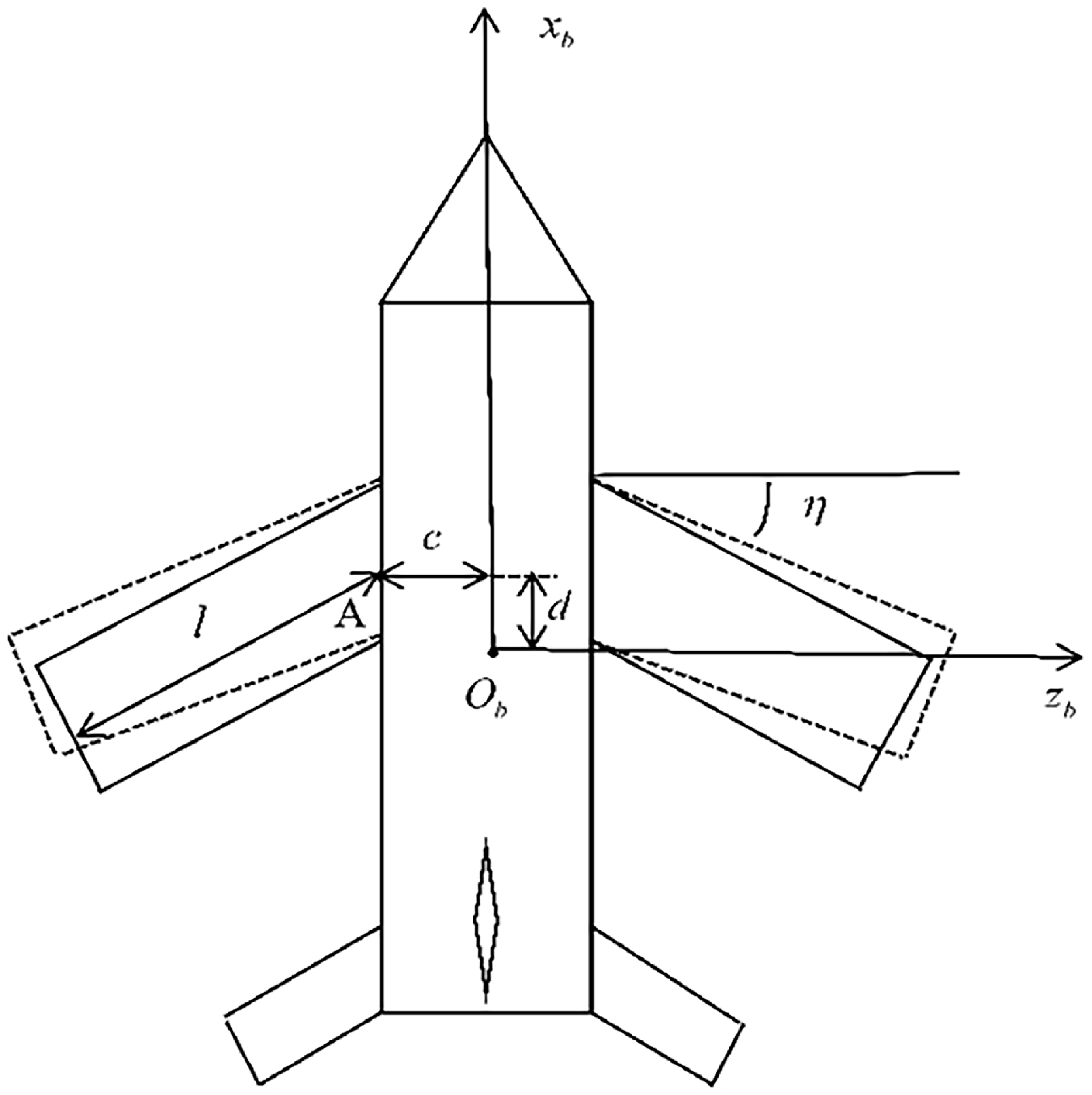
This study examines an HMV featuring a fixed fuselage coupled with a pair of symmetric variable-sweep wings. Figure 1 is a simplified schematic diagram of the HMV.
 ${O_b}{x_b}{y_b}{z_b}$
represents the body coordinate system.
 $\eta $
is the back-swept angle. The left swept-back wing can rotate relative to the fuselage about the axis passing through point A. The extended length of the swept wing is
 $l$
. The distances from the fuselage centre of mass
 ${O_b}$
to the connection point A between the fuselage and the wings in the
 ${x_b}$
and
 ${z_b}$
directions are denoted as
 $d$
and
 $c$
.
Diagram of a simplified HMV model.

Assumption 1. The left and right sides of the variable swept-back wing undergo symmetrical deformation in this study.
In order to accurately depict the changes in aerodynamic characteristics of the HMV resulting from variations in the sweep angle, including additional aerodynamic forces and moments, this paper introduces a six-degree-of-freedom model of the HMV using multi-body dynamics principles [Reference Zhang, Huang and Nie13, Reference Bao, Wang and Tang42]. The HMV attitude model can be established as:
 \begin{align*}&\!\!\left\{ \begin{array}{l}\dot \alpha = {\omega _z} + ({\omega _y}\sin \alpha - {\omega _x}\cos \alpha )\tan \beta + \dfrac{1}{{\cos \beta }}(\dot \chi \sin \mu \cos \gamma - \dot \gamma \cos \mu )\\[8pt]\dot \beta = {\omega _x}\sin \alpha + {\omega _y}\cos \alpha - (\dot \gamma \sin \mu + \dot \chi \cos \mu \cos \gamma )\\[8pt]\dot \mu = \dfrac{1}{{\cos \beta }}({\omega _x}\cos \alpha - {\omega _y}\sin \alpha ) - \dot \chi (\sin \gamma + \cos \gamma \sin \mu \tan \beta ) + \dot \gamma \cos \mu \tan \beta \\[18pt]{{\dot \omega }_x} = \dfrac{{{c_1}{M_x} + {c_3}{M_y} + {c_1}{c_2} + {c_3}{c_4}}}{{{c_5}{c_1} - {c_3}^2}}\\[18pt]{{\dot \omega }_y} = \dfrac{{{c_3}{M_x} + {c_5}{M_y} + {c_3}{c_7} + {c_5}{c_6}}}{{{c_5}{c_1} - {c_3}^2}}\\[18pt]{{\dot \omega }_z} = \dfrac{{{M_z} + {c_8}}}{{{c_9}}}\\[10pt]\dot V = \dfrac{{ - D}}{{{m_T}}} - g\sin \gamma - \omega _{\rm{e}}^2r({\rm{cos}}\phi {\rm{sin}}\phi {\rm{cos}}\chi {\rm{cos}}\gamma - {\rm{co}}{{\rm{s}}^2}\phi {\rm{sin}}\gamma )\\[10pt]\dot \gamma = \dfrac{1}{{{m_T}V}}(Z\cos \mu - C\sin \mu - {m_T}g\cos \gamma ) + \dfrac{{\omega _{\rm{e}}^2}}{V}r{\rm{cos}}\phi ({\rm{sin}}\phi {\rm{cos}}\chi {\rm{sin}}\gamma + {\rm{cos}}\phi {\rm{cos}}\gamma ) - 2{\omega _{\rm{e}}}{\rm{cos}}\phi {\rm{sin}}\chi \\[10pt]\dot \chi = \dfrac{1}{{ - {m_T}V\cos \gamma }}(Z\sin \mu + C\cos \mu ) + \dfrac{{\omega _{\rm{e}}^2}}{{V\cos \gamma }}r{\rm{sin}}\phi {\rm{cos}}\phi {\rm{sin}}\chi\\[15pt]\quad + 2\dfrac{{{\omega _{\rm{e}}}}}{{\cos \gamma }}({\rm{cos}}\phi {\rm{cos}}\chi {\rm{sin}}\gamma - {\rm{sin}}\phi {\rm{cos}}\gamma )\end{array} \right.\nonumber\\[5pt]{c_1} & = {J_{By}} + 2{J_{Wy}} - 2{m_W}\left( {{d^2} + {c^2} + {l^2} - 2dl\sin \eta + 2cl\cos \eta } \right)\nonumber\end{align*}
 \begin{align}{c_2} & = - {J_{Bxy}}{\omega _x}{\omega _z} - \left( {{J_{Bz}} + 2{J_{Wz}} - {J_{By}} - 2{J_{Wy}}} \right){\omega _y}{\omega _z} - {\rm{2}}{m_W}\left( {c + l\cos \eta } \right)\left( {{\omega _y}{\omega _z}\left( {c + l\cos \eta } \right) + 2{\omega _x}l\dot \eta \sin \eta } \right)\nonumber\\{c_3} & = {J_{Bxy}}\nonumber\\{c_4} & = {J_{Bxy}}{\omega _y}{\omega _z} - \left( {{J_{Bx}} + 2{J_{Wx}} - {J_{Bz}} - 2{J_{Wz}}} \right){\omega _x}{\omega _z} - {\rm{2}}{m_W}\left( {c + l\cos \eta } \right)\left( {2{\omega _y}l\dot \eta \sin \eta - {\omega _x}{\omega _z}\left( {c + l\cos \eta } \right)} \right)\nonumber\\ & - {\rm{2}}{m_W}\left( {d - l\sin \eta } \right)\left( {{{\dot V}_z} + {\omega _y}\left( { - {V_x} + 2l\dot \eta \cos \eta } \right) + {\omega _x}\left( {{V_y} + {\omega _z}\left( {d - l\sin \eta } \right)} \right)} \right)\nonumber\\{c_5} & = {J_{Bx}}{\rm{ + 2}}{J_{Wx}} - 2{m_W}{\left( {c + l\cos \eta } \right)^2}\nonumber\\{c_6} & = {J_{Bxy}}{\omega _y}{\omega _z} - \left( {{J_{Bx}} + 2{J_{Wx}} - {J_{Bz}} - 2{J_{Wz}}} \right){\omega _x}{\omega _z} - {\rm{2}}{m_W}\left( {d - l\sin \eta } \right)\left( \begin{array}{l}{{\dot V}_z} + {\omega _y}\left( { - {V_x} + 2l\dot \eta \cos \eta } \right)\nonumber\\[5pt] + {\omega _x}\left( {{V_y} + {\omega _z}\left( {d - l\sin \eta } \right)} \right)\end{array} \right)\nonumber\\[5pt]& - 2{m_W}\left( {c{\rm{ + }}l\cos \eta } \right)\left( {2{\omega _y}l\dot \eta \sin \eta - {\omega _x}{\omega _z}\left( {c + l\cos \eta } \right)} \right)\nonumber\\{c_7} & = - {J_{Bxy}}{\omega _x}{\omega _z} - \left( {{J_{Bz}} + 2{J_{Wz}} - {J_{By}} - 2{J_{Wy}}} \right){\omega _y}{\omega _z} - {\rm{2}}{m_W}\left( {c + l\cos \eta } \right)\left( {{\omega _y}{\omega _z}\left( {i + l\cos \eta } \right) + 2{\omega _x}l\dot \eta \sin \eta } \right)\nonumber\\[5pt]{c_8} & = {J_{Bxy}}( {{\omega _x}^2 - {\omega _y}^2} ) - ( {{J_{By}} + 2{J_{Wy}} - {J_{Bx}} - 2{J_{Wx}}} ){\omega _x}{\omega _y} + 2{m_W}\left( {d - l\sin \eta } \right)\left(\! \begin{array}{l}{{\dot V}_y} + {\omega _z}\left( {{V_x} - 2l\dot \eta \cos \eta } \right)\nonumber\\[5pt] - {\omega _x}( {{V_z} - {\omega _y}( {d - l\sin \eta } )} )\end{array}\! \right)\nonumber\\{c_9} & = {J_{Bz}} + 2{J_{Wz}} - 2{m_W}{\left( {d - l\sin \eta } \right)^2}\end{align}
where
 $\alpha $
,
 $\beta $
and
 $\mu $
are the angle-of-attack, sideslip angle and bank angle, respectively;
 $\gamma $
and
 $\chi $
are trajectory inclination angle and trajectory angle, respectively;
 ${\omega _x}$
,
 ${\omega _y}$
,
 ${\omega _z}$
are the roll, yaw and pitch angular velocities, respectively;
 $V$
,
 ${V_x}$
,
 ${V_y}$
and
 ${V_z}$
are the body centroid velocity and body centroid velocity about the
 $x$
,
 $y$
,
 $z$
axes, respectively;
 $g$
denotes the acceleration of gravity,
 $\phi $
denotes the current geocentric latitude,
 $r$
denotes the radial distance from the earth’s centre to the HMV’s centroid, and
 ${\omega _{\rm{e}}}$
represents the angular velocity of earth’s rotation;
 $D$
,
 $C$
,
 $Z$
are the drag force, lateral force, lift force;
 ${M_x}$
,
 ${M_y}$
,
 ${M_z}$
are the roll torque, yaw torque and pitch torque of the vehicle.
 ${m_T}$
and
 ${m_W}$
denote the total mass and swept-back wing mass, respectively;
 ${J_{Bx}}$
,
 ${J_{By}}$
,
 ${J_{Bz}}$
,
 ${J_{Bxy}}$
represent the moment inertia of the fuselage part.
 ${J_{Wx}}$
,
 ${J_{Wy}}$
,
 ${J_{Wz}}$
are the moment inertia of swept-back wing.
The aerodynamic moment can be described as Equation (2), where
 $Q$
,
 $L$
,
 ${S_{ref}}$
represent the dynamic pressure, reference length and reference area, respectively.
 ${\delta _x}$
,
 ${\delta _y}$
and
 ${\delta _z}$
represent actual three-axis control deflections.
 ${m_{x0}}$
,
 ${m_{y0}}$
,
 ${m_{z0}}$
represent the moment coefficients, which are functions of
 $\alpha $
,
 $\beta $
,
 $\eta $
and Mach number
 $Ma$
.
 $m_x^{{\delta _x}}$
,
 $m_x^{{\delta _y}}$
,
 $m_y^{{\delta _x}}$
,
 $m_y^{{\delta _y}}$
and
 $m_z^{{\delta _z}}$
denote the moment coefficients with respect to
 ${\delta _x}$
,
 ${\delta _y}$
and
 ${\delta _z}$
.
 \begin{align}{M_x} & = QL{S_{ref}}\left( {{m_{x0}} + m_x^{{\delta _x}}{\delta _x} + m_x^{{\delta _y}}{\delta _y}} \right)\nonumber\\[5pt]{M_y} & = QL{S_{ref}}\left( {{m_{y0}} + m_y^{{\delta _x}}{\delta _x} + m_y^{{\delta _y}}{\delta _y}} \right)\nonumber\\[5pt]{M_z} & = QL{S_{ref}}\left( {{m_{z0}} + m_z^{{\delta _z}}{\delta _z}} \right)\end{align}
Thus, combining Equations (1) and (2), the HMV model can be formulated as a state-space representation with a strict feedback structure, as shown below. Where
 $\unicode{x1D734} = {\left[ {\alpha ,\beta ,\mu } \right]^{\mathrm{T}}}$
,
 $\boldsymbol{\omega} = {\left[ {{\omega _x},{\omega _y},{\omega _z}} \right]^{\mathrm{T}}}$
,
 $\boldsymbol{u} = {\left[ {{\delta _x},{\delta _y},{\delta _z}} \right]^{\mathrm{T}}}$
,
 ${\boldsymbol{d}_1}$
and
 ${\boldsymbol{d}_2}$
represent the model uncertainties and external disturbances of the inner and outer loops, respectively.
 \begin{equation}\left\{ \begin{array}{l}\dot{\unicode{x1D734}} = {\boldsymbol{f}_1} + {\boldsymbol{g}_1}\boldsymbol\omega + {\boldsymbol{d}_1}\\[5pt]\dot{\boldsymbol\omega} = {\boldsymbol{f}_2} + {\boldsymbol{g}_2}\boldsymbol{u} + {\boldsymbol{d}_2}\end{array} \right.\end{equation}
 \begin{align*}{\boldsymbol{f}_1} = \left[ {\begin{array}{*{20}{c}}{\dfrac{1}{{\cos \beta }}(\dot \chi \sin \mu \cos \gamma - \dot \gamma \cos \mu )}\\[9pt]{ - (\dot \gamma \sin \mu + \dot \chi \cos \mu \cos \gamma )}\\[5pt]{ - \dot \chi (\sin \gamma + \cos \gamma \sin \mu \tan \beta ) + \dot \gamma \cos \mu \tan \beta }\end{array}} \right],{\boldsymbol{g}_1} = \left[ {\begin{array}{c@{\quad}c@{\quad}c}{ - \cos \alpha \tan \beta } & {}{\sin \alpha \tan \beta } & {} {}1\\[5pt]{\sin \alpha } & {} {}{\cos \alpha } & {} {}0\\[5pt]{\dfrac{{\cos \alpha }}{{\cos \beta }}} {} & {}{ - \dfrac{{\sin \alpha }}{{\cos \beta }}} & 0\end{array}} \right]\\\end{align*}
 \begin{align}{\boldsymbol{f}_2} & = \left[ {\begin{array}{c}{\dfrac{{{c_1}{c_2} + {c_3}{c_4}}}{{{c_5}{c_1} - {c_3}^2}}}\\[15pt]{\dfrac{{{c_3}{c_7} + {c_5}{c_6}}}{{{c_5}{c_1} - {c_3}^2}}}\\[15pt]{\dfrac{{{c_8}}}{{{c_9}}}}\end{array}} \right] + QL{S_{ref}}\left[ {\begin{array}{c@{\quad}c@{\quad}c}{\dfrac{{{c_1}}}{{{c_5}{c_1} - {c_3}^2}}} & {\dfrac{{{c_3}}}{{{c_5}{c_1} - {c_3}^2}}} & 0\\[15pt]{\dfrac{{{c_3}}}{{{c_5}{c_1} - {c_3}^2}}} & {\dfrac{{{c_5}}}{{{c_5}{c_1} - {c_3}^2}}} & 0\\[15pt]0 & {}0 & {}{\dfrac{1}{{{c_9}}}}\end{array}} \right]\left[ {\begin{array}{c}{{m_{x0}}}\\[5pt]{{m_{y0}}}\\[5pt]{{m_{z0}}}\end{array}} \right]\nonumber\\[10pt]{\boldsymbol{g}_2} & = QL{S_{ref}}\left[ {\begin{array}{c@{\quad}c@{\quad}c}{\dfrac{{{c_1}}}{{{c_5}{c_1} - {c_3}^2}}} & {\dfrac{{{c_3}}}{{{c_5}{c_1} - {c_3}^2}}} {} & 0\\[15pt]{\dfrac{{{c_3}}}{{{c_5}{c_1} - {c_3}^2}}} {} & {\dfrac{{{c_5}}}{{{c_5}{c_1} - {c_3}^2}}} & {}0\\[15pt]0 {} & 0 & {}{\dfrac{1}{{{c_9}}}}\end{array}} \right]\left[ {\begin{array}{c@{\quad}c@{\quad}c}{m_x^{{\delta _x}}} & {}{m_x^{{\delta _y}}} & {}0\\[5pt]{m_y^{{\delta _x}}} & {}{m_y^{{\delta _y}}} & {}0\\[5pt]0 & {}0 & {}{m_z^{{\delta _z}}}\end{array}} \right]\end{align}
2.2 Control-oriented model
Selecting state tracking error vector as
 ${\boldsymbol{x}_1} = \unicode{x1D734} - {\unicode{x1D734} _d} = {\left[ {\Delta \alpha , \Delta \beta , \Delta \mu } \right]^{\mathrm{T}}}$
,
 ${\boldsymbol{x}_2} = \dot{\unicode{x1D734}} - {\dot{\unicode{x1D734}}_d} = {\left[ {\Delta \dot \alpha , \Delta \dot \beta , \Delta \dot \mu } \right]^{\mathrm{T}}}$
, where
 ${\unicode{x1D734} _d} = {\left[ {{\alpha _d}, {\beta _d}, {\mu _d}} \right]^{\mathrm{T}}}$
and
 ${\dot{\unicode{x1D734}}_d} = {\left[ {{{\dot \alpha }_d}, {{\dot \beta }_d}, {{\dot \mu }_d}} \right]^{\mathrm{T}}}$
represent the command of the attitude angle and its rate of change, respectively. Therefore, the state tracking error model of the hypersonic morphing vehicle is given as the following form:
 \begin{align}& \quad \left\{ \begin{array}{l}{{\dot{\boldsymbol{x}}}_1} = {\boldsymbol{x}_2}\\[3pt]{{\dot{\boldsymbol{x}}}_2} = \boldsymbol{F} + \boldsymbol{Gsat}\left( {{\boldsymbol{u}_c}} \right) + \boldsymbol{d}\end{array} \right.\nonumber\\[6pt]\boldsymbol{sat}\left( {{u_{ci}}} \right) & = \left\{ \begin{array}{l}{u_{\max }},{u_{ci}} \gt {u_{\max }}\\[3pt]{u_{ci}},{u_{\min }} \lt {u_{ci}} \lt {u_{\max }}\\[3pt] - {u_{\min }},{u_{ci}} \lt - {u_{\min }}\end{array} \right.\end{align}
where
 $\boldsymbol{F} = {\boldsymbol{g}_1}\,{\boldsymbol{f}_2}$
,
 $\boldsymbol{G} = {\boldsymbol{g}_1}{\boldsymbol{g}_2}$
and
 $\boldsymbol{d} = {\dot{\boldsymbol{f}}_1} + {\dot{\boldsymbol{g}}_1}\boldsymbol\omega + {\boldsymbol{g}_1}{\boldsymbol{d}_2} + {\dot{\boldsymbol{d}}_1} - {\ddot{\unicode{x1D734}}_d}$
, while
 ${u_{\max }}$
and
 ${u_{\min }}$
denote the minimum and maximum limits of fin deflection,
 ${\boldsymbol{u}_c} = {\left[ {{u_{c1}},{u_{c2}},{u_{c3}}} \right]^{\mathrm{T}}}$
denote the desired fin deflection. Define
 $\Delta \boldsymbol{u} = \boldsymbol{u} - {\boldsymbol{u}_c}$
, which will be used in the anti-saturation auxiliary system.
Assumption 2.
Assuming that the lumped disturbance
 $\boldsymbol{d}$
acting on the HMV are continuous and bounded.
3.0 Controller design
In this section, the control target is to construct a predefined-time anti-saturation compensator-based controller that enables the state errors to converge to a residual set around the zero within a predefined time, despite the morphing process, external disturbances and parametric perturbations. Figure 2 shows the structure diagram of the proposed controller design scheme.
Structure diagram of proposed controller design scheme.

3.1 Definitions and lemmas
Lemma 1. For the given system [Reference Riaz, Li, Qi and Zhang43]
 $\dot{\boldsymbol{x}} = \boldsymbol{f}({\boldsymbol{x}(t)}),\boldsymbol{x}(0) = {\boldsymbol{x}_{\rm{0}}} \in {{\mathbb R}^n},\boldsymbol{x} \in {{\mathbb R}^n}$
, where
 $\boldsymbol{f}$
is a continuous nonlinear function on
 ${\mathbb R}^n$
. If there exists a positive-definite Lyapunov function
 $V(\boldsymbol{x})$
such that
 \begin{equation}\dot V(\boldsymbol{x}) \le - \frac{\boldsymbol{\pi} }{{rT\sqrt {ab} }}\left( {aV{{(\boldsymbol{x})}^{1 + \frac{r}{2}}} + bV{{(\boldsymbol{x})}^{1 - \frac{r}{2}}}} \right)\end{equation}
where
 $0 \lt r \lt 1$
and
 $\mathrm{T} \gt 0$
,
 $a \gt 0$
,
 $b \gt 0$
. Then, the origin serves as a globally predefined-time stable equilibrium for the system under consideration, with
 $T$
representing the predefined time, namely,
 $\boldsymbol{x}$
converge to origin within
 $t \le \mathrm{T}$
.
Lemma 2. For
 $\forall {x_i},i = 1,2, \cdots n$
,
 $0 \lt a \lt 1$
,
 $b \gt 1$
, we have
 \begin{equation}{\left( {\sum\limits_{i = 1}^n {\left| {{x_1}} \right|} } \right)^a} \le \sum\limits_{i = 1}^n {{{\left| {{x_1}} \right|}^a}} ,{\rm{ }}{\left( {\sum\limits_{i = 1}^n {\left| {{x_1}} \right|} } \right)^b} \le {n^{b - 1}}\sum\limits_{i = 1}^n {{{\left| {{x_1}} \right|}^b}} \end{equation}
3.2 Predefined-time disturbance observer
In this section, we will introduce a predefined-time disturbance observer combined with an RBF neural network. The observer can accurately estimate the lumped disturbances during flight, including model uncertainties and external disturbances, thereby enhancing the robustness of the control system.
The observer system is constructed as follows
 \begin{equation}\dot{\boldsymbol{Z}} = {\boldsymbol{F}} + {\boldsymbol{Gu}} + \hat{{\boldsymbol{d}}} + {k_1}{{\boldsymbol{e}}_z} + {k_2}\mathrm{sgn}( {{{\boldsymbol{e}}_z}}) + \frac{\boldsymbol{\pi} }{{{\rm{2}}{r_1}{\mathrm{T}_d}}}\left( {1 + {{\left\| {{{\boldsymbol{e}}_z}} \right\|}^{2{r_1}}}} \right)\frac{{{{\boldsymbol{e}}_z}}}{{{{\left\| {{{\boldsymbol{e}}_z}} \right\|}^{{r_1}}}}}\end{equation}
Noting that
 ${k_1}$
and
 ${k_2}$
are positive constant,
 $0 \lt {r_1} \lt 1$
,
 ${T_d}$
is the user-defined time. The states
 ${\boldsymbol{Z}}$
denote the estimation of states
 ${{\boldsymbol{x}}_2}$
,
 ${{\boldsymbol{e}}_z} = {{\boldsymbol{x}}_2} - {\boldsymbol{Z}}$
,
 $\hat{{\boldsymbol{d}}}$
is the approximation of lumped disturbance.
Then, we have
 \begin{equation}\hat{{\boldsymbol{d}}} = {\hat{{\boldsymbol{W}}}^{\mathrm{T}}}{\boldsymbol{h}}( {{{\boldsymbol{e}}_z}})\end{equation}
 \begin{align}{h_i}( {{{\boldsymbol{e}}_z}}) & = \exp \left( { - \frac{{{{\left\| {{{\boldsymbol{e}}_z} - {{\boldsymbol{c}}_i}} \right\|}^2}}}{{2{b^2}}}} \right),0 \le i \le N\nonumber\\{\boldsymbol{h}}( {{{\boldsymbol{e}}_z}}) & = {\left[ {{h_1}( {{{\boldsymbol{e}}_z}}),{h_2}( {{{\boldsymbol{e}}_z}}), \ldots ,{h_N}( {{{\boldsymbol{e}}_z}})} \right]^{\mathrm{T}}}\end{align}
where
 $\hat{\boldsymbol{W}} \in {{\boldsymbol{R}}^{N \times 3}}$
is the weight matrix and
 ${{\boldsymbol{c}}_i} \in {\boldsymbol{R}^{3 \times 1}}$
is the
 $i$
-th column of
 ${\boldsymbol{c}} \in {\boldsymbol{R}^{3 \times N}}$
. According to Ref. [Reference Cheng, Zhang, Jiang and Simani36], there is an optimal weight matrix available. Suppose that
 ${\left\| {{{\boldsymbol{W}}^*}} \right\|_F} \le \bar W$
and
 $\left\| \boldsymbol\varepsilon \right\| \le \bar \varepsilon $
, we can get:
 \begin{equation}{\boldsymbol{d}} = {{\boldsymbol{W}}^*}^{\mathrm{T}}{\boldsymbol{h}}( {{{\boldsymbol{e}}_z}}) + \boldsymbol\varepsilon \end{equation}
Denote
 $\tilde{{\boldsymbol{W}}} = {{\boldsymbol{W}}^ * } - \hat{{\boldsymbol{W}}}$
as the estimation error of optimal weight matrix.
Theorem 1. Taking into account the following adaptive law:
 \begin{equation}\dot{\hat{{\boldsymbol{W}}}} = \unicode{x1D71E} \big( {{\boldsymbol{h}}( {{{\boldsymbol{e}}_z}}){{\boldsymbol{e}}_z}^{\rm{T}} - {\mu _w}\hat{{\boldsymbol{W}}}} \big)\end{equation}
where
 $\unicode{x1D71E} \in {{\boldsymbol{R}}^{N \times N}}$
is the constant symmetric positive definite matrices.
 $\mu \gt 0$
is the constant parameters. We can conclude that the state and disturbance estimation errors
 $( {{{\boldsymbol{e}}_z},\tilde{\boldsymbol{d}}})$
will converge to the zero accurately within
 ${T_d}$
, if parameters are chosen reasonably.
Proof. For brevity, the proof of Theorem 1 is broken down into the following two steps.
Step 1: Initially, the uniform stability is examined. Let the candidate Lyapunov function be defined as follows.
 \begin{equation}{V_1} = \frac{1}{2}{\boldsymbol{e}_z}^{\mathrm{T}}{\boldsymbol{e}_z} + \frac{1}{2}tr\big({\tilde{\boldsymbol{W}}^{\mathrm{T}}}{\unicode{x1D71E} ^{ - 1}}\tilde{\boldsymbol{W}}\big)\end{equation}
According to the adaptive law designed in Equation (12), taking the derivative of
 ${V_1}$
, we have
 \begin{align}{{\dot V}_1} & = {\boldsymbol{e}_z}^{\mathrm{T}}{{\dot{\boldsymbol{e}}}_z} - tr\Big( {{{\tilde{\boldsymbol{W}}}^{\mathrm{T}}}{\unicode{x1D71E} ^{ - 1}}\dot{\hat{\boldsymbol{W}}}} \Big)\nonumber\\[5pt]& = {\boldsymbol{e}_z}^{\mathrm{T}}\left( {{{\tilde{\boldsymbol{W}}}^{\mathrm{T}}}\boldsymbol{h}\left( {{\boldsymbol{e}_z}} \right) + \boldsymbol\varepsilon - {k_1}{\boldsymbol{e}_z} - {k_2}\mathrm{sgn}\left( {{\boldsymbol{e}_z}} \right) - \frac{\boldsymbol{\pi} }{{{\rm{2}}{r_1}{\mathrm{T}_d}}}\left( {1 + {{\left\| {{\boldsymbol{e}_z}} \right\|}^{2{r_1}}}} \right)\frac{{{\boldsymbol{e}_z}}}{{{{\left\| {{\boldsymbol{e}_z}} \right\|}^{{r_1}}}}}} \right)\nonumber\\[5pt]& - \mathrm{tr}\Big( {{{\tilde{\boldsymbol{W}}}^{\mathrm{T}}}\boldsymbol{h}\left( {{\boldsymbol{e}_z}} \right){\boldsymbol{e}_z}^{\mathrm{T}}} \Big) + {\mu _w}\mathrm{tr}\big( {{{\tilde{\boldsymbol{W}}}^{\mathrm{T}}}\hat{\boldsymbol{W}}} \big)\end{align}
Note that
 ${\boldsymbol{e}_z}^{\mathrm{T}}{\tilde{\boldsymbol{W}}^{\mathrm{T}}}\boldsymbol{h}( {{\boldsymbol{e}_z}} ) = \mathrm{tr}( {{{\tilde{\boldsymbol{W}}}^{\mathrm{T}}}\boldsymbol{h}( {{\boldsymbol{e}_z}} ){\boldsymbol{e}_z}^{\mathrm{T}}} )$
and
 ${\boldsymbol{e}_z}^{\mathrm{T}}\left( {{k_2}sgn( {{\boldsymbol{e}_z}} ) + \frac{\boldsymbol{\pi} }{{{\rm{2}}{r_1}{T_d}}}( {1 + {{\| {{\boldsymbol{e}_z}} \|}^{2{r_1}}}} )\frac{{{\boldsymbol{e}_z}}}{{{{\| {{\boldsymbol{e}_z}} \|}^{{r_1}}}}}} \right) \ge 0$
always holds. By using Young’s inequality and
 $\mathrm{tr}( {{{\tilde{\boldsymbol{W}}}^{\mathrm{T}}}\hat{\boldsymbol{W}}} ) \le \frac{1}{2}\mathrm{tr}( {{\boldsymbol{W}^{ * T}}{\boldsymbol{W}^ * }} ) - \frac{1}{2}\mathrm{tr}( {{{\tilde{\boldsymbol{W}}}^{\mathrm{T}}}\tilde{\boldsymbol{W}}} )$
, we can obtain that
 \begin{align}{{\dot V}_1} & \le \frac{1}{2}{\| {{\boldsymbol{e}_z}} \|^2} + \frac{1}{2}{\| \boldsymbol\varepsilon \|^2} - {k_1}{\| {{e_z}} \|^2} + {\mu _w}\left( {\frac{1}{2}\mathrm{tr}( {{\boldsymbol{W}^{ * T}}{\boldsymbol{W}^ * }} ) - \frac{1}{2}\mathrm{tr}( {{{\tilde{\boldsymbol{W}}}^{\mathrm{T}}}\tilde{\boldsymbol{W}}} )} \right)\nonumber\\[5pt] & \le - {k_1}{\| {{\boldsymbol{e}_z}} \|^2} - \frac{{{\mu _w}}}{2}\mathrm{tr} \big( {{{\tilde{\boldsymbol{W}}}^{\mathrm{T}}}\tilde{\boldsymbol{W}}} \big) + \frac{1}{2}{\| \boldsymbol\varepsilon \|^2} + \frac{{{\mu _w}}}{2}\mathrm{tr}( {{\boldsymbol{W}^{ * T}}{\boldsymbol{W}^ * }} )\nonumber\\[5pt] & \le - {k_1}{\| {{\boldsymbol{e}_z}} \|^2} - \frac{{{\mu _w}}}{2}\mathrm{tr} \big( {{{\tilde{\boldsymbol{W}}}^{\mathrm{T}}}\tilde{\boldsymbol{W}}} \big) + {\kappa _1}\end{align}
where
 ${\lambda _1} = {k_1} - \frac{1}{2}$
,
 ${\kappa _1} = \frac{1}{2}{\bar \varepsilon ^2} + \frac{{{\mu _w}}}{2}{\bar W^2}$
. By choosing
 ${k_1} \gt \frac{1}{2}$
and
 ${\mu _w} \gt {\frac{{2{k_1}}}{{\left\| {{{\unicode{x1D71E}}^{ - 1}}} \right\|}}_F}$
, we have
 \begin{equation}{\dot V_1} \le - 2{\lambda _1}{V_1} + {\kappa _1}\end{equation}
Therefore, we can conclude that the estimation deviations
 ${\boldsymbol{e}_z}$
and
 $\tilde{\boldsymbol{W}}$
are ultimately uniformly bounded. Hence,
 $\tilde{\boldsymbol{d}} = {\tilde{\boldsymbol{W}}^{\mathrm{T}}}\boldsymbol{h}\left( {{\boldsymbol{e}_\boldsymbol{z}}} \right) + {\boldsymbol{\varepsilon}}$
is also bounded.
Step 2: In the following, let us prove that the estimation errors
 ${\boldsymbol{e}_z}$
and
 $\tilde{\boldsymbol{d}}$
can converge to the zero within
 ${T_d}$
. Consider the following Lyapunov function:
 \begin{equation}{V_2} = {\boldsymbol{e}_{\boldsymbol{z}}}^{\mathrm{T}}{\boldsymbol{e}_\boldsymbol{z}}\end{equation}
Based on the Equation (16), we conclude that the
 ${\tilde{\boldsymbol{W}}^{\mathrm{T}}}\boldsymbol{h}\left( {{\boldsymbol{e}_\boldsymbol{z}}} \right) + {\boldsymbol{\varepsilon}}$
is bounded. Therefore, by choosing proper
 ${\lambda _2}$
satisfying
 ${\boldsymbol{e}_{\boldsymbol{z}}}^{\mathrm{T}} ( {{{\tilde{\boldsymbol{W}}}^{\mathrm{T}}}\boldsymbol{h}\left( {{\boldsymbol{e}_z}} \right) + \boldsymbol\varepsilon - {k_2}\mathrm{sgn}\left( {{\boldsymbol{e}_z}} \right)} ) \le 0$
, we can obtain that
 \begin{align}{{\dot V}_2} & = 2{\boldsymbol{e}_\boldsymbol{z}}^{\mathrm{T}}\left( {{{\tilde{\boldsymbol{W}}}^{\mathrm{T}}}\boldsymbol{h}\left( {{\boldsymbol{e}_z}} \right) + \boldsymbol\varepsilon - {k_1}{\boldsymbol{e}_z} - {k_2}\mathrm{sgn}\left( {{\boldsymbol{e}_{\boldsymbol{z}}}} \right) - \frac{\boldsymbol{\pi} }{{2{r_1}{T_d}}}\left( {1 + {{\left\| {{\boldsymbol{e}_{\boldsymbol{z}}}} \right\|}^{2{r_1}}}} \right)\frac{{{\boldsymbol{e}_{\boldsymbol{z}}}}}{{{{\left\| {{\boldsymbol{e}_{\boldsymbol{z}}}} \right\|}^{{r_1}}}}}} \right)\nonumber\\ & \le 2{\boldsymbol{e}_\boldsymbol{z}}^{\mathrm{T}}\left( {{{\tilde{\boldsymbol{W}}}^{\mathrm{T}}}\boldsymbol{h}\left( {{\boldsymbol{e}_z}} \right) + \boldsymbol\varepsilon - {k_2}\mathrm{sgn}\left( {{\boldsymbol{e}_z}} \right) - \frac{\boldsymbol{\pi} }{{2{r_1}{T_d}}}\left( {1 + {{\left\| {{\boldsymbol{e}_{\boldsymbol{z}}}} \right\|}^{2{r_1}}}} \right)\frac{{{\boldsymbol{e}_{\boldsymbol{z}}}}}{{{{\left\| {{\boldsymbol{e}_{\boldsymbol{z}}}} \right\|}^{{r_1}}}}}} \right)\nonumber\\ & \le - \frac{\boldsymbol{\pi} }{{{r_1}{T_d}}}\left( {{{\left\| {{\boldsymbol{e}_\boldsymbol{z}}} \right\|}^{2 + {r_1}}} + {{\left\| {{\boldsymbol{e}_\boldsymbol{z}}} \right\|}^{2 - {r_1}}}} \right)\nonumber\\ & \le - \frac{\boldsymbol{\pi} }{{{r_1}{T_d}}}\left( {{V_2}^{1 - \frac{{{r_1}}}{2}} + {V_2}^{1 + \frac{{{r_1}}}{2}}} \right)\end{align}
Following Lemma 1, it is inferred that the state errors
 ${\boldsymbol{e}_\boldsymbol{z}}$
can regulate to the origin within predefined time
 ${T_d}$
. Combined with Equation (8), there is:
 \begin{equation}{\dot{\boldsymbol{e}}_\boldsymbol{z}} = \tilde{\boldsymbol{d}} - {k_1}{\boldsymbol{e}_{\boldsymbol{z}}} - {k_2}\mathrm{sgn}\left( {{\boldsymbol{e}_z}} \right) - \frac{\boldsymbol{\pi} }{{{\rm{2}}{r_1}{T_d}}}\left( {1 + {{\left\| {{\boldsymbol{e}_z}} \right\|}^{2{r_1}}}} \right)\frac{{{\boldsymbol{e}_z}}}{{{{\left\| {{\boldsymbol{e}_z}} \right\|}^{{r_1}}}}}\end{equation}
Since
 ${\boldsymbol{e}_\boldsymbol{z}}$
will converge to the origin, combining with Equation (19), we get
 $\tilde{\boldsymbol{d}} = 0$
. The proof is complete.
Remark 1. Compared with finite/fixed-time observers, the proposed disturbance observer guarantees accurate estimation of the lumped disturbance within a predefined time. This convergence time is independent of the initial conditions and is straightforward to configure. Furthermore, by leveraging the approximation capabilities of a neural network, the system exhibits enhanced robustness against model uncertainties and external disturbances.
3.3 Predefined-time anti-saturation controller
In order to ensure that the attitude tracking error converges to zero with input constraint and address singularity issues, a nonsingular predefined-time anti-saturation sliding mode controller has been developed.
Firstly, the nonsingular predefined-time sliding mode (NPTSM) manifold is established as
 \begin{align}\boldsymbol{s} & = {\left[ {{s_{\rm{1}}},{s_{\rm{2}}},{s_{\rm{3}}}} \right]^{\rm{T}}},\bar{\boldsymbol{s}} = {\left[ {{{\bar s}_{\rm{1}}},{{\bar s}_{\rm{2}}},{{\bar s}_{\rm{3}}}} \right]^{\rm{T}}}\nonumber\\[5pt]{s_i} & = \left\{ \begin{array}{l@{\quad}l}{{\bar s}_i} & {{\bar s}_i} = 0\ and\ {{\bar s}_i} \ne 0,\left| {{x_{1i}}} \right| \ge \varepsilon \\[5pt]{x_{2i}} + \dfrac{{{e^{{{\left| {{x_{1i}}} \right|}^{{r_2}}}}}}}{{{r_2}{T_s}}}\left( {{l_1}{x_{1i}} + {l_2}\mathrm{sig}{{\left( {{x_{1i}}} \right)}^2}} \right) & {{\bar s}_i} \ne 0,\left| {{x_{1i}}} \right| \lt \varepsilon \end{array} \right.\nonumber\\[5pt]{{\bar s}_i} & = {x_{2i}} + \frac{{{e^{{{\left| {{x_{1i}}} \right|}^{{r_2}}}}}}}{{{r_2}{\mathrm{T}_s}}}\mathrm{sig}{\left( {{x_{1i}}} \right)^{1 - {r_2}}}\end{align}
where
 ${T_s} \gt 0$
and
 $0 \lt {r_2} \lt 1$
,
 $\varepsilon \gt 0$
is a small positive constant,
 ${l_1} = \left( {1 + {r_2}} \right){\varepsilon ^{ - {r_2}}}$
,
 ${l_2} = - {r_2}{\varepsilon ^{ - 1 - {r_2}}}$
.
Theorem 2.
Consider the sliding manifold
 $s = 0$
in Equation (20), once the NPTSM surface is reached,
 ${\boldsymbol{x}_1}$
and
 ${\boldsymbol{x}_2}$
converge to the neighbourhoods of the origin,
 ${\Omega^{\prime}_{1}} = \left\{ {{\boldsymbol{x}_1}|\left| {{x_{1i}}} \right| \le \varepsilon } \right\}$
,
 ${\Omega _2} = \left\{ {{\boldsymbol{x}_2}|\left| {{x_{{\rm{2}}i}}} \right| \le \frac{{{e^{{{\left| \varepsilon \right|}^{{r_2}}}}}}}{{{r_2}{T_s}}}\mathrm{sig}{{(\varepsilon)}^{{\rm{1}} - {r_2}}}} \right\}$
within
 ${\mathrm{T}_s}$
.
Proof.
In the sliding mode, we have
 $s \equiv 0$
. Firstly, when
 $\boldsymbol{s} = \bar{\boldsymbol{s}} = 0$
, we have
 \begin{equation}{x_{2i}} = - \frac{{{e^{\left| {{x_{1i}}} \right|}}^{^{{r_2}}}}}{{{r_2}{T_s}}}\mathrm{sig}{\left( {{x_{1i}}} \right)^{1 - {r_2}}}\end{equation}
Choose the Lyapunov function candidate:
 ${V_{31}} = \mathop \sum \limits_{i = {\rm{1}}}^{\rm{3}} {V_{31i}} = \mathop \sum \limits_{i = {\rm{1}}}^{\rm{3}} {x_{1i}}^2$
, and take the time-derivative of
 ${V_{{\rm{31}}}}$
, it yields to
 \begin{equation}{\dot V_{31}} = \mathop \sum \limits_{i = {\rm{1}}}^{\rm{3}} {\dot V_{31i}} = - \mathop \sum \limits_{i = {\rm{1}}}^{\rm{3}} \frac{{{e^{{{\left( {{V_{31i}}} \right)}^{\frac{{2 - {r_2}}}{2}}}}}}}{{{r_2}{T_s}}}{e^{{{\left( {{V_{31i}}} \right)}^{\frac{{2 - {r_2}}}{2}}}}}\end{equation}
For the
 $i$
th joint, there is
 ${\dot V_{31i}} = - \frac{{{e^{{{\left( {{V_{31i}}} \right)}^{\frac{{{r_2}}}{2}}}}}}}{{{r_2}{T_s}}}{e^{{{\left( {{V_{31i}}} \right)}^{\frac{{2 - {r_2}}}{2}}}}}$
. Suppose that at time
 ${t_i}$
,
 ${V_{31i}}\left( {{t_i}} \right) = 0$
, then the convergence time of tracking errors is calculated as
 \begin{equation}{t_i}{\rm{ = }}{{\rm{T}}_s}\Bigg( {1 - {e^{\Big( { - {{\left( {{V_{31i}}} \right)}^{\frac{{{r_2}}}{2}}}} \Big)}}} \Bigg) \le {{\rm{T}}_s}\end{equation}
Therefore, at time
 $t = \max \left( {{t_i}} \right)$
,
 ${V_{31}}(t) = 0$
. Now we can conclude that the states
 $\left( {{\boldsymbol{x}_1},{\boldsymbol{x}_2}} \right)$
converge to the origin in no more than the predefined time
 ${\mathrm{T}_{\mathrm{s}}}$
while on the sliding manifold
 $\boldsymbol{s} = \bar{\boldsymbol{s}} = 0$
.
Secondly, in the case that
 $\boldsymbol{s} = {\rm{0}}, \bar s \ne 0$
, according to the Equation (20), it is inferred that
 ${\boldsymbol{x}_1}$
and
 ${\boldsymbol{x}_2}$
are within the neighbourhoods of the origin
 ${\Omega^{\prime}_{1}}$
,
 ${\Omega _2}$
. Then, we choose the Lyapunov function candidate:
 ${V_{32}} = \mathop \sum \limits_{i = {\rm{1}}}^{\rm{3}} {V_{32i}} = \mathop \sum \limits_{i = {\rm{1}}}^{\rm{3}} \frac{{\rm{1}}}{{\rm{2}}}{x_{1i}}^2$
and take the time-derivative of
 ${V_{{\rm{32}}}}$
, it yields to
 \begin{equation}{\dot V_{32}} = \mathop \sum \limits_{i = {\rm{1}}}^{\rm{3}} {\dot V_{32i}} = \mathop \sum \limits_{i = {\rm{1}}}^{\rm{3}} {x_{1i}}{\dot x_{1i}} = - \mathop \sum \limits_{i = {\rm{1}}}^{\rm{3}} \frac{{{e^{\left| {{x_{1i}}} \right|}}^{^{{r_2}}}}}{{{r_2}{T_s}}}\left( {{l_1}{x_{1i}}^2 + {l_2}{{\left| {{x_{1i}}} \right|}^3}} \right)\end{equation}
It is evident that when
 $\left| {{x_{1i}}} \right| \in \left[ {\left. {0,\frac{{2\left( {1 + {r_2}} \right)\varepsilon }}{{3{r_2}}}} \right)} \right.$
, the function
 $ - \left( {{l_1}{x_{1i}}^2 + {l_2}{{\left| {{x_{1i}}} \right|}^3}} \right)$
is monotonically decreasing. Notice that
 $\varepsilon \lt \frac{{2\left( {1 + {r_2}} \right)\varepsilon }}{{3{r_2}}}$
, hence, it can be obtained that
 $ - \left( {{l_1}{x_{1i}}^2 + {l_2}{{\left| {{x_{1i}}} \right|}^3}} \right) \le 0$
always holds when
 $\left| {{x_{1i}}} \right| \le \varepsilon $
. Furthermore, we can get that
 ${\dot V_{32}} \le 0\ \forall \left| {{x_{1i}}} \right| \le \varepsilon $
, which will drive
 ${\boldsymbol{x}_1}$
and
 ${\boldsymbol{x}_2}$
to the origin asymptotially.
From the results in the two cases, we can conclude that once the sliding mode surface
 $\boldsymbol{s} \equiv 0$
is reached,
 ${\boldsymbol{x}_1}$
and
 ${\boldsymbol{x}_2}$
will converge to the neighbourhoods of the origin,
 ${\Omega^{\prime}_{1}} = \left\{ {{\boldsymbol{x}_1}|\left| {{x_{1i}}} \right| \le \varepsilon } \right\}$
,
 ${\Omega _2} = \left\{ {{x_2}|\left| {{x_{{\rm{2}}i}}} \right| \le \frac{{{e^{\left| \varepsilon \right|}}^{^{{r_2}}}}}{{{r_2}{T_s}}}\mathrm{sig}{{(\varepsilon)}^{1 - {r_2}}}} \right\}$
within
 ${\mathrm{T}_s}$
. The proof is complete.
Remark 2. In this paper, we construct a nonsingular predefined-time sliding mode manifold, a piecewise function is constructed to solve singularity problems and get faster convergence rate. According to Theorem 2, it is inferred that when the user-defined time
 ${T_s}$
is given, the final tracking errors will decrease by choosing proper
 ${r_2}$
and a small positive number
 $\varepsilon $
.
Based on the NPTSM surface, we can design the following disturbance-based predfined-time anti-saturation controller:
 \begin{align}{\boldsymbol{u}_c} & = {\boldsymbol{G}^{{\rm{ - 1}}}}\left( \begin{array}{l} - \boldsymbol{F} - \hat{\boldsymbol{d}} - \boldsymbol{R} - \dfrac{\boldsymbol{\pi} }{{2{r_3}{{\rm{T}}_c}}}\left( {{a_1}{3^{\frac{{{r_3}}}{2}}}{\rm{sig}}{{(\boldsymbol\chi)}^{1 + {r_3}}} + {b_1}{\rm{sig}}{{(\boldsymbol\chi)}^{1 - {r_3}}}} \right)\\[15pt] - \dfrac{1}{2}\boldsymbol\chi - \dfrac{\boldsymbol{\pi} }{{2{r_4}{{\rm{T}}_\xi }}}\left( {{a_2}{3^{\frac{{{r_4}}}{2}}}{\rm{sig}}{{\left( {\boldsymbol{\xi }} \right)}^{1 + {r_4}}} + {b_2}{\rm{sig}}{{\left( {\boldsymbol{\xi }} \right)}^{1 - {r_4}}}} \right)\end{array} \right)\\[10pt] {R_i} & = \left\{ \begin{array}{l@{\quad}l}\dfrac{{1 - {r_2}}}{{{r_2}{{\rm{T}}_s}}}{e^{{{\left| {{x_{1i}}} \right|}^{{r_2}}}}}{\left| {{x_{1i}}} \right|^{ - {r_2}}}{x_{2i}} + \dfrac{1}{{{{\rm{T}}_s}}}{e^{{{\left| {{x_{1i}}} \right|}^{{r_2}}}}}{x_{2i}} & {{\bar s}_i} = 0\ and\ {{\bar s}_i} \ne 0,\left| {{x_{1i}}} \right| \ge \varepsilon \\[15pt] \dfrac{{\mathrm{sig}{{\left( {{x_{1i}}} \right)}^{{r_2} - 1}}{x_{2i}}{e^{{{\left| {{x_{1i}}} \right|}^{{r_2}}}}}}}{{{\mathrm{T}_s}}}\left( {{l_1}{x_{1i}} + {l_2}\mathrm{sig}{{\left( {{x_{1i}}} \right)}^2}} \right) + \dfrac{{{e^{{{\left| {{x_{1i}}} \right|}^{{r_2}}}}}}}{{{r_2}{\mathrm{T}_s}}}\left( {{l_1}{x_{2i}} + 2{l_2}\left| {{x_{1i}}} \right|{x_{2i}}} \right) & {{\bar s}_i} \ne 0,\left| {{x_{1i}}} \right| \lt \varepsilon \end{array} \right.\nonumber\end{align}
 \begin{equation}\dot{\boldsymbol\xi} = - \frac{\boldsymbol{\pi} }{{2{r_4}{{\rm{T}}_\xi }\sqrt {{a_2}{b_2}} }}\left( {{a_2}{3^{\frac{{{r_4}}}{2}}}{\rm{sig}}{{\left( {\boldsymbol{\xi }} \right)}^{1 + {r_4}}} + {b_2}{\rm{sig}}{{\left( {\boldsymbol{\xi }} \right)}^{1 - {r_4}}}} \right) + \boldsymbol{G}\Delta \boldsymbol{u}\end{equation}
where
 $0 \lt {r_3} \lt 1$
,
 $0 \lt {r_4} \lt 1$
, and
 ${{\rm{T}}_c} \gt 0$
,
 ${{\rm{T}}_\xi } \gt 0$
,
 $\boldsymbol\chi = \boldsymbol{s} - {\boldsymbol{\xi }}$
and
 ${\boldsymbol{\xi }}$
is the auxiliary variable.
Theorem 3.
Considering the control-oriented model of the HMV with input saturatioin in Equation (5), if the disturbance observer is designed as Equation (8), the sliding mode manifold and predfined-time anti-saturation controller are given by Equations (20) and (25), respectively. Then, we can conclude that the
 ${\boldsymbol{x}_1}$
and
 ${\boldsymbol{x}_2}$
will converge to the neighbourhoods of the origin within the predefined time
 $\mathrm{T} = {\mathrm{T}_d} + {\mathrm{T}_s} + {\mathrm{T}_c} + {{\rm{T}}_\xi }$
.
Proof. For brevity, the proof of Theorem 3 is broken down into the following two steps.
Step 1: Firstly, the convergence of
 $\boldsymbol\chi $
will be proved. Choosing the Lyapunov function
 ${V_4} = {{\boldsymbol{\chi}}^{\rm{T}}}{\boldsymbol{\chi}}$
and combining with Equation (25), the derivative of
 ${V_4}$
is satisfied with:
 \begin{align}{{\dot V}_4} & = 2{{\boldsymbol{\chi}}^{\rm{T}}}\dot{\boldsymbol{\chi}} = 2{{\boldsymbol{\chi}}^{\rm{T}}}\left( {\dot{\boldsymbol{s}} - \dot{\boldsymbol{\xi}}} \right)\nonumber\\[5pt]& = 2{{\boldsymbol{\chi}}^{\rm{T}}}\left( { - \frac{\boldsymbol{\pi} }{{2{r_3}{{\rm{T}}_c}\sqrt {{a_1}{b_1}} }}\left( {{a_1}{3^{\frac{{{r_3}}}{2}}}{\rm{sig}}{{(\boldsymbol\chi)}^{1 + {r_3}}} + {b_1}{\rm{sig}}{{(\boldsymbol\chi)}^{1 - {r_3}}}} \right) - \frac{1}{2}\boldsymbol\chi + \tilde{\boldsymbol{d}}} \right) \end{align}
By using Lemma 2, we can obtain
 \begin{align}{{\dot V}_4} & \le 2{{\boldsymbol{\chi}}^{\rm{T}}}\left( { - \frac{\boldsymbol{\pi} }{{2{r_3}{{\rm{T}}_c}\sqrt {{a_1}{b_1}} }}\big( {{3^{\frac{{{r_3}}}{2}}}{a_1}{\rm{sig}}{{(\chi)}^{1 + {r_3}}} + {b_1}{\rm{sig}}{{(\chi)}^{1 - {r_3}}}} \big) - \frac{1}{2}\chi } \right) + \big( {{{\left\| \chi \right\|}^2} + {{\| {\tilde{\boldsymbol{d}}} \|}^2}} \big)\nonumber\\[5pt] & \le - \frac{\boldsymbol{\pi} }{{{r_3}{{\rm{T}}_c}\sqrt {{a_1}{b_1}} }}\big( {{a_1}{V_4}^{1 + \frac{{{r_3}}}{2}} + {b_1}{V_4}^{1 - \frac{{{r_3}}}{2}}} \big) + {\| {\tilde{\boldsymbol{d}}} \|^2}\nonumber\\[5pt] & \le - \frac{\boldsymbol{\pi} }{{{r_3}{{\rm{T}}_c}\sqrt {{a_1}{b_1}} }}\big( {{a_1}{V_4}^{1 + \frac{{{r_3}}}{2}} + {b_1}{V_4}^{1 - \frac{{{r_3}}}{2}}} \big) + \nu \end{align}
From the demonstration of Theorem 1, it can be known the estimation error
 $\tilde{\boldsymbol{d}}$
is bounded during
 $t \in \left( {0,{\mathrm{T}_d}} \right)$
,
 $\nu = {\| {\tilde{\boldsymbol{d}}} \|^2}$
is bounded. According to Ref. [Reference Chen, Chen, Zhang, Xiao and Cao27] and Lemma 1, it can be proved that
 ${V_4}$
is able to converge into the region
 ${V_4} \le \min \bigg\{ {{{\left( {\dfrac{{\theta {r_3}{{\rm{T}}_c}\sqrt {{a_1}{b_1}} \nu }}{{\left( {\theta - 1} \right)\boldsymbol{\pi} {b_1}}}} \right)}^{\frac{2}{{2 - {r_3}}}}},{{\left( {\dfrac{{\theta {r_3}{{\rm{T}}_c}\sqrt {{a_1}{b_1}} \nu }}{{\left( {\theta - 1} \right)\boldsymbol{\pi} {a_1}}}} \right)}^{\frac{2}{{2 + {r_3}}}}}} \bigg\},\theta \gt 1$
within
 $\sqrt \theta {{\rm{T}}_c}$
, which means
 $\boldsymbol\chi $
is bounded before the disturbance estimation error
 $\tilde{\boldsymbol{d}}$
converges to the zero.
When the disturbance estimation error
 $\tilde{\boldsymbol{d}}$
converges to the zero after
 ${{\rm{T}}_d}$
, we can obtain that
 ${\dot V_4} \le - \dfrac{\boldsymbol{\pi} }{{{r_3}{{\rm{T}}_c}\sqrt {{a_1}{b_1}} }}\big( {{a_1}{V_4}^{1 + \frac{{{r_3}}}{2}} + {b_1}{V_4}^{1 - \frac{{{r_3}}}{2}}} \big)$
, by using Lemma 1, it can be known
 $\boldsymbol\chi $
will converge to the origin exactly wihin
 ${{\rm{T}}_c}$
.
Step 2: The auxiliary variable
 ${\boldsymbol{\xi }}$
can ensure actuator exit saturated region. When the control input exits the saturation state, namely,
 $\Delta \boldsymbol{u} = 0$
, the convergence of auxiliary variable
 ${\boldsymbol{\xi }}$
can be proved as:
Choosing the Lyapunov function
 ${V_5} = {{\boldsymbol{\xi }}^{\mathrm{T}}}{\boldsymbol{\xi }}$
, combining with Equation (26) and Lemma 2, it satisfies:
 \begin{align}{{\dot V}_5} = 2{{\boldsymbol{\xi }}^{\mathrm{T}}}\dot{\boldsymbol{\xi}} & = 2{{\boldsymbol{\xi }}^{\mathrm{T}}}\left( { - \frac{\boldsymbol{\pi} }{{2{r_4}{{\rm{T}}_\xi }\sqrt {{a_2}{b_2}} }}\left( {{3^{\frac{{{r_4}}}{2}}}{a_2}{\rm{sig}}{{\left( {\boldsymbol{\xi }} \right)}^{1 + {r_4}}} + {b_2}{\rm{sig}}{{\left( {\boldsymbol{\xi }} \right)}^{1 - {r_4}}}} \right)} \right)\nonumber\\[5pt]& \le - \frac{\boldsymbol{\pi} }{{{r_4}{{\rm{T}}_\xi }\sqrt {{a_2}{b_2}} }}\left( {{a_2}{V_4}^{1 + \frac{{{r_4}}}{2}} + {b_2}{V_4}^{1 - \frac{{{r_4}}}{2}}} \right)\end{align}
By using Lemma 1, it can be concluded that
 ${\boldsymbol{\xi }}$
will converge to the origin exactly within
 ${{\rm{T}}_\xi }$
.
From the above conclusions, we can obtain that after the convergence of
 ${\boldsymbol{\xi }}$
,
 $\boldsymbol\chi $
equals
 $\boldsymbol{s}$
, which means
 $\boldsymbol{s} = 0$
can be reached within the predefined time. According to Theorem 2, it can be known that the
 ${\boldsymbol{x}_1}$
and
 ${\boldsymbol{x}_2}$
will reach the vicinity of the origin within the set time
 $\mathrm{T} = {\mathrm{T}_d} + {\mathrm{T}_s} + {\mathrm{T}_c} + {{\rm{T}}_\xi }$
. The proof is complete.
Remark 3. In order to solve the actuator saturation issue, a predefined-time compensator is introduced in this paper. When saturation occurs in the actuator, the auxiliary system variables
 ${\boldsymbol{\xi }}$
will increase, helping the actuator to quickly exit the saturated state. Compared with the control methods without anti-saturation auxiliary system, the proposed method is capable of significantly decreasing the time that the actuator remains in the saturated state.
Remark 4. According to the analysis in the proof of Theorem 3, we can get that the settling time of the whole system can be given as
 $\mathrm{T}$
. It should be noted that the settling time of the observer
 ${\mathrm{T}_d}$
should not exceed
 ${\mathrm{T}_s} + {\mathrm{T}_c} + {{\rm{T}}_\xi }$
. Furthermore, we can conclude that a short predefined time is able to guarantee estimation of disturbance and error states converge quickly; however, too small predefined time will cause overshoot. Hence, the predefined time should be chosen carefully.
4.0 Simulation
In this section, numerical simulations are performed to validate the superiority of the proposed predefined-time anti-saturation controller.
The morphing vehicle parameters are set as:
 ${m_T} = 1200\, \mathrm{kg}$
,
 ${m_W} = 110\,\mathrm{kg}$
,
 $g = 9.81{\rm{ m/}}{{\rm{s}}^2}$
,
 ${J_{Bx}} = 120\,\mathrm{kg} \cdot {\mathrm{m}^2}$
,
 ${J_{By}} = 1080\,\mathrm{kg} \cdot {\mathrm{m}^2}$
,
 ${J_{Bz}} = 1230\,\mathrm{kg} \cdot {\mathrm{m}^2}$
,
 ${J_{Bxy}} = 30\,\mathrm{kg} \cdot {\mathrm{m}^2}$
,
 ${S_{\mathrm{ref}}} = 1.76\,{\mathrm{m}^2}$
,
 $L = 4.23\,\mathrm{m}$
,
 ${\omega _e} = 7.292 \times {10^{ - 5}}\,\mathrm{rad/s}$
. The initial flight altitude and velocity in the simulation are 40 km and 1650 m/s, respectively. All the initial angular velocities are set to zero. The fin deflections are controlled within 30°, namely
 $\left| {{\delta _i}} \right| \le {30^ \circ },{\rm{ }}i = x, y, z$
. A first-order actuator
 $\frac{1}{{0.5s + 1}}$
is utilised to produce the sweep angle
 $\eta \in [{0^ \circ },{30^ \circ }]$
.
4.1 Control characteristic verification
To confirm the predefined-time convergence of the proposed method, different settling times are set as
 $\mathrm{T} = 3$
,
 $\mathrm{T}= 5$
and
 $\mathrm{T} = 8$
s, while the initial states and commands are specified as
 ${\alpha _0} = {0^ \circ }$
,
 ${\beta _0} = {3^ \circ }$
,
 ${\mu _0} = {0^ \circ }$
,
 ${\alpha _c} = {3^ \circ }$
,
 ${\beta _c} = {0^ \circ }$
,
 ${\mu _c} = {5^ \circ }$
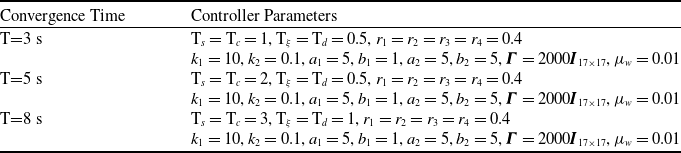
. The controller settings corresponding to several settling times are presented in Table 1. Figure 3 shows the simulation outcomes.
Controller parameters

Tracking results with different predefined time.

To further demonstrate the characteristics of the predefined-time structure, simulations under various initial-error conditions are tested, as detailed in Table 2. Control commands are uniformly configured to:
 ${\alpha _c} = {3^ \circ }$
,
 ${\beta _c} = {0^ \circ }$
,
 ${\mu _c} = {5^ \circ }$
. Furthermore, the settling time is set to T = 3 s, and the controller parameters are chosen to match the first row of Table 1. The simulation results are shown in Fig. 4.
Initial condition configurations

Tracking results under various initial errors with settling time T=3 s.

As can be seen from the simulation results, consistent with Theorem 3, the attitude angle tracking error can converge to a vicinity of the origin within the user-defined time, and the settling time is unaffected by the initial attitude states.
4.2 Control effectiveness verification
In this subsection, we will further verify the tracking performance and anti-saturation characteristics of the developed controller during the deformation process under nominal case. The initial attitude states are set as
 ${\alpha _0} = {0^ \circ }$
,
 ${\beta _0} = {3^ \circ }$
,
 ${\mu _0} = {0^ \circ }$
. The reference commands and sweep angle variation process are shown in the simulation results. The controller parameters are specified as:
 ${\mathrm{T}_s} = 2$
,
 ${\mathrm{T}_c} = 5$
,
 ${\mathrm{T}_\xi } = 2$
,
 ${\mathrm{T}_d} = 1$
,
 ${k_1} = 10$
,
 ${k_2} = 0.1$
,
 ${a_1} = 5$
,
 ${b_1} = 1$
,
 ${a_2} = 5$
,
 ${b_2} = 5$
,
 $\unicode{x1D71E} = 2000{\boldsymbol{I}_{17 \times 17}}$
,
 ${\mu _w} = 0.01$
.
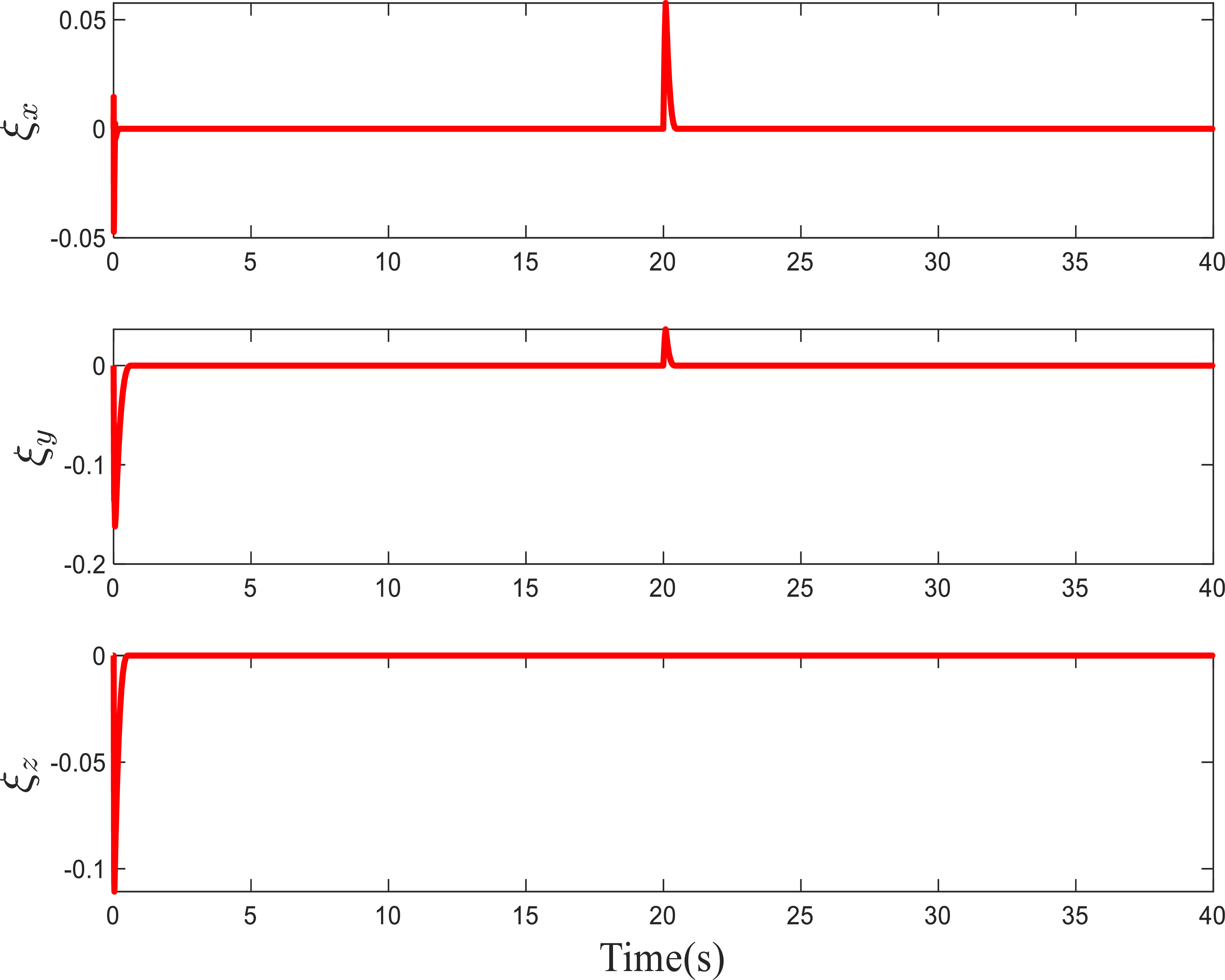
Figure 5 shows the response of the attitude angle to the given command as well as the variation of the sweep angle. The simulation results indicate that the designed control scheme has excellent tracking accuracy for the attitude angle command. When the deformation occurs at 30 s, due to the effect of the additional moment, the angle-of-attack attitude tracking error increases. Figure 6 illustrates the control input in the different scenarios. It can be seen from the figure that deformation leads to changes in the elevator angle and the attitude system quickly adjusts to re-establish a balanced state. Moreover, compared with the control method without the anti-saturation compensator, the proposed approach enables faster recovery from input saturation during transients and reduces rudder usage. Figure 7 shows the auxiliary variables in the anti-saturation system. The results indicate that the auxiliary variables converge to zero after driving the control input to exit the saturation state within a predefined time.
Angle responses and sweep angle.

Control inputs.

Anti-saturation variables.

4.3 Comparative analysis
In this subsection, we will validate the robustness of the developed controller under external disturbances; the disturbances are set as Equation (30). Moreover, −30% bias for aerodynamic parameters is considered during the morphing phase to simulate the parameters uncertainties. The controller parameters and the variation of the sweep angle are consistent with Section 4.2.
 \begin{align}{\boldsymbol{d}_1} & = 0.03 \times {\left[ {\sin \left( {\frac{\boldsymbol{\pi} }{2}t} \right) + \sin \left( {\frac{\boldsymbol{\pi} }{4}t} \right),\cos \left( {\frac{\boldsymbol{\pi} }{2}t} \right) + \cos \left( {\frac{\boldsymbol{\pi} }{4}t} \right),\sin \left( {\frac{\boldsymbol{\pi} }{2}t} \right) + \cos \left( {\frac{\boldsymbol{\pi} }{4}t} \right)} \right]^{\mathrm{T}}},10 \lt t \lt 18\nonumber\\[5pt]{\boldsymbol{d}_2} & = 0.4 \times {\left[ {\sin \left( {\frac{\boldsymbol{\pi} }{2}t} \right) + \sin \left( {\frac{\boldsymbol{\pi} }{4}t} \right),\cos \left( {\frac{\boldsymbol{\pi} }{2}t} \right) + \cos \left( {\frac{\boldsymbol{\pi} }{4}t} \right),\sin \left( {\frac{\boldsymbol{\pi} }{2}t} \right) + \cos \left( {\frac{\boldsymbol{\pi} }{4}t} \right)} \right]^{\mathrm{T}}},10 \lt t \lt 18\end{align}
To demonstrate the superiority of our approach, a predefined-time controller in this paper without its disturbance observer (PTC) and a finite-time controller with a fixed-time observer (FxTO-FTC) [Reference Liang, Wang, Hu and Dong44] are employed to compare with the proposed controller. The parameters of the FxTO-FTC are carefully selected as
 $\kappa = 0.2$
,
 $m = 4.5$
,
 $n = 2.5$
,
 $\eta = 0.002$
,
 $\mu = 1$
and
 ${l_1} = {l_2} = {l_3} = 4$
.
Angle responses with different methods.

Tracking errors with different methods.

Root mean square tracking error

Control inputs with different methods.

To evaluate the performance of the proposed controller more quantitatively and comprehensively, the root mean square error (RMSE) is introduced as Equation (31) where
 ${t_1}$
and
 ${t_2}$
indicate the beginning and end times of the simulation, respectively.
 $e$
means tracking error.
 \begin{equation}\sigma = \sqrt {\frac{1}{{{t_2} - {t_1}}}\int_{{t_1}}^{{t_2}} {{{\left| e \right|}^2}dt} } \end{equation}
The simulation results are shown in Figs 8–10 and Table 3. Figures 8 and 9 illustrate the attitude tracking performance and state errors, respectively. It is demonstrated that in the nominal phase, all three methods can achieve convergence of the tracking error to the small residual sets of the origin. However, owing to the absence of compensation for unknown disturbances, the tracking performance of the FTC is shown to deteriorate dramatically during 10–18 s. The FxTO-FTC shows better tolerance to disturbances, but the vibration occurs at 10 and 18 s. In this case, the proposed method can accurately estimate the disturbances, and thus, it keeps a decent performance under external disturbances. Moreover, the magnified inset of the pitch channel shows that the proposed method yields the lowest attitude-tracking error during the deformation phase. Notably, unlike the finite-time control scheme, the controller in this paper does not rely on the initial error and shows improved transient response. As summarised in Table 3, it achieves the smallest root mean square error in each channel. Figure 10 depicts the control input with different methods, which demonstrates that the suggested method can drive the control input away from the saturation state after entering it.
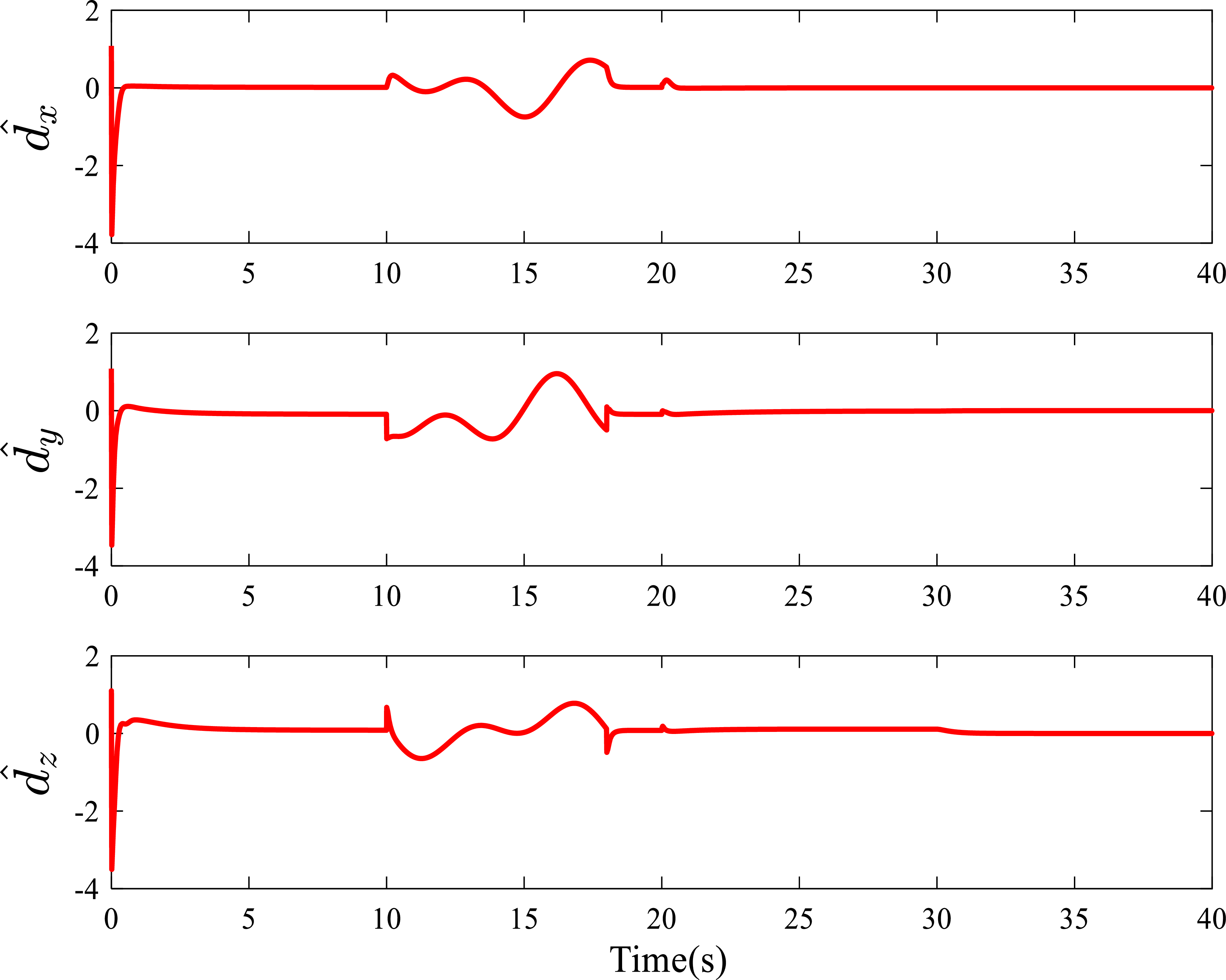
Figures 11 and 12, respectively, show the estimation of the attitude rate tracking errors by the disturbance observer from FxTO-FTC and the observer proposed in this paper. The figures indicate that both estimation errors quickly converge to the small residual sets of the origin within a fixed time. On the other hand, in the initial stage, the fixed-time observer experiences difficulties in observing the rapidly changing variables, while the designed observer shows favorable performance. When external disturbances occur at 10 s, the proposed observer ensures the estimation error converges to a small residual set of the origin more rapidly compared to the fixed-time observer. Owing to the introduction of the neural network and the predefined-time technique, the proposed observer can approximate the lumped disturbances in the high nonlinear morphing vehicle system shortly. Figure 13 shows the proposed observer’s estimation of the disturbances in each channel.
The observed states with the fixed-time observer.

The observed states with the proposed observer.

Estimation of the lumped disturbances.

5.0 Conclusion
In this paper, a predefined-time attitude control scheme for HMV with multi-source disturbances and control input constraints is proposed. In order to achieve outstanding transient performance in attitude tracking, a nonsingular predefined-time sliding mode manifold is established. Then, we employ a predefined-time disturbance observer combined with RBF neural network to approximate the lumped disturbance. Moreover, a predefined-time anti-saturation compensator is utilised to address the saturation issue. The settling time of the attitude control system can be preselected via distinct parameter tuning and is independent of initial errors. Numerical simulations are conducted to validate the superiority of the proposed controller. The simulation results indicate that the designed approach demonstrates significant advantages under morphing effects and uncertainties compared with other control algorithms. Notably, the user-predefined time of the proposed controller exhibits a certain conservatism compared with the actual convergence time, warranting further investigation in future work.
Acknowledgements
The authors declare that they have no relevant financial or non-financial interests to disclose.
Competing interests
The authors declared that they have no conflicts of interest to this work.