The recent global economic crisis highlighted the growing importance of finance in affluent economies, raising questions about why this ‘financialization’ occurred. A number of studies have improved our understanding of the causes of financialization, but due to a lack of political science research on this topic, our knowledge of the role of political actors and policy makers remains limited. I argue that because this process distributes costs and benefits unevenly across groups, politics and policy likely affect the process of financialization. In the analysis, I examine the relationship between changes in the power of organizations representing the ‘winners’ and ‘losers’ of financialization and the pace of financialization in the United States between 1949 and 2005. I find that when groups representing the losers of financialization are less powerful, this process advances more rapidly, and that when the financial industry is more active in politics, financialization proceeds more rapidly.
Financialization refers to growth in the relative importance of financial compared to other types of economic activity in affluent economies – a shift that has important economic, social and political consequences.Footnote 1 Though an increasing reliance on financial activity is not universally condemned, critics claim that financialization has contributed to a variety of problems, including income inequality, growing household debt, slow economic growth, economic instability and, ultimately, global economic crisis.Footnote 2 Thus understanding the potential political roots of this process is critically important. Financialization has taken place in many affluent economies in recent decades, and I draw from both the comparative and American politics literatures to develop theoretical expectations for this analysis. Focusing initially on the United States makes sense, because America may be the archetypal financialized economy.Footnote 3 Furthermore, as the recent global economic crisis demonstrates, the financialization of the American economy has important implications for economies all over the world. Since the changes that I find are associated with growing financialization in the United States (deunionization and the decline and transformation of center-left parties) have also taken place in other countries, this analysis has important implications for our understanding of similar shifts in other nations.
Much existing financialization research focuses on the behavior of economic actors, but given the importance of the state in modern economies, it would be surprising if the government did not help facilitate economic change of this magnitude. Indeed, in an important study of the American economy, Krippner argues that the state embraced financialization because it presented a solution to the looming ‘state crisis’ confronting advanced capitalist nations in the 1970s.Footnote 4 But this apparent solution was not neutral – it produced disproportionate costs and benefits for different groups.Footnote 5 Scholars have argued that the process of financialization has aspects of both redistributive politics and classic rent seeking by the financial industry.Footnote 6 From this perspective, the financial industry used its influence with politicians and regulators to extract rents and engage in upward redistribution from consumers to wealthy investors and firm managers.Footnote 7
Though many Americans fail to benefit from financialization, the poor and working class benefit the least from (and are even harmed by) this process.Footnote 8 Thus I argue that when organizations representing the poor and working-class losers of financialization – traditionally the Democratic Party and labor unions in America – are stronger, financialization will be slower. In contrast, when organizations representing the winners of financialization – most obviously large financial firms and the Republican Party – are more highly mobilized into politics and powerful, financialization is more rapid. I confirm these arguments in the analysis and demonstrate that deregulation is one policy mechanism that may have translated the changing power and mobilization of these organizations into shifting economic outcomes. However, it seems that in recent years, even when the Democratic Party is in power, financialization does not slow very much. I find that as organized labor declined and the party became more reliant on white collar professionals for electoral support, the retardant effect of Democratic Party control of government on the pace of financialization diminished.
THE POLITICS OF FINANCIALIZATION
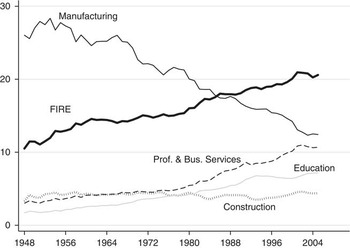
Over the last few decades, the proportion of economic activity generated by finance increased significantly in many affluent countries, especially the United States. From the 1950s through the early 2000s, the percentage of economic activity derived from the finance, insurance and real estate (FIRE) sector almost doubled. This can be seen in Figure 1, which plots the percentage of value added to GDP by FIRE and selected industries.
Sector shares of total U.S. economic output (GDP)

We see clearly that FIRE’s share of economic activity has consistently increased since the late 1940s, almost mirroring manufacturing’s decline (though the latter was more rapid and volatile). The rate of increase in the percentage of economic activity in the FIRE sector varies substantially over time, however. Between 1949 and 1959 the percentage of economic activity in FIRE grew by approximately 0.30 percentage points per year; in the 1960s and 1970s this figure was around 0.08, and after 1980 it was approximately 0.20. How did the government affect this variation?
The State and the Winners and Losers of Financialization
From the standpoint of neoclassical economic theory, major structural shifts like financialization must reflect the behavior of utility-maximizing actors, and the role of the state is largely ignored.Footnote 9 Based on existing research, the desire for more profit and income does appear important to the process of financialization. In the late 1960s and early 1970s, profits in the real sectors (manufacturing, construction, etc.) began to decline as inflation, labor and energy costs, and foreign competition increased. Finance was relatively immune to many of these problems and was able to maintain higher profits, leading profit-maximizing investors to shift toward financial activity.Footnote 10 From a macroeconomic perspective, as trade with the global South expanded, affluent nations may have become better off by specializing in financial activities.Footnote 11
Important changes in corporate management practices accompanied the desire for greater rates of return. There was a change from a paradigm of investing profits back into the company in order to build for the long term to ‘maximizing shareholder value’, which centers corporate activity on keeping profits high and boosting firm equity prices in the short run.Footnote 12 This shift was enforced by the threat of hostile takeovers for under-performing companies and was encouraged by the use of stock options as executive compensation.Footnote 13 While changes in the behavior of economic actors and institutions are important, given the role of the state in modern economies, political scientists may be surprised if the government did not help facilitate economic change of this magnitude.Footnote 14
In a compelling account, Krippner argues that the American state facilitated financialization because it helped avoid the looming ‘state crisis’ of the 1970s.Footnote 15 This crisis was predicted because, as economic growth slowed in the late 1960s and 1970s, analysts thought the government would not be able to meet the increasing demands of competing interests, producing conflict and undermining the state.Footnote 16 Krippner argues that the state enabled financialization by deregulating the financial sector and enacting other policies. Though not always pursued with the explicit goal of generating additional activity and profits in the financial sector, these decisions did just that.Footnote 17 Initially, policy choices fueling financialization satisfied diverse constituencies according to Krippner, but many observers note that financialization ultimately produced very uneven costs and benefits across different groups.Footnote 18
Tomaskovic-Devey and Lin argue that financialization is a system of income redistribution in which actors in the financial industry use the government to extract ‘rents’ from others.Footnote 19 Freeman writes that in the process of financialization, bankers and financiers ‘enrich themselves at the expense of shareholders, consumers or workers’.Footnote 20 If these views are accurate, we should see evidence of differential gains from the process of financialization among different groups, and we certainly do. The profits accruing to financial firms and average pay in the financial sector have increased dramatically.Footnote 21 The increasing value of stocks during the 1980s and 1990s also benefited CEOs and executives in other industries (who were increasingly likely to be compensated with stock options), and any other households that derived significant income from investments.Footnote 22
In contrast, the long-term benefits of financialization to most Americans are questionable. Former Federal Reserve Chairman Paul Volcker observed that there is not ‘one shred of evidence that financial innovation has helped the economy’.Footnote 23 Erturk et al. state that the benefits of the democratization of finance (that is, more investment and borrowing opportunities) are ‘uncertain for existing middle class savers and very unlikely for lower income groups’.Footnote 24 Others note that consumer ignorance and predatory practices have increased levels of debt and debt-service payments for most consumers; from 1989–2007 the median debt held by families increased from $24,100 to $67,300 (after adjusting for inflation).Footnote 25 Furthermore, the new ‘opportunities’ to invest for retirement or health care reflect the elimination of good health insurance and defined benefit pension plans, which were routinely offered by employers before the 1980s, when the growing need to maintain a high profit margin and stock price contributed to eliminating these expenses.Footnote 26
Hardest hit by financialization, though, are low-income individuals and the working class. In recent years, almost 30 per cent of debtor families in the bottom quintile of the income distribution devoted more than 40 per cent of their income to debt-service payments, while only 3.8 per cent of debtor families in the top quintile did so.Footnote 27 Lower-income families fail to benefit from the upside of financialization because they lack the capital and expertise to take advantage of new investment opportunities.Footnote 28 In addition, when companies shed workers to reduce expenses and raise stock prices, those with fewer skills have the hardest time finding jobs with similar compensation and lack the wealth to cushion job loss.Footnote 29 In this era of financialization, low-skilled and low-wage workers have fared the worst among any economic groups. This is not attributable solely to financialization, of course, but it underscores the fact that financialization provides few opportunities and imposes more costs on low-income individuals compared to other groups, especially the wealthy investors and managers who gain the most.
Parties, Organized Interests and Financialization
Presumably, managers and investors would always prefer greater income and returns, but at some times financialization grows more rapidly. According to some scholars, the economic troubles and state crisis of the 1970s discredited the existing Keynesian policy paradigm and economic system, which created an opportunity to reorder the economic policy landscape and economy.Footnote 30 If it is simply the case that the perceived economic and policy failures of the 1970s led to the more efficient deployment of resources to the financial sector and caused a change in the direction of the technically ‘better’ economic policy alternative, then objective economic conditions and the behavior of economic actors should do an adequate job of explaining financialization. Hall argues, however, that when such windows of major change are open, the political power of competing economic actors is critical to which policies are adopted – and, ultimately, to what modes of economic activity are pursued.Footnote 31 Because financialization produces winners and losers, the mobilization and power of organizations representing the winners and losers in the party and organized interest system are likely to be critical determinants of the rate financialization.
Comparative researchers working from a power resources theory perspective argue that left parties represent the lower classes in government and are more likely to engage in downward redistribution.Footnote 32 Another line of research shows that switches in party control of government in affluent countries influence the expectations for, and the performance of, different economic sectors.Footnote 33 Thus when left parties are in power the upward redistribution of financialization should be less likely to take place. Though the class basis of the party system in America is muted, for several decades the Democratic Party often approximated a left-wing party by advancing the economic interests of working-class voters, stimulating economic activity in sectors that employed these constituents and placing the costs of economic change on the wealthy.Footnote 34
Despite this history, it seems that in recent years even when the Democratic Party is in power it does not seem to slow financialization very much. This may reflect the fact that in many countries the traditional left-right cleavage and the salience of economic issues has receded in importance.Footnote 35 At the same time, many center-left parties in affluent democracies shifted to the right on economic issues.Footnote 36 In the United States, the best politician-level measures of ideology, Poole and Rosenthal’s DW-Nominate Scores (first, economic dimension), show that Democratic presidents have become more conservative since the 1970s, but they also show that the mean ideology of Congressional Democrats became more liberal throughout the 1980s.Footnote 37
Nevertheless, there is no doubt that a critical mass of Congressional Democrats and much of the party leadership increasingly embraced deregulation and other policies that benefit finance.Footnote 38 Furthermore, at the mass level, the traditional working-class base of the party shrunk and the Democratic electoral coalition expanded to include more professionals and managers, who are often more concerned with post-material issues, and are more likely to invest in (or even work in) the financial industry.Footnote 39 Indeed, National Election Studies (NES) data show that the gap in the percentage of managers and professionals v. non-managers and non-professionals supporting the Democratic presidential candidate was as large as forty-five points in the 1960s, but closed to less than ten points in the 1990s.Footnote 40 It seems probable that even with these changes, the Democratic Party is still, on average, to the left of the Republican Party on financialization. However, it also seems that as the Democratic Party’s constituency has changed over time to become more economically heterogeneous, the effect of Democratic control of government may have weakened. This suggests two hypotheses.
Hypothesis 1a: Democratic control of government is associated with slower financialization.
Hypothesis1b: Democratic control of government has a weaker suppressant effect on financialization as the party’s electoral coalition becomes more economically heterogeneous.
Parties are likely important because they represent different economic constituencies, but the United States also has a fragmented, pluralistic political system and thus organized interests likely play a critical role in the process of financialization. Unions represent the ‘losers’ of financialization in the US interest system, and based on Hacker and Reference Hacker and PiersonPierson’s description it seems clear that as the percentage of workers in unions declined, unions became significantly weaker in the interest system.Footnote 41 This is important because unions work to create economic activity in the sectors in which they are strong (FIRE is very lightly unionized) and often opposed deregulation, and other tax and trade policies that likely expedited financialization.Footnote 42 Epstein and Jayadev find that the share of income going to ‘rentiers’ (that is, investors in the financial industry) is highest in Organisation for Economic Co-operation and Developemnt (OECD) countries with the weakest labor unions.Footnote 43 Both deunionization and financialization have advanced more rapidly in the United States than most OECD nations.Footnote 44
However, the decline of labor unions may have also had important implications for the Democratic Party’s approach to financial matters. According to Hacker and Reference Hacker and PiersonPierson, declining unions contributed to the aforementioned Democratic shift to the right on financial issues, as financial interests rushed to fill the void left by declining resources from organized labor.Footnote 45 This leads to Hypotheses 2a and 2b.
Hypothesis 2a: As unions become weaker, financialization is more rapid.
Hypothesis 2b: As unions become weaker, the suppressant effect of Democratic control of government on financialization becomes smaller.
The financial industry – which represents the primary winners of financialization – was clearly not a passive spectator during this process.Footnote 46 Banks are quite powerful in all capitalist countries.Footnote 47 Yet for a number of decades after the 1930s, American financial corporations were constrained by a broad consensus in favor of the New Deal regulatory regime.Footnote 48 As real profit growth rates declined in the 1970s, banks sought greater profits by innovating within the existing regulatory framework; these innovations, which were sometimes of questionable legality, were often accommodated by regulators with the intention of bolstering bank profits.Footnote 49 Ultimately, however, the banks favored dismantling the New Deal regulatory regime altogether, and this preference was accommodated by policy makers during the 1980s and 1990s.Footnote 50 Qualitative evidence indicates that the political mobilization of the financial sector accelerated in the 1970s, prior to the dramatic financialization witnessed since the early 1980s.Footnote 51 Thus I consider Hypothesis 3.
Hypothesis 3: Greater political mobilization by the financial industry is associated with more rapid financialization.
Much of the discussion above assumes intentionality by policy actors, but it should be noted that neither organized interests nor parties need to intend for policy to slow or accelerate financialization in order to have this effect. For example, if the Democrats raise income taxes on the wealthy to fund infrastructure because they want to stimulate construction employment at the behest of their union allies, this might reduce investment in stocks and would certainly increase activity in the construction industry, slowing financialization. While slowing financialization was not the primary goal, this is entirely consistent with the logic of my argument. Given the variety of ways that government may affect sectoral activity, I examine the direct effect of the political variables discussed above on the rate of financialization in the analysis.
However, to establish at least one policy mechanism that links these political variables directly to economic outcomes, I consider a policy with a more predictable (and even intentional) effect on financialization: deregulation. The decision to deregulate the financial industry was complex and involved many considerations aside from any potential growth of the financial sector.Footnote 52 But deregulation intentionally permitted financial companies to grow larger and enter into new financial activities.Footnote 53 Qualitative accounts suggest that financial interests (especially large banks) and the Republican Party were aggressive proponents of deregulation, while unions largely resisted it, and Democrats embraced it less enthusiastically.Footnote 54 Therefore I examine the effect of deregulation on financialization. I also consider the effect of federal funds rate volatility, which previous research suggests fueled financialization, but which is not as directly subject to political pressures because it is determined by the unelected Federal Reserve Board.Footnote 55 Thus I consider Hypotheses 4a and 4b.
Hypothesis 4a: Deregulation is associated with more rapid financialization.
Hypothesis 4b: Federal funds rate volatility is associated with more rapid financialization.
ANALYSIS
I examine the arguments above using data from the United States for the period 1949–2005, though some of the models only extend from 1954–2005 for data availability reasons (the federal funds volatility rate is not available until 1953). But this time period contains dramatic variation in the outcome and explanatory variables. My analysis also wisely excludes the (hopefully) atypical economic conditions after 2007.Footnote 56
Variables and Data
Outcome variable: Financialization
To measure the process of financialization I use the annual change in the percentage of total economic output (GDP) derived from the FIRE sector, presented in Figure 1.Footnote 57 Different scholars have measured financialization in other ways (for example, the percentage of total corporate profits accruing to financial companies), but given my argument regarding how financialization affects different economic groups in the mass public, it is most useful to consider the percentage of total economic activity.Footnote 58
Explanatory variables and controls
To measure Democratic strength in government, I use a variable that assigns one point each for Democratic control of the House, Senate and presidency. It makes sense to measure party in an additive manner because each branch of government has the potential to shape financialization independently, and that ability is greater when a party controls more institutions. For instance, if the Democratic Party controls only one house of Congress or the executive, it can effectively veto pro-finance legislation and potentially shape financialization via budgeting for regulatory enforcement. But if the Democrats control both congressional chambers they can pass legislation, and if they control all three institutions they can enact laws. Thus the number of tools available to shape financialization increases as more institutions are controlled.Footnote 59
Constructing a measure of the power of labor unions is straightforward, as scholars typically measure union strength using data on union membership, because the power of organized labor is ultimately tied to the number of dues-paying union members who provide both money and labor for union political activities.Footnote 60 Therefore to measure union strength I use union density, which is the percentage of non-agricultural workers covered by union collective bargaining agreements.Footnote 61
To test Hypotheses 1b and 2b regarding the conditional effect of Democratic control, in one model I interact the union density variable and the Democratic control variable. To test the hypothesis regarding the changing party electoral constituency, I used the NES data referenced above to create a variable that measures the gap in the proportion of professionals and managers v. non-professionals and non-managers that voted for the Democratic presidential candidate, and then interacted this with the Democratic control variable. When unions are weaker and when the preference gap is smaller (that is, the Democratic Party is more reliant on the support of professionals and managers), I expect Democratic control of government to have a smaller suppressant effect on financialization.
In contrast to measuring union strength, determining the potential for financial industry influence is difficult because the sources that are commonly used to measure interest group activity are not available for much of the period of this study. For instance, industry campaign contributions are a good indicator of the political mobilization of business, but systematic campaign finance data are only available beginning in the late 1970s (the same is true of Washington Representatives, which is often used to track lobbying presence).Footnote 62 Tichenor and Harris use data on interest group testimony at Congressional hearings to measure the emergence of organized interests as early as the late 1800s. However, using Congressional testimony as a way to document interest group mobilization is problematic in this case, because it is possible that as financialization increases, more financial firms and organizations will appear in Congressional hearings regardless of industry political mobilization simply because the industry is objectively more important to the economy.Footnote 63 Furthermore, unlike unions, banks always have an abundance of resources, so the important question is the extent to which the banks try to use those resources to influence policy.
Therefore, this analysis requires a variable that measures the financial industry’s engagement in politics and the policy process but is not simply driven by current government attention to financial issues. To develop such a measure, I obtained data from one of the oldest sources of information about the political concerns of major financial firms – the American Bankers Association (ABA) Banking Journal. The ABA is the main umbrella lobbying organization for the largest banks. Though other financial interests were active on financial issues (that is, savings and loans, insurance companies), it was the large banks that most aggressively pushed for the policy changes that led to deregulation and other pro-finance policy changes.Footnote 64 Most items in the ABA publication are unrelated to policy and focus on topics like where to locate branches, how to promote women and minorities, or reviews of the latest banking-related technologies. Thus measuring the percentage of stories that is related to politics and policy provides us with a good idea of how focused the ABA leadership is on politics and policy versus other matters.Footnote 65
One problem with this approach is that, again, as financial issues become more dominant on the nation’s policy agenda, the ABA will likely become more focused on politics even if its independent concern with politics and policy does not increase. Therefore, in the spirit of Alesina, Cohen and Roubini’s approach to measuring ‘unexpected’ elections, I developed a measure of ‘unexpected’ political interest or mobilization that is above and beyond (1) the current volume of financial issues on the nation’s policy agenda and (2) the ABA’s own past emphasis on politics using an ARIMA approach.Footnote 66 Specifically, I modeled current ABA attention to politics as a function of the current volume of financial industry matters before Congress (measured as the number of Congressional hearings on financial sector issues) and past attention to politics in the ABA Banking Journal. I use the residuals of this model, which are by construction only weakly correlated with current Congressional attention to financial issues and are thus ‘exogenized’, as the exogenous measure of financial industry political mobilization. Much more information on the construction of this variable is presented in the Online Appendix. But the key point is that this measure is an indicator of large banks’ interest in political and policy issues that is exogenous to the current Congressional agenda and is thus not simply proxying for the potential growing importance of financial issues as financialization increases.
Though all observers agree that deregulation began in earnest in the late 1970s or early 1980s, there have been few attempts to quantitatively measure deregulation. To create the deregulation variable, a number of sources were consulted and I ultimately developed a measure using information in an article prepared by Matthew Sherman of the Center for Economic and Policy Research, who identified a timeline of key legislation and regulatory changes that deregulated the financial sector.Footnote 67
I treat deregulation as cumulative, where new deregulatory actions build upon previous deregulation, by coding each major act as a 1 in the year it occurs and all remaining years, and adding this value to the current level of deregulation. For example, prior to the late 1970s, because the New Deal regulatory structure remained intact all years are a 0. After the first deregulatory act the deregulation variable was coded as a 1 for all years until the next major deregulatory act, when it was coded as 2, and so on. This cumulative approach reflects that fact that once regulations are changed, economic actors adjust their behavior to maximize profit under that regulatory structure until it is again altered.
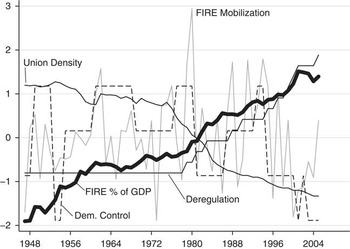
The measure of deregulation has good face validity, as the trajectory of deregulation in the data clearly fits qualitative perceptions, as can be seen in Figure 2, which plots deregulation and the other explanatory variables along with the outcome variable. The trends in deregulation are also very similar to what may be the only other attempt to quantitatively measure deregulation, which was made by Philipon and Resheff.Footnote 68 For the remaining variables we see that there was a major increase in FIRE sector focus on politics in the late 1950s and early 1960s and again in the late 1970s and early 1980s (preceding the increasing rate of financialization in the 1980s), with fairly high levels in the late 1980s through the mid-1990s. What was clearly different at these later times, compared to the late 1950s and early 1960s, was that unions and the Democratic Party both began to experience decline.
Union strength, FIRE access party control and deregulation

As noted, I also control for an additional policy variable that may influence financialization – federal funds rate volatility – which Krippner argued was associated with greater financialization.Footnote 69 However, the federal funds rate variable does not measure mechanisms of the influence of political organizations to the same extent, because it is determined by the unelected Federal Reserve Board. Federal funds rate volatility is the absolute change in the federal funds rate from the previous year as a proportion of the total rate in the previous year. For instance, if last year’s rate was 2 and this year’s rate is 3, this variable would equal 1.0 ((3−2)/1).Footnote 70
Though a full analysis of how economic factors and corporate management practices may have shaped financialization is not the goal here, it is obviously necessary to control for the more important potential confounds. With the modeling approach used in the analysis, which I discuss more below, it is necessary to include the lagged level of financialization. But this variable also has a theoretical interpretation, since as financialization increases it is less likely that there will be very large increases in the next year. Because the poor performance of the ‘real’ sectors may have caused a shift of activity to the financial sector, I control for the real (that is, inflation-adjusted, 2005 dollars) growth rates of non-financial corporate profits using data collected from the Bureau of Economic Analysis. Note that corporate profit growth is not the same as GDP growth in a given sector, which is what the outcome variable measures. High inflation also appeared important because it forced more aggressive financial practices to prevent the erosion of the value of assets.Footnote 71 However, high inflation was only really problematic for a relatively short period of time during the pivotal 1970s and early 1980s, however, so it is not clear what overall effect this variable will have. I also control for the use of stock options as executive compensation, since this should cause firm managers to boost equity prices, using a measure of the average value of stock option grants for the three highest executives of a large sample of companies collected by Frydman and Molloy.Footnote 72
Modeling Approach
I estimate single-equation error correction models (ECMs) for the statistical analysis. De Boef and Keele note that the single-equation ECM is essentially equivalent to an autoregressive distributed lag model and that ‘ECMs may be used with stationary data to great advantage’; but they also note that the ECM approach is superior when data are integrated or near-integrated, because first-differencing the outcome variable (as is done in an ECM) helps avoid spurious findings.Footnote 73 In this case, statistical tests indicated that co-integration was likely present between many of the explanatory variables and the outcome variable.Footnote 74
Engle and Granger pioneered the ‘two-step’ method for estimating relationships between co-integrated variables.Footnote 75 More recent research typically uses the single-equation ECM approach because it produces all of the same information about long- and short-term relationships and the rate of ‘error correction’, but does so more efficiently by estimating a single equation rather than a series of equations.Footnote 76 More precisely, whereas the Engle-Granger approach estimates separate equations to analyze long- and short-term relationships between variables, both parameters are simultaneously estimated with each explanatory variable having the first-differenced term and a lagged term included in the model. The coefficient of the lagged level of the outcome variable provides the ‘error correction rate’. Using the error correction rate and the coefficients of the lagged levels of the explanatory variables, we can obtain the total long-term impact of an explanatory variable (computed by dividing the coefficient of the lagged-level explanatory variable by the error correction rate).
‘Weak exogeneity’ is required in order for single-equation ECMs to produce reliable estimates and significance tests.Footnote 77 Charemza and Deadman’s approach to investigating exogeneity indicated that the explanatory variables were at least weakly exogenous.Footnote 78 As with any time-series model, we want to ensure that autocorrelation is not a major problem; the relevant Q statistics for each model that confirm this are presented in the Appendix.
POLITICAL AND POLICY DETERMINANTS OF FINANCIALIZATION
Because the effect of political variables may take place through policies, I first present results excluding policy variables, providing estimates of the total effect of the political variables. I then present results with controls and policy variables. Finally, I present a full model with all explanatory variables.
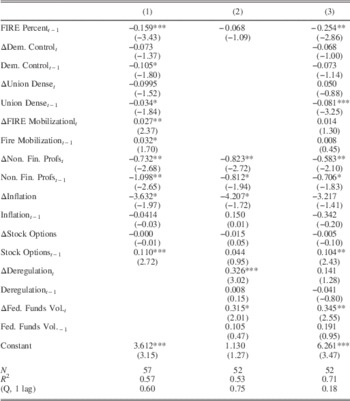
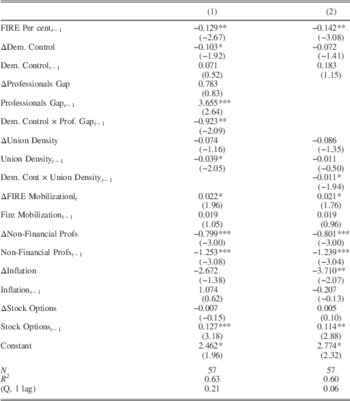
Beginning with the first model in Table 1, we can see that all of the coefficients for the political variables are in the expected direction and a number of them are statistically significant, or very close. Both the long-term Democratic Party and union density coefficients are negative and have associated two-tailed p-values of 0.07. In contrast, as expected, the FIRE mobilization coefficients are both positive. The short-term p-value is 0.02 and the long-term coefficient has a p-value of 0.10. The control variables have significant effects in the expected direction, except for the short-term effect of inflation, which is negative rather than positive (p=0.06). This may reflect the fact that the model already controls for inflation to some extent indirectly via the variable measuring inflation-adjusted non-financial corporate profit growth rates. The long-term stock options and the non-financial corporate profits variables both have significant coefficients that are signed as expected. The increasing use of stock options as compensation is associated with more rapid financialization in the long term, while more rapid growth in non-financial corporate profits is associated with slower financialization in both the long and short term.
Political and Policy Determinants of Financialization

Note: t statistics in parentheses. *p<0.10, **p<0.05, ***p<0.01.
In the second model I remove the party and interest group variables but include the policy variables. We observe that deregulation and federal funds rate volatility are associated with financialization in the expected manner, with both variables having significant, positive short-term effects. This indicates that the influence of additional deregulatory acts and increased federal funds rate volatility is realized in an increase of financialization within the year. In the last model, which includes the political and policy variables, we see that the results are similar, except that once we include the party and interest group variables, the size of the deregulation coefficient declines and is not quite significant at the 0.10 level. This may be because the deregulation variable is highly negatively correlated with the union density variable (if we remove the latter from the last model, the deregulation coefficient is 0.23 (p=0.06).
The long-term union density variable is consistently associated with the rate of financialization across all models, but in the model that includes the policy variables, both the FIRE mobilization and Democratic Party control variable coefficients are smaller and are no longer statistically significant. This likely shows, to some extent, that these political variables influence financialization via deregulation. The fact that the Democratic Party variable is not consistently significant in all specifications may also suggest that the average effect of the Democratic Party is not very large, but rather varies along with the strength of unions and the changing composition of the party’s electoral constituency (Hypotheses 1b and 2b), which I investigate more below.
Overall, however, we see in the tables that the political and policy variables are associated with financialization in the expected manner. In ECM models, the short-term coefficients are interpreted like any other regression coefficient, but the total long-term effect is computed by dividing the long-term coefficient by the error correction rate. As noted, the union density and Democratic control variables also likely affect financialization via deregulation. Determining any indirect effects of the political variables via deregulation is complicated because relationships are non-linear. But since deregulation only has short-term effects, these indirect effects via deregulation are limited to one year and are modest compared to the total long-term direct effects (even though these variables have substantial effects on deregulation).Footnote 79 We can get a good sense of the total long-term effects of the political variables (via deregulation and any other policies not analyzed) using the results in Column 1, which indicate that the total long-term effect of a standard-deviation change in Democratic control is approximately −0.64 percentage points. The comparable figures for union density and FIRE mobilization are −1.50 and 0.70 (p < 0.10). Thus of the political variables, union density seems to have the largest substantive effect on financialization. For comparison purposes, the effect of union density is even larger than the economic controls. Stock options and non-financial profits have effect sizes computed in the same manner of 0.93 and 0.97 percentage points, respectively (p < 0.05). In some ways these effects understate the influence of politics, because politics also probably shapes choices about executive compensation practices via the tax code. The findings above are interesting, but to the extent that the effect of Democratic control varies along with other conditions, the ‘average’ Democratic effect and related significance tests are somewhat misleading.
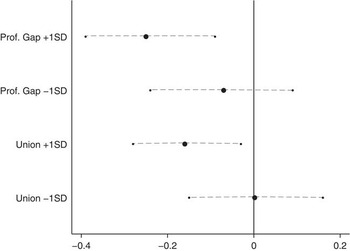
I argued that the relationship between Democratic control and financialization may vary depending on (1) the strength of unions and (2) how heterogenous the economic base of the party is, measured as a small gap in support for the Democratic presidential candidate between professionals and managers and non-professionals and non-managers. These conditional hypotheses are explored in the two models presented in Table 2 (interactions were estimated in separate models to reduce multicollinearity). We see that each of the hypothesized interaction effects has a negative coefficient with a two-tailed p-value below or very near 0.05 (for the union density interaction p=0.06, and for the professionals gap interaction p=0.04). Because interaction effects can be difficult to interpret by merely examining coefficients, I present the marginal effect of a plus 1 standard-deviation change in Democratic control of government (which is 0.97, or the approximate equivalent of the party holding one additional branch of government) on financialization at plus 1 and minus 1 standard deviations of the union density and ‘professionals gap’ variables in Figure 3.
The marginal effect of democratic control under different conditions

Conditional Effects of Democratic Control

Note: t statistics in parentheses. *p<0.10, **p<0.05, ***p<0.01.
The large dot is the point estimate and the dashed line bounded by the small dot represents the 95 per cent confidence interval, with a vertical ‘zero effect’ line. We see that when union density and the professionals gap increase (that is, the Democratic Party receives more support from non-managers and less support from managers) by one standard deviation, an additional institution controlled by the Democrats is associated with a significantly slower rate of financialization (about two-tenths of a percentage point lower in the next year). In contrast, at one standard deviation below the variable means, an additional branch controlled by the Democrats does not have an effect that is distinguishable from zero. This conditional effect of Democratic control is likely because strong unions push Democrats to the left on economic issues, and in order to appeal to professionals Democrats have moved to the right on economic issues (or alternatively, that professional supporters push them to the right). These changes can help explain why the Democratic Party has become a more willing accomplice in financialization in recent decades. Of course, these changes in union strength and the economic constituency of the party are not independent. The decline of unions as agents mobilizing the working class and providing money to left-leaning politicians encouraged Democrats to court professionals and managers for votes.
CONCLUSION
The financialization of affluent economies has important economic, social and political consequences. The 2008 financial crisis generated debate about the growth of the financial sector and the need for re-regulation to avoid the problems associated with it. Major policy change in America is rare, but if there was ever an opportunity to reverse the process of financialization, the financial crisis provided it. The so-called Dodd-Frank legislation (HR 1473) to regulate finance was enacted in 2010 by a unified Democratic government. The roll-call vote on Dodd-Frank was one of the AFL-CIO’s fourteen key votes in 2010. It was opposed and weakened by the financial industry, and it received almost no support from Republicans in Congress before being signed by President Obama.Footnote 80 While Democrats have been more willing to regulate, many critics on the left noted that this law did not go nearly far enough and it is currently being weakened as regulations are finalized, sometimes with the assistance of Democrats.Footnote 81 As of 2014, the percentage of economic activity in the FIRE sector remained near historic highs and Wall Street is again booming, while job creation and income growth for most Americans are tepid. On balance then, the response to the financial crisis was about what one would expect based on the analysis presented here.
This study showed that financialization was not simply a ‘natural’ economic development in America, but rather that the government and public policy choices played a critical role in the financialization of the American economy. Though this will perhaps not be too surprising to political scientists, large-scale economic change is often portrayed as the result of impersonal economic forces in the media and public discourse. We see here that even in the context of a relatively weak American state, the government has an important influence on structural economic change.
The results of the analysis show that the level of representation of the winners and losers of financialization in government alters its rate. On average, union strength and Democratic control of government are associated with slower financialization. But the analysis also showed that as the Democratic Party coalition began to include more professionals and managers, and as unions declined, the negative relationship between Democratic control of government and financialization weakened. Scholars have observed a similar dynamic regarding the effect of the Democratic Party on income inequality.Footnote 82 Future research in American politics should further consider how the changing party coalitions and the decline of organized labor affect the representation of different economic groups in the party system, and ultimately economic outcomes. The findings from this analysis demonstrate that the lack of representation for the poor and working class in both interest and party systems in recent years has very important economic consequences. Given their constituency and ideological preferences, we would not necessarily expect the Republican Party to try to advance the interests of the poor and working class when in office. But based on this study, it seems that the Democratic Party has also become less responsive to the interests of the poor and working class, as other scholars have observed in different contexts.Footnote 83
Because the decline and transformation of left and center-left parties and the weakening of labor unions are almost ubiquitous across affluent countries, this study also has important implications for comparative research. The important political factors identified here may have an even greater influence on financialization in countries where the state plays a larger and more acknowledged role in the economy. Future research should also consider how the growing economic interdependence among nations contributes to the process of financialization and conditions the relationship between domestic political conditions and policy choices and economic changes like financialization. The United States has an unusual degree of autonomy in defining its economic policies and practices, but such external pressures are likely to play a very large role in countries with smaller economies, again raising debates about the capacity of governments to shape national economic outcomes in an increasingly globalized world.
APPENDIX
Investigating Co-integration
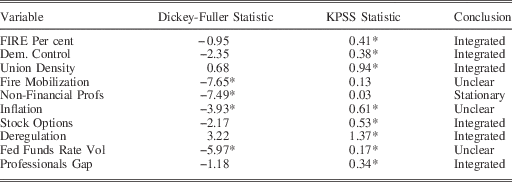
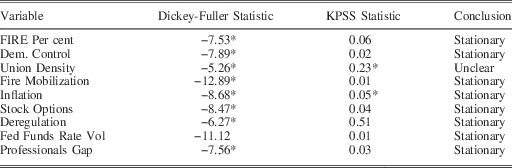
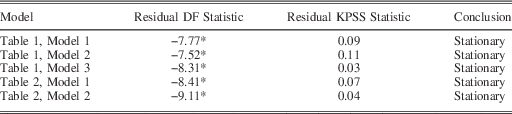
Though as De Boef and Keele explain ECMs can be used even in the absence of co-integration, in this section I present the results of three sets of statistical tests that demonstrate the existence of co-integration between some explanatory variables and the outcome variable.Footnote 84 For co-integration to be demonstrated, both outcome and explanatory variables must be integrated of the same order, and the residuals from the single-equation ECM must be stationary. First, in Table 3 I present the results of Dickey-Fuller and KPSS tests of stationarity for the variables included in the models in Tables 1 and 2, which show that some of them are integrated (a significant Dickey-Fuller test indicates that we can reject the null hypothesis of non-stationary residuals, while a significant KPSS test indicates that the series is integrated). In Table 4 I show that the integrated variables are integrated order one – that is, first-differencing the variables produces a stationary series. For the union density variable the Dickey-Fuller test indicates this, while the KPSS test does not, leaving the overall conclusion ambiguous. However, given that the outcome variable is first-differenced, the risks of a spurious relationship between union density and the outcome variable are minimized, and indeed, the first-difference of the union density variable is not a significant predictor of financialization. Finally, in Table 5 I present the results of stationarity tests of the residuals from the models presented in Tables 1 and 2. We see that the model residuals are stationary.
Testing for Stationarity of Undifferenced Variables

Testing for Stationarity of First-differenced Variables

Testing for Stationarity of Model Residuals

Exogeneity Tests
At least weak exogeneity is needed for ECMs to provide reliable coefficients and significance tests. Charemza and Deadman state that weak exogeneity is demonstrated when the error correction mechanism is an insignificant predictor when included in a model using the explanatory variable as the outcome variable.Footnote 85 Thus the full model in Table 1 was re-estimated sequentially using the important explanatory variables that might reasonably be endogenous as outcome variables. The results for the lagged outcome variable and the error correction rate are presented in Table 6. In no case is the error correction rate a significant predictor at the 0.05 (or 0.10) level while controlling for the other predictors, so we can conclude that these variables are at least weakly exogenous with respect to the FIRE percentage of GDP.
Exogeneity Tests

Autocorrelation Tests
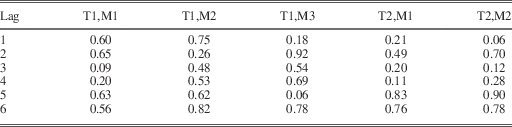
As with any time-series model, we want to ensure that there is not a serious problem with autocorrelated residuals. Using the common rule of thumb of investigating ¼× n lags, I examined Q statistics for thirteen residuals, but because there were not any significant Q statistics (with p-values below 0.05) I did not present all lags in the table in the interest of space. The p-values for the first six lag Q statistics are presented in Table 7 (going from Table 1, Model 1 to Table 2, Model 2). The only model that shows some potential for problems with autocorrelation (that is, almost-significant levels of autocorrelation at short lags) is the second model in Table 2, which has some autocorrelation in the first lag. If this model is estimated using a Prais-Winsten regression approach to address potential problems with an AR1 process, the results of the model are nearly identical and the interaction remains significant (p=0.001).
Regression Model Q Statistic P-Values