The term psychological first aid (PFA) first appeared in the military during World War II as a debriefing tool.1 Subsequently, PFA has become a critical dimension of response to the needs of those who are acutely stressed due to a disaster or emergency situation.Reference Everly and Flynn2Reference Parker, Everly, Barnett and Links3 PFA has been used by the National Center for Post Traumatic Stress Disorder, the Disaster Mental Health Institute of the University of South Dakota, the International Federation of Red Cross and Red Crescent Societies, and the American Psychological Association to denote programs that provide psychological care in the aftermath of traumatic events. Today, PFA is being used to describe an increasingly larger number of different types of actions that are taught to various responder audiences (eg, from trained lay people to mental health specialists). Currently, PFA is being taught in every chapter of the Red Cross in the United States, where at least 50% of volunteers have received this training.
The American Red Cross (ARC) provides multiple health and safety services for the community in preparation for and during disasters. In 2006, ARC Disaster Services introduced the course Psychological First Aid: Helping Others in Times of Stress.4 At present, this PFA course is recommended for all ARC disaster volunteers and is mandated for ARC disaster volunteers who serve on disaster assessment teams. The stated purpose of the course curricula is “to enable the participant to provide basic care, comfort and support to people who are experiencing disaster related stress.”4
In late 1998, the ARC formed the Advisory Council of First Aid and Safety (ACFAS), an independent panel of nationally recognized health and safety experts. The current composition of this advisory board is the Advisory Council on First Aid, Aquatics, Safety and Preparedness (ACFASP). Drawing on a body of collective expertise from diverse fields including emergency medicine, occupational health, mental health, sports medicine, school health, public health, emergency medical services (EMS), response and disaster mobilization, ACFASP was created to be independent from the ARC, and therefore free from organizational bias or influence. This arrangement allows ACFASP to advise the ARC on the latest evidence, best practices, science and technical information, and changes in the field. ACFASP is recognized both internally within the ARC and externally as a validity check for the services in health and safety that the ARC deploys. The core of the ACFASP's work is in using an evidence-based consensus process to inform recommendations. This process assures the ARC that the work of the ACFASP can be easily defended if questioned. Within the disciplines of disaster medicine and first aid, the evidence may be weak or absent; in such cases, the ACFASP relies on group expertise. The review process ensures that transparency occurs with what evidence and expert opinion were used.
ACFASP generates triennial reviews of relevant topics to advise the ARC. All recommendations are derived from critical review of available literature including formal clinical trials, observational studies, and expert opinion. All recommendations are weighted based on the source and strength of the scientific evidence and are classified into one of the three following groups:
• Treatment standards represent the strongest recommendations and have a high degree of clinical certainty. These recommendations result from strong evidence obtained from well designed, prospective, randomized controlled studies.
• Treatment guidelines provide a moderate degree of clinical certainty and are based on less robust evidence such as nonrandomized cohort studies, case-control studies, or retrospective observational studies.
• Treatment options result from all other evidence, publications, and expert opinion; these are the least compelling in terms of scientific evidence.
In June 2008, PFA was examined as part of the process within the rubric of ARC Health and Safety Services. In light of the proliferation of new PFA applications since 2008, the ARC Disaster Services requested the newly formed ACFASP Subcouncil on Disaster Health to readdress PFA services through a systematic review to:
• update the prior 1990 to 2008 review through September 2010,
• provide clarification of PFA terms and process for the ARC, and
• determine whether PFA is a “safe, effective and feasible intervention for first-aid providers without professional mental health training when confronted with people who have experienced a traumatic event.”
A clear distinction is made between PFA intended to be applied by nonprofessionals and that applied by ARC Disaster Mental Health professionals defined as those who hold a license in their home state in any mental health profession. These professionals include those who have an independent license (license to practice without supervision) as a clinical social worker, psychologist, professional counselor, marriage and family therapist, psychiatric nurse, psychiatrist, school psychologist, or school counselor. In the case of psychiatric nurses, American Nurses Credentialing Center certification is accepted in lieu of a license. The ARC uses the term nonprofessionals to refer to lay rescuers or volunteers who do not meet these professional criteria.
The purpose of this systematic review, therefore, is to investigate the current evidence for the safety, effectiveness, and feasibility of PFA when used by nonprofessional implementers and to make appropriate recommendations as to its use within the ARC. It is anticipated that this study will help clarify PFA use as a disaster intervention tool.
METHODS
MEDLINE, PILOTS, PsychArticles, PubMed, PsychInfo, and Cochrane databases were searched for articles from 1990 to September 2010. Each database was searched using the key word phrase “psychological first aid.” After eliminating redundant references, this search yielded 275 citations. Of these citations, 14 were books or chapters within books that were excluded.
Documents were excluded if they did not specifically refer to:
• the process used by the ARC, or
• the association with a disaster or mass casualty event, or
• the application of PFA rather than only psychological effects of a trauma, or
• PFA for use after individual nondisaster traumas such as rape and murder.
Documents were included when:
• the process of PFA was referred to as care provided to victims, first responders, or volunteers.
Using the criteria defined here, 50 peer-reviewed journal articles of the 275 citations were found to be relevant to the specific inquiry and were examined for this study. In addition, eight practice guidelines were examined from the following agencies: ARC, American Psychiatric Association, National Institutes of Mental Health, and the Department of Health and Human Services. These guidelines were selected because they used evidence at the time to draw conclusions as to why and how PFA was being used professionally.
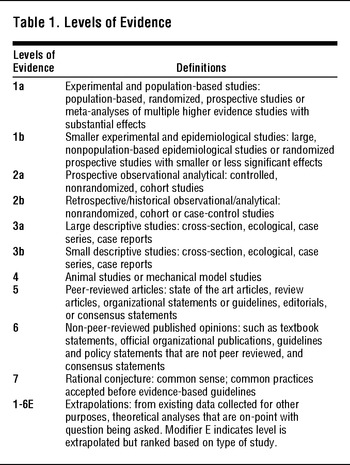
A total of 58 documents (50 peer-reviewed journal articles and 8 organizational guidelines) were reviewed within 10 levels of evidence (Table 1) by the Subcouncil Review Committee (four authors plus Cindy Rowe, PhD, and Jeffrey L. Pellegrino, PhD), who independently selected and then as a group confirmed both inclusion eligibility of the document and the level of evidence subscribed for each document. At the completion of this process the authors jointly rated and designated an inclusive classification level of scientific support based on strengths of the literature review process.
Levels of Evidence

RESULTS
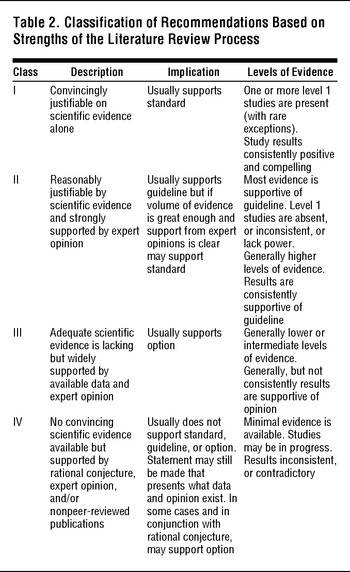
The eAppendix provides a summary of the literature reviewed and their determined levels of evidence. The literature reviewed were categorized as 50 articles in peer-reviewed journals (level 5 by virtue of being peer reviewed), and 8 organizational statements (3 at level 5, as clinical expert consensus or review, and 5 at level 6, as guidelines or official statements). Finally, employing the classification standards listed in Table 2, the summation of the level of scientific support based on strengths of the literature review process would be rated as class III-IV: adequate scientific evidence is lacking but widely supported by expert opinion and rational conjecture. No controlled studies were found.
Classification of Recommendations Based on Strengths of the Literature Review Process

There is neither sufficient evidence to support a treatment standard nor sufficient evidence to support a treatment guideline. However, there is wide support by expert opinion and rational conjecture (at class III-IV) to demonstrate that PFA offers an acceptable intervention option to be provided by trained volunteers (those without professional mental health training) for people who have experienced a traumatic event.
RESULTS-BASED RECOMMENDATIONS
Based on this research analysis, the recommendation made to the ARC is that the principles of PFA be included in all ARC courses relevant to the aftermath of traumatic events, including but not necessarily limited to first aid, cardiopulmonary resuscitation, lifeguard training, and nurses assistant training. Since the completion of this scientific review, the ARC has, in fact, mandated that all disaster assessment team members complete the PFA course.
The literature reviewed provides wide agreement as to definition of the term PFA as a process used to enable the participant to provide basic care, comfort, and support to people who are experiencing disaster-related stress. While no standard operationalization of PFA exists, consistent actions are present across applications.
The implications of the lack of level 1 to 3b studies emphasize that PFA should not move into the realm of treatment as other programs (ie, critical incidence debriefing and critical incident stress management) have claimed.Reference McNally, Bryant and Ehlers5Reference Bisson6Reference Bisson, Shepherd and Joy7Reference Litz, Gray, Bryant and Adler8 The caution is that the volunteer provider must be trained that PFA assists victims with their initial needs, but this is not a treatment for their mental health problems, which is the responsibility of the disaster mental health professional staff.
The Disaster Health Subcouncil recommended that ACFASP be available in the future to review and evaluate the implementation of the Red Cross PFA model. In particular, this model would include reviewing the specific PFA skills and training needed to implement them, the decision plans for when and to whom referrals are made, and adaptations for vulnerable populations. It was further recommended that any related tools and guides introduced be reviewed by ACFASP.
LIMITATIONS
This review and the conclusions drawn are limited because of the lack of scientific evidence from level 1 to 3b studies. To date, operational circumstances have not allowed PFA to be eligible for population-based randomized studies or meta-analysis, leaving such programs to the scrutiny of rational conjecture, common practices, and expert opinion.
COMMENT
Researchers have identified several of the core physiological factors accompanying acute stress response. These factors provide the scientific foundation for the application of PFA. Cannon (1935) first noted that stimulating the sympathetic nervous system resulted in adrenal gland discharges, causing a predictable pattern of similar biochemical cardiovascular changes that prepared the body for fight or flight.Reference Cannon9 Selye demonstrated that the stress of somatic or mental demands is naturally accompanied by bodily and chemical changes. In spite of dissimilar situations, stress-induced biochemical changes that prepare the body for flight or fight tend to be fairly uniform. Accordingly, a realistic goal of stress management is not so much to eliminate any stress response but rather to learn adaptive responses to stressful situations.Reference Selye10
When acute stress response-induced psychological reactions are not managed effectively, the trauma survivor can have difficulty with basic task performance. Easterbrook found that during stress, task attention narrows; a complex task is harder to complete when attention is divided by competing demands. Critical details of the task may not be fully processed due to information processing overload.Reference Easterbrook11 Clark also found that physiological reactions distract from task performance during stress when these sensations are negatively interpreted. These research studies implicate the need for basic intervention to help trauma survivors reduce the negative impact of acute stress and maximize adaptive functioning following the event.Reference Clark12
Research has shown that for the majority of people who experience traumatic events, posttraumatic stress reactions generally dissipate within the first six months to a year. The American Psychiatric Association's Diagnostic and Statistical Manual of Mental Disorders Revised, Fourth Edition (DSM-IVTR) defines acute stress disorder as a set of specific physiological and psychological trauma symptoms that are limited to a duration of one month.13 With posttraumatic stress disorder (PTSD), between 10% and 30% of those who develop early acute symptoms fail to recover, manifesting PTSD symptoms even years after the traumatic event.Reference Kessler, Sonnega, Bromet, Hughes and Nelson14Reference Solomon15 There is evidence for an association between early symptomatology and the potential for the later development of chronicity of trauma symptoms for some casualties.Reference Shalev, Sahar and Freedman16Reference Ehlers, Clark and Hackmann17Reference Litz18Reference La Greca and Silverman19 The provision of basic emotional support and physical safety and care immediately following a traumatic event has been posited to be important in reducing the acute and long-term negative effects of disasters and other emergency situations.
PFA has been widely applied by lay rescuers in public health settings, workplaces, the military, mass disaster venues, and in circumscribed critical incidents such as floods, fires, accidents, and other traumatic events. As Everly et al concluded, “there appears to be virtual universal endorsement, by relevant authorities, of the value of acute PFA.”Reference Everly, Phillips, Kane and Feldman20 While the process has widespread appeal and has been safely administered by a range of lay responders in an array of settings, evidence attesting to the efficacy of the use of PFA has not been obtained through rigorously controlled research such as randomized clinical trials.
As Jacobs and Meyer suggest, it might be useful to think of a dichotomy between a lay person providing a service that is “helpful” rather than a professional providing a “therapeutic” intervention. The authors distinguish PFA when used by lay responders as being helpful from a therapeutic technique.Reference Jacobs and Meyer21 Several sources, including the Disaster Mental Health Institute17and the International Federation of Red Cross and Red Crescent Societies, specifically refer to PFA as having the potential to be applied by the population at large.2223 Even licensed mental health professionals may only be able to administer “first aid” in a crisis because they lack the time or equipment needed for more intensive procedures that would be available in a clinical setting. Similarly, the National Institutes of Health (NIMH) reportReference Burkle, Chatterjee, Bass and Bolton24 and the Veteran's Health Administration guidelines25 examined the process of PFA under the rubric of management of acute stress reaction, while professional interventions such as cognitive therapy, exposure therapy, and stress inoculation were categorized as treatment techniques for severe stress reactions. Eleven descriptions of PFA in the articles reviewed included the admonition to identify the need for referral to a professional based on observed behavior or situation. The ARC PFA course provides clear guidelines to users, including basis for referral to disaster mental health and mental health professionals, when indicated.4
The NIMH defined PFA as “pragmatically oriented interventions with survivors or emergency responders targeting acute stress reactions and immediate needs.”26 The PFA Field Operations Guide defined PFA as “an evidence-informed modular approach for assisting people in the immediate aftermath of disaster and terrorism: to reduce initial distress and to foster short- and long-term adaptive functioning.”27
Key United Nations (UN) partners, including the World Health Organization, nongovernmental organizations (NGOs), private governmental organizations (PGOs), and international governmental organizations (IGOs) have come together and created an Interagency Standing Committee (IASC) Reference Group for Mental Health and Psychosocial Support. Per their 2010 guidelines for mental health and psychosocial support in emergency settings, the IASC defines PFA as that:
which entails basic, non-intrusive pragmatic psychological support with a focus on listening but not forcing talk; assessing needs and ensuring that basic needs are met; encouraging but not forcing company from significant others; and protecting from further harm. PFA thus involves a non-clinical, humane, supportive response to a fellow human being who is suffering and who may need support immediately after an extremely stressful event. It is very different from psychological debriefing in that it does not necessarily involve a discussion of the event that caused the distress. Psychological debriefing is a popular but controversial technique (which at best is ineffective) and should not be implemented. All aid workers, and especially health workers, should be able to provide very basic PFA. In a minority of cases, when emergency-induced severe, acute distress limits basic functioning or is intolerable, clinical management will probably be needed.28
PFA should be seen as providing situational knowledge, both from the victims to the assessor and from the assessor to the victims. This approach allows the victims to experience a sense of safety and security and to have ready access to essentials (ie, water, sanitation, food, shelter, health). Providing these actions has the effect of reducing symptoms of stress. For those who continue to show symptoms of stress, PFA should be used as a referral tool to various avenues of treatment. The use of the term intervention(s) is seen in a majority of the works reviewed as referring to help as opposed to therapy. It must be clear that PFA is universally referred to as responses or actions to be taken when encountering individuals who have experienced a traumatic event. As used in this context, intervention is NOT treatment. The interventions provided are the actions common to all versions of PFA on an interim basis. These interventions are not an end point, but may lead to various avenues of treatment.
Last, our findings strongly support the original study of Bisson and colleagues who, in 2007, concluded that there is “no evidence to support a policy of formal therapeutic intervention” for everyone following a traumatic event. However, they recommend that “shortly after a traumatic event, it is important that those affected be provided, in an empathic manner, with practical, pragmatic psychological support. Individuals should be provided with information about possible reactions they might have; what they can do to help themselves (coping strategies); how they can access support from those around them (particularly family and community); and how, where, and when to access further help if necessary.” They concluded their study by encouraging the further exploration of the PFA approach.Reference Bisson, Brayne, Ochberg and Everly29
To date, the ARC is in the process of completing a PFA-related victim-outcome evaluation used during the post-oil-spill disaster in the Gulf of Mexico. Further research studies should consider:
• victim-centered surveys of the post-PFA process to assess acceptability and applicability by victims;
• outcome studies of those who received PFA intervention alone and those referred by the PFA process to mental health professionals;
• disaster-specific (eg, pandemics, earthquake, nuclear event, war, or conflict) comparisons of PFA utility and applicability.
CONCLUSIONS
This systematic review confirms that although scientific evidence is lacking, sufficient evidence for PFA, rated as a class III-IV guideline, is widely supported by available objective observations of measurements of effectiveness and expert opinion and best fits the category of “evidence informed” but without proof of effectiveness. Furthermore, there is not sufficient evidence to support a treatment standard or a treatment guideline. PFA offers an acceptable intervention option to be provided by volunteers without professional mental health training for people who have experienced a traumatic event. PFA is a vital first step in ensuring basic care, comfort, and support. Volunteer providers must be trained and reminded that PFA assists victims with their initial needs but is not a treatment for their mental health problems, which is the responsibility of the disaster mental health professional staff.
Suppport: This research is presented on behalf of the American Red Cross Advisory Council of First Aid, Aquatics, Safety and Preparedness (ACFASP).
Acknowledgments: Cindy Rowe, PhD, and Jeffrey L. Pellegrino, PhD, assisted in the initial phases and article review of this study, and the members of the American Red Cross and ACFASP Disaster Health Subcouncil assisted and supported this study: Robert Yin, LISW; Sharon A. R. Stanley, PhD, RN, RS; James A. Judge II; Tener Goodwin Veenema, PhD, MPH; Lou Ellen Romig, MD; and Rebecca S. Noe, MN, MPH.