INTRODUCTION
The monogenean flatworm Gyrodactylus salaris Malmberg, 1957 is an ectoparasite on Atlantic salmon (Salmo salar L.) and rainbow trout (Oncorhynchus mykiss Walbaum). G. salaris is found both in the Baltic Sea and the Atlantic Ocean, but is considered endemic to the Baltic area. The parasite was introduced to Norway on several occasions (Johnsen and Jensen, 1991; Johnsen et al. 1999; Hansen et al. 2003), and has since its first record in 1975 been found in more than 40 Atlantic salmon populations. G. salaris also occurs on Atlantic salmon in at least 11 rivers of the Swedish west coast and in several rainbow trout farms and salmon hatcheries in Fennoscandia (Malmberg and Malmberg, 1993; Koski and Malmberg, 1995; Buchmann et al. 2000).
The damage caused by G. salaris has initiated many studies aimed at unambiguously identifying the parasite. G. salaris can readily be differentiated from most closely related species by morphology (Ergens, 1983; Shinn et al. 2000, 2001) and molecular markers (Cunningham et al. 2001; Matejusová et al. 2001). However, the internal transcribed spacers ITS1 and ITS2 of the ribosomal gene cluster are identical between G. salaris and G. thymalli Žitňan, 1960, a harmless parasite described from grayling (Thymallus thymallus L.), in a wide geographical range (Ziętara and Lumme, 2002). ITS1 and 2 have proven useful to delimit the majority of Gyrodactylus species (Matejusová et al. 2001; Ziętara et al. 2002; Ziętara and Lumme, 2002, 2004). Morphologically the 2 species are also very similar, but in some instances statistical classification methods on morphometric measurements could discriminate them (McHugh et al. 2000; Shinn et al. 2004). These studies were, however, based on either a limited number of samples (McHugh et al. 2000) or on aquarium-reared specimens (Shinn et al. 2004).
Sterud et al. (2002) and Cunningham et al. (2003) considered some repeat types and repeat configurations in the intergenic spacers (IGS) of the ribosomal gene cluster specific for G. thymalli and G. salaris and suggested the IGS useful for distinguishing them. Cloned IGS sequences from G. salaris specimens recovered from rainbow trout, however, contained typical repeat types of both G. salaris and G. thymalli (Sterud et al. 2002; Cunningham et al. 2003). The authors therefore suggested that the rainbow trout parasites may be considered either hybrids or ancestors of both G. salaris and G. thymalli. Alternatively, the IGS arrangements of rainbow trout parasites may just reflect the dynamics of a repetitive region. The lack of IGS sequence variation in parasites from rivers with recently introduced parasites led the authors to conclude that IGS is not suitable for discriminating recently separated populations of G. salaris.
In comparison to the very low intra- and interspecific variability of ribosomal DNA, Hansen et al. (2003) and Meinilä et al. (2004) detected surprisingly high sequence diversity of the mitochondrial cytochrome oxidase I (COI) gene. In a comprehensive study including Gyrodactylus parasites from 32 Norwegian, Swedish and Latvian localities, Hansen et al. (2003) detected 12 mitochondrial haplotypes that grouped into 5 well-supported clades. Three clades consisted of haplotypes found in G. salaris and 2 clades consisted of haplotypes found in G. thymalli. There was no support for the monophyly of either G. salaris nor G. thymalli haplotypes. Hansen et al. (2003) suggested that G. salaris and G. thymalli could either be 1, 2, or several species, but did not favour any of these alternatives. Later, Meinilä et al. (2004) identified additional haplotypes and clades when studying G. salaris and G. thymalli parasites from Sweden, Finland, and Russia, but also the extended data set did not support monophyly of either species. Thus, Meinilä et al. (2004) were in favour of G. salaris and G. thymalli being 1 species.
In the current study the repetitive region of the IGS and the mitochondrial COI from parasites from Norway, Sweden, Latvia, and one of the type localities of G. thymalli in Slovakia (Žitňan, 1960) were sequenced. It was of particular interest to know whether the mitochondrial DNA variation of G. salaris and G. thymalli is mirrored in the nuclear genomes, i.e. whether particular IGS repeats and/or arrangements correlate to mitochondrial DNA clades.
MATERIALS AND METHODS
Sampling of parasites and species identification
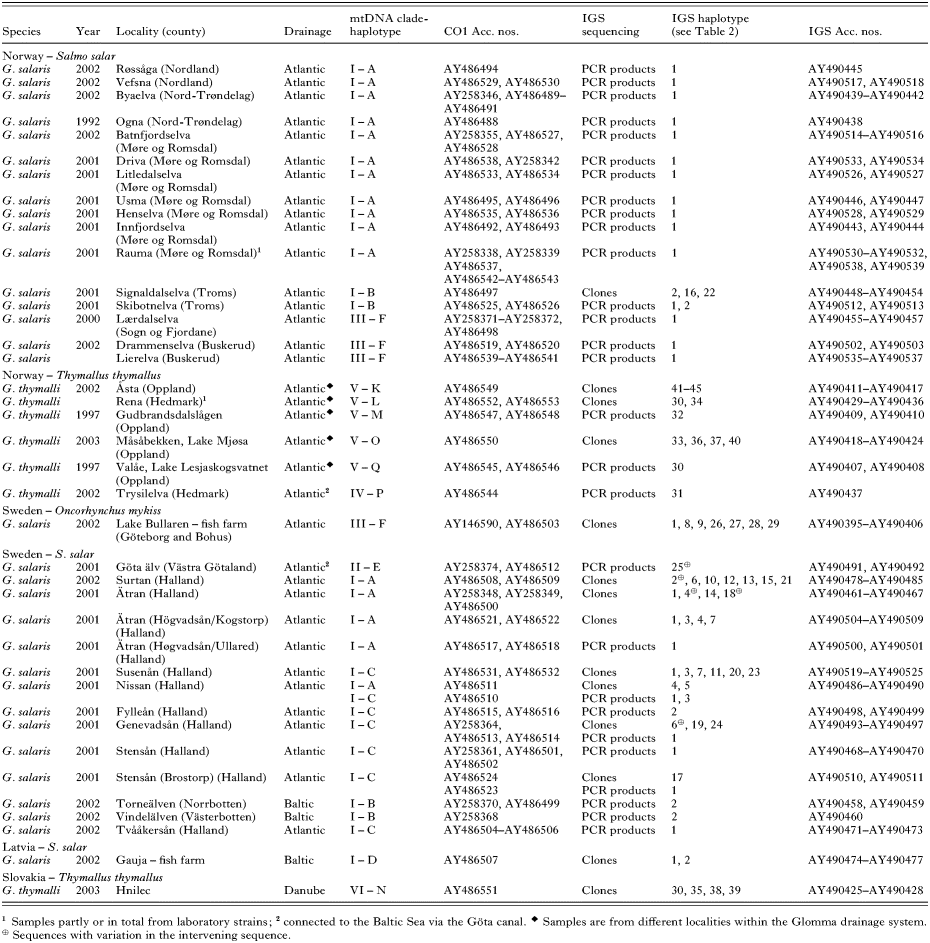
Gyrodactylus specimens were collected from Atlantic salmon (Salmo salar L.), grayling (Thymallus thymallus L.) and rainbow trout (Oncorhynchus mykiss Walbaum) from 35 localities in Norway and Sweden that drain into the North Sea/Atlantic Ocean. Gyrodactylus specimens from Baltic salmon were collected in 3 localities in Sweden and Latvia that drain into the Baltic Sea (Table 1). In addition, Gyrodactylus specimens were collected from grayling from River Hnilec, Slovakia, a tributary to the Danube. This is one of the type localities of G. thymalli (Žitňan, 1960).

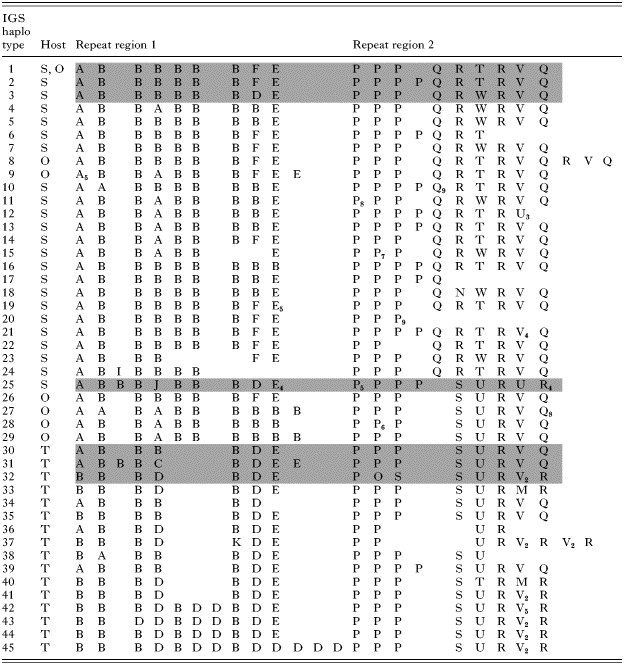
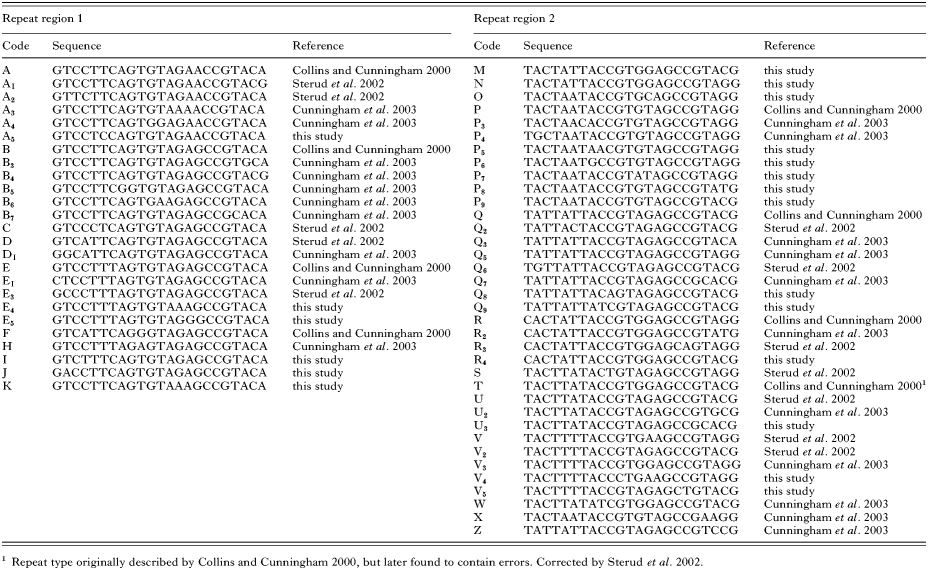
Table 2. Alignment of IGS haplotypes of Gyrodactylus salaris and G. thymalli (The sequences and codes of the 23 bp repeat types are given in Table 3. The most common/characteristic haplotypes are shaded. This alignment was constructed manually and reflects the authors' understanding of similarity of the repeats. Host: S=Salmo salar, T=Thymallus thymallus, O=Oncorhynchus mykiss.)

Classification of parasites was based on the host species, i.e. Gyrodactylus parasites on salmon and rainbow trout were considered as G. salaris and individuals on grayling as G. thymalli. Thus, within this manuscript G. salaris and G. thymalli refer to operational taxonomic units rather than to biological species if not stated otherwise.
DNA amplification, cloning and sequencing
DNA was extracted as described by Cunningham et al. (2001). Approximately 750 bp of the mitochondrial cytochrome oxidase I gene (COI) and 600–700 bp of the intergenic spacer (IGS) of the nuclear ribosomal DNA cassette were amplified from the same individuals. The COI was amplified as 2 overlapping ~400 bp segments employing the primers ZMO1, ZMO2, ZMO3 and ZMO4 (Hansen et al. 2003). The primer pairs IGSV3 and IGSV4 (Sterud et al. 2002) were used to amplify the IGS repeat regions of the same individuals. The PCR reaction was performed in a GeneAmp PCR System 9700 (Applied Biosystems) and contained 1 μl of DNA template, PCR buffer (Roche), 200 mM dNTPs, 1 mM of each primer and 1 U Taq polymerase (Roche) in a total volume of 25 μl. Cycling conditions were identical to those described by Sterud et al. (2002).
PCR products were purified with QIAquick PCR Purification Kit (Qiagen) and subsequently sequenced using BigDye chemistry on a ABI 3100 capillary sequencer (Applied Biosystems) using the same primers as for PCR. In some instances, the IGS amplicons yielded ambiguous sequences due to intra-individual heterogeneity of the IGS repeat regions (Table 1). If so, the purified PCR products were cloned in the pCR ‘4Blunt-TOPO’ plasmid vector by means of the Zero Blunt TOPO PCR Cloning Kit (Invitrogen) and individual clones were sequenced. In these instances, sampling of clones was not aimed towards exhaustive assessment of sequence variation but biased towards clones of different length. Sequences were proof-read and edited in Sequencher (Gene Codes Corporation) and labelled according to the codes used in previous studies (Collins and Cunningham, 2000; Sterud et al. 2002; Cunningham et al. 2003). In total, IGS from 81 parasite specimens were sequenced. All sequences were deposited in GenBank and the respective Accession numbers are listed in Table 1.
Nucleotide sequence alignment and tree construction
Nucleotide sequences were aligned using ClustalX (Thompson et al. 1997). Phylogenetic trees of COI sequences were inferred by neighbour-joining (NJ, Kimura's 2-parameter) and maximum parsimony (MP, unweighted, close-neighbour-interchange, random addition of trees: 10 replications) analyses implemented in MEGA 3·0 (Kumar et al. 2004). Genetic distances were calculated according to Kimura's (1980) 2-parameter method. All mitochondrial haplotypes determined in this study as well as those obtained by Hansen et al. (2003) were included in the data set, i.e. the mitochondrial haplotypes G, H, I, and J were included in the tree construction although they were not detected in this study. The COI sequences from Gyrodactylus sp. from alpine bullhead (AY258375) and G. lavareti (AY225306) were used as outgroups. Bootstrap estimates were obtained by running 1000 replicates. The minimum spanning tree of the 23 bp IGS repeats was constructed using the program Arlequin (ver. 2000) (Schneider et al. 2000).
RESULTS
Cytochrome oxidase I
The mitochondrial cytochrome oxidase I (COI) sequences were determined for 81 specimens of G. salaris and G. thymalli from 39 localities (listed in Table 1), and the nomenclature of the COI sequences follows that introduced by Hansen et al. (2003). For G. thymalli 5 new haplotypes were observed, but none for G. salaris.
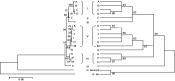
The topology of the neighbour-joining tree of the COI sequences is very similar to that published by Hansen et al. (2003), except for the new clade VI formed by the new haplotype N from specimens of one of the type localities of G. thymalli (Fig. 1). The new haplotype N is characterized by 9 diagnostic nucleotides and differs from the haplotypes of clades I–V by 2·33–3·61%. The new haplotypes from Trysil and Glomma river systems grouped together with the previously described haplotypes from the same water systems. The 6 clades, 3 relating to G. salaris sequences and 3 relating to G. thymalli sequences, are well supported, but the internal nodes remain unresolved. Figure 1 also presents the bootstrap consensus tree of 64 equally parsimonious trees obtained in the maximum parsimony analysis. For the majority of the obtained MP trees the clades found in the NJ-analysis were also recovered.

Fig. 1. Neighbour-joining dendrogram (Kimura's two parameter) and maximum parsimony bootstrap consensus tree (unweighted close-neighbour-interchange, random addition of trees) of mitochondrial haplotypes of Gyrodactylus salaris and G. thymalli (see Table 1). Haplotypes from this study and from Hansen et al. (2003) are included. The depicted haplotypes and clades (Roman capitals) are listed in Table 1. Bootstrap support is indicated as percentages of 1000 replicates. Scale bar refers to a genetic distance of 0·05.
The ribosomal intergenic spacer (IGS)
IGS sequences. In total 145 IGS sequences were obtained. Of these, 114 sequences (56 directly sequenced PCR products and 58 clones) were obtained from 71 G. salaris individuals of 32 localities, and 31 sequences (5 directly sequenced PCR products and 26 clones) were obtained from 10 G. thymalli individuals of 7 localities (Table 1). All IGS sequences had the typical structure described earlier (Collins and Cunningham, 2000; Sterud et al. 2002; Cunningham et al. 2003). The 81 bp intervening sequence was almost invariant; in only 5 sequences, 3 clones and 2 PCR products, nucleotide exchanges were detected and in one a 1 bp deletion was detected (see Table 1). A G→A transition at position 26 and a C→A transversion at position 33 of the intervening sequence are shared by both G. salaris individuals from River Göta älv, Sweden, and are therefore considered informative.
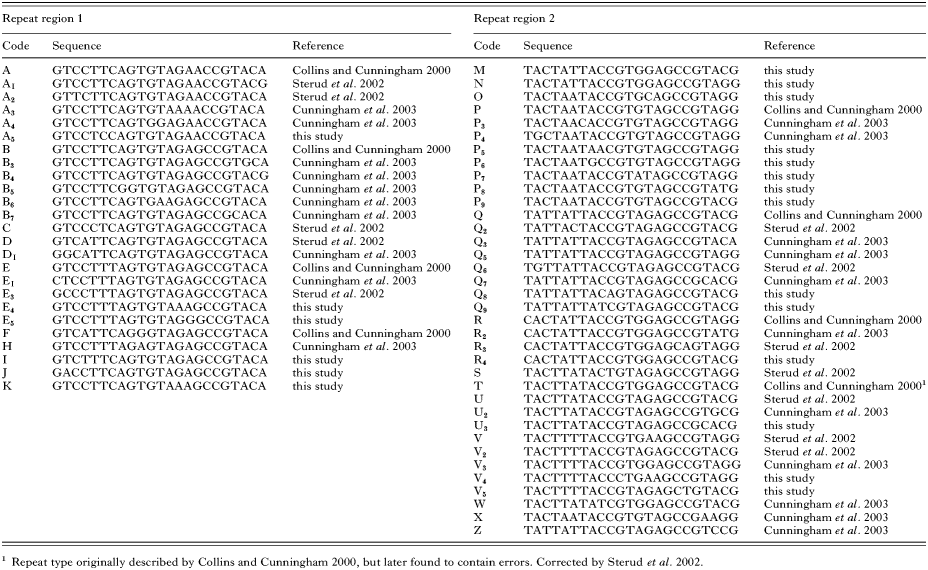
The repeat regions 1 and 2. The repeats of repeat region 1 differ from each other at 1–4 positions, and the repeats of repeat region 2 differ at 1–7 positions. The variants A, B, D, E, and F in repeat region 1 and P, Q, S, R, T, U and V in repeat region 2 are most abundant, and this corresponds well to previously described data (Collins and Cunningham, 2000; Sterud et al. 2002; Cunningham et al. 2003). Twenty new variants, 6 in region 1 and 14 in region 2, were discovered in this study. Some repeat types are more common in either G. salaris (e.g. repeat type F) or G. thymalli (e.g. repeat types C and V2), but no repeat type is found exclusively in all sequences from either species.
Evolution of the IGS
There are typical IGS arrangements for parasites from salmon, grayling, and rainbow trout (shaded in Table 2). IGS arrangements were considered typical if they can be found in parasites of different geographical origin and/or can be sequenced directly as homogeneous PCR products. Typical IGS arrangements of G. salaris assigned according to different geographical origin do not result from biased sampling. IGS arrangements 1 and 2 that are typical for G. salaris from Norwegian rivers where the parasite has been recently introduced are also found in the specimens from Latvia. Typical IGS arrangements assigned according to direct sequencing of PCR products reflect IGS sequences homogenized within a genome according to the concept of concerted evolution (Dover, 1982). Although intragenomic variation cannot be excluded, one can expect one particular IGS arrangement (PCR template) that dominates in number. In contrast, PCR products that could not be sequenced directly indicate substantial intragenomic IGS variation in the genomes with no particular IGS arrangement dominating in number. The IGS sequences of G. thymalli are intra-individually less homogenized than those of G. salaris. Direct sequencing of PCR products was only possible in 5 instances and standard IGS arrangements are more difficult to define. However, the most common IGS arrangements of G. salaris (1, 2, 3, and 25 in Table 2) are longer than those of G. thymalli (30, 31, and 32 in Table 2).
The cloned IGS sequences from G. salaris from rainbow trout show some G. thymalli-like features in repeat region 2 while the arrangements of region 1 are very similar to those of G. salaris from salmon. This is consistent with the results of Sterud et al. (2002) and Cunningham et al. (2003). Interestingly, the IGS sequences from G. salaris on Atlantic salmon from River Göta älv, Sweden, also have unusual repeat arrangements in regions 1 and 2. Repeat region 1 is longer than average and includes repeat type D that is otherwise characteristic for G. thymalli. In repeat region 2 the SU repeat motif is also typical for G. thymalli.
A hypothetical evolutionary history of the ribosomal intergenic spacer repeats
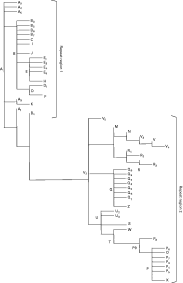
The nucleotide sequences of IGS repeats from regions 1 and 2 show high levels of sequence similarity that indicate common ancestry. Maximum similarity is observed between repeat types B4, E, E1, E3, H, J, and I from region 1 which all share 17 identical positions with repeat type V2 in repeat region 2. A minimum spanning tree (Fig. 2) illustrates that the IGS repeat types are more similar within each repeat region than between repeat regions. Furthermore, there is no indication of sequence homogenization between the 2 repeat regions.

Fig. 2. Minimum spanning tree of individual IGS repeats found in Gyrodactylus salaris and G. thymalli. The tree was constructed in Arlequin (Ver. 2000) (Schneider et al. 2000). The corresponding sequences of the individual repeats can be found in Table 3. Labelling follows earlier studies (Collins and Cunningham, 2000; Sterud et al. 2002; Cunningham et al. 2003).
Nuclear versus mitochondrial variation in G. salaris and G. thymalli
The observed IGS arrangements were compared to the clades of mitochondrial COI haplotypes (see Table 1). The mitochondrial haplotype E that has so far only been observed in G. salaris specimens from River Göta älv, Sweden, occurs together with the typical IGS repeat arrangements 25. Otherwise, there is no match of specific mitochondrial haplotypes with specific IGS arrangements. The typical repeat arrangements 1, 2, 3 found in G. salaris occur in specimens that bear mitochondrial haplotypes of both clades I and III. The typical repeat arrangements 30, 31 and 32 found in G. thymalli specimens are also not specific for any particular clade of mitochondrial haplotypes.
DISCUSSION
In this study sequence data of the ribosomal intergenic spacer (IGS) regions and the mitochondrial cytochrome oxidase I (COI) genes of G. salaris and G. thymalli that complement earlier IGS (Collins and Cunningham, 2000; Sterud et al. 2002 Cunningham et al. 2003) and COI data sets (Hansen et al. 2003; Meinilä et al. 2004) are presented.
Sequence variation in the CO1 gene
The COI data largely confirm the clades and tree topologies reported by Hansen et al. (2003) and Meinilä et al. (2004). The new COI haplotype N detected in the G. thymalli specimens from one of the type localities in Slovakia adds an additional well-supported clade. In total, there are now 8 mtDNA clades (6 included in this study and 2 described by Meinilä et al. (2004)). In the present data set, clades I and II are specific for Gyrodactylus parasites on salmon and clade III for Atlantic salmon and rainbow trout. Clades IV–VI are specific for grayling as are two further clades described by Meinilä et al. (2004). The data are still most consistent with considering G. salaris and G. thymalli to be either one polytypic species or several different species, each relating to one of the distinct mitochondrial clades described here, by Hansen et al. (2003) or by Meinilä et al. (2004)
Meinilä et al. (2004) suggested that the mitochondrial clades specific for grayling parasites reflected ice-age refugia due to congruence with 4 postulated refugia for grayling (Koskinen et al. 2000; Weiss et al. 2002). Accordingly, one may assume a further ice-age refugium for grayling bearing parasites with the new haplotype N. Alternatively, grayling from any particular ice-age refugium is infected with parasites bearing mitochondrial haplotypes from more than one clade. For us it seems likely that any further geographically isolated population of G. thymalli being sampled will provide haplotypes belonging to a new mitochondrial clade. We favour the assumption of COI clades mirroring geographically isolated parasite strains that evolved independently after a bottleneck associated with the spreading into new water systems.
IGS repeat types
Twenty new IGS repeat types were found in this study, most of which are rare and expected to result from point mutations affecting individual rDNA repeats. Not surprisingly, most new repeat types were detected in cloned sequences. Accordingly, some rare IGS repeat types that have been described earlier (Collins and Cunningham, 2000; Sterud et al. 2002; Cunningham et al. 2003) were not found in the present study. However, some new repeat types were obtained from direct sequencing of PCR products and are therefore considered characteristic for the analysed Gyrodactylus specimens; E4, J, P5 and R4 were detected in G. salaris from River Göta älv, Sweden, and contribute to IGS arrangement 25, and; O was detected in G. thymalli from River Gudbrandsdalslågen, Norway, carrying the mitochondrial haplotype M.
According to Sterud et al. (2002) and Cunningham et al. (2003) some IGS repeat types may be specific and suitable for discriminating G. salaris and G. thymalli. Sterud et al. (2002) found repeat types C and D only in G. thymalli, with C only occurring in specimens from Trysil, Norway. Repeat types F and T were only found in G. salaris from salmon while S and U were absent. Later, Cunningham et al. (2003) found D also in one clone from G. salaris from rainbow trout in Berlin, Germany. They also found repeat type F in G. salaris from rainbow trout in western Sweden. Here repeat type T was also found in one clone from G. thymalli from Måsåbekken, Norway, and repeat types S and U in G. salaris from River Göta älv, Sweden. If rare and clone-specific repeat types are not considered, currently only repeat type F is diagnostic but not found in all G. salaris populations. This is in line with Cunningham et al. (2003) who suggested dynamic IGS patterns; all repeat types can accordingly be found in all populations but with different frequencies. Presence or absence of certain repeat types is thus not considered informative.
Evolution of the repetitive region of the IGS
The sequence similarity of the 23 bp IGS repeats suggests common ancestry and it can be assumed that repeat regions 1 and 2 result from a duplication of just one ancestral repeat region. Following the duplication both repeat regions evolved independently. In the lack of sequence data from closely related species it is impossible to reconstruct the sequence and repeat arrangement of the ancestral IGS repeat region. According to the concept of concerted evolution (Dover, 1982) both repeat regions will be homogenized in individuals, populations and species by recombination processes such as, for example, unequal crossing-over and replication slippage. Mutations will generate new repeat types that may be homogenized or may disappear. In addition, recombination may alter the number and order of repeats. Although most of the variation may be selectively neutral, the length of the IGS may affect transcription (e.g. Zentgraf et al. 1990; Zentgraf and Hemleben, 1992). Footprints of concerted evolution can be seen clearly in the IGS dataset as particular IGS haplotypes are homogenized in the genomes and can be unambiguously sequenced as PCR products. The rare repeat types detected through cloning illustrate the significance of mutations in the concept of concerted evolution. Since the IGS repeats are only 23 bp long, there may be a relatively high probability that homoplasic repeat types appear independently.
This particular mode of evolution of the ribosomal IGS region makes it impossible to align nucleotide sequences unambiguously. Alignments are biased towards the researchers' understanding of similarity and may not reflect homologous positions. We therefore consider phylogenetic trees based on IGS data such as, for example, that put forward by Cunningham et al. (2003) not informative. Although the authors were aware of the problem and excluded ‘difficult’ sequences from the data set, they presented a phylogenetic tree with very low bootstrap support depicting a ‘grayling form’ and a more derived ‘salmon form’ of IGS which they took as support for G. thymalli and G. salaris being 2 species.
Nuclear versus mitochondrial variation in G. salaris and G. thymalli
Since phylogenetic analyses of IGS sequences of G. thymalli and G. salaris are not straightforward, the IGS features were related to the clades of mitochondrial haplotypes. The clade II-specific IGS arrangement 25 will not be considered in this context, since this clade/haplotype currently only includes the G. salaris specimens from River Göta älv, Sweden; any peculiarity of the IGS of this strain will by default be specific for mitochondrial clade II.
Three features within repeat region 1 can be related to mitochondrial clades: (i) repeat type D occurs in clades II and IV–VI, but does not occur in clades I and III; (ii) repeat type F is only found in parasites bearing mitochondrial haplotypes from clades I and III. Repeat type F differs from D by only 1 nucleotide substitution; we therefore assume that F replaced D in clades I and III; (iii) repeat type B at the first position of repeat region 1 is restricted to clades IV–VI. Within repeat region 2, two features can be related to mitochondrial clades: (1) the repeat arrangement SU does not occur in clade I; (2) repeat type V2 that is considered ancestral due to its position in the minimum spanning network is restricted to clade IV.
Taxonomic implications of the IGS sequences
According to our interpretation there are no diagnostic repeat types or repeat arrangements for either G. salaris or G. thymalli. More exhaustive cloning and sequencing of IGS is expected to support this assumption. Nevertheless, there is a trend in favour of a ‘grayling form’ and a ‘salmon form’ of IGS as described by Cunningham et al. (2003). However, repeat arrangements similar to the ‘grayling form’ in salmon parasites from River Göta älv, Sweden, challenges this view. Parasites from this locality have the distinct clade II mitochondrial haplotype E (Hansen et al. 2003). Other authors such as Meinilä et al. (2004) do not accept haplotype E as a separate clade and consider this haplotype as belonging to clade I.
As already noticed by Sterud et al. (2002) and Cunningham et al. (2003), the IGS of Norwegian and Swedish G. salaris populations from rainbow trout share features with both the ‘grayling form’ and the ‘salmon form’. Cunningham et al. (2003) suggested that G. salaris on rainbow trout may either be a hybrid between G. salaris from salmon and G. thymalli from grayling or the ancestor of both forms. All currently known COI sequences of G. salaris from rainbow trout (Hansen et al. 2003; Meinilä et al. 2002, 2004) are haplotype F and if true the putative mother must bear the same haplotype. So far, this haplotype in the wild has only been found in G. salaris from the Norwegian rivers Drammenselva, Lierelva, and Lærdalselva, where the parasite was recently introduced (Hansen et al. 2003). We consider it more likely that the IGS of G. salaris on rainbow trout results from recombination of 2 ancestral G. thymalli IGS haplotypes prior to host switches to rainbow trout and salmon. This hypothesis is favoured since the most important step in generating an IGS haplotype, as observed today in G. salaris on rainbow trout, is recombination.
According to our opinion, the IGS data are most consistent with G. salaris and G. thymalli being a single polytypic species. This hypothesis has been first suggested as one of three possibilities by Hansen et al. (2003) and was also favoured later by Meinilä et al. (2004). Different mitochondrial haplotypes may be suitable to characterize clades or strains that are separated geographically and/or are infecting different salmonid hosts. The major remaining argument in favour of considering G. salaris and G. thymalli as 2 valid species is their different host preference (Soleng and Bakke, 2001; Bakke et al. 2002; Sterud et al. 2002). However, host switches are frequent in Gyrodactylus (Ziętara and Lumme, 2002) and host preferences may depend on the particular host (Bakke et al. 1990; Bakke et al. 1996) and/or parasite strains (Lindenstrøm et al. 2003) in question. Until now, only a very limited number of G. salaris and G. thymalli populations have been tested for host preference, and therefore host preference should be used with caution in Gyrodactylus taxonomy.
We are grateful to Vladka Hanzelova for providing G. thymalli samples from Slovakia. We thank Lars Karlsson, Ingemar Perä, Thrond Haugen, Kjetil Olstad and Dag Gammelsæter for collecting material in Sweden and Norway. The project was supported by the Norwegian Research Council's Wild Salmon Programme (Project no. 145861/720) and the National Centre for Biosystematics (Project no. 146515/420), co-funded by the NRC and the NHM, University of Oslo, Norway.