A MEMORABLE COLLECTOR AND PATRON (JF-S)
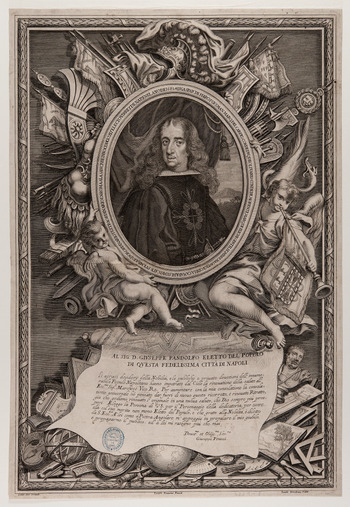
Gaspar de Haro y Guzmán (b. Madrid, 1 June 1629 – d. Naples, 16 November 1687, fig 1) is best remembered as the 7th Marquess del Carpio. The great-nephew of the count-duke of Olivares and the son of Luis de Haro, Philip iv’s first ministers of state at the helm of the Spanish monarchy from 1622 to 1661, the young Carpio lived under the shadow cast by their accomplishments. Wishing to keep him at a distance, the regent Mariana of Austria appointed him ambassador to Rome in 1671; however, only reluctantly and after procrastinating for long years did Carpio finally set out for Italy.Footnote 1 A record of his passport as he passed through Tronzano (Vercelli, Piedmont) on 4 January 1677 describes him as a 46-year-old man of medium-to-short stature with blonde but greying hair and beard.Footnote 2
Jacques Blondeau, engraved portrait of the Marquess del Carpio after drawings by Philipp Schor and Giuseppe Pinacci (Rome, 1682). Photograph: Biblioteca Nacional de España, Madrid.

Carpio’s greatest contribution was surely as viceroy of Naples (1683–7). There, the once profligate youth with a tarnished reputation was transformed into an unimpeachable and severe reformer whose government would be long remembered by the middle-class intelligentsia (the ceto civile) and the common people as a period of ethically oriented efficiency enlivened by spectacular festivities. After visiting Naples in 1685, the Scotsman Gilbert Burnet, a fellow of the Royal Society who would soon play a crucial role in the Glorious Revolution, penned a glowing portrait of Carpio as an able and resolute administrator capable of fending off ecclesiastical meddling and ready to support scientific progress.Footnote 3 Also in 1685, the antiquarian Jean Mabillon visited Naples, noting approvingly Carpio’s enlightened government and not forgetting to mention a pigmy’s skull among his prized possessions (cimelia).Footnote 4 By contrast Carpio’s ambassadorship to Rome (1677–82) was plagued by tense relations with the reigning pontiff, Innocent xi Odescalchi, leaving him more time to indulge his passion for the arts.
Artists awaited eagerly the arrival of the wealthy Spanish nobleman in Rome. In a country where the education of the high nobility traditionally left out a European grand tour, the 7th Marquess del Carpio was the one patron of the arts, collector and cultural promoter in Spain to have grasped first and also best the increased political and socio-economic advantages attached to the advancement of the arts in the new Europe defined by the treaty of Westphalia (1648), particularly so in light of what Colbert had achieved in France from the early 1660s.Footnote 5 A comparatively austere pope, and a papal court with declining financial resources to draw on, put within Gaspar de Haro’s reach the achievement of fame as one of Rome’s most popular patrons and collectors. Carpio’s honorary membership of the Accademia di San Luca, voted on 16 July 1679, speaks for a truly privileged standing with Rome’s artistic community. His departure from Rome for Naples is reported to have been met ‘with universal displeasure, especially by those proficient in Design (Disegno) of whom he was a most munificent patron as someone unmatched in the unceasing pleasure (diletto) he derived from Painting, Sculpture and Architecture’.Footnote 6 In fact, Francis Haskell remarked that at the time ‘there was no native Italian to show such discriminating enthusiasm’.Footnote 7
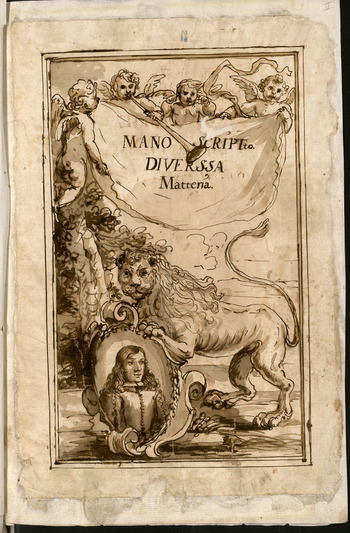
Carpio’s enthusiasm for art ranged widely across painting, music, theatre, the decorative arts, architecture and – as SAL ms 879 bears witness – sculpture. This rare ‘album’, which is closer to what Italians would describe at the time as a libro di disegni (book of drawings), was structured along the, by then, canonical and internationally popular comparison (paragone) between ‘antique’ and ‘modern’ works and exempla. From 1643 onward, the titles of various guidebooks of Rome advertised that they catered to both categories, Roma antica and moderna, drawing the visitor’s attention to the emergence of modern Rome as an object of interest in its own right.Footnote 8 Undoubtedly spurred by what he saw and admired in Rome and by the example of his maternal uncle, Pedro Antonio de Aragón, viceroy of Naples (r. 1666–71), who is known to have assembled in Italy a collection of statues for his residence in Madrid, Carpio became one of very few Spaniards during the seventeenth century to have invested substantially in the collecting of statuary, both antique and modern. Traditionally, the interests of Spain’s antiquaries focused rather narrowly on epigraphy and numismatics. The king and royal collection excepted, the acquisition of full-scale replicas in stucco or bronze of antique statues conforming a proper sculpture gallery was unheard of in Habsburg Spain.Footnote 9 Moreover, Spain’s handful of mostly modest collectors of antique statuary shared an Italian experience that had acquainted them with its socially prestigious aesthetic and cultural value. The three illustrated publications of Spanish collections of antiquities to have been envisaged in the sixteenth and seventeenth centuries, including the Carpio Album, never made it to the press.Footnote 10
Many of Carpio’s pursuits and interests are reflected directly or indirectly in the Album. Although summarily brushed aside in Madrid, his endorsement of a project to set up an art academy in Rome for the training of Spanish artists (1680)Footnote 11 ties in well with his convening of a so-called ‘scuola Platonica’ in Rome, of which little is known for certain other than the noted collector and connoisseur of drawings, Sebastiano Resta, and the painter of battle scenes, Giuseppe Pinacci, both with strong ties to Carpio, were members.Footnote 12 Proof of Carpio’s belief that galleries of antique statuary were essential to the training of young artists is found in an allegorical composition by Carlo Maratta (plainly inspired by Giovanni Pietro Bellori’s Neoplatonic ideals) that was conceived and presented to him c 1680–2. In it Leonardo da Vinci surrounded by pupils points to an écorché standing next to the statues of Hercules, Venus Kallipygos and Apollo.Footnote 13 The Roman weekly news (avvisi) reported on 8 October 1678 that Carpio’s acquisition of Massimo’s anticaglie had left the city’s virtuosi tearful knowing that such treasures were slated for shipment to SpainFootnote 14 – an acquisition for Madrid, but a loss for Rome that an illustrated book would have in part contributed to mitigate.
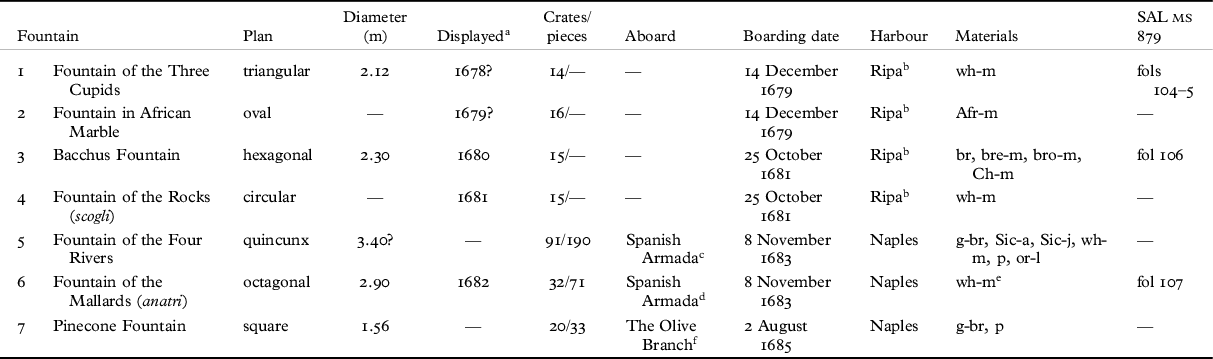
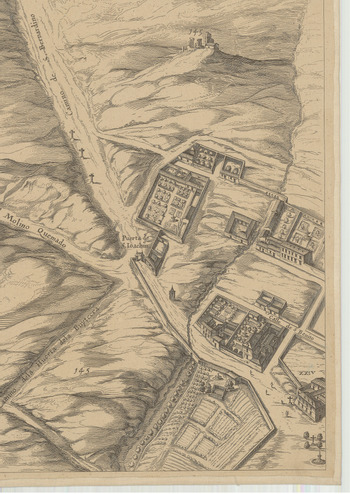
As Carpio was a talented and avid collector of the relics of ‘antique’ Rome,Footnote 15 the book would also have called attention to his resourcefulness when it came to its ‘modern’ counterpart. Six drawings at the end of the Carpio Album record the appearance of three fountains the marquess commissioned in Rome. Yet, the poet Sebastiano Baldini left us a poem celebrating a total of ‘seven fountains’ whose shipment to Spain was otherwise dutifully recorded (see table 1).Footnote 16 Out of the seven, three, and possibly four, were connected to or inspired by Gian Lorenzo Bernini, who died on 28 November 1680 in Rome while Carpio was resident ambassador there. Baldini makes clear the complete set of fountains was commissioned for Madrid, meaning in all likelihood Carpio’s Huerta de San Joaquín, a medium-sized villa located next to one of the city’s northern gates (fig 2).Footnote 17
Set of ornamental fountains the Marquess del Carpio commissioned in Rome.

Sources: RBE, ms &.iv.25; SAL, ms 879, fol 2; ADA, cajas 217.12 and 302.4; BNE, ms 7526, fols 136–8.
Key: Afr-m = African marble; br = bronze; bre-m = breccia marble; bro-m = broccatello marble; Ch-m = Chios (or portasanta) marble; g-br = gilt bronze; or-l = oriental lumachella (or pietra pidocchiosa); p = porphyry; Sic-a = Sicilian alabaster; Sic-j = Sicilian jasper; wh-m = white marble.
Notes:
a) Displayed on 29 June in Rome’s Piazza di Spagna to mark the yearly cavalcade culminating at Saint Peter’s with the presentation to the Pope of the feudal tribute for the Kingdom of Naples on a white palfrey or chinea.
b) Crates were remitted to consul Don Joseph Renda, at Civitavecchia, whose task was to forward them to Spain.
c) The ninety-one crates to be delivered to Captain Miguel Clemente Venzal at Cartagena were split between various vessels of the Spanish fleet docked in Naples: the San Carlos (flagship of the commander-in-chief or Capitana of the Flemish Fleet) (20), San Pedro de Alcántara (second-in-command flagship or Almiranta of the Flemish Fleet) (17), Santa Rosa (Royal Almiranta) (24), San Diego de Alcalá (20), San Jerónimo (10), San Carlos of Biscay (3 crates of remnants), and Santo Domingo of Flanders (piece of rough alabaster for the Fountain of the Four Rivers).
d) Nineteen crates plus an extra one of remnants aboard the vessel San Carlos of Biscay and fourteen aboard the vessel San Juan (one of which fell into the sea).
e) According to Juan Vélez de León, purple (morado) marble was also used. López Torrijos 1991, 33–4.
f) English merchant ship.
Detail of Pedro Texeira and Solomon Savery’s 1656 Plan of Madrid showing the Huerta de San Joaquín. Photograph: Instituto Geográfico Nacional, Madrid.

The grandest and costliest of all the fountains is the only one of the seven that Baldini actually named: a scaled-down version of Bernini’s Four Rivers Fountain in Piazza Navona. It may be described as the customised, exportable and jewel-like version of an urban masterpiece appropriated for the merriment of a private villa, echoing the Spanish penchant for locating Italian sculpture, including monumental equestrian bronze statues in royal or aristocratic residences and their gardens.Footnote 18 According to Carpio’s secretary, Juan Vélez de León,Footnote 19 the smaller size was compensated by two advantages (vantaggi):Footnote 20 the use of prized coloured marbles and the fact it was Bernini’s last work.Footnote 21 Vélez de León does attribute to Bernini the idea of revisiting his most celebrated fountain design, and it may well be the case that the old master had given Carpio advice on the matter.Footnote 22
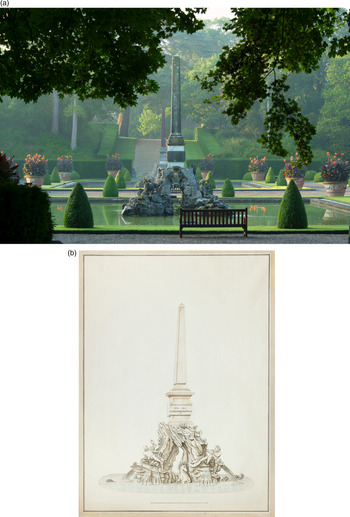
Carpio’s Four Rivers Fountain bore his coat of arms.Footnote 23 Although its actual placement is unclear, there was also a low-relief likeness of Bernini in gilt bronze mounted on porphyry, perhaps based on the pencilled self-portrait Carpio obtained from the artist’s son, Domenico.Footnote 24 While important, albeit dilapidated and weathered, elements of Carpio’s fountain are still found today in the so-called ‘Bernini Fountain’ at Blenheim Palace, on the second terrace of the Italian Gardens Achille Duchêne designed,Footnote 25 many others are missing, including a gilt-bronze winged Fame and the basin (conca) in Sicilian jasper. Its porphyry obelisk, ostensibly broken, must have been reassigned in the 1930s to the nearby ‘Vanbrugh Fountain’ (fig 3).
(a) View of the ‘Bernini Fountain’ and (in the background) the nearby ‘Vanbrugh Fountain’ fitted with the porphyry obelisk originally belonging to the ‘Bernini Fountain’, Water Terrace, Italian Garden, Blenheim Palace; (b) John Yenn, drawing of the ‘Bernini Fountain’ (with misconstrued Pamphilj inscription) as it stood in its original location assigned by Sir William Chambers near the Grand Cascade, c 1780. Photographs: His Grace the Duke of Marlborough/Royal Academy of Arts, London.

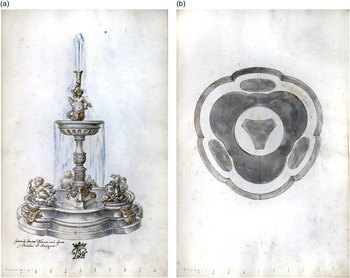
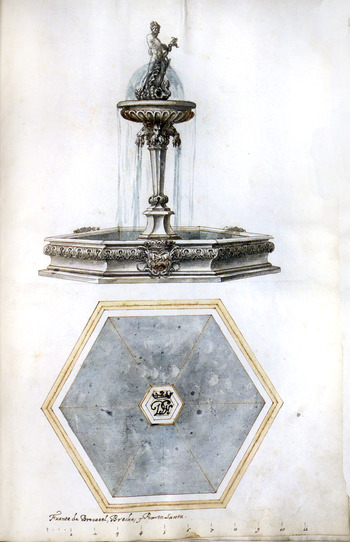
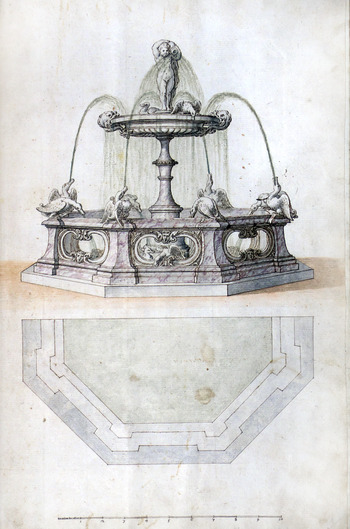
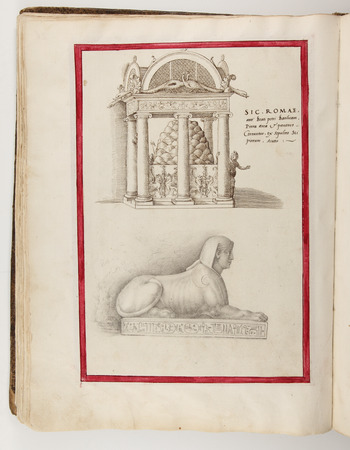
On the visual evidence provided by SAL ms 879 we can conclude that the crowning figures of the Three Cupids and the Bacchus fountains (figs 4 and 5) were inspired, respectively, after Bernini’s Triton Fountain in Piazza Barberini (1642–3) and the Fountain of the Moor in Piazza Navona (1653–5).Footnote 26 The inventory name of another of Carpio’s fountains, the ‘Fountain of the Rocks’, brings to mind Bernini’s unrivalled sculptural mastery of scogli and scogliere, not only in sculpture but also in architectural projects. Perhaps the Fountain of the Mallards (fig 6) memorialised Carpio’s patronage – to Innocent xi’s dismay – of the Feast of San Rocco on 16 August, the highlights of which were boat racing and the hanging of mallards and geese from ropes across the Tiber to be sacrificed by boatmen.Footnote 27 The Pinecone Fountain is a last and surprising choice. Like the Four Rivers Fountain, it stood out for the lavish use of porphyry and gilt bronze.Footnote 28 Described as square in plan, its inspiration must have come from that once at the centre of the atrium of Old Saint Peter’s (fig 7). Carpio could not have seen the original, which was long dismantled. Listed and marked in Tiberio Alfarano’s 1590 plan of the Old Basilica,Footnote 29 its antique bronze elements had been relocated to the Cortile della Pigna in the Belvedere. The bronze peacocks, reputed to come from Hadrian’s mausoleum,Footnote 30 may have provided Carpio with an added reason to fix his attention on this particular fountain. A bust of the Antonine emperor of Hispano-Roman roots appears alongside a congeries of miscellaneous objects at the foot of Carpio’s official portrait engraved in Rome in 1682 as he prepared to leave for Naples (see fig 1). It is nonetheless worth remarking that a fountain based on an early medieval and undoubtedly prestigious exemplar of Roma sacra, should find its way into a set of seven fountains Carpio commissioned to pay homage to the Roma moderna and to its most celebrated sculptor.
Philipp Schor (attrib.), ‘Carpio Album’, fols 104–5: coloured (a) elevation and (b) plan of the Fountain of the Three Cupids, c 1678–82 (420 × 285mm, as all subsequent fols from this Album), Society of Antiquaries of London. Photographs: Society of Antiquaries of London.

Philipp Schor (attrib.), ‘Carpio Album’, fol 106: coloured (top) elevation and (bottom) plan of the ‘Bacchus’ fountain, Society of Antiquaries of London. Photograph: Society of Antiquaries of London.

Philipp Schor (attrib.), ‘Carpio Album’, fol 107: coloured (top) elevation and (bottom) half plan of the Fountain of the Mallards, Society of Antiquaries of London. Photograph: Society of Antiquaries of London.

Francisco d’Olanda: Cantharus and Pigna of Old Saint Peter’s from the Album dos Desenhos das Antigualhas, c 1538–40. Photograph: Real Biblioteca, Real Monasterio de San Lorenzo el Real de El Escorial/Patrimonio Nacional, Madrid.

THE DRAWINGS OF THE CARPIO ALBUM (GF)
As is well known, the 7th Marquess del Carpio was also an avid collector of drawings. There are numerous inventories of his collections, drawn up both during his lifetime and after his death. Beatrice Cacciotti first drew attention to the fact that the post-mortem inventory compiled in Naples in 1687–8 records a total of forty-three volumes containing drawings; all but one, which was still in sheets, lavishly bound in red Morocco or green leather.Footnote 31 Together with fifty volumes of collected prints, the volumes of drawings were stored on eight shelves of ‘a bookcase in a hall’ of the vice-regal palace in Naples.Footnote 32 Unfortunately, the lack of titles or content descriptions works against identification – the only exception being the volume listed as containing drawings by Domenico Tintoretto.Footnote 33 According to what Giovan Pietro Bellori wrote in the Life of Carlo Maratta, thirty of the forty-three volumes were probably assembled in Rome during Carpio’s tenure as ambassador for Charles ii of Spain, and contained drawings not only ‘by the most famous painters both antique and modern’ but also ‘by the most esteemed artists then to be found in Rome’.Footnote 34 The remaining thirteen volumes were collected in Naples during Carpio’s nearly five years as viceroy.
Recent studies have focused on the eight volumes containing drawings that are still identifiable as part of the marquess’s collection – among which SAL ms 879 stands out.Footnote 35 The latest addition to the list is a heretofore overlooked volume kept at the Real Academia de Bellas Artes de San Fernando in Madrid. The still unbound sheets of SAL ms 879 must have been transferred from Rome to Naples in 1682 with the rest of Carpio’s library. Among the marquess’s still-extant volumes of drawings, this volume constitutes a unicum as its 105 sheets with drawings record the appearance of ancient sculptures – as well as some modern ones – from the marquess’s collection (statues, busts, reliefs, vases and sarcophagi fronts) followed by the drawings of three of the seven marble fountains Carpio had built in Rome for his Madrid residence. We know that the marquess did not confine himself to having the sculptures of his collection recorded in drawings, but had also taken steps to have the paintings from his ‘many galleries to be ranked amongst the best in Italy’ drawn too, filling ‘various tomes’.Footnote 36 The Carpio Album stands, therefore, as the only surviving element of an intended exhaustive and ongoing visual record of Carpio’s voracious collecting in Italy. The Album’s preface was the work of Carpio’s chamber and cipher secretary Juan Vélez de León (fig 8). A Madrid-born academic, polyglot, comedy writer, antiquarian and occasional attendee at some of Christina of Sweden’s academic gatherings at Palazzo Riario alla Lungara,Footnote 37 Vélez de León informs us that Carpio wished to engrave the set of drawings ‘for the convenience [commodità] of scholars [studiosi] of antiquity’ or, as stated more precisely in the Spanish version, for ‘the common education of the scholars of Antiquity’.Footnote 38 The undertaking implied reproducing all the pieces of sculpture – including sideboards, columns, doorframes, chimneys, vases and even the smallest of things. The last five sheets of the Album, which are blank, were presumably intended for drawings of the four fountains not actually reproduced (see table 1). In fact, Vélez de León alerts us to the volume’s incomplete state, declaring that Carpio’s project had been interrupted ‘for now’ on account of the marquess’s scheduled departure for Naples to discharge duties as newly elect viceroy. News of this eagerly awaited promotion reached the diplomat in Rome on 4 September 1682, followed by an official confirmation arriving on 2 October.Footnote 39 We do not know whether the marquess entertained the idea of a similarly ambitious publishing project for the drawings of his paintings. Be that as it may, only a few engravings of highly acclaimed pictorial masterpieces were produced by Teresa del Po and Arnold van Westerhout.Footnote 40
Anonymous, Presumed portrait of Juan Vélez de León as a young man, c 1680. Photograph: Biblioteca Nacional de España, Madrid.

It is likely the folia of the Carpio Album, still unbound, were stacked up and packaged for transport to Naples. The verso of several sheets bears the imprint from the pencilled drawing originally underneath – a staining that must have occurred while still awaiting binding. Oddly, many of these imprints do not correspond to the drawings currently opposite them but to other folia.Footnote 41 What is more, there is a fairly legible imprint of two philosopher busts, the drawings of which are missing from SAL ms 879: the (pseudo) Seneca and the Socrates that Carpio had acquired in 1678 alongside the rest of the ‘13 philosopher heads’ mentioned in the Massimo inventory of 1677.Footnote 42 At some point before the execution of the Album’s current binding, the original pile of drawings must have been reshuffled and at least one folio taken out.Footnote 43 Just as was the case with Carpio’s other libri di disegni, the final decisions regarding the page order and binding were most likely taken in Naples. To be sure, Carpio’s 1682 appointment to head the Neapolitan viceroyalty was registered at the foot of the Album’s allegorical frontispiece.Footnote 44
The man most likely in charge of curating Carpio’s collection of drawings was the Oratorian padre Sebastiano Resta, a collector in his own right, historian and connoisseur who accompanied the marquess from Rome to Naples. He remained there until at least April 1683 organising the many volumes and annotating and attributing their contents.Footnote 45 The frontispiece of SAL ms 879 is followed by Vélez de León’s already quoted foreword in Italian.Footnote 46 It was his task – and, significantly, not Resta’s – to caption succinctly, and perhaps hastily, all the Album’s drawings.Footnote 47 For the execution of these pencil drawings, the marquess probably turned to artists still undergoing training. Such had been the case with the ‘young [artists] with a promising talent for drawing’ Cassiano dal Pozzo hired for his Museo Cartaceo,Footnote 48 and with the draughtsmen whose work served as a basis for the plates of the acclaimed Galleria Giustiniana commissioned by Marchese Vincenzo Giustiniani.Footnote 49 Particularly the latter publishing enterprise, a copy of which was in Carpio’s library,Footnote 50 must have spurred him and Vélez de León to envisage the publication of SAL ms 879. Remarkably, Carpio was in possession of a copy of Du Quesnoy’s Mercury and Cupid in bronze just like the one in Giustiniani’s published gallery.Footnote 51
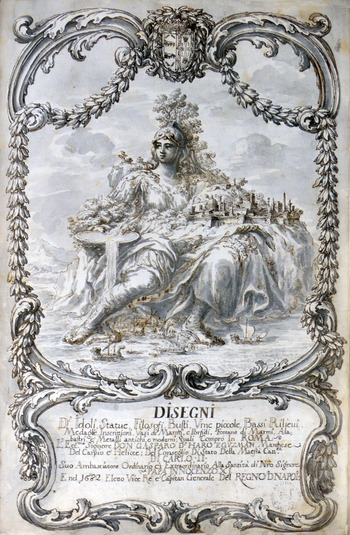
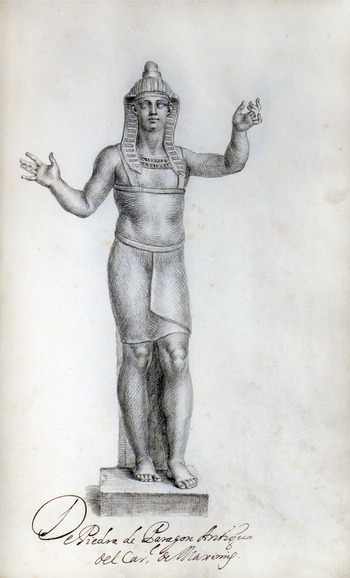
Aspiring artists in Rome were busy copying ancient statues as an integral part of their education. Not surprisingly Carpio turned for his copies to preferably young draughtsmen with links to his Roman household. Some names have been suggested. The frontispiece of the Carpio Album (fig 9) is attributed to Philipp Schor (Rome, 1646–Madrid, 1715),Footnote 52 a resourceful artist employed as furniture designer, architect and scenographer. Philipp’s father, the better-known Johann Paul, left his native Tyrol around 1640. He became Bernini’s trusted collaborator in all matters pertaining to the decorative arts, a field in which he attained international recognition during the Chigi (1655–67), Rospigliosi (1667–9) and Altieri (1670–6) papacies. The drawings of ancient sculptures found in the Album have been recently attributed to Paolo De Matteis (1662–1728).Footnote 53 Although a closer look helps solve some issues, new questions emerge. In addition to the frontispiece, the drawings of the fountains at the end of the volume (see figs 4–6) can be now safely attributed to Philipp Schor, while the drawings dall’antico are probably the work of two or more artists: Paolo De Matteis, and other, less sophisticated and so-far unidentified, draughtsmen. Beginning with the philosopher busts from the Massimo collection,Footnote 54 a second hand appears intermittently. The same hand was responsible for drawing the series of Egyptian statues in touchstone (fig 10),Footnote 55 also of Massimo provenance, and for a few other folia among the Album’s last sheets.Footnote 56 The second artist’s rendering is comparably heavy-handed and somewhat rudimentary. De Matteis relied on a sophisticated use of sfumato under the pencil hatching to achieve the sort of delicate chiaroscuro gradation ideally suited for a convincing depiction of sculpture in the round. By contrast, the second hand resorted to an elementary network of lines covering large parts of the statues’ surfaces. As a result, white marble appears unnaturally dark. Arguably, De Matteis was taking a lot of time, perhaps too much, to finish all the commissioned drawings. As early as May 1681 news circulated in Rome that Carpio was to become the next viceroy of Naples.Footnote 57 Given this context, it is possible that the marquess, wishing to hasten the completion of the set of drawings he was planning to publish, hired other artists to assist De Matteis.
Philipp Schor, Frontispiece of the ‘Carpio Album’: allegory of the Marquess del Carpio as Alexander the Great, Society of Antiquaries of London. Photograph: Society of Antiquaries of London.

Anonymous (Rome, c 1678–82), ‘Carpio Album’, fol 90: copy of an Egyptian statue, Society of Antiquaries of London. Photograph: Society of Antiquaries of London.

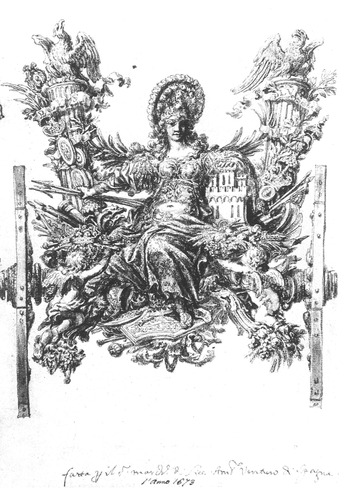
Much has been written recently about Philipp Schor, helping to outline his role as Carpio’s court artist of choice in charge of festivities and theatrical performances both in Rome and, more closely spaced and on a far grander scale, in Naples.Footnote 58 Philipp’s cultural referents were manifold. Through his father, Johann Paul, who had been apprenticed under Pietro da Cortona when newly arrived in Rome, Philipp was exposed at an early age to the Cortonesque grand manner. Bernini’s sculptural works were a constant source of inspiration. Finally, the demands of Maratta’s return to order in painting lent composure to Schor’s work and encouraged him to adopt a more classicising decorative repertoire. This eclectic style can be appreciated in the lavish ceremonial coach Schor designed for the memorable cavalcade that took place on 28 June 1677. It was then that Carpio presented for the first time to Innocent xi the stipulated yearly sum for the kingdom of Naples, a tribute that was traditionally presented on a white palfrey or chinea (fig 11).Footnote 59 To sum up, Schor aptly epitomised the eclecticism of the late Baroque in Rome. Yet, in Carpio’s eyes, Schor’s greatest asset was his close association with Bernini, the unrivalled star of modern sculpture, who, more than anyone else, could stand his ground against the ancients. The reduced reproduction in precious marbles of the Four Rivers Fountain in Piazza Navona that the marquess commissioned – and which would have ensured the Carpio Album ended on a high note – was still unfinished when Bernini died, its demanding completion having been entrusted to Philipp Schor.Footnote 60 During Carpio’s embassy years, Schor executed drawings for ephemeral architecture, clocks, candlesticks, embroidered livery, carriage panels and engravings such as Carpio’s allegorical portrait (see fig 1).Footnote 61 Later, once in Naples, Schor must have executed the frontispiece of the Carpio volume, which was also intended to be engraved. Like the comparatively simpler 1682 printed portrait, the frontispiece allegorised Carpio, showing him in the guise of Alexander the Great, a historical figure enjoying renewed popularity in the seventeenth century.Footnote 62 As has been pointed out, the frontispiece of SAL ms 879 represents an accurate copy of the print by François Spierre, itself based on a drawing by Pietro da Cortona exalting Alexander vii as the new Alexander the Great. Schor’s rich composition recalls Cortona also from a stylistic point of view: the towering figure stands out for its expansive, sumptuous classicism, while the masterful use of grey wash renders the delicate pen-strokes pictorial. The suggestive and flattering allegory must have caught the marquess’s fancy. In 1687 he had it materialised in the form of an imposing horse-drawn carnival carriage, whose popularity was such as to be celebrated in a poetic composition and to be recorded in a rare etching by Teresa del Po.Footnote 63 Probably Schor was also responsible for the design of this carriage. If one accepts, as most critics do, the attribution of the SAL ms 879 frontispiece to Philipp Schor, the plans and elevations of three of Carpio’s fountains closing the volume can be now safely attributed to the same hand (see table 1, nos 1, 3 and 6).Footnote 64 The sheets depicting fountains share with the Album’s frontispiece the same refined decorative taste, the graphic rendering of frames, the acanthus-leaf motif and the use of garlands. The accurate use of pen and grey ink wash and the proclivity for interweaving Berninian and classicist ornamentation also point to Philipp Schor.
Philipp Schor, Carriage for the Marquess del Carpio’s official parade in Rome in 1677. Photograph: Art Market.

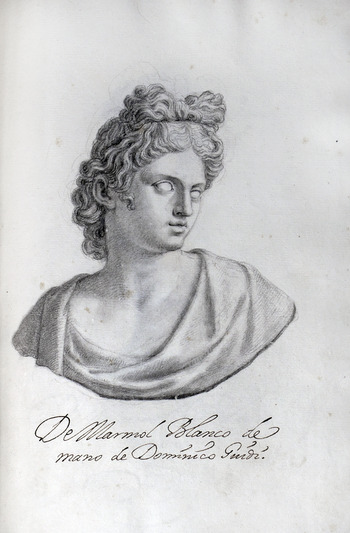
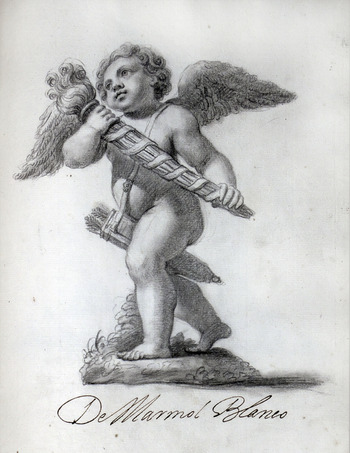
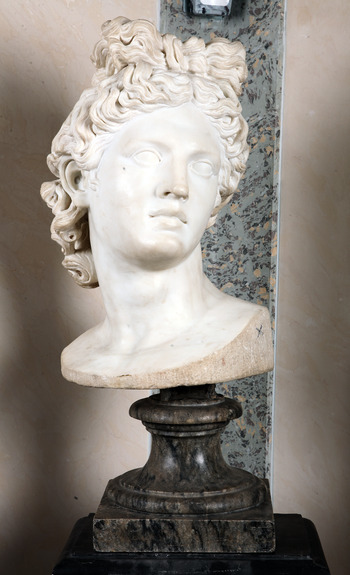
According to Leone Pascoli, the stonecutter Francesco Fancelli executed ‘numerous alabaster and marble fountains’ for Carpio, which the Spaniard shipped to Spain.Footnote 65 The drawings from the Carpio Album alert us to the presence of other artists working for the marquess, such as Domenico Guidi, the most famous sculptor in Rome after the death of Bernini. Guidi is rightly quoted once in the Album as the author of the bust of Apollo (fig 12).Footnote 66 If not Guidi himself, some other sculptor/restorer must have been responsible for the modern additions to antique pieces and perhaps yet another one must have executed the few sculptures reproduced in the Album that Vélez de León did not caption as ‘antique’ (antiguo/a) (fig 13).Footnote 67 One should not discard the possibility that Johann Bernhard Fischer may have contributed in some capacity to the still anonymous sheets in SAL ms 879. For one, he was active as a sculptor since his arrival in Rome in 1670,Footnote 68 first in Bernini’s workshop and later, after the great master’s death in 1680, in Philipp Schor’s atelier, first in Rome and then in Naples.
Paolo De Matteis (attrib.), ‘Carpio Album’, fol 40: copy of Domenico Guidi’s ‘Apollo Belvedere’ head, c 1680–2, Society of Antiquaries of London. Photograph: Society of Antiquaries of London.

Paolo De Matteis (attrib.), ‘Carpio Album’, fol 78: copy of Cupid’s statue, Society of Antiquaries of London. Photograph: Society of Antiquaries of London.

THE CLASSICAL AND MODERN SCULPTURES IN THE DRAWINGS OF THE CARPIO ALBUM, WITH AN ATTRIBUTION (BK-F)
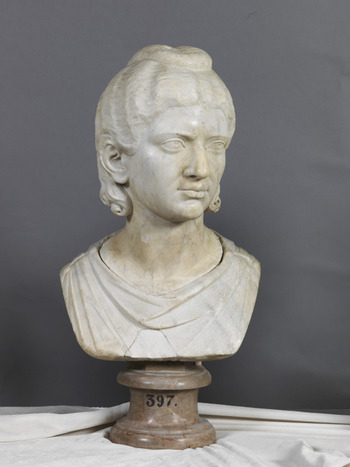
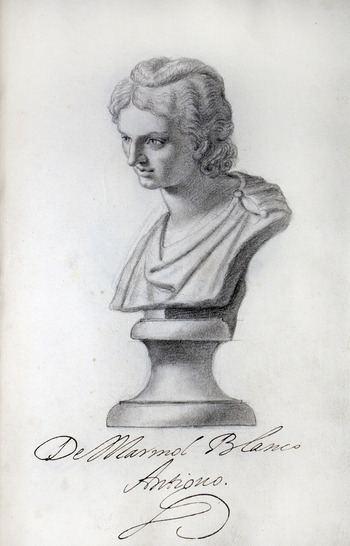
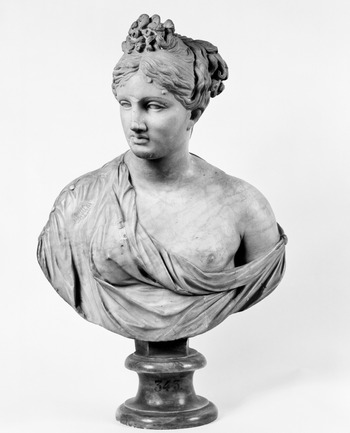
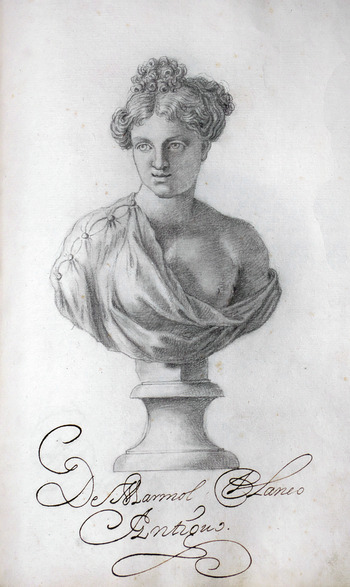
Given the importance of the drawings in the London Album for the reconstruction of the Marquess del Carpio’s collection of classical and modern sculptures, let us briefly look at its contents, already investigated by Beatrice Cacciotti,Footnote 69 but with numerous identifications and questions still unresolved. Too often, Juan Vélez de León, author of the captions,Footnote 70 adds ‘de marmol antiguo’ to drawings of pseudo-antique sculptures. Even in the first Prado catalogues, some seventeenth-century marbles are recorded as being antique, such as the female head modelled on a portrait of the Severian period (ad 193–211; figs 14 and 15),Footnote 71 and the bust of a Venus (figs 16 and 17).Footnote 72 Coppel Aréizaga established a modern dating for many statues,Footnote 73 until now not universally accepted.Footnote 74
Anonymous (Rome, 1678–82), after the Antique: portrait in Severian style, Madrid, Prado, inv. 397E (480mm). Photograph: Museo Nacional del Prado, Madrid.

Paolo De Matteis (attrib.), ‘Carpio Album’, fol 49: female portrait, Society of Antiquaries of London. Photograph: Society of Antiquaries of London.

Anonymous (Rome, 1678–82), after the Antique: Venus, Prado, inv. 343E (690mm). Photograph: Museo Nacional del Prado, Madrid.

Paolo De Matteis (attrib.), ‘Carpio Album’, fol 52: Venus, Society of Antiquaries of London. Photograph: Society of Antiquaries of London.

Carpio was not only a collector of drawings, but also of paintings. An inventory from 1682 lists 1,162 paintings and framed drawingsFootnote 75 as well as classical and modern sculptures distributed between the Palazzo di Spagna and a palazzetto on the Janiculum Hill.Footnote 76 By contrast, the post mortem inventory,Footnote 77 compiled in Naples in 1687–8, lists far fewer antiques, as from 1679 onwards Carpio shipped most of them to adorn his Madrid residence (see fig 2).Footnote 78
The dispersion of the artistic collection in Spain proved fatal. Forced by debts left by her father, Catalina (from 1688 Duchess of Alba) held an auction in 1689 followed by further sales, until a substantial acquisition of 189 sculptures by King Philip v and his consort Elisabetta Farnese in 1728. The sculptures were moved to the couple’s favourite residence ‘La Granja’ de San Ildefonso near Segovia, but were not displayed before c 1745.Footnote 79 In 1788 eight antique Egyptian-style statues from the Carpio collection (now lost) were relocated in the gardens of Aranjuez.Footnote 80 In 1828 many marbles were transferred from San Ildefonso to the Prado Museum, founded in 1819.Footnote 81
Part of the collection was already dispersed in Naples, which might explain how the Album came to London. According to the biographer Bernardo de Dominici, Francesco Antonio Picchiatti (1619–94), the viceroy’s architect and antiquary, and likewise a collector, had inherited ‘gran copie di disegni’ from Carpio. Piacchiatti’s heirs subsequently sold the collection of drawings, among others, to the famous violinist and composer Francesco Geminiani (Lucca, 1687–Dublin, 1762),Footnote 82 active for some time (1706–7, 1710–14) in Naples.Footnote 83 In 1714, Geminiani emigrated to England, ‘in the capacity of an Italian Merchant’, bringing with him his collection, and supporting himself as an art dealer and by organising auctions (1723–43).Footnote 84 Although the sales catalogues only mention paintings and there is no document to prove Geminiani’s ownership of the Carpio Album, it is plausible that its arrival in England was owed to him. In 1882 its then owner, Sir Augustus Franks, bequeathed it to the Society of Antiquaries of London, that he would later preside (1892–7).
Fittingly, Carpio’s collecting passion in Rome embraced sculpture. In fact, the title on the frontispiece of the Album specifies that the sculptures depicted were purchased there: ‘[Disegni di Idoli, Statue, Filosofi, Busti … quali Don Gasparo D’Haro …] bought in Rome’ (see fig 9). The ambassador frequented the studios of famous sculptors, including Bernini, whom he befriended,Footnote 85 and Domenico Guidi.Footnote 86 Other important artists of the Roman Baroque worked for him, such as Lorenzo Ottoni (called to Naples in 1686),Footnote 87 Francesco Antonio Fontana (1641–1700)Footnote 88 and the latter’s friend Alessandro Rondoni (1644–c 1710), also a restorer of antique sculptures, who executed a (lost) half-figure portrait of the marquess in military clothes,Footnote 89 and perhaps four allegorical busts.Footnote 90 Domenico Guido created a copy of the head of the ‘Apollo Belvedere’ for Carpio, embellished with added drapery in the Album (see fig 12). Recently, Cristiano Giometti identified Guidi’s ‘Apollo’ in a statue head at the Palace of San Ildefonso (fig 18).Footnote 91
Domenico Guidi, Copy of head of ‘Apollo Belvedere’ (1677–82), Royal Palace of La Granja de San Ildefonso (Segovia), inv. ES-40004P (760mm). Photograph: Patrimonio Nacional, Madrid.

Don Gaspar commissioned a copy of the ‘Apollo Belvedere’, preserved since 1503–4 in the Vatican and, together with the ‘Laocoon’, the most celebrated (and unpurchaseable) classical statue.Footnote 92 He also owned bronze replicas of the famous Capitoline ‘Spinario’ and the sensual ‘Hermaphrodite Borghese’ (now in the Louvre).Footnote 93 Similarly, he commissioned a series of twenty-two pseudo-antique and often deceptively classical busts (see fig 14)Footnote 94 from a series of still unidentified Roman sculptors, perhaps including Alessandro Rondoni.Footnote 95 Only one bust depicted in the Album is actually antique.Footnote 96
Once arrived in Rome, where classical heritage survived in architectural monuments and collections,Footnote 97 Carpio was eager to boost his status by acquiring his own gallery of antique sculptures. A few months later, on 11 September 1677, Cardinal Camillo Massimo died. When his prestigious collection came up for auction shortly after,Footnote 98 the French ambassador and Carpio inspected itFootnote 99 – the latter not on behalf of Charles ii of Spain but in a private capacity. Despite rivals such as Louis xiv, Christina of Sweden and Grand Duke Cosimo iii de’ Medici,Footnote 100 Carpio was allotted a series of valuable antique pieces in 1678.Footnote 101
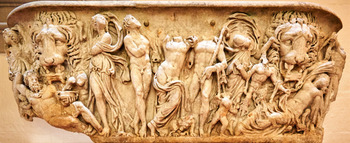
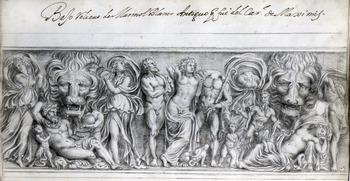
Despite their provenance coming to be mixed up with that of the collection of Christina of Sweden, which Philip v and Elisabetta Farnese had purchased from the Odescalchi family in 1724, before acquiring the Carpio marbles in 1728, Beatrice Cacciotti has successfully identified Carpio as the source of many sculptures in Spain: at the Prado, the Museums of Cordoba and Pontevedra and the Palace of San Ildefonso. Archival research and the drawings of the Carpio Album helped Cacciotti identify the parts of Carpio’s collection originally belonging to Cardinal Massimo.Footnote 102 Consequently, the Massimo–Carpio provenance of the famous ‘Ganymede with eagle’ in the Prado Museum is now firmly established.Footnote 103 The same is true for six (of thirteen) philosopher herms in the Prado,Footnote 104 five (of nine) ‘idoli egizi’ (see fig 10) – Egyptian black-marble divinities unearthed in Villa AdrianaFootnote 105 – and the exquisite nightingale urn.Footnote 106 From the famed sixteenth-century Della Valle collection, through Massimo, a rare Roman zodiac calendar (the lost Menologium Rusticum Vallense)Footnote 107 passed into Carpio’s ownership, as well as two large Dionysiac sarcophagi pictured in the Carpio Album: one depicting a crowded Thiasos (now lost),Footnote 108 the other showing Dionysus discovering Ariadne on Naxos (figs 19 and 20). The latter, spotted by Cacciotti in the gardens of Blenheim Palace,Footnote 109 came by means still unknown into the possession of John Churchill, 1st Duke of Marlborough (1650–1722), together with the above-discussed version of the Four Rivers Fountain (see fig 3).Footnote 110
Anonymous (Roman, third century ad), Dionysus discovering Ariadne on Naxos, Blenheim Palace. Photograph: Blenheim Palace/BNPS.

Anonymous (Rome, 1678–82), ‘Carpio Album’, fol 102: Blenheim sarcophagus. Society of Antiquaries of London. Photograph: Society of Antiquaries of London.

From the Massimo collection also came three (lost) marble vases decorated with leaves, classical according to the captions in the Carpio Album (see fig 23),Footnote 111 and maybe some of the nearly one hundred marble medallions with relief heads.Footnote 112
As the captions of the drawings and research by Cacciotti and Coppel Aréizaga show, the ambassador bought from other collections besides the Massimo estate. From ‘cardenal Nini’ – Bellori had mentioned Giacomo Nini’s collection in 1664Footnote 113 – came twelve modern marble vases with serpent handles,Footnote 114 a small urn and a modern statue of Ganymede.Footnote 115 From ‘Patriarcha Altoviti’ (Iacopo Altoviti), who offered Carpio a drawing in 1682, the marquess acquired an ancient porphyry inscription.Footnote 116 For some inscribed cinerary urns, already documented in the sixteenth century, a Cesi provenance has been ascertained.Footnote 117
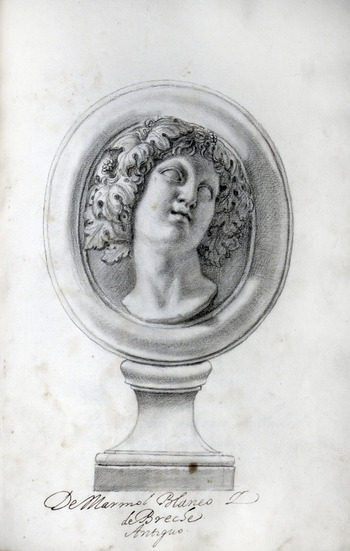
The drawings of the Carpio Album are ordered into categories: vases (see fig 23);Footnote 118 fifteen medallions with Bacchic head reliefs with the erroneous caption ‘de marmol antiguo’ (see fig 25);Footnote 119 thirty-six busts and herms (see figs 15, 17 and 21);Footnote 120 animal sculptures; twenty-seven statues (see figs 10 and 13); five inscriptions and reliefs;Footnote 121 two sarcophagi with Dionysiac subjects (see fig 20);Footnote 122 and views and plans of three fountains (see figs 4–6).
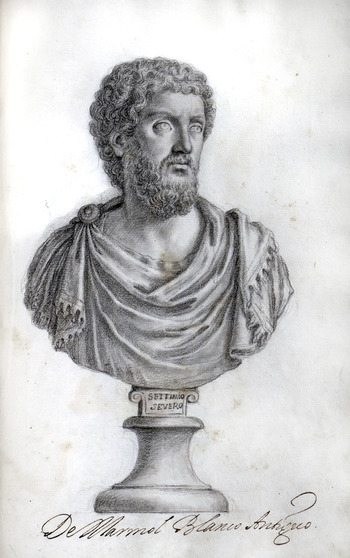
Paolo De Matteis (attrib.), ‘Carpio Album’, fol 60: colossal bust of emperor Septimius Severus, Society of Antiquaries of London. Photograph: Society of Antiquaries of London.

The bust portrait of emperor Septimius Severus with paludamentum, colossal according to the 1682 inventory, Footnote 123 stands out for the quality of both the drawing (fig 21) and its (still unidentified) antique model.Footnote 124
As described above, several different artists’ hands can be discerned in SAL ms 879.Footnote 125 Some of the drawings of antique and pseudo-antique sculptures were executed by Paolo De Matteis.Footnote 126 According to De Dominici’s biography (1742), upon his arrival in Rome at a young age, Paolo was noticed by the marquess. Welcoming him into his palace with a daily stipend, Carpio commissioned him to execute some paintings and draw his antique sculptures.Footnote 127 Like Philipp Schor, De Matteis would later follow the viceroy to Naples.
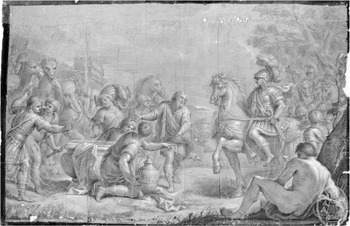
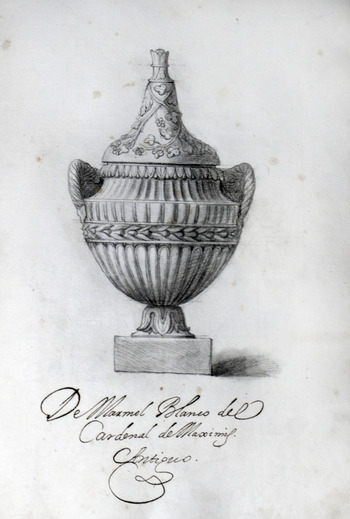
The only document from De Matteis’ stay in Rome is a drawing submitted to the 1682 competition at the Academy of San Luca on the subject ‘Alexander the Great meets Abuleites, governor of Susa’ (fig 22), for which he won third prize.Footnote 128 In the drawing, among the gifts offered by the satrap to Alexander is a fluted vase decorated with a laurel wreath and its base covered with a kymation. Carpio owned a similar antique marble vase, drawn with few variations in the Carpio Album (fig 23),Footnote 129 and it seems likely that the young artist reproduced a simplified version of the antique vase he had already copied for his patron.
Paolo De Matteis, Alexander the Great meets Abuleites, governor of Susa, 1682 (450 × 700mm), 1682, Rome, Accademia Nazionale di San Luca, Archive, inv. A 68. Photograph: Accademia Nazionale di San Luca, Rome.

Paolo De Matteis (attrib.), ‘Carpio Album’, fol 19: antique marble vase, Society of Antiquaries of London. Photograph: Society of Antiquaries of London.

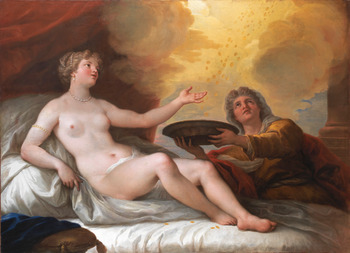
Whereas De Matteis’s drawings represent a heterogeneous corpus less apt for comparison, some of his paintings and several drawings in the Carpio Album share compelling typological and stylistic traits:Footnote 130 one need look no further than the maid in Danae from 1704 (fig 24)Footnote 131 and the Bacchic head illustrated in the Album (fig 25),Footnote 132 especially the lower part of the face. Characteristic of De Matteis’ rounded female figures are faces with large noses and plump, broad cheeks: for example, the Nereid on the left in the Triumph of Galatea (after 1705),Footnote 133 and, in an almost exaggerated way, the ‘Venus’ in the Album (see fig 17).Footnote 134
Paolo De Matteis, Danae, 1704, United Kingdom, private collection (until 2017 on loan to Museo del Barocco, Ariccia; 1300 × 1800mm). Photograph: Museo del Barocco, Ariccia.

Paolo De Matteis (attrib.), ‘Carpio Album’, fol 38, after pseudo-antique Bacchic head, Society of Antiquaries of London. Photograph: Society of Antiquaries of London.

More space would allow for further comparisons between the drawings of the Carpio Album – including the numerous putti (see fig 13) or Bacchic heads on medallions (see fig 25) – and paintings and frescoes by De Matteis. To be sure, thanks to the drawings Carpio commissioned, the young painter gained a repertoire that would last for decades. In later years De Matteis returned to all’antica hairstyles, as was the case when he depicted, inspired by the ‘Apollo Belvedere’ (see figs 12 and 18), locks of hair pinned up in curls above the forehead in the wall frescoes (c 1699) of the Pharmacy of the Certosa di San Martino (Naples).Footnote 135
As in the Galleria Giustiniana, the model for Carpio,Footnote 136 so in SAL ms 879 do several drawings exemplify a ‘vivification’ of sculpture. Described as a ‘Pygmalion effect’ by Elizabeth Cropper (an ‘attempt to bring antiquity to life’),Footnote 137 this was a technique already known in antiquity and the Renaissance, and taken up again in the seventeenth century by Rubens in his important treatise De imitiatione statuarum,Footnote 138 and realised in vivid drawings by Sandrart, Perrier and others.Footnote 139 If we look at the pseudo-antique marble portrait of an austere woman and its respective drawing by Paolo De Matteis (see figs 14 and 15), we seem to be looking at two different figures: instead of a faithful copy of a static stone sculpture, the artist (a painter!) chose to display the bust like a detail in a painting: seen from above and rotated to the right. The expression is more intense, the sinuous corners of the mouth suggest a half-smile and a dimple is implied on the chin.
In the Album’s drawings the Marquess del Carpio wanted to represent his statues as living, and with his publishing project he wanted to immortalise them as a galleria he himself had assembled, even if in the future it was to go missing, as unfortunately transpired.
ABBREVIATIONS AND BIBLIOGRAPHY
Abbreviations
- ADA
-
Archivo Ducal de Alba, Madrid
- AGS
-
Archivo General de Simancas
- ASR
-
Archivio di Stato di Roma
- BAV
-
Biblioteca Apostolica Vaticana
- BNE
-
Biblioteca Nacional de España
- RBE
-
Real Biblioteca, El Escorial
- SAL
-
Society of Antiquaries of London