Implications
Fermentation characteristics can be affected by soluble fiber composition and physical structure. In vitro fermentation analysis indicated that the production of both short-chain fatty acids (SCFA) and related kinetics was influenced by fermentation of enzymolyzed residues of various soluble fiber sources included in gestation diet. Inclusion of fonjac flour (KF) with unique fermentation characteristics during gestation can facilitate the increase of lactational feed intake of sows and economic income from sow operations.
Introduction
The transition from pregnancy to lactation is characterized by physiological and metabolic changes, such as a progressive decrease in insulin sensitivity during late gestation and early lactation (Pere and Etienne, Reference Pere and Etienne2007; Tan et al., Reference Tan, Wei, Sun, Ao, Long, Jiang and Peng2015a). For sows, this decrease unfortunately can result in a lower feed intake during lactation (Mosnier et al., Reference Mosnier, Le Floc’h, Etienne, Ramaekers, Seve and Pere2010). Our previous studies showed that sows provided with high-fiber diet during gestation significantly increased their voluntary feed intake during lactation (Sun et al., Reference Sun, Zhou, Tan, Zheng, Peng and Jiang2014 and Reference Sun, Tan, Wei, Zou, Long, Ao, Xue, Jiang and Peng2015; Tan et al., Reference Tan, Wei, Sun, Long, Ao, Jiang and Peng2015b), probably as a result of insulin sensitivity improvement. Nevertheless, the findings of previous studies regarding the effect of fiber on insulin sensitivity were inconsistent in rodents (Isken et al., Reference Isken, Klaus, Osterhoff, Pfeiffer and Weickert2010).
In pigs, in vitro fermentations with fecal inoculum are frequently used to investigate how different sources of fiber materials in the large intestine (Williams et al., Reference Williams, Bosch, Boer, Verstegen and Tamminga2005). Bacterial fermentation of these compounds results in the production of SCFA, which could decrease fatty acid flux and improve insulin sensitivity in humans (Fernandes et al., Reference Fernandes, Vogt and Wolever2012). In addition, high level fermentable fibers (fermentation kinetics and SCFA-profile) in the diet seemed to enhance satiety in sows (Da et al., Reference Da, Jj, Gerrits, Kemp and Bolhuis2013). Generally, fermentation kinetics and SCFA are influenced by different sources of fiber materials depending on their degree of polymerization, chemical composition and bond types (Macfarlane and Macfarlane, Reference Macfarlane and Macfarlane1993).
Konjac flour is obtained from the tubers of Amorphophallus which mainly contains glucomannan (Chen et al., Reference Chen, Cheng, Liu, Liu and Wu2006), a water soluble, viscous dietary fiber with high water-binding capacity and fermentability (Tan et al., Reference Tan, Wei, Ao, Long and Peng2016a and Reference Tan, Wei, Zhao, Xu, Zhou and Peng2016b). KF is considered a functional fiber of food ingredient and has been consumed in the form of rubbery jelly, noodles and other food products by humans in Asia for centuries (Chua et al., Reference Chua, Baldwin, Hocking and Chan2010). Our previous study indicated that dietary inclusion of KF increased lactational feed intake of sows (Sun et al., Reference Sun, Tan, Wei, Zou, Long, Ao, Xue, Jiang and Peng2015; Tan et al., Reference Tan, Wei, Sun, Long, Ao, Jiang and Peng2015b). However, the mechanism remains poorly understood. Sugar beet pulp (SBP) is a rich source of carbohydrate, primarily consisting of pectin and cellulose with a low lignin content (Zheng et al., Reference Zheng, Lee, Yu, Cheng, Zhang, Jenkins and Vandergheynst2013). Although both KF and SBP are soluble fibers, their composition and physical structure may affect SCFA yield by fermentation (Brouns et al., Reference Brouns, Kettlitz and Arrigoni2002) and absorption (Regmi et al., Reference Regmi, van Kempen, Matte and Zijlstra2011). The objective of the present study was to investigate whether dietary fibers with high fermentability increased lactational feed intake as well as the potential mechanism underlying it by evaluating their effect on plasma concentration of SCFA, free fatty acids (FFA) and homeostasis model assessment (HOMA) values, lactational feed intake and piglet performance of sows.
Material and methods
All procedures and the use of animals in this experiment were carried out in accordance with the Huazhong Agricultural University Animal Care and Use Committee guidelines.
Animals, diets and housing
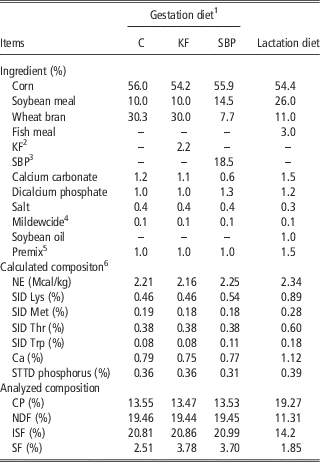
A total of 90 landrace sows with an average parity of 4.0±1.8 (2 to 6) were allocated across three dietary treatments groups. After breeding, sows were separated into two groups to start the experiment. In each group, sows were assigned to three dietary treatments based on parity and BW. All sows were maintained on the same dietary treatments from breeding to farrowing in the reproductive cycles of 1 and 2. Three gestation diets were formulated (Table 1): a control diet based on corn, soybean meal and wheat bran; the second diet included 2.2% KF diet; the third one included 18.5% SBP diet. The two experimental diets had similar levels of soluble fiber from the different sources of fibers, but their soluble fiber level was higher than that of the control diet. The three diets had similar levels of net energy, CP, insoluble fiber and NDF. During gestation, feed was offered twice a day at 0700 and 1430 h and half of the daily feed was given at each meal. Sows were fed 2.0 kg/day from days 1 to 30 of gestation, 2.5 kg/day from days 31 to 90 of gestation and 3.0 kg/day from day 91 of gestation to farrowing. During lactation, all sows were allowed to consume the same lactation diet ad libitum (Table 1). Sows and piglets were given free access to drinking water, and piglets were not provided with creep feed during lactation. During the experimental period, sows with illness, serious lameness, death and reproductive failure such as return to estrus, abortion or non-pregnant after breeding were culled (Supplementary Table S1).
Ingredient and nutrient composition of experimental gestation diets and common lactation diet (as-fed basis)

SID=standardized ileal digestible; STTD=standardized total tract digestible; ISF=insoluble fiber; SF=soluble fiber
1 C=control diet group; KF=2.2% konjac flour diet group; SBP=18.5% sugar beet pulp diet group.
2 KF contains 8% CP, 10.81% insoluble fiber, 61.03% soluble fiber, 48.66% NDF and 3.76% ADF.
3 SBP contains 9.80% CP, 55.13% insoluble fiber, 18.09% soluble fiber, 44.07% NDF and 29.27% ADF.
4 Mildewcide contains 60% potassium propionate.
5 Provided per kilogram of diet: Cu, 10.0 mg (as CuSO4·5H2O); Fe 100 mg as ferrous sulfate; Mn 30 mg (as MnO2); Zn 60 mg as zinc sulfate; I 0.6 mg as potassium iodide; Se 0.3 mg selenium selenite; Vitamin A 7000 IU; Vitamin D3 1400 IU; Vitamin E 28 mg; Vitamin K 1.2 mg; 1 mg thiamin; 2 mg riboflavin; 1 mg pyridoxine; 0.014 mg cobalamin.
6 Calculated chemical concentrations using values for feed ingredients from National Research Council (2012).
Performance measurement
Body weight and backfat thickness of sows were measured on days 0 and 106 of gestation, within 24 h of farrowing and at weaning. Backfat thickness at 65 mm on each side of the dorsal midline at the last rib level (P2) was measured using ultrasound (PIGLOG105, a mode scanner; SFK Technology A/S Helver, Denmark). The number of total piglets born or born alive was recorded at farrowing. Cross-fostering was kept within diet treatments to adjust litter size to about 10±1 piglets per sow within 48 h after parturition. Piglets were weaned at an average age of 22±1 days. At weaning, the number of weaned piglets was recorded. Piglets were weighed within 24 h of birth (day 0), on days 7, 14, 21 and at weaning. The daily feed intake of sows during lactation was measured each morning by weighing daily feed refusals.
Blood sampling
During the second cycle, before feeding and 4 h after feeding on days 7 and 90 of gestation, before feeding on day 0, 14 of lactation and on the day of weaning, 15 sows (five sows per dietary treatment with the similar parity and BW) were selected for blood sampling. Fasting sows were selected for blood sampling after an overnight fasting period of 16 h during gestation and 12 h during lactation. Blood samples from ear vein were collected with a minimum amount of stress. The samples were collected in tubes (5 ml), immediately kept on ice and mixed with 10% EDTA (10 ul/ml) and aprotinin (500 IU/ml). Then they were centrifuged for 3 min at 8500×g at 4°C for separation of plasma, and stored at −80°C until analysis.
In vitro fermentation and short-chain fatty acid analysis
Three gestation diets were incubated in duplicate with the in vitro two-stage enzyme incubation and dialysis procedures. The samples were enzymatically hydrolyzed using pepsin and pancreatin, and the enzymolyzed residues were used in in vitro fermentation. In vitro enzyme hydrolysis procedures were carried out as described by Fang et al. (Reference Fang, Peng, Tang, Liu, Dai and Jin2007).
To reduce variation between animals, the inoculum was prepared by mixing the feces of three pregnant sows (Landrace) from the herd of Hunan Academy of Agricultural Sciences Swine Centre (Changsha, China) for fermenting three gestation diets. Fecal samples were collected directly from the animal under anaerobic conditions, and immediately placed in a pre-warmed CO2-filled container for transfer to the laboratory. Then, samples were weighed, and an amount of pre-warmed (39°C), anaerobic, sterile, saline (9 g/l NaCl) was added in relation to the combined weight, usually at a ratio of 1 : 5. The diluted material was then homogenized using a hand-mixer for 60 s and strained through a double layer of cheesecloth with 16 threads/cm in both directions. The inoculum was then dispensed into the pre-warmed bottles containing substrate and medium. In vitro fermentation of enzymatically hydrolyzed residues was carried out according to the procedure previously described by Williams et al. (Reference Williams, Bosch, Boer, Verstegen and Tamminga2005) (Supplementary Material S1).
Two batches of in vitro fermentation were run with two replicates in each batch. Kinetics of fermentation was assessed by measuring cumulative gas production over time and gas accumulation was modeled according to the method described by Wang et al. (Reference Wang, Tang and Tan2011). At the end of the fermentation, SCFA were analyzed from the fermentation residues. Acetic, propionic, butyric, iso-butyric, valeric and iso-valeric acids were analyzed using gas chromatograph as described by Bosch et al. (Reference Bosch, Pellikaan, Rutten, van der Poel, Verstegen and Hendriks2008).
Chemical analyses and calculations
All samples were analyzed in duplicate. Crude protein was determined by the Kjeldahl method according to the Association of Official Analytical Chemists (AOAC) (1999) Method 955.04. Neutral detergent fiber was analyzed according to the method described by Van Soest et al. (Reference Van Soest, Robertson and Lewis1991). Soluble fiber and insoluble fiber were determined by AOAC (1999) Method 991.4. Plasma concentrations of glucose were determined using the glucose dehydrogenase activity colorimetric assay kit (BioVision Inc., Palo Alto, CA, USA) according to the manufacturer’s instructions. Plasma insulin level was determined by ultrasensitive pig insulin ELISA kit (Biosource Inc., Sunnyvale, CA, USA) according to the manufacturer’s instructions. Plasma SCFA and FFA were analyzed using gas chromatograph (Bosch et al., Reference Bosch, Pellikaan, Rutten, van der Poel, Verstegen and Hendriks2008). The indirect methods were used to evaluate insulin sensitivity by HOMA, HOMA-insulin resistance (HOMA-IR)=((fasting insulin, mIU/l)×(fasting glucose, mmol/l))÷22.5; HOMA-insulin sensitivity (HOMA-IS)=1÷((fasting insulin, mIU/l)×(fasting glucose, mmol/l)) (Bonora et al., Reference Bonora, Targher, Alberiche, Bonadonna, Saggiani, Zenere, Monauni and Muggeo2000).
Gas accumulation curves were modeled using the mathematical model proposed by Wang et al. (Reference Wang, Tang and Tan2011). The cumulative gas production (V) was fitted to the biphasic model. The equation for the model is:
 $$\eqalignno{ & V\,{\equals}\,V_{{F{\rm 1}}} {\times}\left[ {{\rm 1}{\minus}{\rm exp}\left( {{\minus}K_{{\rm 1}} {\times}T} \right)} \right]{\div}\left[ {{\rm 1}{\plus}{\rm exp}\left( {B_{{\rm 1}} {\minus}K_{{\rm 1}} {\times}T} \right)} \right] \cr & \quad{\plus}V_{{F{\rm 2}}} {\times}[\left( {{\rm 1}{\minus}{\rm exp}\left( {{\minus}K_{{\rm 2}} {\times}T} \right)} \right]{\div} \cr & \quad\left[ {{\rm 1}{\plus}{\rm exp}\left( {B_{{\rm 2}} {\minus}K_{{\rm 2}} {\times}T} \right)} \right] $$
in which V F is the final asymptotic gas volume (ml/g), K the fractional rate of gas production at particular time (h−1), B a positive shape parameter without dimension. FRD0, the initial fractional rate of degradation of the enzymolyzed residues of the gestation diets at t-value=0 (h−1), is calculated by the following equations:
 $$\left( {{\rm FRD}_{0} } \right)_{{\rm 1}} {\equals}\,K_{{\rm 1}} {\div}\left[ {{\rm 1}{\plus}{\rm exp}\,\left( {B_{{\rm 1}} } \right)} \right]\,{\rm and }\,\left( {{\rm FRD}_{0} } \right)_{{\rm 2}} {\equals}K_{{\rm 2}} {\div}{\rm }\left[ {{\rm 1}{\plus}{\rm exp}\,\left( {B_{{\rm 2}} } \right)} \right]$$
The half-life (T 1/2), the time at which half of the final gas production is generated, is calculated by the following equations:
The subscripts (1, 2) following the factors in the biphasic model describe the rapidly fermented fraction (V F1, K 1, B 1, (T 1/2)1, (FRD0)1) and the slowly fermented fraction (V F2, K 2, B 2, (T 1/2)2, (FRD0)2) of the model.
Statistical analyses
Gas production parameters and fermentation metabolites production were analyzed using the MIXED procedure of SAS (SAS Institute Inc., Cary, NC, USA) with the diet as a fixed factor and batch as a random factor, using the following statistical model:
 $$Y\,{\equals}\,\alpha {\plus}S_{i} {\plus}B_{j} {\plus}{\epsilon}_{{ij}} $$
where Y is the parameter to be tested, α the mean, S i the effect of the diet (i=1, 2, 3), B j the random effect of the batch (j=1, 2) and ε ij the error term. Means were separated using Tukey method with a significance level of 0.05.
In total, 67 sows (22, 22 and 23, respectively) that finished the experiment from two successive reproductive cycles were included in the data analysis. An individual sow was considered the experimental unit in all statistical analyses. Before analysis, the data were tested for normality and homoscedasticity using the Kolmogorov–Smirnov and Levene tests (with the significance level set at 5%). Two transformations of data (square root (x)), log10(x) were performed when the distribution was not normal and/or heteroscedastic (x). After transformation, the repeated measures ANOVA using the MIXED procedure of SAS was used to examine the responses of litter performance, sow BW, backfat depth and lactation feed intake. The statistical models included dietary treatment, reproductive cycle, group, parity and interactions between dietary treatment and cycle, with treatment and reproductive cycle considered as two main effects, with group and parity considered as a random effect. When significant treatment differences were detected, the PDIFF option of the LSMEANS statement of MIXED procedure was used to compare individual least-square means. Plasma concentrations of hormones and metabolites were analyzed as a completely randomized design using the MIXED procedure of SAS. The model contained the fixed effect of diet and the random effect of sow. Differences were considered statistically significant at P<0.05. If significant treatment differences were found (P<0.05), means were compared with each other using the Tukey’s all-pairwise comparisons. Data are presented as means and SEM.
Results
In vitro fermentability of gestation diets
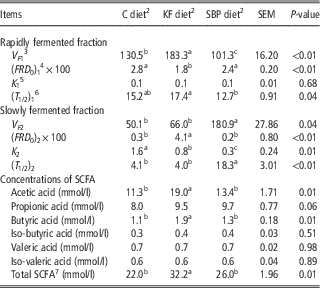
For rapidly fermented fraction, the enzymolyzed residues of KF diet had significantly higher V F (P<0.01) than those of the control diet or SBP diets (Table 2), lower FRD0 than those of the control or SBP diets (P<0.01), and the KF diet took longer T 1/2 than the SBP diet (P<0.05). For slowly fermented fraction, SBP diet had higher V F (P<0.05) and T 1/2 (P<0.01) than the control or KF diets.
Gas production parameters and concentrations of short-chain fatty acids (SCFA) during the in vitro fermentation of enzymolyzed residues of three diets using fecal inocula from gestation sowsFootnote 1

a,bMeans in the same row with different letters differ significantly at P<0.05.
1 Data are given as means and SEM, n=4 (number of observations in fermentation).
2 C diet=control diet group; KF diet=2.2% konjac flour diet group; SBP diet=18.5% sugar beet pulp diet group.
3 V F , the final asymptotic gas volume (ml/g).
4 FRD 0, initial fractional rate of degradation at t-value=0 (h−1).
5 K, fractional rate of gas production at particular time (h−1).
6 T 1/2, half-life to asymptote (h).
7 Total SCFA= the sum of acetic, propionic, butyric, iso-butyric, valeric and iso-valeric acid.
Notably, KF diet produced significantly higher (P<0.05) concentrations of acetate, butyrate and total SCFA than either control or SBP diet, while no differences were detected between the latter two diets (Table 2).
Plasma concentrations of short-chain fatty acid, free fatty acid and homeostasis model assessment values
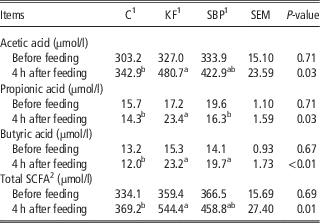
The result in Table 3 shows that there were no obvious differences in plasma concentrations of SCFA before feeding on day 90 of gestation among the three groups. However, inclusion of KF in the diet remarkably increased (P<0.05) plasma concentrations of acetic acid, propionic acid, butyric acid and total SCFA at 4 h after feeding on day 90 of gestation compared with control diet group. The SBP diet sows also showed an increase in plasma concentration of butyric acid (P<0.01) at 4 h after feeding compared with the control diet group.
Effect of inclusion of konjac flour (KF) or sugar beet pulp (SBP) in gestation diet on plasma concentrations of short-chain fatty acids (SCFA) on day 90 of gestation in the second reproductive cycle

Data are given as means and SEM, n=5.
a,bMeans in the same row with different letters differ significantly at P<0.05.
1 C=control diet group; KF=2.2% konjac flour diet group; SBP=18.5% sugar beet pulp diet group.
2 Total SCFA=the sum of acetic, propionic and butyric acid.
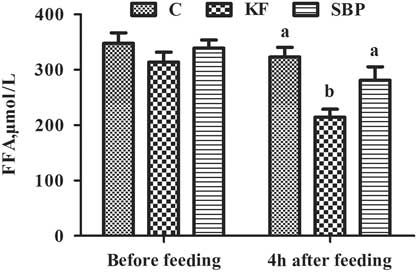
As shown in Figure 1, there was no significant difference in the plasma level of FFA before feeding on day 90 of gestation among three groups. Similarly, there was no obvious difference in the plasma level of FFA at 4 h after feeding between the control diet group and SBP diet group. However, compared with control and SBP diet groups, the inclusion of KF in gestation diet greatly reduced the plasma concentration of FFA (P<0.01) at 4 h after feeding on day 90 of gestation.
Effect of inclusion of konjac flour (KF) or sugar beet pulp (SBP) in gestation diet on plasma concentration of free fatty acid (FFA) during the second reproductive cycle. C=control diet group; KF=2.2% konjac flour diet group; SBP=18.5% sugar beet pulp diet group. Values are means±SEM, n=5. a,bMeans in the same bar with different letters differ significantly at P<0.05.

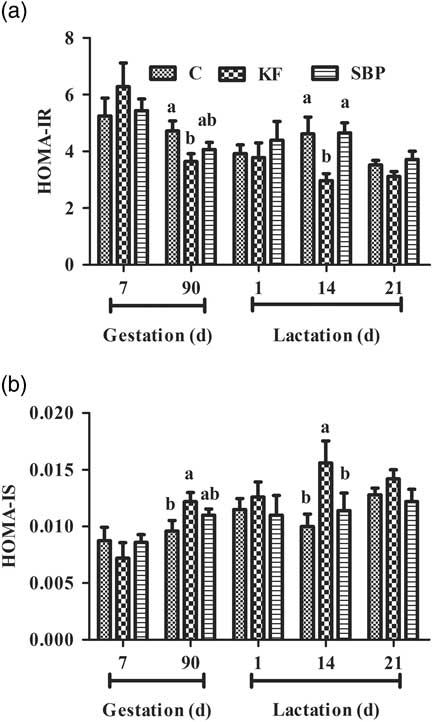
In addition, when compared with the control diet sows, the KF diet sows had a lower value of HOMA-IR (P<0.05; Figure 2a), but a higher value of HOMA-IS (P<0.01; Figure 2b) on day 90 of gestation and day 14 of lactation.
Effect of inclusion of konjac flour (KF) or sugar beet pulp (SBP) in gestation diet on the value of homeostasis model assessment-insulin resistance (HOMA-IR) (a) and HOMA-insulin sensitivity (HOMA-IS) (b) during the second reproductive cycle. C=control diet group; KF=2.2% konjac flour diet group; SBP= 18.5% sugar beet pulp diet group. Values are means±SEM, n=5. a,bMeans in the same bar with different letters differ significantly at P<0.05.

Sow performance
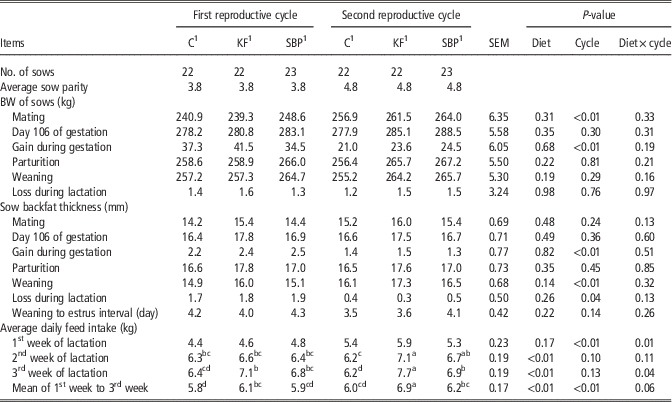
Dietary treatments had no effect on sow BW, backfat thickness or on weaning to estrus interval (Table 4). Compared with the first reproductive cycle, sows had higher BW at mating (P<0.01), lower gestation BW and backfat thickness gain (P<0.01), and lactational backfat thickness loss (P<0.05) during the second cycle.
Effect of inclusion of konjac flour (KF) or sugar beet pulp (SBP) in gestation diet on BW, backfat thickness, weaning to estrus interval and feed intake during lactation of sows

a,b,c,dMeans within a row with different superscript differ significantly (P<0.05).
1 C=control diet group; KF=2.2% konjac flour diet group; SBP=18.5% sugar beet pulp diet group.
There was an interaction between dietary treatment and reproductive cycle on feed intake of sows during first (P<0.05) and third (P<0.05) weeks of lactation (Table 4). Regardless of the reproductive cycle, the KF diet sows had an obvious increase of feed intake in the 3rd week and days 1 to 21 of lactation in comparison with the control diet sows (P<0.05). During the second cycle, sows in the SBP treatment group also increased the feed intake in the 3rd week compared with the control group (P<0.05). In addition, compared with the first reproductive cycle, sows had a significantly greater feed intake in the 1st week of lactation (P<0.01) and the entire lactation period (P<0.01) during the second cycle.
Piglet performance
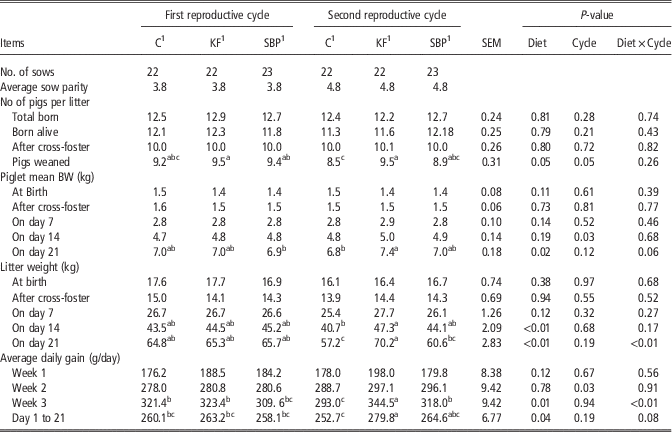
There were interactions between dietary treatment and reproductive cycle on litter weight on day 21 of lactation (P<0.01) and piglet average daily gain during the 3rd week of lactation (P<0.01) (Table 5). There were no differences in the numbers of total piglets born and liveborn among the three dietary treatments. During the second cycle, the KF diet sows had a higher number of weaned piglets than the control group (P<0.05). In addition, compared with the control group, the KF diet sows significantly increased the litter weight on day 14 and day 21, and the average daily gain of piglet in the third week and days 1 to 21 of lactation (P<0.05), while the SBP diet sows increased the average daily gain of piglets only in the 3rd week (P<0.05).
Effect of inclusion of konjac flour (KF) or sugar beet pulp (SBP) in gestation diet on litter performance

a,b,cMeans within a row with different superscript differ significantly (P<0.05).
1 C=control diet group; KF=2.2% konjac flour diet group; SBP=18.5% sugar beet pulp diet group.
Discussion
This study explored the fermentation characteristics of soluble fiber inclusion in gestation diets in an in vitro system and found that the enzymolyzed residues of the KF diet were mainly part of rapidly fermented fractions, whereas those of the SBP diet mainly part of slowly fermented fractions. The FRD0 was the starting value of fractional rate of degradation (FRD) and affected by the initial fermentation efficiency of inoculated microbes for a feed stuff (Wang et al., Reference Wang, Sun, Tang, Tan and Pacheco2013). It seemed that the FRD at t-value=0 of the logistic-exponential model was an important starting rate of the early in vitro incubation, although an increased FRD was observed with prolonged incubation time (Wang et al., Reference Wang, Sun, Tang, Tan and Pacheco2013). This study showed that fermentation of the KF diet resulted in the lowest FRD0 compared with the other two diets, indicating that it may require more time for microbiota to start the fermentation of the KF diet. Konjac glucomannan is the primary component of the KF (Chen et al., Reference Chen, Cheng, Liu, Liu and Wu2006), which is composed of glucose and mannose residues at a molar ratio of 2 : 3 with β-1-4 linkages and is more linear (Onishi et al., Reference Onishi, Kawamoto, Ueda, Yamanaka, Katayama, Suzuki, Aki, Hashimoto, Hide and Ono2007), thus the microbiota needs to produce more endoenzymes in the beginning of fermentation (Jonathan et al., Reference Jonathan, Haenen, Souza da Silva, Bosch, Schols and Gruppen2013). Therefore, it could be deduced that the KF diet may escape degradation by the terminal small intestinal microflora and serve as the fermentative substrate in the large intestine of sows.
Fermentation kinetics, combined with information about the transit time, can indicate where the ingredients are fermented and could be used as an indicator for selecting ingredients that undergo fermentation in specific places of the gastrointestinal tract of pigs (Williams et al., Reference Williams, Bosch, Boer, Verstegen and Tamminga2005). For example, higher T 1/2 values of rapidly fermented fractions may indicate the occurrence of the fermentation mainly in the distal part of the large intestine (Jha et al., Reference Jha, Bindelle, Van Kessel and Leterme2011; Wang et al., Reference Wang, Tang and Tan2011). When fermentable carbohydrate substrate shortage occurs in the more distal parts of the colon, the inclusion of fermentable fiber in sow diets, along with other non-digestible carbohydrate sources, might provide further substrates for generating SCFA (Regmi et al., Reference Regmi, van Kempen, Matte and Zijlstra2011). This leads to a possible reduction of protein fermentation and related potentially harmful end-products (Knudsen et al., Reference Knudsen, Hedemann and Lærke2012). The present study revealed that T 1/2 for the rapidly fermented fraction was higher in the KF diet than in the SBP diet, indicating that more SCFA might be generated by the KF diet. This was well supported by the result that the SCFA concentration was higher in the enzymolyzed residues of KF diet after fermentation.
Compared with the control group, at 4 h after feeding, the KF diet sows had an increased plasma concentration in acetic acid, propionic acid, butyric acid and SCFA, whereas the SBP diet sows only had an increased plasma concentration in butyric acid. The increased plasma concentration of SCFA, particularly acetate, suppressed the release of FFA from adipose tissue, thus lowering the FFA concentration in circulation (Schenk et al., Reference Schenk, Saberi and Olefsky2008). The present results also showed that inclusion of KF in gestation diet reduced the plasma concentration of FFA. This was similar to a previous study reporting that the fermentable fiber inulin increased postprandial serum SCFA and reduced FFA in healthy humans (Tarini and Wolever, Reference Tarini and Wolever2010).
Colonic fermentation of dietary fiber may exert an insulin-sensitizing effect through the production of SCFA, especially acetic acid. Acetic acid may modulate insulin sensitivity by reducing fatty acid flux (Judlyn et al., Reference Judlyn, Janet and Wolever Thomas2011). Insulin sensitivity could be indirectly estimated using HOMA indexes (Bonora et al., Reference Bonora, Targher, Alberiche, Bonadonna, Saggiani, Zenere, Monauni and Muggeo2000). In this study, the KF inclusion in the gestation diet substantially increased the value of HOMA-IS and reduced the value of HOMA-IR on day 90 of gestation and on day 14 of lactation compared with the control diet sows, which indicated that inclusion of KF in gestation diet increased the insulin sensitivity in sows during late gestation and lactation. A possible explanation is that an increased acetic acid concentration in the systemic circulation may reduce lipolysis and plasma FFA concentrations, and thus improve insulin sensitivity (Fernandes et al., Reference Fernandes, Vogt and Wolever2012).
In the current study, the higher feed intake for the KF diet sows in the entire lactation period during the second cycle is in line with the results of our previous studies (Sun et al., Reference Sun, Tan, Wei, Zou, Long, Ao, Xue, Jiang and Peng2015; Tan et al., Reference Tan, Wei, Sun, Long, Ao, Jiang and Peng2015b). However, such beneficial effects were not detected in the SBP group. During lactation, insulin resistance is negatively correlated with the feed intake of sows (Mosnier et al., Reference Mosnier, Le Floc’h, Etienne, Ramaekers, Seve and Pere2010). Given that there is no difference between the SBP and the control groups in the values of HOMA-IS and HOMA-IR, a possible reason for the beneficial effect of the KF diet is the insulin sensitivity improvement during late gestation and lactation as indicated by the HOMA values.
Piglets are mainly dependent on the milk of sows for nutrients to reach adequate weaning weights. Numerous studies have shown that milk production increases with increasing lactational feed intake of sows (Van den Brand et al., Reference Van den Brand, Heetkamp, Soede, Schrama and Kemp2000). In the present study, the increased growth in the suckling phase and the number of weaning piglets from the KF diet sows for two successive reproductive cycles can be attributed to the result of a higher feed intake and an increased quantity of nutrients available from milk to facilitate the growth of piglets.
In the current study, the addition of KF during gestation could produce a substantial financial impact on sow operations compared with the SBP group.
Conclusions
This study explored the different fermentation characteristics of the control, SBP and KF diets, and it showed that, in the two successive reproductive cycles, the high-fermentability KF diet substantially increased the feed intake of sows during lactation, and correspondingly improved litter performance. The potential mechanism is that the fermentation characteristics of KF diet contributed to an increased acetic acid concentration in the systemic circulation, which in turn may reduce plasma FFA concentrations, improve HOMA values of sows and increase their feed intake during lactation.
Acknowledgments
This work was supported by Fundamental Research Funds for Innovation Position in Agricultural science and Technology Innovation Center of Hubei Province (2007-062) and International Cooperation Projects of Ministry of Science and Technology of the People’s Republic of China (2013DFG32510). The authors would like to thank Jiajian Tan, Zhaowei Xu and Haibo Gao at GuoXiang Pig Farm for their support during feeding trial.
Supplementary material
To view supplementary material for this article, please visit https://doi.org/10.1017/S1751731117003019