Reflections on Mobilizing Democracy
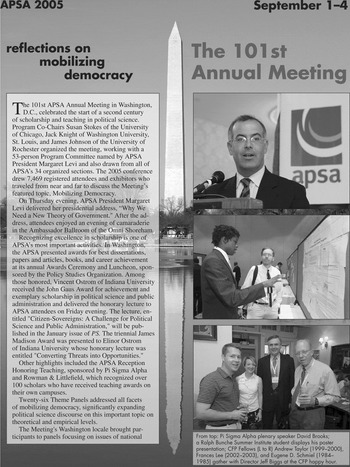
The 101st APSA Annual Meeting in Washington, D.C., celebrated the start
of a second century of scholarship and teaching in political science.
Program Co-Chairs Susan Stokes of the University of Chicago, Jack Knight
of Washington University, St. Louis, and James Johnson of the University
of Rochester organized the meeting, working with a 53-person Program
Committee named by APSA President Margaret Levi and also drawn from all
of APSA's 34 organized sections. The 2005 conference drew 7,469
registered attendees and exhibitors who traveled from near and far to
discuss the Meeting's featured topic, Mobilizing Democracy.
On Thursday evening, APSA President Margaret Levi delivered her
presidential address, “Why We Need a New Theory of Government.” After
the address, attendees enjoyed an evening of camaraderie in the
Ambassador Ballroom of the Omni Shoreham.
Recognizing excellence in scholarship is one of the APSA's most important
activities. In Washington, the APSA presented awards for best
dissertations, papers and articles, books and career achievement at its
annual Awards Ceremony and Luncheon, sponsored by the Policy Studies
Organization. Among those honored, Vincent Ostrom of Indiana University
received the John Gaus award for achievement and exemplary scholarchip
in political science and public administration and delivered the
honorary lecture to APSA attendees on Friday evening. The lecture,
entitled “Citizen-Sovereigns: A Challenge for Political Science and
Public Administration,” will be published in the January issue of
PS. The trienniel James Madison Award was presented to
Elinor Ostrom of India University whose honorary lecture was entitled,
“Converting Threats into Opportunities.”
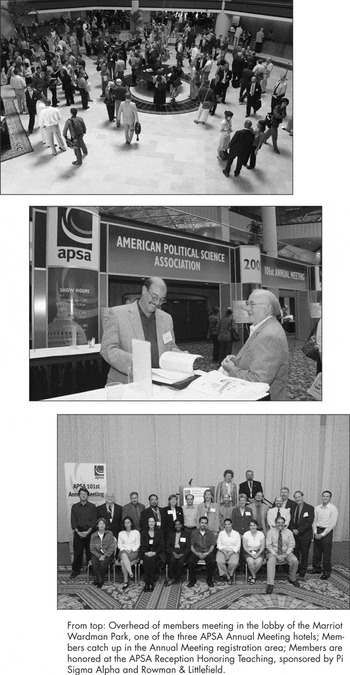
Other highlights included the APSA Reception Honoring Teaching, sponsored
by Pi Sigma Alpha and Rowman & Littlefield, which recogized over 100
scholars who have received teaching awards on their own campuses.
Twenty-six Theme Panels addressed all facets of mobilizing democracy,
significantly expanding political science discourse on this important
topic on theoretical and empirical levels.
The Meeting's Washington locals brought participants to panels focusing
on issues of national and international politics ranging from
assessments of the Bush administration and its role in the Iraq War to
the struggle for democracy in Russia to the effects of globalization in
developed and developing countries.
APSA plenary events offered attendees opportunities to hear from a
variety of well-known voices on national and international politics.
New York Times columnist David Brooks spoke at the Pi Sigma
Alpha plenary session on the current U.S. political environment. Brooks
had earlier participated on a theme panel led by Stephen J. Macedo with
political commentator E. J. Dionne, David Gergen, and Jennifer
Hochschild. On U.S. foreign policy, USAID Administrator Andrew S.
Natsios discussed democratic opportunity in the Arab and Muslim world
and Rashid Khalidi, Edward Said Professor of Arab Studies and Director
of the Middle East Institute at Columbia University, held discourse on
the challenges the Western world now faces in the Middle East following
the Iraq War.
APSA 2005 “By the Numbers”
7,469 total attendees (including exhibitors, members of the
press, and guests)
736 panel sessions
2,016 papers submitted to PROceedings
475 poster presentations
113 travel grants awarded
22 APSA awards presented
75 Section awards presented
423 exhibitors
APSA 2006: The 102nd Annual Meeting
APSA will gather for its 102nd Annual Meeting in Philadelphia next year.
For more information on the 2006 APSA Annual Meeting check
www.apsanet.org, and look for more details in PS throughout the
year ahead.
Recognizing Outstanding Contributions to the Profession: The
2005 Frank J. Goodnow Awards
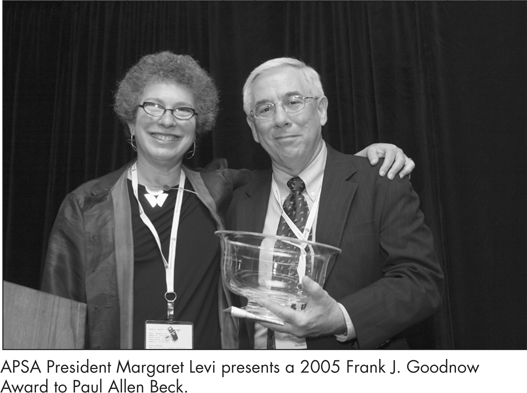
For more than three decades Paul Allen Beck has dedicated his
time and knowledge to the study of American politics and the
intersection of mass media and public opinion. As a leader in the field
of parties and voting behavior, he has provided the basis for a future
generation of scholars. He has contributed his knowledge to several
institutions, and has been honored for his exceptional teaching and
service with major awards from Ohio State University and Florida State
University.
His edited volume, Party Politics in America with Marjorie
Hershey, and earlier with Frank Sorauf, is now in its 10th edition and
remains a definitive book on American party politics. His contributions
to the field include more than two dozen journal articles and book
chapters, and as many more conference papers. He has served on the
editorial boards of the American Journal of Political Science,
the American Political Science Review, and numerous others.
He has continued to dedicate his experience to associations of the
discipline, serving the APSA in nearly a dozen capacities including
chair of the 1994 Annual Meeting and chair of the Association's
Strategic Planning Committee which helped guide the Association as it
moved into the new century. He has also served in leadership positions
for the Organized Section on Elections, Public Opinion, and Voting
Behavior and as program chair for the Annual Meeting of the Midwest
Political Science Association.
For over 20 years Jennifer Hochschild has dedicated her time and
knowledge to the intersection of American politics and political
philosophy. Her work in the areas of race, ethnicity, and
immigration—and education—has provided critical understanding to a
generation of scholars and students. As a faculty member at Princeton
University, and now at Harvard University, she has been recognized with
a number of the most prestigious awards in the discipline, including
being named a fellow of the American Academy of Arts and Sciences in
1996.
She has authored path-breaking works such The American Dream and the
Public; Facing Up to the American Dream: Race, Class, and
the Soul of the Nation; and The New American Dilemma:
Liberal Democracy and School Desegregation, all of which have
contributed significantly to public education. She has authored more
than 50 journal articles, book chapters, and conference papers. She has
also served on the editorial board of the American Journal of
Political Science, among nearly half dozen more.
She has continued to dedicate her experience to the discipline: serving
the APSA as vice president, Council member, Annual Meeting co-chair, and
participant in dozens of committees and task forces. As inaugural editor
of Perspectives on Politics, she has helped develop a critical
new journal in the discipline. Her drive to assist a new generation of
women scholars led to her election as president of the Women's Caucus
for Political Science in 1993.
The Frank J. Goodnow Award
The APSA Council established the Frank J. Goodnow Award in 1996 to honor
the contributions of individuals to both the development of the
political science profession and the building of the Association. Frank
J. Goodnow, the Association's first president, exemplified the public
service and volunteerism that this award represents. He was the first of
many who voluntarily contributed an extraordinary amount of their time,
energy, and attention to building a dynamic learned profession.
Previous recipients are Gabriel A. Almond, Walter Beach, Eugene
Eidenberg, Richard Fenno, F. Chris Garcia, Betty Glad, Doris Graber,
Pendleton Herring, Malcolm Jewell, Max Kampelman, Gerhard Loewenberg,
Thomas Mann, Warren E. Miller, Samuel Patterson, Dianne M. Pinderhughes,
Nelson Polsby, Jewel Prestage, Catherine E. Rudder, Roberta Sigel, Frank
J. Sorauf, Charles O. Jones, Fred Greenstein, Jean Bethke Elshtain, Dale
Rogers Marshall, Nelson Polsby, M. Margaret Conway, Jack W. Peltason,
and Michael B. Preston.
APSA Recognizes Outstanding Career Accomplishments in
Washington
The Association honored 25 scholars for their career achievements and
outstanding research at the Awards Ceremony and Luncheon, held as part
of the 2005 Annual Meeting in Washington, D.C. Hosted by 2005 Program
Co-Chairs James Johnson, Jack Knight, and Susan Stokes, the event began
with a luncheon for the winners, their guests, and committee members,
and was followed by a ceremony presenting 20 prizes. Complete citations
on each award can be found in the Gazette section of this issue of
PS.
The Association recognized four individuals for their major contributions
to the profession and our understanding and practice of politics. The
Association was pleased to honor Vincent Ostrom of Indiana
University with the John Gaus Award for a lifetime of exemplary
scholarship in the joint traditions of political science and public
administration. In conjunction with receiving the Gaus Award, Ostrom
delivered the annual John Gaus lecture, titled “Citizen-Sovereigns: A
Challenge for Political Science and Public Administration.” The lecture
will be published in the January issue of PS.
Former APSA president Elinor Ostrom was awarded the
Association's James Madison Award. The committee selected Ostrom in
recognition of her distinguished 40-year career over which her
scholarship has made a deep and lasting impact on the study of
political, social, and economic institutions. As part of the Award she
delivered the 2005 Madison Lecture, titled “Converting Threats into
Opportunities.” The Madison lecture will be published in a future issue
of PS.
The Benjamin E. Lippincott Award was presented to political theorist
Carole Pateman of UCLA for her seminal work, The Sexual
Contract (Stanford University Press, 1988). The committee noted
“this richly textured study offers a powerful critique of social
contract theory, raising questions about its philosophical integrity and
its political import.” The Lippincott Award is presented every two years
for a work of exceptional quality that is still considered significant
after at least 15 years since the publication date.
The Carey McWilliams Award, presented annually to an individual who has
made a major journalistic contribution to the understanding of politics,
was presented to one of today's foremost political commentators,
Seymor M. Hersh of The New Yorker for his
contribution to the public's understanding of major social and political
trends.
The Hubert H. Humphrey Award, presented each year in recognition of
notable public service by a political scientist, was presented to
Richard H. Solomon, president of the United States
Institute of Peace. Solomon earned his Ph.D. from the Massachusetts
Institute of Technology. As leader of the USIP since 1993, Ambassador
Solomon has turned the Institute into a vibrant center of international
conflict management analysis and action.
Eight dissertation prizes were awarded to young scholars who had
completed their doctoral studies in 2003 or 2004. The Gabriel A. Almond
prize for the best dissertation in comparative politics was awarded to
Edmund James Malesky, University of California, San Diego.
Malesky completed “At Provincial Gates: The Impact of Locally
Concentrated Foreign Direct Investment on Provincial Autonomy and
Economic Reform” under the direction of Robert O. Keohane and Herbert
Kitschelt at Duke University.
The 2005 William Anderson Award for the best doctoral dissertation in the
general field of federalism, intergovernmental relations, or state and
local politics was awarded to Michael C. Craw, Michigan State
University. Craw completed his dissertation, “Bringing the City Back In:
Municipal Government in U.S. Redistributive Policy,” under the direction
of Kenneth N. Bickers at the University of Colorado, Boulder.
Lori A. Johnson, Mercer University and Martin J. Sweet,
Honors College, Florida Atlantic University, were dual recipients of the
Edward S. Corwin award for their dissertations respectively entitled
“Who Governs the Guardians? The Politics of Policymaking for Federal
Courts” and “Supreme Policymaking: Coping with the Supreme Court's
Affirmative Action Policies.” Robert Kagan of the University of
California, Berkeley served as Johnson's dissertation chair while John
Witte from the University of Wisconsin, Madison, directed Sweet's work.
The Corwin Award is given for the best doctoral dissertation in the
field of public law.
The Harold D. Lasswell Award for the best dissertation in policy studies
was awarded jointly to Esther N. Mwangi of the Consultative
Group on International Agricultural Research, and Thad
Williamson of the University of Richmond. Mwangi's
dissertation, entitled “Institutional Change and Politics: The
Transformation of Property Rights in Kenya's Maasailand” was completed
under the direction of Elinor Ostrom at Indiana University. Williamson's
work “Sprawl, Justice and Citizenship: A Philosophical and Empirical
Inquiry,” was overseen by Michael Sandel of Harvard University.
Emilie Marie Hafner-Burton of Nuffield College, Oxford
University received the Helen Dwight Reid Award for the best doctoral
dissertation in international relations, law, and politics.
Hafner-Burton wrote her dissertation, “Globalizing Human Rights? How
International Trade Agreements Shape Government Repression,” under the
direction of Michael Barnett, University of Wisconsin, Madison.
The E. E. Schattschneider Award for the best dissertation in the field of
American Politics presented to Markus Prior, Princeton
University. Prior completed his dissertation, “Post-Broadcast Democracy:
How Greater Media Choice Changes Politics” under the direction of Shanto
Iyengar of Stanford University.
The Leonard D. White Award for best doctoral dissertation in the field of
public administration was awarded to Sergio Fernandez of
Indiana University. Guided by Hal Rainey of the University of Georgia,
Fernandez's dissertation was entitled, “Explaining Contracting
Effectiveness: An Empirical Analysis of Contracting for Services among
Local Governments.”
The Leo Strauss Award, for the best doctoral dissertation completed and
accepted in 2003 or 2004 in the field of political philosophy, was
presented to Douglas Casson of St. Olaf College. He completed
his dissertation, “Liberating Judgment: John Locke and the Politics of
Probability,” under the direction of Ruth Grant of Duke University.
Two awards were presented in the paper and article category in 2005. For
the first time the Heinz Eulau Award was given for both the best article
published in the American Political Science Review and the best
article published in Perspectives on Politics during 2004. The
prize for the best APSR article was given to Jonathan
Bendor of Stanford University and Adam H. Meirowitz of
Princeton University for their work entitled, “Spatial Models of
Delegation,” published in the May 2004 issue. Mala N. Htun from
the New School for Social Research was recognized for her work entitled,
“Is Gender like Ethnicity? The Political Representation of Identity
Groups,” published in the September 2004 issue of
Perspectives.
The 2005 Franklin L. Burdette/Pi Sigma Alpha Award for the best paper
presented at last year's Annual Meeting was presented jointly to
William T. Bernhard of the University of Illinois at
Urbana-Champaign and David Leblang of the University of
Colorado, Boulder, for their work, “When Markets Party: Stocks, Bonds
and Cabinet Formations.”
Five book awards were also presented. Seyla Benhabib of Yale
University and Richard M. Valelly of Swarthmore College were
co-winners of the Association's Ralph Bunche Award. Benhabib's book is
entitled, The Rights of Others (Cambridge University Press)
while Valelly's is entitled, The Two Reconstructions: The Struggle
for Black Enfranchisement (University of Chicago Press). The
Bunche award is given for the year's best scholarly work(s) in political
science which explores the phenomenon of ethnic and cultural
pluralism.
The Gladys M. Kammerer Award, given for the best political science
publication in 2004 in the field of U.S. national policy, was awarded to
Charles T. Clotfelter of Duke University for his work,
After Brown: The Rise and Retreat of School Desegregation
(Princeton University Press) and to Geoffrey R. Stone of the
University of Chicago for his book, Perilous Times: Free Speech in
Wartime from The Sedition Act of 1798 to The War on Terrorism
(W. W. Norton & Company).
The 2004 Victoria Schuck Award, for the best book published in 2004 on
women and politics was awarded to Saba Mahmood of the
University of California, Berkeley for Politics of Piety: The
Islamic Revival and the Feminist Subject (Princeton University
Press).
Finally, the Woodrow Wilson Foundation Award, for the best book published
in 2004 on government, politics, or international affairs was awarded to
both Kathleen Thelen of Northwestern University and Steven
I. Wilkinson of Duke University. Thelen's was presented the
award for her work, How Institutions Evolve: The Political Economy
of Skills in Germany, Britain, the United States, and Japan
(Cambridge University Press). Wilkinson was recognized for his book,
Votes on Violence: Electoral Competition and Ethnic Riots in
India (Cambridge University Press).
APSA recognizes the achievements of these scholars, and looks forward to
presenting 20 awards at the next Annual Meeting to be held in
Philadelphia from August 31–September 3, 2006. Nomination information
can be found on the APSA web site at www.apsanet.org.
New 2005–2006 APSA Officers Elected
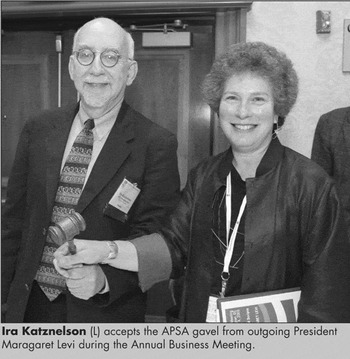
Ira Katznelson, the Ruggles Professor of Political Science and History at
Columbia University, became the Association's 102nd president
on September 3rd at the Association's Annual Business Meeting
when outgoing APSA President Margaret Levi of the University of
Washington, Seattle, presented Katznelson with the Association gavel.
Joining Katznelson in guiding the Association are six new officers.
Eight new members of the council will be elected in an all member
electronic election during the month of October. Details on the results
of the election will be available on the web and in the January issue of
PS.
Katznelson earned his B.A. from Columbia in 1966 and his Ph.D. from
Cambridge University in 1969. Before returning to Columbia in 1994, he
was a member of the department of political science at the University of
Chicago (where he was chair) and the New School for Social Research
(where he was dean of the graduate faculty).
His scholarship at the boundary of political science and history on the
liberal state, inequality, social knowledge, and institutions primarily
concerns the United States, but is indebted, and seeks to contribute to,
the discipline's other subfields. Katznelson is currently finishing a
short book on affirmative action and a long volume on the New Deal. His
most recent book is When Affirmative Action was White (2005).
Other books include: Desolation and Enlightenment: Political
Knowledge after Total War, Totalitarianism, and the Holocaust
(2003), Black Men, White Cities (1973), City Trenches
(1981), Schooling for All (with Margaret Weir, 1985),
Marxism and the City (1992), and Liberalism's Crooked
Circle (1996), which won the Michael Harrington and Lionel
Trilling Book Awards. He also co-edited Working Class Formation
(with Aristide Zolberg, 1986), Paths of Emancipation: Jews, States,
and Citizenship (with Pierre Birnbaum, 1995), and Shaped by
War and Trade: International Influences on American Political
Development (with Martin Shefter, 2002).
His APSA responsibilities include serving as vice president of the
Association, co-chairing, with Helen Milner, the 2000 Program Committee
and editing Political Science: The State of the Discipline,
Centennial Edition (Norton Publishers, 2002). He has also
served as president of the Politics and History Section of APSA,
president of the Social Science History Association, and chair of the
Russell Sage Foundation Board of Trustees. He has been a Guggenheim
Fellow, and is a fellow of the American Academy of Arts and
Sciences.
Assuming the position of president-elect is Robert Axelrod, the Arthur W.
Bromage Distinguished University Professor of Political Science and
Public Policy at the University of Michigan. He has appointments in the
department of political science and the Gerald R. Ford School of Public
Policy. Prior to coming to Michigan he taught at the University of
California, Berkeley (1968–1974). He holds a B.A. in mathematics from
the University of Chicago (1964), and a Ph.D. in political science from
Yale (1969).
He is best known for his interdisciplinary work on the evolution of
cooperation that has been cited in over 3,000 articles. His current
research interests include complexity theory (especially agent-based
modeling) and international security. Axelrod has been elected to the
National Academy of Sciences, the American Academy of Arts and Sciences,
and the Council on Foreign Relations. Among his honors are a five-year
MacArthur Prize Fellowship, the Newcomb Cleveland Prize of the American
Association for the Advancement of Sciences for an outstanding
contribution to science, and the National Academy of Sciences Award for
Behavioral Research Relevant to the Prevention of Nuclear War.
Recently, Axelrod has consulted and lectured on promoting cooperation and
harnessing complexity for the United Nations, the World Bank, the U.S.
Department of Defense, and various organizations serving health care
professionals, business leaders, and K–12 educators. Axelrod's service
contributions to APSA include service as vice president and secretary of
the Association, member of the Nominating Committee, and chair of the
APSA panel on the Perestroika debate.
Other 2005–2006 officers include:
Vice Presidents: Gary Cox, University of California, San Diego;
David Laitin, Stanford University; Katherine Tate, University of
California, Irvine
Treasurer: Tony Affigne, Providence College
Secretary: Dvora Yanow, California State University-Hayward
Graduate Students Attend Meeting with APSA Assistance
In an effort to increase graduate student participation in the Annual
Meeting, the Association awarded 62 Advanced Graduate Student Travel
Grants for the 2005 meeting in Washington, D.C. The names and
institutional affiliations of the 2005 winners follow.
Jimi Adams, Ohio State University
Amel F. Ahmed, University of Pennsylvania
Linda Allegro, Rollins College
Brandon L. Bartels, Ohio State University
Sarah Bermeo, Princeton University
Eric Brahm, University of Colorado
Kelly Burke, Louisiana State University
Jason Caro, University of Houston
Royce A. Carroll, University of California, San Diego
Andrew J. W. Civettini, University of Iowa
Tom Clark, Princeton University
Daniel Cordes, Columbia University
David Cunningham, University of California, San Diego
Kathryn A. DePalo, Florida International University
Alexis J. Diamond, Harvard University
Brendan J. Doherty, University of California, Berkeley
Rose Ernst, University of Washington
Michele A. Gilbert, Kent State University
Bruce Gilley, Princeton University
Katherine Adams Gordy, Cornell University
Devashree Gupta, Cornell University
Sally Hansen, University of South Carolina
Eric H. Hines, University of Iowa
Brandy Jones, University of Michigan
Sara R. Jordan, Texas A&M University
Diana Kapiszewski, University of California, Berkeley
Sara Kendall, University of California, Berkeley
Julia Hyeyong Kim, University of California, Los Angeles
Anessa L. Kimball, SUNY, Binghamton
Daniel Kinderman, Cornell University
Yanna Krupnikov, University of Michigan
Shana Kushner, Princeton University
Edward Lai, University of Western Ontario
Mary Frances Rosett Lebamoff, Loyola University, Chicago
Adrienne LeBas, Columbia University
Michael Lerma, University of Arizona
Laura C. Lucas, Boston University
Neil Malhotra, Stanford University
Ronald Eric Matthews, Jr., Kent State University
Susan J. McWilliams, Princeton University,
Molly M. Melin, University of California, Davis
Claire Margaret Metelits, Northwestern University
James Edward Monogan, III, University of North Carolina, Chapel
Hill
Davin J. Montgomery, University of Colorado, Colorado
Springs
Chandra Mudaliar, Michigan State University
Simeon C. Nichter, University of California, Berkeley
Nhu-Ngoc T. Ong, University of California, Irvine
David Palmieri, Université de Montréal
Erin E. Richards, Washington State University
Rebecca Kathreen Root, University of Massachusetts, Amherst
Idean Salehyan, University of California, San Diego
Elisha Carol Savchak, University of South Carolina
Laura U. Schneider, Purdue University
Becki Scola, University of California, Irvine
Zachary Coleman Shirkey, Columbia University
Salmon A. Shomade, University of Arizona
Shyam K. Sriram, Georgia State University
Brent Strathman, Ohio State University
Holley E. Tankersley, University of Georgia
Melody Ellis Valdini, University of California, San Diego
Gloria C. Walker, University of California, Davis
David Dahua Yang, Princeton University
International Scholar Travel Grants
Fifty-one senior and graduate student international scholars
benefited from the APSA travel grant program this year. Twenty-six
grants to scholars representing 21 countries were awarded for travel
expenses and lodging in Washington, D.C. All award winners were APSA
members and participants in the 2005 Annual Meeting program.
Twenty-five international advanced graduate students studying at U.S.
institutions were also awarded travel grants to help defray their
costs in attending the 2005 meeting. All awardees presented papers
or posters at the meeting and all were advanced graduate students
who had almost completed their dissertations.
International Graduate Students at U.S.
Institutions
Naazneen Barma, University of California
Deborah A. Boucoyannis, Harvard University
Guillermo M. Cejudo-Ramirez, Boston University
Els de Graauw, University of California
Cyril Ghosh, Syracuse University
Choong-Nam Kang, SUNY, Buffalo
Doo-Rae Kim, Michigan State University
Hunjoon Kim, University of Minnesota - Twin Cities
Soonjeong Kwon, University of Oklahoma
Terence C. Lee, University of Washington, Seattle
Claudia Leeb, New School University
David Leon, University of Minnesota
Zihua Liu, University at Buffalo
Aleksander Lust, Cornell University
Mara Gabriela Marin, University of Chicago
Katja Michalak, Ohio State University
Sangay K. Mishra, University of Southern California
Bappaditya Mukherjee, Wayne State University
Nam Tae Park, Texas A&M University
Nicole Richardt, Northwestern University
Julio Rios-Figueroa, New York University
Tatiana Petrova Rizova, University of California, Los
Angeles
Tobias Schulze-Cleven, University of California,
Berkeley
Yongseok Seo, University of Hawaii at Manoa
Wu Zhang, Cornell University
International Scholars and Graduate Students
Anette Ahrnens, Lund University, Sweden
Alexander Baturo, Trinity College Dublin, Ireland
Sean Carey, University of Sheffield, United Kingdom
Clare Elizabeth Chambers, Oxford University, United
Kingdom
Oliver S. Curry, London School of Economics, United
Kingdom
Rita Dhamoon, University of British Columbia, Canada
Sebastien Dube, Universite de Montreal, Canada
Andreas Duer, University of Mannheim, Germany
Jessica Fortin, McGill University, Canada
Yaprak Gursoy, University of Virginia
Indridi Haukur Indridason, University of Iceland
Niraja Gopal Jayal, Jawaharlal Nehru University,
India
Joseph S. Joseph, University of Cyprus
Ivan Katchanovski, Smith College, Ukraine
Thomas A. Koelble, University of Cape Town, South
Africa
Peter A. Kraus, University of Frankfurt, Germany
Yu-Kang Lee, National Sun Yat-sen University, China
Tove T. Lindén, Stockholm University, Sweden
Aurelian Daniel Muntean, National School of Political
Studies, Romania
Luis A. Ordonez, Universidad Simon Bolivar,
Venezuela
Diana Panke, Free University of Berlin, Germany
Susan Park, Deakin University, Australia
Dmitry Shakin, Institute for Open Economy, Russia
Jeanne W. Simon, Universidad de Concepcion, Chile
Wouter Teepe, Universiteit Groningen, Netherlands
Chia-hung Tsai, Election Study Center, Taiwan
Political Studies Association (UK)
Terrell Carver, University of Bristol
Wyn Grant, University of Warwick
Neil Collins, University College Cork, Dublin
John Benyon, University of Leicester
Japanese Political Science Association
Takashi Oshimura, Aoyamagakuin University
Toshio Ochi, Niigata University
Ralph Bunche Summer Institute Participants Present Work at
Annual Meeting
Twelve outstanding students from the 2005 Ralph Bunche Summer Institute
(RBSI) presented their research at this year's Annual Meeting in
Washington, D.C. The students presented their research at the American
Politics II and Teaching and Learning Poster Session, with topics
ranging from the Black media to Latino voting to the role of religion in
politics. Students were accompanied to the Annual meeting by RBSI 2004
student Cheryl Laird, University of Maryland. This year's class of RBSI
students and the research they presented at this year's meeting:
Amir T Ayres, Rutgers University, Camden, “Examining the
Contradiction: Black Patriotism in America”
Karen Ellis, William Patterson University, “If Democracy Doesn't
Work for Most, It Doesn't Work: A Comparative Look at the Role of
Efficacy in Democracies Around the World”
Justin Hall, Andrews University, “Is Racism the Reason?
Underlying Factors of White Opposition Towards Racial Policies”
Erin K. Melton, Lincoln University, “A Nativity Scene? Political
Participation among the Latino Electorate”
DeReal R Moore, Texas Christian University, Prestage-Fenno
Fellow, “The Virtuous Voter: Religion, Republicans, and
Politics”
Melissa Swaby, Hartwick College, “Black Media: Motivator of the
Black Electorate?”
Dianna A. Vazquez, University of Hartford, “The Politics of
Exclusion: Political Alienation and Powerlessness Among Latinos”
Robert Walsh, Texas A & M University, “Arts and Democracy:
Social Capital and its Cultivation through Art”
Candis Watts, Duke University, Prestage-Fenno Fellow,
“Elephant Food: White Partisanship and Racial Resentment”
Shaun Williams-Wyche, Southern Methodist University, “A New Bloc
of Latino Voters? The Prospects for Latino Non-Partisanship”
Christopher Wilson, Pennsylvania State University, “Black
Democrats and Positive Thinking: Measuring the Effect of Optimism on
Black Democratic Affiliation and Partisanship Strength”
Reymundo Zambrano, Marquette University, “The Double-edged Sword
of Immigration on Native-born Latinos: A Study on Native-born Latino
Opinion Regarding Immigration Policy and Immigrants”
APSA's Ralph Bunche Summer Institute is a five-week program for minority
undergraduate students interested in pursuing a doctoral degree in
political science. The Institute is hosted by Duke University and is
supported by a grant from the National Science Foundation. For more
information or to download an application for next summer's Institute,
visit the APSA web site at www.apsanet.org/section_397.cfm.
Pi Sigma Alpha Award Winners, 2005
Pi Sigma Alpha, the National Political Science Honor Society, proudly
announces the following award winners for 2005.
Student Award Winners
Washington Internship Scholarships
Washington Intern Scholarships were awarded tor five Pi Sigma
Alpha members spending the summer or fall semesters in a
Washington internship program:
Ashley Pichon, Hofstra University
Adam Reiser, University of Utah
Devin Rhinerson, Emory University
Meggin Rutherford, Austin College
Luke Wake, Elon University
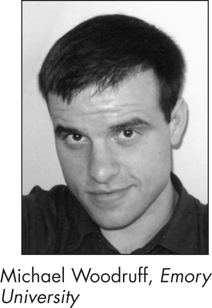
Howard Penniman/Pi Sigma Alpha Scholarships
Howard Penniman/Pi Sigma Alpha Scholarships for Graduate Study in
Political Science were awarded to three members entering
graduate programs in the fall of 2005:
Stephanie Burchard, University of New Orleans (photo
unavailable)
Michael Woodruff, Emory University
Kristen Hudak, Mercyhurst College
Best Undergraduate Class Papers
FIRST PLACE
“Candidates' Use of the Media in the Most Recent Elections in
Canada, Great Britain and the United States”, Kate Metcalf,
University of Richmond
RUNNER-UP
“The Publication of Polls and Voter Selection”, Caitlin Dwyer,
Hartwick College
RUNNER-UP
“In the Coverage of the Rolling Stone: The Significance
of Politics in a Medium of Popular Culture”, Andrew Bloeser,
University of Wisconsin, Stevens Point
Best Undergraduate Honors Theses
FIRST PLACE
“Understanding Civil Liberties Judgements after September 11: An
Experimental Study”, Chase Samples, Furman
University
RUNNER-UP
“Affecting Citizen Satisfaction: Transitions to Mixed-Member
Electoral Systems in Latin America and the Effects on Citizen
Satisfaction”, Jason Eichorst, Texas A&M
University
RUNNER-UP
“Amoral Liberals, Liberal Democrats, and Moral Republicans: Some
Explanations for the Democratic Party's Apparent Debility”,
Jacqueline Chattopadhyay, University of California,
Irvine
Best Chapter Awards
Schools with under 6,000 enrollment:
Gamma Sigma, Sewanee: University of the South
Omicron Lambda, Illinois Wesleyan University
Pi Iota, Ohio Northern University
Pi Nu, Benedictine University
Schools with 6,000–15,000 enrollment:
Beta Tau, University of Pennsylvania
Epsilon Mu, University of Montana
Kappa Eta, Austin Peay State University
Mu Pi, Winthrop University
Schools with over 15,000 enrollment:
Nu, University of Washington
Alpha Zeta, University of Maryland
Alpha Iota, Utah State University
Beta Mu, Brigham Young University
Sigma Mu, University of Central Oklahoma
Best Chapter Advisors
Michelle Brophy-Baermann, University of Wisconsin, Stevens
Point
Jan Hardt, University of Central Oklahoma
Scott Huffmon, Winthrop University
Organized Sections Distribute Awards at 2005 Annual
Meeting
In addition to awards conferred at the Association's Award Ceremony on
Thursday, September 1, the following recognitions are being made at the
business meetings and receptions of APSA's Organized Sections.
Section 1: Federalism & Intergovernmental
Relations
Martha Derthick Book Award
Conferred for the best book on federalism and intergovernmental
relations published at least 10 years ago that has made a
lasting contribution to the study of federalism and
intergovernmental relations.
Award Committee: Ann O'M. Bowman, University of South
Carolina; Martha Derthick, University of Virginia; John J.
Dinan, Wake Forest University
Recipient:
Richard Simeon, University of Toronto
Title: Federal-Provincial Diplomacy (University of
Toronto Press, 1972)
Deil S. Wright Best Paper Award
Conferred for the best paper in the field of federalism and
intergovernmental relations presented at the previous year's
APSA Annual Meeting.
Award Committee: Jody Neathery-Castro, University of
Nebraska-Omaha; Troy E. Smith, Drury University; Deil S. Wright,
University of North Carolina, Chapel Hill
Recipient:
Megan Mullin, University of California, Berkeley
Title: “Fighting Over Land and Water; Venues in Local
Growth Disputes”
Daniel Elazar Distinguished Federalism Scholar
Award
Recognizes distinguished scholarly contributions to the study of
federalism and intergovernmental relations.
Award Committee: Jocelyn M. Johnston, American
University; Paul L. Posner, George Mason University; Barry G.
Rabe, University of Michigan
Recipient:
Robert Agranoff, Indiana University
Section 2: Law and CourtsAmerican Judicature Society
Award
Given annually for the best paper on law and courts presented at the
previous year's annual meetings of the American, Midwest,
Northeastern, Southern, Southwestern, or Western Political Science
Associations.
Award Committee: Lori A. Johnson, Mercer University; Wendy
L. Martinek, SUNY, Binghamton; Chad Westerland, University of
Arizona
Co-Recipients:
Gregory A. Caldeira, Ohio State University, Kevin T.
McGuire, University of North Carolina, Chapel Hill, and
Charles E. Smith, Jr., University of Mississippi
Title: “A Spatial Model of Supreme Court Voting”
C. Herman Pritchett Award
Given annually for the best book on law and courts written by a
political scientist and published the previous year.
Award Committee: Lisa M. Holmes, University of Vermont;
Robert M. Howard, Georgia State University; Jeff Yates,
University of Georgia
Co-Recipients:
William T. Haltom, University of Puget Sound and
Michael W. McCann, University of Washington,
Seattle
Title: Distorting the Law: Politics, Media, and the
Litigation Crisis (University of Chicago Press,
2004)
CQ Press Outstanding Student Paper
Given annually for the best paper on law and courts written by a
graduate student.
Award Committee: Rachel Paine Caufield, Drake
University; Mark Kemper, Bridgewater State College; Emery G.
Lee, III, Case Western Reserve University
Recipient:
David Glick, Princeton University
Title: “Strategic Retreat and the 1935 Gold Clause
Cases: Upholding the New Deal to Challenge the New Deal”
Lifetime Achievement Award
Honors a distinguished career of scholarly achievement and
service to the Law and Courts field.
Award Committee: Scott Barclay, SUNY, Albany; Charles R.
Epp, University of Kansas; Laura L. Langer, University of
Arizona; Christine L. Nemacheck, College of William & Mary;
Jeffrey A. Segal, SUNY, Stony Brook
Recipient:
Joel B. Grossman, Johns Hopkins University
McGraw Hill Award
Recognizes the best journal article on law and courts written by
a political scientist and published during the previous calendar
year.
Award Committee: Sara C. Benesh, University of
Wisconsin, Milwaukee; Keith J. Bybee, Syracuse University; Scott
A. Comparato, Southern Illinois University, Carbondale
Co-Recipients:
Kevin T. McGuire, University of North Carolina, Chapel
Hill and James A. Stimson, University of North
Carolina, Chapel Hill
Title: “The Least Dangerous Branch Revisited: New
Evidence on Supreme Court Responsiveness to Public Preferences”
Journal of Politics 66 (4): 1018–1035
Teaching and Mentoring Award
Recognizes innovative teaching and instructional methods and
materials in law and courts. The Award is supported by a
contribution from the Division for Public Education of the
American Bar Association.
Award Committee: Chris W. Bonneau, University of
Pittsburgh; Michael W. McCann, University of Washington,
Seattle; Howard Schweber, University of Wisconsin, Madison
Recipient:
Lawrence Baum, Ohio State University
Wadsworth Publishing Award
Given annually for a book or journal article, 10 years or older,
that has made a lasting impression on the field of law and
courts.
Award Committee: Paul Frymer, University of California,
Santa Cruz; Lori J. Hausegger, Boise State University; Stefanie
A. Lindquist, Vanderbilt University
Co-Recipients:
Jeffrey A. Segal, SUNY Stony Brook and Harold J.
Spaeth, Michigan State University
Title: The Supreme Court and the Attitudinal Model
(Cambridge University Press, 1993).
Section 3: Legislative Studies
Alan Rosenthal Prize
In the spirit of Alan Rosenthal's work, this prize is dedicated
to encouraging young scholars to study questions that are of
importance to legislators and legislative staff and to conduct
research that has the potential application to strengthening the
practice of representative democracy.
Award Committee: Joseph Cooper, Johns Hopkins
University; Cherie Maestas, Florida State University; Daniel
Palazzolo, University of Richmond.
Recipient:
Thad Kousser, University of California, San Diego
Title: Term Limits and the Dismantling of State Legislative
Professionalism (Cambridge University Press, 2004)
Carl Albert Award
Given annually for the best dissertation in legislative studies.
Topics may be national or subnational in focus-on Congress,
parliaments, state legislatures, or other representative bodies.
Dissertations must have a copyright date of one or two years
previous to the year in which the award is presented.
Award Committee: Christian R. Grose, Vanderbilt
University; Noelle Helen Norton, University of San Diego; Jack
Wright, Ohio State University
Co-Recipient:
Gail McElroy, Trinity College
Title: “In Pursuit of Party Discipline: Committees and
Cohesion in the European Parliament”
Co-Recipient:
Robert Van Houweling, Harvard University
Title: “Legislators; Personal Policy Preferences and
Partisan Legislative Organization”
CQ Press Award
For the best paper on legislative studies presented at the
previous year's APSA Annual Meeting.
Award Committee: Samuel Kernell, University of
California, San Diego; Lynda W. Powell, University of Rochester;
Sean M. Theriault, University of Texas, Austin
Recipient:
Tracy Sulkin, University of Illinois, Urbana
Champaign
Title: “Legislative Responsiveness to Campaign
Challenges”
Jewell-Loewenberg Award
For the best article in the Legislative Studies
Quarterly in the previous year.
Award Committee: Garrison Nelson, Brandeis University;
Charles Stewart, III, Massachusetts Institute of Technology;
Michele L. Swers, Georgetown University
Co-Recipients:
Sarah A. Binder, George Washington University and
Forrest Maltzman, George Washington University
Title: “The Limits of Senatorial Courtesy”
Richard F. Fenno Prize
In the tradition of Professor Fenno's work, this prize is
designed to honor work that is both theoretically and
empirically strong. Moreover, this prize is dedicated to
encouraging scholars to pursue new and different avenues of
research in order to find answers to previously unexplored
questions about the nature of politics.
Award Committee: Scott Adler, University of Colorado,
Boulder; Sarah A. Binder, George Washington University; Gary W.
Cox, University of California, San Diego
Recipient:
Diana Evans, Trinity College
Title: Greasing the Wheels: Using Pork Barrel Projects to
Build Majority Coalitions in Congress (Cambridge
University Press, 2004)
Section 4: Public Policy
Aaron Wildavsky Enduring Contribution Award
Given for a book or article published in the last 10 to 20 years
that continues to influence the study of public policy.
Award Committee: Ann Chih Lin, University of Michigan;
Mark A. Peterson, University of California, Los Angeles; Paul
Rich, Policy Studies Organization
Recipient:
Gosta Epsing-Anderson, European University
Institute
Title: The Three Worlds of Welfare Capitalism (Polity
Press, 1990)
Best Public Policy Paper
Given to the best paper presented at previous year's Annual
Meeting.
Award Committee: Alesha E. Doan, Cal Poly University;
William R. Lowry, Washington University; Deborah R. McFarlane,
University of New Mexico
Co-Recipients:
Michele A. Gilbert, Kent State University, Karen
Mossberger, Kent State University, and Caroline J.
Tolbert, Kent State University
Title: “Race, Place, and Information Technology”
Excellence in Mentoring Award
This is the inaugural offering of this award, which recognizes
excellence in mentoring junior scholars in the field of public
policy research.
Award Committee: William T. Gormley, Jr., Georgetown
University; Michael Mintrom, University of Auckland; Saundra K.
Schneider, Michigan State University
Recipient:
Frank R. Baumgartner, Pennsylvania State University
Section 5: Political Organizations and Parties
Emerging Scholars Award
Given to a scholar who has received his or her Ph.D. within the
last five years and whose career to date demonstrates unusual
promise.
Award Committee: Scott H. Ainsworth, University of
Georgia; David C. Kimball, University of Missouri, St. Louis;
Barbara Norrander, University of Arizona
Co-Recipients:
Barry C. Burden, Harvard University and Beth L.
Leech, Rutgers University
Jack Walker Award
“Honors an article published in the last two calendar years that
makes an outstanding contribution to research and scholarship on
political organizations and parties.”
Award Committee: Andrea Colleen Campbell-Francis,
University of Illinois at Urbana-Champaign; Anne N. Costain,
University of Colorado – System; Thomas Ferguson, University of
Massachusetts, Boston
Co-Recipients:
James W. Boyd, Kent State University, Ping
Cheng, Florida Atlantic University, Alan J.
Ziobrowski, Georgia State University, and Brigitte
J. Ziobrowski, Augusta State University
Title: “Abnormal Returns from the Common Stock
Investments of the United States Senate.” 2004. Journal of
Financial and Quantitative Analysis 39 (4).
Leon Epstein Book Award of Political Organizations and
Parties Section
“Honors a book published in the last two calendar years that
makes an outstanding contribution to research and scholarship on
political organizations and parties.”
Award Committee: Robin A. Kolodny, Temple University;
Mark A. Smith, University of Washington; Daniel J. Tichenor,
Rutgers University, New Brunswick
Co-Recipients:
Pradeep Chhibber, University of California, Berkeley
and Kenneth W. Kollman, University of Michigan
Title: The Formation of National Party Systems
(Princeton University Press, 2004)
POP/Party Politics Award
Honors the best paper delivered on a Political Organizations and
Parties-sponsored panel at the preceding APSA Annual Meeting.
The award recipient is offered the opportunity to publish the
paper in Party Politics.
Award Committee: Andrew S. McFarland, University of
Illinois, Chicago; Jennifer Nicoll Victor, University of
Pittsburgh; Christina Wolbrecht, University of Notre Dame
Recipient:
Michael T. Heaney, University of Florida
Title: “Reputation and Leadership Inside Interest Group
Coalitions”
Samuel Eldersveld Career Achievement Lifetime
Award
Honors “a scholar whose lifetime professional work has made an
outstanding contribution to the field.”
Award Committee: Nicol C. Rae, Florida International
University; Susan Scarrow, University of Houston; Byron E.
Shafer, University of Wisconsin, Madison
Recipient:
James Q. Wilson, University of California, Los
Angeles
Section 6: Public Administration
Herbert Kaufman Award
Given for the best paper presented at the preceding year's APSA
Annual Meeting.
Co-Recipients:
Richard C. Feiock, Florida State University,
Meeyoung Lamothe, University of Nebraska, Omaha,
and Scott Lamothe, University of Nebraska, Lincoln
Title: “Vertical Integration in Municipal Service
Provision: In-House Production of Previously Outsourced
Services”
Herbert A. Simon Best Book Award
Conferred annually for the best book on public administration
published in the last three to five years that has made a
significant contribution to public administration
scholarship.
Co-Recipients:
Steven Maynard-Moody, University of Kansas, and
Michael C. Musheno, Arizona State University
Title: Cops, Teachers, Counselors: Stories from the
Front-Lines of Public Service (University of Michigan
Press, 2003)
Co-Recipient:
John A. Rohr, Virginia Tech
Title: Civil Servants and Their Constitutions
(University of Kansas Press, 2002)
Paul Volcker Endowment Grant
This annual grant provides support in research and theory
building on public administration issues affecting governance in
the U.S. and abroad.
Recipient:
Alisa Hicklin, Texas A&M University
Section 7: Conflict Processes
Lifetime Achievement Award
Created to honor lifetime achievement in the study of conflict
and peace.
Award Committee: William J. Dixon, University of
Arizona; Kelly M. Kadera, University of Iowa; Jack S. Levy,
Rutgers University
Recipient:
Anatol Rapoport, University of Toronto
Section 8: Representation and Electoral Systems
George H. Hallet Award
Presented annually to the author of a book published at least 10
years ago that has made a lasting contribution to the literature
on representation and electoral systems.
Award Committee: John C. Courtney, University of
Saskatchewan; Todd Donovan, Western Washington University; Miki
Caul Kittilson, Arizona State University
Recipient:
V. O. Key, Jr., late of Harvard University
Title: Southern Politics in State and Nation (University
of Tennessee Press, 1984)
Leon Weaver Award
Given for the best paper presented at a panel sponsored by the
Representation and Electoral Systems Division.
Award Committee: Henry Milner, Universite Laval; Burt L.
Monroe, Michigan State University
Recipient:
Mona Lyne, University of South Carolina
Title: “Endogenous Institutions: Electoral Law and
Internal Party Dynamics in Brazil”
Section 9: Presidency Research
Founders Paper Award
Given for the best paper presented at the previous year's Annual
Meeting.
Award Committee: David Gray Adler, Idaho State
University; Peri E. Arnold, University of Notre Dame; John P.
Burke, University of Vermont; Janet M. Martin, Bowdoin
College
Co-Recipients:
James N. Druckman, University of Minnesota and
Lawrence R. Jacobs, University of Minnesota
Title: “Lumpers and Splitters: The Public Opinion
Information that Politicians Collect and Use”
Neustadt Award for the Best Book on the
Presidency
Given for the best book published during the year that
contributed to research and scholarship in the field of American
presidency.
Award Committee: MaryAnne Borrelli, Connecticut College;
Jeffrey E. Cohen, Fordham University; Kenneth R. Mayer,
University of Wisconsin, Madison; Bert A. Rockman, Purdue
University; David A. Yalof, University of Connecticut
Recipient:
Kevin J. McMahon, Trinity College
Title: Reconsidering Roosevelt on Race: How the Presidency
Paved the Road to Brown (University of Chicago Press,
2003)
Best Undergraduate Paper Award
Award Committee: Patricia D. Conley; David E. Lewis,
Princeton University; John M. Orman, Fairfield University
Recipient:
Rebecca Stark, Carleton College
Title: “The Influence of Foreign Affairs in Presidential
Elections: 1992–2004”
Section 11: Religion and Politics
Best Publication Award
Inaugural presentation of award for the best publication by an
APSA member.
Award Committee: Clarke E. Cochran, Texas Tech
University; Dale S. Kuehne, Ph.D., Saint Anselm College; Laura
R. Olson, Clemson University
Co-Recipients:
Brian S. Krueger, University of Rhode Island, David
C. Leege, University of Notre Dame, Paul D.
Mueller, University of Notre Dame, and Kenneth D.
Wald, University of Florida
Title: The Politics of Cultural Difference: Social Change and
Voter Mobilization Strategies in the Post-New Deal
Period (Princeton University Press, 2002)
Section 13: Urban Politics
Norton Long Lifetime Achievement Award
Recipient:
Martin Shefter, Cornell University
Best Book in Urban Politics
Presented for the best book in urban politics for 2004.
Recipient:
James DeFilippis, Baruch College, CUNY
Title: Unmaking Goliath: Community Control in the Face of
Global Capital (Roultledge, 2003)
Best Paper, 2004 APSA Annual Meeting
Recipient:
Michael Jones-Correa, Cornell University
Title: “Racial and Ethnic Diversity and the Politics of
Education in Suburbia.”
Byran Jackson Award
Recipient:
Paru Shah, Rice University
Best Dissertation in Urban Politics
Recipient:
Christine Kelleher, University of Michigan,
Dearborn
Title: “Representation and Responsiveness in American
Local Governments.”
Section 15: Science, Technology & Environmental
Politics
Don K. Price Award
For the best book on science, technology, and environmental
politics published in the last year.
Award Committee: Bruce Bimber, University of California,
Santa Barbara; David M. Hart, George Mason University; J. P.
Singh, Georgetown University
Recipient:
Thomas C. Bernauer, Swiss Federal Institute of
Technology, Zurich
Title: Genes, Trade, and Regulation: The Seeds of Conflict in
Food Biotechnology (Princeton University Press,
2004)
Lynton K. Caldwell Award
For the best book on environmental politics and policy published
in the past three years.
Award Committee: Christopher J. Bosso, Northeastern
University; Michael E. Kraft, University of Wisconsin, Green
Bay; Judith A. Layzer, Massachusetts Institute of Technology
Recipient:
Barry G. Rabe, University of Michigan, Ann Arbor
Title: Statehouse and Greenhouse: The Emerging Politics of
American Climate Change Policy (Brookings, 2004)
Virginia M. Walsh Dissertation Award
Named in honor of a young scholar who tragically passed away in
2003 and given for the best dissertation in the field of
science, technology, and environmental politics.
Award Committee: Mark B. Brown, California State
University, Sacramento; Renee Marlin-Bennett, American
University; Mark C. Stephan, Washington State University,
Vancouver
Recipient:
Daniel J. Sherman, University of Puget Sound
Title: “Not Here, Not There: The Federal, State, and
Local Politics of Low-Level Radioactive Waste Disposal in the
United States”
Section 16: Women and Politics Research
Best Dissertation Award
For the best dissertation on women and politics. To be eligible,
a dissertation must be completed and successfully defended in
the previous calendar year.
Award Committee: Jennifer Leigh Disney, Winthrop
University; Susan Hekman, University of Texas, Austin; Elora
Shehabuddin, Rice University
Recipient:
Carisa R. Showden, University of North Carolina,
Greensboro
Title: “Mythologies of Choice: The Politics of Domestic
Violence and Alternative Reproduction”
Best Paper Award
For the best paper presented at the previous year's Annual
Meeting in the field of women and politics.
Award Committee: Alice L. Hearst, Smith College; Nancy
J. Hirschmann, University of Pennsylvania; V. Spike Peterson,
University of Arizona
Co-Recipient:
Liesl Haas, California State University, Long Beach
Title: “Intergovernmental Relations and Feminist Policy
Makings: A Case Study of Domestic Violence in Chile”
Co-Recipient:
S. Laurel Weldon, Purdue University
Title: “Inclusion, Solidarity and Transnational Social
Movements: The Global Movement Against Gender Violence”
Section 17: Foundations of Political Thought
Best Paper Award
Given for the best paper presented on a Foundations panel at the
2005 Annual Meeting.
Award Committee: Susan Bickford, University of North
Carolina, Chapel Hill; Alfonso J. Damico, University of Iowa;
Emily R. Gill, Bradley University
Recipient:
Samuel A. Chambers, University of Wales, Swansen
Title: “The Alterirty of the Present: Reading Sexuality
in Six Feet Under”
David Easton Award
Recognizing a book that broadens the horizons of contemporary
political science by engaging issues of philosophical
significance in political life through any of a variety of
approaches in the social sciences and humanities.
Award Committee: Seyla Benhabib, Yale University;
William A. Galston, University of Maryland, College Park;
Jeffrey C. Isaac, Indiana University, Bloomington
Recipient:
Ira Katznelson, Columbia University
Title: Desolation and Enlightenment. Political Knowledge
after Total War, Totalitarianism and the Holocaust
(Columbia University Press, 2003)
First Book Award
Recognizing the best first book published in 2004 by a scholar in
the early stages of his or her career in the area of political
theory/philosophy.
Award Committee: Christine DiStefano, University of
Washington; Leslie Thiele, University of Florida; Simone
Chambers, University of Toronto
Recipient:
Corey Robin, CUNY Brooklyn
Title: Fear: The History of a Political Idea (Oxford
University Press, 2004)
Section 20: Comparative Politics
Data Set Award
Given for a publicly available data set that has made an
important contribution to the field of comparative politics.
Award Committee: Thomas R. Cusack, WZB; Lane Kenworthy,
University of Arizona; Nicholas Sambanis, Yale University
Recipient:
Timothy M. Smeeding, Syracuse University
Title: Luxembourg Income Study
Leubbert Best Article Award
Given for the best article in the field of comparative politics
published in the previous two years.
Award Committee: Edward Gibson, Northwestern University;
Pauline Jones Luong, Brown University; George Tsebelis,
University of California, Los Angeles
Co-Recipients:
Scott J. Basinger, Stony Brook University, SUNY and
Mark Hallerberg, Emory University
Title: “Remodeling the Competition for Capital: How
Domestic Politics Erases the Race to the Bottom.” American
Political Science Review 98 (May, 2004).
Co-Recipients:
Ernesto F. Calvo, University of Houston and Maria
Victoria Murillo, Columbia University
Title: “Who Delivers? Partisan Clients in the Argentine
Electoral Market.” American Journal of Political Science 48
(October 2004): 742–757.
Leubbert Best Book Award
Given for the best book in the field of comparative politics
published in the previous two years.
Award Committee: Jeffrey Kopstein, University of
Toronto; Ashutosh Varshney, University of Michigan, Ann
Arbor
Recipient:
Elisabeth Jean Wood, Yale University
Title: Insurgent Collective Action and Civil War in El
Salvador (Cambridge University Press, 2003)
Sage Best Paper Award
Given to the best paper in the field of comparative politics
presented at the previous year's APSA Annual Meeting.
Award Committee: Carol A. Mershon, University of
Virginia; Daniel N. Posner, University of California, Los
Angeles; J. Nicholas Ziegler, University of California,
Berkeley
Co-Recipients:
Macartan Humphreys, Columbia University and Jeremy
M. Weinstein, Stanford University
Title: “Handling and Manhandling Civilians in Civil War:
Determinants of the Strategies of Warring Factions”
Co-Recipients:
Lianjiang Li, Hong Kong Baptist University and
Kevin J. O'Brien, University of California,
Berkeley
Title: “Popular Contention and its Impact in Rural
China”
Section 21: European Politics and Society
Best Book Award
Given for the best book on European Politics and society
published in the previous year.
Award Committee: Valerie Bunce, Cornell University;
Miriam A. Golden, University of California, Los Angeles; Jacques
J. Thomassen, University of Twente
Recipient:
V. P. Gagnon, Ithaca College
Title: The Myth of Ethnic War: Serbia and Croatia in the
1990s (Cornell University Press, 2004)
Ernst B. Haas Best Dissertation Award
Given for the best dissertation on European Politics and Society
filed during the previous year.
Award Committee: Christopher K. Ansell, University of
California, Berkeley; Amie Kreppel, University of Florida;
Martin A. Schain, New York University
Recipient:
Uwe Puetter, Central European University
Title: “The Eurogroup as a Forum for Informal
Deliberation Among Ministers”
Section 24: Politics and History
J. David Greenstone Book Prize
For the best book in history and politics in the past two
calendar years.
Award Committee: Howard Gillman, University of Southern
California; Alberta M. Sbragia, University of Pittsburgh; Eric
Schickler, Harvard University
Recipient:
Richard M. Valelly, Swarthmore College
Title: The Two Reconstructions: The Struggle for Black
Enfranchisement (University of Chicago Press, 2004)
Mary Parker Follett Prize
For the best article on politics and history published in the
previous year.
Award Committee: Mabel Berezin, Cornell University;
Sarah A. Binder, George Washington University; Herman Schwartz,
University of Virginia
Recipient:
Peter A. Swenson, Yale University
Title: “Varieties of Capitalist Interests: Power,
Institutions, and the Regulatory Welfare State in the United
States and Sweden” Studies in American Political
Development 18 (spring 2004): 1–29.
Section 25: Political Economy
Best Paper Award
Given for the best paper in Political Economy presented at the
previous year's APSA Annual Meeting.
Award Committee: Torben Iversen, Harvard University;
Layna Mosley, University of North Carolina, Chapel Hill; Frances
M. Rosenbluth, Yale University
Co-Recipients:
William T. Bernhard, University of Illinois,
Urbana-Champaign and David Leblang, University of
Colorado, Boulder
Title: “When Markets Party: Stocks, Bonds and Cabinet
Formations”
Mancur Olson Dissertation Award
Given for the best dissertation in political economy completed in
the previous two years.
Award Committee: Scott G. Gehlbach, University of
Wisconsin, Madison; Gerry Mackie, University of California, San
Diego; Joe A. Oppenheimer, University of Maryland
Recipient:
Christopher Adolph, Harvard University
Title: “The Dilemma of Disretion: Career Ambitions and
the Politics of Central Banking”
William H. Riker Book Award
Given for the best book on political economy published during the
past three calendar years.
Award Committee: Sarah M. Brooks, Ohio State University;
Stephan Haggard, University of California, San Diego; John D.
Huber, Columbia University
Recipient:
Fiona McGillivray, New York University
Title: Privileging Industry: The Comparative Politics of
Trade and Industrial Policy (Princeton University
Press, 2004)
Section 27: New Political Science
Christian Bay Award
For a New Political Science paper presented at the previous
year's Annual Meeting of the American Political Science
Association.
Award Committee: Jennifer Leigh Disney, Winthrop
University; Khalil M. Marrar, Loyola University Chicago; Daniel
J. O'Connor, California State University, Long Beach
Recipient:
Hamideh Sedghi, Columbia University
Title: “Islamization, Globalization, and Gender in Iran:
Compatible or Not?”
Richard Cloward and Frances Fox Piven Award
For an activist group, in the region of the Annual Meeting, that
puts the ideals of the New Political Science Section, “to make
the study of politics relevant to the struggle for a better
world,” into practice.
Award Committee: Stephen L. Elkin, University of
Maryland; Carol C. Gould, George Mason University; R. Claire
Snyder, George Mason University
Recipient:
Institute for Policy Studies
Charles A. McCoy Career Achievement Award
For a progressive political scientist who has had a long,
successful career as a writer, teacher, and activist.
Award Committee: John C. Berg, Suffolk University; John
Ehrenberg, Long Island University; Laura Katz Olson, Lehigh
University
Recipient:
Stephen Eric Bronner, Rutgers University
Michael Harrington Book Award
Given for an outstanding book that demonstrates how scholarship
can be used in the struggle for a better world.
Award Committee: Christine A. Kelly, William Paterson
University; Joseph Kling, St. Lawrence University; Selma K.
Sonntag, Humboldt State University
Recipient:
Katherine Van Wezel Stone, University of California,
Los Angeles
Title: From Widgets to Digits: Employment Regulation for the
Changing Workplace (Cambridge University Press,
2004)
Section 28: Political Psychology
Robert Lane Best Book Award
For the best book in political psychology published in the past
year.
Award Committee: Cynthia Burack, Ohio State University;
Michael A. Diamond, University of Missouri, Columbia; James M.
Glass, University of Maryland, College Park
Recipient:
Kristen Renwick Monroe, University of California,
Irvine
Title: The Hand of Compassion (Princeton University
Press, 2004)
Section 29: Undergraduate Education
Best Presentation Award
For the best presentation on undergraduate education at the past
year's APSA Annual Meeting.
Award Committee: Bernard L. Bray, Talladega College;
Larry W. Chappell, Mississippi Valley State University; Joseph
Kahne, Mills College; Joel Westheimer, University of Ottawa
Co-Recipients:
Kerstin Hamann, University of Central Florida,
Philip H. Pollock, III, University of Central
Florida, and Bruce M. Wilson, University of Central
Florida
Title: “Teaching and Learning Online: Assessing the
Effect of Gender Context on Active Learning”
Section 30: Politics, Literature, and Film
Best Paper Award
For the best paper presented at the previous year's APSA Annual
Meeting.
Award Committee: Lilly J. Goren, Carroll College; Ann
Ward, University of Regina
Recipient:
John Uhr, Australian National University
Title: “Inequality and Inequity in Political Leadership:
Henry Fielding's Satire in Jonathan Wild”
Section 31: Foreign Policy
Best Paper Award
For the best paper on foreign policy presented at the previous
year's APSA Annual Meeting.
Award Committee: Paul Kowert, Florida International
University; Peter A. Furia, Wake Forest University; Elizabeth G.
Matthews, Rochester Institute of Technology
Recipients:
William J. Josiger, Georgetown University and
George E. Shambaugh, Georgetown University
Title: “Public Prudence and its Support for
Counter-Terrorism Initiatives”
Section 32: Elections, Public Opinion, and Voting
Behavior
Best Paper Award
Given for the best paper delivered at the previous year's APSA
Annual Meeting.
Award Committee: Jane Y. Junn, Rutgers University, New
Brunswick; Caroline J. Tolbert, Kent State University; Clyde
Wilcox, Georgetown University
Recipient:
David E. Campbell, University of Notre Dame
Title: “Community Heterogeneity and Participation”
Emerging Scholar Award
Awarded to the top scholar in the field who is within 10 years of
her or his Ph.D.
Award Committee: Darren Davis, Michigan State
University; Leonie Huddy, SUNY, Stony Brook; George E. Marcus,
Williams College
Recipient:
James N. Druckman, University of Minnesota
Philip E. Converse Best Book Award
Given for an outstanding book in the field published at least
five years before.
Award Committee: Elisabeth L. Gidengil, McGill
University; M. Kent Jennings, University of California, Santa
Barbara; Jon A. Krosnick, Stanford University
Co-Recipients:
Stanley Presser, University of Maryland and Howard
Schumann, University of Michigan
Title: Questions and Answers in Attitude Surveys: Experiments
on Question Form, Wording, and Context (Academic Press,
1981)
Section 33: Race, Ethnicity and Politics
The APSA Section on Race, Ethnicity and Politics presents various
best book awards for outstanding publishing in four major
categories.
Award Committee: Co-Chairs: John G. Bretting, University of
Texas at El Paso and Ange-Marie Hancock, Yale University
General Committee: Lawrie Balfour, University of Virginia; Henry
Flores, St. Mary's University at San Antonio; Vince Hutchings,
University of Michigan; Angela Lewis, University of Alabama,
Birmingham
Comparative Racial and Ethnic Research
Recipient:
James L. Gibson
Title: Overcoming Apartheid: Can Truth Reconcile a Divided
Nation? (Russell Sage Foundation).
Recipient:
Sherene H. Razack
Title: Dark Threats and White Knights: The Somalia Affair,
Peacekeeping and the New Imperialism (University of
Toronto Press).
Legal Dimensions of Ethnic and Racial Politics
Recipient:
Albert L. Samuels
Title: Is Separate Unequal? Black Colleges and the Challenge
to Desegregation
(University of Kansas Press).Racial and
Ethnic Political Identities, Ideologies and
Theories
Recipient:
Melissa V. Harris-Lacewell
Title: Barbershops, Bibles and BET: Everyday Talk and Black
Political Thought.
(Princeton University
Press).Intersectionalities: Race, Gender,
Ethnicity and Politics
Recipient:
Michele T. Berger
Title: Workable Sisterhood: The Political Journey of
Stigmatized Women with HIV/AIDS (Princeton University
Press).
Section 34: International History and Politics
Jervis and Schroeder Best Book Award
For the best book on international history and politics published
in the previous two years.
Award Committee: Emily O. Goldman, University of
California-Davis; Ted Hopf, Ohio State University; Richard
Samuels, Massachusetts Institute of Technology
Recipient:
Jeffrey W. Taliaferro, Tufts University
Title: Balancing Risks: Great Power Intervention in the
Periphery (Cornell University Press, 2004).
Section 35: Comparative Democratization
Best Article Award
Given for the best article published on Comparative
Democratization within the last year.
Award Committee: Timothy Frye, Ohio State University;
Mark P. Jones, Rice University; Ellen M. Lust-Okar, Yale
University
Recipient:
Lisa Baldez, Dartmouth College
Title: “Elected Bodies: The Gender Quota Law for
Legislative Candidates in Mexico,” Legislative Studies
Quarterly 29 (May 2004): 231–258
Best Book Award
For the best single authored, multi-authored, or edited book on
comparative democratization published in the previous year.
Award Committee: William Case, Griffith University; M.
Steven Fish, University of California, Berkeley; Wendy Hunter,
University of Texas, Austin
Co-Recipient:
Kurt Schock, Rutgers University, Newark
Title: Unarmed Insurrections: People Power Movements in
Nondemocracies (University of Minnesota Press,
2004)
Co-Recipient:
Charles Tilly, Columbia University
Title: Contention and Democracy in Europe, 1650–2000
(Cambridge University Press, 2003)
Best Field Work Award
New award that will be presented for the first time at the 2005
APSA Annual Meeting
Award Committee: Joseph L. Klesner, Kenyon College
Recipient:
Lily Tsai, Harvard University
Title: “The Informal State: Governance, Accountability,
and Public Goods Provision in Rural China,” Ph.D. dissertation
at Harvard University
Juan Linz Best Dissertation Award
For the best dissertation in the comparative study of
democracy. Will be presented for the first time at the 2005 APSA
Annual Meeting.
Award Committee: Jonathan Hartlyn, University of North
Carolina, Chapel Hill; Richard Snyder, Brown University
Recipient:
Staffan I. Lindberg, Lund University
Title: “The Power of Elections: Democratic
Participation, Competition, and Legitimacy in Africa”
Section 37: Qualitative Methods
Alexander L. George Article Award
Honors Alexander George's contributions to the comparative
case-study method, including his work linking that method to a
systematic concern with research design, and his contribution of
developing the idea and the practice of process tracing. This
award may be granted to a journal article or to a chapter in an
edited volume that stands on its own as an article.
Co-Recipients:
Gary Goertz, University of Arizona and James
Mahoney, Northwestern University
Title: “The Possibility Principle: Choosing Negative
Cases in Comparative Research.” American Political Science
Review 98 (November 2004): 653–669.
Co-Recipient:
Henry E. Hale, Indiana University
Title: “Divided We Stand: Institutional Sources of
Ethnofederal State Survival and Collapse.” World
Politics 56 (January 2004): 165–193.
Giovanni Sartori Book Award
Given by the Qualitative Methods organized section, honors
Giovanni Sartori's work on qualitative methods and concept
formation, and especially his contribution to helping scholars
think about problems of context as they refine concepts and
apply them to new spatial and temporal settings. The award is
intended to encompass two types of contributions: new research
on methodology per se, i.e., studies that introduce
specific methodological innovations or that synthesize and
integrate methodological ideas in a way that is in itself a
methodological contribution; and substantive work that is an
exemplar for the application of qualitative methods.
Co-Recipients:
Henry E. Brady, University of California, Berkeley, and
David Collier, University of California,
Berkeley
Title: Rethinking Social Inquiry: Diverse Tools, Shared
Standards (Rowman & Littlefield, 2004)
Sage Paper Award
Honors Sara and George McCune, who founded and sustained Sage
Publications as a leading publisher of social science
methodology—including very centrally qualitative methods. Given
to a paper presented at the Annual Meeting of the American
Political Science Association.
Recipient:
Colin Elman, Arizona State University
Title: “Theoretical Typologies in the Qualitative Study
of International Politics”