


%20--%3e%3c!DOCTYPE%20svg%20PUBLIC%20'-//W3C//DTD%20SVG%201.0//EN'%20'http://www.w3.org/TR/2001/REC-SVG-20010904/DTD/svg10.dtd'%3e%3csvg%20version='1.0'%20id='Layer_1'%20xmlns='http://www.w3.org/2000/svg'%20xmlns:xlink='http://www.w3.org/1999/xlink'%20x='0px'%20y='0px'%20width='64px'%20height='64px'%20viewBox='5.5%20-3.5%2064%2064'%20enable-background='new%205.5%20-3.5%2064%2064'%20xml:space='preserve'%3e%3cg%3e%3ccircle%20fill='%23FFFFFF'%20fill-opacity='0'%20cx='37.785'%20cy='28.501'%20r='28.836'/%3e%3cpath%20fill='%23595959'%20d='M37.441-3.5c8.951,0,16.572,3.125,22.857,9.372c3.008,3.009,5.295,6.448,6.857,10.314%20c1.561,3.867,2.344,7.971,2.344,12.314c0,4.381-0.773,8.486-2.314,12.313c-1.543,3.828-3.82,7.21-6.828,10.143%20c-3.123,3.085-6.666,5.448-10.629,7.086c-3.961,1.638-8.057,2.457-12.285,2.457s-8.276-0.808-12.143-2.429%20c-3.866-1.618-7.333-3.961-10.4-7.027c-3.067-3.066-5.4-6.524-7-10.372S5.5,32.767,5.5,28.5c0-4.229,0.809-8.295,2.428-12.2%20c1.619-3.905,3.972-7.4,7.057-10.486C21.08-0.394,28.565-3.5,37.441-3.5z%20M37.557,2.272c-7.314,0-13.467,2.553-18.458,7.657%20c-2.515,2.553-4.448,5.419-5.8,8.6c-1.354,3.181-2.029,6.505-2.029,9.972c0,3.429,0.675,6.734,2.029,9.913%20c1.353,3.183,3.285,6.021,5.8,8.516c2.514,2.496,5.351,4.399,8.515,5.715c3.161,1.314,6.476,1.971,9.943,1.971%20c3.428,0,6.75-0.665,9.973-1.999c3.219-1.335,6.121-3.257,8.713-5.771c4.99-4.876,7.484-10.99,7.484-18.344%20c0-3.543-0.648-6.895-1.943-10.057c-1.293-3.162-3.18-5.98-5.654-8.458C50.984,4.844,44.795,2.272,37.557,2.272z%20M37.156,23.187%20l-4.287,2.229c-0.458-0.951-1.019-1.619-1.685-2c-0.667-0.38-1.286-0.571-1.858-0.571c-2.856,0-4.286,1.885-4.286,5.657%20c0,1.714,0.362,3.084,1.085,4.113c0.724,1.029,1.791,1.544,3.201,1.544c1.867,0,3.181-0.915,3.944-2.743l3.942,2%20c-0.838,1.563-2,2.791-3.486,3.686c-1.484,0.896-3.123,1.343-4.914,1.343c-2.857,0-5.163-0.875-6.915-2.629%20c-1.752-1.752-2.628-4.19-2.628-7.313c0-3.048,0.886-5.466,2.657-7.257c1.771-1.79,4.009-2.686,6.715-2.686%20C32.604,18.558,35.441,20.101,37.156,23.187z%20M55.613,23.187l-4.229,2.229c-0.457-0.951-1.02-1.619-1.686-2%20c-0.668-0.38-1.307-0.571-1.914-0.571c-2.857,0-4.287,1.885-4.287,5.657c0,1.714,0.363,3.084,1.086,4.113%20c0.723,1.029,1.789,1.544,3.201,1.544c1.865,0,3.18-0.915,3.941-2.743l4,2c-0.875,1.563-2.057,2.791-3.541,3.686%20c-1.486,0.896-3.105,1.343-4.857,1.343c-2.896,0-5.209-0.875-6.941-2.629c-1.736-1.752-2.602-4.19-2.602-7.313%20c0-3.048,0.885-5.466,2.658-7.257c1.77-1.79,4.008-2.686,6.713-2.686C51.117,18.558,53.938,20.101,55.613,23.187z'/%3e%3c/g%3e%3c/svg%3e)
%20--%3e%3c!DOCTYPE%20svg%20PUBLIC%20'-//W3C//DTD%20SVG%201.0//EN'%20'http://www.w3.org/TR/2001/REC-SVG-20010904/DTD/svg10.dtd'%3e%3csvg%20version='1.0'%20id='Layer_1'%20xmlns='http://www.w3.org/2000/svg'%20xmlns:xlink='http://www.w3.org/1999/xlink'%20x='0px'%20y='0px'%20width='64px'%20height='64px'%20viewBox='5.5%20-3.5%2064%2064'%20enable-background='new%205.5%20-3.5%2064%2064'%20xml:space='preserve'%3e%3cg%3e%3ccircle%20fill='%23FFFFFF'%20fill-opacity='0'%20cx='37.637'%20cy='28.806'%20r='28.276'/%3e%3cg%3e%3cpath%20fill='%23595959'%20d='M37.443-3.5c8.988,0,16.57,3.085,22.742,9.257C66.393,11.967,69.5,19.548,69.5,28.5c0,8.991-3.049,16.476-9.145,22.456%20C53.879,57.319,46.242,60.5,37.443,60.5c-8.649,0-16.153-3.144-22.514-9.43C8.644,44.784,5.5,37.262,5.5,28.5%20c0-8.761,3.144-16.342,9.429-22.742C21.101-0.415,28.604-3.5,37.443-3.5z%20M37.557,2.272c-7.276,0-13.428,2.553-18.457,7.657%20c-5.22,5.334-7.829,11.525-7.829,18.572c0,7.086,2.59,13.22,7.77,18.398c5.181,5.182,11.352,7.771,18.514,7.771%20c7.123,0,13.334-2.607,18.629-7.828c5.029-4.838,7.543-10.952,7.543-18.343c0-7.276-2.553-13.465-7.656-18.571%20C50.967,4.824,44.795,2.272,37.557,2.272z%20M46.129,20.557v13.085h-3.656v15.542h-9.944V33.643h-3.656V20.557%20c0-0.572,0.2-1.057,0.599-1.457c0.401-0.399,0.887-0.6,1.457-0.6h13.144c0.533,0,1.01,0.2,1.428,0.6%20C45.918,19.5,46.129,19.986,46.129,20.557z%20M33.042,12.329c0-3.008,1.485-4.514,4.458-4.514s4.457,1.504,4.457,4.514%20c0,2.971-1.486,4.457-4.457,4.457S33.042,15.3,33.042,12.329z'/%3e%3c/g%3e%3c/g%3e%3c/svg%3e)
Introduction
Gram-negative bacteremia carries a significant risk of morbidity and mortality. Reference Ling, Paterson, Harris, Furuya-Kanamori, Edwards and Laupland1 Beta-lactamases, specifically extended spectrum beta-lactamases (ESBLs), are increasingly common and have been a focus of gram-negative resistance studies. Reference Jernigan, Hatfield and Wolford2 At some institutions, ceftriaxone-non-susceptibility in Enterobacterales is used as a phenotypic proxy for the presence of ESBL genes. Reference Castanheira, Kimbrough, DeVries, Mendes and Sader3,Reference Tamma, Heil, Justo, Mathers, Satlin and Bonomo4 This method of detection is sensitive, but not specific for identifying ESBLs. Reference Tamma and Humphries5 Management of ceftriaxone-non-susceptible Enterobacterales is primarily focused on ESBLs. Current guidance for ESBL treatment recommends the use of carbapenems as first-line treatment. Reference Tamma, Heil, Justo, Mathers, Satlin and Bonomo4,Reference Harris, Tambyah and Lye6 For infections caused by ceftriaxone-non-susceptible, non-ESBL Enterobacterales bacteremia, there is no clear guidance for the optimal antimicrobial selection and whether a carbapenem is warranted.
Controversy and variability exist in the standards for detecting and classifying ESBLs. In the United States, the Clinical and Laboratory Standards Institute (CLSI) sets the standards for testing ESBLs in selected Enterobacterales (Escherichia coli, Klebsiella oxytoca, Klebsiella pneumoniae, or Proteus mirabilis). 7 The European Committee on Antimicrobial Susceptibility Testing (EUCAST) establishes testing criteria for detection of ESBLs in European countries. 8 Both genotypic and phenotypic testing are available. The CLSI and EUCAST standards for phenotypic testing of ESBLs are similar and include analysis of MICs (minimum inhibitory concentrations) for selected third-generation cephalosporins or aztreonam. Growth at/above the set MIC for the cephalosporin indicates possible ESBL production. This would be followed by confirmatory testing with susceptibility to clavulanate combined with the cephalosporins which had tested resistant alone. 7,8 Genotypic testing is typically limited to identification of the most common ESBL gene in the United States and internationally, bla CTX-M. Reference Castanheira, Kimbrough, DeVries, Mendes and Sader3,Reference Al-Mustapha, Muasa and Adetunji9 At Northwell Health’s microbiology laboratory, both genotypic testing (ie, bla CTX-M), followed by ESBL phenotypic testing are used to detect ESBL production in blood cultures growing E. coli, K. oxytoca, K. pneumoniae, or P. mirabilis.
There has been interest to better elucidate the mechanism of resistance in ceftriaxone-non-susceptible Enterobacterales and trying to differentiate between ESBLs and increased AmpC production, especially since optimal treatment would differ. In an epidemiologic study of ceftriaxone-non-susceptible Escherichia coli, Klebsiella pneumoniae, Klebsiella oxytoca, or Proteus mirabilis, 482 isolates with ceftriaxone MICs ≥ 2 mg/L were analyzed for a genotypic mechanism of resistance. Of these isolates, 78% were identified as having ESBL and/or plasmid-mediated ampC genes. Twenty-two percent had narrow-spectrum beta-lactamases alone. Reference Tamma and Humphries5,Reference Tamma, Sharara and Pana10 Based on epidemiology data, possible mechanisms for this resistance can be due to plasmid-mediated Amp-C induction, a narrow-spectrum beta-lactamase, or no identifiable beta-lactamase gene. Reference Spafford, MacVane and Humphries11 With ceftriaxone-non-susceptibility used as a proxy for ESBLs, non-ESBLs that fit into this category are poorly studied, leaving a void in our understanding of optimal management.
Furthermore, classifying ceftriaxone-non-susceptible Enterobacterales as ESBLs can increase carbapenem use. Reference Tamma and Humphries5 Providers are more likely to select a carbapenem treatment option when no confirmatory test for ESBLs is present. Reference Tamma, Cosgrove, Avdic, Carroll and Simner12 With increasing carbapenem resistance, there is significant motive to find carbapenem-sparing treatment options. The objective of this study was to assess clinical outcomes between carbapenem and non-carbapenem therapy in patients with bacteremia caused by non-ESBL, ceftriaxone-non-susceptible, Enterobacterales.
Materials and methods
Study design and patients
This was a pilot, retrospective, observational chart review study evaluating adult patients admitted to one of the Northwell Health facilities between January 1, 2021, and November 1, 2024 with a bacteremia caused by a ceftriaxone-non-susceptible (MIC > 1), TZP-susceptible, cefepime (FEP)-susceptible Escherichia coli, Klebsiella oxytoca, Proteus mirabilis, or Klebsiella pneumoniae. Patients with blood cultures with the aforementioned susceptibility pattern, along with a negative polymerase chain reaction (PCR) test for the bla CTX-M gene via BIOFIRE® or Roche® PCR technology, and a negative ESBL phenotypic screen on susceptibility panel screening via MicroScan® were identified through the Northwell microbiology lab database. Phenotypic screening for an ESBL would be positive when cefpodoxime or ceftazidime was resistant alone but susceptible when combined with clavulanic acid. 7 Data were collected via manual chart review for patients who met the criteria. Study data were collected and managed using REDCap electronic data capture tools at Northwell Health. This study was conducted in accordance with the Declaration of Helsinki and approved by the Institutional Review Board of Northwell Health (24-0789). Individual informed consent was waived due to the retrospective design of the study. Patients with bacteremia caused by the same organism within 6 months prior to the index positive blood culture were excluded. Additionally, polymicrobial growth on blood culture (with the exception of gram-positive bacteria known to be a skin contaminant with growth in one set of blood cultures), treatment without intent to cure, carbapenem resistance, antibiotics with gram-negative bacterial coverage for another indication, pregnancy or lactation, antibiotic treatment with a newer beta-lactam/beta-lactamase inhibitor or cefiderocol, or patients who expired within 48 hours of positive cultures were likewise excluded.
Variables and definitions
Variables collected included baseline demographics, select medical comorbidities, immunocompromised status, ICU admission at the time of treatment initiation, ICU admission during treatment, septic shock, mechanical ventilation within 72 hours of blood culture collection, quick Pitt (QPitt) bacteremia score, Reference Battle, Augustine and Watson13 use of hemodialysis or continuous renal replacement therapy (CRRT), presumed source of infection and source control, organism, and treatment data. The presence of septic shock was defined as administration of vasopressors within 72 hours of blood culture collection. Immunocompromised status was defined by the presence of neutropenia (absolute neutrophil count < 500 cells/µL), CD4 < 200 cells/µL, chemotherapy in the last six months, history of solid organ transplant, history of hematopoietic stem cell transplantation in the last year and/or active graft versus host disease, or an autoimmune condition requiring immunosuppression. Source control was the removal of relevant devices or drainage of infected fluid collections within five days of onset of bacteremia. Empiric antibiotics were antimicrobials administered before susceptibility data was available. During the time frame of the study, extended infusion piperacillin-tazobactam (generally, 3.375 g every 8 h infused over 4 h) was routinely used throughout the health system but significant use of extended infusion strategies for other beta-lactams was not used. Appropriate empiric antimicrobials were antimicrobial therapy for which the pathogen showed in vitro susceptibility. Reference Ohnuma, Chihara and Costin14 Targeted therapy was defined as the predominant antibiotic administered within seven calendar days after the index culture was taken. Escalation of therapy was defined as the administration of an antimicrobial with a broader spectrum of activity than the previous definitive regimen administered for >24 hours (or if death occurred within 24 h of when a patient was escalated, escalation criteria would be met).
The primary outcome was 30-day mortality. Secondary outcomes included 14-day mortality, 30-day relapse, 90-day relapse, 30-day readmission, and hospital length of stay (LOS).
Statistical analysis
Patients were stratified into 3 groups depending on the administered targeted treatment (TZP or FEP vs carbapenem vs other). Additionally, a secondary analysis was conducted comparing outcomes in a grouping of four (TZP vs FEP vs carbapenem vs other antibiotics). Descriptive statistics included frequency distribution and percentage for categorical variables; mean, standard deviation (SD), median, and interquartile range (IQR) for continuous variables were reported for demographics, clinical characteristics, and outcomes. Kruskal–Wallis test was performed to determine the differences in continuous patient demographic and medical history variables. χ2 or Fisher’s exact test were used for categorical variables. A univariate logistic regression was performed to determine the difference in 30-day all-cause mortality, 14-day all-cause mortality, and 30- and 90-day relapses, and 30-day readmission among the three treatment groups. A P-value of < .05 was considered statistically significant. Backward selection was used with variable entry and retention criteria of P < .05 to select the final multivariate model. Univariate COX regression model was used to screen variables that might be associated with hospital LOS using a P-value criterion of P < .05 for entry into the model selection procedure. Backward selection was used with variable entry and retention criteria of P < .05 to select the final multivariate model. A final COX regression model was used to test whether there was a difference in total hospital LOS among the three study groups adjusting for covariates, if any. In cases of death, loss of follow up, or both, outcomes were censored as appropriate.
Results
Of the 76 patients who were screened, 44 patients met the inclusion criteria (Figure 1). Patients that met the prespecified exclusion criteria included nineteen patients with polymicrobial bacteremia, eight patients with a bacteremia without a qualifying bacterial resistance pattern, three patients who expired within 48 hours, one patient who had a bacteremia within the last 6 months, and one patient who received treatment without intention to cure. A post hoc decision was made to exclude four patients who received a cephalosporin without in vitro activity, for targeted therapy. The final analyzed cohort included 40 patients. There were 28 patients in the FEP or TZP group (8 and 20, respectively), eight patients in the carbapenem group, and four patients in the other antibiotics group. Of the patients in the other antibiotic group, three patients received a fluoroquinolone as targeted therapy, and one patient received trimethoprim/sulfamethoxazole.
Study enrollment. FEP, cefepime; TZP, piperacillin/tazobactam.

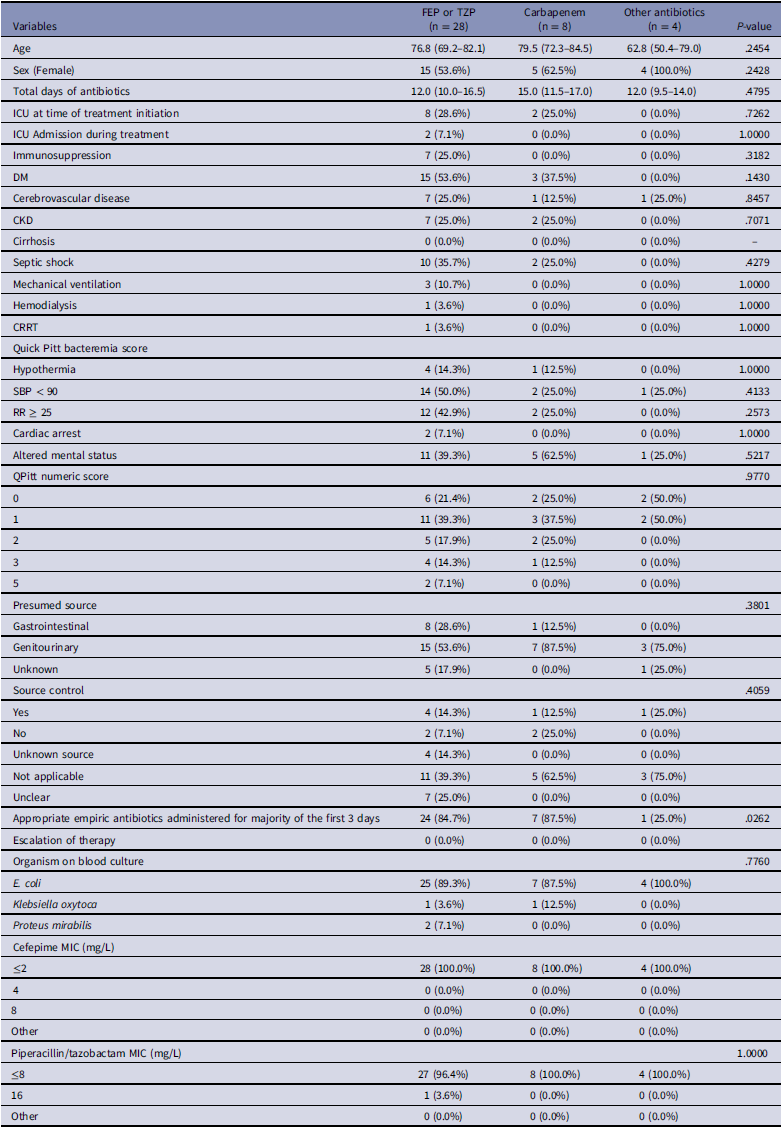
Baseline demographics were evenly distributed between the three treatment groups (Table 1). The median ages were 77, 80, and 63 years in the FEP or TZP, carbapenem, and other antibiotics groups respectively (P = .24). Most patients in the cohort were female. There was no statistical difference in baseline severity of illness as described by ICU admission at the time of treatment initiation, QPitt bacteremia score, or septic shock. A numerically larger percentage of patients had medical comorbidities in the FEP or TZP group.
Demographics and baseline characteristics

Table 1. Long description
The table compares demographics and baseline characteristics across three antibiotic treatment groups: FEP or TZP, Carbapenem, and Other antibiotics. It has 28 rows and 13 columns. The columns are labeled as Variables, FEP or TZP (n = 28), Carbapenem (n = 8), Other antibiotics (n = 4), and P-value. The rows include variables such as Age, Sex (Female), Total days of antibiotics, ICU at time of treatment initiation, ICU Admission during treatment, Immunosuppression, DM, Cerebrovascular disease, CKD, Cirrhosis, Septic shock, Mechanical ventilation, Hemodialysis, CRRT, Quick Pitt bacteremia score, Hypotension, SBP < 90, RR >= 25, Cardiac arrest, Altered mental status, QPitt numeric score, Presumed source, Source control, Unknown source, Appropriate empiric antibiotics administered for majority of the first 3 days, Escalation of therapy, Organism on blood culture, E. coli, Klebsiella oxytoca, Proteus mirabilis, Cefepime MIC (mg/L), Piperacillin/tazobactam MIC (mg/L). Each row provides specific data points for each group and a P-value indicating statistical significance. Notable trends include the higher percentage of females in the Carbapenem group and the higher median age in the Carbapenem group compared to the Other antibiotics group.
FEP, cefepime; TZP, piperacillin/tazobactam; DM, diabetes mellitus; CKD, chronic kidney disease; CRRT, continuous renal replacement therapy; MIC, minimum inhibitory concentration.
The source of bacteremia was primarily genitourinary (GU) in approximately 63% of patients. This did not significantly differ between treatment groups. Source control was not applicable to most patients. Most patients had E. coli as the organism recovered from blood culture (90%). All of the isolates had a FEP MIC of ≤2 mg/L. All but one of the isolates had a TZP MIC of ≤8 mg/L. There was one patient with a TZP MIC of 16 mg/L, which was reported as susceptible at that time. Appropriate empiric antibiotics were administered for the majority of the first three days of treatment in approximately 85% of patients in both the FEP or TZP group and the carbapenem group. In contrast, only 25% of the other antibiotic group received appropriate empiric antibiotics (P = .026). No patients had escalation of therapy.
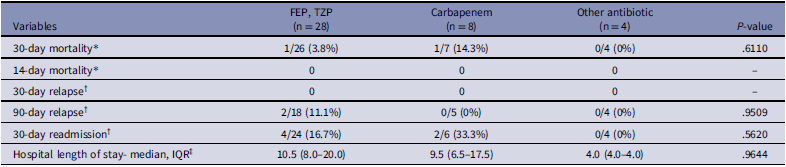
There was one death in both the FEP or TZP group (3.8%) and carbapenem group (14.3%), and no deaths in the other antibiotic group within 30 days (P = .61) (Table 2). Three patients were censored from this outcome as they were lost to follow up. No patients experienced 14-day mortality or 30-day relapse. There was no difference in 90-day relapse or 30-day readmission between treatment groups. The median hospital LOS was 10.5, 9.5, and 4 days in the FEP or TZP, carbapenem, and other antibiotic groups, respectively (P = .9644). There were 3 patients who were censored from this outcome as they expired during hospital stay.
Primary and secondary outcomes

Table 2. Long description
The table compares primary and secondary outcomes across different antibiotic treatments. It has six rows and five columns. The columns are labeled as Variables, FEP, TZP (n=28), Carbapenem (n=8), Other antibiotic (n=4), and P-value. The rows are labeled as 30-day mortality, 14-day mortality, 30-day relapse, 90-day relapse, 30-day readmission, and Hospital length of stay-median, IQR. The values in the table are as follows: Row 1: 30-day mortality, 1/26 (3.8%), 1/7 (14.3%), 0/4 (0%), .6110. Row 2: 14-day mortality, 0, 0, 0. Row 3: 30-day relapse, 0, 0, 0. Row 4: 90-day relapse, 2/18 (11.1%), 0/5 (0%), 0/4 (0%), .9509. Row 5: 30-day readmission, 4/24 (16.7%), 2/6 (33.3%), 0/4 (0%), .5620. Row 6: Hospital length of stay-median, IQR, 10.5 (8.0-20.0), 9.5 (6.5-17.5), 4.0 (4.0-4.0), .9644. The table also includes notes on patients lost to follow-up and the definitions of FEP and TZP.
* Patients who were lost to follow up were censored from this end point, as reflected by the denominator.
† Patients who were lost to follow up or died before this event were censored from this end point, as reflected by the denominator.
‡ Patients who died were censored from this end point.
FEP, cefepime; TZP, piperacillin/tazobactam.
In a secondary analysis, the four groups of antibiotics were analyzed individually (FEP, TZP, carbapenem, other antibiotics). Baseline demographics were similar to the primary analysis, with no statistically significant difference between the groups (Supplemental Table S1). As was seen in the primary analysis, there was a statistically significant difference in appropriate empiric antibiotics administered for the majority of the first three days (P = .0057). One patient died within 30 days in both the TZP group (5.3%) and carbapenem group (14.3%); no patients died in the FEP and other antibiotic groups (P = .8495). None of the other secondary outcomes were statistically significant (Supplemental Table S2).
Discussion
In this pilot, retrospective, chart review, there were no differences in treatment outcomes between the carbapenem and non-carbapenem treatment options for patients with non-ESBL, ceftriaxone-non-susceptible E. coli, K. oxytoca, K. pneumoniae, or P. mirabilis. The cohort was mostly comprised of elderly patients. Numerically, the patients in the FEP or TZP group had more comorbidities and appeared more acutely ill. Due to the small sample size, there was no statistically significant difference between the groups. Neither the primary nor secondary outcomes showed any difference between patients who received FEP or TZP, a carbapenem, or other antibiotics. Although the results of this study suggest that non-carbapenem options may be a viable treatment option in patients with non-ESBL, ceftriaxone-non-susceptible Enterobacterales, the small sample size is an important limitation. However, institutions should reconsider the use of ceftriaxone-non-susceptibility as the sole proxy for ESBLs until further data are available.
Understanding the mechanism of resistance has been highlighted as a way to optimize treatment and limit carbapenem use. Two large epidemiology studies conducted in the mid-Atlantic United States describe ceftriaxone-non-susceptibility rates in Enterobacterales. Reference Tamma, Sharara and Pana10,Reference Hareza, Bergman and Jacobs15 As described above, Tamma et al reported 78% ESBL and/or ampC genes in patients with ceftriaxone-non-susceptible (MIC ≥ 2 mcg/mL) Escherichia coli, Klebsiella pneumoniae, Klebsiella oxytoca, or Proteus mirabilis clinical isolates. Reference Tamma, Sharara and Pana10 Another study was conducted to analyze the epidemiology of ceftriaxone-resistant (MIC ≥ 4 mg/L) Enterobacterales isolated from the bloodstream. Reference Hareza, Bergman and Jacobs15 Of the 500 qualifying isolates, which included various Enterobacterales including E. coli, K. pneumoniae, and Enterobacter cloacae complex, 497 (99.4%) had either an ESBL gene, an ampC gene, or both. Within the cohort 6% of patients with E. coli, K. pneumoniae, K. oxytoca, or P. mirabilis were non-ESBL, ceftriaxone-resistant isolates. It should be noted that of the 287 E. coli isolates, 259 (90%) carried a bla CTX-M gene and although 243 (84.7%) had mutations within the promoter or attenuator regions of the chromosomal ampC (c- ampC) genes, only 15 (7%) exhibited cefoxitin resistance, which can be used as a proxy for excessive AmpC production. In our cohort, of 32 E. coli isolates with cefoxitin susceptibility, all (100%) had cefoxitin MICs of 16 or above. This would suggest a possible important role of AmpC production in our isolates but the resistance mechanism is unknown without genomic testing. It could be seen as further evidence of the need for more available testing to differentiate the mechanism of resistance.
Although these studies lend insight into epidemiology data, they do not provide information on outcomes. To our knowledge, our study is the first study to assess treatment outcomes specifically in non-ESBL, ceftriaxone-non-susceptible Enterobacterales isolates. Considering the ampC gene rates, we analyzed a subgroup of FEP separated from TZP when comparing the different treatment groups. In this subgroup analysis, there were no differences in outcomes data but the number of patients is not sufficient for a robust analysis. Our study highlights the distinctiveness of this resistance pattern. The results suggest that non-carbapenem treatment may potentially be an option in managing patients with non-ESBL, ceftriaxone-non-susceptible Enterobacterales bacteremia. This can provide an opportunity for carbapenem-sparing treatment options. Larger studies are needed to fully elucidate optimal treatment in these bacterial infections, ideally combining genomic testing with more strategically chosen antibiotic regimens.
This study has several notable limitations. The nature of a retrospective chart review can be limited by inaccuracies in documentation and data collection. Furthermore, this was a small pilot study that was not sufficiently powered to detect differences between groups. It is possible that the study did not identify a difference between treatment groups due to Type II error. Similarly, the study did not identify a statistical difference in baseline characteristics despite the groups appearing numerically different. Ultimately, the sample size limits the interpretation of the study. In addition, we did not anticipate having four patients who received inappropriate antibiotics as targeted therapy. The decision to exclude these patients stemmed from concern that this group would skew the data due to the lack of in vitro activity. This study did not include whole genome sequencing, therefore the mechanism of resistance was not fully elucidated. There is a possibility that AmpC induction may have played a role thereby limiting the utility of TZP. Despite these limitations, the data contributes to the gap of literature on the subject and highlights the need for more literature on the topic.
In this pilot retrospective chart review, patients with non-ESBL, ceftriaxone-non-susceptible, Enterobacterales bacteremia experienced no difference in treatment outcomes between FEP or TZP, carbapenem, or other antibiotic treatment options. Further studies are needed to better understand optimal treatment in patients with bacteremia caused by this unique resistance pattern.
Supplementary material
The supplementary material for this article can be found at https://doi.org/10.1017/ash.2026.10807.
Acknowledgments
None.
Financial support
This work was supported by a travel grant from the MAD-ID conference 2025. This work was supported by a Trainee Travel Award from IDWeek 2025.
Competing interests
The authors have no conflict of interest to disclose in relation to this article.


 Open access

