Introduction
Can music as an expressive form contribute to public and political debate? Moreover, can the expressive output of music be seen to provide arguments that engage publics? Public sphere theory as most pertinently moulded by Jürgen Habermas offers, in the words of Craig Calhoun (1992, p. 41), ‘one of the richest, best developed conceptualisations available of the social nature and foundations of public life’, and hence provides a convincing framework in which to understand the democratic potential of various communicative practices. John Street (Reference Street2012, p. 8) argues that it is when music makes the transition from the private to the public sphere that it becomes politically significant. He further calls attention to the value of the Habermasian concept of the public sphere as a means by which to understand the role of music in political participation. Similarly, Keith Negus (1995, p. 192) emphasises the public dimension of political music, arguing that music may gain political significance through ‘processes of mediation and articulation through which particular styles of music are produced, circulated, experienced and given quite specific cultural and political meanings’. Also, David Hesmondhalgh (Reference Hesmondhalgh2007) highlights the importance of the ‘aesthetic public sphere’ in assessing the democratic merits of music. These writers provide valuable insight into the ways in which music becomes politically significant through mass mediation and public exposition, not least in emphasising how talk about music may be vital in political participation and action. However, they do not examine how music by means of its expressive properties may itself function as a contribution to ongoing public debate. Neither do these writers examine the tension between the aesthetic expressivity of music and the centrality of verbal argument and communicative rationality inherent to Habermasian public sphere theory.
In analysing rapper Lars Vaular's ‘Kem Skjøt Siv Jensen’ – a song that recently generated considerable public political debate in Norway – the aim of this article is threefold. Firstly, to examine how the lyrical and musical elements of the song constitute the song as political expression. Secondly, to examine the song's potential democratic relevance in light of central concepts from Habermas' theory of the public sphere and subsequent revisions of this theory. Lastly, this article considers hip hop expressivity within the parameters of communicative rationality. It is thus a study that both employs public sphere theory in order to examine the political significance of hip hop music, and a study that addresses and discusses a fundamental theoretical problem of public sphere theory in relation to music.
Hip hop and public debate in Norway
Lars Vaular's (2010) hit ‘Kem Skjøt Siv Jensen’ (Who Shot Siv Jensen) makes up a particularly relevant case for the study of music's role in the public sphere because of its public outreach, the controversy it caused and the expressive features of the song. In general, hip hop music is today one of the most popular musical genres in Norway, measured in radio airtime (Gramo-statistikken 2011, 2012), record sales (VG Lista), and presence at music festivals. Vaular is presently one of the most commercially successful as well as critically acclaimed hip hop artists in Norway. ‘Kem Skjøt Siv Jensen’ was one of several hits on his 2010 album Helt om natten, helt om dagen (Hero at Night, Hero at Day).Footnote 1 Upon its release, the song was subjected to a highly politicised public response (see the Appendix for selected examples). The song, for instance, made headline news in the NRK's (the public broadcaster's) late night newscast (airing excerpts from a live performance of the song), was publicly commented upon and condemned by a range of politicians from the Progressive Party (FRP) and assessed by the Norwegian Police Security Service. Moreover, the release was widely covered in most national newspapers. The public debate generated by ‘Kem Skjøt Siv Jensen’ focused upon highly topical social and political issues, such as artistic freedom of speech, multiculturalism, right-wing populism and the relationship between the cultural field and the political left wing in Norway. Crucially, not only did the song become the focal point of discourse in the public arenas specific to the hip hop scene, but it was also widely discussed in the cultural press, as well as by actors affiliated with the political public sphere.
A key factor in the media commotion the song generated is the song's lyrical depiction of the fictional assassination of Siv Jensen – the female leader of the Progress Party (FRP), who became, after the 2013 elections, Minister of Finance. Representing a considerable political force in Norway, and being the second largest party in the present right-wing coalition government, the FRP sit on the far right in the landscape of Norwegian mainstream politics, championing a political agenda characterised by economic liberalism, moral conservatism and right-wing populism. Their political views include a restrictive stance on immigration and an integration policy of cultural conformity – which are issues that the song addresses.Footnote 2
Habermas and hip hop
Habermas' conceptualisation of the public sphere is a promising, albeit underexplored framework in which to understand the democratic role of music. By introducing the notion of ‘the literary public sphere’ in The Structural Transformation of the Public Sphere (Reference Habermas1971) Habermas gave aesthetics a central function, both as a means to articulate critique and as an organising force of critical publics. The key role Habermas ascribes to the public sphere in the makeup of deliberative democracy is that it functions as the actual or symbolic space where citizens collectively negotiate important matters, public opinion is formed and critique against the state can be articulated. Furthermore, the public sphere is vital to democratic legitimacy as it facilitates a mutual responsiveness between citizens and political-administrative decision makers.
Hence, discursive articulation and interaction operate at the core of Habermas' theory of deliberative democracy. Crucially, this has implications for musical communication. Firstly, because music is an expressive form that potentially involves an articulation of specific identity positions as well as lifestyles, and as will be brought to attention in this case study, explicit political critique and commentary. Secondly, as the public response to ‘Kem Skjøt Siv Jensen’ makes evident, music is an integral part of public life, where musical articulations may be discussed, interpreted and criticised. Thus music may enter discursive processes vital to deliberative democracy. Thirdly, musical communication often involves the articulation of private or subcultural experiences and perspectives, which are posited and engaged with in the public sphere. Thus, as this study highlights, music may function as a mediating vehicle between the private and the public sphere.
Although giving prominence to linguistic forms of communication and the importance of traditional political communication, Habermas (Reference Habermas2006) proposes a multilevel, bottom-up, top-down laundering model of the political system that entails an enhanced sensitivity to musical communication. Here Habermas presents a conceptualisation of the public sphere which also acknowledges that political communication may ‘take on different forms in different arenas’ (Habermas Reference Habermas2006, p. 415), and ‘need not fit the pattern of fully fledged deliberation’. He further contends that the public sphere is rooted in networks of ‘wild flows of messages’, which include media with polemical or entertaining content, and by implication also music. In this model the public sphere is located at the periphery of the political system, as opposed to the institutionalised discourses at the centre, where the public sphere may ‘facilitate deliberative legitimation processes by “laundering” flows of political communication through a division of labour with other parts of the system’ (Habermas Reference Habermas2006, p. 415).
As such, this model offers an anatomy of democracy where musical communication also has its place. Locating music in the ‘wild’ part of the public sphere, Gripsrud (Reference Gripsrud, Bondebjerg and Madsen2009) argues that music must be considered an important means of expressing ideas or experiences, which are filtered into and ‘laundered’ in the ‘serious’ part of the public sphere before actual political decisions are made. Moreover, as argued in more depth elsewhere (Nærland Reference Nærland2014), this model highlights how politically committed hip hop and the public response it sometimes generates may involve a democratically vital bottom-up, top-down responsiveness between citizens and elites.
Thus, whereas the public sphere provides a spatial framework in which music can be meaningfully located, the nature of music as communicative content is more problematic. Given the fundamental role Habermas ascribes to the notion of communicative rationality, his theory of deliberative democracy can be seen to privilege speech and verbal modes of communication at the expense of aesthetic forms of communication, not least music.
Perhaps the most important reason why music has been considered an inadequate form of democratic communication is that musical language is widely understood to be essentially non-referential. Consequently, musical utterances have not been regarded as precise enough for them to be contested through rational public discourse. Therefore, any thorough discussion of music as political discourse, within the framework of Habermasian public sphere theory, requires a consideration of musical communication in relation to communicative rationality.
Central to Habermas' overarching theory of communicative action is the idea that human communication is a medium of a rationally binding character that hence has the capacity to coordinate human action. Here rationality is not grounded in a positivist conception of reality or in the Cartesian subject, but is a product of the communicative interactions between people. Incorporating the insights from the philosophy of language of Austin (Reference Austin1962) and Searle (Reference Searle and Günderson1975) into his own theory of communicative rationality, the fundamental premise is that our communication through language can be regarded as speech acts – or equivalent non-verbal communicative acts – that constantly presuppose judgement in terms of implicit standards of rational validation. The concept of speech acts is central here as it assumes a function of language that transcends its purely referential dimensions and emphasises the performative character of language, i.e. how we engage with each other, symbolically act and make propositions through the medium of language.
In continuation of Kantian enlightenment ideals and in response to the early Frankfurt School's pessimistic account of modernity, Habermas (Reference Habermas1981, pp. 75–102) establishes a concept of rationality differentiated into three different types, which corresponds to a set of different criteria of validation. These are: (1) cognitive-instrumental reason, which involves claims that can be validated in terms of their truth value; (2) moral-practical reason, which involves claims that can be validated in terms of their moral rightness; and (3) aesthetic-expressive reason, which can be validated in terms of the utterer's truthfulness in making a claim and the authenticity of his/her convictions. A fourth validation criterion, that encompasses all three types of claims, is comprehensibility, i.e. the degree to which a claim makes sense to the participants in discourse. Crucially, communicative rationality normatively underpins our public use of reason – which forms the normative bedrock of Habermas' theory of discursive democracy.
This article examines the extent to which the expressive output of Kem Skjøt Siv Jensen is at all susceptible to assessment within the parameters of communicative rationality. Consequently, and based on the analysis of the song, a key set of musically and lyrically constituted communicative acts are identified and discussed in light of the differentiated criteria of rational validation postulated by Habermas. Such an examination allows, firstly, for a clarification of the extent to which hip hop expressivity and communicative rationality speak to each other, i.e. if these communicative acts invite judgement in terms of implicit standards of rational validation and thus may contribute to the public exercise of communicative rationality. Further, it allows for a critical assessment of ‘Kem Skjøt Siv Jensen’ as an example of musically constituted public political discourse in light of the normative framework offered by Habermas.
Critical perspectives and supplementary modes of communication
Habermas' focus on verbal communication has led a number of scholars – in both political theory and communication studies – to call for a public sphere theory with a better explanatory and normative grasp on other communicative sites, modes and topics than those associated with political discourse proper. Crucially, these subsequent theoretical revisions and critical perspectives also render public sphere theory more adept at explaining the democratic role of hip hop by introducing communicative modes supplementary to verbal communication.
Addressing the exclusionary aspects of strict verbal deliberation, Sheila Benhabib (Reference Benhabib and Benhabib1996, p. 6) argues that Habermas ‘cuts political processes too cleanly away from cultural forms of communication’, and hence may exclude cultural and demographic groups which do not have the competence required to participate. Thus, Benhabib brings attention to the ways in which hip hop expressivity may involve a more inclusive discursive practice. Accentuating the significance of emotions in public political discourse, Jim McGuigan (Reference McGuigan2005) argues that public and personal politics may also be articulated through ‘affective’ and ‘aesthetic’ modes of communication, which are both modes inherent to hip hop music. Pointing out the need to supplement verbal argument, political theorist Iris Marion Young (Reference Young and Benhabib1996) suggests three communicative modes of which all may be salient in hip hop music. The first mode Young calls greeting, by which she means a ‘moment of communication’ that has no specific content, but which is important in initiating discourse. This mode closely resembles Roman Jacobsen's (1960) phatic, and essentially social, communicative function, which captures the workings of communicative acts that open up discussion, by so to speak saying ‘Hello, we are here, and, we can talk – if you like’. The second mode is rhetoric, which names the styles and forms of communication that capture and sustain the audience's attention, and that are effective in addressing issues and making arguments.
Young's third mode is storytelling or narrative, which supplements argument by its capacity to exhibit subjective experience, and foster understanding of the values, culture and priorities of the other. A similar argument is also forcefully brought forward by political theorist Robert Goodin (Reference Goodin2003) who argues that (mass-mediated) narratives are necessary engines for the ‘empathetic imagining’ among citizens. He further argues that:
For democracy to be truly deliberative, there must be uptake and engagement – other people must hear or read, internalize and respond – for that public sphere activity to count as remotely deliberative. (Goodin Reference Goodin2003, p. 178)
An interesting question is thus how hip hop music may facilitate such ‘emphatic imaginings’. Consequently, I examine the extent to which these different modes can be seen at play in the lyrical-musical text of ‘Kem Skjøt Siv Jensen’, and how these modes may enable the song to function as political discourse.
Hip hop music as political discourse
The public sphere perspective is latently present, yet not explicated, in early writings on hip hop, such as Tricia Rose's (Reference Rose1994, p. 124) statement: ‘Rap's cultural politics lies in its lyrical expression, its articulation of communal knowledge, and in the context for its public reception’. Similarly, later writers like Kitwana (Reference Kitwana2002), Pough (Reference Pough2004) and Perry (Reference Perry2004) contend that it is through hip hop that the African American experience comes to the public's attention and is critically illuminated. Although not confined to hip hop culture, the concept of a ‘Black Public Sphere’ (The Black Public Sphere Collective 1995; Neal Reference Neal1999; Hanson Reference Hanson2008) much inspired by Fraser's (1992) concept of subaltern public spheres, involves the reformulation and expansion of Habermas' original concept in order to accommodate the vernacular practices, forms of expressions and institutions specific to the African American community. Although these studies are valuable in highlighting the political significance of hip hop music's public outreach in the context of American society, they do not problematise the concept of the public sphere and its inherent tensions in relation to musical expressivity. Neither are these studies directly applicable to the comparatively more affluent and socially homogenous conditions of Norwegian society.
Hip hop music has several qualities that, perhaps more than any other popular musical genre, renders it a musical practice apt for articulations of politics. Rose (Reference Rose1994, p. 2) offers the following short definition of hip hop music: ‘Rap music is a form of rhymed storytelling accompanied by highly rhythmic, electronically based music.’,Footnote 3 thus emphasising the importance of the verbal and semantic aspects of hip hop. The importance of the verbal articulation in hip hop is also highlighted by Danielsen (Reference Danielsen, Krogh and Stougaard Pedersen2009, p. 204), who contends that hip hop is ‘message-orientated, in the sense that lyrical content and shape are central’. Moreover, linguists such as Smitherman (Reference Smitherman1997) and Alim (Reference Alim2003, Reference Alim, Murray and Neal2004) root the practice of rapping in the African American tradition of everyday speech, and further emphasise how repetition, the poetic use of metaphor, simile and hyperbole define hip hop as a lyrical-musical practice. A similar argument is made by Van Leeuven (Reference Van Leeuwen1999, p. 2), who points out that hip hop is one of those musical genres where the interplay between music and speech is most vividly evident. From a democratic theory perspective, rap's rootedness in everyday speech is significant because this, according to Habermas (Reference Habermas1981, p. 86), is where our capacity for communicative rationality naturally resides.
The musical characteristics of hip hop – such as sampled drum patterns, layered with additional sounds from drum machines and synthesisers – accommodate political articulations as these combined form the often rhythmically complex and bass heavy, but stable, platform for the rapping (Walser Reference Walser1995, p. 200). Moreover, in the perspective of political discourse, the structure and composition of the groove and the melodic phrases are key in that they provide poetical organisation for the verbal delivery. Crucially, according to Walser (Reference Walser1995), these musical features also serve the function of rhetorically aiding the effective delivery of the lyrics as well as investing these with affective force. This is not to say that the beats, melodic hooks, samples and compositional structure of ‘Kem Skjøt Siv Jensen’ do not convey any (political) meaning in their own right; they do, but the analytical position adopted in this particular reading is that these elements are meaningful as part of an expressive whole in which the rhymed delivery of words occupies a privileged position.
A central aspect of hip hop music, that encompasses both the musical and verbal element, is flow, which Alim (Reference Alim2003, p. 550) defines as ‘the relationship between beats and rhymes in time’, or which more generally could be described as the way that the rapper rhythmically engages with the beat. The flow is a defining characteristic of hip hop as political discourse. According to Krims (Reference Krims2000) it is vital in ensuring both the persuasive and the aesthetically enticing delivery of the lyrics. The interplay between rhythm, rhyme and performance must be seen as a significant aspect of what makes hip hop a potent form of political public discourse. When good, hip hop beats reinforce the rhymes as well as enhancing the role of the rapper. Hence, the lyrical message of the song is ‘amplified’ and the rapper is established as (public) speaker.
Method
The ambition of the following analysis is to provide apt descriptions of the song under scrutiny, and by combining analytical resources from rhetoric and musicology, to elucidate the meaning potentials which lie in this song – which ultimately may or may not be realised in their performative and receptive contexts. However, the politicised reception that this song received in the Norwegian media and hip hop's generic attentiveness to political and social matters inform the hermeneutical position of this analysis. Consequently, it is mainly concerned with the ways in which this song functions as political expression. Furthermore, in assessing how hip hop music may entail qualities relevant to public political discourse, the analysis is concerned with the ways in which affective, rhetorical, phatic and dramatic modes of communication emphasised in democratic theory can be seen at play in ‘Kem Skjøt Siv Jensen’ (hereon abbreviated as KSSJ), and how these enable the song to function as political discourse.
First, this analysis provides a descriptive outline of the lyrics, highlighting lyrical themes, style, tone and narrative, as well as lyrical context. Based on the descriptive outline, the analysis next highlights key rhetorical, affective and narrative characteristics of the lyrics. The analysis does not follow any elaborate analytical framework of lyrical poetics. The scope of the analysis is rather to examine the ways in which political meaning is established and how the song addresses its listeners. In doing so the analysis makes use of key concepts from rhetorical theory that illuminate both affective and persuasive dimensions of the lyrics and how the lyrics are rhetorically situated in the public and sociopolitical context of present-day Norway.
There follows an analysis of the groove in terms of its rhythmic, melodic, compositional and timbral qualities. It highlights how the assemblage of these elements constitutes the platform for the rapping, ensures the poetical organisation of the lyrics and establishes the mood of the song. Moreover, the analysis examines the dramatic, affective and rhetorical functions of these musical elements, and how these accommodate the particular political expressiveness of KSSJ.
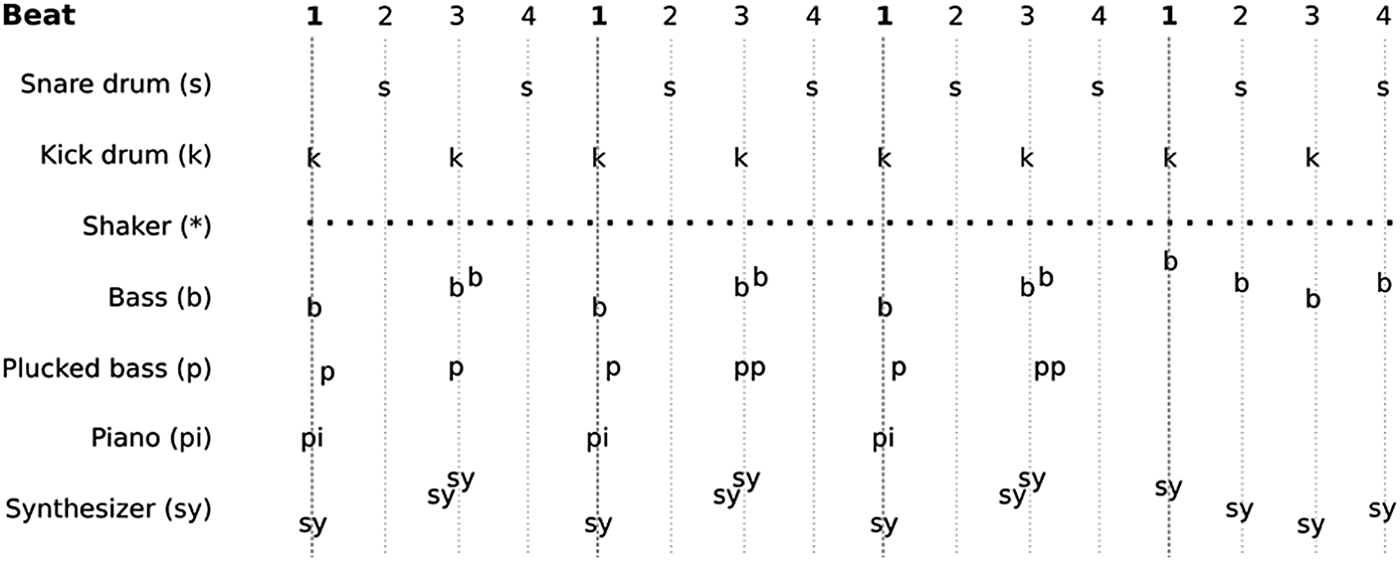
A notational scheme of the basic grove sequence (Figure 1) is here employed to elucidate the groove's key features, and as a means of presenting evidence for the interpretation of its dramatic, rhetorical and affective meanings. The notational scheme, adopted from Machin (Reference Machin2010 , pp. 127–32), is not suitable for minute or exhaustive explorations of musical groove. However, a strength of this scheme is that it allows for a presentation of the groove's constitutive parts that may also be intelligible to non-musicians and non-musicologists. Furthermore, the analysis of the musical text is aided by the provisional inventories of musical and aural meaning potentials provided by Van Leeuven (Reference Van Leeuwen1999) and Machin (Reference Machin2010), as well as the ‘phrase book’ of emotional signifiers provided by Cooke (Reference Cooke1959). Lastly, departing from Krims' (Reference Krims2000) conceptualisation of flow, the analysis considers the rhetorical and aesthetical functions of the flow particular to KSSJ, and how these may enable the song to function as a form of political discourse. The separation of analysis into lyrics and music is necessarily contrived. However, a continual attention to how these two modes constitute each other is maintained.
The basic groove sequence.
Notes: *Melodic pitch movement of bass and synthesiser is indicated by the ascending or descending positions of the notes in relation to each other.

In order to support the reading with contextual data, a semi-structured, personal interview with Lars Vaular was conducted (Oslo, 3 September 2012). The interview focused on his own creative intentions behind the song, his understanding of the political significance of his own musical work and his account of the public reception of the song. Moreover, a set of key musically and lyrically constituted, and politically themed, communicative acts are identified. These form the basis for the subsequent consideration of hip hop expressivity in light of Habermas' concept of communicative rationality.
Analysis
KSSJ is a fictional and comical story about the identification of suspects and the ‘solving’ of the shooting of Siv Jensen,Footnote 4 stretched over a vague linear time frame, and could therefore be characterised as a combination of comedic narrative (Perry Reference Perry2004, p. 78) and political satire. The song neither musically nor lyrically adheres to the more confrontational and aggressive tradition of political hip hop associated with ‘hardcore rap’ (Potter Reference Potter1995) – a tradition Vaular himself refuses to be associated with (personal interview). It is nevertheless a piece of explicitly political hip hop, as the thematic focus of the lyrics is wholly on public and political matters, including the lyrical hostility to Siv Jensen and the FRP, and also public bodies.
Whereas the personal experiences of the rapper in hip hop often form the most prominent source of lyrical material (Rose Reference Rose1994) and also in Norway (ADD), there are in KSSJ no direct references to actions, conditions or places of the rapper's own life. Although the rapper himself is present as the subject Eg (in English: I), the lyrics are not explicitly centred around classic hip hop themes such as the rapper's own identity and location, but unfold entirely within the context of Norwegian society and its mediascape. The public context of the lyrics is established through anonymous but typified figures such as asylsøkeren (the asylum seeker), han som falt utenfor (the one who fell through), politiet (the police) and statsadvokaten (the public prosecutor), or well-known figures from Norwegian public and political life such as Eli Hagen (a politician's wife with a high media profile), and Jens Stoltenberg (the former Labour prime minister).
Mapping the lyrics
The song begins with the chorus, consisting of four metres repeated once:
Chorus:
Kem skjøt Siv Jensen? Vet du ka han heter? Who shot Siv Jensen? Do you know his name?
Fra syv og en halv meter From seven and a half meters
No e snuten ute å leter Now the cops are out searchin'
De spør, de spør, men vet du ka han heter? They ask, they ask, but do you know his name?
The placement of the chorus at the very beginning of the lyrical composition establishes a dramatic focal point (the assassination of Siv Jensen), as well as posing the central rhetorical question (who did it?) of the song. In the subsequent verse a number of socially disadvantaged groups, often framed by the media as the ‘usual suspects’, are quizzically suggested. These include asylum seekers from Afghanistan, a manic depressive, a drugged or angst-ridden social outcast, an immigrant from Damascus or Chechnya and a well-known Norwegian black metal rocker who was convicted of murder. After the chorus, the second verse abandons the suggestive mode of the first verse in favour of a more proclamatory tone. The first couplet explicitly derides the competency and decency of the police by proclaiming:
Snuten burde holde seg til å lage veisperringer The cops should stick to setting up roadblocks
De mistenkte bare gamle kjenninger og utlendinger They suspected only the usual suspects and foreigners
The following couplets jokingly propose how specific Norwegian politicians and public figures would have done it, also including the suggestion that it could have been a sexually closeted female lover of Siv Jensen.Footnote 5 The last but narratively significant couplet, where it is revealed that she was not in fact killed, proclaims:
Men eg bryr'kkje meg om kem det va But I don't care about who it was
For hun va så tjukk I hodet sitt at kulen bare prellet av 'Cause her head was so thick that the bullet just bounced off
Then follows an interlude, in a conversational mode of delivery, joking about how Siv Jensen is both steinhard (rock hard) and iskald (ice cold) – qualities here also ascribed to her politics – to such a degree that shooting her was like ‘throwing a marble at her forehead’. The chorus is then repeated before the song's outro, where the rapper in conversational mode concludes that the only thing that could kill Siv Jensen is garlic, hence jokingly comparing her to a vampire.
The phatic function of shooting Siv Jensen
In loudly, yet ironically, suggesting that Siv Jensen was assassinated, the song makes rhetorical use of shock and sensationalism. Here a rhetoric of hyperbole typical of hip hop can be seen at play, where hyperbole and moral transgression are used as a means of commanding attention and publicity. As the public reception of the song makes evident, the apparent shock quality of the lyrics served an important phatic function (Jacobson Reference Jacobson and Sebeok1960) in that it provoked and invited response. In so doing, and consistent with Young's (Reference Young and Benhabib1996) notion of greeting, the song initiated public discourse. Not only did the song provoke response in terms of its lyrical acceptability, it also became the focal point of public debates about general political and cultural issues, involving a range of different actors – including Vaular himself.
In addition, and rather cleverly, the hyperbolic rhetoric was here intentionally used as a means of provoking the same kind of public kneejerk responses that the song indeed satirises. Vaular contends that:
Although the song has many messages … it is most of all a critique of the media and of populist politics, and how politicians exploit sensationalist headlines that are blind to the complexity of things. In a way the song was a social experiment where I played at the same populist strings – in order to gain my own creative project. … By using such a song title I wanted to show how people only read headlines and make choices on the basis of headlines. (Personal interview)
Hence, managing media reception by means of hyperbolic rhetoric was in fact part of Vaular's creative project, where lyrical sensationalism was also used to establish himself as a public discursive actor.
Public situatedness and emphatic imaginings
A prominent quality of the song that enables it to function as political discourse is sociopolitical relevance and actuality, or its situatedness in public discourse. The song functioned as a response to what by many perceived to be an enduringly problematic aspect of public life in Norway, namely how the interplay between sensationalist media, populist politics and the audience operate by ethnical and social stereotypes. The regular manifestations of this interplay in the Norwegian media were prompted what can be seen as a rhetorical situation (Bitzer Reference Bitzer1968) in which Vaular seized the opportunity to respond by means of the lyrical-musical language of hip hop. The extensive and immediate public response that the song provoked also makes evident a familiar and rhetorically significant dimension of the song, namely its timeliness, or in rhetorical terms the way in which the song seized kairos. Hence KSSJ was situated in public discourse in that it thematically responded to critical conditions in Norwegian society, and by musical-expressive means provoked further public discourse.
The song's potential relevance to public discourse is further enhanced by the lyrics' mode of address and persuasive strategies. A key theme in KSSJ is how the public's reaction to sensational events – in the song staged as the fictional assassination of a profiled politician – are governed by negative social and ethnic stereotypes. The problem responded to here is one of collective mentality, rather than a concrete social or political event; nonetheless, it is a collective mentality which has very concrete social and political ramifications. It is manifest in the lyrics that the authorities (police and public prosecutor) operate with negative stereotypes, but in addressing the listeners directly (Vet du ka han heter? Do you know his name?), the lyrics also suggest that our reactions as a public might be governed by similar kinds of negative stereotypes. Vaular himself indeed contends that the song was meant to address people in general (personal interview). Thus, by holding this collective mentality up to critical attention, the lyrics also attempt to persuade us that these are wrong.
Furthermore, these socially disadvantaged groups, that by collective kneejerk reaction are routinely suspected in criminal events, are in the lyrics described in ways that call for an understanding of their situation as well as evoking sympathy on their behalf. The Afghan asylum-seeker is for instance described as ‘truly scared of the Taliban’ (livredd for Taliban), and the social outcast as one who fell ‘outside the safety net, anxiety, drugs and cold sweat’ (utenfor fallnettet, angst, dop, kaldsvette). Although Vaular here speaks on behalf of others, the exhibiting of the experiences of these groups may foster what Goodin calls emphatic imaginings. Such imaginings are potentially vital in facilitating public discourse, in this case not least about issues involving immigration, social problems and crime. The sympathy and understanding that the song potentially evokes may motivate socio-economically asymmetric and ethnically diverse groups to speak to each other in the first place. Furthermore, these emphatic imaginings may foster a discursive climate more informed by mutual understanding, thus strengthening the quality of deliberation. As Vaular is here not mobilising the classical hip hop ethos of the ‘radically honest’ exposition of his own personal experiences (Perry Reference Perry2004, p. 6), his perceived authority to speak of these matters is more a question of Vaular's authenticity as a hip hop artist and where the audience locate him within the field of tension between hip hop as a sociopolitically aware and oppositional subculture and hip hop as a commercialised style.
Mapping the beat
The analysis of the groove shows how the rhythmic, melodic and timbral qualities, and the overall composition of the song, not only function as the poetic organisation through which political expression can take place, but also in various ways invest political expression with energy, emotion, drama and rhythmic punch. It also shows how these qualities rhetorically accentuate central lyrical points. As is typical of most hip hop grooves it follows a four/four rhythm, where the chorus stretches over eight bars, each verse over 16, and the interlude and outro over two bars each. Initially a mechanical sounding sample of the loading of a gun is heard, thus denotatively and by means of what Danielsen (Reference Danielsen2008) terms ‘musical reality effects’, immediately places the song within the context of an assassination, as well as aurally providing a sense of mechanical hardness. The sampled gun loading is also significant in alluding to the street-hard and gloomy universe of gangsta rap, which is here mobilised with a sense of irony that underpins the song's satirical dimension.
The basic groove sequence (Figure 1) then sets off (without rapping), consisting of four bars which are repeated with only minor variances throughout the song, thus constituting the rhythmic backbone of the song as a whole (including the verses, chorus and interlude). The highly accented snare drum on each downbeat, which runs consistently throughout the song, and the shaker on each eighth note, combine to anchor the groove in a steadily unfolding four beat. The kick drum and the bass syncopate the groove by simultaneously playing on the first note of each bar and slightly before the third note, thus creating a sense of energising tension. Moreover, the bass line, layered on in a p-funk style, anchors the groove in a four beat by marking the rhythm in the first note of each bar. The plucked bass notes are added either two or three times per bar on the offbeat, which further adds to the syncopated tension as well as giving the groove a sense of organic looseness. The result is a chopped-up, slightly bouncy, but steadily moving funky groove that invests the song with a certain ‘cool’ assertiveness. This contributes to the feeling of laidback insistency, rather than anger, which characterises the mode of lyrical delivery. The offbeat bass-plucking itself connotatively signifies ‘funk’ as it is popularly associated with the style of p-funk. Such rhythmic cool is indeed central to what marks out hip hop among other forms of political discourse. It involves an aesthetic articulation of politics that potentially evokes pleasure, and involves modes of discursive, emotional and, not least, physical engagement that transcends the confines of traditional political engagement. Hence, the song addresses audiences who may otherwise be excluded from traditional forms of political discourse.
The melodic qualities of the groove are essential to the overall mood of the song. A heavy low-pitched minor piano chord is played with sharp attack at the first note of each bar, at the same time as the bass and the kick bass (which are hardly discernible from each other), thus creating an effect of booming graveness. The combined heavy accent on the first beat, in funk terms on ‘the one’ (Smith Reference Smith2012), also gives the groove an assertive and forward-moving quality. The bass line is ascending in pitch, which, according to Cooke (Reference Cooke1959), may express a sense of energy and extrovertly directed emotion. However, as the groove is rooted in a minor key, the pitch ascendance helps constitute the context of alarm and tabloid outcry in which the lyrical message is situated. This effect is enhanced by the synthetically sharp-sounding keyboard line, melodically phrased like the bass line, but in a higher octave. In the fourth and last bar the melodic line of the bass and synthesiser is altered into a four note figure where the first three notes are descending but the last note ascends in pitch, thus bringing closure to the groove sequence yet suggesting there is more to come.
Drama, affect and musical satire
The melodic, timbral and compositional elements are key in providing the song with affective force and a sense of drama. In the chorus the sense of sensationalism and tabloid alarm achieves full expression by means of musical devices. First, the double-voiced rapping in a slightly elevated pitch accentuates the tabloid quality of the chorus. This sense of sensationalism is further underscored by the insertion of a highly accentuated sampled gunshot at the same time as the first note of the second bar, and immediately before the lyrical line Fra sju og en halv meter (From seven and a half metres). The high-pitched and rapidly fluctuating synthesiser sound resembling sirens – layered into the background of the soundscape – further underscores this effect. Moreover, the sense of alarm is enhanced by applying extra accent on the synthesiser carrying the melodic line.
In the chorus the lyrics and musical effects come together as a political anthem. Crucially, given what Stefani (cited in Middleton Reference Middleton1990, p. 232) terms axiological connotations, referring to the ‘moral or political evaluations of musical pieces, styles or genres’, Norwegian hip hop music is popularly understood to have political left leanings. The explicit critique of Siv Jensen's policy and persona in the lyrical verses, where she and the police are established as the antagonists, anchors the meaning of the song in an anti-FRP political universe. Therefore, at this level the song functions as a political anthem where a general anti-FRP sentiment is energised and given affective force by means of rhythmical, melodic and timbral effects.
There is, however, a much more subtle yet highly significant dimension to the booming sense of alarm created by the various musical and lyrical elements of the chorus: these also function as rhetorical devices necessary to constitute the satirical dimension of the song as a whole. These elements combined convey hysteria as well as alarm. In rhetorical terms, one could say that the song addresses its audience with such overstated musical pathos that the ironic dimension of the lyrics becomes apparent. Moreover, the musically constituted hysteria firmly locates the song in the realm of satire. However, an ironic interpretation of the song is partly dependent on a minimum level of musical and generic code competency (Middleton Reference Middleton1990, pp. 172–6). Some of the public critique that the song provoked indeed appeared to be informed by a lack of such competency. One example was prominent representatives from the FRP who, in op-ed articles (see Appendix), accused Vaular of ‘encouraging political violence’.
The political rhetoric of flow
The flow in KSSJ is essential to how the song function as political discourse. Not only does the flow invest political discourse with aesthetic pleasure in terms of rhythmic dynamism and playfulness: the way Vaular rhythmically engages with the beat is also rhetorically important in accentuating and energising key lyrical points as well as sustaining the listeners attention. The style of Vaular's Flow can best be described in terms of what Krims (Reference Krims2000, p. 49) coins the ‘sung rhythmic style’. Vaular keeps within the rhythmic framework of the beat – he does not spill over the metre and the couplets are rapped with regularity. Vaular is on the beat throughout the song. Hence the song attains a distinct ‘old school-feeling’. This ‘sung style’ is accentuated by how it contrasts with the more conversational interlude and outro. There are, however, passages, towards the end of each verse, where the flow is better characterised in terms of what Krims (Reference Krims2000, p. 51) terms ‘percussive effusive style’. In these passages Vaular uses his voice more percussively, in that he rhythmically accelerates and concentrates an increased number of syllables within the same metre. This creates a sense of rhythmic saturation that breaks with the rhythmic framework.
These shifts in style and the rhythmic acceleration create what Walser (Reference Walser1995, p. 205) terms ‘larger scale rhetorical flow’. The accelerating shift from sung rhythmic to percussive effusive style in each verse is significant for the unfolding of the narrative: it creates an increasing sense of energy that supports the more aggressively proclaiming tone with which Vaular ends each verse. Also the conversational and rhythmically less intense interlude and outro have the rhetorical function of providing rhythmic rest – thus accentuating the more expressively significant chorus and verses.
The variations in voice pitch, number and accentuation of specific words and syllables within each single couplet also have rhetorical functions in that they produces what Walser (Reference Walser1995, p. 204) terms ‘a dialectic of shifting tensions’. As well as investing the song with energy, this dialectic of shifting tensions supports the textual argument by highlighting certain lyrical points and sustaining the listener's attention. In the chorus, for instance, emphasis is placed on KEM skjøt Siv JENSen (WHO shot Siv JENsen), thus accentuating the questioning modus of the chorus. This is further enhanced by the use of an ascending pitch in the last word of the line, which also produces rhythmic suspense. Similarly, the repetition of the phrase de spør, de spør (they ask, they ask) in the next line creates rhythmically attractive suspense as well as underlining the inquisitorial mode of address.
One of many examples of the rhetorical use of variance in vocal accent and punch is also evident in the following couplet:
Kanskje en som falt UTENFOR, UTENFOR ruten vår Perhaps one who fell OUTSIDE, OUTSIDE our scheme
UTENFOR fallnettet, angst, dop, kaldsvette OUTSIDE the safety net, anxiety, drugs and cold sweat
Here, repetition and the repeated accent on the same single word is used rhetorically to emphasise the point that the usual suspects are socially marginalised, as well as creating novel dynamism in the flow.
Hip hop expressivity and communicative rationality
We have now seen how the lyrical and musical elements of KSSJ together constitute the song as political expression, and furthermore how the song make use of rhetoric, affective, dramatic and phatic modes of communication that in light of recent revisions of public sphere theory may render the song a vital supplement to traditional verbal political discourse. However, an important remaining question is the extent to which the song addresses its audience with messages that invite or may prompt communicative action, i.e. comprises communicative acts that lay themselves open to rational validation in terms of the differentiated standards of rational validation that underpin the concept of communicative rationality.
Although Habermas locates aesthetic/expressive validity claims in the subjective sphere of the speaker, which renders such claims subject to validation in terms of truthfulness (i.e. the degree to which the speaker is sincere), it can be argued that this confinement of aesthetics to the subjective sphere is dependent on the type of aesthetic expression in question. Hip hop, unlike ‘autonomous’, self-referential or abstract forms of artistic expression, is also committed to saying something about the world by means of language. Thus hip hop music also lays itself open to validation in terms of the two other criteria of rational validation inherent to communicative rationality: truth and moral value. If we regard KSSJ as comprising a set of key musically enabled communicative acts (it is clearly intended as such), this allows us to assess the expressive output of the song within the parameters of communicative rationality.
Firstly, the sensational suggestion that Siv Jensen is assassinated entails a communicative act that subjects itself to moral contestation, in terms of the moral acceptability of just voicing such a suggestion. The public reception of the song makes evident that this was indeed an aspect of the song that stirred response. However ironically or jokingly the shooting of a particular politician is presented, the artistic portrayal of political assassinations remains a sensitive subject in Norway, particularly after the Utøya massacre. By means of hyperbolic rhetoric and moral transgression, Vaular and many other rappers deliberately challenge the conventions of public conduct and artistic freedom of speech, not least in regard to the depiction of political violence.
Secondly, the song's ridicule of populist logics and social stereotypes entails a proposition that can be summarised as follows: ‘Our responses to sensational media events are governed by a certain set of negative preconceptions.’ First, the question of whether our responses are governed or not by certain preconceptions is both contestable and justifiable in terms of its truth value. Secondly, the normative aspect of this question – are these preconceptions negative? – is also contestable and justifiable. Thirdly, the ways in which Vaular utters this proposition can also be contested in terms of his truthfulness and authenticity as a performer. Thus, this is a communicative act that lays itself open to assessment in light of all three standards of validation.
Fourthly, the communicative act at the level of political anthem can be assessed in light of similar criteria. If we accept that the song, in the context of its reception, is heard, engaged with and also enacted as a non-explicated musical statement of anti-FRP sentiment (in verbal terms something similar to ‘Fuck the FRP!’), it constitutes what Searle (Reference Searle and Günderson1975) calls an expressive speech act in that it conveys a generally hostile attitude and aggressive emotion towards Siv Jensen and the FRP. It is, however, not a communicative act susceptible to all three of Habermas' validity standards; there is no truth value to assess, but it lays itself open to scrutiny both in terms of the normative aspect of this utterance and the truthfulness of its performance. Crucially, reasons for opposing the FRP are given by means of lyrical explication in several of the song's couplets.
However, if we proceed to consider these communicative acts in light of the fourth validation standard, namely comprehensibility, which is tightly connected with the level to which their meanings are manifest (Eriksen and Weigaard Reference Eriksen and Weigaard1999, p. 59), the limits of hip hop expressiveness within the parameters of communicative rationality become apparent. These communicative acts are not clearly explicated in adherence to established conventions of language, as for example in the format of a political speech or a newspaper column. Neither does the song present one clear argument, but makes several statements about the world which are both embedded in and a product of the expressive relationship between words, composition, rhyme patterns, vocal intonation, beats, melody and timbre. Consequently, a certain degree of (sub)cultural or musical code competency – or, more generally speaking, pragmatic competency – is required to identify and interpret these utterances in their performative context.
Nevertheless, given the public reception of KSSJ, it is evident that these meanings are in fact actualised within the receptive context of the Norwegian public sphere. However veiled and obscured musical communication is thought to be, KSSJ evidently speaks to some in a manner open to intersubjective (in)validation. And, although hip hop music primarily addresses the social, aesthetic and physical sensibilities of the audience, not least by evoking fun and pleasure, it is not the same as saying that the expressive output of (hip hop) music is inherently ‘irrational’ or that it denies scrutiny by any significant standards of rational validation. As this analysis bring to attention, hip hop expressivity and communicative rationality are not as alien to each other as one would first assume. Moreover, given that audiences have the necessary pragmatic competency, hip hop music may also be seen to conform to the ideals of communicative rationality as it may involve musically and lyrically enabled communicative acts that invite contestation and validation. Significantly, this case thus highlights how music under particular circumstances may contribute to the public exercise of communicative rationality that lies at the heart of Habermas' framework of deliberative democracy.
Conclusion
As recent revisions of public sphere theory have shown, there is a need to include communicative modes that do not narrowly limit political discourse to verbal argument. As this analysis shows, these modes are inherent to KSSJ, and have qualities that enable the song as a form of political discourse. First, the song facilitates public discourse by commanding public attention through the use of hyperbolic language and, as examples from the public reception of the song make evident, it has phatically initiated public conversation about political matters of current importance. Secondly, the lyrical and musical language of KSSJ is characterised by rhetorical qualities of high relevance to public discourse. The song employs lyrical and musical devices in order to effectively address and engage the audience, and also to convince the audience of the song's political messages. Moreover, a significant function of the song's flow is that it rhetorically emphasises, energises and draws attention to key lyrical points. Thirdly, by means of both dramatic and rhetorical devices, KSSJ exhibits the experiences of socially and politically marginalised groups and evokes sympathy for these. It thus potentially fosters emphatic imaginings crucial in motivating as well as strengthening the quality of public deliberations. Fourthly, the dramatic, melodic and rhythmic qualities of the music are highly significant as they invest political discourse with a sense of drama, humour, affective force and energy, all of which may engage audiences beyond the increasingly limited readership of traditional political journalism.
The case of KSSJ further illustrates how hip hop may function as a means of the aesthetical and affective, but also rational, articulation of private perspectives on political matters. In giving public expression to Vaular's private or subcultural perspective on politics, KSSJ serves as an example of how music may serve as a mediating vehicle between the private and the public spheres. The critical public response that the song was subjected to further highlights how hip hop music may enter discursive processes central to the public sphere, which play a peripheral yet indispensable role in the anatomy of the political system outlined by Habermas (Reference Habermas2006).
Does KSSJ constitute a form of political discourse able to convince people of its message(s)? This is primarily an empirical question, but some approximations based on the expressive features of the song can be made. Most significantly, I would argue that the song invests anti-FRP sentiment with a sense of rhythmic cool as well as (sub)cultural legitimacy. It even provides the vehicle for physically enacting anti-FRP sentiment through dance. Although this involves a kind of persuasion primarily induced by social and aesthetic factors rather than by fair argument, it is plausible that engagement with the song enchants and thus solidifies anti-FRP sentiment among those already of the same view. It may also render this sentiment more attractive to others, young people in particular. Moreover, in elucidating the interplay between tabloid logic, populist politics and public response through musical satire, the song may also make audiences aware of this interplay and thus prompt further reflection and action.
The argument made here is not that musical expression can substitute for verbal argument in discursive democracy – it neither can nor should – but rather that (hip hop) music should in particular cases and under particular circumstances be considered as a potentially vital supplementary vehicle for democratic political communication. A necessary course for further research would, however, require systematic analysis of the public reception of hip hop music, both in regard to scale, media location and the degree to which the political expressiveness of hip hop is identified and engaged with as public discourse.
Appendix 1: Selected examples of national media coverage of Lars Vaular's ‘Kem Skjøt Siv Jensen’
Berner E.C. (FRP politician) ‘Er oppfordring til vold ok?’ (Is encouraging violence ok?) (chronicle), in Rogalands Avis (newspaper), 15 August 2012. https://web.retriever-info.com/services/archive.html?method=displayDocument&documentId=05512720120815250686&serviceId=2 (accessed 28.05.2013)Bjerkestrand, F. ‘Morder-rap’ (Murder rap) (commentary), in Bergens Tidene (newspaper), 22 April 2010. https://web.retriever-info.com/services/archive.html?method=displayDocument&documentId=02002120100422102031F5CA8D162297CE9578628D456A&serviceId=2 (accessed 19.04.2013)Skarsbø Moen, E. ‘Kommentar: Hvem skjøt Siv Jensen?’ (Comment: Who shot Siv Jensen) (commentary), in Verdens Gang (newspaper), 18 June 2011. Kommentar: Hvem skjøt Siv Jensen? – VG Nett om Elisabeth Skarsbø Moen kommenterer (accessed 19 April 2013)Larsen, B. ‘Dagens kulturradikale’ (Intellectual leftist of today) (commentary), in Minerva (political magazine), 26 January 2012. http://www.minervanett.no/dagens-%E2%80%9Dkulturradikale%E2%80%9D/ (accessed 28 May 2013)Lundesgård, E. ‘La musikken være musikk’ (Let music be music) (chronicle), in Klassekampen (newspaper), 6 July 2011. https://web.retriever-info.com/services/archive.html?method=displayDocument&documentId=0550102011070611789&serviceId=2 (accessed 28.05.2013)Opsahl, A.M. ‘Bergensprekenen’ (The sermon from Bergen) (interview), in Dagens Næringsliv (newspaper), 24 April 2010. https://web.retriever-info.com/services/archive.html?method=displayDocument&documentId=0550082010042448B66A99573CEF66A3336035377EB3B4&serviceId=2 (accessed 29 May 2013)NRK Kveldsnytt (TV, 9 o'clock news feature ), 20 April 2010. http://www.nrk.no/nett-tv/klipp/630031/ (accessed 19 April 2013)Ullebø, K. ‘Musikken i politikken, politikken i musikken’ (The music in the politics, the politics of music) (commentary), in Aftenposten (newspaper), 19 December 2010. https://web.retriever-info.com/services/archive.html?method=displayDocument&documentId=020002201012193076&serviceId=2 (accessed 19 April 2013)