Philosophers of science and informed readers of the political science literature have understood for decades that the traditional epistemological quest for the incontrovertible foundations of scientific knowledge is futile. What most of us have not yet understood, however, is what follows from this insight. Shall we hold on, devoting more time to the idle search for incontrovertible foundations? Shall we dig in, pretending that the foundations of our knowledge are incontrovertible when they are not? Or shall we cut losses and look for pragmatic alternatives?
We argue that the latter strategy is much better, and we propose the research strategy of abduction as a concrete example of how pragmatism can advance international relations research and methodology (we hasten to submit that abduction is only one among many possible pragmatic research strategies, which are for others to explore).
Political science, and especially international relations (IR), is developing in two problematic directions simultaneously. Some scholars pursue the accumulation of law-like statements as if positivism had never been rocked. Independent, intervening, and dependent variables are tossed around as if the social world resembled a bowling alley. In other quarters, there is a hypertrophic quest for epistemological foundations precisely at a time when philosophers of science have come to accept science as the communicative practice of scientists.Footnote 1 While discussions in the philosophy of science have abandoned the traditional obsession with field-independent and timeless warrants for secure knowledge, the trend in political science and IR seems to be the reverse.
This is unfortunate. If the philosophy of science has abandoned the notion that secure knowledge can be based on field-independent and timeless methodological procedures, social scientists are ill-advised to stick to heroic idealizations familiar from textbooks reconstructing a science that never was.Footnote 2 Instead, the time has come for a pragmatic turn in research and methodology. To acquire useful and reliable knowledge for theoretical and practical purposes, we need alternatives to standard scientific methods.
Standard scientific methods maximize all sorts of important values, such as logical coherence and rigor, but they do a poor job when it comes to the decisive purpose of human cognition: the efficient and efficacious production of useful knowledge. Just imagine that, for the purposes of your everyday social practice, you had to find your way by means of, say, deductive theory testing (“trial and error”), or the inductive derivation of theoretical propositions from empirical observations. You would get lost, stumble around, and eventually share the fate of the astronomer-philosopher Thales of Miletus, who fell into a well while observing the stars and was consequently scorned by a female servant who had both feet firmly on the ground.Footnote 3 At the bottom of our hearts, we all know that the way we produce knowledge in our everyday social practice has advantages over standard scientific methods.
Take as an example the way one learns to drive a car.Footnote 4 The decisive stage is getting acquainted with the practice of navigating through traffic. What the novice learns in driving lessons is helpful to a certain extent, but she will quickly find out that driving is a social practice. What she really needs is useful frames for getting through specific types of situations. Driving in Naples during rush hour poses a different challenge to driving on a country road in Nebraska. Trucks move differently from bicycles. Fellow drivers using the horn, talking on the cell-phone, or wearing bowler hats must be treated with special care.
As any other social practice, traffic is full of contingent behavioral regularities and reasonably clear rules reflected in typical forms of behavior. As road users, we do not discover these regularities and rules of behavior by anything even remotely resembling experimentation, theory testing, or other standard scientific methods. The bottom line is that, first, in our own practice most of us manage to deal with a lot of challenging situations; and, second, that the way we accomplish this is completely different from, and far more efficient than, the way knowledge is generated according to standard scientific methods.
All of this is neither to suggest that pragmatism is the philosopher's stone, nor that we should secede from academia. As intellectuals, we will stick to our conviction that warranted knowledge presupposes a degree of reflexive elaboration that is largely absent from everyday life. Our goal is therefore neither to derogate science, nor to erect new epistemological idols. Nor are we setting out to offer yet another “critique of the critical critique.” Instead, the challenge we pose to ourselves is to outline an alternative methodological approach that should reconcile scientific inquiry with the requirements of practical reason and offer a regulative ideal for scientific practice to compete with less practical approaches such as naïve truth seeking à la Francis Bacon or deductive theory testing à la Karl Popper.
From Deconstruction to Reconstruction
Standard methodology is based on ontological realism and the correspondence theory of truth.Footnote 5 Ontological realism assumes that there is an objective “world out there,” while correspondence theory indicates that propositions are true when they match reality.Footnote 6 Ontological realism and correspondence theory have a certain intuitive appeal because they work for factual statements about the object world. But pure factual statements are extremely rare in social intercourse. Take for example the sentence “your shoelace is untied.” Here, a veristic interpretation entirely misses the social component. When somebody tells you that your shoelace is untied, what he really means is that you should tighten it.Footnote 7
As we shall see, ontological realism and correspondence theory are untenable. Over the centuries, some of the best philosophical minds have shown their inadequacy.Footnote 8 Philosophically minded social scientists, including various IR scholars, have reached the same conclusion.Footnote 9 Since ontological realism and correspondence theory have already been deconstructed so many times in the past, we can limit ourselves to recapitulating the most important points and then quickly move on suggesting alternatives.
Ontological realism is based on the assumption that the world exists independently from its human observers. Against this, Immanuel Kant compellingly demonstrated that what is observed is always constituted by the observing subject.Footnote 10 Even the categories of time and space are constituted by the “transcendental” presuppositions of human reason, which are by necessity prior to experience because they make any experience possible. Insofar as the subject is deeply implicated in the constitution of the object, it is impossible to derive concepts and theoretical assertions directly from “the facts.” If the objects of experience are not simply “out there,” to understand the world we have to reflect on the categories we use. Since it is clear that these categories are part of the human mind and not a property of the object world, ontological realism is in trouble and an epistemological alternative is required. Any such alternative will highlight the constitution of what we perceive as the world through our cognitive endowment and conceptual instruments.
Ontological realism is also in trouble for reasons that are more specific to social science. Social facts are different from the facts of “nature.”Footnote 11 Social science therefore requires a social ontology. As Max Weber emphasized, the social world is constituted not by physical objects but by intersubjective meaning and “value relations” (Wertbeziehungen). Social scientific knowledge is therefore based as much on verstehen (understanding) as on erklären (explaining).Footnote 12 This does not imply that a correct understanding of social conduct is possible only if we “empathize” with others. The personal realm or private mind of others is ultimately inaccessible, and thus we always have to attribute motives and meaning. But far from depending on empathy, such attributions can be based on intersubjectively shared understanding and culturally transmitted schemes. It is then possible to test our interpretations by confronting them with the internal accounts of those being studied, as well as engaging in counterfactual reasoning.Footnote 13 An alternative to ontological realism will accordingly take the intersubjective quality of social reality seriously.
The correspondence theory of truth stands and falls with ontological realism. It posits that we should attempt to grasp reality through conceptual matching operations. As we have already seen, however, what we perceive as the world is inseparable from our concepts and theories. This is not to deny the existence of physical reality, in whatever form.Footnote 14 The point is rather that the assumption of “objective” physical reality is inadequate as a foundation for social science. If it is true that the subject is always implicated in the constitution of the object, then there can be no direct testing against reality.Footnote 15 An alternative to the correspondence theory of truth will accordingly focus on the procedures by which we, as knowing subjects, reach consensus on our shared concepts and theories.
Correspondence theory also rests on the assumption that there are two logical possibilities: something either is or is not the case (tertium non datur). But alas, traditional binary logic is a poor philosopher's stone for social science. While clear “yes” or “no” answers are relatively rare, the class of “undecidable” questions—a category that supposedly cannot exist—is embarrassingly large. The physicist Ziman has pointed this out for the “hard sciences,” and it applies even more to the social sciences.Footnote 16 To cite but a few examples from international relations: what is more important, material or ideational factors? Has the collapse of the Soviet Union made the world safer? Is extraordinary rendition an effective tool in the war on terror? As social scientists, we simply cannot stop dealing with such important but ultimately undecidable questions. Instead of relying on the bivalence principle of logic as an automatic truth finder, we need to “weigh” the evidence.Footnote 17 An epistemological alternative to correspondence theory will therefore move beyond traditional binary logic.
If standard methodology is so moot, how can it then be so resilient against criticism? One reason might be that intellectual humility and epistemological agnosticism go against our grain as scientists and the way we conventionally think about our task. Another reason is a widespread concern that “there is no alternative.” In the absence of an alternative epistemological and methodological approach, even the most compelling arguments are unlikely to bring about a sea change. But questioning conventional methodology has nothing to do with “nihilism.” Instead, it obliges us to critically examine alternative criteria that can lend force to our assertions. It is a fallacy to assume that without universally valid, timeless, and unshakeable foundations “everything becomes relative” and “anything goes.” On the contrary, the failure of standard methodology simply indicates that we need practical alternatives.
The alternative to the correspondence theory of truth is a consensus theory of knowledge.Footnote 18 The alternative to ontological realism is epistemological instrumentalism.Footnote 19 Thus understood, social scientific knowledge rests on two prerequisites: a particular form of consensus within and across communities, and a particular kind of intellectual and/or practical purpose.
We subscribe to the consensus theory of knowledge, but not without a caveat. Consensus is a necessary prerequisite for social scientific knowledge, but not any kind of consensus is sufficient. Social scientific knowledge is necessarily committed to substantive and methodological standards shared by a community of scholars. But this is not sufficient. To avoid the risk of academic self-encapsulation, social scientific knowledge also needs to be externally evaluated. It should resonate with other academic disciplines, with the human “objects” of study, and with society at large. The more scholarly consensus is meaningful to such multiple constituencies, the more it warrants the exacting predicate of knowledge. On the important proviso that there is more to knowledge than “what our peers let us get away with saying,”Footnote 20 we subscribe to consensus theory.Footnote 21
We also subscribe to epistemological instrumentalism, but again with a caveat. In addition to consensus, purpose is another prerequisite for social scientific knowledge—but not any kind of purpose. Social scientific knowledge is not primarily knowledge for its own sake as in first philosophy, nor for the sake of money as in business, nor for the sake of beauty, nor for the sake of power, and so on.Footnote 22 Its purpose is to enable orientation in the social world. Its utility consists in helping us to understand complex social phenomena and/or to explain observed social regularities. Its value can be assessed by looking at how it enables orientation in the social world, including the tractability of relevant social problems. It is only on this proviso that we subscribe to epistemological instrumentalism.
In sum, our understanding of social scientific knowledge rests on a consensus theory of knowledge rather than a correspondence theory of truth, and on epistemological instrumentalism rather than ontological realism. Let us briefly illustrate this with an example from IR. If it turns out, over and over again, that democratic freedoms cannot be imposed from the barrel of a gun and that bombing civilian targets does not lead to military victory, one should be sceptical about these instruments. The reason is not so much a lack of correspondence with the facts in the “real world,” but rather the need to agree on the harmful consequences of sticking to schemes that have misfired so many times.
Pragmatism in IR
De facto, pragmatism is of course not new. In philosophy, there has been a long tradition of proposing it as a way out of various quagmires.Footnote 23 But for a long time this was hardly echoed by the social sciences (with the partial exception of sociology, where pragmatism had a lasting impact on the Chicago school and symbolic interactionism).Footnote 24 In their research practice, IR scholars and other social scientists have often embraced pragmatic commonsense. But usually they have done this without professing pragmatism as a formal doctrine.
For example, Rosenau declared in 1988 that he coveted “a long-held conviction that one advances knowledge most effectively by continuously moving back and forth between very abstract and very empirical levels of inquiry, allowing the insights of the former to exert pressure for the latter even as the findings of the latter, in turn, exert pressure for the former, thus sustaining an endless cycle in which theory and research feed on each other.”Footnote 25 This was a few years before Rosenau's turn to postmodernism, when he was still touting the virtues of behaviourism and standard scientific requisites such as independent and dependent variables and theory testing. But if we take his statement at face value, it appears that Rosenau-the-positivist was guided by a sort of pragmatism for all but the name.
Rosenau's failure to call his pragmatism by name is understandable because, at the time, pragmatism was hardly discussed outside philosophical circles. During the 1990s, however, pragmatism grew into an explicit item on the disciplinary agenda of IR.Footnote 26 In 2002, pragmatism was featured in a special issue of the leading British journal Millennium.Footnote 27 Since then, pragmatism has never ceased to be an item of methodological and epistemological debate.Footnote 28 In 2007, the Journal of International Relations and Development hosted a symposium on pragmatism.Footnote 29 In 2009, the ISA journal International Studies Review is following suit.Footnote 30
We are not interested here in pragmatism as a pretext for doing empirical research unencumbered by epistemological and methodological considerations. Nor are we concerned with pragmatism as an excuse for staging yet another epistemological debate. Instead, we are interested in pragmatism as an instrument to go about research with an appropriate degree of epistemological and methodological awareness. Taking this criterion as our yardstick, the following three varieties of pragmatist methodology in recent IR scholarship are worth mentioning: theory synthesis, analytic eclecticism, and abduction.
Theory Synthesis
Moravcsik claims that theories can be combined as long as they are compatible at some unspecified fundamental level, and that data will help to identify the right combination of theories.Footnote 31 His theory synthesis does not abandon ontological realism and the correspondence theory of truth, although the assumption that there can be only one correct theory of everything is relaxed in favor of a cautious but not quite convincingly argued plea for methodological pluralism. Moravcsik does not explicitly invoke pragmatism but vests his pleading for theory synthesis in a positivist cloak by using the language of theory testing. When looking closer, however, it becomes apparent that Moravcsik's theoretical and methodological nonchalance is far more pragmatic than what his positivist rhetoric suggests. He sees himself in good company, dropping the following names: Keohane, Walt, Snyder, Van Evera, Buzan, Russett, O'Neal, Finnemore, and Sikkink.
In fact, Moravcsik is right that all of these scholars have sometimes followed practical commonsense in combining theories to make them work for their analytical purposes. With the partial exception of Finnemore, however, none of them has explicitly linked his or her scholarship to pragmatism.Footnote 32 This is remarkable because, as we have seen, since the mid-1990s pragmatism has become available as an epistemological and methodological position. It is paradoxical that so many authors employ pragmatic commonsense in their research, but devoutly ignore pragmatism as a philosophical and methodological position.
Analytic Eclecticism
Analytic eclecticism, as advertised by Katzenstein and Sil, links a commonsensical approach to empirical research with an explicit commitment to pragmatism.Footnote 33 The idea is to combine existing research traditions in a pragmatic fashion and thus to enable the formulation and exploration of novel and more complex sets of problems. The constituent elements of different research traditions are translated into mutually compatible vocabularies and then recombined in novel ways. In addition to themselves, Katzenstein and Sil cite a number of like-minded scholars such as Tilly, Tarrow, Pierson, and Jervis. The ascription is probably correct given the highly analytical and eclectic approach of these scholars.Footnote 34 One may further expand the list by including the international society approach of the English school, as well as the early Waltz of Man, the State, and War.Footnote 35 However it is significant that, apart from Katzenstein and Sil themselves, none of these scholars has explicitly avowed himself to analytic eclecticism.
Analytic eclecticism certainly is an advanced application of pragmatism to empirical research, but it is also extremely demanding because it presupposes mastery of various theoretical approaches. It is based on an elitist division of intellectual labor, exploiting existing research traditions and presupposing that most scholars continue the laborious process of parochial research so that a few cosmopolitan colleagues can draw on their work and construct syncretistic collages. Analytic eclecticism does not jettison ontological realism and correspondence theory. When Katzenstein and Sil call for combining theoretical frameworks “that work,” they refer to those that work in matching reality with words.
Abduction
In addition to theory synthesis and analytic eclecticism, yet another pragmatist label has haunted the IR literature during the last two decades: abduction.Footnote 36 The term has occasionally been used by prominent scholars such as Wendt, Ruggie, Checkel, Shapiro, Stone Sweet, Finnemore, and others.Footnote 37 While they all use the term abduction, none has ever thoroughly specified its meaning. To make up for this omission, we hereby claim “abduction” for a pragmatic research strategy that overcomes the epistemological and methodological limitations imposed by ontological realism and correspondence theory.
The typical situation for abduction is when we, as social scientists, become aware of a certain class of phenomena that interests us for some reason, but for which we lack applicable theories. We simply trust, although we do not know for certain, that the observed class of phenomena is not random. We therefore start collecting pertinent observations and, at the same time, applying concepts from existing fields of our knowledge. Instead of trying to impose an abstract theoretical template (deduction) or “simply” inferring propositions from facts (induction), we start reasoning at an intermediate level (abduction).Footnote 38
No matter the original intention of Charles Peirce in introducing the concept, we argue that abduction should be at the center of our methodological efforts while deduction and induction are important but auxiliary tools. Abduction follows the predicament that (social) science is, or should be, above all a more conscious and systematic version of the way by which humans have learned to solve problems and generate knowledge in their everyday lives. As it is currently practiced, science is often a poor emulator of what we are able to achieve in practice. This is unfortunate because human practice is the ultimate miracle. With the help of abduction, science can mimic human practice at least in some respects.
As we have seen, pragmatic commonsense is not new to international relations scholarship. Successful research has always been to a large extent pragmatic, but scholars have not been willing to admit it or did not even know about it. Although it is doubtful that any IR scholar has ever conducted research the way King, Keohane, and Verba describe it, most scholars stick to the methodological “organized hypocrisy” of positivism, which is a self-vindicating and self-justificatory discourse that seeks to establish social scientific credibility and rigor despite its practical nonapplicability. Everybody knows, but nobody recognizes openly, that no one actually follows the stylized steps of hypothesis formulation, testing, and so on. Popperian fantasies about ingenious conjectures and inexorable refutations continue to hold sway despite the much more prosaic way most scholars grope around in the formulation of their theories, and the much less rigorous way they assess the value of their hypotheses.Footnote 39
There are at least two reasons for this. The first one is that, as Friedrich Nietzsche knew, the knower is strangely unknown to himself.Footnote 40 Scholars are more likely to come up with expost rationalizations of how they would like to see their activity than with accurate descriptions of how they go about business. As a result, there is a paradoxical divide between positivist pretence and pragmatic practice. Many prominent scholars proceed pragmatically in generating their knowledge, only to vest it all in a positivist cloak when it comes to presenting results. The other reason is a widespread concern that to refuse positivism amounts to embracing relativism, thus killing the scientific project as a whole. Fortunately, however, such fears are unwarranted. On the contrary, an increased awareness of how research actually proceeds can release the enormous creative potential of practical reason and make it work for international relations scholarship.
There is a lot to be gained from adopting epistemological instrumentalism and the consensus theory of knowledge. But the two belong together. Otherwise, there is the risk of erecting pragmatism as the ultimate epistemological fantasy to caress the vanity of Nietzschean knowers unknown to themselves, namely that they are ingeniously “sorting out” problematic situations. Scientific inquiry is not simply an intimate encounter between a research problem and a problem solver. It is a social activity taking place in communities of practice.Footnote 41 If pragmatism is to constitute an epistemological and methodological alternative, it must be neither reduced to the utility of results regardless of their social presuppositions and meaning, nor to the fabrication of consensus among scientists. In a nutshell: pragmatism as the reflexive practice of discursive communities of scholars (consensus theory), and pragmatism as a device for the generation of useful knowledge (epistemological instrumentalism) are two sides of the same methodological coin.Footnote 42
In the next section, we show that pragmatism aids and abets a reflexive understanding of scientific research as the social practice of researchers. We then proceed to suggest abduction as a heuristic strategy for pragmatic research, aiming at a kind of useful knowledge that should help us to find our way through the complexities of the social world.
Pragmatism as Practice
Pragmatism takes its departure from acting (πράττɛιν). It leads us beyond the correspondence theory of truth because the agency of researchers and their communities comes to the fore. There are seven good reasons why an understanding of research as the consensus-oriented practice of discursive communities is preferable to correspondence theory.
First
Pragmatism liberates us from unnecessary headaches. The cure for the Cartesian anxiety induced by radical doubt does not lie in the discovery of absolute certainty, which is a phantasmagorical undertaking.Footnote 43 It lies in recognizing the unproductive nature of radical doubt. Renouncing unrealizable pretensions that lead down the road to delusional projects, and acquiring instead the ability to “go on” unperturbed by uncertainty and the unknown, is the most valuable lesson to learn. Thus, even if it has turned out that mathematics, as the most rigorous and secure system of thought, is not free of contradictions, this realization does not prevent mathematicians from continuing to solve mathematical problems.Footnote 44A fortiori, scholars working in other disciplines should be content to act without the privilege of basing their decisions on secure and universally valid knowledge. Pragmatism does not begin with first principles such as “the thing in itself,” or “reason” or “thought,” but with acting. We all know from experience that praxis creates its own logic.
Second
Pragmatism recovers the creative potential in science. It renounces the idea that science is “just” the accumulation of knowledge or the approximation to truth. If the world were ready-made to be discovered, then scientific research would be the accumulation of true statements, with the totality of all true statements as “the truth.” What comes to mind here is Popper's initial interpretation of scientific progress as a self-correcting process of conjectures and refutations.Footnote 45 But, as the history of science suggests, scientific progress is characterized by paradigmatic revolutions and not just normal science.Footnote 46 If we have learned anything from the study of various disciplines, then it is that scientific progress consists of being able to formulate new questions that could not even be asked previously. There are creative moments in science when the bounds of sense are redrawn, and when we do not simply learn more and more about an already-encircled area.Footnote 47 It is therefore misleading to imagine scientific progress as a closer and closer approximation to “the truth” without ever reaching it. By renouncing the objectivist idea that warranted knowledge is generated either through the accumulation of knowledge or the closest possible approximation to “the truth,” pragmatism takes the preliminary character of scientific knowledge seriously and frees our minds from the elusive quest for ultimate certainty.
Third
Pragmatism appraises science as a social activity. Even without ultimate certainty, knowledge is construed within communities of practice.Footnote 48 In the process of inquiry, scientists themselves set the definitions of their problems and assess the evidence produced by their methodical procedures, rather than merely lifting a veil from nature. Instead of applying invariable standards, each community of scholars provides its own tribunal and judges the appropriateness of its own practices and methods. To make their first-hand rulings “stick,” these tribunals need to try and convince other tribunals and ultimately society at large.Footnote 49 Understanding scientific practice as a quasi-judicial procedure is the best available surrogate for the Kantian “court” where Reason sits in judgment of itself.Footnote 50
Fourth
Pragmatism does not put an end to justified knowledge claims. Within communities of practice, there are rules for the admissibility of arguments and supporting evidence. Despite the fact that truth is no longer a function of the bivalence principle (true or false, once and for all), and no longer anchored either in things themselves or in reason, justified knowledge claims are not abolished. Instead, they become the product of a procedural notion of rule-following in accordance with the practices of a community. Nobody can simply make the rules of the game as he or she goes along. Social rules do not “determine” outcomes, as the classical logic of deductions or truth conditions suggested, but they do constrain and enable us in our activities and allow us to go on.
Fifth
Pragmatism reinstates the provisional character and historical contingency of scientific knowledge. Precisely because rule-following does not result in exact multiple copies of a fixed template, assumed to be unchanging or universally valid, social rules can provide us with orientation in new situations. In this way we are able to accommodate both continuity and change when we engage in making validity claims. Validity no longer has to assume timeless universality.Footnote 51 Thus “history” enters the picture and matters, and change can be properly understood as path-dependent development, as evolution, or even in terms of radical historicity, and not only as a nuisance impairing true, timeless knowledge.
Sixth
Pragmatism is more than simply an updated version of the traditional sociology of knowledge. Although a pragmatic approach is sensitive to the social conditions of knowledge production, it does not hinge on the cui bono question, not to mention more radical Marxist claims of false consciousness. No argument about a link between social stratification and problem definition is implied.Footnote 52 Nor can pragmatism be reduced to crude instrumentalism à la Friedman, accepting anything that provides useful predictions.Footnote 53 Although usefulness is indeed a practical idea, not every employment of it satisfies the more exacting criteria of a coherent pragmatic approach that recognizes the critical and intersubjective nature of knowledge generation. Pragmatism highlights the interdependence of meaning and social structure, and is therefore compatible with reflexive sociology or with constructivist accounts of knowledge production such as social epistemology.Footnote 54
Finally
Pragmatism is attuned to the “practice turn” in social ontology.Footnote 55 From a pragmatist standpoint, there is reason to hope that social practices will be a particularly rewarding object of study.Footnote 56 Because pragmatism is sensitive to the way by which knowledge is embedded in practice, it is suitable to lead us from “simple” via “double” to “triple hermeneutics.” Not only will pragmatic researchers try to understand the texture of human practice via objectifying observation; they will also be reflexive about the intersubjective rationalizations of the practitioners themselves; and they will ruminate on the conceptual instruments used for observation.Footnote 57 Pragmatic researchers will not uncritically impose their own categories, nor will they become enmeshed in interpretive or ethnographic research to such an extent as to surrender all critical judgment to the practitioners in the “field.”Footnote 58
For all of these reasons, pragmatism allows us to proceed without the naïve optimism that faith in unshakeable epistemological foundations implies (and on which it cannot deliver). Instead of relying on false promises, we will learn to act on reasonable bets.
Pragmatic Research Strategy
While there are many possible strategies to make pragmatism work for scientific research, our preferred one is abduction. As any other pragmatic approach, abduction takes its departure from social practice. If we accept that knowledge generation in everyday social practice has important advantages over standard scientific methodologies (as suggested); and if we admit that attempts to provide incontrovertible foundations for universally valid and field-independent knowledge are doomed; then it seems reasonable to develop a research methodology that would mimic the way we generate knowledge in everyday social practice.
This is not to idealize the “quick and dirty” mode of knowledge production in everyday social practice, which is beleaguered by emotional biases and conceptual blinders. There are good reasons why social scientists are not usually satisfied with intuitive rules of thumb and prefer explicit and intersubjectively valid propositions instead. What we need, therefore, is a compromise between some rock-bottom standards of scientific methodology and the way we produce knowledge in everyday social practice. To provide such a compromise, we suggest a methodologically informed version of what the American pragmatist philosopher Charles Peirce used to call “abduction” (or retroduction).Footnote 59
As indicated, the typical situation for abduction is when we become interested in a class of phenomena for which we lack applicable theories. We simply trust, although we do not know for certain, that what we see is not random. We collect pertinent observations while applying concepts from existing fields of our knowledge. Instead of trying to impose an abstract theoretical template (deduction) or “simply” inferring propositions from facts (induction), we start reasoning at an intermediate level (abduction).
Our choice of observations to be made and concepts to be applied will be driven by our research interests. Do we want to control complexity? Do we want to solve a social problem? Do we seek understanding? These are all legitimate objectives, but we should be explicit and conscious about which ones we pursue. If the concepts selected do not help us to reach our objectives, we may reject or refine them. Alternatively, we may redefine the boundaries of the class of phenomena under study. A procedure of hermeneutic adjustment and “educated guesswork” will then lead to a framework of analysis (or set of propositions, or even theory) to grasp the class of phenomena as it evolves in the process of our inquiry.
It is left to the interpreters of Peirce to decide whether this is exactly what the dean of American pragmatism had in mind.Footnote 60 If we agree, however, that it is akin to what we do in our everyday social practice when confronted with overwhelming complexity; and if we agree, further, that it works better than the methods we usually apply in social science; then it will be worthwhile exploring whether and to what extent abduction can improve the way we generate social scientific knowledge. The result is likely to be quite different from, on the one hand, purely idiographic research and, on the other hand, the search for scientific laws through deductive theory testing or inferential statistics.Footnote 61
Abduction can to some extent build on existing methods of comparative case study research.Footnote 62 Unfortunately, however, comparative case study research is frequently not carried out in a very practical way. Its typical objective is causal inference rather than the efficient generation of useful knowledge. Even qualitative comparative analysis and fuzzy-set social science, which are bold enough to abandon the quantitative template and drop the ideal of correlation analysis, nevertheless depend on heavy epistemological assumptions about necessary and sufficient causation.Footnote 63
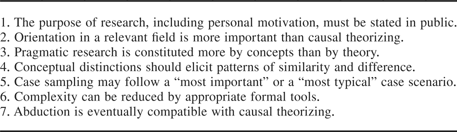
As can be gleaned from the “Seven Pragmatic Principles” (Table 1), abduction builds on, and at the same time provides an advanced alternative to, conventional methods of comparative case study research.
Seven pragmatic principles

The purpose of research, including personal motivation, must be stated in public
A pragmatic researcher will acknowledge that the main purpose of research is the generation of useful knowledge with a particular research interest in mind. Whatever that interest is, it must be stated in public. It is an obscurantist move to claim that personal motivation “should not appear in our scholarly writings.”Footnote 64 On the contrary, the interest of the researcher should always be clearly stated. It will then be up to the relevant evaluators and the peer community at large to establish whether and to what extent some research serves a legitimate, useful, and socially relevant purpose. Truth in the social sciences is not simply a property of the world. Our truth claims are meaningful only in the context of our analytical and/or normative purposes.
Orientation in a relevant field is more important than causal theorizing
Causal theorizing is neither the only legitimate nor the most important purpose of research. The typical goal of abduction is to enable orientation in a relevant field. It consists of mapping a class of phenomena to increase cognitive understanding and/or practical manipulability. To reach this objective, it is often sufficient to detect patterns of similarity and difference that allow for the identification of regularities within an otherwise confusing field of research. To the extent that abduction elucidates a class of phenomena that previously escaped our cognitive or operational parameters, it has already served its most important purpose. In some cases, it is possible to go beyond this and formulate a “grounded theory,”Footnote 65 or even some tentative causal hypotheses. But causal theory is not the gold standard of scientific success. Given the contingent nature of the social world, the best we can hope for in social science is contingent generalizations.Footnote 66
Pragmatic research is constituted more by concepts than by theory
Abduction is concept-driven rather than theory-driven.Footnote 67 The pragmatic researcher will reject a “causal, ontological, and realist view of concepts”Footnote 68 and prefer an antinaturalist view that recognizes their constitutive, intersubjective, and semantic quality.Footnote 69 Abduction is not committed to the classical tradition of Aristotelian taxonomy (genus proximum—differentia specifica), nor to the conventional view that taxonomies must allow for the unequivocal attribution of phenomena to exhaustive and mutually exclusive conceptual categories.Footnote 70 Wittgenstein has convincingly shown, and cognitive psychology confirms, that classical taxonomy does not adequately capture the way by which humans construct and employ their categories.Footnote 71 Humans typically work on the basis of “family resemblance” and “paradigmatic exemplars” which, contra Sartori, are extended through analogies and conceptual stretching.Footnote 72
Our concepts constitute our field of research. What we observe in that field will in turn elucidate or modify our understanding of the concepts. Rather than accepting the positivist view that the operational definition of concepts should be stipulated at the beginning of the research process and then be held constant, it is better to allow for the mutual adaptation of conceptual framework, field of research, and empirical findings. Especially during the initial stages of the research process, it would be counterproductive to ban the adjustment of concepts. Instead, the pragmatic researcher will carefully work and rework his concepts. The very process of research should then lead to increasing operational and denotative clarity. Self-imposed conceptual blinders are not useful, nor is it helpful to cast concepts into the procrustean bed of lexical definitions. Human cognition happens in hermeneutic circles. We should welcome the kind of circularity in which our understanding of the whole is modified by our progressive understanding of the parts. We should also welcome the fact that, while not all conceptual stretching is desirable, there is considerable heuristic utility in stretching our concepts through analogies.
Conceptual distinctions should elicit patterns of similarity and difference
A field of research is constituted by the intersection of a few (maybe two or three) core concepts. It is then divided, by further conceptual distinctions, into a number of subfields or “domains.” Whereas positivist research examines the causal impact of variables, abduction is concerned with the heuristic value of core concepts and conceptual distinctions. Core concepts and the field, as well as conceptual distinctions and domains, are mutually constitutive. Typically, conceptual distinctions take the shape of crosscutting categorizations that parcel out the field in a number of different ways. If useful, they elicit patterns of similarity and difference that increase our knowledge. If not, it is better to try other distinctions. Since the objective of abduction is detecting patterns of similarity and difference, it must be possible to readjust conceptual distinctions in the course of research, especially during the early stages. It will then be possible to examine whether and how different distinctions are helpful in structuring the field under examination. Since the objective is to map a class of phenomena, finding the most useful distinctions is an important achievement in itself.
Case sampling may follow a “most important” or a “most typical” case scenario
In many cases, pragmatic case sampling will follow a “most important” or a “most typical” case design. Having constituted a field of research and its domains by a small number of core concepts and a larger number of conceptual distinctions, a pragmatic researcher will typically select either the most important or the most typical cases in each domain.Footnote 73 The greatest advantage of these strategies is that they mitigate the problem of fuzzy conceptual borders. Interesting social-scientific concepts are hardly ever mirrored by a homogenous population of real-world manifestations with clearly defined boundaries. There are virtually always borderline cases that are hard to subsume under the concept at hand. While there is usually consensus on the prototypical cases at the conceptual core, the boundaries of a concept (as well as the field or domain constituted by that concept) are usually contested.Footnote 74 Especially at the early stages of a research program, it is reasonable to avoid the problem by studying the most important or most typical cases.Footnote 75 Either strategy is reasonable, but to avoid unnecessary asymmetries it is convenient to choose only one.
Complexity can be reduced by appropriate formal tools
Due to the practice of crosscutting conceptual distinctions, abduction comes with an inherent drift toward complexity. While some distinctions divide the field into domains, thereby determining case selection and preparing the ground for cross-case analysis, there will be additional distinctions to enable within-case analysis. Abduction thus produces an enormous amount of observations for inter-case and intra-case comparison. This may easily lead to a degree of complexity beyond our cognitive capacities. There are limits beyond which it is difficult to keep track of the ramifications engendered by our research design, and when we reach these limits, we are at risk of indulging in cognitive or emotional biases in order to maintain the illusion that we are still in control of the Golem that has been created by our conceptual distinctions.
When a purely hermeneutic approach to data analysis is beyond our cognitive capacities, formal tools can help to ensure that patterns of similarity and difference remain detectable despite the complexity induced by crosscutting conceptual distinctions. Complexity can be controlled by technical instruments such as structured-focused comparison, formal coding, synthetic indices, and descriptive statistics. While abduction is fundamentally based on a holistic understanding of the cases, it is possible to set up a unified set of aspects that shall be covered in every narrative. This is done by the technique of structured-focused comparison.Footnote 76 Formal coding enables the creation of a matrix containing the most important information in a synoptic format. Synthetic indices can be used to further aggregate such information, while descriptive statistics can help to detect patterns of similarity and difference in a dataset. Once detected, it is fundamentally important always to (re)interpret the patterns in the light of the original qualitative evidence.
When using statistics, a pragmatic researcher will preferably use intuitive tools such as frequency counts or cross-tabulation, which keep it easy to check statistical findings against the qualitative record. While there is no need for a taboo against inferential statistics as long as it is used for heuristic purposes, one has to be extremely careful with the alchemy of statistical methods that smuggle unwarranted assumptions such as the homogeneity or independence of cases into the dataset and thereby “miraculously” lead to sweeping generalizations across and beyond the sample. Formal research tools can be helpful, but statistical sophistication as such is not a goal of pragmatic research. The main goal of abduction is more straightforward: the detection of patterns of similarity and difference within a complex field. The pragmatic researcher will therefore keep analytical procedures as simple and intuitive as possible, and prefer descriptive to inferential statistics.
Abduction is eventually compatible with causal theorizing
As we have shown, causal theorizing is not the main purpose of abduction. Nevertheless, pragmatic research is sometimes amenable to causal theorizing in a broad sense. This can be accomplished by means of the same tools used for abduction as a descriptive instrument. Imagine a dataset containing observed causal pathways. If the number of pathways in the dataset is sufficiently large, nothing prohibits observing, coding, and counting their frequency. Abduction can be used not only for mapping descriptive patterns of similarity and difference, but also patterns of similarity and difference in the explanation of the observations made. In short, abduction is as suitable for mapping patterns of causality as for descriptive purposes.
In a nutshell, abduction is a comparative case study method. It starts with a research interest that relates to some relevant purpose. The specific field of research is constituted by a limited number of core concepts. A variety of conceptual distinctions is applied to divide the field into a number of domains. The researcher examines the most important or most typical cases in each domain to establish whether and how each distinction is important in structuring the field under examination. To that end, cross-case analysis is combined with within-case analysis. Despite a healthy dose of skepticism, formal methods can be helpful to control complexity, avoid biases, and analyze data. The ultimate goal, however, is not statistical sophistication but orientation in a complex field of research. In addition to mapping a field descriptively, the development of a causal theory is sometimes an option.
Research Design
To give a flavor of how pragmatic research strategy works in practice, we now turn to concrete cases of research design. For illustrative purposes, we juxtapose standard methodology to theory synthesis, analytic eclecticism, and abduction. All examples are drawn from the same field of research: preference analysis. They are all concerned with the analysis of European state preferences on regional integration and/or international cooperation. The point is not so much to demonstrate that abduction is best suited to find the truth (we do not believe in correspondence theory), but rather to illustrate how it works in comparison to both conventional and other pragmatic approaches. For the edification of the spectator, we showcase all of these different approaches in a sort of methodological theme park.
Standard Methodology
For standard methodology, let us consider a recent article on the intergovernmental conference leading up to the EU Treaty of Amsterdam.Footnote 77 The author derives rival expectations from two competing theories: institutionalism and intergovernmentalism. If intergovernmentalism is true, large member states will get their way significantly more often than small member states. If institutionalism got it right, veto power will make sure that member states defending the status quo will fare better than those favoring constitutional change. The author then uses quantitative data on national preferences to test the two theories.
To make the problem amenable to statistical analysis and to cope with the limitations of the available datasets, the author is forced to make a number of momentous simplifications.Footnote 78 State preferences are assumed to be given and fixed; member-state governments are seen as facing binary choices between status quo and treaty amendment; it is further assumed that they contemplate every issue in isolation; compromises and creative bargaining solutions such as issue linkage or logrolling are thereby excluded; finally, all of the 228 issues in the dataset are assumed to have equal importance to every member-state government.Footnote 79
The article is a typical example of the “gladiator style of analysis, where one perspective goes forth and slays all others.”Footnote 80 On the basis of a probit regression, the author finds that veto is an important source of bargaining power, while resources are irrelevant or even counterproductive. Thus, institutionalism slays intergovernmentalism. Despite the stark simplifying assumptions, the author is not beleaguered by doubts about the accuracy and reliability of his findings. As is typical for this genre, methodological considerations are replaced by statistical technicalities.Footnote 81 This is possible because the article relies on standard methods accepted by the mainstream and presumably not in need of further justification.
Theory Synthesis
The most obvious example of theory synthesis is Moravcsik's liberal intergovernmentalism as proposed in his book The Choice for Europe.Footnote 82 Moravcsik assumes that, ever since the intergovernmental conference in Messina, successive rounds of European integration have gone through the same three stages: domestic preference formation, interstate bargaining, and formal institutionalization. As Moravcsik declares, “the synthetic element of the explanation lies in the fact that each of the three stages is explained separately.”Footnote 83 In other words, temporal sequencing makes it possible to combine different theories while keeping them separate from each other. When seen as a whole, liberal intergovernmentalism is a rationalist animal with a liberal head, an intergovernmentalist rump, and an institutionalist tail.
All of these component theories are varieties of rationalism. Within its domain of application, each is pitched against a less rationalist competitor. In the stage of domestic preference formation, commercial liberalism comes out ahead of geopolitical interest.Footnote 84 In the subsequent stage of interstate bargaining, intergovernmentalism outperforms supranational entrepreneurship. In the final stage of formal institutionalization, rational institutionalism defeats federalism. While the gladiator style of analysis is preserved, the games are sequenced into separate rounds so that more than one variety of rationalism can emerge victorious.
Analytic Eclecticism
Analytic eclecticism has been practiced in a 2002 article on the EU Common Foreign and Security Policy (CFSP).Footnote 85 To examine why certain member states are more supportive of CFSP than others, the author begins rather conventionally by considering the following explanatory hypotheses:
H1: A member state with lower material capabilities will be more supportive of CFSP because of its inability to push an independent foreign and security policy.
H2: A member state will be less supportive of CFSP when it expects that future substantive decisions under CFSP will run counter to its foreign policy preferences.
H3: A member state will be more supportive of CFSP when the degree of European identification of its political elite and general public is higher.
H4: A member state will be more supportive of CFSP when its political culture at the domestic level is characterized by multilevel governance.
The first analytical cut is a logistic regression analysis to examine the relative strength of these hypotheses. This is fully in line with standard methodology, although the author does not pitch competing hypotheses against each other but examines their relative strength. The result is that H1 and H4 stand corroborated. Support for CFSP is more likely when material capabilities are low and when constitutional culture is polycentric.
But the analysis doesn't stop there. The innovative aspect of the article is that the regression analysis is complemented by an unorthodox version of fuzzy-set analysis that reinterprets the causal hypotheses as explanatory factors.Footnote 86 The result of this fuzzy-set analysis is that the factors indicated by H2 and H4 are jointly sufficient. In other words, member states support CFSP when the following two conditions are both fulfilled: their constitutional culture is polycentric, and they expect that future decisions under CFSP will suit their preferences.
While H2 is discarded by the regression analysis, the fuzzy-set analysis shows that it contains a causal factor that is sufficient to produce the result in combination with another causal factor. The beauty of this eclectic approach lies in its ability not only to assess the relative strength of causal hypotheses but also to identify the particular ways by which explanatory factors interact to generate the outcome. Analytic eclecticism is an interesting alternative to the “gladiator style of analysis, where one perspective goes forth and slays all others.”Footnote 87
Abduction
The pragmatic research strategy of abduction transcends the gladiator style of analysis even further. It was first applied in a book by one of the authors of this article.Footnote 88 The book deals with the preferences of the largest European states (Britain, France, Germany, Italy) on international police cooperation. It explores when and why these countries are willing, or unwilling, to participate in the international fight against terrorism and drugs.
The analytical objective is to understand “who wants what, when, and why” in an important field of international politics (as an antecedent to “who gets what, when, and how”). The tactic is to describe and explain state preferences as contained in statements by decision makers. Whenever possible, the book relies on first-hand sources to preserve the intended meaning of preferences rather than imposing a theoretical template.
The main part of the book is dedicated to forty-eight case studies. Following a “most important” case scenario, the case sample is systematically set up to allow for comparison by countries, time periods, issue areas, and levels of cooperation. There are further distinctions to allow a combination of cross-case and intra-case comparison. For example, state preferences are broken down into preferences on the substantive scope, geographical range, and institutional depth of international cooperation. Their explanation is attributed to interests, institutions, and ideas that can operate at the domestic, national, or international level with a positive or a negative effect on the willingness of a country to cooperate.
The book is the result of a four-year research project.Footnote 89 Both case sampling and conceptual distinctions were fixed only in the middle of the second year. A significant number of additional cases and alternative distinctions were explored but ultimately rejected due to their inferior heuristic purchase. Once cases and criteria had been established, it was possible to produce case study narratives that were painstakingly organized along these distinctions. The objective of this meticulous procedure was to control complexity to provide maximum orientation to both project participants and future readers of the book.
The next step was to elicit patterns of similarity and difference. Given the large number of case studies (forty-eight) and the enormous complexity of the data engendered by crosscutting conceptual distinctions, this was a serious challenge. A mere perusal of the qualitative case studies in the main part of the book would not have been sufficient to reliably detect such patterns. The qualitative observations recorded in the analytical narrative protocols were therefore formally coded and entered into a descriptive and an explanatory dataset.Footnote 90 Simple statistical techniques such as cross-tabulation and rank-order correlation could then be applied to sift the database for patterns. Finally, the patterns detected by means of statistical analysis were scrutinized in terms of the qualitative observations. Whenever a statistical finding could not be reasonably interpreted in qualitative terms, it was dropped as spurious.
It turned out, for example, that international sources of preference formation have grown more frequent from the 1970s to the 2000s. As the qualitative case studies show, this is mainly due to the piecemeal transferal of authority to international institutions, such as the UN with its drug prohibition machinery or the EU with its Third Pillar. Another pattern is that preferences on substantive scope, geographical range, and institutional depth are mutually reinforcing. There seems to be a virtuous cycle between preferences for broadening, widening, and deepening cooperation in the European Union and elsewhere.
These and numerous other findings are not to be understood as theoretical deductions or as simple inferences from the “world out there.” Instead, they are based on “triple hermeneutics.”Footnote 91 On the basis of existing conceptual notions derived from scholarship, as well as the interpretation of utterances by the actors under study, an empirical domain was constituted in an iterative and reflexive procedure of case sampling and conceptual distinction. The empirical domain thus constituted could then be examined for detectable patterns of similarity and difference, which reflected both the contextual understanding of the actors in the field and the conceptual notions introduced by the researcher. All this was done in such a way that the hermeneutic procedure would be fully transparent to the readers of the book.
Although research was of course theoretically informed from the start, findings were initially not forced into theoretical terms. Only in the fourth and final year of the research cycle were the emergent findings systematically interpreted in light of existing theories. The theoretical interpretation of the findings supports a blend of classical functionalism with social institutionalism. (1) International police cooperation is primarily driven by the collective and individual interest of states in solving practical problems; the countries under examination seem to genuinely believe that international cooperation is the best way to mitigate problems such as terrorism and drugs. (2) This functional impetus is often enhanced by the socialization effects of existing international institutions, and hampered by the countervailing inertia emanating from institutions at the national and domestic level.Footnote 92
Conclusion
Accepting the consequences of the failure of false epistemological ambitions does not mean an end to all critical inquiry, nor is it nihilism, relativism, or “anything goes.” If there are no incontrovertible foundations of scientific knowledge, a pragmatic strategy of knowledge generation is the obvious alternative. In this spirit, we have fleshed out problems of research design as they arise when one opts for a pragmatic approach. This is not to claim that abduction is the only possible pragmatic approach, nor is it to deny that other forms of scientific inquiry have their legitimate place. We do argue, however, that abduction represents a good bet in pursuing social scientific research after the failure of traditional epistemology to provide the incontrovertible foundations of knowledge.
In fairness, abduction is a risky endeavor since there is no algorithm to guarantee successful research. Of course the same applies to positivist methodologies such as theory-testing, although novices are often lured into believing that a positivistic logic of inquiry is a guarantee of scientific success. But be that as it may, with abduction there is a danger of endlessly proliferating complexity if one does not take the necessary precautions. As we have seen, however, following a few practical principles can dramatically increase the likelihood that a research effort will lead to meaningful results that will be accepted by the relevant evaluators and a wider audience. Moreover, the risk inherent in abduction is also the price for learning something genuinely new. Only when the range of possible results is predetermined by the kind of questions we ask, as in the case of theory testing, is there no risk of indeterminacy. But then neither is there a chance of any real surprise.
As we have seen, pragmatism as the consensus-oriented practice of discursive communities and pragmatism as a device for the generation of useful knowledge are two sides of the same coin. Discursive communities can go completely astray when they are so alienated from their social environment that they disregard plain commonsense. Take as an example the medieval debate on whether the duck is a bird or a fish, or periodical discussions among IR scholars on what matters more, structure or agency. Such debates quickly peter out when knowledge is understood as a social product and, at the same time, liable to some purpose. Pragmatism must therefore neither be reduced to the existing (or fabricated) consensus of a narrow group of scientists, nor to the utility of results regardless of their presuppositions and meaning. An academic research project should carry the day if, and only if, it fulfils the following two criteria: first, it should “work” as a reasonable response to the problem at hand; and second, it should convince the relevant evaluators. Academic communities should not become so self-referential to behave as the sole judges of their own discourse, without considering what other tribunals have ruled or what the jury says.
It is important to maintain the communicability of our research questions and findings not only to fellow specialists but also to a wider academic audience and, ultimately, society at large. It is also important that we listen to what these other constituencies have to say. It matters if philosophers of science have reached the conclusion that there is no epistemological basis for the accumulation of law-like statements. It similarly matters if political decision makers and people interested in politics are not interested in our theoretical ruminations because they either do not understand them or do not see their utility. Ideally, the findings of empirical research and the gist of theoretical debates should be reported in a vocabulary close enough to everyday language to allow for cross-community dialogue.
The appropriate response to the epistemological impasse is neither indulgence in endless meta-theoretical debating nor a candid denial of the problem, but the pursuit of a pragmatic approach to research and methodology. Or, more bluntly: let us recognize that neither lofty theory bashing nor clueless research activism can provide secure foundations for our knowledge, and let us instead seek knowledge that will enable us to deal with relevant problems and, ultimately, to find our way through the complexities of the social world.