Introduction
The twig borer Xylosandrus compactus Eichhoff (Coleoptera: Scolytidae) is a highly damaging pest of more than 225 plant species in about 62 families, including those listed as threatened and endangered species (Ngoan et al., Reference Ngoan, Wilkinson, Short, Moses and Mangold1976; CABI, 2015). After mating, the adult female X. compactus migrates from the mother brood to establish her own colony. The infestive beetle tunnels into the pith of host seedlings, shoots or twigs, and interrupts the transmission of water and nutrients. This leads to wilting of the infested part of the plant within weeks. The pest uses its tunnels to grow an ambrosia fungus, which is the sole source of food for both adults and larvae. This invasive species originated from tropical and subtropical Southeast Asia, from where it has spread to many parts of the world (CABI, 2015).
In Uganda, X. compactus was initially reported on robusta coffee, Coffea canephora Pierre (Gentianales: Rubiaceae) (Egonyu et al., Reference Egonyu, Kucel, Kangire, Sewaya and Nkugwa2009), but it was later found attacking cocoa, Theobroma cacao L. (Malvales: Malvaceae) and more than 40 other plant species, including commercial and food crops, trees and shrubs (Kagezi et al., Reference Kagezi, Kucel, Mukasa, van Asten, Musoli and Kangire2013; Kagezi et al., Reference Kagezi, Kucel, Egonyu, Ahumuza, Nakibuule, Kobusingye and Wagoire2014b). Besides unvalued losses on other host plants, X. compactus is estimated to reduce foreign exchange earnings from coffee exports in Uganda by US$ 40 million annually (Kagezi et al., Reference Kagezi, Kucel, Egonyu, Kyamanywa, Karungi, Pinard, Jaramillo, van Asten, Wagoire and Ngabirano2014a).
Traditionally, farmers in Uganda often plant and/or maintain naturally established trees in their coffee and cocoa plantations for shade. This practice of shading coffee and cocoa is also popular globally (DaMatta, Reference DaMatta2004). However, shade use in agrosystems, especially on coffee, has long been a hotly debated topic among producers and researchers (Rice and Ward, Reference Rice and Ward1996). The benefits of well-managed shade trees on coffee, cocoa and other crops are numerous, among which are (a) enabling the shaded crops to endure adverse climatic and edaphic conditions; (b) reducing excessive light to the crops; (c) providing litter to boost soil carbon levels; (d) creating hostile conditions to some pests and diseases; (e) meeting the demand for organically and sustainably produced commodities; (f) providing secondary products such as timber, firewood, fruits and medicines, and (g) harbouring a variety of natural enemies of pests and other biodiversity (Beer, Reference Beer1988; Herzog, Reference Herzog1994; Staver et al., Reference Staver, Guharay, Monterroso and Muschler2001; Peeters et al., Reference Peeters, Soto-Pinto, Perales, Montoya and Ishiki2003; DaMatta, Reference DaMatta2004; Perfecto et al., Reference Perfecto, Vandermeer, Bautista, Nunñez, Greenberg, Bichier and Langridge2004; Ruf and Schroth, Reference Ruf, Schroth, Schroth, da Fonseca, Harvey, Gascon, Vasconcelos and Izac2004; Somarriba et al., Reference Somarriba, Harvey, Samper, Anthony, González, Staver, Rice, Schroth, da Fonseca, Harvey, Gascon, Vasconcelos and Izac2004; Armbrecht and Gallego, Reference Armbrecht and Gallego2007; Bisseleua et al., Reference Bisseleua, Missoup and Vidal2009). However, unshaded coffee may benefit from high photosynthetic activity of most leaves and less competition with shade trees for resources such as soil nutrients, water and light, hence out-yielding the shaded counterpart (Albertin and Nair; Reference Albertin and Nair2004; DaMatta, Reference DaMatta2004). Additionally, the use of shade plant species that harbour pests or diseases of other species in the system increases the risk of pest and disease outbreaks (Schroth et al., Reference Schroth, Krauss, Gasparotto, Duarte Aguilar and Vohland2000). The decision to undertake monoculture farming or agroforestry is based, therefore, on the individual evaluation of the merits and demerits of the systems.
In Uganda, shade systems, especially Albizia chinensis (Osbeck) Merrill (Fabales: Fabaceae), allegedly promote X. compactus infestation as indicated by an unquantified number of farmers (A. Nambuya, unpublished observations). To this end, some farmers have removed A. chinensis from their coffee gardens as a way of preventing attack by X. compactus. There is, therefore, an urgent need for evidence on the influence of shade trees on populations of X. compactus, to help guide coffee and cocoa farmers. This study was undertaken to screen 10 common hosts of X. compactus for preferential infestation by the pest and to use the results to simulate potential influence of shade trees on the incidence and damage by X. compactus on coffee and cocoa.
Materials and methods
Determination of host preference by Xylosandrus compactus
The study was conducted at the National Coffee Research Institute, Mukono, Uganda (1209 m above sea level; 0°15ʹ26.33ʺN and 32°47ʹ26.67ʺE) from August to September 2014. These months were chosen, because populations of live adult X. compactus inside galleries often peak during this period of the year (Egonyu et al., Reference Egonyu, Ahumuza and Ogari2016), hence ensuring availability of the beetles to infest the experimental seedlings. Potted seedlings of 10 common hosts of X. compactus, namely C. canephora, C. arabica L., Persea americana Mill. (Laurales: Lauraceae), Eucalyptus sp. (Myrtales: Myrtaceae), T. cacao, Calliandra calothyrsus Meisn. (Fabales: Fabaceae), Artocarpus heterophyllus Lam. (Rosales: Moraceae), Mangifera indica L. (Sapindales: Anacardiaceae), A. chinensis and Grevillea robusta R. Br. (Proteales: Proteaceae) were obtained from a local plant nursery.
According to the nursery manager (J. Kasirye, pers. commun.), seeds of these species were germinated on lake-sand and the seedlings were potted in black polythene sleeves filled only with loam soil on attainment of two open leaves. The seedlings were approximately 6 months old and 15–30 cm tall when used for the experiment.
The host seedlings, free from infestation by X. compactus, were arranged in a completely randomized design on a wooden table, 1 m high in an unshaded garden of mature C. canephora infested by X. compactus, which served as a natural source of infestation for the seedlings. The garden was selected for the experiment, because of having the highest infestation by X. compactus compared to any other garden within the institute. Routine farm management practices on this coffee garden included weed management by monthly slashing; application of the herbicide glyphosate 48% at 5 l/ha twice a year; desuckering to maintain 3–4 stems per tree and elimination of secondary branches; and soil fertilization twice a year with NPK (25:5:5) at approximately 280 kg/ha. However, none of these activities were carried out during the experiment. The experiment was replicated five times with 10 seedlings per host plant per replicate, totalling 500 seedlings. The height of the table allowed the seedlings to be approximately at the same level with the coffee canopy in the study field, giving the seedlings equal chance of being selected for infestation by the beetles like the twigs of the mature coffee trees. The seedlings were watered as necessary throughout the experiment. The seedlings that were infested by X. compactus in each host plant were counted weekly.
Data analysis
Counts of infested seedlings per host plant per week were subjected to generalized linear modelling with family Poisson and logit link (Zuur et al., Reference Zuur, Ieno, Walker, Saveliev and Smith2009; Knoblauch and Maloney, Reference Knoblauch and Maloney2012) in R statistical software version 3.1.1 (R Development Core Team, 2014). The validity of the models was confirmed by considering the ratios of residual deviances and degrees of freedom, which were all approximately 1 (Zuur et al., Reference Zuur, Ieno, Walker, Saveliev and Smith2009).
Simulation of populations of X. compactus on host plants which are preferred to the shade trees
Based on the results from the above experiment on preferential infestation of host plants by X. compactus, different likely populations of the pest on its preferred host plants shaded with unpreferred host trees were simulated using plant images which were generated from Adobe® Illustrator® (Adobe Systems Incorporated, San Jose, CA).
Results and Discussion
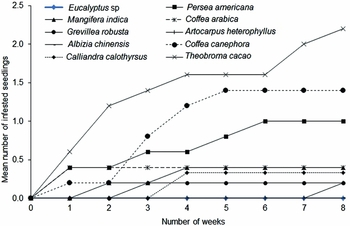
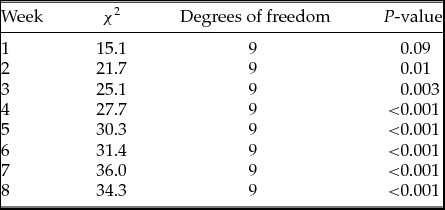
There were significant effects of host plants on the number of X. compactus-infested seedlings from the 2nd to 8th week (Fig. 1, Table 1), but the number of infested seedlings in the first week of the experiment was not significantly different among the hosts. Theobroma cacao was most preferred by X. compactus followed by C. canephora and P. americana, but the rest of the hosts tested appear to be unpreferred by the pest. However, it is possible that preference for C. canephora could have been enhanced over other hosts by the prior experience the infestive X. compactus females had with the mature host species (Zhang et al., Reference Zhang, Liu, Wang and Zalucki2007), but whether or not this influence was significant enough to alter the observed pattern remains unknown. The cues governing the host preference by X. compactus as observed in this study remains to be unveiled, although semiochemical cues are most likely among them (Gries et al., Reference Gries, Nolte and Sanders1989; Erasmus and Chown, Reference Erasmus and Chown1994; Byers, Reference Byers1996; Bonello et al., Reference Bonello, Mcnee, Storer, Wood and Gordon2001).
Mean number of infested seedlings of different hosts of Xylosandrus compactus per week for 8 weeks from August to September 2014 at the National Coffee Research Institute, Mukono, Uganda. Standard Errors of the means not presented to minimise crowding.

Summary of analyses of variances from generalized linear models of number of Xylosandrus compactus seedlings per host plant per week

Although our results are based on potted seedlings rather than mature trees in the field, to a great extent, they concur with reports that T. cacao and C. canephora are the most threatened crops by X. compactus in Uganda (Egonyu et al., Reference Egonyu, Kucel, Kangire, Sewaya and Nkugwa2009; Kagezi et al., Reference Kagezi, Kucel, Egonyu, Ahumuza, Nakibuule, Kobusingye and Wagoire2014b). However, reports on the significance of the pest on P. americana in Uganda are still scarce. Other than T. cacao, C. canephora and P. americana, the rest of the hosts tested appear to be un-preferred by X. compactus, with Eucalyptus sp. and A. chinensis being completely uninfested throughout the host preferential experimental period, despite having been reported as alternate hosts (Kagezi et al., Reference Kagezi, Kucel, Mukasa, van Asten, Musoli and Kangire2013).
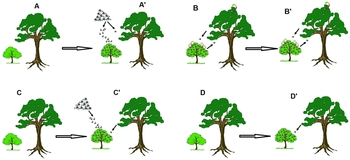
Using C. canephora as an example of a tree crop and A. chinensis as the shade tree species, we simulate four scenarios based on our results above on host preferential infestation by X. compactus. The first scenario is where the infestive X. compactus females come from outside the C. canephora–A. chinensis cropping system in which both the crop and the shade tree are free from infestation by the pest (Fig. 2A). The infestive X. compactus would most probably prefer C. canephora to A. chinensis, and hence the presence of A. chinensis would most likely not increase the population of X. compactus on C. canephora (Fig. 2Aʹ). A second scenario is when the infestive X. compactus females come from both the less preferred A. chinensis and within the already heavily infested preferred C. canephora (Fig. 2B). Here, the contribution of the low population of X. compactus from A. chinensis to the overall population of the pest on C. canephora would most probably be overshadowed by the large number of infestive beetles from within C. canephora (Fig. 2Bʹ). The 3rd scenario is when the infestive X. compactus females come from outside the shaded C. canephora and also from the low population of the pest in A. chinensis into the shaded crop where the pest has been completely controlled (Fig. 2C). Besides the scarcity of scenarios of complete control of pests on crops, the incidence and damage on C. canephora due to infestation from higher populations of X. compactus from external sources would most probably overshadow the incidence and damage due to lower populations of the pest on the unpreferred A. chinensis (Fig. 2C'). The 4th scenario is when the infestive X. compactus females come from only the low populations on less preferred A. chinensis to the shaded preferred C. canephora where the pest has been completely controlled (Fig. 2D). This scenario of complete control of the pest on the crop and all the surroundings except the shade trees is even most unlikely in pest management practices. However, if it does ever occur then the contribution of A. chinensis to the pest incidence and damage on C. canephora would most probably be significant, especially as the pest multiplies on the crop over time.
Simulated populations of Xylosandrus compactus on Coffea canephora (shorter tree) which is shaded by unpreferred Albizia chinensis (taller tree). A: infestive Xylosandrus compactus originate from outside the shaded C. canephora where both the crop and the shade tree are free from infestation by the pest, and Aʹ is the resulting situation; B: infestive Xylosandrus compactus originate both from the shade tree and within the already heavily infested more preferred C. canephora and Bʹ is the resulting situation; C: infestive Xylosandrus compactus originate from both external sources and A. chinensis into a more preferred C. canephora where the pest has been fully controlled, resulting in Cʹ; D: infestive Xylosandrus compactus originate from only A. chinensis into a more preferred C. canephora where the pest has been fully controlled.

These four simulation scenarios suggest that it is most unlikely for unpreferred alternate host shade tree species to markedly increase populations of X. compactus on shaded preferred host plants, and hence fail to offer a scientific support for the removal of shade trees such as A. chinensis on C. canephora/T. cacao as a way of managing X. compactus. However, these simulations, which are based on results from potted seedlings, need to be validated in a real field situation, taking into account other ecological parameters that are likely to influence pest populations.
Conclusion
Xylosandrus compactus shows marked preference for particular hosts, with T. cacao and C. canephora being the most preferred, while Eucalyptus sp. and A. chinensis are the least preferred among the 10 hosts screened. Four simulated scenarios of incidence and damage by X. compactus on a preferred crop as a result of shading with an unpreferred tree, suggest that it is most unlikely for unpreferred alternate host shade tree species to increase populations of X. compactus on shaded preferred host plants. However, further research is required to test this hypothesis in a real field situation.
Acknowledgements
We thank Viola Kigonya for assistance with field experimentation and the Director of Research, NaCORI, William Wamala Wagoire for administrative support. This work was funded by the International Development Agency (IDA) through the Agricultural Technology and Agribusiness Advisory Services (ATAAS).