Introduction
The continuous advancement in technology has led to the development of communication systems that offer numerous services in various applications. IR Wireless transmission, Satellite communications, Bluetooth, Wi-Fi, Zigbee, Radio Broadcast, Home Automation Systems, Sensing Systems are few applications that are in tremendous use and are ruling the world. These services widely utilize wireless networks that offer advantages of being cost-effective, convenient to use as it is exempted from the use of cables, provides flexibility in terms of location of the device and the user. Antennas play an important role in the field of mobile communication as well. The wireless wide area network comprising of Universal Mobile Telecommunications System (UMTS) band covering 1.92-2.17GHz band, Long-Term Evolution (LTE) covering 2.5-2.69GHz, WLAN-based network covering 2.4-2.485GHz band are few rapidly growing fields simplifying the integration of mobile and internet services. The multiband antenna uses a folded strip [1-3], slot-loading [4], and electromagnetic coupling [5], gained notable attention in recent years providing better aspect for covering multiple frequency bands.
The healthcare or medical industry is one of the widely growing fields that have been greatly influenced by the emerging wireless technology with a focus on Body Area Network (BAN)[Reference Jiang, Cui, Yue, Zhu and Werner6–Reference Kumar, Badhai and Suraj9]. Portable microwave-based techniques employed for brain stroke detection[Reference Mohammed, Ireland and Bialkowsk10–Reference Abtahi, Yang and Kidborg15], microwave-based imaging [Reference Abbak, Özgür and Akduman16], use of microwave cameras for 3D head imaging [Reference Ghasr, Horst, Dvorsky and Zoughi17], microwave imaging system for Breast cancer detection [Reference Bahramiabarghouei, Porter, Santorelli, Gosselin, Popović and Rusch18–Reference Aguilar, Al-Joumayly, Burfeindt, Behdad and Hagness20], Pleural Effusion detection (detection of fluid accumulation within the lungs) for heart and lung failure detection [Reference Ahdi Rezaeieh, Abbosh, Zamani and Bialkowski21–Reference Kumar and Badhai25], tumor detection, biomedical telemetry (allows setting up of transmission link for measurement of physiological signals at a distance) [Reference Xiao, Liu, Li, Yang and Liu26–Reference Mobashsher and Abbosh28], Blood Glucose monitoring [Reference Tamborlane, Beck, Bode, Buckingham, Chase, Clemons, Fiallo-Scharer, Fox, Gilliam, Hirsch, Huang, Kollman, Kowalski, Laffel, Lawrence, Lee, Mauras, O'Grady, Ruedy, Tansey, Tsalikian, Weinzimer, Wilson, Wolpert, Wysocki and Xing29, Reference Liu, Wu, Fan and Tentzeris30] are a few applications to mention. Antennas are being used in medical implantable devices supporting the application such as retinal implants [Reference Gosalia, Lazzi and Humayun31], pacemakers, and cardioverter-defibrillators [Reference Shimonov, Vulfin, Sayfan-Altman and Ianconescu32–Reference Wessels34] and microstrip antennas have emerged as a promising tool in a number of RF and microwave systems.
A brain stroke is the cause of the highest death in the modern era, just after cardiovascular disease and cancer. The detecting traumatic brain injuries using non-invasive techniques [Reference Wu and Pan14, Reference Mobashsher, Bialkowski, Abbosh and Crozier35, Reference Mobashsher, Abbosh and Wang36] is one of the latest research areas which has seen significant growth in recent years. A hemorrhagic brain stroke has been simulated and validated with the 3D model, using a custom antenna fabricated on the FR-4 substrate with the overall size of 45 × 25 × 7 mm3 [Reference Bisio, Estatico, Fedeli, Lavagetto, Pastorino, Randazzo and Sciarrone37]. The substrate of thickness 1.5 mm is utilized. The antenna is simulated for the frequency range between 500 MHz and 2.5 GHz, and the minimum value of the reflection coefficient is obtained as around −23 dB at 2.2 GHz. However, the antenna comprises of folded structure separated by a distance of 7 mm. In [Reference Rokunuzzaman, Ahmed, Baum and Rowe38] a probe-fed 3-D folded cavity-backed antenna with multi-layer structure for human head diagnosis is proposed with the size of 68 × 68 × 22.5 mm3, resonating on 1–1.7 GHz band with a small specific absorption rate (SAR) value. This antenna has a large size due to a multi-layer structure. An array of 24 antennas [Reference Scapaticci, Tobon, Bellizzi, Vipiana and Crocco39] with a final antenna size of 3 × 4 cm2 and 1.6 mm thickness, fabricated on a standard FR-4 dielectric substrate, has been designed to obtain a good matching when the antenna is immersed in the coupling medium. The antenna is simulated in the frequency range of 500 MHz to 1.5 GHz and the reflection coefficient below −10 dB is obtained for frequencies from 900 MHz to 1.5 GHz. However, the antenna has not been tested for the SAR, and the effect of radiation not studied when placed close to the human head. A flexible wideband antenna array utilizing electromagnetic bandgap (EBG) and metamaterial unit cells reflector has been proposed [Reference Alqadami, Bialkowski, Mobashsher and Abbosh40] with the overall size of 0.29λ0 × 0.41λ0 × 0.0198λ0, where λ0 corresponds to the wavelength at the center frequency of 1.45 GHz. The array consists of 4 × 4 radiating patches loaded with symmetrical extended open-ended U-slots and fed by a combination of series and corporate transmission lines operated in contact with the human head. The simulated and measured results show that the antenna has a fractional bandwidth of 53.8% (1.16–1.94 GHz). A trapezoidal-shaped monopole antenna proposed for wearable EM head imaging has been presented [Reference Bashri, Arslan and Zhou41]. The antenna is designed on FR-4 substrate with 0.2 mm thickness; however, the antenna was not implemented on an EM head imaging system. In recent research, flexible antennas for body area network have gained considerable attention. The extending to brain stroke detection applications, flexible antenna using PET substrate [Reference Rahman, Hossain, Riheen and Sekhar42, Reference Guo, Hang, Xie, Wu, Gao and Liu43] with inkjet printing, polymer technology has been studied.
In the present work, the antenna has been designed for biomedical applications to cover lower frequency bands suitable for microwave imaging and brain stroke detection. Furthermore, the same antenna can be used at higher frequencies for off-body communication. The design comprises of CPW feed, dual folded strip monopole, and open loop structure with optimized length to achieve wide operating bandwidth. Wide operating bandwidth with a fractional bandwidth of 138% is obtained for frequencies from 0.78 to 4.02 GHz, frequencies well suited for brain stroke detection. The structure has been modified in steps by adding monopoles, varying the lengths of the arms of monopoles, introducing slots in the design, and varying loop length.
To evaluate SAR which finds out the amount of power absorbed by human tissue, the human phantom (Head Model) has been introduced using ANSYS simulator and SAR has been calculated to corroborate its applicability for wearable devices as well as for specified brain stroke detection. The values of SAR were found to lie within the standards regulated by IEEE [44]. As per the radiation norms defined by the International Electrotechnical Commission (IEC), the SAR limit on the head is 2 W/kg at average 10 g tissues. However, the FCC and International Commission on Non-Ionizing Radiation Protection (ICNIRP) limits the SAR to 1.6 W/kg per 1g mass tissue, accordingly [Reference Yahya, Kamarudin and Seman45]. To experimentally validate the characteristics of an antenna for a specific application of brain stroke detection, a brain tissue-mimicking model is prepared by using materials with similar electrical properties as head tissue. The experimental results obtained for the model are in good agreement with the simulated results.
Proposed antenna configuration
Antenna design
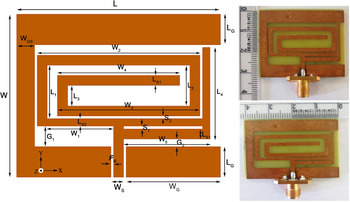
The proposed folded strip monopole antenna, as shown in Fig. 1, is designed with compact size of 40 × 32 × 0.8 mm3. The folded strips of copper are printed on FR-4 epoxy substrate with permittivity, ɛ r = 4.4 and loss tangent, (tanδ) = 0.02. The design consists of a dual folded strip resonators with optimized length to get broad bandwidth and multiple resonances. The two folded strip radiators are attached to the feed line in opposite directions. The length of folded strip loop l 1 = (W 1 + L 1 + W 2 + L 2 + W 3 + L 3 + W 4) is optimized to a quarter wavelength at the lowest resonating frequency to get multiple resonances i.e. l 1 = λ/4 at 740 MHz. The length of the second folded strip (l 2 = W 5 + L 4) is optimized to l 2 = λ/8 for achieving the resonance at higher frequencies. The loading of slot (S 1) in the l 2 radiator improves the bandwidth of the response and shifts the resonance to a desired lower frequency band, suitable for bio-medical applications. The proposed antenna dimensions are presented in Table 1.
Proposed antenna structure and prototype.

Dimensions of the proposed antenna

Resonance analysis
The most suitable frequency reported in the literature for microwave head imaging/brain stroke detection is 1 GHz [Reference Quresh and Mustansar46]. This frequency offers a reasonable compromise between the spatial resolution of brain images and the penetration of microwave signals into the human head. Therefore, the frequency-dispersive model is evaluated near the 1 GHz. The resonating frequency of the antenna can be calculated as [Reference Balanis47].

Where c is the velocity of light in free space.


With the length of the patch as L and the width as W, relative permittivity (ɛ r) and thickness of substrate h.
Antenna configurations
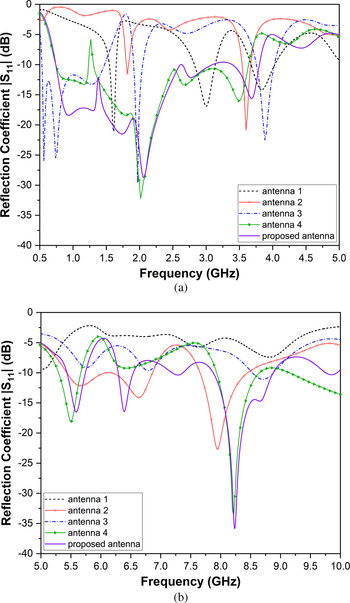
In this section, the design of the proposed antenna is discussed. The progressive evolution of the proposed antenna is shown in Fig. 2. The reflection coefficient (|S 11|) at a lower frequency band suitable for brain stroke detection is shown in Fig. 3(a). While Fig. 3(b) presents |S 11| for upper-frequency bands suitable off-body communication. The design starts with a folded resonating strip and the conventional rectangular ground plane (Antenna 1). Folding the radiating strip increases the electrical path of current on the radiating patch. The folded strip antenna presents multiple resonances, but the reflection coefficient (|S 11|) is narrowband and not resonating at the desired frequency band of brain stroke detection as shown in Fig. 3. To improve the performance of the antenna, parasitic strips of length 92 mm (E1+E2+E3) is added to the ground plane (Antenna 2). Proximity coupling between the arms of the folded radiating patch l1 and parasitic strip results in the generation of resonance at the upper-frequency band and improves the impedance matching at higher frequency bands. It provides wideband between 5.5 and 6.5 GHz, covering UNII bands for WLAN, Wi-Fi, WiMAX, and X-band applications. To achieve resonance at lower frequencies suitable for head imaging/brain stroke detection, a modification in design is required. From simulations, it is noted that, in Antenna 2, most of the coupling exists between the upper arm of the radiator and extended ground strip E2. Therefore, the dimension of the extended ground plane is reduced empirically using a simulation tool to obtain an optimum length of 76 mm (E1+E2) (Antenna 3). The inverted L-shaped open circuit stub acts as a capacitor-fed monopole excited at the low-frequency band. The inverted L-shaped open circuit stub excites lower frequencies, however resonant peaks at upper bands are disturbed. The shift in the return loss values at higher frequencies may be attributed because of open-ended ground length. The antenna design is further improved by introducing a second monopole folded strip to the right of the CPW feed (Antenna 4). The length of monopole strip l 2 is chosen to be λ/8 at the lowest operating frequency to excite the resonance at higher frequencies. Adding of the optimized folded arm of length 31 mm (Antenna 4) allows redistribution of current. The coupling between the monopole and folded radiator helps achieve resonance at higher frequencies. The addition of an l2 resonator improves the impedance matching at higher frequency bands while impedance matching at lower frequency bands is degraded because of the poor coupling between the l1 and l2 radiators. The poor coupling diminishes the current distribution at lower frequencies. The antenna design is further improved in the final step, toward the design of the proposed antenna, a slot is introduced in the arm of the second monopole. The slot increases the current path length and contributes to getting lower resonating frequencies. The slotted arm and the ground loop improve the performance of the antenna. The proposed antenna gains the needed impedance matching at lower and higher bands suitable for on-body and off-body applications.
Progressive developments of the proposed antenna.

Comparison of |S 11| for initial antenna designs with the proposed monopole antenna (a) 0.5–5 GHz, (b) 5–10 GHz.

Effect of variation of folded strip length (l1)
The lowest resonating frequency f 1 of the proposed antenna can be calculated using the empirical formula presented in equation (5),

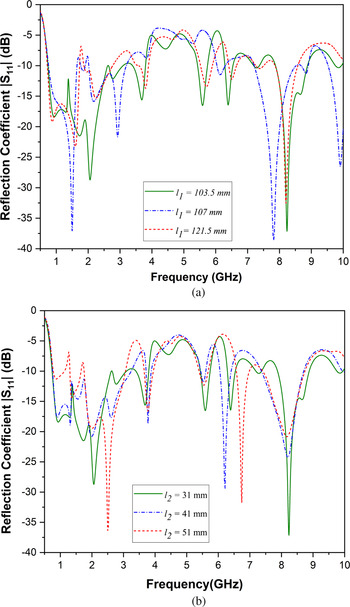
where c is the velocity of light in free space. The folded strip length l 1 of the monopole antenna is varied to get the desired frequency band. The effect of the various folded strip length on the reflection coefficient |S 11| of the antenna is shown in Fig. 4(a). From the figure, it is seen that for the folded strip length l 1 = 103.5 mm, dual resonance bands are obtained. The impedance matching for the lower and higher frequency bands is good but the impedance matching between 2.0 and 6.4 GHz band is poor. Next, for the l 1=107 mm, multiple resonances are obtained at 1.6, 2.25, 3.8, 5.7, 6.5, and 8.2 GHz. However, it shows a poor impedance matching values at 3.8, 5.7, and 6.5 GHz. Further by increasing the folded arm length l 1 to 121.5 mm, resonance with significant impedance matching (|S 11| ≤ −10 dB) gained. Also, the suitable lower band is covered with a wider bandwidth.
Effect of folded length on reflection coefficient (|S 11|) (a) l 1, (b) l 2.

Effect of variation of folded strip length (l2)
The folded strip length l 2 has its impact on a higher frequency, while the lower frequencies are not much affected by the variation in the l 2 as shown in Fig. 4(b). By increasing the folded strip length l 2, the higher-order bands shifted toward lower resonating frequencies because of the increase in the electrical length of the radiator. The effect of folded strip l 2 on the reflection coefficient of the antenna is considered for the length of l 2 = 31, 41, and 51 mm, while the l 1 is kept constant at 121.5 mm. The better impedance matching for WiMAX, WLAN, and X-band application is gained at l 2 = 31 mm.
Results and discussion
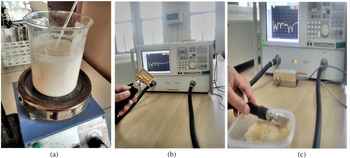
The proposed antenna design simulated on a high-frequency EM simulator (HFSS). The antenna simulated in free space and in the proximity of the human head phantom. The proposed antenna prototype is fabricated on a glass epoxy FR-4 substrate. The designed antenna is further tested in free space and on brain mimicking tissue. The low-cost brain-mimicking tissue represents the soft tissues of the human brain. The different percentages of Propylene Glycol, Sodium Azide, Corn Flour, Gelatin, and distilled water are taken to prepare low-cost brain tissue sample [48]. The mixture is heated at desired temperatures with constant stirring using the magnetic stirrer to form a semi-solid compound. The experimental setup to prepare tissue mimic mixture and the reflection coefficient measurement in free space and in the vicinity of the brain tissue model is shown in Fig. 5.
Experimental set up to demonstrate (a) tissue-mimicking mixture preparation, (b) reflection coefficient free space, and (c) reflection coefficient measurement in the presence of brain tissue-mimicking compound.

Reflection coefficient
The reflection coefficient (|S 11|) measurement of the proposed antenna is performed using AGILENT PNA-LN5230A Vector Network Analyzer. The antenna, when tested on Human head phantom, showed significant values of reflection coefficient with good impedance matching at desired frequencies. The plot of |S 11| shows a wide operating bandwidth at frequencies desirable for brain stroke detection. The ultra-wideband (UWB) operation is achieved for frequencies 0.78–4.02 GHz, frequencies well suited for brain stroke detection. The proposed antenna can also resonate at 2.4, 3.6, 5.6, 8.2 GHz for ISM band (2.40–2.48 GHz), WiMAX (3.3–3.6 GHz), WLAN UNII-2 (5.40–5.75 GHz) and also the 8 GHz band can be utilized for satellite X-band applications. The simulated and measured reflection coefficients of the proposed antenna in free space as well as on the human head phantom are shown in Fig. 6.
Simulated and measured reflection coefficient (|S 11|) of the proposed antenna in free space and human head phantom.

Electric field distribution
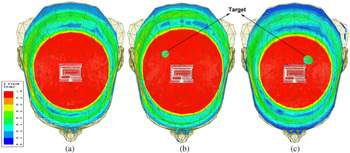
The proposed antenna is placed at the top of the human head phantom at the separation of 5 mm from the surface of the head phantom. The electric field distribution on the human head is simulated at 1 GHz. The spherical shape hemorrhage target (permittivity (ɛ r) = 61.065 and conductivity (σ) = 1.5829 S/m) with a radius of 7 and 10 mm are located in the brain at a depth of 50 mm from the top surface of the head. The electric field distribution of the proposed antenna for a healthy brain and brain with hemorrhage stroke is shown in Fig. 7. No significant scatterer is observed for a healthy brain. While the lower electric field distribution is observed across the hemorrhage target results from an increase in the absorption, which is presented due to the high conductivity of the target. By analysis of the E-field of normal brain and brain with hemorrhage stroke using digital image processing algorithms, the signature can be visualized as a 2D image.
The normalized electric field distribution on human head phantom at 1 GHz (a) normal brain, (b) hemorrhage target r = 7 mm, and (c) hemorrhage target r = 10 mm.

Specific absorption rate
The adaptability of an antenna for biomedical applications can be evaluated by measuring its SAR. The purpose of the SAR analysis is to describe the energy absorbed by the human head when it is exposed in RF electromagnetic field produced by the proposed antenna and its value should comply with the Institute of Electrical and Electronics Engineers (IEEE C95.1 standard), which restricts SAR values averaged over 1 g of any tissue to be less than 1.6 W/kg. For on-body applications where tissue serves as a propagation channel, tissue conductivity, and frequency-dependent electric fields are factors that affect the precise determination of SAR. The SAR is related to the electric field and temperature at a point by the equation (6) [49].

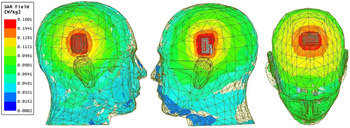
where ρ is the mass density of the tissue (kg/m3), E is the RMS electric field strength (V/m), ΔT is the change in temperature (K), Δt is the duration of exposure in seconds, and c is the specific heat capacity (J/kg). Low SAR indicates low near field radiations as SAR is proportional to the square of the magnitude of the electric field. The maximum average SAR for the proposed antenna is obtained to be 0.016, 0.16, and 1.16 W/kg for the input power of 0, 10, and 20 dBm respectively averaged over 1 g of tissue, when placed at a distance of 5 mm from the head model. The values lie within range so as not to cause any undesirable impact when placed near the head. The SAR for the proposed antenna for three positions of the brain is shown in Fig. 8. The effect of the distance between the human head phantom and the antenna on SAR value for the three different input levels of 0, 10, 20 dBm is plotted in Fig. 9(a). The antenna is also simulated for the average SAR values for 1 and 10 g of tissues mass for an input power of 100 mW (20 dBm) and the calculated values for 1 and 10 g of tissues are 1.16 and 0.63 W/kg respectively, which follow the standard limits defined by ICNIRP and IEEE. The variation in average SAR due to the separation distance between the human head phantom and the proposed antenna for an input power of 20 dBm is shown in Fig. 9(b). It is seen from Fig. 9 that the increase in distance between the human head phantom and the antenna, the average SAR values decrease and vice versa. The SAR analysis also reveals the maximum allowable power. The proposed antenna can be operated up to 125 mW of antenna input power without effecting the human head tissues as shown in Table 2.
SAR determination on human head model for input power of 10 dBm at a distance of 5 mm resonating at 1 GHz.

Variation of average SAR due to the separation distance between the human head phantom and the proposed antenna at 1 GHz for (a) different input powers, (b) 1 gm and 10 g tissue mass for 20 dBm input power.

Simulated average specific absorption rate (SAR) at the center frequency of 1 GHz

Radiation pattern
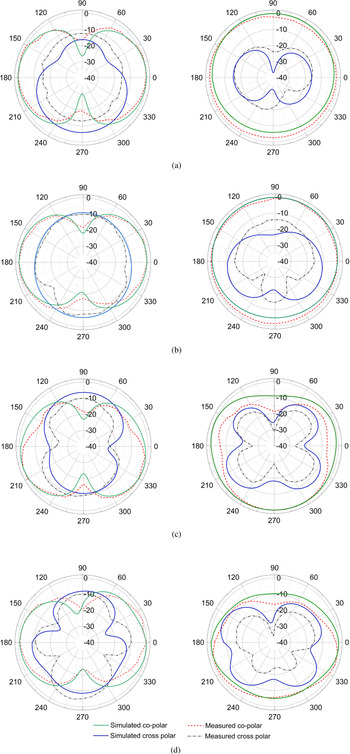
To ensure that the antenna radiates most of its accepted power in the desired direction, its far-field radiation patterns were simulated and measured at 1, 2.05, 5.6, and 8.24 GHz. The simulated and measured normalized radiation patterns are presented in Fig. 10. The proposed antenna shows monopole-like radiation pattern with the maximum gain in the boresight direction. The antenna radiates in broadside direction in the XZ plane, while an omnidirectional pattern is obtained in the XY plane at 1 and 2.05 GHz. The antenna produces directive radiation patterns for both the plane at 5.6 and 8.24 GHz, which are useful for communication from on-body to off-body devices. The cross-polarization level is found to be 12 dB lower than co-polarization, both XZ and XY plane at all the operating frequency bands in boresight direction. The measured radiation pattern of the proposed antenna reasonably validates the simulated radiation patterns.
The simulated and measured normalized radiation pattern of the proposed antenna E-plane (Left side) and H-plane (right side) at (a) 1 GHz, (b) 2.05 GHz, (c) 5.60 GHz, and (d) 8.24 GHz.

The proposed antenna has a peak gain of 7.1 dB at 3.60 GHz in free space and 6.8 dB at 3.45 GHz in the presence of a human brain tissue phantom. The measured gain plot of the antenna in free space and the human brain tissue phantom is shown in Fig. 11. The characteristics of the proposed antenna are compared with some similar types of papers as presented in Table 3 and found it is suitable for the brain stroke detection application.
The measured gain of the antenna in free space and the presence of the human brain tissue phantom.

Comparison of proposed antenna design with similar literature

* Not reported.
Conclusion
This paper illustrates the design of the folded strip monopole antenna for brain stroke detection/imaging applications. The design of the UWB antenna operating at the multiband frequency, makes it suitable for on-body and off-body communication such as WLAN, WiMAX, and X-band communications. The proposed antenna has a compact size, good impedance matching, wideband characteristics, and good radiation pattern with lower SAR values suitable for wearable devices and brain imaging applications. The antenna operates with suitable efficiency and gains over the desired frequency band. The measured results are in close agreement with the simulated results.
 Payal Bhardwaj received her B.Tech degree in Electronics and Communication Engineering from UP Technical University in the year 2005, and ME degree from Jadvpur University, Kolkata, in Electron Devices in the year 2013. She is pursuing her Ph.D. in the field of Microwave Engineering from Birla Institute of Technology. Currently she is serving as an Assistant Professor in the Electronics and Communication Department of Birla Institute of Technology, Deoghar. Her current research is in the field of design and implementation of printed microstrip antennas for biomedical applications.
 Ritesh Kumar Badhai was born in India on 1984. He received the Bachelor of Engineering degree in Electronics and Communication Engineering from Rajiv Gandhi Proudyogiki Vishwavidyalaya, Bhopal, India in 2007. He has completed his Master of Engineering and Ph.D. degree in Electronics and Communication Engineering from Birla Institute of Technology, Mesra, Ranchi, India in 2009 and 2015 respectively. He currently is an Assistant Professor in the Department of Electronics and Communication Engineering, Birla Institute of Technology, Patna, Bihar, India. His research interests are omputational electromagnetics, antenna design, RF circuit design, and EMI/EMC.