The Brahms-Institut Lübeck was founded 25 years ago, in 1991, and is closely affiliated with the Musikhochschule Lübeck, with which it runs an annual Brahms Festival. The founding collection of the Institut, the largest private collection of Brahms material in the world, is that of Kurt and Renate Hofmann – familiar names to Brahms scholars for their countless invaluable publications, including studies on Brahms’s time in Hamburg, Kiel and Baden Baden, a list of his library collection and most recently a catalogue of Brahms’s performances as a conductor and pianist including full programme information and review details.Footnote 1 Professor Wolfgang Sandberger has headed the Institut since 1999, and it has gained a considerable reputation for its publications, as well as its fine exhibitions and increasing digital legacy.Footnote 2 Through its links with the Musikhochschule, it also aims to provide and encourage ‘a fruitful exchange of musical research and artistic practice’.Footnote 3
The digital material available via the Brahms-Institut is enormously rich – all the more so for being concerned not just with Brahms himself, but various individuals with whom he had a close association. Digitization of the collection began in 2003, and so far around 41,000 images are available, including photographs, autograph scores, letters and printed music. The site provides a brief timeline of the various stages of work undertaken to date:
2003 Digitization of the photography collection, largely from the Brahms estate
2006 Digitization of the first and early editions of Brahms’s works
2007 Digitization of all program notes or books
2008 Digitization of all Brahms manuscripts, Stichvorlagen (engraving templates), and Brahms letters with numerous first editions of works dedicated to Brahms and personal documents
2010 Digitization of musical manuscripts from the Brahms circle
2012 Digitization of first and early editions of the works of Robert Schumann
2015/16 Digitization of the partial estate of Theodor Kirchner, a Brahms-friendFootnote 4
A link in the top-right of the ‘Sammlung/Collection’ page provides an overview document of the complete holdings of the Institut as a downloadable .pdf, although it has not been updated since 2010.Footnote 5 Various further projects, still in progress or planned for future years, are provided elsewhere on the site – and it is within the ‘Digitales Archiv/Digital Archive’ section, above all, that the greatest treasures are to be discovered.
The real difficulty, however, is mastering the layout and functionality of the site itself. Some aspects of its design point simply to the structure having been planned a number of years ago: the rather unnecessary ‘enter’ page, for example. The website has been designed by Dematon, a Weimar-based company specializing in the digitization of archive material – particularly musical archives – and which is also responsible for providing high-quality digitized images for an impressive range of other German collections and educational establishments. These include the Hamburg Brahms-Museum, Deutsche Liszt-Gesellschaft Weimar, Humboldt-Universität Berlin, Mendelssohn-Stiftung Leipzig, Meininger Museen, Schleswig-Holstein Musikfestival and the Musikhochschule Lübeck, with which the Brahms-Institut is closely affiliated.Footnote 6 The majority of these organizations seem to have looked to Dematon only for their digitization work, with separate companies credited as designers;Footnote 7 the Brahms-Institut, however, appears to have entrusted all aspects of site design to Dematon itself. The result is a site without dynamic features (not inherently a problem, but giving it a somewhat dated feel) and lacking several functions that would greatly improve usability. There is no overarching site search facility, for example, nor, since the menus are not dynamic, is it possible to view the subsections in a given menu category simply by hovering over the top level. The three-column page structure is not always used in full: the right-hand column is sometimes empty, though the band of an inoperable scrollbar remains visible in the page template. And, most frustratingly of all, pages will not scroll fully to the top or the bottom if your browser window is open to fill the screen: the window must be reduced in order to scroll up or down to the extremes of the page.Footnote 8 (Indeed, having been a user of this site for many years, it was only in the process of constantly reducing and enlarging my browser window, in order to glean details for this review, that I discovered the English and German-language toggle buttons on many of the pages! It is the cataloguing work itself that is German-language only.) Furthermore, the landing page is the only part of the site that can be viewed in small resolution. Attempting to browse from a mobile phone simply calls up an error message since the site cannot be viewed on a screen of less than 1000 pixels wide. A tablet will allow site access only if held in landscape, rather than portrait, orientation. Of course, high-resolution images are best studied on full-size computer screens, but this restriction renders a considerable amount of text-based information unusable – not least the visitor information pages for those curious to see the Lübeck collection first-hand.
‘Lieben Sie Brahms?’
The Brahms-Institut site can be roughly divided into three sections: Digital Archive, Research Projects, and information for visitors online and in person. ‘Lieben Sie Brahms?’, visitors are asked as they open the website. ‘Then you’re in just the right place. The Brahms-Institut seeks to appeal to all those interested in this great composer: music lovers, musicians, and musicologists’.Footnote 9 For visitors and non-professional music lovers, the site provides a brief Brahms biography, an overview of the Institut and its history, detailed descriptions of current and past exhibitions and events, an online shop and contact information. Again, the site design provides some problems here: the Brahms biography, by Sandberger, is supplemented by several pop-out images containing text, which cannot be magnified sufficiently to a point of legibility. But the events listings and exhibition texts are impressive both in terms of their variety and the imaginative approaches that have been taken to the collection. Brahms remains at the centre of exhibition planning of course, but Beethoven, Schumann, Mendelssohn, Haydn, Tchaikovsky and others have been drawn into displays and discussions, and the shop offers past exhibition catalogues (filled with thought-provoking articles as well as fine illustrations) in addition to manuscript facsimiles, and scholarly publications including the weighty Brahms-Handbuch, edited by Sandberger in 2009.Footnote 10 Elsewhere on the site, a full list of Institut publications is given: a telling reminder of the scholarly importance of catalogues and pamphlets, and the insights gained by archivists and librarians working closely with archive material.Footnote 11 Press releases and newspaper articles are also available to read, as well as the fruits of the Musikhochschule’s new ‘TV Livestream’: a series of recorded discussions with musicians and scholars, ‘Zu Gast bei Brahms’.Footnote 12 All in all, there is much of interest across these pages, even before investigating the Archive and Projects, although locating information is not always easy, and a few additional cross-references and links could greatly aid a first-time user.
Digital Archive
The Digital Archive, like the Institut’s Research Projects, runs as a mini-site within the main structure. This is allotted its own menu, split into ‘Brahmsiana’ and other collections, with the Brahms holdings further divided by material type. Given the basic design of the pages, each subcategory (autographs, engraving templates, first and early editions, photographs, letters, address book) leads to an overview of holdings and a gallery link of individual images.Footnote 13 The slightly cumbersome route to the images contains an impressive amount of detail. Autographs, engraving templates and edition links lead to what is, effectively, a central worklist (the only works shown are those for which digitized material is available). Clicking on a given work leads to a page containing information about composition dates, earliest known performances and performers and autograph sources, followed by extensive descriptions of digitized items and the opportunity to view these at high resolution. For a collection like the Fünf Lieder op. 47, for example, it is possible to view a working manuscript of ‘Liebesglut’ (no. 2), followed by its engraver’s copy; the engraver’s copies for ‘Sonntag’ (no. 3) and ‘Die Liebende schreibt’ (no. 5), and the first edition, first printing of the full opus. Names of copyists, incipits, page measurements, provenance information and bibliographic details are given per item. The images are all watermarked, sufficiently subtly not to interfere with visibility of the text below; and the pop-up digitized images are clearly labelled with a running header, as well as a dropdown menu to allow individual page selection. Song and movement titles are included as part of this menu, which is tremendously helpful to speedy navigation of a score. Although it is not mentioned on the Brahms Institut site, a number of these scores have also been made available on IMSLP, with the institutional link ‘D-LÜbi’ in each case taking users straight to the relevant worklist page within the Digital Archive.Footnote 14
The photographic archive, consisting of over 600 images, is similarly well documented: catalogue numbers, dimensions, provenance and format are provided per image. There is a simple search facility to allow refinement by date, location, description, title or full text; a link is also provided to a .pdf catalogue of photographic holdings, dated May 2016. There is also one curious feature of this catalogue that I could not quite fathom. Each image listing, with thumbnail, contains links to ‘Recte’ [sic] and ‘Verso’ images, and once the image viewer is open, it is possible to click between the two. However, in all cases that I encountered, the images were both recto – no distinct verso was apparent. Even a photograph of Theodor Kirchner, with a catalogue record stating that there is a handwritten date on the back of the image, yielded two shots of the photograph itself, rather than the aforementioned handwriting.Footnote 15 In this respect, the image labelling is misleading, and there is no mention of this rather curious mislabelling within the introductory text.Footnote 16
Among the remaining categories of digitized material, there are many other fascinating documents. The manuscripts from Brahms’s circle include works by Robert and Clara Schumann, Donald Francis Tovey, Rheinberger, Mendelssohn, Joachim, Henschel and Hans von Bülow, as well as album leaves by poets Klaus Groth and (possibly) Goethe – and these vary from scores to letters and written fragments.Footnote 17 Full scores of 78 works dedicated to Brahms are also included in full, under ‘Brahms gewidmet …’;Footnote 18 and his address book has been scanned in full, and supplemented with a helpful explanation of its rather idiosyncratic ordering!Footnote 19 The Schumann-Erstdrucke and Kirchner-Nachlass collections are also very considerable, with the former including over 140 works (the vast majority of Schumann’s publications, from the early piano works to full and vocal scores of pieces such as Das Paradies und die Peri and all four Symphonies – including the early version of Symphony no. 4). The Kirchner-Nachlass is divided into sub-categories of manuscripts, sketches, printed music, letters, documents and so on (including his cigar case!), totalling around 9,000 images in all. Kirchner’s significance as a superbly well-connected composer, pianist, organist and conductor begins to emerge from this considerable collection, and it is hoped that there are plans to transcribe the letters and other written documents to supplement the photographs provided.Footnote 20 It is also from Kirchner’s Nachlass that many of the Schumann-Erstdrucke images are drawn.Footnote 21 A tantalizing announcement on the Digital Archive landing page makes mention of plans to digitize part of the Joseph Joachim Nachlass, but there is no live link attached to the headline – and non-German speakers should be warned that the link to the Kirchner-Nachlass does not even appear in the menu on the English-language page of the Digital Archive, so the page must be viewed in German to follow the navigation link.Footnote 22
Research Projects
One of the smallest sections within the Digital Archive – that of Brahms’s letters – ties up with the most ambitious of the Brahms Institut’s Research Projects, namely the Brahms-Briefwechsel-Verzeichnis (BBV). This is a database of over 10,800 letters held by institutions and individuals all over the world – nearly 4,000 of which are to Brahms, and around 3,500 of which were previously unpublished – and it is an invaluable resource to scholars. It was made possible through the support of the Deutsche Forschungsgemeinschaft, the Lübeck Possehl-Stiftung, and the collaboration of countless international organizations and individuals, bringing together information on the major holdings of institutions such as the Archiv der Gesellschaft der Musikfreunde and the Staatsbibliothek zu Berlin, alongside tiny clutches of letters that have found their way into private hands.Footnote 23 Sandberger has provided a fine overview of ‘Brahms as a Letter Writer’, and the significance of both the correspondence itself and the implications that the BBV has for scholarship.Footnote 24 He also provides a thought-provoking comparison in terms of the number of surviving letters by other composers: 6,825 by Brahms, around 5,000 by Schumann and Weber, 7,000 by Mendelssohn and 10,000 by Wagner and Liszt.Footnote 25
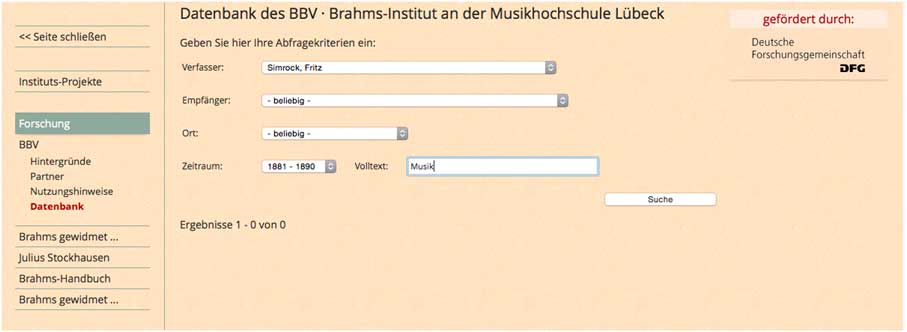
The letter texts are not included in full within BBV: instead, the database is an index of names, dates, locations and incipits of the Brahms correspondence. The search facility provides the options to specify writer, addressee, locations, date by decade (all of these options are given as drop-down boxes), and to look for particular words within the full text of records. Although this last box is described as ‘Volltext’, the well-crafted usage instructions spell out that this ‘does not mean access to complete letter texts … BBV only allows users to research the opening lines of the letters. The full text search also provides information on library holdings, locations, and call numbers’, see Figure 1.Footnote 26
Brahms Briefwechsel Verzeichnis, ‘Datenbank’ search page

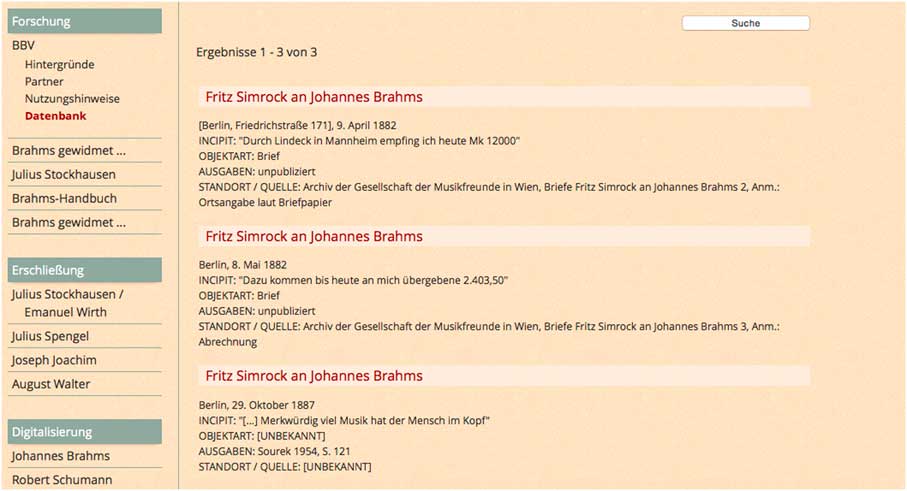
Thus a search which specifies Fritz Simrock as the writer, a time period of 1881–1890 and the full text search term ‘Musik’ yields the three results, shown in Figure 2. Result are always listed in chronological order and cannot be further refined or reordered.
Brahms Briefwechsel Verzeichnis, ‘Datenbank’ results page

‘Musik’ is to be found in the incipit of the third letter – ‘Merkwürdig viel Musik hat der Mensch im Kopf’ – as well as the location of the remaining two, at the Archiv der Gesellschaft der Musikfreunde in Wien. Whilst it might seem tantalizing and frustrating in equal measure to be granted only a small snippet of the full text, crucially two of these letters are unpublished, whilst the other is in print but the original source is lost. As a tool for tracing mention of specific subjects, the database’s power is limited; but it is a powerful tool for determining the availability and location of correspondence, and discovering some of the less obvious publications in which Brahms’s letters appear (including biographies of contemporaries and organization histories).Footnote 27 The Siglenverzeichnis is a treasure trove of lesser-known correspondence sources – not to mention an indispensable tool for untangling the rather convoluted publishing history of Max Kalbeck’s early twentieth-century volumes of Johannes Brahms in Briefwechsel.Footnote 28
The Project pages also provide a brief overview of the Brahms-Handbuch, further introductory material to the ‘Brahms gewidmet …’ digital collection, and an overview of current research being undertaken into the recently acquired partial estate of the singer, Julius Stockhausen.Footnote 29 Details are also given of projects in progress, focusing on the digitzation of collections associated with violinist Joseph Joachim, composer and conductor Julius Spengel, the Basel-based musician August Walter, Stockhausen and the violinist Emanuel Wirth. The scope and scale of these projects is not only impressive in terms of the time and resources required to carry them out; the insights that such collections might afford into the public and private musical lives of the Brahms circle, and the towns and cities in which these performers and composers worked, are considerable. Brahms scholars – and indeed scholars of this period of Austro-German music in general – owe a considerable debt to Kurt and Renate Hofmann for their dedication in assembling the founding collection of the Institut. The digitization and public cataloguing of this and other collections is particularly valuable since Brahms’s own Nachlass is held by the Archive of the Gesellschaft der Musikfreunde in Wien, for which no public access catalogue or images are available.Footnote 30 The motto to which the Brahms Institut lays claim is ‘sammeln verpflichtet’ – ‘committed to collecting’. This is interpreted by the Institut not only as an obligation to amass and privately catalogue its holdings, but also to make material publicly accessible to researchers and interested parties through exhibitions and digitization.Footnote 31 It is a tribute to the dedication of Sandberger and his colleagues that they have succeeded in both securing so many considerable acquisitions, and identifying partners and funding bodies to research and digitise them.
Whilst there are a number of technical irritations with the Brahms Institut website – almost all of which could be solved by an updated web platform – the content of the site itself, and in particular its rigorous cataloguing of manuscripts and early printed editions of music by Brahms, Schumann and others, is both highly commendable and extremely valuable to researchers. An overarching search facility, both for the site content itself and, ideally (though this would be far more complex) across several of their considerable databases, would provide great benefits to users. It is striking that no mention is made anywhere on the site of similar organizations that visiting scholars might find of interest: for example, IMSLP, the Schumann Portal, Archiv der Gesellschaft der Musikfreunde, Johannes Brahms Gesamtausgabe, Joseph Joachim research site, or even library listings of relevant Nachlass holdings, such as that of Julius Stockhausen.Footnote 32 Finally, the partially translated nature of the Institut’s website is problematic in ensuring access and full listing of all available material. But none of these things should dissuade scholars from exploring these pages. After all, it is thanks to ambitious, generous and enthusiastic advocates such as the staff of the Brahms Institut and their partners, that national and international research into this field can progress.