Subvalvular aortic stenosis is the second most common cause of left ventricular outflow obstruction in children after valvular aortic stenosis and it accounts for 15% of left ventricular outflow obstruction in children. Reference Friedland-Little, Zampi, Gajarski, Allen, Shaddy, Penny, Cetta and Feltes1 It constitutes 1–2% of all CHDs, and there is a male predominance with a male to female ratio of 1.5–2.5. Reference Friedland-Little, Zampi, Gajarski, Allen, Shaddy, Penny, Cetta and Feltes1,Reference Uysal, Bostan, Signak, Semizel and Cil2 It may be isolated or accompany other cardiac anomalies such as ventricular septal defect, coarctation of the aorta and interrupted aortic arch. Reference Tal, Golender, Rechtman, Tidhar and Erez3 It may also occur after the surgical repair of congenital heart defects. Reference Tutar, Atalay, Turkay, Gumus and Imamoglu4
Three different morphological subtypes of subaortic stenosis have been described. The most common type is the membranous type and accounts for 70–80% of the cases. It is a thin crescent-shaped membrane that is located just below the aortic valve and is usually attached to the anterior leaflet of the mitral valve. The second most common type includes a thicker fibromuscular ridge which is located slightly more inferior to the aortic valve. The most severe form is a long diffuse fibromuscular tunnel. Reference Friedland-Little, Zampi, Gajarski, Allen, Shaddy, Penny, Cetta and Feltes1–Reference Tal, Golender, Rechtman, Tidhar and Erez3
Subaortic stenosis is commonly considered an acquired disease because it is rarely seen during infancy and becomes evident in the first decade. Many different aetiologies have been proposed as the cause of subaortic stenosis. One of the most strongly proposed aetiologies is the abnormalities of left ventricular outflow architecture that leads to turbulence which results in progressive thickening, fibrosis and scarring. Reference Friedland-Little, Zampi, Gajarski, Allen, Shaddy, Penny, Cetta and Feltes1,Reference Shar, Keswani, Grande-Allen and Sucosky5,Reference Barkhordarian, Wen-Hong, Li, Josen, Henein and Ho6 A steep angle between the muscular and conal septae is one of the most strongly proposed abnormalities of left ventricular outflow architecture. Tutar et al Reference Tutar, Atalay, Turkay, Gumus and Imamoglu4 reported that subaortic stenosis is associated with a steeper aortoseptal angle and a wider mitral-aortic valve separation. Peri-membranous ventricular septal defect and septal malalignment are other factors proposed to be associated with subaortic stenosis. Reference Friedland-Little, Zampi, Gajarski, Allen, Shaddy, Penny, Cetta and Feltes1,Reference Tutar, Atalay, Turkay, Gumus and Imamoglu4–Reference Mulla and Siddiqui7
Left ventricular hypertrophy occurs over time due to the increased pressure gradient. Another important complication is aortic insufficiency that develops in 70% of patients secondary to long-term exposure to high-velocity jet and incomplete coaptation due to scarring of the valve. Reference Friedland-Little, Zampi, Gajarski, Allen, Shaddy, Penny, Cetta and Feltes1,Reference Tutar, Atalay, Turkay, Gumus and Imamoglu4,Reference Shar, Keswani, Grande-Allen and Sucosky5 Although most patients with mild or moderate stenosis are usually asymptomatic; dyspnoea on exertion, syncope and chest pain may appear with progressive worsening of obstruction and it may eventually lead to heart failure, arrhythmia and death if left untreated. Reference Friedland-Little, Zampi, Gajarski, Allen, Shaddy, Penny, Cetta and Feltes1,Reference Uysal, Bostan, Signak, Semizel and Cil2
The choice of treatment is resection of subaortic stenosis with/without myectomy. Although the risk of early mortality is very low, reoperation is required in 15–20% of the cases. Reference Friedland-Little, Zampi, Gajarski, Allen, Shaddy, Penny, Cetta and Feltes1,Reference Tal, Golender, Rechtman, Tidhar and Erez3,Reference Vogt, Dische, Rupprath, de Vivie, Kotthoff and Kececioglu8 Risk factors for recurrence are increased peak gradient and early age at the time of diagnosis, distance <5 mm between the membrane and aortic valve and peak Doppler gradient of >60 mmHg. Reference Friedland-Little, Zampi, Gajarski, Allen, Shaddy, Penny, Cetta and Feltes1,Reference Geva, McMahon, Gauvreau, Mohammed, del Nido and Geva9,Reference Pickard, Geva, Gauvreau, del Nido and Geva10
In this single-centre study, we aimed to evaluate clinical and surgical outcomes of children with subaortic stenosis, to determine the risk factors for surgery and reoperation and to evaluate the differences between the isolated subaortic stenosis and those associated with CHDs.
Material and methods
Medical records of all the patients that were followed up with the diagnosis of subaortic stenosis at Ankara University Medical Faculty Pediatric Cardiology Department between 1993 and 2020 were reviewed retrospectively. Patients with missing or insufficient demographic, echocardiographic and/or angiographic data were excluded from the study. The ethics committee of Ankara University approved the study.
Study population
Patients with a ventricular septal defect, coarctation of the aorta, tetralogy of Fallot, atrioventricular septal defect and tricuspid atresia were classified as the CHD group. Patients with isolated subaortic stenosis had no associated congenital defect or had haemodynamically insignificant defects (small atrial septal defect and patent ductus arteriosus, persistent superior vena cava, etc.). Patients in the isolated group were also classified as the membranous or fibromuscular group according to the morphological nature of the obstructing tissue. At first, the isolated and CHD groups, and then membranous and fibromuscular groups were compared in means of demographic, echocardiographic and angiographic data. Demographic data including age, gender, age at the time of diagnosis, history of catheter angiography and surgery, indications for catheter angiography and surgery, duration of follow-up, number of surgeries and history of reoperation were reviewed. Indications for surgery were: Reference Uysal, Bostan, Signak, Semizel and Cil2,Reference Mulla and Siddiqui7 A catheter peak-to-peak or echocardiographic mean gradient >50 mmHg at the left ventricular outflow; a catheter peak-to-peak or echocardiographic mean gradient between 30 and 50 mmHg and associated symptoms such as angina, syncope, dyspnoea or ECG changes; and progressive worsening of aortic insufficiency (more than mild). Patients with a catheter peak-to-peak or echocardiographic mean gradient <30 were followed up if they had no left ventricular hypertrophy. All the patients who underwent surgery for CHD had also resection of subaortic stenosis if it existed before the surgery.
Echocardiographic data
Echocardiographic data included the initial, pre-operative, post-operative and the most recent gradient and the degree of aortic insufficiency, the maximum gradient during follow-up, morphological type of subaortic stenosis, the distance between the aortic valve and subaortic membrane, the degree of aortoseptal angle and the measurement of mitral-aortic valve separation. Although most of the recent patients had maximum and mean gradients of the left ventricular outflow tract, the maximum gradient was used in the study because the mean gradient was missing in most patients back to the date 1990–2005.
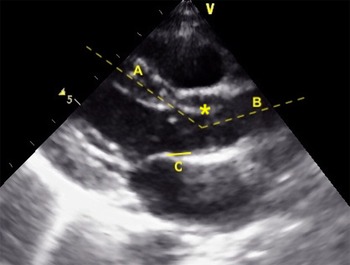
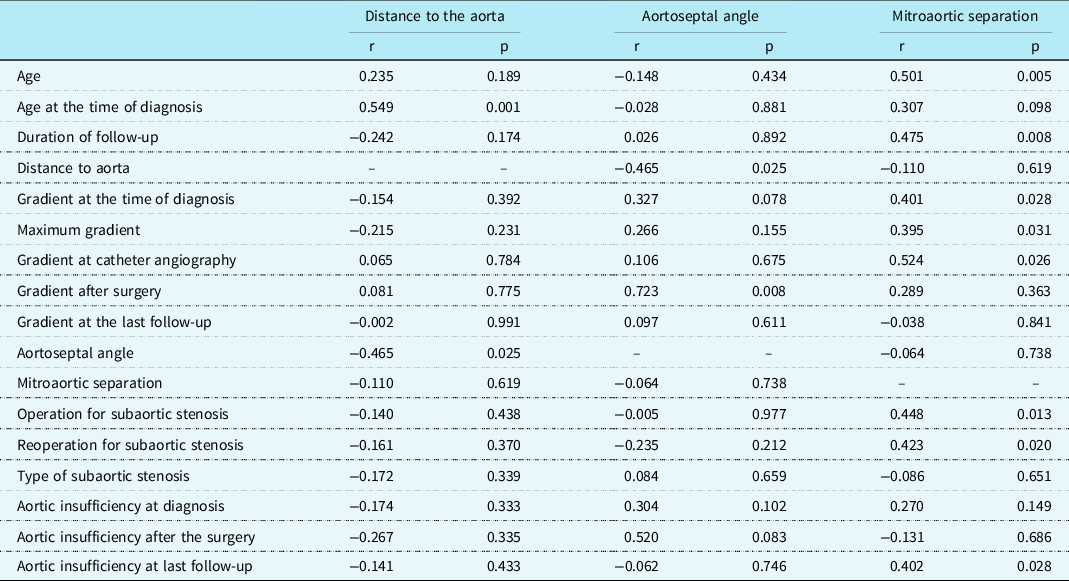
Subaortic ridge morphology was defined using 2D echocardiography and was confirmed with surgical morphology in patients who underwent surgery. The maximum instantaneous gradient was measured using colour flow, continuous and pulsed wave Doppler. Apical 5 chamber, subcostal and suprasternal long-axis views, and the cleanest spectral Doppler envelope were used for determining maximum gradient. Reference Lopez, Colan and Frommelt11,Reference Baumgartner, Hung and Bermejo12 Aortic insufficiency was assessed from multiple views by using colour flow Doppler and was graded qualitatively as none, trivial, mild, moderate and severe. Reference Lancellotti, Tribouilloy and Hagendorff13 Aortoseptal angle was determined by measuring the angle between the long axis of the aortic root and proximal ascending aorta and the midline of the interventricular septum Reference Masse, Shar, Brown, Keswani, Grande-Allen and Sucosky14 (Fig 1). Mitral-aortic valve separation was measured from the hinge point of the non-coronary aortic valve leaflet to the hinge point of the anterior mitral leaflet Reference Tutar, Atalay, Turkay, Gumus and Imamoglu4 (Fig 1). Aortoseptal angle and mitral-aortic separation were measured by Dicom viewer software (MicroDicom viewer®) virtual goniometer and caliper using DICOM views.
The measurement of the aortoseptal angle (indicated by asterix) obtained from the parasternal long-axis view in systole: the angle formed by the plane of the interventricular septum (dotted line A) and the long axis of the ascending aorta (dotted line B). Measurement of mitral-aortic valve separation: the distance from the hinge point of the non-coronary aortic valve leaflet to the hinge point of the anterior mitral leaflet (line C).

Catheter angiography
Catheter angiography included peak-to-peak gradient and the degree of aortic insufficiency. Aortic insufficiency was classified as none, trivial, mild, moderate and severe.
Statistical Analyses
Statistical analyses were performed using the statistical package program SPSS for Windows 22.0. The mean, standard deviation, and frequency were used for descriptive statistics. Student t-test and the Chi-square test were used for comparison of groups where appropriate. Pearson’s chi-square was used for correlation analysis. The confidence interval was given as 95 % and statistical significance was set at p < 0.05.
Results
One-hundred and two patients were diagnosed with subaortic stenosis at Ankara University Medical Faculty Pediatric Cardiology Department between the dates of 1993–2020. Patients with missing echocardiographic and/or angiographic data were excluded. As a result, the study included a total of 80 patients: 45 patients with isolated subaortic stenosis and 35 patients with CHD and subaortic stenosis.
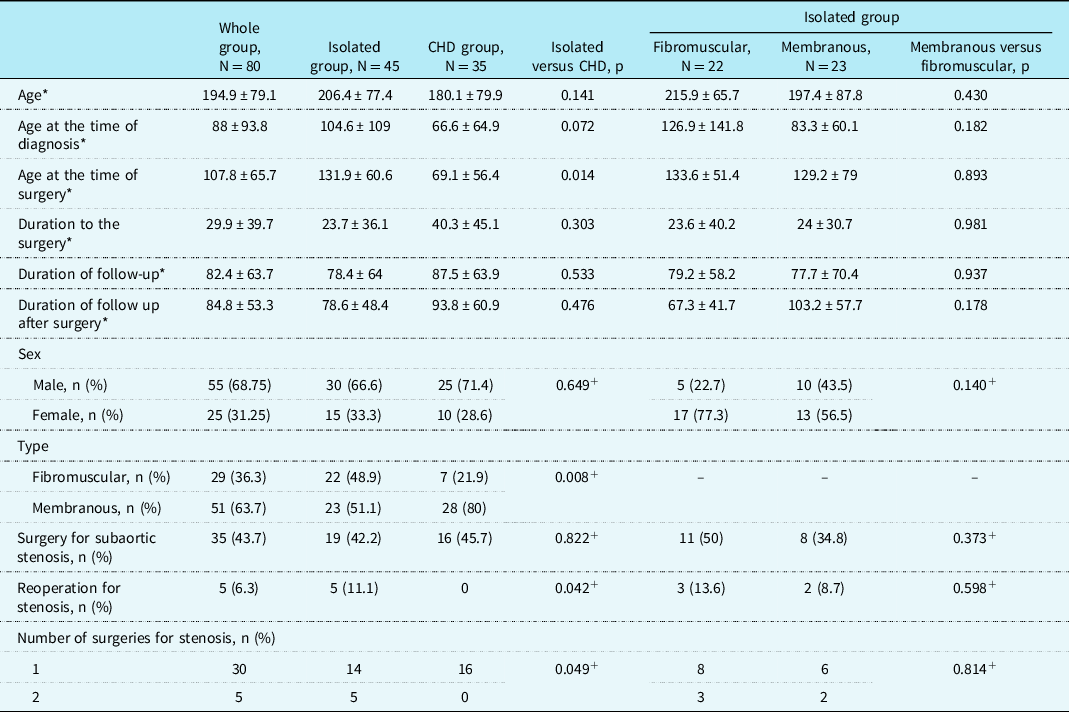
The demographic properties of the whole study group, CHD group and the isolated group are shown in Table 1. The distribution of CHDs was as follows: Ventricular septal defect (n = 23), coarctation of the aorta (n = 7), atrioventricular septal defect (n = 3), tetralogy of Fallot (n = 1), tricuspid atresia (n = 1). Although gender distribution was similar between groups, there was a significant male predominance in all groups (p < 0.05). The male/female ratio was 2.2, 2 and 2.5 in the whole, isolated and CHD group, respectively. The frequency of membranous type was significantly higher than the fibromuscular type in the whole and the CHD group (p = 0.014, p = 0.001 respectively), but it was similar in the isolated group.
Demographic properties of the patients

C angiography: Catheter angiography; p: Student t test; p+: Chi-square.
* Are expressed as mean±standard deviation in means of months.
A total of 35 patients had subaortic stenosis resection. Thirty patients underwent surgery only once, whereas five patients were reoperated. Twenty-six of 35 patients in the CHD group underwent surgery for CHD. Twelve had subaortic stenosis before the surgery for CHD and they had subaortic stenosis resection during the surgery. Subaortic stenosis developed after CHD surgery in 14 patients. In these patients, the mean duration for the development of subaortic stenosis was 34.91 ± 46.17 months. Only two of 14 patients, that underwent surgery for ventricular and atrioventricular septal defect had another surgery for stenosis. Two patients (both with a ventricular septal defect that did not require surgery) underwent surgery with the indication of subaortic stenosis. As a result, 16 patients in the CHD group had surgical relief of stenosis. Nineteen of 45 patients in the isolated group underwent surgery. All the patients in the isolated group underwent surgery with the indications described above but none of them underwent surgery with the indication of progressive aortic insufficiency. Five patients in the isolated group were reoperated and three of them were male. Reoperation was significantly higher in the isolated group than in the CHD group. Although the ratio of patients who underwent surgery was higher in the fibromuscular group than the membranous group, there was no significant difference in means of operation and reoperation between these two groups.
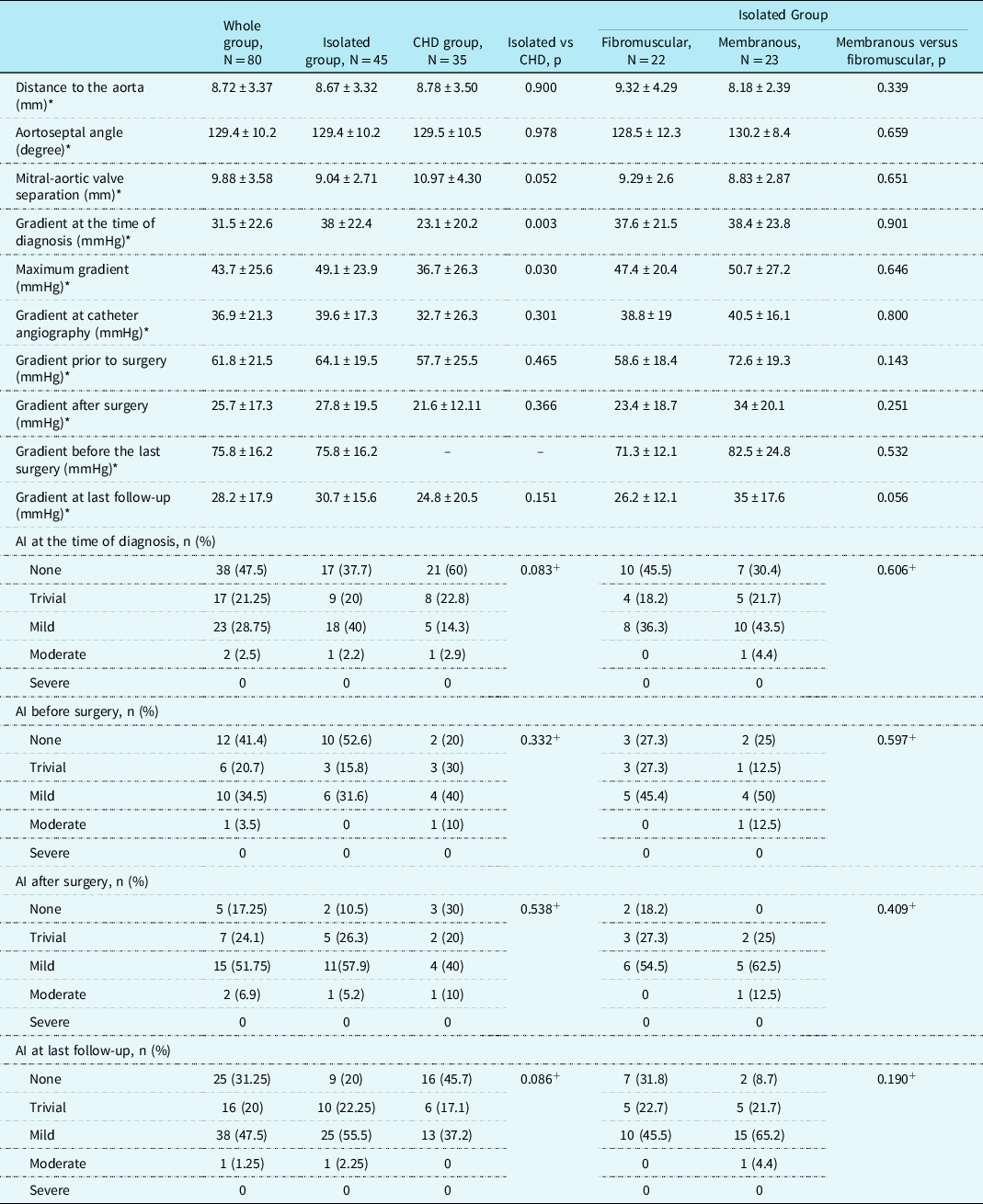
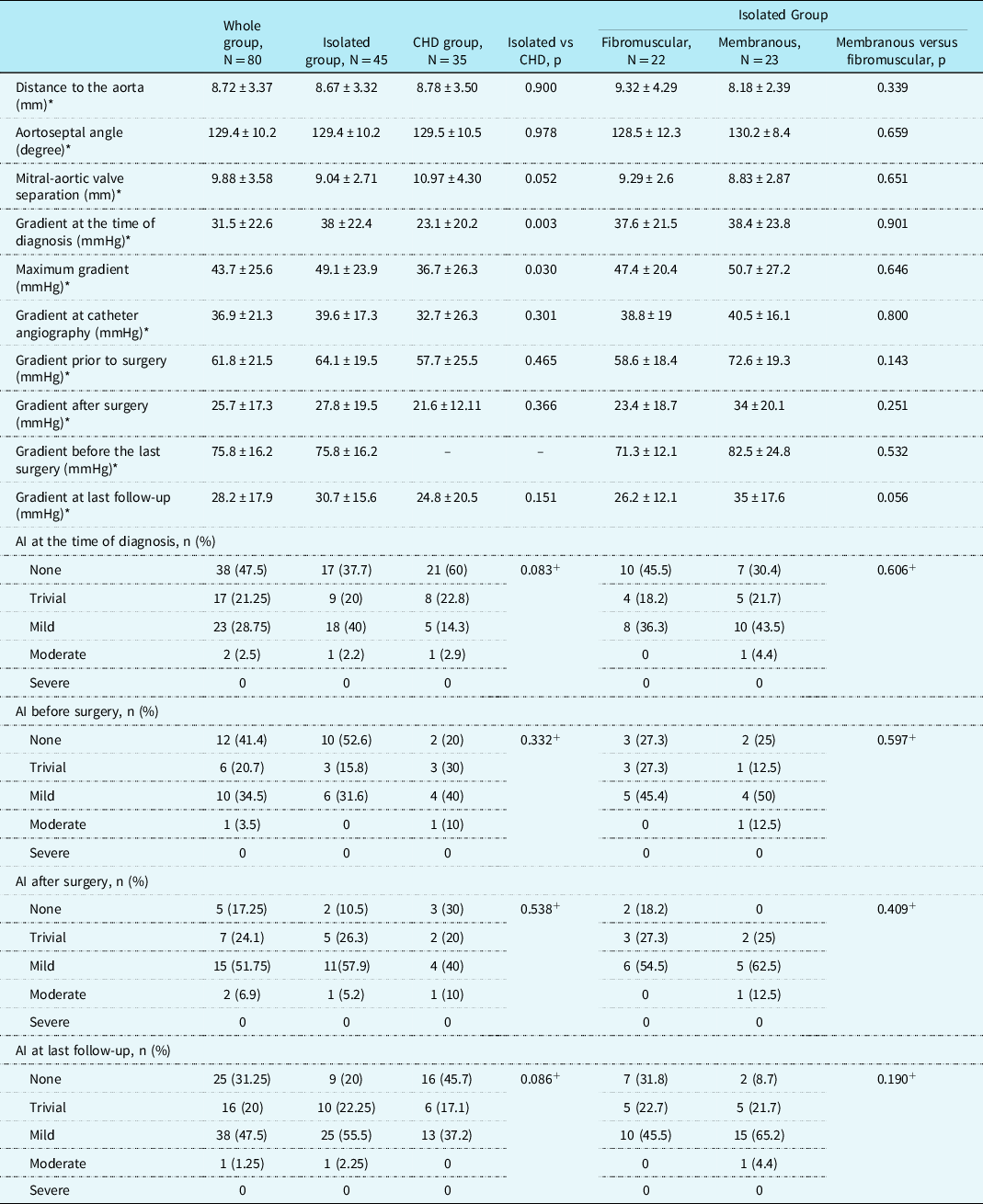
The echocardiographic and catheter angiographic data are shown in Table 2. The degree of aortic insufficiency was similar between the groups, but when aortic insufficiency was compared as none and present, the number of patients with aortic insufficiency was significantly higher in the isolated group at the last follow-up (p = 0.026). The distribution of aortic insufficiency at the time of diagnosis and the last follow-up in the isolated group were as follows, respectively: None: 11 versus 7, Trivial: 5 versus 6, Mild: 10 versus 13. At the last follow-up, none of the patients had severe aortic insufficiency.
Echocardiographic and angiographic data of the patients
AI: Aortic insufficiency; p: Student t test; p+: Chi-square.
* Are expressed as mean±standard deviation.
Correlation analysis of the whole group revealed a positive correlation between age and gradient at the time of diagnosis (p < 0.05). A positive correlation between the gradient at the time of diagnosis and aortic insufficiency at all times was observed. (At the last follow-up, p = 0.000, r = 0.425). Maximum gradient during follow-up was positively correlated with the gradient at the time of diagnosis, angiographic gradient, gradient before and after surgery, the gradient at the last follow-up and aortic insufficiency at all times. The mitral-aortic separation positively correlated with the age at the time of surgery and duration of time to surgery (p = 0.014, r = +0.585 and p = 0.010, r = +0.578 respectively) whereas aortoseptal angle positively correlated with gradient after surgery (p = 0.001, r = +0.702).
Correlation analysis of the isolated group revealed a positive correlation between age at the time of diagnosis and aortic regurgitation at catheter angiography (p = 0.006, r = +0.525) and after surgery (p = 0.015, r = +0.547). The gradient at the time of diagnosis was positively correlated with age (p = 0.030, r = 0.323), mitral-aortic separation (p = 0.028, r = +0.401) and aortic insufficiency at all times in the isolated group. The gradient at the last follow-up was positively correlated with aortic insufficiency at the last follow-up (p = 0.006, r = +0.405).
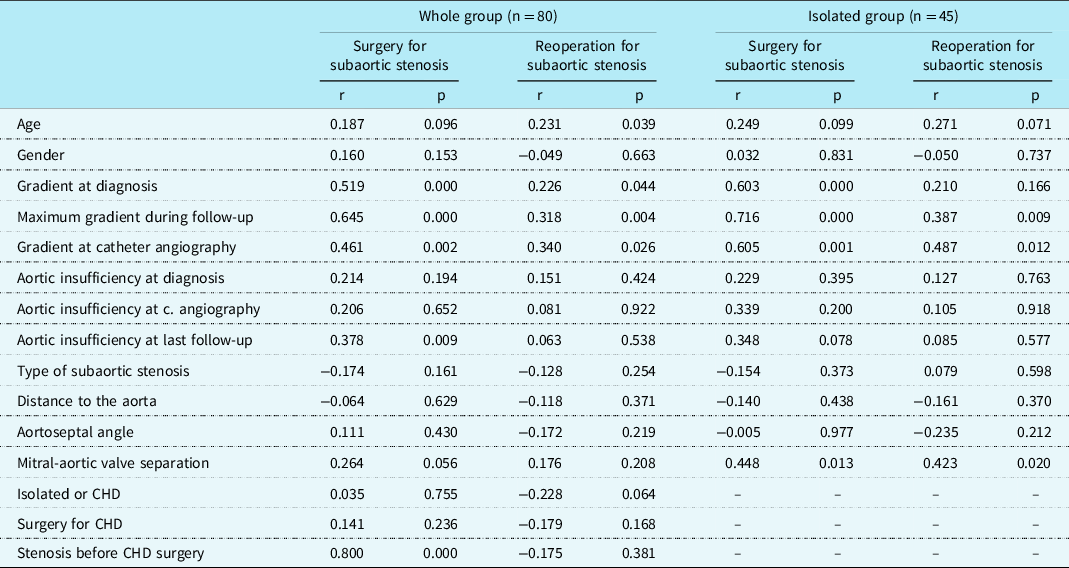
Factors correlated with surgery and reoperation for subaortic stenosis for the whole and isolated group are shown in Table 3.
Correlation analysis of both groups in means of surgery and reoperation for subaortic stenosis.
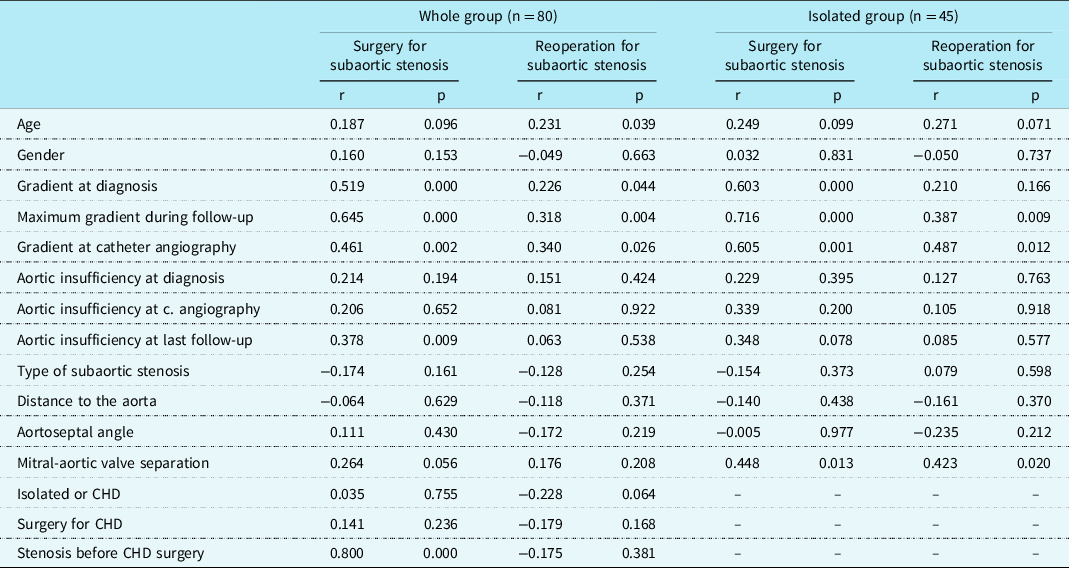
C angiography: Catheter angiography; Pearson Correlation Analysis.
Correlation of mitral-aortic separation, distance to the aorta, and aortoseptal angle with demographic, echocardiographic and angiographic parameters in the isolated group are shown in Table 4. Among these three parameters, mitral-aortic separation was the only parameter that correlated with surgery and reoperation.
Correlation of echocardiographic parameters
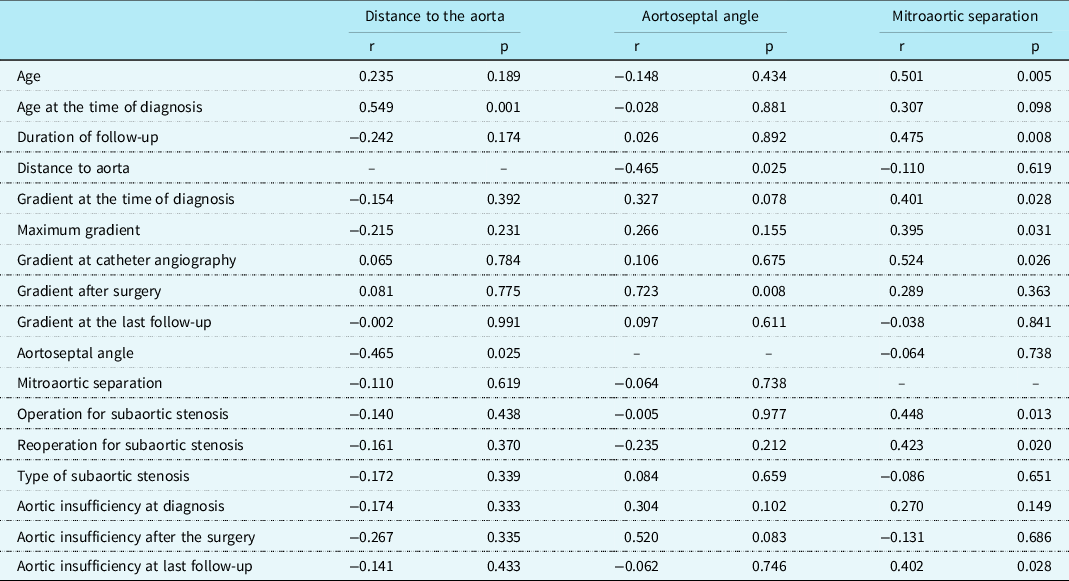
C angiography: Catheter angiography; Pearson Correlation Analysis.
Discussion
Subaortic stenosis is the second most common cause of left ventricular outflow obstruction in children, and it may be isolated or accompany other cardiac anomalies. Reference Friedland-Little, Zampi, Gajarski, Allen, Shaddy, Penny, Cetta and Feltes1 It is more common in males with a male to female ratio of 1.5:1–2.5:1. Reference Friedland-Little, Zampi, Gajarski, Allen, Shaddy, Penny, Cetta and Feltes1 In our study, there was a significant male predominance as previously reported and the male to female ratio was 2.2, 2 and 2.5 in the whole, isolated and CHD group, respectively. Subaortic stenosis is associated with other CHD’s in more than half of the patients. Reference Newfeld, Muster, Paul, Idriss and Riker15,Reference Choi and Sullivan16 The most common additional malformations are ventricular septal defect and coarctation of the aorta with a ratio of 10–48% and 6–20%, respectively. Reference Friedland-Little, Zampi, Gajarski, Allen, Shaddy, Penny, Cetta and Feltes1 Thirty-five patients in our study had CHD and the ratio of CHD was 43.75%. Similar to previous reports, the most common additional malformations in our study were ventricular septal defect (28.75%) and coarctation of the aorta (8.75%). The most common type is the membranous type which accounts for 70–80% of cases. Reference Friedland-Little, Zampi, Gajarski, Allen, Shaddy, Penny, Cetta and Feltes1,Reference Devabhaktuni, Chakfeh, Malik, Pengson, Rana and Ahsan17,Reference Abushaban, Uthaman, Selvan, Al Qbandi, Sharma and Mariappa18 Although 63.7 and 80% of cases in the whole and CHD group had membranous type; the frequency of membranous and fibromuscular type was similar in the isolated group (51.1% versus 48.9%) in our study. The mean age at the time of surgical resection was significantly lower in the CHD group. This is because the patients who underwent surgery for CHD also had subaortic stenosis resection irrespective of the severity of the stenosis.
Aortic insufficiency is an important complication that may develop in 50–70% of these patients over time. Reference Friedland-Little, Zampi, Gajarski, Allen, Shaddy, Penny, Cetta and Feltes1,Reference Devabhaktuni, Chakfeh, Malik, Pengson, Rana and Ahsan17 Unsurprisingly, in our study, the frequency of aortic insufficiency increased from 52.5%, 62.3%, and 40% to 68.75%, 80%, and 54.3% at the last follow-up in the whole, isolated and CHD group, respectively. The association between a higher gradient and aortic insufficiency has been confirmed by the previous studies Reference Abushaban, Uthaman, Selvan, Al Qbandi, Sharma and Mariappa18–Reference Karamlou, Gurofsky and Bojcevski20 . In our study gradient at the time of diagnosis and maximum gradient during follow-up was positively correlated with aortic insufficiency at all times, as previously reported. Besides gradient, mitral-aortic separation and surgery were also positively correlated with aortic insufficiency at the last follow-up. The correlation of gradient and surgery with aortic insufficiency is not surprising, as one of the proposed mechanisms of aortic insufficiency is long-term exposure to high-velocity jet. The degree of aortic insufficiency was similar between the groups, but when aortic insufficiency was compared as none and present, the number of patients with aortic insufficiency was significantly higher in the isolated group at the last follow-up (p = 0.026). We think that this may be due to two reasons: The primary disease of the patients in CHD may also cause aortic insufficiency; the patients in the CHD group had surgical resection earlier than the isolated group and the mean maximum gradient of the CHD group was significantly lower. Brauner et al Reference Brauner, Laks, Drinkwater, Shvarts, Eghbali and Galindo21 and Somerville et al Reference Somerville, Stone and Ross22 also reported that early surgical intervention can be beneficial in preventing progressive damage to the aortic valve.
Subaortic stenosis constitutes 20% of obstructions that require intervention in children. Reference Masse, Shar, Brown, Keswani, Grande-Allen and Sucosky14 The treatment of choice is surgical resection. The risk of early mortality of surgery is very low, but subaortic stenosis reoccurs in 20–30% of the patients after successful surgical resection. Reference Friedland-Little, Zampi, Gajarski, Allen, Shaddy, Penny, Cetta and Feltes1,Reference Tal, Golender, Rechtman, Tidhar and Erez3,Reference Vogt, Dische, Rupprath, de Vivie, Kotthoff and Kececioglu8 Uysal et al Reference Uysal, Bostan, Signak, Semizel and Cil2 reported that 64.6% of 66 children with subaortic stenosis underwent surgery and only 1 of the15 patients with recurrence required a second surgery. Tal et al Reference Tal, Golender, Rechtman, Tidhar and Erez3 reported that 26 of 34 patients with isolated subaortic stenosis underwent surgery and only 3 (12%) patients required reoperation. Two of these patients in this study were reoperated because of progressive aortic insufficiency. Binsamalah et al Reference Binsalamah, Spigel and Zhu23 reported that 12 (14%) of 84 patients who underwent resection of isolated subaortic stenosis required reoperation and one patient required reoperation twice at a median follow-up of 9.3 years. The median time to the first operation was 4.6 years. In our study, a total of 35 (43.7%) patients underwent surgery for subaortic stenosis. 16 (45.7%) and 19 (42.2%) patients in the CHD and isolated group underwent surgical resection. Although the rate of surgery was similar between the groups, 12 of 16 patients with CHD had surgical resection as they underwent surgery for CHD. All the patients in the isolated group underwent surgery with the indications described above but none of them underwent surgery or reoperation with the indication of progressive aortic insufficiency. Twenty-six of the patients in the isolated group did not undergo surgery. The distribution of aortic insufficiency in this subgroup at the time of diagnosis and the last follow-up respectively were as follows: None: 11 versus 7, Trivial: 5 versus 6, Mild: 10 versus 13. None of these patients had moderate or severe aortic regurgitation. We think that progression of aortic insufficiency in patients with lower gradients is slow. Therefore clinicians should feel safer in this group of patients and should prefer close follow-up instead of early surgery. The rate of reoperation was 14% at a mean follow-up of 84.8 ± 53.3 months and all the reoperated patients were in the isolated group. We believe that this difference is because most of the patients in the CHD group had surgical resection irrespective of the severity of the stenosis as they underwent surgery for CHD. Although the ratio of patients who underwent surgery was higher in the fibromuscular group than the membranous group, there was no significant difference in means of operation and reoperation between the fibromuscular and membranous groups.
Subaortic stenosis may cause progressive obstruction in children but the rate of progression varies among patients. Several factors have been opposed in the development of subaortic stenosis but factors leading to rapid progression are still unclear. Reference Friedland-Little, Zampi, Gajarski, Allen, Shaddy, Penny, Cetta and Feltes1,Reference Tutar, Atalay, Turkay, Gumus and Imamoglu4–Reference Mulla and Siddiqui7 Surgical resection is the ultimate treatment for the relief of obstruction. The most and well-known predictor of surgery is the gradient across left ventricular outflow tract. Reference Friedland-Little, Zampi, Gajarski, Allen, Shaddy, Penny, Cetta and Feltes1,Reference Mulla and Siddiqui7,Reference Brauner, Laks, Drinkwater, Shvarts, Eghbali and Galindo21,Reference Carlson, Pickard and Gauvreau24 Aortic and mitral annulus z score, longer left ventricular ejection time, the distance of the membrane to the aorta during systole, and other left-sided lesions have been proposed to correlate with surgery. Reference Karamlou, Gurofsky and Bojcevski20,Reference Carlson, Pickard and Gauvreau24 In our study, the gradient at the time of diagnosis and the maximum gradient during follow-up were the only predictors of surgery in both groups. The role of abnormalities in left ventricular outflow architecture in the development of subaortic stenosis has been previously shown. A steeper aortoseptal angle and wider mitral-aortic separation are the most strongly proposed anomalies. Reference Tutar, Atalay, Turkay, Gumus and Imamoglu4,Reference Kalfa, Ghez, Kreitmann and Metras25 In our study, mitral-aortic valve separation was positively correlated with surgery and reoperation just in the isolated group but in contrast to previous reports, we did not find any correlation between the aortoseptal angle and surgery. Although similar to previous studies we found a positive correlation between mitral-aortic valve separation and surgery/reoperation, this result must be interpreted carefully as in our study mitral-aortic valve separation was not indexed to body surface area. Tutar et al Reference Tutar, Atalay, Turkay, Gumus and Imamoglu4 and Kalfa et al Reference Kalfa, Ghez, Kreitmann and Metras25 both used an aortoseptal angle of <130° as a cut-off value and Tutar et al Reference Tutar, Atalay, Turkay, Gumus and Imamoglu4 also reported that an aortoseptal angle of <130° is a highly sensitive marker for possible development of subaortic stenosis. We failed to show any correlation of aortoseptal angle with surgery and reoperation even when we used 130° as a cut-off value in patients who underwent surgery for subaortic stenosis.
Although inadequate resection may be a factor for reoperation, reoperation is required in 15–20% of the cases with subaortic stenosis despite successful resection. Reference Devabhaktuni, Chakfeh, Malik, Pengson, Rana and Ahsan17 Increased peak gradient and early age at the time of diagnosis, tunnel-type stenosis, distance <5 mm between the membrane and aortic valve, peak Doppler gradient of >60 mmHg, concomitant cardiovascular defects (esp. coarctation of the aorta), younger age at initial surgery are risk factors for recurrence and reoperation. Reference Friedland-Little, Zampi, Gajarski, Allen, Shaddy, Penny, Cetta and Feltes1,Reference Geva, McMahon, Gauvreau, Mohammed, del Nido and Geva9,Reference Pickard, Geva, Gauvreau, del Nido and Geva10,Reference Abushaban, Uthaman, Selvan, Al Qbandi, Sharma and Mariappa18 Abushaban et al Reference Abushaban, Uthaman, Selvan, Al Qbandi, Sharma and Mariappa18 reported that age <6 years at initial repair to be an independent predictor of reoperation. In our study, all patients who were reoperated had a peak gradient of <25 mmHg after surgery except one patient who had a peak gradient of 50 mmHg. The earliest reoperation was 73 months after the first surgery in a patient with a post-operative gradient of 15 mmHg. Only one of these patients had the first operation at <6 years of age. None of the seven patients with coarctation of the aorta had reoperation. In our study, the maximum gradient during follow-up, the gradient at the time of diagnosis and catheter angiography were the most important factors for reoperation, as expected.
Aortoseptal angle, mitral-aortic separation and distance of membrane to the aorta are known to correlate with the development of subaortic stenosis, surgery and reoperation. In our study, among these parameters, only mitral-aortic separation correlated with surgery and reoperation in the isolated group. Contradictory to the previous reports, we failed to show any correlation of aortoseptal angle and distance of membrane to the aorta with reoperation. Aortoseptal angle just positively correlated with the gradient at the time of the diagnosis and after surgery.
Study limitations
This study is subject to the usual limitations of a retrospective study. The sample size is limited due to the rarity of the disease. Most of the data analysed are derived from echocardiography which is an operator-dependent examination. As the study covers 27 years, the examinations were performed by different paediatric cardiologists which may have some effect on the accuracy of the measurements. Another limitation is that none of the patients had tunnel-type stenosis. Also, the role of the aortic annulus in recurrence was not evaluated because some patients lack the data to calculate z scores of the aortic annulus.
Conclusion
Left ventricular outflow gradient is the most important predictor of the disease course. Higher initial gradients are associated with adverse outcomes, recurrence and reoperation. Progressive aortic insufficiency by itself is rarely an indication for surgery in patients with lower gradients. Early surgery may be beneficial in preventing aortic insufficiency but does not affect reoperation. The clinicians must evaluate these patients with regular close follow-ups and perform echocardiographic measurements precisely for surgical decision-making. Because the rate of reoperation and recurrence is high, and early surgery has no benefit on reoperation, the clinicians should avoid surgery unless it is really indicated.
Acknowledgements
None.
Financial support
This research received no specific grant from any funding agency, commercial or not-for-profit sectors.
Conflicts of interest
None.
Ethical standards
The authors assert that all procedures contributing to this work follow the ethical standards of the relevant national guidelines on human experimentation and with the Helsinki Declaration of 1975, as revised in 2008, and has been approved by the ethics committee of Ankara University.