Introduction
The welfare of older people in sub-Saharan Africa is gaining research and policy interest globally. The interest stems from multiple, contingent and closely-related issues in a combination that seems unique to the region. First, despite the life-curtailing effects of HIV/AIDS and other infectious diseases, Africans, on average, are living longer. Life expectancy is increasing in many countries and there are indications that the number of Africans aged 60 or more years, which is currently about 35 million, will double by 2030 (Velkoff and Kowal Reference Velkoff and Kowal2006). Second, the high mortality rate of the adult population due to HIV/AIDS has produced about 12 million orphans whose care usually falls on older relatives, especially grandparents (Joint United Nations Programme on HIV/AIDS 2006). Thus, older people have become the primary care-givers of not only younger adult children or relatives, but also of orphaned grandchildren affected by HIV/AIDS (HelpAge International 2002; Joint United Nations Programme on HIV/AIDS 2006; United Nations Children's Fund 2003).
Besides the grief associated with the loss of adult children, the care-giving responsibility is believed to be a source of additional stress, as HIV-affected households are more likely to experience reduced income, food insecurity and related health problems (Agyarko, Kalache and Kowal Reference Agyarko, Kalache and Kowal2000; Charlton and Rose Reference Charlton and Rose2001; Nyambedha, Wandibba and Aagaard-Hansen Reference Nyambedha, Wandibba and Aagaard-Hansen2001; Ogunmefun and Schatz Reference Ogunmefun and Schatz2006; Williams and Tumwekwase Reference Williams and Tumwekwase2001). Third, population ageing in sub-Saharan Africa coincides with rapid urbanisation (Ezeh et al. Reference Ezeh, Chepngeno, Kasiira, Woubalem, Cohen and Menken2006). Apart from the fact that older people have to negotiate the highly-monetised urban economies, urbanisation (together with persistent poverty) is believed to have resulted in the weakening of traditional family structures which used to cater for their needs. Fourth, in many sub-Saharan Africa countries today, there are no adequate welfare policies or systematic guidelines to address the interests and needs of older people (Apt Reference Apt1994; Cohen and Menken Reference Cohen and Menken2006).
Consequently, the rhetoric about ageing in sub-Saharan Africa is laden with the notion that ageing is problematic and stressful. Unfortunately, there is not much empirical evidence on how older people themselves perceive their ageing experience. As Makoni (Reference Makoni2008) succinctly pointed out, there is a sharp disconnection between discourses of ageing as a social problem and how individuals themselves experience ageing. Studies that examine how older people view their lives are few and far between in the region. It is therefore important to gather empirical evidence on the relevant drivers of life satisfaction for older people in sub-Saharan Africa.
Besides financial wellbeing and health status, commonly-cited contributors to life satisfaction among older people relate to their religious and non-religious social involvement. Drawing from the larger gerontology and medical literatures, it is evident that the salutary effects of participation in formal religious organisations, secular social support and informal interactions are not trivial for older people. Involvement in organised religious activity has been linked to a wide variety of outcomes including psychological wellbeing, depression, health, life satisfaction and self-esteem (Ellison, Gay and Glass Reference Ellison, Gay and Glass1989; Ellison and Levin Reference Ellison and Levin1998; Idler Reference Idler1994; Koenig Reference Koenig2001, 2006; Koenig, McCullough and Larson Reference Koenig, McCullough and Larson2001; Matthews et al. Reference Matthews, McCullough, Larson, Koenig and Swyers1998). Koenig (Reference Koenig2001) reviewed several studies of the relationship between social support and mental health and found a predominantly positive association. Although the effects of organised religion and social engagement on life satisfaction have been widely investigated among older people in various social contexts, they have not been examined in sub-Saharan Africa. Consequently, in addition to finding out the salience of social support structures for older people in urban areas, we have two motivations for our interest in the effects of religion. The first motivation stems from religion's centrality in the African social context (Gallup International 2000). In a recent global survey of who had the most the influence on one's decision-making in the last year, a significantly higher proportion of respondents in Africa (13%) indicated religious leaders, compared to the global average (5%) and other world regions (BBC News 2005). The second motivation comes from the recognition that religion provides a unique perspective on life outcomes. Recent studies in the region have demonstrated the link between religion and reproductive health-related outcomes including maternity-services utilisation, child mortality, fertility, contraceptive behaviour and sexual behaviour (seeDoctor, Phillips and Sakea Reference Doctor, Phillips and Sakea2009; Garner Reference Garner2000; Gyimah Reference Gyimah2007; Gyimah, Takyi and Addai Reference Gyimah, Takyi and Addai2006; Odimegwu Reference Odimegwu2005; Smith Reference Smith2004; Takyi Reference Takyi2003; Trinitapolis and Regnerus Reference Trinitapoli and Regnerus2006; Uecker Reference Uecker2008).
Therefore, the purpose of this paper is primarily to examine the implications of religious involvement and secular forms of social engagement on the general life satisfaction of older people in an African context. Given Africa's young age structure and shorter life expectancy, we define older people as aged 50 or more years. Using data from a sample of older men and women living in the informal settlements of Nairobi City, we investigate the effects of participatory and affiliation aspects of religiosity after controlling for the major predictors of life satisfaction, particularly aspects of family support, secular social participation and personal sociability. In the process, this study invariably examines other primary determinants of general life satisfaction. Situating the study in an urban context has also provided the opportunity to ascertain whether religion is a source of resilience for older people who are likely to be affected by weakening social support structures. Furthermore, against the background that older people living in poor settings may not have the social and economic resources to care for themselves, let alone to support HIV-affected dependants, examining these factors become important as policy solutions are sought to address their needs. In the context where dedicated senior-community institutions are virtually non-existent, it is important that policies seek workable solutions that improve the everyday life circumstances of older people. The remainder of the paper has four main sections. The theoretical background of this study is developed in greater detail in the next section. Following this, the study sample and measures are introduced. Finally, the empirical findings are reviewed and discussed.
Religion, social engagement and life satisfaction in older ages
Personal ageing takes place in a social context, with the individual belonging to a variety of formal and informal social settings – kinship, community, professional and organised religious institutions. The extent to which older people are embedded in such social networks greatly affects their experience of ageing. Modernisation, urbanisation and the attendant social change have been associated with changes in traditional social arrangements for older people in sub-Saharan Africa (Ezeh et al. Reference Ezeh, Chepngeno, Kasiira, Woubalem, Cohen and Menken2006). The rapidly changing social landscape has not only affected individual lifestyles and family structures, but also the role of the family as a primary support system for older adults. Consequently, changes in kinship ties, living arrangements and intergenerational roles are likely to have affected the nature of older urban residents' social-support exchanges, interactions and overall life satisfaction. Admittedly, individuals may or may not perceive such social changes in their lifetimes, but prevailing social forces are likely to condition expectations, adaptations and feelings of satisfaction about life in older ages.
The feeling of satisfaction with life is an essential element of subjective wellbeing, especially for older adults. Life satisfaction encompasses attitudes about psychological wellbeing and, specifically in gerontology research, is a near-synonym of ‘successful ageing’ (Neugarten Reference Neugarten1982; Tate, Lah and Cuddy Reference Tate, Lah and Cuddy2003). Even though the concept of life satisfaction may be highly subjective, it has useful psychological and social implications. Beyond capturing elements of personal contentment with life and positive self-worth, it also captures aspects of personal fulfilment in one's social circumstances. For older people, life satisfaction is characterised by low prevalence of disease and disability, high cognitive and physical function, and active engagement with life (Rowe and Kahn Reference Rowe and Kahn1997; Steverink, Lindenberg and Ormel Reference Steverink, Lindenberg and Ormel1998; Tate, Lah and Cuddy Reference Tate, Lah and Cuddy2003). It is also a good indication of the overall adjustment and adaptive coping ability of older adults. More importantly, studies have found that individuals with lower life satisfaction typically do not find it important to seek health care for age-related conditions and partly in consequence experience higher levels of depression, and poor health-related quality of life outcomes (Sarkissian, Hays and Mangione Reference Sarkissian, Hays and Mangione2002). Therefore, given the centrality of the notion of life satisfaction to successful ageing, what explains life satisfaction reflects, to a large degree, an assessment of the priorities older people place on different aspects of their lives (Cheng and Chan Reference Cheng and Chan2006).
Why then might religious commitment and involvement with people be expected to affect satisfaction in late life? The theoretical linkages are very down-to-earth and intuitively appealing. First, religious denominations are distinctive in terms of the kinds of lifestyles they proscribe and in the frameworks or lenses through which successful living is defined. Accordingly, studies have shown that the particular religious community to which individuals are integrated may affect their subjective wellbeing. The extent of affiliation or identity with a particular religious group may inadvertently define a subculture or worldview that impacts one's mental health. However, to the extent that denominations may tolerate pluralistic beliefs or may not emphasise their distinctive denominational traits, beliefs and lifestyles, the impact of religious affiliation may be weaker. Second, a number of studies suggest that older people are more likely to face long-term stressors – for example, chronic disease, disability and financial strains (Krause Reference Krause, Aneshensel and Phelan1999). When such strains arise, older people may have fewer options to deal with them and are likely to explore other forms of social arrangements to cope with life demands. Consequently, religiosity may become an especially practical adaptation for coping with difficulty.
One can add that personal faith influences individuals' worldview and interpretation of life and specific life experiences. Spiritually-minded and highly-religious people may draw on subjective elements of their spirituality in handling life situations. Moreover, routine religious practices such as prayer and meditation invariably affect the body's mechanism of handling stress and have been shown to have positive effects on mental health (Carlson et al. Reference Carlson, Speca, Patel and Goodey2000; Seeman et al. Reference Seeman, Albert, Lusignolo and Berkman2001). Third, religious attendance may contribute to subjective wellbeing by increasing the social integration of older people. Applying a principle of homology, a church or mosque may provide an organised setting in which individuals with shared values can interact regularly and nurture friendships and social ties (Ellison, Gay and Glass Reference Ellison, Gay and Glass1989). Fourth, frequent attendance at religious meetings brings people into contact with other people with similar experiences to which they attribute significant meaning. This in turn galvanises a sense of purpose and direction in life, fostering a more hopeful and optimistic attitude (Koenig Reference Koenig2001). As Fung and Carstensen (Reference Fung and Carstensen2000) pointed out, as people grow old they become increasingly aware they have fewer years to live. A growing awareness about finitude and the essence of time may lead older people to seek out relationships that are emotionally close, and to shed social ties regarded as unproductive. Given this consideration, it seems that the closely-tied social support systems that arise in religious settings may be especially attractive to older people. Not surprisingly, rates of religious attendance have been shown to be higher among older people than younger people (Idler Reference Idler1994; Krause Reference Krause2006).
While the informal social ties and cohesiveness that arise from religious settings may be emotionally supportive, social integration can also be provided by secular forms of social involvement – for instance, through personal sociability, social support and participation in voluntary community organisations. Based on the theoretical principle that individuals want to get the most benefit out of productive interactions, and withdraw from unproductive ones, those who, for example, frequently participate in voluntary social activities are likely to derive greater satisfaction from those activities than others. Furthermore, individuals who are sociable are likely to have positive feelings towards a wider range of people and tend to have more positively-reciprocated social encounters. There is also evidence of the positive effects of family and secular social support on life satisfaction. The question that arises, therefore, is whether religious and secular forms of engagement satisfy similar social needs for older adults. In other words, is there an independent life satisfaction effect of participation in a religious organisation? To answer this question, analyses of the effect of religious participation should control for the influence of secular social engagement. Moreover, conceptually, to the extent that physical function determines life satisfaction, it is conceivable that declining health would tend to be associated with increased social support (especially instrumental help), and reduced social activity (including religious activity). Thus, apart from measures of secular social engagement, one needs to control for various dimensions of functional health.
Beyond controlling for functional health, most studies of life satisfaction or psychological wellbeing recognise other predictors, especially socio-demographic and socio-economic variables. Studies of the influence of religion on life satisfaction have found that among these, religion accounts for a small fraction of the variability in life satisfaction (Witter et al. Reference Witter, Stock, Okun and Haring1985). Financial wellbeing has been shown to be a key predictor, for it commonly correlates positively with life satisfaction in the general population and especially among older people (Deaton Reference Deaton2007). Previous research also strongly suggests that older men tend to have higher life satisfaction than women, likewise married people (Cheng and Chan Reference Cheng and Chan2006; Levin and Taylor Reference Levin and Taylor1993). Studies in economics and gerontology of life satisfaction in cross-sectional samples (mostly in Western societies) have typically observed a U-shaped age profile (Clark and Oswald Reference Clark and Oswald2000; Easterlin Reference Easterlin2006). Furthermore, in the United States of America and other ethnically-diverse regions of the world, ethnic differences in life satisfaction have been observed (Krause Reference Krause2004; Levin, Chatter and Taylor Reference Levin, Chatter and Taylor1995).
The literature reviewed so far suggests that after controlling for key socio-demographic and socio-economic background factors and health status, we expect a weak positive relationship between religious belonging or affiliation, religious attendance, and life satisfaction. Furthermore, given the evidence that various aspects of individual social involvement have positive effects on life satisfaction, we also expect that measures of social integration will maintain a positive effect on life satisfaction over and above what is explained by religious engagement and other primary determinants.
Data and methods
The data come from the ‘ageing’ component of a Wellcome Trust-funded multi-year research programme on the linkages between urbanisation, poverty and health dynamics across the lifecourse. This study is nested in the longitudinal Nairobi Urban Health and Demographic Surveillance System (NUHDSS) that is being conducted by the African Population and Health Research Center in two slum communities in Nairobi. In 2006/7, a sub-sample of about 2,608 men and women aged 50 or more years were interviewed about a broad range of issues including living arrangements, their use of health services, social support, and socio-demographic and socio-economic factors. They were also asked various questions requiring self-assessments of their health and wellbeing.
The dependent variable
The recent gerontology and medical literatures include numerous studies of various dimensions of the quality of life (QOL) among older people. While some authors focus on understanding the health and functioning, others focus on elements of their subjective psychological wellbeing. Conceptually, psychological wellbeing has two distinctive components: cognitive and affective (Cheng Reference Cheng2004). Measures that capture cognitive dimensions are believed to reflect stable traits of the individual and are more amenable to sociological influences than affective measures, which tend to be more transient. Given the complexity of the concept and measurement of psychological wellbeing, a combination of domain-specific measures of life satisfaction was therefore believed to be better than a single measure – this approach has become standard practice (Neugarten Reference Neugarten1982). Further, the literature indicates that simpler multidimensional indexes are just as useful as more complex approaches such as factor analysis or latent variable analysis. From exploratory analyses of the questions capturing subjective wellbeing, we retained three questions, all of which allowed five category responses scaled and recoded such that higher values indicate better performance. They are: Taking all things together, how satisfied are you with life as a whole these days? How would you rate your overall quality of life? Taking all things together, how happy would you say you are these days? We standardised the responses to these questions, setting the mean at zero and the variance as 1.0, and derived a composite index by summing values across questions (mean 0, standard deviation (SD) 0.86, range −2.8 to 2.0). Cronbach's alpha for the index was 0.83.
The primary independent variables
Like life satisfaction, religiosity is a multidimensional construct that captures elements of religious community belonging (affiliation), participation and personal devotion or spirituality. The available data allowed us to focus on two dimensions: participation in religious activities and individual affiliation with a religious community. Religious affiliation was coded as ‘Catholic’, ‘non-Catholic Christian’ (comprising protestant Christians, Pentecostals, and members of smaller Christian denominations), ‘Moslem’, and ‘unaffiliated’ for those who reported no religious affiliation. Religious participation captures the frequency of religious attendance – we created a dummy variable that captured whether the respondent attended religious services frequently (at least weekly).
We also examined three aspects of social engagement: sociability, extended family support and voluntary community participation. These variables include the number of close friends; whether the respondent receives material or financial support from relatives other than own children; and a composite index of the intensity of community participation, derived from three questions: frequency of attending social meetings during the last four months, frequency of community volunteering in the last four months, and frequency of meeting the community leader in the last four months. Cronbach's alpha for the voluntary community participation index was 0.93, with an average inter-item correlation of 0.87, indicating that the index captured very well the intensity of social participation construct.
The control variables
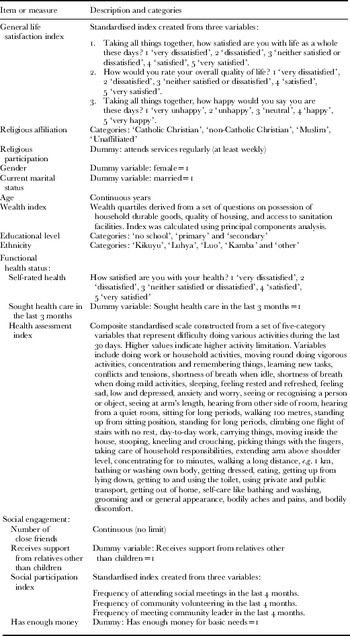
Finally, we included variables that have frequently been shown to associate with life satisfaction: socio-demographic attributes (including age, gender, marital status, level of education, household wealth), self-rated overall health (five-point scale, with higher values indicating better health status), subjective health assessment index, and whether the respondent had sought health care for a severe illness during the previous three months. Subjective health was measured using a standardised composite index based on responses to a battery of questions from the short form of the individual Study on Global Ageing and Adult Health (SAGE) module developed and tested by the World Health Organisation. SAGE captures the extent of difficulty or limitations during the last 30 days in multiple domains of health including physical mobility, self-care, vision, pain and discomfort, cognition, interpersonal activity, sleep and energy. Higher values on the general health variable mean worse health condition. Finally, to capture the dimension of financial wellbeing, we also included a dummy variable that captured whether the respondents had enough money to meet their basic needs. Details of the coding scheme for variables included in the analysis are presented in Table 1.
Measures of general life satisfaction among elderly slum residents in Nairobi

Results
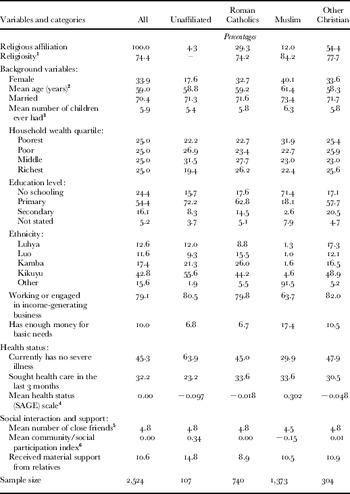
On the whole, the respondents were only fairly satisfied with the various domains of their lives. The descriptive statistics for the analysis sample are presented in Table 2. The respondents were predominantly male (66%) and married (70%), and the mean age was 59 years. Most (79%) of the respondents were working or undertook some form of income-generating activity. The majority of the sample were Christians, with non-Catholics making up 54 per cent of the entire sample followed by Catholics (29%). Across the religious affiliations, many (74%) attended religious services at least once a week. There were no major differences between the religious groups in the socio-demographic, economic, health and other characteristics, except that Moslems attended services slightly more frequently and regularly, but the differences were not statistically significant. The Moslems were less likely to have had any formal schooling, to be working, and their household wealth was more likely to be in the lowest or poorest quartile even though, compared to those adherent to other religions, a higher percentage reported they had enough money to meet basic needs. The Moslems were predominantly from a number of small ethnic groups, most from the coastal areas of Kenya and the frontiers with Somalia. They were three to four times more likely than other religious groups to have had no formal schooling, and they had the worst health status, being more likely to have severe illnesses and to score low on overall functional health status. Moslems were also the least socially-engaged in terms of participation in communal and social activities.
Profile of the sample and the religious groups
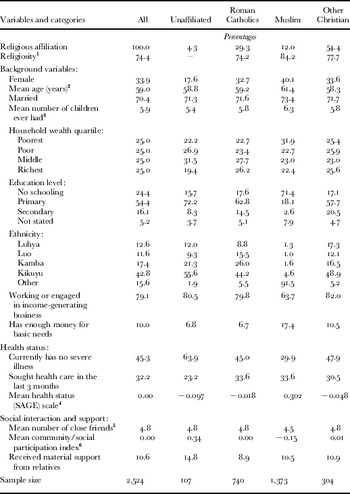
Notes: 1. Attends religious services at least weekly. 2. Standard deviation (SD) 9.0. 3. SD 2.8. 4. SD 0.65. 5. SD 7.32. 6. SD 0.95. SAGE: Study on Global Ageing and Adult Health.
The multivariate analysis
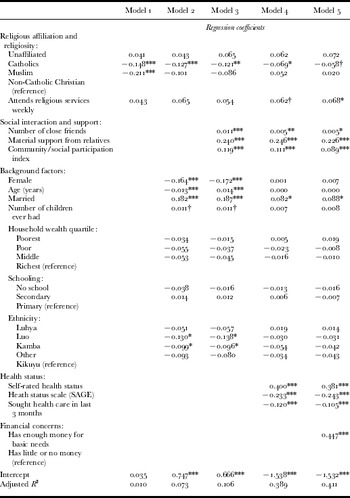
We ran a series of nested ordinary least-squares regression models with the general life satisfaction index as the dependent variable in each (see Table 3). Model 1 shows the effects of religious affiliation and attendance. In subsequent models, we added blocks of variables to examine the effects on life satisfaction of the socio-demographic and socio-economic background factors, social integration, functional health, and financial welfare. Model 1 shows that religious belonging or affiliation had a significant effect on general life satisfaction at the bivariate level. Catholics and Moslems reported being less satisfied than non-Catholic Christians. We also observed a positive effect for respondents who reported no religious affiliation and for individuals who attended religious services frequently (at least once a week); however, these effects were not statistically significant.
Multivariate regression: effects of religious affiliation, religiosity, social integration and other predictors on general life satisfaction among older people in Nairobi informal settlements

Notes: The sample size for all models was 2,524. SAGE: Study on Global Ageing and Adult Health.
Significance levels: †p<0.10, * p<0.05, ** p<0.01, *** p<0.001.
In Model 2, we find that the socio-demographic and socio-economic variables together with religion explained 7 per cent of the variance in life satisfaction. Most of the independent variables had the expected signs, but there were significant differences between men and women, married and unmarried people and some ethnic groups; for example, women reported lower satisfaction than men, and married respondents were more satisfied. We also note that after controlling for background factors, the effect of belonging to the Islamic religion was no longer significant, which may imply that differences in life satisfaction between Moslems and non-Catholic Christians are mostly explained by the differing background factors. Model 3 added the social engagement variables. The directions and magnitudes of effects of the religious and background variables were substantially unchanged, suggesting that religious involvement and social engagement made independent influences on general life satisfaction. Consistent with the hypotheses, the number of close friends, the presence of family support, and the intensity of social participation, all had strong positive effects on general life satisfaction.
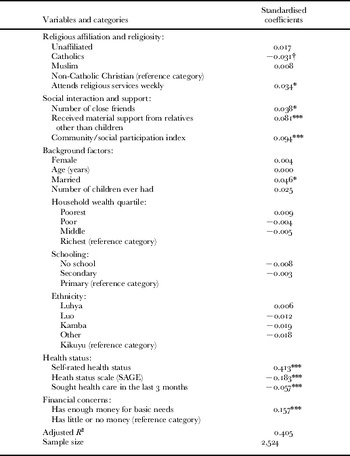
Model 4 incorporated the functional health status variables, which greatly attenuated the effects of most background explanatory variables and to some extent the Catholic/non-Catholic Christian effect, but not the social integration effect. The explained variance increased substantially from 11 per cent for Model 3 to 39 per cent for Model 4. In essence, Model 4 shows that health-related factors are the key drivers of life satisfaction among older people in the slums. This finding supports the growing empirical evidence that health is of prime importance in the wellbeing of older people. To ascertain the separate contribution of financial wellbeing on life satisfaction, Model 5 added a dummy variable for whether or not the respondent had enough money for their basic needs. It demonstrates a strong positive effect of financial wellbeing on life satisfaction, controlling for other predictors of satisfaction. In the final model, the social engagement variables maintained their significant positive effects, and likewise the Catholic/non-Catholic Christian difference remained. The direction of the effect changed for Moslems but the effect was not significant. We also found that the frequency of religious service attendance, which was not significant in the early models, became significant at the 5 per cent level in the final model. Finally, after controlling for functional health and financial status, socio-demographic variables such as gender and age lost their statistical significance, but the dummy for being married maintained its positive effect in all the models. To compare the effect sizes of the predictors, we estimated Model 5 with standardised (z scores) predictors (see Table 4). The results indicate that self-rated health, health status and sufficiency of money for basic needs were the leading predictors of life satisfaction. Community participation and extended family support contributed significantly, next to health and money.
Multivariate regression: predictors of general life satisfaction among older people in Nairobi informal settlements

Note: SAGE: Study on Global Ageing and Adult Health.
Significance levels: †p<0.10, * p<0.05, *** p<0.001.
Discussion and conclusions
This paper has investigated the unique contributions of religious involvement and secular social factors to life satisfaction among older people living in two slums in the City of Nairobi. The urban context coupled with the poverty and deprivation of the sample provides a distinctive setting which allowed us to investigate how some support structures, other than family, may affect life satisfaction among older residents. We found that both religious and non-religious forms of social involvement mattered but to different extents. The religious variables accounted for a small but important part of the explanation of life satisfaction. Catholics had significantly lower levels of satisfaction than non-Catholic Christians (Evangelicals, Charismatics, Pentecostals and members of smaller independent churches), and this difference persisted even after controlling for other factors. Unlike Moslems, the Catholic ‘effect’ could not be attributable to differences in socio-demographic and socio-economic factors. Specific doctrinal differences and denominational traits may account for their distinctiveness. It is commonplace in many settings in sub-Saharan Africa that the worship experience of Pentecostal and Evangelical churches tends to be associated with messages of hope, including expectations of divine miracles for healing and material provision. It is likely that the positive emotions engendered from exposure to such messages may counteract negative feelings from the stresses of daily life. In addition to specific denominational differences, we found that regular religious service attendance was positively associated with life satisfaction.
Not only did this study support previous studies on the effects of religiosity, it also confirmed previous evidence that secular social support, personal sociability and community participation have positive effects on subjective wellbeing in late life (Bukov, Maas and Lampert Reference Bukov, Maas and Lampert2002; Diener et al. Reference Diener, Suh, Lucas and Smith1999; Fiori, Antonucci and Cortina Reference Fiori, Antonucci and Cortina2006; Seeman et al. Reference Seeman, Albert, Lusignolo and Berkman2001; Van Willigen Reference Van Willigen2000). In this context, we observe that the salutary effects of social involvement may be more salient than religious participation and identity. Specifically, we found that extended family ties and support (material and financial) contribute significantly to the psychological wellbeing of older people. Beyond extended family support, relationships formed in the secular world – having close friends and engaging in community activities – substantially affect life satisfaction. Positive social relations satisfy one of the fundamental human needs for belonging and provide the necessary support for daily living and for difficult times. However, ageing affects social relations because of lifecourse transitions such as retirement, ‘the empty nest’ and physical health limitations associated with ageing (Bukov, Maas and Lampert Reference Bukov, Maas and Lampert2002). In the light of this evidence, there is the need to encourage older people to build family cohesion and for community health policies to foster the provision of family care. However, in the face of declining family support due to urbanisation, it is important to encourage older people to expand their social networks and strengthen their inter-personal and community ties.
Undoubtedly, the strongest observed relationships were related to the participants' health status and financial situation. Even though the final model explained only 41 per cent of the variance in general life satisfaction, a substantial proportion was attributable to various dimensions of health status (28%), and the standardised coefficients for the health-related variables were the largest. Furthermore, the single variable measuring whether or not respondents had enough money for basic needs explained about 3 per cent of the variance in life satisfaction. These findings buttress existing literature and underscore the point that cross-culturally, health status and financial condition are the primary drivers of subjective wellbeing in older ages (Bowling et al. Reference Bowling, Farquhar, Grundy and Formby1993; Girzadas et al. Reference Girzadas, Counte, Glandon and Tancredi1993; Liang, Levin and Krause Reference Liang, Levin and Krause1989; Usui, Keil and Durig Reference Usui, Keil and Durig1985).
This study has some limitations. First, the results derive from cross-sectional data. Therefore, the temporal ordering of variables and constructs used in the analyses were based on theoretical considerations and empirical generalisations. Admittedly, one could reverse the causal ordering of our primary variables or specify mediating and interaction mechanisms (some of which we have tested). Thus, for further research, issues of causality must be evaluated with longitudinal data. Second, we are unable to capture aspects of the quality of relationships and support. Thirdly, we did not have measures of personal devotion to capture aspects of spirituality, which may be more meaningful in determining life satisfaction.
Acknowledgements
We thank the staff of the African Population and Health Research Center for collecting and organising the data. Many thanks also to Gloria Langat for helpful comments on earlier drafts of the paper. This work was supported by The Wellcome Trust (grant no. GR078530M), under the Urbanisation, Poverty and Health Dynamics Project; The Rockefeller Foundation (grant no. 2004AR037) and The Hewlett Foundation (grant no. 2006-8376).