


Introduction
What is major depressive disorder?
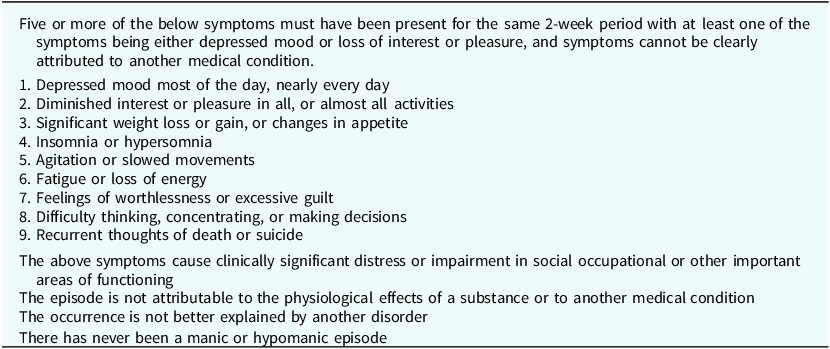
Major depressive disorder (MDD) is a common mental health problem characterised by persistent feelings of sadness, hopelessness, and loss of interest in activities that were once enjoyable. Symptoms of MDD can vary from person to person but may include a persistent sadness, loss of energy, difficulty sleeping, changes in appetite or weight, feelings of guilt or worthlessness, difficulty concentrating or making decisions, and thoughts of suicide or self-harm. To meet the diagnostic criteria, a person must experience five or more symptoms for at least 2 weeks. See Table 1 for the diagnostic criteria for MDD from the DSM-V (American Pyschiatric Association, 2013).
DSM-V criteria for major depressive disorder

From American Psychiatric Association (2013; p. 161).
Estimates of prevalence in 2000 were approximately 16 per 100,000 per year for men and 25 per 100,000 per year for women worldwide (Üstün et al., Reference Üstün, Ayuso-Mateos, Chatterji, Mathers and Murray2004). The Global Burden of Disease (GBD, 2019) reported that depressive disorders accounted for the largest proportion of mental disorders in 2019 (approximately 37.3%). In addition, Santomauro et al. (Reference Santomauro, Herrera, Shadid, Zheng, Ashbaugh, Pigott, Abbafati, Adolph, Amlag, Aravkin, Bang-Jensen, Bertolacci, Bloom, Castellano, Castro, Chakrabarti, Chattopadhyay, Cogen, Collins and Ferrari2021) estimated a further 27.6% increase in MDD due to the COVID-19 pandemic. In terms of impact, MDD is associated with significant burdens including decreased quality of life, functional impairment, suicide, cardio/cerebral mortality, disability, and economic and family burdens (Lepine and Briley, Reference Lepine and Briley2011).
CBT as an effective treatment for MDD
In randomised control trials (RCTs), cognitive behavioural therapy (CBT) for the treatment of MDD has demonstrated efficacy compared with control/waitlist groups (Beltman et al., Reference Beltman, Voshaar and Speckens2010; Van Straten et al., Reference Van Straten, Geraedts, Verdonck-de Leeuw, Andersson and Cuijpers2010) and is as effective as other forms of psychological therapy (Barth et al., Reference Barth, Munder, Gerger, Nüesch, Trelle, Znoj, Jüni and Cuijpers2013; Cuijpers et al., Reference Cuijpers, Muñoz, Clarke and Lewinsohn2010; Cuijpers et al., Reference Cuijpers, Berking, Andersson, Quigley, Kleiboer and Dobson2013; Hofmann et al., Reference Hofmann, Asnaani, Vonk, Sawyer and Fang2012). CBT is more effective than relaxation (Jorm et al., Reference Jorm, Morgan and Hetrick2008) or psychodynamic therapy (Tolin, Reference Tolin2010). This is not only true within study conditions; more recently, a systematic review and meta-analysis by Öst et al. (Reference Öst, Enebrink, Finnes, Ghaderi, Havnen, Kvale, Salomonsson and Wergeland2023) found that CBT for MDD is an effective treatment when delivered in routine clinical care, with outcomes comparable to those obtained in efficacy studies.
Although CBT is sometimes considered a monolith, it is more akin to a family of therapies with similarities and differences. Even within the treatment of MDD, there is cognitive therapy (CT) based on Beck (Reference Beck1979) and behavioural activation (BA) based on Martell et al. (Reference Martell, Addis and Jacobson2001) and Lejuez et al. (Reference Lejuez, Hopko and Hopko2001). In England, the National Institute for Health and Care Excellence (NICE) recommends these as front-line treatments delivered either individually or in groups. According to NICE guidelines, these CBT-based treatments should be considered first before exploring other modalities such as group exercise, mindfulness, interpersonal therapy, SSRI anti-depressants, counselling, and short-term psychodynamic psychotherapy (NICE, 2022).
Group delivery of CBT for MDD
Initially developed as an individual therapy (Beck, Reference Beck1979), CBT delivered in a group format has been found to be effective, with meta-analyses of RCTs of group CBT for MDD reporting good efficacy (Cuijpers et al., Reference Cuijpers, van Straten, Andersson and van Oppen2008; Feng et al., Reference Feng, Chu, Chen, Chang, Chen, Chou, Chang and Chou2012; Huntley et al., Reference Huntley, Araya and Salisbury2012). A more recent network meta-analysis by Cuijpers et al. (Reference Cuijpers, Noma, Karyotaki, Cipriani and Furukawa2019) highlighted that the efficacy of individual, group, telephone, and guided self-help CBT formats did not differ significantly. In addition, individual and group formats were more acceptable to clients.
In England, the majority of CBT for mild to severe MDD is delivered through the NHS Talking Therapies Programme (formerly known as Improving Access to Psychological Therapies or IAPT). This national initiative aims to improve access to evidence-based psychological therapies for individuals with common mental health disorders such as anxiety and MDD. Group CBT is a commonly offered treatment option within the NHS Talking Therapies programme, with a total of 23,868 clients receiving group CBT between 2021 and 2022 in England (NHS Digital, 2022). The data further indicate that group CBT for MDD yields promising results, reducing PHQ-9 scores from an average baseline score of 12.2 to an average final score of 9.2 over the same period (NHS Digital, 2022). The prevalence of group CBT in the NHS Talking Therapies programme is consistent with the NICE guidelines for MDD (NICE, 2022), which recommend group CBT as a second-line intervention.
In terms of benefits, group CBT provides frequent and varied opportunities for mutual reinforcement and peer modelling (Wolgensinger, Reference Wolgensinger2015), which is much more powerful than reinforcement by a therapist alone (Rose, Reference Rose, Price, Hescheles, Rae Price and Price1999). Group CBT is considered cost and time efficient for treating many patients (Kwon and Oei, Reference Kwon and Oei2003; Oei and Dingle, Reference Oei and Dingle2008). Therefore, given the need to improve access to talking therapies and meet targets, many services use group treatments (Wykes, Reference Wykes2013). The NICE guidelines for MDD (NICE, 2022) note benefits of connecting with others who are having similar experiences.
However, this is not to say that group CBT has no disadvantages. These may include possible confrontations between participants, the development of sub-group/cliques, and participants talking over each other (Tucker and Oei, Reference Tucker and Oei2007). Group CBT may not be suitable for people with recurrent MDD, co-morbidity, or those who need reasonable adjustments (e.g. language or accessibility). Finally, when reviewing the NHS Talking Therapies data from NHS Digital (2022), it is unclear what constitutes group CBT, as it is described as ‘psychoeducational peer support’ but it is not clear whether all services have a shared understanding of what this entails. For instance, do they all use the same interventions? Is there any difference in the intensity or number of sessions? Is there consensus about group size? Do they all involve rigorous quality assurance?
Influence of culture on the presentation and treatment of MDD
Culture can be described as the behaviours, norms, ideas, attitudes and traditions that exist within groups of people and are typically explicitly/implicitly communicated. Examples include whether one takes their shoes off or keep them on within the house, eating etiquette, rules around personal space, communication styles, greeting customs, and family structures. Whatever it is, if one has a typical pattern of behaviour; where did they learn this norm? Are there any explicit messages or implicit meanings that have been conveyed? If one has a typical pattern of behaviour, one’s culture helps to understand the origins of such norms and their associated meanings.
In the context of healthcare, culture inevitably impacts every aspect of illness and adaptations, such as responses to symptoms, explanations of illness, patterns of coping, help-seeking behaviour, adherence to treatment, and even emotional expression (Helman, Reference Helman2007).
This is also true with MDD, as culture influences the expression of symptoms, illness explanation, and pathways to care (Patel, Reference Patel2001). In many cultures, physical symptoms are the most common presenting feature, and they are more likely to be expressed than psychological symptoms (Aichberger et al., Reference Aichberger, Schouler-Ocak, Rapp and Heinz2008; Bhugra and Mastrogianni, Reference Bhugra and Mastrogianni2004; Desjarlais et al., Reference Desjarlais, Eisenberg, Good and Kleinman1995). Culturally bound descriptions are more likely to be used; for instance, clients from Iraq may be more likely to describe ‘oppression in the chest’ or ‘hunger for air’ than depression (Al-Krenawi and Graham, Reference Al-Krenawi and Graham2000). Some clients from Arabic backgrounds are more likely than Western clients to describe aches, pains and weakness (Sulaiman et al., Reference Sulaiman, Bhugra and de Silva2001).
In terms of the explanation of illness, this also varies too. With culturally specific presentations and understanding resulting in culturally specific syndromes such as ‘Brain Fag’, ‘Ode-ori’, ‘Hwa-byung’ or ‘Neurastheni’ (Kirmayer, Reference Kirmayer2001). Kleinman et al. (Reference Kleinman, Anderson, Finkler, Frankenberg and Young1986) reported that 30% of clients attending out-patient clinics in Hunan, China were diagnosed as ‘neurathenic’ (meaning having neural weakness) as this was more common and acceptable than depression. A more recent example comes from Taiwan, where Chen (Reference Chen2021) reported on the emergence and increasing prevalence of ‘Zilushenjin shitiao’ (自律神經失調 or autonomic imbalance). Autonomic imbalance is not a formal diagnosis but refers to a wide range of physical and mental symptoms that are medically unexplained (Chen, Reference Chen2022)
In terms of pathways to care, there is variation due to patterns of help-seeking behaviour ranging from traditional to informal, or semi-formal routes. This leads to variation between seeking help from religious leaders, family members and even internet forums (Markova et al., Reference Markova, Sandal and Pallesen2020). GPs face challenges in supporting clients from other cultures due to a lack of knowledge of past experiences/norms, culturally based differences, e.g. understanding of the aetiology, and even misunderstandings in communication (Lehti et al., Reference Lehti, Hammarström and Mattsson2009).
The influence on the presentation and treatment of MDD is not just limited to cultural differences but is also influenced by geopolitical events and historical processes. Considering the differences alone risks a simplistic, ahistorical, and decontextualised view. For instance, Okazaki et al. (Reference Okazaki, David and Abelmann2008) warn against the tendency in psychology to ascribe observed group differences to East–West binaries such as individualism–collectivism or Judaeo-Christian versus Confucian. Rather, it is necessary to be open to complex, multi-factorial influences and narratives. Due to historical and societal factors, some clients from diverse backgrounds face adversity, which may relate to an increased risk of mental health problems and is compounded by barriers to accessing mental healthcare (Lawton et al., Reference Lawton, McRae and Gordon2021).
In summary, all of this highlights the importance of clinicians gaining the necessary understanding of the client, their culture, and wider context to reach a shared understanding of the presenting problem and agree on a treatment approach (Kirmayer et al., Reference Kirmayer, Narasiah, Munoz, Rashid, Ryder, Guzder, Hassan, Rousseau and Pottie2011).
Poorer access and outcomes for clients from diverse backgrounds
Discourse is increasingly focused on how CBT may be less effective and less acceptable to clients from diverse backgrounds when delivered in a generic manner (Bennett et al., Reference Bennett, Flett and Babbage2016). It may not be appropriate for individuals from non-Western backgrounds due to the significant role that culture plays in the conceptualisation of difficulties and the ethnocentric nature of psychosocial interventions, developed based on Western cultural values (Naeem et al., Reference Naeem, Phiri, Rathod and Ayub2019).
In the NHS Talking Therapies programme, many clients receive CBT, accounting for 46.3% of all treatment episodes in 2020–2021 (NHS Digital, 2022). Despite this large proportion receiving CBT, clients from diverse backgrounds tend to have lower access rates and poorer outcomes than their White British counterparts (Baker and Kirk-Wade, Reference Baker and Kirk-Wade2023). This trend is true across the years as individuals who identified as White British were more likely to complete treatment and improve than those from any other background between 2018 and 2019 (Ahmad et al., Reference Ahmad, McManus, Cooper, Hatch and Das-Munshi2022). Poorer outcomes were reported for clients from Yemeni, Pakistani and Somali background (Arafat, Reference Arafat2021) and women of Pakistani background (Kapadia et al., Reference Kapadia, Brooks, Nazroo and Tranmer2017). In addition, clients from Black Caribbean, Black other, and White other groups were more likely to be referred to other services than to be treated within NHS Talking Therapies (Harwood et al., Reference Harwood, Rhead, Chui, Bakolis, Connor, Gazard and Hatch2023). Bhavsar et al. (Reference Bhavsar, Jannesari, McGuire, MacCabe, Das-Munshi, Bhugra and Hatch2021) noted that individuals residing in the UK for less than 10 years are less likely to engage with NHS Talking Therapies, even after accounting for factors such as English proficiency or reason for moving.
Poorer outcomes are also true in relation to engagement and completion. NHS Talking Therapies data highlights lower completion rates for clients from diverse backgrounds than White British counterparts (Baker and Kirk-Wade, Reference Baker and Kirk-Wade2023). However, whether this is solely associated with not receiving culturally adapted or sensitive psychological interventions or other factors is unclear. Rathod et al. (Reference Rathod, Kingdon, Pinninti, Turkington and Phiri2015) warn of the potential risk of clients disengaging if CBT is continually delivered in a generic way as it creates a perception or experience that their culture or they themselves are not understood.
Generic application of CBT could also obstruct the process of change, especially if the therapists’ explanations are contradictory or not acceptable to the client’s cultural model (Jameel et al., Reference Jameel, Munivenkatappa, Arumugham and Thennarasu2022). For example, when providing psychoeducation about the fight-or-flight response in practice, many therapists link this with the theory of evolution. However, this may contradict some clients’ beliefs or cultural models. Similarly, when implementing BA, there is a risk of focusing solely on generic activities or those that are the norm for the majority, such as going for a night out, drinking, socialising between genders, or engaging in certain recreational activities. However, these activities may not align with those preferred by clients from diverse backgrounds and may even directly conflict with their cultural models, obstructing the process of change.
This highlights significant issues with access and outcome rates for clients from diverse cultural backgrounds. Historically, this trend was not fully acknowledged, and the explanation reinforced problematic narratives. Clients from diverse backgrounds tended to be portrayed as being ‘hard to reach’ (Naz et al., Reference Naz, Gregory and Bahu2019).
There is a significant need to ensure that the delivery of CBT is not done in a copy-and-paste manner. It is worth noting that the author has chosen to use the term ‘generic’ rather than ‘standard’ as such copy-and-paste work is not consistent with CBT standards. Greenberger and Padesky (Reference Greenberger and Padesky1995) warn against such an approach in the 1990s:
‘Therapists can err in ignoring culture or over attributing cultural influence on problems. Therapists who do not even notice a client’s race or do not inquire about religious beliefs are guilty of the first error.’
(Greenberger and Padesky, Reference Greenberger and Padesky1995; p. 41)
If anything, CBT offers opportunities to ensure that psychological therapies are accessible and acceptable to clients from diverse backgrounds. Bhardwaj (Reference Bhardwaj2016) argues CBT has strengths lending itself to cultural adaptation, such as the flexibility to meet the needs of the individual, the focus on client empowerment, and attention to conscious processes and specific behaviours which are more appropriate.
Implicit cultural assumptions within CBT
CBT has been developed and studied predominantly with participants from the racial and cultural majority in Western countries, leading to criticism for being overly Western-centric and founded solely on cultural assumptions that align with Western societies (Summerfield and Veale, Reference Summerfield and Veale2008). Some aspects of CBT may be contradictory or incompatible with the values and cultural assumptions of individuals from non-Western cultures or those from marginalised backgrounds (Jameel et al., Reference Jameel, Munivenkatappa, Arumugham and Thennarasu2022). Therefore, it can be helpful to consider inherent, implicit assumptions when considering CBT in diverse cultures.
One of the key assumptions of CBT is that thoughts and beliefs are the primary drivers of emotions and behaviour. However, some individuals and cultures may be less likely to attribute their emotions and behaviour to internal factors, and more likely to attribute them to external factors such as social context and relationships (Heine et al., Reference Helman2007). Thus, CBT’s focus on changing internal thought patterns invariably influences the acceptability and efficacy of CBT.
The degree to which a culture or individual is individualistic or collectivistic is worth considering. Guo and Hanley (Reference Guo and Hanley2015) outline the challenges and opportunities for adapting CBT for Chinese clients and describe how CBT was developed based on the Western individualistic worldview. Such a worldview promotes the autonomy of the individual. It also emphasises the individual’s need for self-development. However, such values may not be relevant in the Chinese collectivist culture, where the needs of the community are placed before the needs of the individual, and the individual’s locus of control is often externalised.
Another culturally based assumption within CBT, rooted in Western cultural values, is a prioritisation of personal responsibility. Based on this cultural context, it is sometimes assumed that individuals are solely responsible for change, so much so, that personal responsibility for change is considered an indicator of suitability for CBT (Myhr et al., Reference Myhr, Talbot, Annable and Pinard2007). However, this assumption may not apply to individuals from collectivistic cultures, which emphasise interdependence, cohesion, and social harmony (Friedman et al., Reference Friedman, Rholes, Simpson, Bond, Diaz-Loving and Chan2010; Heine et al., Reference Heine, Lehman, Markus and Kitayama1999). Individuals from collectivistic cultures may be more likely to prioritise the family or community needs.
Another culturally based assumption within CBT is that individuals clearly understand the content of their thoughts and beliefs and are comfortable expressing them. However, this assumption may not apply to individuals from cultures where expressing emotions and thoughts is not encouraged or is even discouraged. For example, in some Asian cultures, there is a strong emphasis on emotional control and suppression (Matsumoto and Yoo, Reference Matsumoto and Yoo2006). Individuals from these cultures may be less likely to express their emotions and thoughts in a therapy session, which could influence the acceptability or effectiveness of CBT.
In CBT, there is an underpinning principle that early life experiences can significantly impact an individual’s beliefs, attitudes and behaviours. Specifically, negative early life experiences can lead to the development of maladaptive thought patterns and coping strategies that persist into adulthood. However, what constitutes a negative experience often carries assumptions influenced by norms based on the Western majority, and the assumption may not apply equally to individuals from different cultures. For instance, in CBT, there can be an assumption of a norm about attachment and family dynamics. However, research has shown that attachment styles may vary across cultures, with some cultures emphasising secure attachment, while others may value more autonomous and independent attachment styles (Grossmann and Grossmann, Reference Grossmann and Grossmann1991; Rothbaum et al., Reference Rothbaum, Weisz and Snyder1982). Research has shown that the impact of early life experiences on mental health may vary depending on cultural factors such as collectivism, individualism, and the importance of interdependence (Kirmayer, Reference Kirmayer2001).
There may be cultural differences in the types of early life experiences that are most likely to lead to negative outcomes in adulthood. For example, in some collectivist cultures, interpersonal stressors such as conflicts with family members or social ostracism may be more common and have an impact on mental health more than in cultures where individualism is prioritised (Kirmayer, Reference Kirmayer2001).
While CBT has been shown to be an effective treatment for many individuals, it is important to recognise that it is founded on culturally based assumptions that may not apply to everyone. Culture influences an individual’s life experiences, beliefs and responses, which can influence the development and maintenance of psychopathology, shaping their beliefs about health and illness, pathways into care, and trust in mental health services (Rathod et al., Reference Rathod, Phiri and Naeem2019).
It is important to acknowledge that the criticisms about being overly Western and the implicit assumptions noted above are applicable to CBT and most psychological therapies. As most psychological therapies and their underlying theories are rooted in Euro-American culture (Guo and Hanley, Reference Guo and Hanley2015), they have primarily been tested on individuals within Western countries. These therapies are also predominantly delivered in services that lack diversity and representation (Hays, Reference Hays, Iwamasa and Hays2019). Furthermore, the institutions and departments responsible for training therapists often do not reflect the broader diversity of society (Hays, Reference Hays, Iwamasa and Hays2019).
Addressing these issues requires a concerted effort from all, regardless of whether therapists, researchers and educators promote inclusivity within the field of psychological therapy, moving beyond the copy-and-paste delivery of Western-centric approaches to actively incorporate clients’ diverse cultural perspectives into existing therapeutic frameworks. This involves recognising inherent assumptions, adapting therapeutic techniques to suit different cultural contexts, and fostering a diverse and inclusive community of therapists who can effectively cater to the needs of a multi-cultural clientele. It also progresses to a point where psychological therapies are developed, tested and disseminated by and for clients from diverse backgrounds. By embracing these changes, the field can progress towards a more equitable and effective practice of psychological therapy for all.
Culturally adapted CBT
Culturally adapted CBT (CA-CBT) involves adjustments to how therapy is delivered without compromising the theoretical underpinning of CBT. The adjustments are informed and achieved through developing awareness, knowledge, and skills related to a given culture (Naeem, Reference Naeem2012a). This may include integrating the distinctive and culturally influenced aspects of how mental health issues are expressed and comprehended (Beck, Reference Beck2016). It also integrates the complex and multi-dimensional ways in which people conceptualise their identities (Hays, Reference Hays2016). It acknowledges and integrates cultural factors, values, beliefs and norms into the therapeutic process to enhance the effectiveness of treatment and improve outcomes for individuals from diverse cultural backgrounds.
Depending on the presenting problem and the client’s cultural background, different aspects of the delivery of CBT may be adjusted. Therefore, it is not a one-size-fits-all approach. While it is not feasible to outline all the different examples of adaptations, a range of examples are offered below:
One focus of modification is the integration of the client’s cultural values, in understanding and resolving psychological issues. An example of this is a case study by Diaz-Martinez et al. (Reference Diaz-Martinez, Interian and Waters2010), integrating Latino values of ‘marianismo’ (selfless sacrificing for the family), ‘respecto’ (respect), ‘familismo’ (value of the family), and ‘ser bien educado’ (parents’ responsibility for the behaviour of their children). Another example is the inclusion of Taoist principles of collective benefit, non-competition, moderation, acceptance, humility, flexibility, effortless action, and harmony with the laws of nature into cognitive therapy (Chang et al., Reference Chang, Hung, Ng, Ling, Chen, Cao and Zhang2016). Such integration of values enables greater sense making, provides context for thoughts/beliefs, becomes a central component of the formulation, and influences the interventions.
There may also be focus on modifying the typical assessment process by gaining a greater understanding of the client through discussions about their culture, religion and ethnicity. For instance, discussions about cultural identity, acculturation, religious/spiritual orientation, and difficulties in cultural adjustments can help understand the levels of cultural adjustments and religious orientation (Naeem et al., Reference Naeem, Phiri, Munshi, Rathod, Ayub, Gobbi and Kingdon2015). For other clients, once trust is established, there may be a need to enquire about experiences of racism or micro-aggressions and the impact these may have on the client and on their mental health (Beck, Reference Beck2019).
Another focus is the use of culturally originating or appropriate metaphors, stories, proverbs and lessons to describe key aspects of the client’s experience or principles within CBT. An example with Mauri clients is the metaphor of a house (Māori word – ‘whare’) to describe a formulation, with the foundation representing early childhood experiences. The first floor are the core beliefs, the next floor being rules for living and the roof being the coping strategies, which may or may not be helpful (Bennett et al., Reference Bennett, Flett and Babbage2016). Another example is Washington (Reference Washington2012) who used the metaphor of the trickster coyote with Native American clients. This was useful for explaining how cognitive distortions can trick people and mislead them, but also described cognitive restructuring as knowing the names of the coyotes, which brought them out of the dark and into the light.
Modification may also focus on the therapy process or interventions to ensure they are congruent or originate from the client or their culture. For example, the greater involvement of family members or significant others in therapy can improve communication and share learning (Berry et al., Reference Berry, Day, Mulligan, Seed, Degnan and Edge2018). Another example relates to whether to utilise cognitive or behavioural interventions, as some clients may encounter difficulties discussing thoughts due to cultural norms and a fear of being judged. Therefore, there may be a need to pick an intervention that aligns with a perceived cultural preference for behavioural work (Guo and Hanley, Reference Guo and Hanley2015). Alternative modifications may be focused on homework, whereby some may benefit more from writing in their native language, using symbols with less writing, regular reminders, audio, culturally bound counting (using beads), and involving the family (Naeem et al., Reference Naeem, Phiri, Munshi, Rathod, Ayub, Gobbi and Kingdon2015).
Such adjustments are not ad hoc; instead, they are systematic modifications of various research-based interventions to ensure that they are compatible (Bernal et al., Reference Bernal, Jiménez-Chafey and Domenech Rodríguez2009).
Several conceptual models have been developed and published to inform the systematic approach to adapting psychological therapies. However, within the scope of this review, it is not feasible to outline all of these. Rather, encourage the reader to consult Naeem et al. (Reference Naeem, Sajid, Naz and Phiri2023) who summarises existing frameworks and provide guidance on the processes and elements involved in culturally adapting therapies. The Southampton Adaptation Framework (Naeem et al., Reference Naeem, Ayub, Gobbi and Kingdon2009) was considered for this review. This involves a process of gaining awareness of relevant issues beforehand (through literature, experts, and community engagement), adapting assessment and engagement (assessing not just the presenting problem but the influence of culture, using culturally relevant formulations and modifying engagement approaches) and adjusting therapy processes or techniques (such as style of therapy, structural factors and even focus of interventions).
This field is gradually expanding and is beginning to address the lack of research on the effectiveness of CBT for MDD with clients from diverse backgrounds. However, there are only a few noteworthy systematic reviews in the current literature. Horrell (Reference Horrell2008) reviewed the literature on the use of CBT with ethnic minority clients living in the United States of America (USA) across a range of psychological disorders (including MDD). Six studies reported findings on the effectiveness of CBT as a treatment for ethnic minority adults with MDD. The findings suggest that CBT is an effective intervention for Hispanic and Latina women and has promising results for African American women, but no definitive conclusions were drawn for other communities. Kalibatseva and Leong (Reference Kalibatseva and Leong2014) reviewed existing culturally adapted treatments for MDD across multiple modalities (including CBT) and found that the majority involved practical adaptations, e.g. translating materials.
However, there were some issues within these reviews, such as a small number of appropriate studies, an unclear assessment of quality or a lack of details on methodology within the reviews, appearing to be more critical reviews rather than fully systematic reviews.
Lehmann and Bördlein (Reference Lehmann and Bördlein2020) reviewed culturally adapted BA to examine the methods and outcomes of cultural adaptations. Adaptations were found in different dimensions, including language, content, methods and context. The results indicate the effectiveness of BA and its cultural adaptations across the studies. Anik et al. (Reference Anik, West, Cardno and Mir2021) conducted a systematic review and meta-analysis on the efficacy of culturally adapted face-to-face psychological treatments (including CT and BA). Their findings highlighted how CT and BA were often selected because of their strong evidence base for effectiveness. While both contribute to the literature, there remains a gap in examining culturally adapted CBT specifically and a much larger gap in culturally adapted CBT groups for MDD.
In general, these studies recognised the shortage of research in this area, emphasise the need for continued efforts to incorporate ethnic minorities into research, and provided recommendations for future studies.
Rationale
Despite the literature exploring culturally adapted psychological therapies, there is a gap in research that examines whether CA-GCBT for MDD is effective. Okumura and Ichikura (Reference Okumura and Ichikura2014) were the closest to answering this question, and explored the efficacy and acceptability of group CBT for depression generally. Their findings highlighted that group CBT had a superior efficacy with a standardised mean difference (SMD=−0.68) and similar acceptability compared with non-active controls. However, this had a large proportion of studies that were focused on clients from the racial majority and were not specifically focused on CA-GCBT.
To the researcher’s knowledge, no systematic review has examined the effectiveness of CA-GCBT for depression in adults from diverse backgrounds.
Aim of the current study
The aim of this review is to systematically identify, evaluate, and integrate the findings of the existing empirical literature on the benefits of CA-GCBT for depressed clients from diverse backgrounds.
This systematic literature review explores whether group CBT is an effective treatment for clients from diverse backgrounds if culturally adapted.
It attempts to answer the following research questions: Are culturally adapted CBT groups beneficial for depressed clients from diverse backgrounds? What modifications have been made to make it culturally adapted group CBT?
Method
This systematic review examined whether CA-GCBT was beneficial for depressed clients from diverse backgrounds by examining:
-
CA-GCBT for adults from racially minoritised communities residing within Western countries.
-
CA-GCBT for adults from racial majority communities in non-Western countries.
Search strategy
Database search
Following ethical approval from Coventry University on 30 March 2021, an electronic literature search was conducted on 13 April 2021.
Due to the lack of research on this specific topic, searches were completed in five databases:
-
MEDLINE
-
Cinahl
-
APA PsycINFO
-
Academic Search Complete
-
APA PsycArticle
Search terms
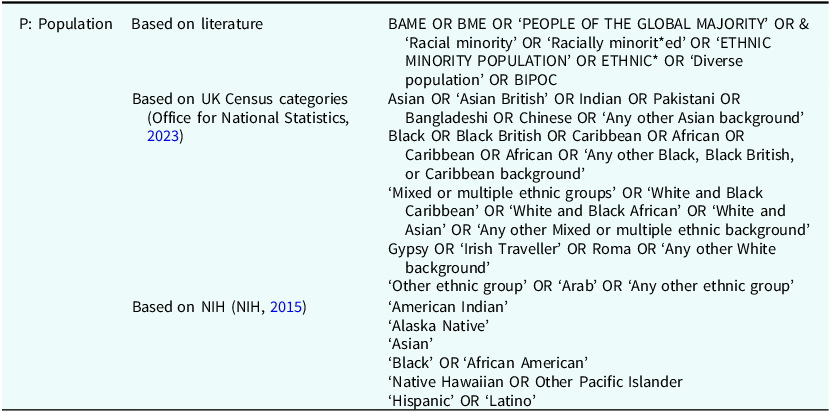
The search terms, truncations and Boolean operators utilised are given in Table 2. These represent the main concepts of the research topic and are the words used in practice to describe the topic. PICO was utilised as it is a comprehensive search framework, appropriate where time and resources are limited, and more likely to identify relevant papers (Methley et al., Reference Methley, Campbell, Chew-Graham, McNally and Cheraghi-Sohi2014).
Search terms structured around PICO

When generating search terms, it was apparent that identifying perfect search terms for the population may not be feasible because of the diversity of the communities in question and the variety of terms in common usage (see Table 3); therefore, the search term adults was utilised. It is important to note that the decision was made to leave the search term for the population as adults and invest more time in screening. It is recognised that terms such as BAME or BME may be unhelpful for communities (Milner and Jumbe, Reference Milner and Jumbe2020). However, alternative terms used to describe racially minoritised populations may not convey the multiple facets of diversity or may not be commonly used (Lawton et al., Reference Lawton, McRae and Gordon2021).
Potential search terms for Population in PICO

Eligibility
Empirical, quantitative studies regarding the effectiveness of CA-GCBT either delivered to adults from racially minoritised communities residing within a Western country or adults from racial majority communities residing in non-Western countries. The focus on quantitative studies was chosen given their concise and delimited nature, which provides a more straightforward way of analysing the results of the included studies. Every study that specifically reported that it involved any type of cultural adaptation to the therapy was included (regardless of the extent of that adaptation).
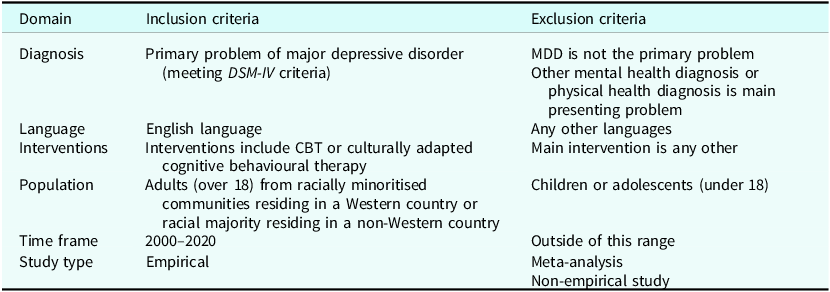
Inclusion and exclusion criteria
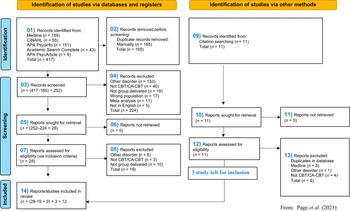
The initial search resulted in 417 studies being identified; of which 165 duplicates were removed, giving a total of 252 studies to be considered for initial screening. A key inclusion criterion was that the population consisted of adults experiencing MDD who were either from racial minority communities residing within Western countries or from racial majority communities residing in non-Western countries. Exclusion criteria included studies where the presenting problem was another disorder (physical or mental) other than MDD, and interventions were not Culturally Adapted CBT, not group delivery, clients under 18, not written in English and not published between 2000 and 2020. As part of the initial screening, the titles and abstracts were assessed utilising the inclusion/exclusion criteria (Table 4); with a total of 224 being disregarded. The remaining 28 were full text screened; resulting in nine that were deemed acceptable. Hand searching of references was utilised to identify any relevant studies, with 11 studies identified; titles and abstracts were assessed utilising the inclusion/exclusion criteria (Table 4); with eight being disregarded, leaving three deemed acceptable. A total of 12 studies were included for quality assessment.
Inclusion/exclusion criteria

Systematic search results (PRISMA chart)
The procedure used for selecting articles follows the Preferred Reporting Items for Systematic Reviews and Meta-Analyses (PRISMA; Moher et al., Reference Moher, Liberati, Tetzlaff, Altman and PRISMA2009). Please refer to Fig. 1.
Search results: PRISMA flow diagram of study selection procedure.

Quality assessment
Quality assessment is crucial in systematic reviews, ensuring that the included studies meet methodological standards and provide reliable results. Systematic reviews aim to synthesise all available evidence on a specific topic for research or decision-making. By evaluating the study design, data collection methods, sample size, results and potential biases, reviewers can determine the strengths, weaknesses and limitations of the included studies. This process helps identify research gaps and inform areas where further investigation is required.
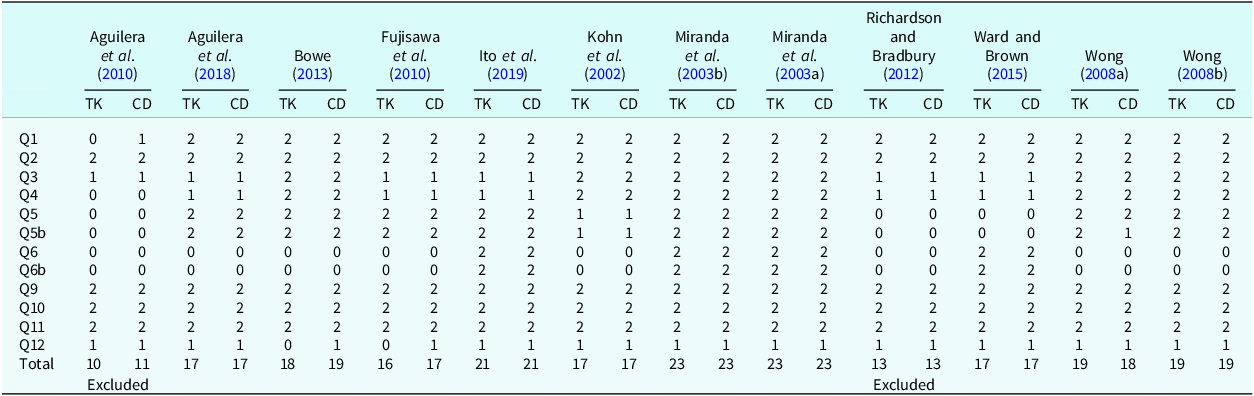
The Critical Appraisal Skills Programme (CASP, 2018) for Cohort Study was used as it has previously been used within healthcare-related systematic reviews and allows newer researchers to undertake a complex task involving many steps in a manageable way. It supports users in being systematic by ensuring that all important factors are considered. The assessment of quality was conducted independently by the main researcher and another researcher for all the papers. They independently reviewed all the papers and scored across the 12 items on the CASP. With each item being scored, a score of 2 is given when a study fully meets the criteria, a score of 1 is given when it partially met/can’t tell, and a score of 0 is given if it does not meet the criteria. See Table 5 for the CASP rating from two raters.
CASP rating from two raters

Scoring: yes = 2, partially = 1, no = 0 and can’t tell = 0; N/A is not included within the final possible total.
The CASP (CASP, 2018) for cohort study checklists has no pre-defined cut-off. Instead, the researcher computed the average midpoint (16.54) for all the studies, and studies scoring above the midpoint were classified as ‘higher quality’ and retained (n=10). Meanwhile, two studies (n=2) that scored below the midpoint were categorised as ‘lower quality’ and excluded. This was assumed to indicate that these studies could be methodologically weak or missing key components to make assumptions about their results. The two excluded studies were Aguilera et al. (Reference Aguilera, Garza and Muñoz2010) and Richardson and Bradbury (Reference Richardson and Bradbury2012). Aguilera et al. (Reference Aguilera, Garza and Muñoz2010) reported on a Spanish speaking CA-GCBT manualised treatment in the USA and Richardson and Bradbury (Reference Richardson and Bradbury2012) described the development of a CA-GCBT for South Asian women with MDD in England.
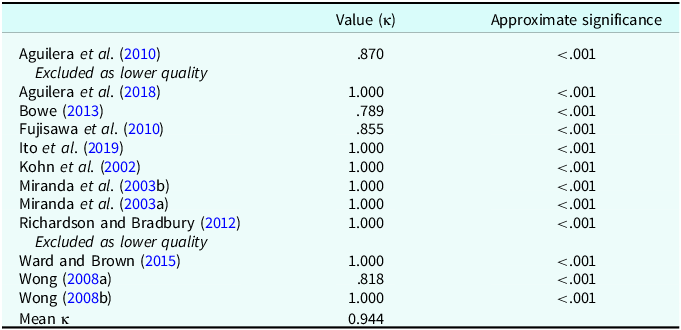
Following the quality assessment, it was necessary to check for inter-rater reliability to ensure systematic and valid quality assessment. This was done by calculating inter-rater reliability using Cohen’s kappa (κ) using SPSS (outputs available upon request). κ inter-rater reliability coefficient scores for all studies that underwent the quality assessment process are shown in Table 6. The overall κ for all studies was 0.944 (strong); with a range from 0.789 to 1.00. A strong agreement was indicated, as a score of 0.902 or above represents a very strong agreement, below 0.8 represents a moderately strong agreement, and values below 0.6 represent low/poor agreement/reliability (Altman, Reference Altman1990).
Kappa inter-rater reliability coefficient scores for all studies

Results
Characteristics of the studies
Of the ten papers included in the review, nine focused on working age adults and one on older adults (65+ is generally considered older adults in England). One study did not clearly report on any exclusion criteria; the remainder had exclusion criteria such as suicidal ideation, bipolar disorder, psychosis or substance misuse, unstable physical health states, bereavement, or perinatal care. Six studies were conducted in the USA with clients who belong to racially minoritised communities. Four studies were conducted with clients who are from racial majority communities residing in non-Western countries, with two studies based in Japan and two based in Hong Kong.
Most of the studies used a recognised CBT approach for treating MDD, either CT or BA, and modified it to suit the client group to ensure it was culturally appropriate. Out of the studies, four were based on CT (Beck, Reference Beck1979); one utilised the Healthy Management of Reality framework (Muñoz, Reference Muñoz2000) which contains elements of CT; one was BA (Lewinsohn, Reference Lewinsohn, Freedman and Katz1974; Martell et al., Reference Martell, Addis and Jacobson2001), one was based on Mind over Mood (Greenberger and Padesky, Reference Greenberger and Padesky1995); and another was based on Coping with Depression Group (Lewinsohn et al., Reference Lewinsohn, Clarke and Hoberman1989). One study mentions that it was based on an amalgamation of BA and CT for depression but does not specify which interventions were selected or how they were amalgamated. Finally, one study, utilised ‘Getting Out of the Abyss of Depression’ (Wong, Reference Wong2005), but the basis for this is unclear as the researcher could not access it, and it is uncertain which interventions were used or if these were aligned more with BA or with CT for depression.
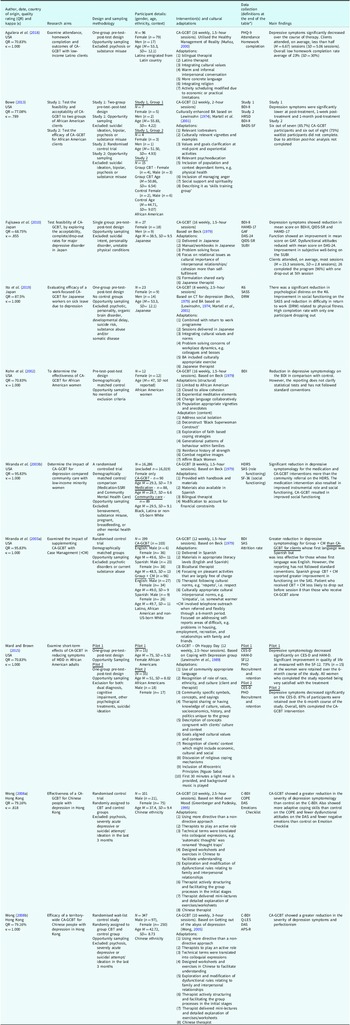
To enable the systematic data analysis, key features of each included study were synthesised and organised utilising using a data extraction tool created by the researcher (Table 7).
Table of characteristics of studies

* PHQ-9 (Patient Health Questionnaire: Kroenke et al., Reference Kroenke, Spitzer and Williams2001), BDI-II (Beck Depression Inventory-II: Beck et al., Reference Beck, Steer and Brown1996), HDRS (Hamilton Rating Scale for Depression: Hamilton, Reference Hamilton1967), BADS-SF (Behavioural Activation for Depression Scale-Short Form; Manos et al., Reference Manos, Kanter and Luo2011), HAMD-17 (Hamilton Rating Scale for Depression-17: Hamilton, Reference Hamilton1967), GAF (Global Assessment of Functioning: American Psychiatric Association, 1994), DAS-24 (Japanese Version of Dysfunctional Attitude Scale: Tajima et al., Reference Tajima, Akiyama, Numa, Kawamura, Okada, Sakai, Miyake, Ono and Power2007), QIDS-SR (Quick Inventory of Depressive Symptomatology: Rush et al., Reference Rush, Trivedi, Ibrahim, Carmody, Arnow, Klein and Keller2003), SUBI (Subjective Well-Being Inventory: Sell, Reference Sell1994), BDI (Beck Depression Inventory: Beck et al., Reference Beck, Ward, Mendelson, Mock and Erbaugh1961), K6 (Japanese version of the Kessler-6: Furukawa et al., Reference Furukawa, Kawakami, Saitoh, Ono, Nakane, Nakamura, Tachimori, Iwata, Uda, Nakane, Watanabe, Naganuma, Hata, Kobayashi, Miyake, Takeshima and Kikkawa2008), SASS (Japanese version of the Social Adaptation Self-evaluation Scale: Goto et al., Reference Goto2005), DRW (Difficulty in Returning to Work Inventory: Tanoue et al., Reference Tanoue, Ito, Shimizu, Ohno, Shirai and Shimada2012), SAS (Social Adjustment Scale: Weissman and Paykel, Reference Weissman and Paykel1974), SF-36 (Short Form 36-Item Health Survey: Ware and Sherbourne, Reference Ware and Sherbourne1992), CES-D (Center for Epidemiologic Studies Depression Scale: Radloff, Reference Radloff1977), CSI-SF (Client Satisfaction Inventory: McMurtry and Hudson, Reference McMurtry and Hudson2000), CSI-SF (Quality of life: Resnick and Nahm, Reference Resnick and Nahm2001), PHO (Physical Health Outcome: Miech and Hauser, Reference Miech and Hauser2001), C-BDI (Chinese version of the Beck Depression Inventory: Shek, Reference Shek1990), Emotions Checklist (Hackney and Cormier, Reference Hackney and Cormier2008), COPE (Carver et al., Reference Carver, Scheier and Weintraub1989), DAS (Dysfunctional Attitude Scale: Weissman and Beck, Reference Weissman and Beck1978), Q–LES (Quality of Life Enjoyment and Satisfaction Questionnaire: Endicott et al., Reference Endicott, Nee, Harrison and Blumenthal1993) and APS-R (Almost Perfect Scale-Revised Version: Slaney et al., Reference Slaney, Rice, Mobley, Trippi and Ashby2001)
Note: Emails were sent out to lead authors of all paper to request further information and missing data. Awaiting response at the time of submission.
Rationale for narrative synthesis
Consideration was given to carrying out a statistical analysis to combine the results of multiple studies. However, the researcher decided not to do this because the identified studies do not consistently answer the same research questions. There are methodological problems and inconsistencies, with several studies not following standard statistical reporting conventions. Therefore, this section provides more of a narrative description of the results.
Summary of findings
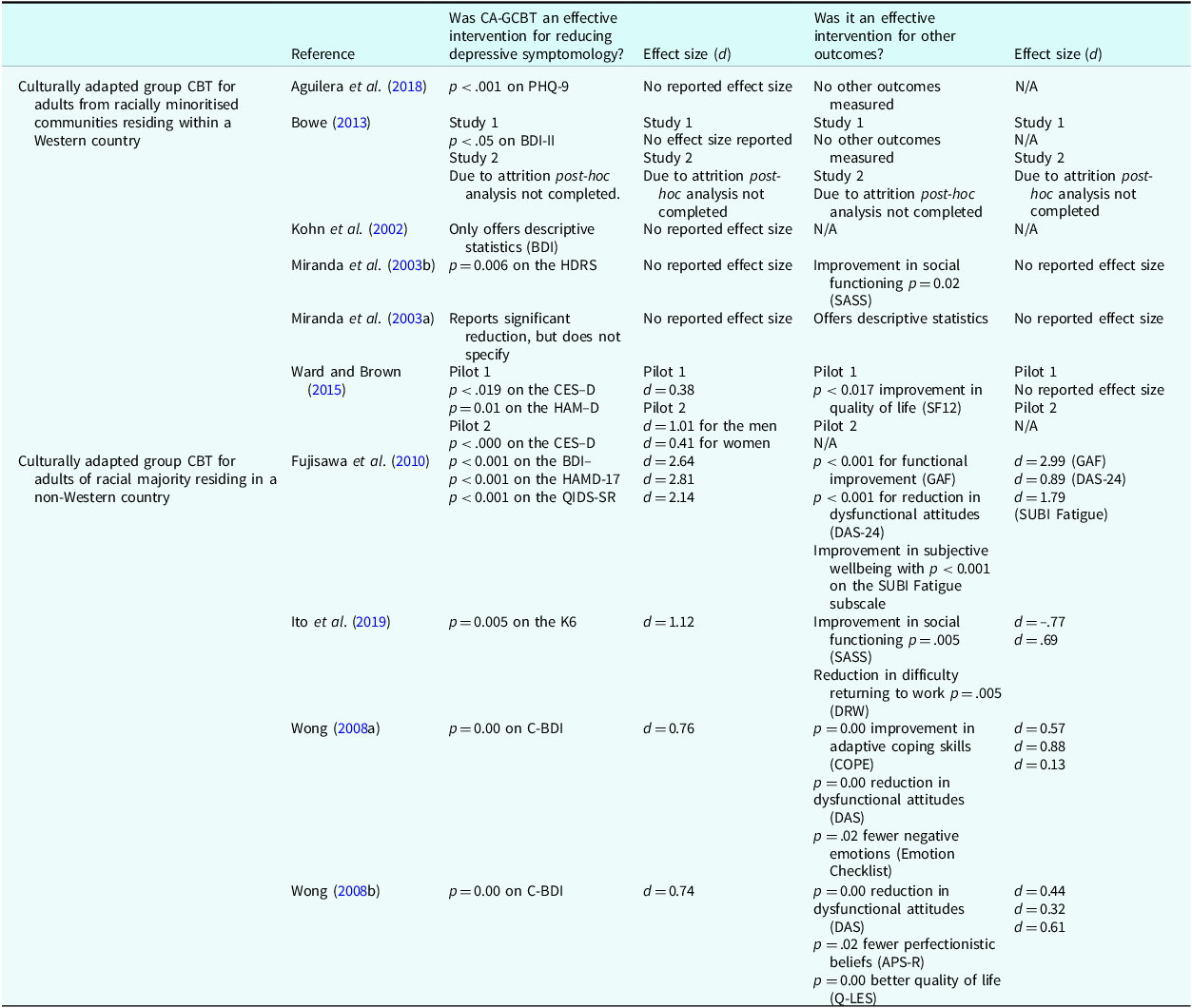
The researcher created a second data extraction tool (Table 8), to summarise the results of the studies included in the review. These outcomes include whether the intervention was statistically significant and the effect size on depressive symptomology. The studies were divided into two main groups, one encompassing racially minoritised communities residing within Western countries and the other encompassing racial majority communities residing in non-Western countries.
Summary of main outcomes

PHQ-9 (Patient Health Questionnaire: Kroenke et al., Reference Kroenke, Spitzer and Williams2001), BDI-II (Beck Depression Inventory-II: Beck et al., Reference Beck, Steer and Brown1996), HDRS (Hamilton Rating Scale for Depression: Hamilton, Reference Hamilton1967), BADS-SF (Behavioural Activation for Depression Scale-Short Form; Manos et al., Reference Manos, Kanter and Luo2011), HAMD-17 (Hamilton Rating Scale for Depression-17: Hamilton, Reference Hamilton1967), GAF (Global Assessment of Functioning: American Psychiatric Association, 1994), DAS-24 (Japanese Version of Dysfunctional Attitude Scale: Tajima et al., Reference Tajima, Akiyama, Numa, Kawamura, Okada, Sakai, Miyake, Ono and Power2007), QIDS-SR (Quick Inventory of Depressive Symptomatology: Rush et al., Reference Rush, Trivedi, Ibrahim, Carmody, Arnow, Klein and Keller2003), SUBI (Subjective Well-Being Inventory: Sell, Reference Sell1994), BDI (Beck Depression Inventory: Beck et al., Reference Beck, Ward, Mendelson, Mock and Erbaugh1961), K6 (Japanese version of the Kessler-6: Furukawa et al., Reference Furukawa, Kawakami, Saitoh, Ono, Nakane, Nakamura, Tachimori, Iwata, Uda, Nakane, Watanabe, Naganuma, Hata, Kobayashi, Miyake, Takeshima and Kikkawa2008), SASS (Japanese version of the Social Adaptation Self-evaluation Scale: Goto et al., Reference Goto2005), DRW (Difficulty in Returning to Work Inventory: Tanoue et al., Reference Tanoue, Ito, Shimizu, Ohno, Shirai and Shimada2012), SAS (Social Adjustment Scale: Weissman and Paykel, Reference Weissman and Paykel1974), SF-36 (Short Form 36-Item Health Survey: Ware and Sherbourne, Reference Ware and Sherbourne1992), CES-D (Center for Epidemiologic Studies Depression Scale: Radloff, Reference Radloff1977), CSI-SF (Client Satisfaction Inventory: McMurtry and Hudson, Reference McMurtry and Hudson2000), CSI-SF (Quality of life: Resnick and Nahm, Reference Resnick and Nahm2001), PHO (Physical Health Outcome: Miech and Hauser, 1998), C-BDI (Chinese version of the Beck Depression Inventory: Shek, Reference Shek1990), Emotions Checklist (Hackney and Cormier, Reference Hackney and Cormier2008), COPE (Carver et al., Reference Carver, Scheier and Weintraub1989), DAS (Dysfunctional Attitude Scale: Weissman and Beck, Reference Weissman and Beck1978), Q–LES (Quality of Life Enjoyment and Satisfaction Questionnaire: Endicott et al., Reference Endicott, Nee, Harrison and Blumenthal1993) and APS-R (Almost Perfect Scale-Revised Version: Slaney et al., Reference Slaney, Rice, Mobley, Trippi and Ashby2001).
Note: Emails were sent out to lead authors of all paper to request further information and missing data. Awaiting response at the time of submission.
CA-GCBT for adults from racially minoritised communities residing within Western countries
Five out of the six studies had significant positive outcomes on depressive symptomology, meaning that the interventions had beneficial effects for the patients. The remaining study did not disclose whether the results of the intervention were significant but reported positive effects. Of the studies that reported significant positive outcomes, only one reported the effect size, making it difficult to draw conclusions. Within these studies, CA-GCBT also had significant positive outcomes for social functioning and quality of life. However, the effect size was not reported for measures of social function and quality of life.
CA-GCBT for adults from racial majority communities residing in non-Western countries
All four studies had significant positive outcomes for depressive symptomology, meaning that the interventions had beneficial effects for the patients. The effect sizes ranged from medium to well above large, which indicates a considerable effect of CA–GCBT on depressive symptomology. Three of the four studies showed a significant reduction in dysfunctional attitudes, with the effect sizes ranging from medium to large, which indicates a moderate effect. In these studies, CA-GCBT also had significant positive outcome on functioning, subjective wellbeing, social functioning, adaptive coping, quality of life, perfectionistic beliefs, negative emotions, and a reduction in ratings of difficulty returning to work. The effect sizes ranged from medium to large, indicating a moderate effect of CA-GCBT on related outcomes.
What are the focuses of adaptation within CA-GCBT?
This review provides insights into potential modifications that can be made to adapt group CBT. The variety of modifications is in line with the description of CA-CBT, which includes adjustments to the delivery of therapy without compromising the theoretical underpinnings of CBT (Naeem, Reference Naeem2012b).
A common focus of modification was around language, with seven studies (Aguilera et al., Reference Aguilera, Bruehlman-Senecal, Liu and Bravin2018; Fujisawa et al., Reference Fujisawa, Nakagawa, Tajima, Sado, Kikuchi, Hanaoka and Ono2010; Ito et al., Reference Ito, Watanabe, Takeichi, Ishihara and Yamamoto2019; Miranda et al., Reference Miranda, Azocar, Organista, Dwyer and Areane2003a; Miranda et al., Reference Miranda, Chung, Green, Krupnick, Siddique, Revicki and Belin2003b; Wong, Reference Wong2008a; Wong, Reference Wong2008b) delivering sessions in the community language through the use of bilingual therapists, more culturally appropriate language, and translated materials. The remaining studies (Bowe, Reference Bowe2013; Kohn et al., Reference Kohn, Oden, Muñoz, Robinson and Leavitt2002; Ward and Brown, Reference Ward and Brown2015), which were delivered in English, considered culturally appropriate CBT terminology and made adaptations to some of the standard CBT terms. For example, rather than referring to it as group therapy, Bowe (Reference Bowe2013) described it as ‘skills training’.
Another common focus of adaptation was having therapists from the same background or culture as the participants, with eight studies (Aguilera et al., Reference Aguilera, Bruehlman-Senecal, Liu and Bravin2018; Fujisawa et al., Reference Fujisawa, Nakagawa, Tajima, Sado, Kikuchi, Hanaoka and Ono2010; Ito et al., Reference Ito, Watanabe, Takeichi, Ishihara and Yamamoto2019; Miranda et al., Reference Miranda, Azocar, Organista, Dwyer and Areane2003a; Miranda et al., Reference Miranda, Chung, Green, Krupnick, Siddique, Revicki and Belin2003b; Ward and Brown, Reference Ward and Brown2015; Wong, Reference Wong2008a; Wong, Reference Wong2008b) mentioning this. In most of these studies it was unclear whether this was done intentionally, or just happened due to circumstance. Ward and Brown (Reference Ward and Brown2015) specifically stated that they wanted therapists who share or at least had knowledge of the culture, values, socioeconomics, history, and politics unique to the group.
Aguilera et al. (Reference Aguilera, Bruehlman-Senecal, Liu and Bravin2018) and Miranda et al. (Reference Miranda, Azocar, Organista, Dwyer and Areane2003a) reported adapting the interpersonal dynamic and matching it with the cultural norms. In doing so, they acknowledge that cultural norms vary and at times a change in this dynamic to fit these norms could be beneficial. For instance, Miranda et al. (Reference Miranda, Azocar, Organista, Dwyer and Areane2003a) reported an adaptation whereby the therapist was aware of and followed cultural norms of ‘respeto’ (i.e. respect) and ‘simpatia’ (i.e. the tendency to create warmer social interactions and avoid conflict).
Two other studies adapted the collaborative stance within their CA-GCBT to be more culturally appropriate by using more directive than non-directive approaches. Wong (Reference Wong2008a) and Wong (Reference Wong2008b) had group leaders give ‘mini-lectures’ and provide a detailed explanation of the exercises and worksheets.
Most studies mention adaptations, which focused on taking typical CBT interventions for MDD and integrating cultural values, norms, metaphors, appropriate vignettes, and culturally appropriate psychoeducation. This takes into account the participant’s frame of reference, whether it be economic, cultural, social, or political context. Some studies specify changes to certain interventions to make them more appropriate. For example, Aguilera et al. (Reference Aguilera, Bruehlman-Senecal, Liu and Bravin2018); Miranda et al. (Reference Miranda, Azocar, Organista, Dwyer and Areane2003a) and Miranda et al. (Reference Miranda, Chung, Green, Krupnick, Siddique, Revicki and Belin2003b) adapted behavioural activation to take account of economic constraints by ensuring it could be done at no extra cost. Ito et al. (Reference Ito, Watanabe, Takeichi, Ishihara and Yamamoto2019) included culturally appropriate physical activity. Other adaptations of typical interventions were more cognitive, such as exploring and modifying dysfunctional rules related to family and interpersonal relationships (Wong, Reference Wong2008a; Wong, Reference Wong2008b). This was done to account for some common cultural norms. Adaptations were also made by emphasising the focus on problem solving (Fujisawa et al., Reference Fujisawa, Nakagawa, Tajima, Sado, Kikuchi, Hanaoka and Ono2010; Ito et al., Reference Ito, Watanabe, Takeichi, Ishihara and Yamamoto2019). For instance, Ito et al. (Reference Ito, Watanabe, Takeichi, Ishihara and Yamamoto2019) adapted problem solving by focusing on workplace dynamics with colleagues and bosses upon return to work as there was a cultural emphasis and importance of work.
Adaptation also included adding of specific content to the CBT group that was deemed relevant and necessary based on knowledge of the communities or challenges they may face. Discussions and integration of the participants’ religious and faith beliefs were included by Aguilera et al. (Reference Aguilera, Bruehlman-Senecal, Liu and Bravin2018), Kohn et al. (Reference Kohn, Oden, Muñoz, Robinson and Leavitt2002) and Ward and Brown (Reference Ward and Brown2015), as well as inclusion of population and context dependent topics such as managing physical health problems (Bowe, 2012) or acknowledging identity and systemic issues faced such as racism (Kohn et al., Reference Kohn, Oden, Muñoz, Robinson and Leavitt2002).
Other adaptations were more participant centred, encouraging group affiliation, addressing feelings of isolation, and even developing a sense of community. This was done through the inclusion of activities promoting cohesion. Bowe (Reference Bowe2013) for example, used culturally relevant icebreakers to promote cohesion, and Ward and Brown (Reference Ward and Brown2015) invited participants to share a meal at the start of each session, to check-in and bond.
Finally, adaptations were made to the delivery components of the groups, such as recruiting specific demographics, closed groups rather than rolling enrolment, session length, being embedded within another programme, and flexibility with did not attend policy. Examples include being embedded within a return-to-work scheme (Ito et al., Reference Ito, Watanabe, Takeichi, Ishihara and Yamamoto2019) or being delivered to clients living in a nursing home (Bowe, Reference Bowe2013).
In summarising these findings, the focus on modification is consistent with the examples listed in the introduction but also within the wider literature. However, it is important to recognise that there is not a copy-and-paste approach; rather the adaptation varies to meet the needs of the clients and the specific community. What is considered acceptable or desirable in one culture may be considered inappropriate or even offensive in another; for instance, whether the style is ‘warmer’ or more formal ‘mini lectures’. Cultural differences can affect how people perceive and interpret information, leading to different responses and outcomes. Therefore, researchers and clinicians need to consider the cultural context when conducting studies and interpreting results, rather than assuming that findings from one culture can be applied to another.
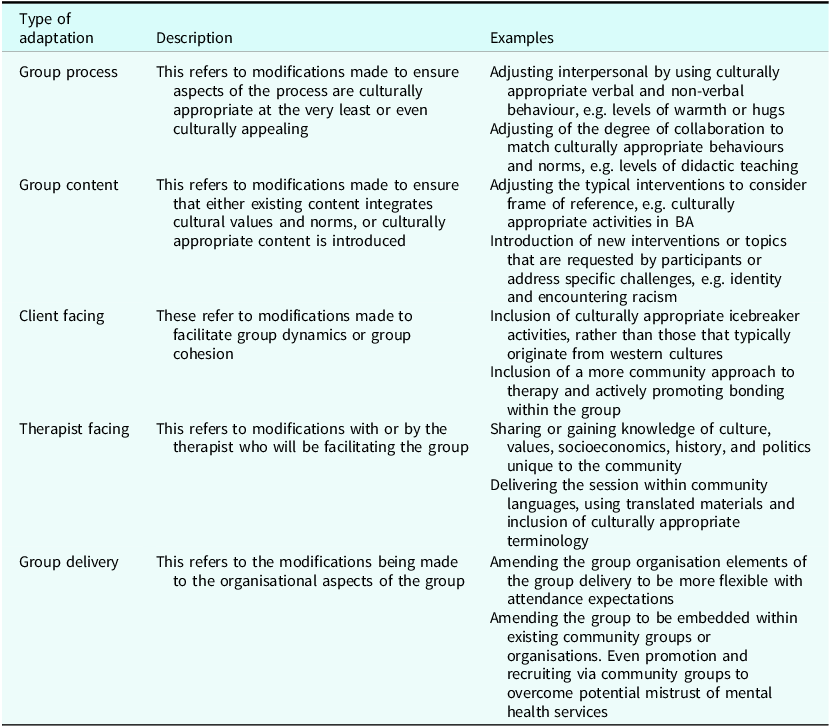
Conceptually, these have been grouped into the domains of a focus on group delivery, a focus on group process, a focus on group content, a focus on client modifications, and a focus on staff modifications. See Table 9 for a summary of the different domains and examples based on the studies. It is important to note that these areas are not mutually exclusive and can be implemented in conjunction with each other.
Focus of cultural adaptation for CBT groups

It is also worth noting that all the studies provided some description of the adaptations; however, only some studies provided rationales for the adaptation, and none explicitly referred to the adaptation framework they employed. For those studies that did provide a rationale for the adaptation, details of participant co-creation and community acceptability would align with the Southampton Adaptation Framework (Naeem et al., Reference Naeem, Ayub, Gobbi and Kingdon2009) as they included some degree of gaining awareness of relevant issues beforehand, adapting assessment and engagement, and adjusting therapy processes or techniques.
However, without explicitly stating it, this is more of an inference. Explicitly citing the framework provides transparency and clarity regarding the theoretical and methodological basis for the adaptation process. It allows readers and researchers to understand the conceptual underpinnings guiding the modifications made to the therapeutic approach. Moreover, citing the framework enhances the replicability and comparability of the study.
In future research, it is recommended that scholars and researchers explicitly cite the specific adaptation framework they utilise. This practice enhances the research’s clarity, transparency and credibility, ultimately contributing to the growth and development of culturally adapted psychological therapies. As the field continues to expand, incorporating this practice can help establish a strong foundation for evaluating and implementing culturally adapted interventions.
Further critique of studies
A major critique is the lack of sufficient comparison against a standard group CBT (TAU). Comparing an intervention with a TAU can provide important information about the practical utility of the intervention in real-world settings. Overall, not comparing an intervention with TAU can limit the ability to determine the effectiveness and practical utility of the intervention, as well as the generalisability of the study findings.
The identified studies have small sample sizes, ranging from 11 to 267, resulting in limited statistical power, a high risk of bias, and a limited scope of findings. This can increase the likelihood of false positives or negatives, which can compromise the study’s internal validity due to attrition bias. For instance, in the second study of Bowe (Reference Bowe2013), six out of seven (85.7%) CA-GCBT participants and six out of eight (75%) waitlist participants dropped out. No post-hoc analysis of the second study was completed because of this attrition.
Another critique is the lack of clarity regarding the CBT approach and interventions utilised. This does not allow us to identify which interventions worked better or even the specific mechanisms of change. Research lacking clarity in this way risks ambiguity as it is difficult to understand what the study is measuring, making it difficult for other researchers to replicate the study or use the same methods in future research.
There was a lack of specificity in some of the studies about who delivered the intervention or how they quality assured the intervention. This makes it difficult to determine whether the results are generalisable. Without this information, it is difficult to determine whether the intervention was delivered in a consistent and standardised manner or if there were differences in the quality of the intervention across participants.
Discussion
Summary of findings
The results of this systematic review highlight that CA-GCBT is a promising treatment for clients from diverse backgrounds experiencing MDD. CA-GCBT offers promising results in reducing depressive symptomology and positive changes identified in other domains (dysfunctional beliefs, improvement in functioning and quality of life) regardless of whether the participants were from racially minoritised communities living in Western countries or from racial majority communities living in non-Western countries. In addition to the findings about whether CA-GCBT can be beneficial for clients from diverse backgrounds, this review provides some insight into the potential modifications that can be made to adapt group CBT. These were grouped into the domains of group delivery, group process, group content, client modifications, and staff facing modifications.
Relation to previous literature
Despite being developed and more extensively studied with clients from racial majority in Western countries and criticisms of being based exclusively on Western cultural assumptions (Summerfield and Veale, Reference Summerfield and Veale2008), this suggests that CA-GCBT shows promise in treating MDD with clients from diverse backgrounds. The results show a pattern of improvements in depressive symptomology, dysfunctional beliefs, functioning, and quality of life. This is consistent with Horrell (Reference Horrell2008) who found that culturally adapted CBT was effective for ethnic minority clients living in the USA across a range of psychological disorders (including depression). Kalibatseva and Leong (Reference Kalibatseva and Leong2014) also found that psychological therapies (including CBT) could be culturally adapted effectively.
These findings align with the CBT-specific literature on its effectiveness when culturally adapted, whether focused on BA (Lehmann and Bördlein, Reference Lehmann and Bördlein2020) and/or cognitive therapy (Anik et al., Reference Anik, West, Cardno and Mir2021). This contributes to the literature as it has focused on group delivery, which had previously not been addressed. The summary of domains in which groups could be modified, is in keeping with the description of culturally adapted CBT.
These results align with recommendations for adapting one-to-one therapy through prior awareness of relevant issues, assessment and engagement, and adjustments in therapy techniques (Naeem et al., Reference Naeem, Phiri, Rathod and Ayub2019). The current findings complement the recommendations within BAME Positive Practice Guide (Beck et al., Reference Beck, Naz, Brooks and Jankowska2019) to consider service level changes, adapting therapy and staff adaptations by extending these to considering group CBT modifications.
This research offers insights into and considerations for adapting group interventions specifically for clients from diverse backgrounds who are experiencing MDD. By acknowledging the unique cultural and contextual factors that influence the expression and understanding of mental health issues, therapists can tailor group interventions to better meet the needs of these individuals. The identified domains for group modification provide a framework for integrating culturally mediated aspects into the group CBT. It is hoped that by adapting group interventions for clients from diverse backgrounds it enhances the cultural sensitivity and relevance of the interventions, allowing participants to engage more deeply and meaningfully in the therapeutic process. By acknowledging and addressing cultural nuances, therapists can foster a sense of belonging and validation, which can promote trust and openness within the group. In addition, group interventions offer a unique opportunity for participants to connect and share experiences with others who may have similar cultural backgrounds or have faced similar challenges.
Limitations
This review has limitations that need to be considered, including the relatively small number of studies included in the review (n=10). This may be related to the lack of research on this specific topic, as mentioned earlier, or the potential for publication bias. Within this review, there was clinical heterogeneity (variance in participants), methodological heterogeneity (variability in study design), and statistical heterogeneity (data analysis), which introduces a risk of bias (Cochrane, 2011).
The studies identified focused on clients from African American, Latino, Japanese, Chinese, and non-USA-born white communities. It therefore is difficult to generalise findings across client groups because different cultures have unique values, beliefs, customs, and behaviours that shape how people think, feel and act. Researchers must consider the cultural context when conducting studies and interpreting results, rather than assuming that findings from one culture can be applied to another.
Another limitation is that the studies included were based in the USA, Japan, and Hong Kong. Although this provides some useful breadth, it is by no means a comprehensive overview of CA-GCBT across a large range of contexts. It is notable that it does not consider anything specific to the UK as Richardson and Bradbury (Reference Richardson and Bradbury2012) was excluded following the quality assessment. Thus, it is difficult to draw concrete conclusions applicable for UK services. Based on the included studies, the findings are more relevant to CBT groups based on BA and CT for MDD.
The decision to exclude studies in languages other than English may have resulted in the omission of crucial findings paradoxically, unintentionally reinforcing the dominance of Western, English language perspectives in the field of CBT. Although it is understandable that the lack of translations creates difficulties, it raises the question of whether vital research conducted in non-English speaking countries is being overlooked.
Finally, the CASP was utilised for quality appraisal. However, small studies may be more difficult to assess for quality because of limited information or insufficient reporting of key methodological details. For example, all papers were consistently rated as ‘can’t tell’ or ‘no to CASP question 12, which asked whether the paper being reviewed states implications for practice.
Clinical implications and research recommendations
This review contributes to the discourse on CA-GCBT by providing a starting point for determining that CA-GCBT can be effective treatment for MDD in adults from racially minoritised communities residing in Western countries or from racial majority communities residing in non-Western countries. The results suggest potentially significant benefits such as a reduction in depressive symptomology, dysfunctional beliefs, and improvement in functioning, subjective wellbeing, quality of life, and adaptive coping. It also provides some initial thoughts on potential cultural adaptations within CA-GCBT.
The clinical implications of these findings are important, as they may allow clinicians and services to build a case for trialling CA-GCBT in the communities they serve. This may address issues of poor access and outcomes for clients from diverse backgrounds. It may also provide an initial focus for developing such a group by reflecting on whether the delivery, client, staff, process, or content components need to be adapted. At the very least, it offers some thoughts on how to modify generic group CBT to be more appealing or effective for clients from diverse backgrounds.
Based on the above-mentioned limitations, a key research recommendation would be to conduct larger, high-quality studies to explore whether CA-GCBT is effective. It would be beneficial to compare key components and explore which adaptations are associated with efficacy, accessibility and acceptability. Once such studies have been completed, conducting an updated review with a larger number of high-quality studies in more countries would be helpful. The dissection of studies to understand which adaptations work for whom, qualitative focus on exploring therapist and client experiences of CA-GCBT for MDD, across a range of disorders and various populations may also be promising areas for further research. Despite the extensive research of CBT, there is a lack of research about cultural adaptations and the inclusion of ethnic minorities in research is essential.
Conclusion
This review contributes to the existing literature on the efficacy of culturally adapted CBT for clients from diverse backgrounds. Systematically identifying, evaluating and integrating the findings of existing empirical literature suggests that CA-GCBT is effective for depressed clients from diverse backgrounds, with a reduction in depressive symptomology, dysfunctional beliefs, and increase in functioning and quality of life. It summarises some of the adaptations implemented within CA-GCBT. However, these adaptations should not be assumed to be applicable to all diverse communities, rather, the broad domains of adaptation should be used to consider how best to suit the community with whom one is working.
The findings add to the evidence base and provide a rationale for further research. This review offers a starting point for developing or delivering CA-GCBT within clinical practice. Within the context of practice, this will be a step towards addressing the low access and poor outcome rates for clients from diverse communities.
Key practice points
-
(1) Culturally adapted group cognitive-behavioural therapy (CA-GCBT) has shown effectiveness in reducing depressive symptoms, dysfunctional beliefs, and improving functioning and quality of life for depressed clients from diverse backgrounds.
-
(2) When adapting a therapy group, consider modifications in group delivery, group process, group content, client modifications and staff facing modifications. These adaptations can be implemented individually or in combination.
-
(3) Further research is needed to fully evaluate the efficacy of CA-GCBT for diverse populations and to explore the experiences of both therapists and clients in implementing or attending such groups.
Data availability statement
The data that support the findings of this study are available on request from the corresponding author, T.K.
Acknowledgments
The author would like to thank Chris Denmark for his support in the quality assessment of the papers included in this review. Special thanks also go to Magda Marczak, who supervised this research as part of the MSc in Cognitive Behavioural Therapy (Top Up) at the University of Coventry. Additionally, the author expresses gratitude to Kate Sheldon, Pawel Kaliniecki, Katy Emerson, Sarah Cantwell, Jessica Hottinger and Liz Ruth for their encouragement and assistance with proofreading.
Author contribution
Taf Kunorubwe: Conceptualization (lead), Data curation (lead), Formal analysis (lead), Investigation (lead), Methodology (lead), Project administration (lead), Writing – original draft (lead), Writing – review & editing (lead).
Financial support
This research received no specific grant from any funding agency, commercial or not-for-profit sectors.
Competing interests
The author declares no conflict of interest with respect to this publication.
Ethical standards
The study was approved by the Faculty of Health and Life Sciences at the University of Coventry before it was conducted (reference P120955). The author has abided by the Ethical Principles of Psychologists and Code of Conduct as set out by the BABCP and BPS.
An important note about terminology
The terminology used when talking about race and ethnicity in research can have a real-world impact. Therefore, due consideration has been given to the language and terminology used in this report. There is a recognition that terms such as BAME or BME may be unhelpful for some communities (Milner and Jumbe, Reference Milner and Jumbe2020); however, alternative terms used to describe racially minoritised populations may not provide a term that conveys the multiple facets of diversity or may not be in common usage (Lawton et al., Reference Lawton, McRae and Gordon2021).
Therefore, in this review, whenever possible, specific language is utilised to describe ethnic, religious, or linguistic groups. Collective terminology is a last resort and where there is a legitimate need to do so. In instances requiring collective terminology, decisions are guided by the context at hand, and refrain from adopting a generic term such as BAME or BME unless absolutely necessary. If the context does not provide a decisive direction, terms such as ‘ethnic minority’, ‘racial minority’ or ‘diverse backgrounds’ are used interchangeably. This approach recognises that no single term is universally suitable and serves to uphold the dignity of individuals and communities. Practitioners, researchers and all stakeholders in the field of mental health are encouraged to consider the terminology they employ when referring to individuals from diverse ethnic, cultural and faith backgrounds. Engaging with groups and individuals is advisable to ascertain their preferred terminology and co-produce whenever feasible.




Comments
No Comments have been published for this article.