Implications
This study assessed the adaptability of two major dairy breeds (Holstein and Montbéliarde) to two low-input grass-based systems. Cows of both breeds prioritized milk production when fed diets of superior nutritional value, which was associated with improved nutritional status and ovarian cyclicity. Holstein cows secreted more milk, but did so at the expense of body reserves. For this reason, indicators of nutritional status and ovarian activity were negatively affected. Holstein cows in this study seemed particularly challenged in both low-input systems. These results are of interest for the development of production systems that rely on feed autonomy.
Introduction
European mountain dairy systems are traditionally grass based and include relatively long winter indoor periods. Herds are often managed to calve preferentially during autumn and winter, and peak of lactation is supported by feeding preserved forages and concentrate supplementation (Coulon and Rémond, Reference Coulon and Rémond1991; Horn et al., Reference Horn, Steinwidder, Starz, Pfister and Zollitsch2014). Under these conditions, cattle breeds selected for milk yield are better suited to winter than spring calving (Horn et al., Reference Horn, Steinwidder, Starz, Pfister and Zollitsch2014). Alternative low-input grass-based dairy systems prioritize the use of local resources and feed autonomy. They require early spring calvings in order to coordinate seasonal pasture growth with nutritional requirements for early lactation (Horn et al., Reference Horn, Steinwidder, Gasteiner, Podstatzky, Haiger and Zollitsch2013; Piccand et al., Reference Piccand, Cutullic, Meier, Schori, Kunz, Roche and Thomet2013). Strict seasonal-calving grazing systems are sensitive to reproductive failure because they depend on the ability of dairy cows to become pregnant within a narrow window of opportunity each year (Cutullic et al., Reference Cutullic, Delaby, Gallard and Disenhaus2011; Piccand et al., Reference Piccand, Cutullic, Meier, Schori, Kunz, Roche and Thomet2013).
Mobilization of body reserves is a key adaptation to lactation that becomes critical when nutrient allowance is limited. Therefore, objective measurements of body fat mobilization and accretion are needed to monitor how dairy cows cope with lactation requirements (Chilliard, Reference Chilliard1999; Schroder and Staufenbiel, Reference Schroder and Staufenbiel2006), particularly in low-input systems, for which literature is limited. Selection prioritizing milk yield changed physiological regulation of body fat mobilization and accretion, aggravated negative energy balance during early lactation and impacted multiple aspects of reproductive function. These effects are mediated in part by hormones and metabolites related to nutritional status, and changes in tissue responsiveness to key hormones (Butler, Reference Butler2003; Chagas et al., Reference Chagas, Bass, Blache, Burke, Kay, Lindsay, Lucy, Martin, Meier, Rhodes, Roche, Thatcher and Webb2007; Leroy et al., Reference Leroy, Opsomer, Van Soom, Goovaerts and Bols2008). As a result, cows selected for conventional continuous calving systems experience longer periods of body fat mobilization, chronic low body condition score (BCS) and are prone to reproduction problems, which may render them incompatible with seasonal-calving grazing systems (Dillon et al., Reference Dillon, Snijders, Buckley, Harris, O’Connor and Mee2003b; Horan et al., Reference Horan, Dillon, Faverdin, Delaby, Buckley and Rath2005b; Macdonald et al., Reference Macdonald, Verkerk, Thorrold, Pryce, Penno, McNaughton, Burton, Lancaster, Williamson and Holmes2008; Piccand et al., Reference Piccand, Cutullic, Meier, Schori, Kunz, Roche and Thomet2013). Nonetheless, there are marked breed differences in production and reproduction outcomes (Cutullic et al., Reference Cutullic, Delaby, Gallard and Disenhaus2011; Horn et al., Reference Horn, Steinwidder, Gasteiner, Podstatzky, Haiger and Zollitsch2013; Piccand et al., Reference Piccand, Cutullic, Meier, Schori, Kunz, Roche and Thomet2013). For instance, a multi-lactation study that included selected Friesian-Holstein (HOLS) and Montbéliarde (MONT) cows under Irish grass-based conditions found that HOLS cows supported lactation by greater body reserve mobilization postpartum and less BCS replenishment during late lactation, and had impaired reproduction performance and longevity in the herd compared with MONT, which had lower milk production (Dillon et al., Reference Dillon, Buckley, O’Connor, Hegarty and Rath2003a and Reference Dillon, Snijders, Buckley, Harris, O’Connor and Mee2003b).
The objective of the present trial was to study production, body fat mobilization, metabolic and hormonal profiles, and ovarian cyclicity of periparturient HOLS and MONT cows under two spring-calving low-input production systems differing in forage quality and concentrate allowance. We hypothesized that HOLS and MONT cows, the two major dairy breeds in France, would differ in their physiological adaptations to early lactation, and that breed by system interactions would occur owing to breed differences in milk yield potential and in the regulation of nutrient partitioning toward different biological functions.
Material and methods
Animals and management
All animals in this study were part of the 1st year of a low-input system research project assessing the long-term interactions among management practices and animal performance at farm level (Pomies et al., Reference Pomies, Martin, Pradel, Verdier-Metz, Constant, Delbès-Paus, Trocquier, Fournier, Montel and Farrugia2013). The study was conducted at the ‘Marcenat’ experimental farm (45°18'21’N, 2°50'13’E) of the ‘Institut National de la Recherche Agronomique’ (INRA), which is located in a mountain grassland area (1100 m of altitude) in the Auvergne region (Cantal, France).
A total of 24 HOLS and 24 MONT cows were assigned to one of two production systems and individual measurements were performed from 4 weeks before expected calving until 12 weeks postpartum. The production systems were denominated extensive (EXT) and semi-extensive (SEMI), and were managed to have seasonal spring calvings (Supplementary Table S1). The EXT system relied on extensive availability of permanent grasslands and no concentrate supplementation (12 HOLS and 12 MONT), whereas SEMI reflected a situation of limited but productive grassland surface with low concentrate supplementation. It was based on established (+10 years) temporary grasslands with concentrate supplementation limited to 4 kg/day per cow (12 HOLS and 12 MONT). Two MONT cows in SEMI carried twins and were excluded from the study (Supplementary Table S1). First lactation cows had been bred and managed to calve at 24 and 36 months in SEMI and EXT, respectively, in accordance with the characteristics of each system (Pomies et al., Reference Pomies, Martin, Pradel, Verdier-Metz, Constant, Delbès-Paus, Trocquier, Fournier, Montel and Farrugia2013). During the previous lactation, multiparous HOLS and MONT cows produced 5714 and 4522 kg of milk in 305 days, respectively. BCS was 2.55 and 2.48±0.09 (P=0.54), and BW was 708 and 698±14 kg (P=0.58) 4 weeks before expected calving for HOLS and MONT, respectively.
Forage and concentrate nutritional composition is presented in Supplementary Table S2. Before the beginning of grazing season, cows were fed hay produced during the previous year from the paddocks that were assigned to the respective production system. During the indoor period, prepartum intake of first and second cut hay was 8.9 and 2.8 kg dry matter (DM)/day in EXT, and 8.6 and 3.0 kg DM/day in SEMI, respectively. For lactating cows, indoor intake of first and second cut hay was 8.6 and 5.6 kg/day in EXT, and 6.4 and 5.2 kg/day in SEMI, respectively. Cows were housed in a tie-stall barn until pasture turnout. There was a 6-day transition period at pasture turnout during which cows grazed during the day and stayed indoors from 1600 to 0800 h, with additional hay being offered. After this period, cows stayed outdoors except for milking and sampling. Owing to the differences of grassland composition (Supplementary Table S2), pasture turnout occurred on the 15 and 22 April 2011 for SEMI and EXT, corresponding to −20 and −16±23 days in milk (DIM) (mean±SD), and length of grazing season was 229 and 222 days, respectively. In SEMI, pasture was managed according to a simplified rotational method (Lerch et al., Reference Lerch, Ferlay, Pomies, Martin, Pires and Chilliard2012). In summary, cows changed paddock when daily milk yield decreased 10% relative to the maximal production registered after the entry in that paddock. Nonetheless, paddock rotation was adjusted whenever needed to balance pasture availability and intake requirements of early lactation cows. In EXT, paddock rotation was managed to maintain a balance between day-to-day milk production and forage availability. Throughout the grazing season, cows in SEMI and EXT changed paddocks 22 and 18 times, corresponding to 4.5 and 4.0 grazing rotations, and 10.4 and 11.7 days/paddock, respectively. Between rotation 1 and rotation 4, stocking rate was decreased from 2.68 to 1.09 cows/ha in SEMI, and from 1.17 to 0.63 cows/ha in EXT. Entry and exit sward height was 121±20 and 82±12 mm for SEMI, and 110±20 and 74±8 mm (mean±SD) for EXT, respectively. Cows in SEMI received 1, 2 and 3 kg/day of concentrate at weeks 3, 2 and 1 before expecting calving, respectively, and 4 kg/day postpartum. After pasture turnout, cows were group-fed and were offered an amount of concentrate corresponding to the daily allowance of the group. In order to prevent eventual overconditioning and related metabolic problems in SEMI, the 12 cows (five MONT and seven HOLS) that were still gestating 10 days after pasture turnout were denied further access to concentrate until calving. Cows in SEMI were offered a total of 33±10 kg of concentrate prepartum, and 326±16 kg (mean±SD) during the first 12 weeks of lactation. The breeding season lasted 10 weeks, from late June to early September, with artificial insemination during the first 6 weeks, followed by natural breeding. Visual estrus detection was performed before each milking.
Individual measurements
Milk yield was recorded daily, and milk samples were collected at four consecutive milkings each week and analyzed for components by mid-IR spectrometry (Lerch et al., Reference Lerch, Ferlay, Pomies, Martin, Pires and Chilliard2012). BW, BCS (French notation scale of 0 to 5 points; Bazin et al., Reference Bazin, Augeard, Carteau, Champion, Chilliard, Cuylle, Disenhaus, Durand, Espinasse, Gascoin, Godineau, Jouanne, Ollivier and Remond1984), and ultrasound measurements of ‘backfat thickness’ (Schroder and Staufenbiel, Reference Schroder and Staufenbiel2006) and subcutaneous adipose and connective tissues (Pires et al., Reference Pires, Bany, Rouel, Giraud and Chilliard2012) were recorded at weeks −4, 2, 5, 8, 10 and 12 relative to calving, corresponding to −25 (±7), 14, 30, 50, 65 and 81 (±5) DIM (mean±SD), respectively. Ultrasound measurements were performed at one-quarter to one-fifth of the distance between the tuber ischii and tuber coxae (Schroder and Staufenbiel, Reference Schroder and Staufenbiel2006), using an Aloka Prosound 2 unit, equipped with a linear probe (ref. UST5820 at 5 MHz; Hitachi Medical Systems, Saint Priest, France), after trimming the hair coat with a handheld electric clipper. The distances analyzed from each ultrasound image were the skin (D0) and ‘backfat thickness’ (D1) that includes the skin and subcutaneous tissues. The thickness of subcutaneous adipose and connective tissues was calculated as D1−D0.
Blood samples were collected after morning milking from the coccygeal vein or artery at weeks −4, 2, 3, 5, 8 and 12 relative to calving date, corresponding to −34±10, 9±2, 18±3, 34±4, 52±4 and 80±3 DIM, respectively (mean±SD). Blood sampling of cows in EXT and SEMI was performed on the same day each calendar week. Sampling dates were adjusted on a weekly basis to avoid the last days of paddock grazing, and the first 2 days immediately after paddock change. This strategy ensured that forage availability in each paddock was not limiting, and that milk yield was maximal at the time of plasma collection. Blood was drawn into evacuated tubes containing EDTA (1.95 mg/ml; Terumo Europe NV, Leuven, Belgium). Plasma was separated by centrifugation at 1400×g for 15 min at 4°C and frozen at −20°C, until analyzed for glucose, nonesterified fatty acids (NEFA), BHBA, insulin, IGF-1 and leptin (Pires et al., Reference Pires, Delavaud, Faulconnier, Pomies and Chilliard2013). Intra- and inter-assay CV were 1.4% and 3.0% for glucose, 2.8% and 2.5% for NEFA, 1.5% and 3.0% for BHBA, 10.1% and 15.0% for insulin, 5.8% and 9.2% for leptin and 6.4% and 10.1% for IGF-1, respectively. Milk fatty acid (FA) composition was determined by GLC in pooled samples from morning and evening milking that were collected on the same day of blood drawing, and secretion of individual milk FA was calculated (Pires et al., Reference Pires, Delavaud, Faulconnier, Pomies and Chilliard2013).
Ovarian cyclicity was studied using milk progesterone concentrations from 10 DIM to the end of the breeding period (i.e. 25 July 2011). Morning milk samples were collected three times per week (Monday, Wednesday and Friday), stored at 4°C in tubes containing a preservative (2-bromo-2-nitropropane-1,3-diol) and assayed for progesterone (P4) using a commercial ELISA kit (Ovucheck Milk; Biovet, Saint-Hyacinthe, QC, Canada). Progesterone concentrations were plotted against DIM to establish individual profiles. These profiles were smoothed using a polynomial regression fitting procedure (Cleveland et al., Reference Cleveland, Grosse and Shyu1993) to estimate a P4 concentration per DIM. Smoothed profiles were used to determine the length of cycles, follicular and luteal phases. The first postpartum P4 value above the 4 ng/ml threshold was used to define the onset of luteal activity after calving. Cows were classed as noncycling if progesterone remained below 4 ng/ml throughout the breeding season (i.e. DIM>88). First and second estrous cycles (when observed) were classed as short when the duration was <17 days, or prolonged when >27 days. The luteal phase was considered as prolonged when ⩾25 days. Interruption of cyclicity was considered when the duration of follicular phase was >12 days (Disenhaus et al., Reference Disenhaus, Cutullic, Blanc, Gatien, Agabriel, Hetreau, Michel, Paccard, Badinand, Egal and Ponsart2008). The analysis of ovarian cyclicity via progesterone profiles was used to assess reproductive function in order to avoid confounding with herd management factors such as initiation of breeding season, estrus detection and timing of insemination (Horan et al., Reference Horan, Mee, O’Connor, Rath and Dillon2005a). All procedures were conducted in accordance with the French guidelines for experimental animal use.
Statistical analyses
All data were analyzed using SAS version 9.3 (SAS Institute, Inc., Cary, NC, USA). Repeated measures were analyzed using mixed models that included the fixed effects of breed (HOLS v. MONT), system (SEMI v. EXT) and time, as well as two- and three-way interactions of system, breed and time, the random effect of cow within breed and Kenward–Rogers adjustment for calculation of denominator degrees of freedom. Variance–covariance structures (spatial power, autoregressive, compound symmetric, heterogeneous) were selected depending on which yielded the best fit according to the Schwarz’s Bayesian criterion. Nonsignificant two- and three-way interactions were removed from the model for all variables except for milk FA composition and secretion. Parity effects (primiparous v. multiparous) are not reported but were included in the statistical models. Logarithmic transformation was used whenever needed to comply with the assumptions of normality and homoscedasticity of the residuals. When transformation was needed, least squares means and SEM were estimated from untransformed values, whereas P-values reflect statistical analyses of transformed data. Values reported are least squares means and SEM, unless otherwise stated. The SLICE option was used to compare treatment differences at individual weeks when interactions with time were significant. Count and binary ovarian cyclicity variables were studied using survival analysis and Fisher’s exact test, respectively. The significance level was predefined at P⩽0.05, and trends toward significance when 0.05<P⩽0.10.
Results
Milk production and composition
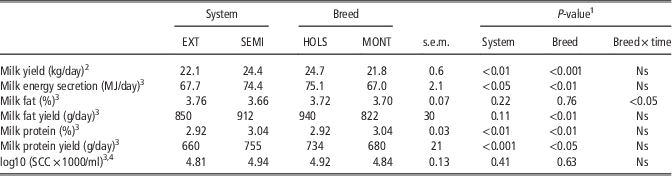
Production data are presented in Table 1 and Supplementary Figures S1 and S2. Independently of breed, cows in EXT produced less milk (22.1 v. 24.4 kg/day; P<0.01) and protein (660 v. 755 g/day; P<0.001) than those in SEMI, respectively. No difference in milk fat secretion was observed (850 v. 912 g/day; P=0.11). Cows in EXT secreted less energy in milk (INRA, 2007) than those in SEMI (67.7 v. 74.4 MJ/day; P<0.05; Supplementary Figure S1).
Milk production and composition of early lactation Holstein and Montbéliarde cows under two low-input production systems

EXT=extensive; SEMI=semi-extensive; HOLS=Holstein-Friesian; MONT=Montbéliarde; NEL=net energy of lactation; SCC=somatic cell count.
1 Time effect was significant (P<0.01), system by time and system by breed by time interactions were nonsignificant for all variables. System by breed interaction was significant for log10 (SCC) (P<0.05).
2 Weeks 1 to 12 of lactation.
3 Weeks 2 to 12 of lactation; NEL (MJ/day)=milk yield (kg/day)×[0.44+(0.0055×(fat content−40))+(0.0033×(protein content−31))]×7.12, with milk fat and protein content expressed as g/kg (INRA, 2007).
4 Log-transformed (base 10) of SCC.
Across production systems, HOLS produced more milk (24.7 v. 21.8 kg/day; P<0.001), protein (738 v. 674 g/day; P=0.05) and fat (939 v. 819 g/day; P<0.01), and secreted more energy (75.1 v. 67.0 MJ/day; P<0.01) than MONT, despite lower protein content for HOLS (2.92% v. 3.04%; P<0.01). There was a breed by time interaction for milk fat content because it was greater or tended to be greater for HOLS on weeks 2 (P=0.03), 3 (P=0.08) and 4 (P=0.03), but tended to be lower on week 11 (P=0.06) compared with MONT (Supplementary Figure S2). For all production variables, breed by system interactions were not significant.
Condition score and ultrasound measurements
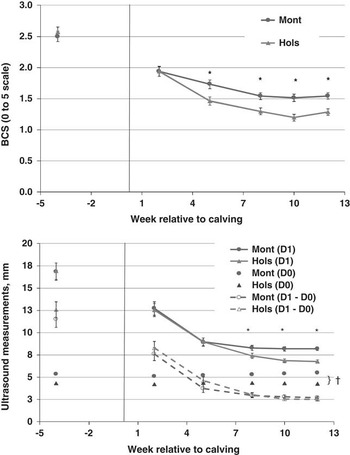
System effects, two- or three-way interactions with system (P⩾0.40) were not observed for BCS, BCS loss or ultrasound measures of subcutaneous tissues. There was a breed by time interaction (P<0.05) for BCS because HOLS lost more BCS (1.41 v. 1.03±0.09; P=0.001) for a longer period postpartum (59 v. 48±4 days; P<0.05) and reached a lower BCS nadir (1.12 v. 1.43±0.05; P<0.001) compared with MONT (Figure 1). ‘Backfat thickness,’ defined as skin plus subcutaneous tissues (D1), was lower for HOLS at week 8 postpartum and thereafter (breed by time interaction: P<0.05) compared with MONT. Nonetheless, this difference was due to the thinner skin (D0) of HOLS (4.3 v. 5.3 mm; P<0.001), because breed effects or breed by time interactions were not observed for measurements of subcutaneous adipose and connective tissues (D1−D0; Figure 1). The distance D1−D0 was 3.0, 2.7 and 2.6 mm on weeks 8, 10 and 12, respectively, and represented only 33% to 35% of D1 (Figure 1).
Body condition score (BCS) and ultrasound measurements of early lactation Holstein (HOLS) and Montbéliarde (MONT) cows under two low-input production systems. BCS was assessed on a six-point (0 to 5) scale (Bazin et al., Reference Bazin, Augeard, Carteau, Champion, Chilliard, Cuylle, Disenhaus, Durand, Espinasse, Gascoin, Godineau, Jouanne, Ollivier and Remond1984). Ultrasound measurements were performed on the sacral region. Measure D1 corresponds to skin plus subcutaneous adipose and connective tissues (i.e. denominated as ‘backfat thickness;’ Schroder and Staufenbiel, Reference Schroder and Staufenbiel2006), D1−D0 corresponds to subcutaneous adipose and connective tissues (Pires et al., Reference Pires, Bany, Rouel, Giraud and Chilliard2012). Significant breed differences within a week are indicated by * for BCS (P<0.01) and D1 (P<0.05), and † for D0 at all time points (P<0.001). Significant fixed effects in the statistical models: breed for BCS and D0; breed×time for BCS, D1 and D0; time for all variables. Error bars indicate s.e.m.

Plasma metabolite and hormone concentrations
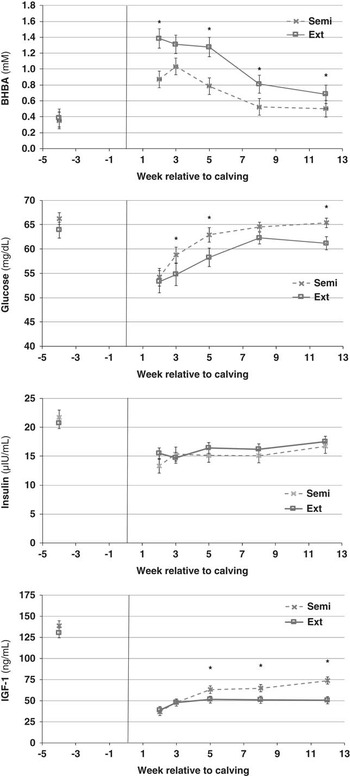
Plasma metabolite and hormone concentrations are presented in Figures 2 and 3, and Supplementary Figure S3. Compared with SEMI, cows under EXT had greater plasma BHBA (0.97 v. 0.69 mM; P<0.001), lower glucose (59.0 v. 62.0 mg/dl; P<0.01) and lower IGF-1 (62 v. 71 ng/ml; P<0.05; Figure 2). System differences on IGF-1 were significant from weeks 5 to 12 postpartum, and a significant system by time interaction was observed. System effects were not observed for plasma insulin or leptin concentrations. Cows under SEMI had greater plasma NEFA concentrations (450 v. 377 µM; P<0.05) than EXT, but a complex three-way interaction among system, breed and time was observed (Supplementary Figure S3).
Physiological adaptations of early lactation Holstein and Montbéliarde cows under an extensive (EXT) or a semi-extensive (SEMI) production system. System effects on plasma β-hydroxybutyrate (BHBA), glucose, insulin and IGF-1 concentrations. Significant system differences within a week are indicated by * (P⩽0.05). Significance of fixed effects in the statistical models: P<0.05 for system effect on BHBA, glucose and IGF-1; P⩽0.05 for breed effect on BHBA and insulin, and P⩽0.10 on glucose and IGF-1; P<0.01 for system×time on IGF-1; P⩽0.05 for breed×time on BHBA and glucose, and P=0.10 on insulin; P<0.05 for system×breed×time on glucose; P<0.001 for time and P<0.05 for parity effects on all variables. Error bars indicate s.e.m.

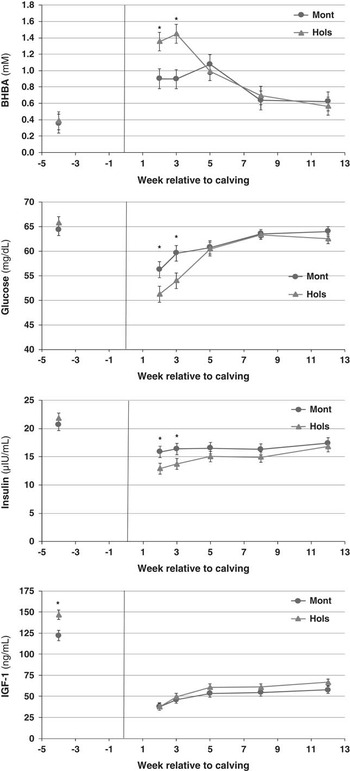
Physiological adaptations of early lactation Holstein (HOLS) and Montbéliarde (MONT) cows under an extensive or a semi-extensive production system. Breed effects on plasma β-hydroxybutyrate (BHBA), glucose, insulin and IGF-1 concentrations. Significant breed differences within a week are indicated by * (P⩽0.05) and trends by ‡ (P<0.10). Significance of fixed effects in the statistical models are reported in Figure 2. Error bars indicate s.e.m.

Overall, HOLS had greater plasma BHBA (0.91 v. 0.75 mM; P<0.05), lower insulin (15.9 v. 17.2 µIU/ml; P<0.05) and tended to have lower glucose (59.6 v. 61.4 mg/dl; P=0.06) than MONT (Figure 3). Breed differences on BHBA, glucose and insulin were observed on weeks 2 and 3 only, leading to trends (insulin; P=0.06) and significant (BHBA and glucose) breed by time interactions (Figure 3).
On week −4 relative to expected calving, HOLS had greater plasma IGF-1 than MONT (147 v. 122 ng/ml; P<0.01; Figure 3), leading to a trend for an overall breed effect on IGF-1. A breed by time interaction was observed for leptin concentration (P<0.01). Prepartum leptin tended to be greater for HOLS compared with MONT (3.2 v. 2.5 ng/ml at week −4), it was decreased at week 2 and thereafter for both breeds, and remained numerically lower in HOLS as lactation progressed (Supplementary Figure S3).
Milk FA composition and secretion
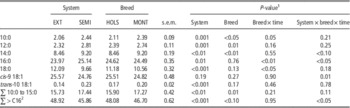
Milk FA composition and secretion of selected FA are presented in Table 2, Supplementary Tables S3 and S4 and Supplementary Figure S4. Cows under SEMI had greater milk fat concentration and secretion of 10:0, 12:0, 14:0, 16:0 (trend for greater secretion), trans-10 18:1 and ∑ 10:0 to 15:0 compared with EXT. Conversely, the milk fat concentration of 18:0 and ∑>C16, and secretion of 18:0 was lower in SEMI. No difference between systems was observed for cis-9 18:1 concentration, despite a complex three-way interaction among system, breed and time. Cows in SEMI had greater milk fat concentration and secretion of trans-10 18:1 (Table 2 and Supplementary Figure S4).
Milk composition (g/100 g FA) of selected FAs of early lactation Holstein and Montbéliarde cows under two low-input production systems

FA=fatty acid; EXT=extensive; SEMI=semi-extensive; HOLS=Holstein-Friesian; MONT=Montbéliarde.
1 System by breed interactions were significant for 16:0 and 18:0 (P⩽0.01). A trend for a system by time interaction was observed for trans-10 18:1 (P<0.10). Time effect (weeks 2, 3, 5, 8 and 12 of lactation) was significant for all variables.
2 Sum of FA with >16 carbons.
Breed differences were observed for milk FA composition and secretion during the first 12 weeks of lactation. MONT cows had greater milk fat concentration of 10:0, 12:0, 14:0, ∑ 10:0 to 15:0, and tended to have lower ∑>C16 compared with HOLS. HOLS cows secreted more 16:0, 18:0, cis-9 18:1, cis-9,cis-12 18:2, 18:3n-3 and ∑>C16 than MONT.
Ovarian cyclicity
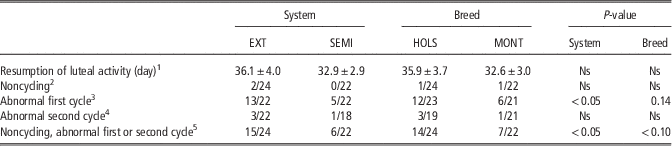
The number of days to the resumption of luteal activity and the number of cows not cycling by 88 DIM were not statistically different between production systems or breeds (Table 3). The number of cows presenting abnormal first cycles was greater for EXT than SEMI (13/22 v. 5/22; P<0.01). Cows in EXT had more ovarian cycle abnormalities (i.e. either noncycling, or presenting abnormal first or second cycles) than those in SEMI (15/24 v. 6/22; P<0.05). Overall, HOLS tended to have more cycle abnormalities compared with MONT (14/24 v. 7/22; P<0.10). Breed effects were numerical when studying the first estrous cycle only (12/24 v. 6/21; P=0.14; Table 3).
Resumption of luteal activity and frequency of ovarian cycle abnormalities of early lactation Holstein and Montbéliarde cows under two low-input production systems

EXT=extensive; SEMI=semi-extensive; HOLS=Holstein-Friesian; MONT=Montbéliarde; DIM=days in milk.
1 Days until first luteal phase. Values are means (±s.e.) estimated by survival analysis.
2 Noncycling at the end of progesterone monitoring period, that is, DIM>88.
3 Short or prolonged first cycle (i.e. cycle shorter than 17 days or longer than 27 days).
4 Short or prolonged second cycle (i.e. cycle shorter than 17 days or longer than 27 days).
5 Proportion of cows with cyclicity problems (i.e. noncycling or with first or second cycle abnormalities).
Discussion
System effects
The greater milk, protein and energy secretion observed in SEMI during the first 12 weeks of lactation was likely owing to differences in nutrient intake (derived from forage quality and concentrate supplement) because there were no system effects on body reserve mobilization, as indicated by BCS and BCS loss. Furthermore, despite greater nutrient export in milk, cows under SEMI maintained a better physiological balance, as shown by plasma metabolite and hormone profiles (e.g. lower plasma BHBA and greater glucose, and greater IGF-1 starting at 5th week of lactation), and by a milk FA profile that indicate a more positive energy balance. Liver IGF-1 synthesis is downregulated during early lactation despite increased growth hormone (GH) levels (Lucy et al., Reference Lucy, Jiang and Kobayashi2001). The greater plasma IGF-1 observed in SEMI is consistent with literature from grass-based systems showing an earlier recoupling of somatotropic axis when cows received 3 kg/day of concentrate, which was sufficient to decrease plasma GH, and increase IGF-1 and glucose concentrations (Grala et al., Reference Grala, Lucy, Phyn, Sheahan, Lee and Roche2011).
The plasma NEFA concentrations followed a general profile found in periparturient cows. A complex breed by system by time interaction was observed, and overall, plasma NEFA was greater for SEMI (450 v. 377; P<0.05) than EXT. Therefore, plasma NEFA system differences are not consistent with other indicators of energy balance. Plasma NEFA concentration may however not reflect long-term lipolytic potential of dairy cows because it is affected by factors such as acute stress due to animal handling (Brickner et al., Reference Brickner, Rastani and Grummer2007; Leroy et al., Reference Leroy, Bossaert, Opsomer and Bols2011). Milk fat enrichment in specific FAs may be an alternative and robust indicator of nutritional status. In this study, milk FA profile supports an improved nutritional status in cows under SEMI. For instance, greater milk fat concentration of FAs potentially originating from de novo synthesis (8:0, 10:0, 12:0, 14:0, 16:0 and ∑ 10:0 to 15:0), and lower concentration of 18:0 and ∑>C16 that are derived in part from mobilization of body reserves. Previous research where energy balance was calculated in periparturient cows receiving the same lactation diet (Pires et al., Reference Pires, Delavaud, Faulconnier, Pomies and Chilliard2013 and unpublished results) showed positive correlation (r=0.80) between energy balance and concentration of ∑ 10:0 to 15:0 FA. A more positive energy balance is further supported by the greater milk protein content and yield observed in SEMI, because energy balance is a major nutritional determinant of milk protein synthesis (DePeters and Cant, Reference DePeters and Cant1992).
Cows under SEMI had increased milk fat concentration and secretion of trans-10 18:1, an indicator of altered rumen FA biohydrogenation with starch and polyunsaturated fatty acid (PUFA)-rich diets (Chilliard et al., Reference Chilliard, Glasser, Ferlay, Bernard, Rouel and Doreau2007). Increased trans-10 18:1 probably results from interactions of concentrate feeding with basal diet, pasturing young grass that is potentially rich in fermentable sugars and PUFAs, and eventual problems of concentrate allocation to individual cows owing to group feeding, as suggested by the individual variability of trans-10 18:1 profiles. Nonetheless, milk fat secretion was not impacted in SEMI, suggesting that critical thresholds of FA isomers, which could induce an inhibition of milk fat synthesis, were not reached.
An improved nutritional status of cows in SEMI was associated with lower frequency of abnormal ovarian cycles compared with EXT. Previous research comparing different HOLS strains did not find system effects on ovarian cyclicity (i.e. resumption and patterns of luteal activity postpartum) or reproduction outcomes, perhaps because pasture allowance was sufficient to meet lactation requirements, and supplemental feed was directed preferentially toward milk production (Horan et al., Reference Horan, Mee, O’Connor, Rath and Dillon2005a). In the current study, system effects on ovarian cyclicity may have been mediated by higher blood concentrations in glucose in early lactation, an earlier recoupling of somatotropic axis postpartum, and the resulting greater plasma IGF-1 concentration observed in SEMI. These changes may have improved the capacity of ovarian cells to respond to gonadotropins, and subsequently the estradiol production by follicles and of progesterone by corpora lutea (Lucy et al., Reference Lucy, Butler and Garverick2014).
Breed effects
HOLS cows secreted more milk, protein and fat compared with MONT, but relied to a greater extent on body reserve mobilization to support lactation, as indicated by the enhanced BCS loss, milk fat content in early lactation and energy secretion, and milk fat concentration and secretion of preformed (>C16) FA. This intense mobilization resulted in an aggravation of the metabolic challenge imposed by the onset of lactation in HOLS, because plasma BHBA concentration was greater, and glucose and insulin were lower compared with MONT. Sustained postpartum low leptinemia was observed for both breeds, probably reflecting the combined effects of negative energy balance and depletion of adipose reserves (Chilliard et al., Reference Chilliard, Delavaud and Bonnet2005). The numerically lower plasma leptin observed in postpartum HOLS is consistent with their lower BCS nadir. HOLS cows had greater plasma IGF-1 concentrations at 4 week before calving, but breed effects disappeared postpartum. Studies comparing early lactation of pure HOLS v. HOLS–MONT crossbreds showed no differences in plasma IGF-1, but greater GH concentrations in HOLSs, which indicates greater uncoupling of IGF-1: GH axis in the latter (Mendonça et al., Reference Mendonça, Litherland, Lucy, Keisler, Ballou, Hansen and Chebel2013). As GH is a major homeorhetic/teleophoretic driver of nutrient partitioning toward milk secretion in early lactation (Chilliard, Reference Chilliard1999; Lucy et al., Reference Lucy, Jiang and Kobayashi2001), uncoupling of somatotropic axis is the likely cause of lower BCS observed in pure HOLSs (Hazel et al., Reference Hazel, Heins, Seykora and Hansen2013). The same mechanisms are probably involved in the current study, but GH was not quantified. Breed differences on plasma glucose, BHBA and insulin were observed during the first weeks postpartum, whereas effects on BCS appeared at week 5 and thereafter. These results confirm that detection of BCS differences is delayed relatively to changes in metabolic and hormonal milieu, and that BCS effects provide a retrospective of physiological regulations of nutrient partitioning (Chagas et al., Reference Chagas, Lucy, Back, Blache, Lee, Gore, Sheahan and Roche2009).
Plasma leptin concentration tended to be greater for HOLS at week −4, despite no differences in prepartum BCS. Sustained low leptinemia was observed postpartum for both breeds, reflecting the combined effects of negative energy balance and depletion of adipose reserves (Chilliard et al., Reference Chilliard, Delavaud and Bonnet2005), especially in the HOLS. The numerically lower plasma leptin observed in postpartum HOLS is consistent with their lower BCS plateau.
The prioritization of milk secretion by HOLS was associated with trends for a greater number of cows presenting abnormal ovarian cycles compared with MONT. Under Irish grass-based systems with seasonal calving, HOLS lost more BCS postpartum and had impaired reproduction performance and longevity compared with MONT (Dillon et al., Reference Dillon, Buckley, O’Connor, Hegarty and Rath2003a and Reference Dillon, Snijders, Buckley, Harris, O’Connor and Mee2003b). Nonetheless, the relatively limited animal numbers in our study may have precluded the detection of significant breed differences for binary variables.
Breed by system interactions
The milk secretion and body reserve mobilization responses of MONT and HOLS to SEMI did not differ, despite significant system effects on indicators of nutritional status for both breeds. This suggests that the nutritional environments generated by the two systems were not sufficiently different to allow the expression of interactions during the studied period. Previous research has reported interactions among HOLS strains of diverse genetic background and feed allowance under grass-based systems (Horan et al., Reference Horan, Dillon, Faverdin, Delaby, Buckley and Rath2005b). These differences have been attributed to adaptations of somatotropic axis components that regulate nutrient partitioning (Lucy et al., Reference Lucy, Verkerk, Whyte, Macdonald, Burton, Cursons, Roche and Holmes2009). Nonetheless, strain by system interactions for milk production, body reserve mobilization and accretion may not occur when cows are on a low plane of nutrition (Grala et al., Reference Grala, Lucy, Phyn, Sheahan, Lee and Roche2011), which is the case in our experiment. In addition, it cannot be excluded that cow numbers may have been insufficient to allow the detection of eventual breed by system interactions. Furthermore, particularities of the experimental design of the long-term systems study, such as the age differences at first calving, may have been detrimental.
Ultrasound assessment of fat mobilization
Ultrasound assessment of ‘backfat thickness’ has been proposed to monitor body reserve mobilization in dairy cows (Schroder and Staufenbiel, Reference Schroder and Staufenbiel2006). The measurement of ‘backfat thickness’ (D1 in the current study) includes the skin (D0) plus the adjacent subcutaneous adipose and connective tissues. MONT cows had greater D1 starting at week 8 postpartum, which is in agreement with breed effects on BCS at week 5 and thereafter. However, statistical differences of ‘backfat thickness’ are due to the greater skin thickness (D0) observed in MONT, which became evident after the depletion of subcutaneous adipose and connective tissues (D1−D0) postpartum. ‘Backfat thickness’ is correlated with total body fat (Schroder and Staufenbiel, Reference Schroder and Staufenbiel2006), and allowed to differentiate body reserve mobilization among cows that calve with different degree of body fatness (Hammon et al., Reference Hammon, Sturmer, Schneider, Tuchscherer, Blum, Engelhard, Genzel, Staufenbiel and Kanitz2009; Weber et al., Reference Weber, Hametner, Tuchscherer, Losand, Kanitz, Otten, Singh, Bruckmaier, Becker, Kanitz and Hammon2013). However, it does not take into account internal adipose depots, which may have different dynamics of mobilization during early lactation (Weber et al., Reference Weber, Hametner, Tuchscherer, Losand, Kanitz, Otten, Singh, Bruckmaier, Becker, Kanitz and Hammon2013). Cows in the current study were at mid (prepartum) to low (postpartum) BCS range, and calved with homogenous levels of fatness, as indicated by BCS. Under these conditions, ultrasound measurements of subcutaneous adipose and connective tissues (D1−D0) failed to discriminate breed differences of body reserve mobilization. Furthermore, ‘backfat thickness’ (D1) was confounded with breed differences of skin depth (D0), therefore, it may not be adequate for multi-breed comparisons.
Conclusions
The greater nutrient allowance derived from type of pasture and concentrate supplement in SEMI did not attenuate body reserve mobilization because both HOLS and MONT prioritized milk secretion in our experimental conditions. Nonetheless, indicators of physiological status and ovarian cyclicity during early lactation were improved in SEMI compared with EXT. HOLS cows secreted more nutrients in milk compared with MONT, but did so by relying to greater extent on body reserve mobilization to support lactation. The prioritization of milk secretion by HOLS imposed a metabolic challenge during the first 3 weeks postpartum, led to lower BCS starting at week 5 and may have impacted ovarian function because there was a trend for greater proportion of cows presenting cyclicity problems compared with MONT. Breed by system interactions were not observed for most variables during this study.
Acknowledgments
The authors thank J. Noel, O. Troquier, K. Vazeille and the staff at the experimental unit ‘Monts d'Auvergne’ of Marcenat (INRA, UE 1296, Puy-de-Dôme, France) for animal management and sample collection; A. Farruggia (INRA, UMR1213, Saint-Genès-Champanelle, France) for the conception and discussions of the ‘system-type’ experiment, and providing pasture nutritional value; D. Bany for performing ultrasound measurements; and E. Tixier and M. Tourret (INRA, UMR1213, Saint-Genès-Champanelle, France) for laboratory analyses. This research was funded in part by the Department of Animal Physiology and Livestock Production Systems (PHASE) of INRA.
Supplementary materials
For supplementary materials referred to in this article, please visit http://dx.doi.org/10.1017/S1751731115001317