

Introduction
Corruption is a phenomenon observable in both dictatorships and democracies, and salient in different periods of the history of mankind (Alatas, Reference Alatas1990: 3–4). However, its understanding is not similar across regimes. Indeed, corruption can be defined as the abuse of public office for private gain, but it can also be understood as any serious violation of the standards and expectations associated with public office, regardless of whether such behaviour or practice implies or not a breach of law or of codes of conduct (Friedrich, Reference Friedrich1966; Gardiner, Reference Gardiner1992; Jos, Reference Jos1993; Johnston, Reference Johnston1996; De Sousa, Reference De Sousa2008). This discrepancy between legal/formal and social/cultural standards defining corrupt behaviour in a given society at a particular time is what makes the study of corruption so challenging (De Sousa, Reference De Sousa2002).
Moreover, addressing this conceptual complexity in dictatorships is more difficult than in democracies. Although the maxim, ‘not everything that is legal is approved ethically by citizens’ may still apply, citizens in dictatorships do not voice it out in the open, in particular when it concerns misconduct by regime officials. This poses additional difficulties to the researcher: how can corruption be studied in a context of limited and unreliable information?
Even if records on criminal laws, penal codes, and other legal provisions are likely to be accessible, there is barely any information about its enforcement and when it exists it is likely to be biased. When it comes to social/cultural norms, the situation is even more stringent. If corruption is a deviant social conduct that raises moral condemnation in society, the immediate question is: who dictates what those moral standards are? (Scott, Reference Scott1972). In a democracy, we can try to understand what those moral standards are by looking at people’s perceptions, attitudes, and practices. This can be done by resorting to the usual opinion-based research techniques, such as survey methods, discussion groups, or content analysis of corruption news. Although in a dictatorship, these sources of information are neither readily available nor do they offer reliable indicators of people’s perceptions due to the fact that freedom of expression, media independence, and parliamentary politics are conditioned by militarist rule, censorship, regime propaganda, etc., they can, nevertheless, be taken as predictors of the regime’s sensitivity to and understanding of the phenomenon and as a discourse control mechanism.
In this line, we have opted to do a content analysis of parliamentary debates during the Portuguese Estado Novo (1935–74) in order to assess the role of National Assembly in steering public discourse and perception of corruption. This is a new approach to the study of corruption in electoral authoritarian regimes. According to our findings, the Portuguese authoritarian regime has used the controlled parliament in an instrumental manner, along with other conventional propaganda mechanisms, to shape the public discourse on corruption by shifting its focus from the legal to the moral dimension of the phenomenon. This move had two important consequences: first, it served to hide eventual involvements in corruption interactions by regime officers; second, it deprived citizens and oppositions of objective standards to hold regime elites accountable.
Why have the authors chosen the Portuguese case? The case of Portugal results is quite unique for three main reasons: it was the longest-lived authoritarian regime in Western Europe; it maintained a parliamentary institution; and it was characterized by strong charismatic rule based on an officially constructed sense of moral rectitude. Morality played a central role in the regime imaginary. The image of austerity purported by a strong catholic rejection of material wealth moulded by the charismatic leadership of Salazar was so intense and widely shared among the population that it still has considerable impact upon today’s perceptions on regime corruption. Despite the authoritarianism of the Estado Novo (monopoly of power, discretion under a legal façade, media censorship, and persecution of political opponents and dissidents), the Portuguese historical narratives have systematically described Salazar as an austere and honest leader, worried about the people, defending of traditional values and with public service devotion. To an extent, this explains why there are very few academic works addressing the issue of corruption during the Estado Novo and why it is so challenging to try to understand the way the regime has handled this sensitive issue.
This article is organized into four parts: the first, discusses the role of legislatures in electoral authoritarian regimes; the second, addresses two regime conceptualizations of corruption – corruption as abuse of office and moral corruption; the third, looks into parliamentary sources to try to understand how the regime treated the theme of corruption and what were the discrepancies between these two conceptualizations of corruption; the final part, makes some general remarks on the official talk of corruption.
The role of legislatures in electoral authoritarian regimes: the Estado Novo’s concept of ‘organic democracy’
Following the seminal works of Schmitter (Reference Schmitter1977) and Linz (Reference Linz1979), the literature on authoritarian regimes in which at least one political institution, the legislature, is chosen through a restricted electoral process has grown considerably during the past decade (Folch, Reference Folch2003; Levitsky and Way, 2003; Brownlee, 2004; Gandhi and Przeworski, 2006; Lust-Okar, 2006; Magaloni, 2006; Boix and Svolik, Reference Boix and Svolik2007; Gandhi, Reference Gandhi2008). However, most publications tend to focus more on dictatorial single parties than on legislatures, in part due to the fact that ‘party systems in dictatorships exhibit much more variation across regions than legislatures’ (Gandhi, Reference Gandhi2008: 38). Historical research on the role of the National Assembly in the Portuguese authoritarian regime is also sizeable (Quintas, Reference Quintas1996; Braga da Cruz, Reference Braga da Cruz1999; Castilho, Reference Castilho2001; de Carvalho, Reference de Carvalho2002; Fernandes, Reference Fernandes2005; Ferreira, Reference Ferreira2009; Pinto, Reference Pinto2011), but none of these contributions have addressed the issue of corruption in particular.
Authoritarian regimes differ in their choice of institutional means for rulemaking and information gathering. Here, we have to start by distinguishing between short-lived tyrannical dictatorships and long-duration authoritarian regimes with a certain degree of support from segments of the population, where discretionary rule takes place under a legal façade and intimidation is more subtle, relying on a widespread state information apparatus that co-opts civilian informants. The Argentine, Chilean, and Greek dictatorships abolished their legislatures, whereas the Portuguese, Brazilian, and Mexican ones retained them under more restricted terms and conditions. In the case of Portugal, the regime’s decision to adopt an ‘organic-statist’ legislature has more to do with a general tendency of interwar dictatorships than a product of specific patterns of institutional development (Pinto, Reference Pinto2012).
‘Parliamentary dictatorships’ or ‘electoral authoritarian regimes’ employ ‘consultative procedures, legislative assemblies, and party organizations to shape the new rules for governing; in general, the greater the resort to these procedures, the more politically effective the authoritarian regime was and the lower was its resort to police or military repression’ (Domínguez, Reference Domínguez2002). As Gandhi noticed, legislatures in dictatorships are not mere shams, but the product of strategic behaviour on the part of political actors’ (Reference Gandhi2008: 180). They serve as a forum in which the regime can announce their policy preferences, co-opt large segments of society, and engage in an institutionalized dialogue (or controlled bargaining) with the more visible sectors of the opposition (Gandhi, Reference Gandhi2008: 34–36, 80–81). Autocrats too ‘need compliance and cooperation’ (Gandhi, Reference Gandhi2008: xviii), hence other than serving as a means through which ‘authoritarian leaders can offer policy and material concessions’ (Gandhi, Reference Gandhi2008: 166) in order to lower political contestation to its rule, legislatures under dictatorships also play a crucial role in framing and promoting the regime’s normative cohesiveness.
This was the case with the Portuguese Estado Novo (1926–74). As Castilho (Reference Castilho2007: 291) explained, despite Salazar’s misbelief in the parliamentary institution, he maintained the National Assembly until the end of his tenure, because it was useful for propaganda purposes, both at home and abroad. On the other hand, he had nothing to fear as MPs rather than being elected were ‘appointed’ by himself or under his supervision: only 15% of MPs during the dictatorship had no direct links to the governing bodies of the regime’s political organizations.
The Portuguese authoritarian regime came to being in a context of civil strife and political instability. In its early days, the regime had to deal with several power groups and currents of opinion. The parliament was abolished with the military coup of 28 May 1926 and only reinitiated its activity 2 years after the adoption of the 1933 Constitution. The Portuguese Estado Novo adopted the concept of democracia orgânica (organic democracy) as a legitimization tool. Its institutional format contemplated the exercise of discretionary rule under a legal façade, the existence of powerless organic legislatures, the holding of elections, and, for part of its duration, a regime party and the Constitution of an opposition front (under tight state police control). These co-option techniques ensured a great degree of regime cohesiveness under a charismatic leadership and strong popular support by large segments of the population. However, we should not mistake popularity for democratic consent. The Estado Novo was in all its plenitude an authoritarian regime, hence it was prepared to repress, and of course, and at times did so.
The Estado Novo decided to reintroduce a legislative body, with limited powers and capacities, to advance its goals: the Assembleia Nacional (henceforth National Assembly) (Article 71 of the 1933 Constitution). The National Assembly was a monocameral parliament composed of 90 deputies in the first legislature and 150 in the last one that ended abruptly with the 25 April Revolution. The deputies were elected by direct majority suffrage. Although the Estado Novo used electoral consultations on a regular basis, these were not free, fair, and universal. Only 12% of the population voted in these elections and there were no mechanisms to control for electoral fraud (de Carvalho, Reference de Carvalho2002: 10). According to the corporatist Constitution, the National Assembly was a sovereign body, with exclusiveFootnote 1 and shared legislative powers and oversight of public expenditure. In practice, however, its legislative powers were reduced to symbolic interventions on a restricted number of policy areas availed by the Government. In that sense, it was not a parliament as such, but a talking shop for regime supporters and at a later stage for some (loyal) opposition members, such as the Ala Liberal (Liberal Wing) (Fernandes, Reference Fernandes2005: 18–25). Only on rare occasions were the interventions in the organic legislature used to voice some discontent from within the regime regarding sensitive policy options, such as the colonial war or the promiscuity between public and private issues. As Juan Linz simply put it, ‘no legislature in an authoritarian regime has either the formal or de facto power to question the ultimate authority of a ruler or ruling group’ (Reference Linz1979: 95).
Neither the National Assembly, nor the Corporatist ChamberFootnote 2 to that regard, played a major role in decisionmaking, but when it came to certain sensitive policy or social issues, it had an ultimate normative function: (1) to set the tone about how certain potentially disruptive issues, such as corruption, should be addressed or simply omitted from the public agenda (Article 85–105 of the 1933 Constitution); and (2) to issue ideological appeals about the rectitude of the regime and its moral superiority. The National Assembly, as it will be demonstrated in this article, was able to shift the debate on corruption from the legal to the moral dimension and thus deprive citizens, and in particular the opposition, of objective standards to hold regime elites accountable for their misconduct.
In a dictatorship, official talk about corruption is meant to have a legitimization effect either by bashing predecessors in an arbitrary and prosecutorial manner (clean up act) or by moulding the way the man of the street talks about corruption (power of manipulation). As Lukes put it, this is the most insidious exercise of power, i.e. the capacity ‘to prevent people to whatever degree, from having grievances by shaping their perceptions, cognitions and preferences in such a way that they accept their role in the existing order of things, either because they can see or imagine no alternative to it, or because they see it as natural and unchangeable, or because they value it as divinely ordained and beneficial’ (Reference Lukes1974: 24).
Whereas in democracies, parliamentary debates are likely to mirror, to a greater or lesser extent, the major issues of concern in society, in electoral authoritarian regimes they serve as a discursive control mechanism. The focus of the information moves from the masses to a specific segment of the elite entrusted with parliamentary functions. Notwithstanding, parliamentary debates are unrepresentative of the nature and extent of corruption during the Estado Novo – by the simple fact that such information would discredit its cohesiveness and threaten its rule – it is, nevertheless, useful to try and understand what type of ‘corruption talk’ the regime wanted to be voiced to the public, when and in what terms. For that reason, instead of taking parliamentary debates at their face value and dismissing tout court their usefulness to understand social representations of corruption, we have opted to survey their contents to understand the elite’s approach to potentially disruptive issues in society.
Two regime conceptualizations of corruption
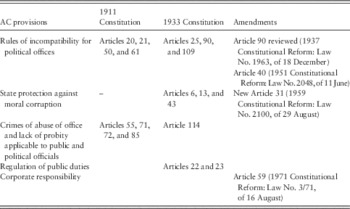
The 1933 corporatist Constitution introduced two conceptualizations of corruption: one based on legal/formal standards associated with the exercise of public duties, which took form through the penal code and other criminal laws (corruption as abuse of office); and another based on subjective/moral standards associated with social conduct and habits in general (moral corruption) (see Table 1).
Anti-corruption (AC) provisions in the Republican and corporatist Constitutions

Both conceptualizations were anchored in the Constitution and had legal backing. However, it is worth noticing that the definition and discursive importance of corruption as abuse of office had a more restricted scope in the 1933 corporatist Constitution than under the 1911 Republican Constitution.
As it happened during the First Republic, the Estado Novo Constitution equated good performance of political and administrative institutions with honesty and public integrity. Both constitutional texts provided a definition for abuse of office applicable to public and elective officials. Acting against the probity of the public administration was considered a serious offence under Article 114/6 of the 1933 National Constitution and Article 55/5 of the 1911 Republican Constitution. Similarly, the misuse of public funds was also considered an offence against the public interest under Article 114/7 of the 1933 National Constitution and Article 55/7 of the 1911 Republican Constitution. However, the constitutional emphasis on the need to build a transparent administration was not the same. Whereas the 1911 Constitution clarified that the crimes of abuse of office would be defined by specific legislation (Article 72) and indicated that the First Congress of the Republic should prepare a series of draft bills on crimes of political responsibility and on incompatibilities and impediments to embody this constitutional principle (Article 85); the 1933 Constitution did not have any article specifically addressing the urgent need to create the necessary legislative/regulatory mechanisms to fight abuse of office by senior public officials and political appointees.
Regarding the regulation of public duties, articles 22 and 23 of the 1933 National Constitution established that public officials – including those in local Governments, administrative corporations, or state-owned enterprises – are serving the collective interest and not private ones. Whereas in the 1911 Republican Constitution, incompatibilities and impediments were mentioned in the Constitution, but were to be regulated in detail through dedicated laws; under the 1933 National Constitution, incompatibilities and impediments were addressed only in the Constitution (Article 25 set incompatibilities for public servants, article 90 for members of the National Assembly, and article 109 for Ministers). These incompatibilities prohibited the accumulation of public employment and the possibility of public and elective officials from entering into contracts with the Government. In 1937, the impediments set under article 90 were extended to include business relations with state-owned enterprises (Article 90, Reform: Law No. 1963, of 18 December 1937). The accumulation of positions in public companies was considered contrary to the public moral and the proper functioning of the economy (Article 40, Reform 1951).
The explicit concern about moral corruption was an innovation under the 1933 National Constitution, which provided that ‘the State must promote the moral unity of the people’ (Article 6). In fact, for the first time in the constitutional history of Portugal, the word corruption is mentioned in a constitutional article, but with an arbitrary meaning: the number 5 of article 13 established that ‘in order to defend the family, the State and local authorities must take all the necessary measures to avoid the corruption of traditions’. In addition, the number 3 of article 43 of the 1933 Constitution provided that public schools should improve the intellectual capacity of individuals, mould their character, and teach them professional values and civic and moral virtues. The reform introduced by Law 1910 of 23 May 1935 clarified that ‘the moral and civic virtues’ were ‘oriented by the principles of Christian doctrine and the moral traditions of the Country’. These two constitutional provisions were at the heart of the regime-led moralization of public and private spheres in view of the creation of ‘a new State, a new society and a new man’.
When economic speculation became a political issue at the end of the 1950s, the provisions of article 31 of the 1933 National Constitution, which defined the rights and obligations of the State to regulate economic and social life, were broadened to include ‘the duty to prevent excessive profits that deviate capital from its human and Christian purposes’ (Modification of Article 31: Article 5 of Law 2100, of 29 August 1959).
The regime focused much of its attention on state protection against corruption defined as moral decay and immoral corporate practice.Footnote 3 In other words, the State was not perceived by the regime as immoral or corrupt; greedy individuals, businesses, and the society as a whole were. The fact that this conceptualization of moral corruption was anchored in the Constitution would influence the way debates about the phenomenon were framed in the National Assembly. The regime wanted not only to regulate conducts in the exercise of public duties, but it also wanted to impose a State definition of morality to private conducts.
A content analysis of parliamentary debates in authoritarian legislatures
We have assessed the use of corruption as a discursive label during the parliamentary debates of the Portuguese Estado Novo. The citations were collected through a keyword search of the online database of the Portuguese ParliamentFootnote 4 that contains all the Session Diaries of the four periods of parliamentary history: the Constitutional monarchy (1821–1910); the First Republic (1910–26); the Estado Novo (1935–74), and the Third Republic (since 1974). This digital archive has a tool to perform advanced searches for words or phrases. We searched for mentions of ‘corruption’ (corrupção), ‘to corrupt’ (corromper), and ‘corrupted’ (corrupto and corrupta) in the Session Diaries of the National Assembly (Assembleia Nacional) and in the Minutes of the Corporatist Chamber (Câmara Corporativa) for the 11 legislatures of the Estado Novo.
We have also checked for the use of the terms ‘fraud’ (fraude) (413 mentions) and ‘bribes’ (suborno) (23 mentions) to see if there was some connection between both. We found no straightforward correlation. Most of the references on fraud are related to fiscal fraud (mostly tax evasion and flight of capital abroad in the last years of the regime) and consumers’ fraud (mostly adulterations of products and falsification). In neither situation, the term ‘fraud’ has been expressly related to corruption or bribery. Regarding bribes, when the word appeared in the debates it was mostly related to foreign corrupt practices in Zaire, England, France, or India. The term bribery has never been used to describe any practice or conduct identified in the Portuguese context.
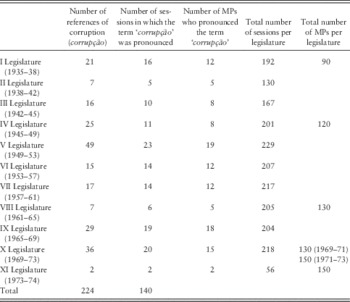
Table 2 shows the number of references found in the texts for the whole period of existence of the National Assembly and the Corporatist Chamber (1935–74). Each mention of ‘corruption’ (corrupção) was treated as a unit of analysis or statement to understand with what frequency and in what terms and context the regime’s parliamentary representatives referred to the term in their interventions or debates. We have analysed a total of 224 mentions of ‘corruption’ that were referred by different MPs during the 140 sessions. Although only a minority of MPs used the term in each legislature (<16% of the total number of MPs), this does not mean that these interventions had no resonance at the level of the general public. Conventional propaganda mechanisms, such as the press under a tight censorship regime, played an important role in conveying to the masses an official narrative of morality emerging from the core state institutions (Adão, Reference Adão2012: 12). The terms ‘to corrupt’ and ‘corrupted’ were used as control variables and allowed us to confirm a prevailing moral understanding of the concept over the abuse of office connotation.
The use of the term corruption in parliamentary debates during the Estado Novo

These statements set the boundaries for the construction of frames to interpret the social, political, and economic context. Reese defines frames as ‘organizing principles that are socially shared and persistent over time, that work symbolically to structure the social world significantly’ (Reference Reese2001: 11). The theory of frames has been widely used in communication research to analyse how the media construct editorial lines that determine what is to be published, what should be censured, and how to talk about a specific topic (Entman, Reference Entman1993; Semetko and Valkenburg, Reference Semetko and Valkenburg2000). Similarly, it can be used to understand how authoritarian Governments decide what socially relevant issues are to be debated and eventually addressed by legislation, what to silence, and what to emphasize. Every political regime tries to build stable frames for interpreting facts. In the case of corruption, they serve as a discursive parameter to semantically settling what corruption, corruptible, and corrupting mean. This characterization of the phenomenon will determine which issues enter into the legislative agenda and with what level of importance. Through a content analysis (Krippendorff, 2003) of the parliamentary debates during the Estado Novo we can identify what frames were used by the regime to limit the understanding and discursive use of the concept of corruption.
As shown in Table 2, the theme has been present, with greater or lesser frequency, in all legislatures of the Estado Novo’s National Assembly, however, with a poorer level of intensity compared with what can be found for the later years of the First Republic and the post-1974 Third Republic. During its 39 years of existence, the term ‘corruption’ (corrupção) was used 224 times in 144 sessions compared with 23 references in the Chamber of Deputies during the last 5 months of the First Republic until the 28 May 1926 coup d’état and 77 references in the Constituent Assembly after the 25 April 1974 Revolution (between 2 June 1975 and 2 April 1976). This seems to corroborate the general belief that democracies are more alerted to the problem of corruption than authoritarian regimes due to greater media freedom and public exposure (Tumbler and Waisbord, Reference Tumbler and Waisbord2004). The data also suggest that the politicization of corruption is likely to intensify during the early period of democratic transition within the context of transitional justice measures/debate and in periods leading to democratic collapse due to the explosive combination of governmental instability and corruption scandals. However, these two inferences need empirical testing.
There were no debates tabled specifically on the issue of corruption. However, the use of the term during parliamentary debates was either introduced in a random manner by MPs or related to several government legislative initiatives. In fact, during the IV, V, IX, and X Legislatures the term ‘corruption’ was used with greater intensity due to the fact that it was directly related to the discussion and approval of various bills on moral corruption. For instance, during the V Legislature, the parliament conducted an intense debate on the Project Law on Family Abandonment. Discussions on this topic had already begun in the Fourth Legislature. Moreover, the debate about the need to promote and protect the ‘good use’ of the Portuguese language in its colonies began during this period. According to the various interventions, this linguistic issue was also a consequence of a more general trend of moral decay that the regime had to address vigorously.
The IX Legislature was marked by various debates on the degradation of the youth, including the increase of drug addiction, the need for censorship in the media and the entertainment industry (cinema, theatre, music), and the need to regulate and suppress immoral conduct in public. During the same period, the debate on the need to defend the good use of the Portuguese language intensified as well.
Interestingly, we only found two references during the parliamentary debates of the last legislature that lasted between 28 October 1973 and 25 April 1974. Our understanding is that by then the parliament had become completely useless even for symbolic purposes. The regime elites could no longer be bothered to mould an official talk on corruption at the parliamentary level when growing democratic contestation was being felt out in the streets and in major institutional circles, such as the military and the university. The regime had become ripe of corruption and there was little that official propaganda could disguise. Not surprisingly, the Movement of the Armed Forces (MFA) that took power at dawn of 25 April 1974 set in its executive document that the fight against corruption and speculation has one of the three urgent priorities for the country.Footnote 5
During the X Legislature, the problem of colonial wars and conflicts overseas entered the scene, and in different ways, were related to corruption. This time, the scope of corruption was not only moral, but also political. Drugs, lewd artistic performances, and the need to exercise exhaustive control over the press were other issues that deputies discursively linked with corruption. In addition to the content analysis of parliamentary debates, we have also identified key historical facts related to both corruption as abuse of office and moral corruption in order to check whether the political class debated or not concrete cases where economic, religious, and political elites were involved, such the paedophile scandal known as Ballet Rose;Footnote 6 the Bank Fonsecas, Santos & Viana fraud scandal,Footnote 7 or the Martin Saint illicit commission scandal.Footnote 8
The meaning of corruption in parliamentary debates during the Estado Novo
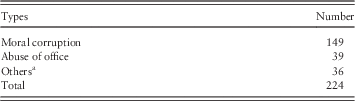
There were two types of use of the label corruption during parliamentary debates: corruption as the decay of society’s moral values and corruption as abuse of office (Table 3).
Number of references to moral corruption and abuse of office
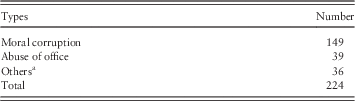
a We have excluded from the analysis 36 mentions of corruption that did not fit either moral or abuse of office conceptualizations. MPs often used the term in a vague manner without a direct relation to the Portuguese society and/or political-administrative system.
Moral corruption
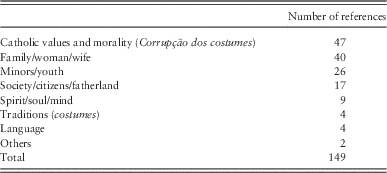
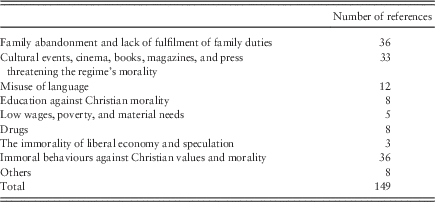
The discursive construction of moral corruption is divided into two categories: those interventions made with concrete references to the regime’s legal framework and those in which the term is linked in a looser manner to the threat to ‘Christian morality’ and ‘good Catholic life’ (see Table 4). In both cases, the use of the concept is connoted with Catholic standards. Any conduct that deviates from these dominant moral standards is perceived by the regime as moral corruption (Table 5).
Number of references to moral corruption

Anatomy of moral corruption
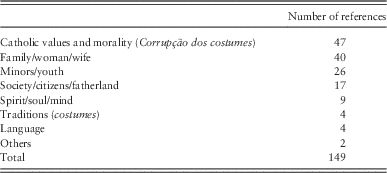
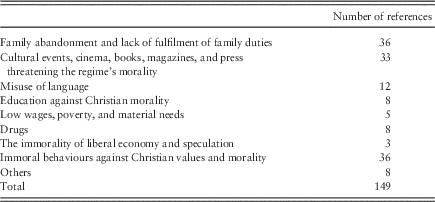
These values were politically filtered. The Government, and more concretely the parliamentarians acting as a puppet legislator, are discursively presented to the audiences as being responsible not only for defining, detecting, and condemning the various forms of moral corruption, but also to seek measures to resolve these degenerations. Family, youth, and society in general were those potential victims of moral corruption (Table 6); neither the Government officials, nor the members of parliament appear in the parliamentary debates as agents threatened by the possibility of being corrupted. Their moral standards are above any suspicion.
Different causes of moral corruption
The legal framework of moral corruption: Moral corruption is not an abstraction. Its legal foundations are to be found in Article 13.5 of the 1933 Constitution, the unique explicit mention to corruption in the text, as said above:
Titulo III – Da Família: Artigo 13, 5° - Tomar todas as providências no sentido de evitar a corrupção dos costumes.
This semantic construction appears in the debates as a unit of analysis. Out of 224 mentions of corruption, more than half (149) refers to moral corruption; 47 refer to moral corruption as corrupção dos costumes (that is 21% of the total references of corruption and 32% of the total references of moral corruption). Of these, 29 refer explicitly to Article 13 of the Constitution quoted above. However, it is important to notice that every time an MP quoted point 5 of Article 13 of the 1933 National Constitution, they referred to it as part of article 14Footnote 9 (see, e.g. Braga da Cruz, IV Legislature, Diário das Sessões, no. 166, 24 February 1949). This only demonstrates the little significance that the Constitution had for the members of the National Assembly or the little constitutional knowledge of MPs. The same error was repeated during the different legislatures. Every explicit reference to this constitutional principle is mentioned in Article 14 and not in Article 13, as it should.
Over the years, this constitutional provision served as the legal foundation for various legislative initiatives on issues or conducts that the members of parliament considered contrary to Christian morality and hence the regime’s dominant value structure, such as divorce and family protection (13 mentions of the term corrupção dos costumes), education (seven mentions), consumption and trafficking of drugs (seven mentions), censorship of ‘indecent’ cultural shows and art exhibitions (10 mentions), censorship of art and media (four mentions), fight against poverty (two mentions), and speculation and economic concentration (four mentions). The World War I was regarded as the starting point of all the immorality in the world (four mentions).
The remaining interventions with reference to the legal framework were related mostly to the debate on the preparatory texts of the Law on Family Abandonment (Law No. 2053, of 22 March 1952) (25 mentions), on the Law of the Press (Law No. 6/71, of 5 November) (four mentions), and on the Decree Law on the fight against drugs (Decree Law 420/70, of 3 September) (four mentions).
Moral corruption beyond the legal framework: Moral corruption (without reference to a strict legal framework) is related to a number of assumptions that defined the constituent principles of the political imaginary of the Estado Novo, that is, stable ideological judgement premises that settle what is good, just, and desirable for the good life of citizens according to the Regime. These statements delimit frames for understanding social and political situation.
Good life, during the Portuguese dictatorship, was related to Christian morals and traditions, and everything that deviated from this norm was considered moral corruption. As Joaquim Saldanha pointed out in one of his interventions, ‘as stated in the National Constitution,Footnote 10 the State is responsible for ensuring that the Portuguese are educated according to the principles of Christian civilization’Footnote 11 (Joaquim Saldanha, III Legislature, Diário das Sessões No. 8, 14/12/1942, p. 53). As the family was understood as the foundation of Christian life, everything that changed its Catholic essence and produced (negative) externalities to society was consider moral corruption. For instance, the ease in which divorce could take place in a given society not only caused family breakdown, it also extended moral corruption (Cunha Gonçalves, I Leg., DdS 87, 24/2/1936, p. 668). Women working at late hours were not only perceived as damaging to their dignity as women and family figures, but also constitute a form of moral corruption (Santos Carreto, VI, 85, 25/3/1955, p. 690). The capitalist profit-making logic was immoral and corrupted the nature and structure of the catholic family, because it sent fathers, mothers, and children to the factories, downgrading their human nature and treating them as mere working machines (Diniz da Fonseca, I, 122, 9/4/1937, p. 515).
Throughout the various parliamentary sessions, there was a discursive consensus about immorality in western societies. The general tone was that modern societies were facing the corruption of morals due to twin-head process of value change: the spread of materialism and the loss of solidarity (Almeida Coita, X, 34, 15/4/1970, p. 674).
The regime was illiberal and sceptical about capitalism, whereas supportive of the social doctrine of the Church. In other words, if affluence was a source of moral decay as it drove people to spend unwisely and to think and act in materialistic terms, material shortage, low salaries, and precarious housing were also factors of moral corruption, because these were improper conditions for human development (João do Amaral, V, 209, 28/2/1953, p. 734; Azeredo Pereira, VI, 35, 14/2/1954, p. 525). It was the State’s competence to set the limits of what was and was not desirable levels of wealth. In this sense, welfare and fiscal policies were understood as mechanisms for the State to prevent moral decay by controlling the redistribution of income in society (Dias Rosas, VII, 89, 4/4/1959, p. 402).
The tone of the debate was also conservative. Modern societies were becoming morally weak and permeable to ‘social bads’. It was the regime’s duty to protect the Portuguese people against undesirable influences coming from progressive countries. MPs continuously alerted to the dangers of youth corruption that could come in different forms: through improper cultural events and foreign cinema (Juvenal de Araújo, I, 76, 11/2/1936, p. 457), subversive books (Pinto de Meneses, IX, 53, 11/1/1967, p. 964), drugs consumption (Leal de Oliveira, X, 53, 10/12/1970, p. 1095), and use of vernacular language and neologisms (José Alberto de Carvalho, IX, 175, 8/2/1969, p. 3137; Pinto de Meneses, IX, 171, 1/2/1969, p. 3075).
The strong emphasis given to Christian morality in the parliamentary speeches was tainted with hypocrisy. The appraisal of the regime’s high moral stand and upright leadership contrasted with a series of events that occurred during the same period. For example, no references were found about the paedophile practices by members of the political, economic, and religious elites linked to the Ballet Rose scandal. Although it is true that the Government took all possible measures to avoid media coverage of the case, it is also true that the parliamentary debates were not public and could serve as space to discuss some sensitive issues or the direction the regime was taking. Instead, MPs took a conservative stand. No signs of moral weakness or dissent should be debated. In the MPs’ discourses, moral corruption was always a danger that lurked on the ordinary citizen, businessmen, or in any case, on the lower-ranking civil servants, never on Government officials. Whenever there was a suspicion compromising the political class, it was immediately hushed up.
The defence of the regime’s high moral stand was not only materialized passively through silence or discretion, but also through a proactive ideological discourse aimed at promoting the moral superiority of the dictatorship. Liberal democracy and communism were perceived as morally corrupt regimes (Camilo de Mendonça, VII, 162, 2/4/1960, p. 561; Homem de Melo, VII, 164, 7/4/1960, p. 581).
Corruption as the abuse of office
References to corruption as the abuse of office for private regards were not based on explicit legal statements or provisions, even if there was a penal framework proscribing these offences, as explained above.
Generalist references abound. Whenever explicit references to corruption and maladministration are made, these concern either past regimes, that is, the First Republic or foreign ones. The elites of the Estado Novo were never (discursively) touched by corruption.
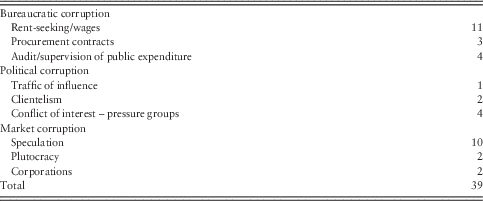
The analysis of this semantic framework can be divided into three categories related to different sphere of activities: those references linked to problems related to the administration (bureaucratic corruption), those related to the Governmental hierarchies (political corruption), and those relating to public and private enterprises and business in general (market corruption). Each type deals with different opportunity structures for corruption and is linked to particular corrupt practices/conducts (Table 7).
Number of references to corruption as the abuse of office by sphere of activity
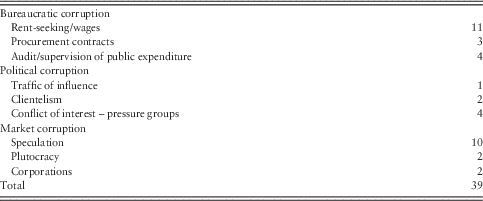
Bureaucratic corruption: Transactive forms of corruption in the public administration were completely repudiated by the regime. For the majority of MPs, those individuals who have been condemned on bribery, corruption, breach of legal duties, or embezzlement could not take public positions. In this sense, the National Assembly played an important role in reconfirming the values of probity and public integrity upon which the imaginary of the Estado Novo was constructed: ‘this guidance, under the banner of truth, seriousness and austerity in the public administration, has been provided by the May 28th Movement, and no one can say in good faith […] that Salazar’s Estado Novo […] has been unfaithful to those principles’ (Moura Ramos, VIII, 105, 12/12/1963, p. 2726; X, 55, 12/12/1970, p. 1143).
Non-transactive forms of corruption in the public administration were also object of criticism. On a regular basis, MPs recalled the regime’s responsibility to fight against clientelism and nepotism (Mendes Correia, VI, 163, 11/7/1956, p. 1268). The recruitment of public officials through favouritism, without taking into consideration the moral aptitude and professional experience of the candidates, was considered a source of corruption and wrongdoing in the civil service (Correia das Neves, X, 94, 22/4/1971, p. 1858).
The narratives on bureaucratic corruption focused on two key corruption control measures: the need to strengthen state inspections (Águedo de Oliveira, III, 32, 30/3/1943, p. 304; Querubim Guimarães, III, 33, 31/3/1943, p. 321) and the need to guarantee a fair salary structure that can keep public officials’ morale and motivation high. MPs considered that badly paid public officials were a source of concern, in the sense that they would be more exposed to undue financial pressure from unscrupulous people (Ernesto Subtil, IV, 48, 16/3/1946, p. 823; Pacheco de Amorim, IV, 64, 13/12/1946, p. 139).
From time to time, the performance and integrity of senior public officials also came under discussion. However, any allegation on the regime’s cadres was immediately addressed with an official report proving their innocence. There were several examples of this. In 1945, a new board of the Comissão Reguladora do Comércio de Metais was appointed and had to deal with several allegations of corruption involving the previous regulators. The new board conducted an inspection and submitted a report about the performance of the previous administration. One deputy explained, ‘in what concerns the financial management of the Commission, no irregularities were found that could have resulted in embezzlement by the previous board members. There had been allegations of corruption, but these have been handled by the new board and passed on to the police for further investigation’ (Querubim Guimarãis, III, 177, 19/6/1945, p. 646). The corruption allegations, as it was mentioned in the debates, did not concern the board but some low-rank officials who did not perform their duties correctly. As a consequence, the new board fired a number of public officials and everything returned to normality. Here, as in other cases, the regime was given an opportunity to demonstrate and uphold strict integrity standards for public officials.
Although there are various testimonies confirming that pulling strings (cunha) was a common practice across all levels of the public administration, there are no interventions registered addressing these routinized practices.
Political corruption: Most official discourses on political corruption remained at a high level of abstraction. In this sense, authoritarian elites did not differ from democratic ones. Traffic of influence, clientelism, and conflicts of interest were perceived as an abuse of power and major threats to public integrity (Dinis da Fonseca, VI, 50, 24/3/1954, p. 866). However, the legitimacy of power, that is, how the regime was structured and functioned was never questioned. This tendency to place the debate on corruption at the symbolic level without addressing day-to-day practices, risks, and opportunity structures for misconduct has remained entrenched in the Portuguese public opinion until today.
Official discourses were meant to control the public debate on corruption. The regime set the tone of how much dissatisfaction with ethical standards in political life could be voiced in public and in what manner. In what concerns the regime’s elites, nothing was particularized, no direct allegations were made, and no names were mentioned (besides discrete talks in reserved places). Political corruption was only a reality with regard to the ‘enemies’ of the regime, that is, ‘clandestine’ political forces, ‘unfriendly’ countries, ‘terrorist’ self-determination movements in the colonies, and ‘dangerous’ secret societies (José Cabral, I, 43, 6/4/1935, p. 898). Besides, very few purges have taken place throughout the Estado Novo’s 48 years of existence and none was publicly justified in terms of misconduct in office.
The culture of ‘respect’ (respeitinho) about the reputation of ruling elites and state institutions was cultivated and enforced through both soft mechanisms (such as state propaganda, the adoption of non-inquisitive educational programmes and methodologies in schools, limiting access to education, etc.) and coercive ones, such as censorship, the prohibition of ‘undesirable’ or ‘de-stabilizing’ organizations (such as the Communist party or the Freemasonry), and the repressive action of the state police.
Market corruption: Several interventions warned against the threat of capital, speculation, and opulence to the Christian moral standards. However, when the debate focused on the conduct of business elites supportive of the regime, the level of abstraction remained high.
Having the social doctrine of the Catholic Church in the background, most MPs regarded wealth and business elites with a mixture of suspicion and complicity: ‘the necessary evil’. To do business and stay in business the ‘big families’ (i.e. the major economic groups owned by the wealthiest families in the country) had to accept and incorporate the regime’s value framework. In this sense, the MPs served as a reminder to business elites not to engage in business practices or postures that could harm the regime’s economic stability and social cohesion.
Throughout the regime’s existence, the parliamentary discourses considered capitalism an immoral thing (Manuel Maria Vaz, V, 122, 18/1/1952, p. 219), hence the State’s role in the economy was perceived as ‘a necessary evil’, to protect the public good against plutocratic corruption (Neves Clara, VII, 168, 21/4/1960, p. 696).
However, when allegations of speculation hit Governmental ranks, the National Assembly reacted in a corporate fashion, defending arduously the integrity of the accused. Those who attempted to offend the regime by denouncing these practices were described as ‘parasites’ (Vasco Borges, II, 59, 8/12/1939, p. 19). One of these sensitive cases was the Bank Fonsecas, Santos & Viana affair involving a senior member of the Bank of Portugal. Álvaro de Sousa was, at the same time, Vice Governor of Bank of Portugal and Director of Bank Fonsecas, Santos & Viana. Mr de Sousa was accused of abusing privileged information to favour his bank. He had been passed privileged information about the depreciation of the British pound against the Portuguese escudo by the Ministry of Finances. In anticipation of the Government’s decision to depreciate the British pound, the private bank sold this currency to the Bank of Portugal, making considerable profit out of this operation.
A report of the Ministry of Finance would dismiss any allegations of wrongdoing. According to the regime’s version of the facts, Mr de Sousa had not acted with a deliberate intention to abuse privileged information (Mário de Figueiredo, II, 59, 8/12/1939, p. 22).
There was still an issue regarding the incompatibility between the position of director of a private bank and that of Vice Governor of the Bank of Portugal, the financial supervisor, but any attempt to invoke an alleged conflict of interest resulting from such accumulation was immediately dismissed (Vasco Borges, II, 59, 8/12/1939, p. 19).
In the 1950s, and while the regime’s industrial capacity grew apace, the Parliament warned against State concessions to large economic groups, as these could impact negatively on the regime’s prestige (Diniz da Fonseca, VI, 142, 18/4/1956, p. 822). The luxury and opulence of certain business sectors was also perceived by MPs as a source of corruption, because it offended ‘the dignity’ of workers and could instigate the corruption of public authorities (Amorim Ferreira, V, 157, 22/4/1952, p. 820). Again, MPs believed that transactive corruption was the result of greed and ambition and could only happen at the low ranks of the public administration.
By the late 1960s, money drain became a recurring issue in the parliamentary debates (António Santos da Cunha, IX, 37, 23/3/1966, p. 660; Almeida e Sousa, X, 19, 31/1/1970, p. 344). Other than being considered a crime, the illegal export of currency was perceived as an unpatriotic practice, as it was weakening the public accounts at the time when the State had to make an extraordinary financial effort to support the colonial wars. In 1970, after some detentions of some citizens at the Lisbon Airport, who were trying to flee from the country with 25 million escudos, discussions about the need to establish a strong legislation against capital speculation and money drain was encouraged. In practice, however, these cases were dealt by the regime’s police and not by the banking supervision.
Throughout the various legislative sessions there was a common tone of criticism towards capitalism. For the majority of MPs, the immorality of capital was directly related with the appetite for ‘insatiable speculation’ causing ‘the creation of huge fortunes without work effort and almost without any risks attached’. In the regime’s last parliamentary session, on the day of the Revolution (25 April 1974), an MP made a final plea in favour of the creation of ‘a strong tax or fee to speculative business’ and ‘a transaction tax for almost everything people can purchase that already exists’ (Roboredo e Silva, XI, 54, 24/4/1974, p. 1090). It was evident by then that the moral cohesiveness of the regime had succumbed and that business elites had gradually defeated the State’s capacity to control capital flows. Some business elites had anticipated the turbulence of the months to come and fled the country; others would be forced to leave given their proximity with the regime and as a consequence of the nationalization processes that would take place in the aftermath of the Revolution.
Conclusion
The discursive use of the term corruption in parliamentary debates during the Estado Novo constructed a narrative through which MPs, on the one hand, invoked the moral superiority of the regime, by muting any discussion on the integrity of its Government officials and parliamentarians or any corrupt practices in the state administration for that matter, and on the other hand, set a moral tone to society based on the social doctrine of the Church.
Corruption is predominantly discussed in the parliamentary debates as a symptom of moral decay, a perversion of Christian values. When corruption is treated as the abuse of office, whether referring to transactive (luvas) or non-transactive (cunha) forms, it was always by reference to outsiders, opponents, or an external feature of the regime. In other words, the term corruption as the abuse of office was either used as an offensive label to diminish the opponents to the regime, its policies and idiosyncrasy, or simply externalized, as a phenomenon that touched other countries (in particular those who were not sympathetic to Portugal’s authoritarian and colonial rule).
This dominant discursive feature conferred the parliament the role of supervisor and guarantor of the regime’s morality, under close scrutiny and instruction from the Government and, more specifically, Salazar, by debating and legislating on matters that regarded the privacy, preferences, and habits of individuals. Corruption is regarded as a societal problem, not a regime one.
The regime was, nevertheless, very cautious at naming and shaming. Although the debates had clearly a tone of moral condemnation, the parliamentarians did not consider that corruption was inherent to the cultural characteristics of our society. In other words, there was no Portuguese DNA of corruption. The Portuguese were a humble and innocent people that needed moral guidance and Salazar was regarded by the MPs as their Sheppard. According to this narrative, the problem of corruption had its roots elsewhere, that is, the improper influences from abroad and the moral decay of the world’s social order. These forces had inevitably an impact in the Portuguese society. Therefore, it was the parliament’s duty to protect it against bad influences.
Neither the National Assembly nor other instances outside S. Bento, such as the press or academia, were discussing corruption affecting the regime’s officials, political appointees, and senior figures of the corporatist bodies. Corruption did not touch them.
Corruption is rife abroad, in modern developed nations, dominated by liberal ideologies, and weakened in moral terms. In opposing ideological openness, the regime protected itself from corruption. In other words, the narrative of corruption also serves as an argument of differentiation with the corrupt otherness that the Estado Novo did not want to be identified with.
Moreover, this narrative of probity is built both by what is said and by what is silenced; and what was muted. Every suspicion or fact susceptible of directly or indirectly affecting the integrity of the political class and regime supporters was swept under the carpet. In those few cases where parliamentarians actually referred to abuse of office, the targets were the lower strata of the hierarchy, and always in a very vague manner as a potential danger and not as a fact of misconduct. Where interventions were harsh on individual integrity, these targeted the regime opponents, but without any concrete reference to the abuse of office.
With these findings, this article is pioneer in analysing how the parliamentary members framed the discursive narratives of corruption during the Estado Novo. These narratives on moral superiority were so intense that not only they helped to shape people’s perceptions about the way the regime functioned at the time, but they also projected an imaginary of the regime’s righteousness for future generations.Footnote 12
Despite the authoritarianism of the Estado Novo, the Portuguese historical narrative has constantly described Salazar as an austere and honest leader, worried about the people, defending of traditional values, and with public service devotion.
This myth about the integrity of the regime and its charismatic leader has perpetuated partly due to the lack of literature addressing corruption during the Estado Novo. We believe this article has made a short contribution to open the Pandora box and trigger appetite for further research on the topic.
Acknowledgement
The authors would like to thank the anonymous reviewers for their valuable remarks and suggestions that helped us to improve the quality of the article. They are also grateful to Dr. António Costa Pinto for his precious comments and help in collecting Portuguese secondary sources.
Financial Support
The research received no grants from public, commercial, or non-profit funding agency.
Data
The replication data set is available at http://thedata.harvard.edu/dvn/dv/ipsr-risp