Introduction
Until recently, studies on late Qing newspapers started ‘with the assumption that Chinese journalism in the nineteenth century was immature in terms of professional standards and played an insignificant role in politics and society’. Liang Qichao was one of the main proponents of this interpretation, seeking to gain a dominant position in the newspaper market by eradicating the memory of previous journalistic activities.Footnote 1
Recent scholarly work has recognized how misleadingly self-serving Liang and the May Fourth writers were, with Natascha Vittinghoff arguing that the nineteenth century newspapers were an important factor in promoting new ideas about the world and had a significant impact on building public opinion.Footnote 2 She argues that the ‘early journalists were. . .well educated and were among the most concerned, informed, daring, visible, and successful Chinese men of middle age in the late nineteenth century’.Footnote 3 Barbara Mittler has focused on the contributions of the Shenbao,Footnote 4 and Joan Judge on the revolutionary newspapers, particularly the Shibao.Footnote 5
Throughout this discussion, one newspaper has been overlooked—the Guangbao, one of the earliest native Chinese-owned newspapers published outside of the control of the foreign treaty ports. The reasons for the neglect are many: Liang Qichao's effective denigration of the early newspapers, the fact that it has been considered a failure (given that it was closed by the authorities in 1891), and because there are few copies still in existence.
Fortunately, as the Guangbao was the only newspaper in Guangzhou, the Hong Kong Daily Press, needing a source of information from the city, frequently provided summaries of the Guangbao's contents. Although it is recognized that the translations of these summaries may have been affected by the attitude of the British editors, they do provide a strong basis for an analysis of the Guangbao. Footnote 6 Supplementing these summaries—and confirming that that their tone was relatively accurate—are 24 original newspapers now housed in the Sun Zhongshan Library in Guangzhou, the Shanghai Library, and the Smithsonian Institution in Washington DC.Footnote 7
Published in Guangzhou between 1886 and 1891, the newspaper, founded by Kuang Qizhao (also known as Kwong Ki Chiu, Kuang Rongjie, Kuang Quanfu, and Kwong Tsun Fuk), is the only source of daily information in the city for most of this period. It operated in a particularly interesting place and time, which has been under-researched, as a number of reformers and future revolutionaries were in the area and just beginning to formulate their ideas. Furthermore, the newspaper was established under the sponsorship of Zhang Zhidong, one of China's most important officials, so it is likely that the newspaper either influenced or reflected many of his thoughts. Therefore, analysis of the thoughts expressed in the Guangbao may provide insights into the behaviour of these officials, reformers, and future revolutionaries.
Background on the Guangbao's establishment
Kuang was the first native Chinese to compile a comprehensive Chinese-English dictionary in 1868.Footnote 8 He was educated at the Government Central School in Hong Kong, where he received a bilingual and bicultural education which included the study of both the Bible and Confucius.Footnote 9 He was among the earliest Chinese to have direct experience of Western culture, living as he did, and being part of the urban elite, in the treaty port environments of Hong Kong, Shanghai, and Guangzhou, and having travelled to Australia, the USA, and Europe.Footnote 10
Although Kuang is primarily known as a dictionary compiler, he also played an important pioneering role in China's emerging press industry—founding at least two, and possibly three, of the earliest newspapers controlled by a native Chinese. In addition to his own Shanghai and Guangzhou newspapers, Kuang was personally familiar with China's pioneering journalists, Wang Tao and Huang Sheng, who in 1874 were involved in founding and editing the other major native-owned newspaper, the Xunhuan Ribao in Hong Kong.Footnote 11
Huibao
In 1874, Kuang was the English instructor and principal of the Chinese Educational Mission (‘CEM’) school in Shanghai.Footnote 12 CEM was China's first-ever attempt to send students to study abroad, and the school was set up to train students for their trip to the USA. In addition to his role at CEM, Kuang also found time to start the Huibao, just a few months after Wang Tao's Xunhuan Ribao, placing it among the earliest pioneering attempts at establishing a Chinese newspaper in China. The organizers of the Huibao were to be among the most influential reformers and entrepreneurs of the late Qing, and include Zheng Guanying, Tang Tingshu, and Rong Hong. Kuang was assigned overall responsibility for the newspaper, and was the main editor and manager.Footnote 13
These reformers had extensive contact with foreigners and would have experienced the many instances of blatant discrimination against Chinese. They were fluent in English and would have read the local English newspapers such as the North China Daily News, and would have been exposed to the arrogant attitude that these newspapers had towards the Chinese, as reflected in the Huibao's complaint that the attitude of English newspapers toward Chinese reform efforts were ‘contemptible in the extreme’.Footnote 14
At the time, the Shenbao, owned and controlled by a British subject, had just been established and had involved itself in a local dispute between the Cantonese and Zhejiangese over an inappropriate marriage between the daughter of a wealthy Cantonese merchant and an actor. The district magistrate, a native Cantonese, ordered the couple to be severely beaten and slapped. The case was heavily debated in the Shenbao, with the newspaper highly sympathetic to the couple, which angered the Cantonese, particularly those from Xiangshan, the region where Kuang was from. Upset by both Shenbao's interference in the local affair and by its imperialistic attitudes, the Cantonese sought to compete by establishing the Huibao on 16 June 1874.Footnote 15 The Huibao, it was declared, ‘was a Chinese newspaper, would promote Chinese interests, and would not be afraid to discuss issues which might upset Westerners’,Footnote 16 and it frequently criticized the Shenbao. Footnote 17
Reflecting its nationalistic attitude, the Huibao was critical of foreigners who abused the protection provided by the treaty power consulates.Footnote 18 One article strongly suggested that Chinese merchants should compete directly with the foreigners by going overseas themselves, and establish their own trading houses in foreign countries.Footnote 19 In addition, the Huibao opposed the construction of the Wusong Railway in Shanghai—not because of the fear that the feng shui of the ancestral tombs would be interfered with, but because foreigners were planning to build this line without government approval, clearly violating Chinese sovereignty, and would receive all the benefits.Footnote 20
Further reflecting its nationalistic tone, the newspaper condemned the Japanese for invading Taiwan and trying to extort money in the form of indemnities to secure their withdrawal. Using highly inflammatory language, the Huibao strenuously argued that China should not ‘feed the hungry tiger’ and that funds demanded by Japan for an indemnity would be better spent on the ‘extermination’ of the invaders.Footnote 21 Other articles encouraged a variety of self-strengthening proposals such as the enhancement of national defence, the construction of ships, urban planning, and the importance of silk and tea exports.Footnote 22
But other more politically sensitive issues may have got the newspaper into trouble. Fang Hanqi states that it published articles involving ‘current affairs’ in which ‘government officials. . .were involved’,Footnote 23 suggesting that the newspaper may have exposed corruption. According to the British consulate, the newspaper was subject to ‘troublesome’ censorship,Footnote 24 while Roswell Sessoms Britton states that the newspaper was ‘denounced by some officials’.Footnote 25 To avoid the censorship, the newspaper was reorganized and renamed on 1 September 1874Footnote 26 and Scott Gill, who was previously the foreign editor, became the sole manager.Footnote 27 As a British citizen in Shanghai, Gill would have been provided British protection against the Chinese authorities.
Kuang may also have given up his role in the newspaper, because in late September, he was assigned to accompany the third group of CEM students to the USA,Footnote 28 and also to go on what appears to have been a secretive diplomatic mission to procure weapons in the USA for China's defence of Taiwan against the Japanese invasion. In the USA he met with President Ulysses S. Grant,Footnote 29 and his private secretary, General Orville E. Babcock, and possibly other top military leaders. He also visited the Army Museum, the Washington Arsenal, the Smithsonian, Philadelphia shipyards, and the Washington Navy Yard.Footnote 30 At the Navy Yard, he received a 15-gun salute.Footnote 31 He then travelled to Europe as ‘Commissioner of the Imperial Chinese Government of the Court of St James’.Footnote 32
Kuang left Europe on 20 December from MarseilleFootnote 33 and returned to Shanghai in March 1875; however, he was immediately appointed to be the permanent translator for CEM and left for the USA in October,Footnote 34 bringing along Shaoqin, his second wife.Footnote 35 Knowing it was likely that he would be returning to the USA, Kuang gave up any remaining role he might have had at the Huibao. On 16 July 1875, a new editor, Zhu Liansheng, was brought in, and the name of the newspaper was changed again, this time to the Yibao.Footnote 36 Possibly because of Kuang's absence, the newspaper published fewer critiques and the quality of the articles declined. The newspaper ceased publishing on 4 December 1875.Footnote 37
Hartford as a platform to observe American society and the American press
Based in Hartford, Connecticut, Kuang had a front row seat to observe American society. He mingled with the intellectual elite both in the Nook Farm community in the city and also at Yale, where he interacted with historical figures such as Mark Twain, the prominent writer;Footnote 38 Joseph Twichell, Twain's best friend and pastor at the Asylum Congregational Church and Yale Board Member;Footnote 39 and Samuel Wells Williams, Yale's first professor of Chinese and a former missionary and American diplomat in China. Kuang worked with Williams to raise money for Young John Allen's Anglo American College in Shanghai.Footnote 40
While he was in Hartford, Kuang wrote a series of pioneering books on learning the English language, one of which, A Dictionary of English Phrases,Footnote 41 made him a minor celebrity. The American press expressed surprised that at the time of the debate on the Chinese Exclusion Act, an English dictionary, targeted at Americans, was written by a Chinese author, a race viewed as inferior.Footnote 42
In the USA, Kuang would be given the opportunity to observe how the American press operated. Cheap, mass-produced newspapers had emerged in the first half of the nineteenth century, transforming daily reading into a form of popular entertainment. The USA had more newspapers than any nation in the world, with the number tripling from four to 12,000 between 1870 and 1890, and the explosive growth would result in intense competition for readers.Footnote 43 Some of the most prominent newspapers were located nearby in New York, including the Herald, the Tribune, and the Sun, and Kuang was able to have his letters opposing the Chinese Exclusion Act published in these papers and the Hartford Daily Courant.Footnote 44 In Hartford, Kuang was familiar with Joseph Hawley and John Warner, owners and editors of the Hartford Courant,Footnote 45 and of course with Mark Twain, who, before moving to Hartford, had worked as a journalist and owned a stake in the Buffalo Express. Kuang also worked closely with E. J. Edwards, who was to become one of the most prominent investigative journalists of the time, working for the New York Sun and Wall Street Journal.Footnote 46
Given his experiences, observations, and relationships with the press, Kuang was an early advocate for a free press, stressing the following in The First Conversation Book, one of the textbooks that he wrote:
[Newspapers] diffuse intelligence among the people in a very rapid manner, and at a very cheap rate. They also promote the interests of the country, and bind all its parts together. . .they benefit the government by keeping the government informed of what takes place in the land, and especially by showing what is the public opinion and feeling concerning the measures of government. . .the newspaper ought to circulate without restriction, and ought to be free to express their opinion on political and social matters. . .the leading nations pursue this course, and the movement of the world is toward education and liberty.Footnote 47
Before leaving for China at the end of 1882, Kuang expressed to his friends his goal of returning to the newspaper business, with the idea of publishing ‘a paper through which he might instruct his countrymen upon the many things he had learned in America’.Footnote 48
Government service
In late 1883, Kuang accepted a position as the chief translator and deputy of the Local Bureau of Foreign Affairs for the Shanghai Daotai Shao Youlian.Footnote 49 He also worked at the Jiangnan Arsenal, where he translated Western newspapers. Kuang selected articles that favoured his beliefs and translated them in a way that made his reformist opinion known. These translations would be distributed to leading government officials, so they would have been read by key decision-makers. In these translations, Kuang strongly advocated for the adoption of Western-style schools and military academies, prevention of the illegal trafficking of women, development of railroads, formation of alliances with China's tributaries to resist foreign encroachment, and the creation of a Chinese-controlled press to counter the foreigner's monopoly on public opinion.Footnote 50
In mid-1884, dealing with the French takeover of Vietnam was the most urgent issue of the day. On 4 June 1884, the Shenbao printed a letter written by Kuang in which he castigates the Shanghai Courier and China Gazette for printing misleading articles that implied that China was provoking a battle with the French, and excoriates the editor for encouraging France to attack and for calling Chinese ‘stupid’ and ‘liars’.Footnote 51 On 23 August, the French attacked Fuzhou, virtually sinking the entire Fujian fleet, and officially starting the Sino-French War.Footnote 52
A week later, Kuang accepted a position to work for Zhang Zhidong in Guangzhou as deputy of the Bureau of Foreign Affairs,Footnote 53 and left Shanghai on 26 September.Footnote 54 Kuang was enthusiastic about the appointment. He had first taken notice of Zhang back in 1882, when Kuang specifically mentioned, in a letter to the London and China Telegraph, that as governor of Shaanxi, Zhang had dismissed officials caught smoking opium.Footnote 55 Just after his appointment, in a letter that he wrote to a personal friend in Hartford, Kuang emphasized that Zhang was ‘spoken of as being the most reforming official in China’, and praised him as he ‘prohibited poppy raising when he was governor’.Footnote 56
With this new job, Kuang was in a position to influence Zhang. As part of Zhang's ‘mu-fu’, he would have been considered to be part of an integral team of friends and colleagues who would advise Zhang,Footnote 57 and, according to William Ayers, Zhang ‘learned from his Chinese subordinates’.Footnote 58 As Zhang's personal translator, Kuang would have had frequent personal contact with Zhang. That Kuang was highly valued by Zhang is reflected by his appointment to be part of a special Chinese Commission to arrange the withdrawal of Chinese troops from Vietnam—a trip which adversely affected his health and during which he was fired upon by Vietnamese outlaws.Footnote 59
Shubao
According to Huang Dasai, Kuang was likely to have been involved in establishing a newspaper in Guangzhou called the Shubao, which had a very similar format to the Huibao.Footnote 60 The newspaper was founded on 18 April 1884, and it was the first to publish news with pictures, Footnote 61 an innovation that Kuang employed in his First Reading Book.Footnote 62 As much as 70 per cent of the newspaper focused on reporting the Sino-French War. According to Fang Hanqi, its stories were highly accurate, which may have stemmed from the inside information provided by Kuang, given his close relationship with Zhang. The newspaper reported on the battles between Liu Yongfu's Black Flag Army and the French Army; the latter's invasions in Guangxi, Ningbo, and Taiwan; the government's war strategy; and negotiations to end the war. It ceased publishing on 3 April 1885,Footnote 63 possibly because of Kuang's assignment to Vietnam: soon after this, Kuang left Guangzhou and arrived in Hong Kong on 19 April on the Chinese gunboat, Peng Chao-hai, on his way to Vietnam.Footnote 64
Establishment of the Guangbao
After returning from Vietnam, under Zhang's sponsorship and protection, Kuang launched the Guangbao on 24 July 1886, with the assistance of General Wang Ronghe and some other officials.Footnote 65 General Wang was a Zhang aide who, shortly after co-founding the newspaper, was sent on a special mission to Southeast Asia to investigate conditions in which overseas Chinese lived.Footnote 66 Kuang was the controlling owner of the Guangbao. Other editors were Zhu He and Xiong Zhangqing, the chief writers were Wu Taiyou and Lin Hanying, and other writers were Xiao Zhupeng and Luo Peiqiong.Footnote 67 Reflecting on the close relationship between Kuang and Zhang, the newspaper's offices were located just ‘opposite to the Viceroy's Yamen’.Footnote 68 Unlike the Shubao, with its layout based on the Huibao's, the Guangbao's was similar to the highly successful Shenbao. In addition to Guangzhou, the newspaper was distributed in Foshan, Xinan, Dalian, Chencun, Jiangmen Xinhui, Xiangshan, Hong Kong, Macau, Shanghai, Singapore, Vietnam, San Francisco, the Philippines, and other locations.Footnote 69
The Shubao and the Guangbao were China's first native-owned newspapers that were published outside the foreign jurisdiction of the treaty ports and special enclaves—about a decade before the better known Qiangxuebao and Xiangbao. Footnote 70 The Guangbao was published daily, and, reflecting Kuang's adoption of Western practices, did not publish on Sundays.Footnote 71 As a non-foreign controlled newspaper, the Guangbao, like the Huibao, was able to publicly recommend views independent of those of foreigners. So, for example, while the British-owned Shenbao advocated a major role for foreigners in developing and financing railroads, the Guangbao sought to restrict foreigner involvement, urging local Chinese to take on this role.Footnote 72
Influence
The newspaper gave Kuang a strong platform to disseminate the nationalistic and reformist ideas that he formulated while he was in the USA. The newspaper had a circulation of around 3,000 to 5,000 subscribers.Footnote 73 At this level, the newspaper appeared to be profitable.Footnote 74 To put this in perspective, Wang Tao's Xunhuan Ribao, a newspaper that historians acknowledge as one of the two most important Chinese newspapers of the period, had only 1,100 subscribers.Footnote 75 The Guangbao's circulation was therefore three to five times larger, and one of the largest after the Shenbao, which had a circulation of 15,000 to 20,000.Footnote 76 Its true impact was probably larger as newspapers were often shared: Judge estimates that at the time there were about 15 readers per newspaper copy.Footnote 77 Using this estimate, the Guangbao could have reached between 45,000 to 75,000 readers. But even a hypothetical 75,000 readers would have been very small relative to China's total population of over 400 million, so it is important not to exaggerate its influence.
The Guangbao's real impact is that the readers are most likely to have been China's elite, particularly in Guangdong: not only officials, but intellectuals, wealthy merchants, and impressionable students—the people who would influence policy and opinions. The Guangbao therefore may have played an important role in influencing public opinion, helping to sow the seeds for the nationalism that would soon emerge, and motivating the elite to adopt modernization ideas. Zhang Zhidong was a sponsor and would have been an avid reader, as would have many of the officials in his yamen, such as Gu Hongming and Liang Dunyan.Footnote 78 Kuang's friends such as Wang Tao, Zheng Guanying, Tang Tingshu, and Xu Run could have been subscribers.Footnote 79 It should also be noted that at the time the Guangbao was published, a number of important reformers and/or future revolutionaries were in the area, including Kang Youwei, Liang Qichao, and Sun Zhongshan.Footnote 80
Moreover, as the only newspaper of any language in Guangzhou, other newspapers used it as a source of news from the city, thereby spreading its ideas. The Daily Press summarized the Guangbao on an almost daily basis, so Kuang's ideas were readily available to the English-speaking community in Hong Kong, not only for foreigners, but also for bilingual Chinese businessmen, officials, and students. It is likely that other Chinese newspapers in Hong Kong and other parts of China also used its information, including the Shenbao. In fact, by the late 1880s, the Shenbao, the Xunhuan Ribao, and the Guangbao probably operated more like sister newspapers as their principals were friends with each other,Footnote 81 and these principals in turn had relationships with Young John Allen.Footnote 82 As a result, there was a cross-fertilization of ideas. Kuang was familiar with Huang Sheng and Wang Tao who edited the Xunhuan Ribao. It was Wang Tao who wrote the preface to one of Kuang's books, and Huang Sheng had also been part of CEM. The Xunhuan Ribao contained a column called ‘News from Canton’, so the Guangbao may have provided information for this column.Footnote 83 And, unlike in 1874, when the Huibao was established with the purpose of competing with the Shenbao, by the 1880s, Kuang's attitude towards the newspaper had changed. He is likely to have admired the success of the Shenbao, and when establishing his own newspaper, copied the style and format of its competitor. By 1884, his friend, Wang Tao, had joined the editorial board of the Shenbao.Footnote 84 The Guangbao reprinted stories from both the Shenbao and Wanguo Gongbao,Footnote 85 and the Shenbao would periodically mention the Guangbao or stories from that newspaper.Footnote 86
A highly opinionated newspaper
The Guangbao’s lead editorials were highly opinionated and critical of leaders who did not perform (including those who controlled the newspaper), and it was highly nationalistic and reformist. With the exception of democracy and radical political change, many of the ideas that were supposedly first promoted after the Sino-Japanese War in 1895 had already been discussed in the Guangbao.
It cannot be known for certain, but these lead articles are likely to have been written or approved by Kuang. That he was heavily involved is suggested by periodic references to information that only Kuang would have known. For example, one article states: ‘I myself when abroad extricated myself from difficult situations’,Footnote 87 possibly a reference to Kuang's time in the USA, Europe, or Australia. The Daily Press credits the Guangbao’s surprising willingness to advocate for free trade to the fact that ‘the editor had traveled abroad’,Footnote 88 again most likely referring to Kuang. So when Guangzhou US Consul General Charles Seymour was concerned about one lead article threatening retaliation against Americans for Chinese exclusion, he wrote a letter directly to Kuang to raise the concern.Footnote 89
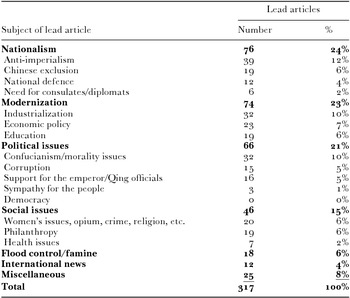
An analysis of the Guangbao's lead articles (as reflected in Table 1),Footnote 90 indicate it was highly focused on nationalistic issues, with 24 per cent of the lead articles covering issues related to nationalism (anti-imperialism, Chinese exclusion, national defence, and the need for consulates); 23 per cent of the articles focused on modernization ideas (industrialization, economic policy, and education); 21 per cent of the articles related to what is classified here as political issues (Confucianism/morality, corruption, support for the emperor and/or Qing officials, and sympathy for the people); 15 per cent of the articles examined a variety of social issues (such as women's rights, harmfulness of opium, crime, religion, philanthropy, and health). Given the frequent calamities that occurred during the period, 6 per cent dealt with flood control/famine issues, and 4 per cent related to international news.
Classification of lead articles in Guangbao.

Nationalism
The Guangbao, as one of the few newspapers owned by a native Chinese and not controlled by foreigners, had the independence to promote nationalistic issues at a time when nationalism was still not a major political force. In promoting these issues, the Guangbao may have planted some of the early seeds of the nationalism that would become a prominent force after the Sino-Japanese War in 1895, with William Keswick of Jardine Matheson observing in around 1890 that nationalism was increasing, and that the ‘native newspapers have fostered. . .[the] highest feeling[s] of a people’.Footnote 91 Kuang was moved by a number of nationalistic issues, which will be discussed in the sections that follow.
Chinese exclusion
Kuang was particularly upset by racial discrimination against Chinese. While he was in the USA, he actively opposed the Chinese Exclusion Act, lobbying senatorsFootnote 92 and sending letters to the editors of the country's most prominent newspapers in an attempt to influence public opinion. The Guangbao continued Kuang's campaign against Chinese exclusion,Footnote 93 and complained about the iniquity of Chinese being discriminated against in Western countries while foreigners were ‘protected in China’.Footnote 94 When China asked the US government to send in troops to quell anti-Chinese riots in Denver in 1880, the American government did nothing, with the federal government claiming that it had limited powers to intervene. However, when Westerners suffered during anti-Western riots in China, Western powers, including the USA, would criticize the Chinese government and demand indemnities and the execution of officials involved.
In October 1888, Congress passed the Scott Act, which further tightened the original Exclusion Act by prohibiting any Chinese labourers who were already residing in the USA from re-entering the country if they returned to China, and provided no time period for the end of the exclusion acts, clearly violating the Burlingame Treaty of 1868. In response, in December, the Guangbao reprinted a letter by a ‘friend’ in San Francisco who suggested retaliation by evicting ‘American missionaries’ from China if the situation did not improve.Footnote 95 A few months later, the Guangbao reprinted a letter from a high Chinese official, originally published in the Chinese Times, threatening to ‘expel’ all Americans.Footnote 96 The Daily Press devoted a lead article expressing its concern over the threat.Footnote 97 US Consul General Seymour in Guangzhou was so alarmed that he reported the article to his superiors in the State Department in Washington DC, and in an attempt to pacify Kuang, sent him a letter to reassure him that the Chinese would be treated well in America, that the Supreme Court would ultimately protect Chinese rights, and that a new Congress would be more supportive.Footnote 98
In addition to the Chinese living in the USA, the Guangbao was adamant in its defence of Chinese living in overseas locations, and opposed proposed taxes and immigration restrictions on Chinese in other parts of the world, including Australia,Footnote 99 Hawaii,Footnote 100 and Thailand.Footnote 101 The newspaper also reported on the abominable treatment of Chinese ‘coolies’ in Peru.Footnote 102
To defend Chinese living overseas, the Guangbao was a strong advocate for the establishment of consulates.Footnote 103 In addition, just as Kuang himself gathered foreign intelligence while he was in Hartford,Footnote 104 the Guangbao argued that officials stationed at the consulates could provide valuable intelligence to help China in future military conflicts. And to make the overseas postings more palatable, given the fear among officials that foreign experience would be detrimental to their careers, the Guangbao encouraged their promotions on their return home.Footnote 105
In addition, clearly demonstrating its independence, the Guangbao did not hesitate to criticize China's own officials if the newspaper felt they were not adequately defending Chinese living overseas. In 1889, the newspaper excoriated Zhang Yinhuan, the Chinese ambassador to the USA, for agreeing to further restrict immigration and for his inability to obtain indemnities for Chinese whose properties and lives were destroyed in anti-Chinese riots.Footnote 106 The Guangbao accused Zhang ‘of total indifference to the interests of his own countrymen’ and suggested he was corrupt,Footnote 107 an inflammatory allegation against an important official; Seymour reported these accusations to the State Department.Footnote 108 The Guangbao caustically complains:
What is the use then of a High officer abroad if he is not to afford protection, and not to devise any better means than to eradicate immigration to put an end to existing abuses. In conclusion, compensation it is said is invariably made by China whenever losses are sustained, and why should not those Chinese who suffer any less be indemnified.Footnote 109
Anti-imperialism
Given the loss of sovereignty from the opium wars and the loss of Vietnam, the Liuchiu Islands, and Burma to foreign powers, the Guangbao was highly sensitive to the encroachment of foreigners on its borders, suspicious even of China's own foreign-born advisers.Footnote 110 The newspaper printed a number of articles on the defence of Taiwan,Footnote 111 and sought a more forceful response to protect its tributaries. The Guangbao made the analogy ‘that the outskirts of a country should be kept in order as the outskirts of a house are kept free of robbers’.Footnote 112 Therefore, China had to prevent the loss of its tributaries, which were China's ‘outskirts’, emphasizing that it should emulate the British and French, and essentially take the tributaries over, while leaving them ‘nominally independent’.Footnote 113
With regard to the British, the Guangbao was deeply suspicious over its intentions towards Tibet, and extremely critical of the Chinese government's handling of the situation. India and Afghanistan were British colonies, and England had taken over Burma in 1885 after the Sino-French War. Tibet, a Chinese tributary, appeared to be England's next target. In 1888, the newspaper blamed a border dispute at Sikkim, on the border between India and China, on the British,Footnote 114 and argued for the forceful defence of the tributary.Footnote 115 The newspaper criticized Chinese leaders for not doing anything, asking ‘how is it. . .that now that Thibet is in danger nothing is done either by the Chinese Resident, from whom nothing is heard, or by the Chinese Government, whose tributary state Thibet is and has been for so many years?’Footnote 116
The Guangbao also accused England of major hypocrisy by harbouring Chinese criminals, many of whom had escaped to Hong Kong under the protection of the British. Chinese requests for their extradition back to China were ignored, prompting the Guangbao to warn in March 1888 that China should then also ignore Britain's requests for the handover of Chinese who harmed missionaries and for their unreasonable demands for indemnities. The ‘editor’, presumably Kuang, warns in harsh tones, ‘Hongkong will be overrun with thieves, and. . .mad dogs bite those they live amongst.’Footnote 117
The Guangbao was a passionate defender of Korea, stressing the importance of protecting the tributary from both Japan and Russia,Footnote 118 and suggesting detailed defence strategies.Footnote 119 Reflecting Kuang's deep knowledge of the military, particularly naval affairs, the newspaper gave such a thorough analysis on how to protect Korea that the Daily Press suggested, ‘Why does not China recall Yuan [Shikai] from Seoul and send the Editor in his place?’Footnote 120 The newspaper went as far as advocating its direct annexation.Footnote 121 Yuan Shikai, China's leading representative in Korea, would make the same argument, but—worried about arousing Korean animosity and possible retaliation from Western powers and Japan—Li Hongzhang took a more restrained position.Footnote 122
The Guangbao was particularly suspicious of the Russians.Footnote 123 It noted that Russia had ‘swallowed up country after country’,Footnote 124 and that the people would revolt if given the chance.Footnote 125 The Guangbao was convinced that ‘like a tiger hungering for its prey’,Footnote 126 Russia had ominous intentions toward China,Footnote 127 and was ‘only waiting her opportunity to extend her frontiers’.Footnote 128 Given England also feared that Russia wanted India, the solution, therefore, was to form an alliance with England.Footnote 129
The newspaper was not as suspicious towards Japan, assuming that although Japan wanted Korea, the former was militarily weaker than China, and therefore would not be willing to fight with China,Footnote 130 an assumption that would soon be proved severely mistaken. Kuang, like others who were also not suspicious of the Japanese, was probably blinded by his affinity for Japanese culture and admiration of the country's leaders in advocating reforms, while China moved more hesitantly.Footnote 131
Having been directly involved in the Sino-French War, Kuang continued to be suspicious of France, with the Guangbao putting the case that Vietnam should be China's tributary.Footnote 132 In a couple of lead articles, the newspaper expressed the suspicion that the British and, particularly, the French would try to annex Thailand,Footnote 133 and warned that the French officers employed in Thailand would act as spies for France.Footnote 134
National defence
Given the Guangbao’s urgent pleas for China to defend its tributaries and borders, national defence was a major area of concern. Kuang was highly knowledgeable with regard to defence matters, and was extremely frustrated at the inadequacies of the military forces. His extensive knowledge stemmed from his experience as an envoy for the USA, and possibly to Europe, in 1874, where he had the responsibility for investigating navy gunboat purchases for China; from his CEM experience, where in addition to supervising the students, he was also in charge of gathering information on military matters through the translation of published and unpublished materials; from his visits to US armouries; and from his involvement at the end of the Sino-French War, when he was directly involved in ordering the withdrawal of Chinese troops from Vietnam.
Having been sent around the world by the government in search of navy warships,Footnote 135 Kuang was particularly knowledgeable on naval defence, and the Guangbao called for significant improvements in the navy, urging China to purchase ‘torpedo boats’.Footnote 136 In particular, the newspaper wanted China to emulate the quality of the British Navy,Footnote 137 especially their training methods. The newspaper noted that the British undertook extensive training exercises and mock battles, whereas China's 96 vessels were ‘never exercised and the men [were]. . .untrained’.Footnote 138 It pointed out China's major weakness in dividing its naval fleet into two commands and urged that these two fleets should be unified. The newspaper gave detailed suggestions on where the naval ships should be based and the number of ships at each location, and discussed tactics on what to do if attacked.Footnote 139
The army received similar criticism, with the newspaper noting ‘the utter uselessness of supporting such a standing army’, and strongly suggested emulating the English and German armies.Footnote 140 Again, the Guangbao not only reiterated the importance of better military equipment, but also of adequate training, pointing out that ‘it is no use having good guns if you cannot aim straight’,Footnote 141 and stressing that the army needed to substitute ‘rifle practice in place of archery’.Footnote 142 The newspaper noted that military officers were inadequately paid,Footnote 143 and felt that the army needed better qualified military leaders, lamenting that ‘China at present possesses no generals. There are plenty of people who say they know all about military matters, but not one of them have ever seen a shot fired.’Footnote 144 ‘Without good leaders,’ the newspaper emphasized, ‘an army is of no use whatever’,Footnote 145 pointing out that during the Sino-French war, China's well-equipped naval fleet in Fuzhou was destroyed because it was led by ‘a cowardly literary man’, whereas it was victorious at Langson because of the bravery of the troops.Footnote 146
In hindsight, the Guangbao’s observations would prove to be hauntingly prescient as China would soon be tragically defeated in the Sino-Japanese War of 1895, resulting in years of turmoil for the country. As the newspaper warned, the lack of a unified navy did indeed prove to be catastrophic. In his analysis of the Sino-Japanese War, Allen Fung concludes that the Chinese military was defeated not because of the quality of its weapons—an assertion which would suggest the arsenals built as a result of the self-strengthening efforts were a failure—but because of the poor ‘quality of the officer corps, the lack of attention to drilling and training, and the numerical inferiority of Chinese soldiers that had real fighting value’.Footnote 147
Non-xenophobic attitude
Despite its apparent hostility towards the Americans, British, French, and Russians, and strong advocacy for a stronger national defence, the Guangbao was not xenophobic. In fact, the newspaper never printed any articles criticizing the activities of foreigners and missionaries inside China, despite real antagonism towards Westerners among the general populace. It was the massacre of French missionaries in Tianjin in 1870 that resulted in a major diplomatic incident, and the anger felt towards foreigners and missionaries would eventually lead to the Boxer Rebellion. Part of the reason for the newspaper's moderation is that fomenting local insurrections might have resulted in an excuse for foreign intervention and demand for indemnities.
However, the most likely reason for its moderate tone is that Kuang personally did not share in the anti-foreigner hysteria. Although the Guangbao reprinted stories threatening to expel American missionaries in retaliation for the Chinese Exclusion Act, this was done more in the spirit of defending national interests, not from any real animosity towards missionaries or Americans on a personal level. Kuang and the CEM students were treated very well by their host families and schools in the USA, and the students assimilated successfully into American society.Footnote 148 Kuang had numerous foreign friends, including some who were very religious, and when he experienced the tragic death of his young wife, who had accompanied him to the USA, it was Julia Filley, an extremely kind, generous, and deeply Christian American woman who offered to take care of his baby.Footnote 149 To show his appreciation to his American friends, Kuang sent back numerous gifts when he returned to China.Footnote 150
The Guangbao therefore recognized the importance of developing strong relationships with foreign countries and foreigners living in China. A major issue at that time was the Western powers’ demand for the emperor to meet its foreign representatives. When China finally relented, the Guangbao praised the decision.Footnote 151 And at the personal level, Kuang encouraged friendly relations between ordinary Chinese and foreign residents. In one article, the Guangbao praised a Western woman for distributing supplies to flood victims, indignant that some people warned sufferers not to accept the aid.Footnote 152 In another article, the newspaper urges:
Friendly relations should. . .be cultivated between foreigners and Chinese and Chinese and foreigners. With the view to the furtherance of friendship, forbearance and consideration should be duly and timely observed, for says the writer, I myself when abroad extricated myself from difficult situations by patience, for had I [presumably Kuang] lost my temper I should surely have involved myself in trouble. In the same way should these qualities be observed in China in order to promote a good understanding between Chinese and foreign residents.Footnote 153
Despite its fiercely nationalistic tone, the Guangbao tried to ease potentially dangerous situations involving foreigners. The newspaper reported favourably on missionary activity, and reflecting its concern for their safety, would print proclamations from officials warning people not to attack them.Footnote 154 While Seymour was alarmed by the Guangbao's February 1889 article suggesting that Chinese officials advocated retaliation, he reported to the State Department that he had frequently met with Kuang, and that during periods when anti-foreign sentiment was high, Kuang had ‘been willing and inclined to pursue a prudent and. . .conciliatory course in journalistic treatment’ of these potentially dangerous situations, and notes that the Guangbao adopted a more moderate tone in subsequent articles.Footnote 155
To provide another example, in July 1889, soldiers in Guangzhou detained a man with a large basket containing the bodies of seven infants. The man claimed that the bodies came from the Roman Catholic Foundling Hospital. With rumours spreading that the foreign missionaries were again murdering Chinese babies to extract their eyes for medical purposes, as they had been accused of doing during the Tientsin Massacre in 1870, the potential for a major insurrection against foreign residents increased. Posters were put up threatening to tear down churches and to kill Christians, a British gunboat was brought in, and Seymour again sent a worried dispatch to the State Department.Footnote 156 However, the Guangbao, as the only Chinese newspaper in Guangzhou, carefully pointed out that the government had made an investigation, that there was no evidence of suspicious activity, and warned potential agitators to stay away.Footnote 157 Seymour reports that as a result of ‘the tranquilizing effects of the Kwang Pao's statement’, ‘the popular excitement subsided’.Footnote 158 The Daily Press was effusive over how the volatile situation was handled.Footnote 159
Modernization ideas
While the Guangbao may have planted some of the seeds for nationalism, the newspaper, along with the Shenbao, Xunhuan Ribao, and other papers, also promoted a variety of ideas for modernization. Kuang was an important, overlooked member of an elite community of well-educated, like-minded, reform-oriented individuals. This elite consisted of people, including missionaries, who lived near each other in Hong Kong, Shanghai, and Guangzhou; shared common interests; corresponded with each other through letters; and worked in new institutions such as the Jiangnan Arsenal and in the newly established newspapers.Footnote 160 Kuang is likely to have been heavily influenced by this community and, in turn, through letters, personal contact, and the Guangbao, shared with them his experiences from his travels abroad, reinforcing the already reformist tendencies of the group, and thereby facilitating the spread of new ideas. In the sections that follow we will discuss some of the ideas promoted by the Guangbao.
Wealth and power through free universal and specialized education
Based on his close and detailed observations of US schools, Kuang was a passionate advocate of free, universal, and specialized education as the key to wealth and power for China. Previously, reformers had focused on guns and commerce as the source of wealth and power. When education was mentioned, it was primarily in the context of education for Confucian scholars. In his First and Second Conversation books, which were entered into the Library of Congress in 1882, Kuang advocated for free education not only for the Confucian elite, but for everyone, including females and the poor.Footnote 161 On his return to China, he passionately promoted the immediate necessity of establishing industrial schools to friends such as Zheng Guanying. His advocacy of Western-style military academies is reflected in the newspaper translations he made for government officials, and he personally lobbied his network of friends and government officials such as Zhang Zhidong and Zeng Guoquan.Footnote 162
The Guangbao would provide a much wider platform to promote his educational ideas, emphasizing that power comes from ‘experience and in learning’, not from ‘physical force’,Footnote 163 and that the government was placing great importance on finding competent men.Footnote 164 The existing civil service examination, it argued, did not create competent men as its candidates were not tested on their knowledge of useful information, instead focusing on writing useless essays.Footnote 165 To develop competent men, the newspaper called for ‘higher education’, particularly the study of science.Footnote 166 Specialized education was stressed, with the newspaper arguing that there were not enough people with specialized skills;Footnote 167 it therefore advocated modifying the existing civil service examination system and awarding degrees ‘in shipbuilding, mining, gun founding, military tactics, and other branches of Foreign science’.Footnote 168 Furthermore, the newspaper strongly encouraged the study of foreign languages, law, and study abroad in order to learn about foreign technology and foreign systems of government,Footnote 169 and urged the government to consider employing people who demonstrated competence in their area of expertise even though they had not passed the civil service examinations.Footnote 170
The Guangbao praised just about any new educational idea. It was encouraged by new schools in Guangzhou, Beijing, and Shanghai;Footnote 171 a proposed naval college in Shanghai;Footnote 172 and by the foreigner's system for ‘teaching the blind to read’.Footnote 173 Kuang was among the lead signatories on a petition that helped convince Dr Andrew Happer to establish Canton Christian College in Guangzhou,Footnote 174 so there were several mentions of this school in the newspaper.Footnote 175
Economic nationalism/industrialization/business
The Guangbao advocated economic policies that would promote economic growth so that China could effectively compete with Western interests, urging the government to adapt to the changing world.Footnote 176 The newspaper praised the Japanese for adopting a ‘liberal policy’ and, based on Japan's example, emphasized that China's leaders should not obstinately rely on ‘Chinese ways, classics, and methods’;Footnote 177 it published Taiwan Governor Liu Minchuan's memorial calling for the country to advance ‘with the times’ and to abandon the ‘conservative policy of adopting no innovation’.Footnote 178
The newspaper strongly encouraged the building of railroadsFootnote 179 and the adoption of just about any industrialization/modernization project: mining; steamships; arms, textile, and other factories; gunpowder; mints; lighthouses; post offices; a Western-type banking system; hot air balloons; water utilities; electricity utilities; silk; watermills for twisting silk; sanitation; and Western medicine.Footnote 180 By the end of 1890, the newspaper appeared extremely satisfied by the progress the country was making.Footnote 181
The Guangbao emphasized the importance of business for China's development, arguing the country was weak because of its poor business environment. It praised the Japanese for going overseas to learn about manufacturing technology; Germans for their business acumen; and France for their manufacturing.Footnote 182 It advocated ‘the establishment of a Board of Trade’ to not only ‘improve the condition of Chinese commerce’, but also to ‘prevent foreigners from getting all the profit’.Footnote 183 And it emphasized that it was important to change the disdainful official attitude towards merchants and soldiers:
Foreign countries have become what they are by their merchants and soldiers, but in China both professions are looked down on. There has been some improvement lately in the institutions of the China Merchants Steam Navigation Company under official patronage, but much yet remains to be done. The troops look to the merchants for support, and the merchants look to the troops for protection in foreign countries, but in China the army never supports the trading class and the merchants never do anything for the troops.Footnote 184
Promotion of free trade
Although wary of foreign exploitation, the Guangbao promoted a free trade policy, advocating the voluntary opening up of more ports to foreigners. With regard to trade, there was a natural local tendency to advocate protectionism. However, the Guangbao felt that opening up the ports would not destroy local industries as feared, but would promote it, and argued that the presence of the foreigners would actually protect the country from invasion.Footnote 185 The Daily Press was astounded by this proposal, and gave the following highly favourable response:
An expression of this kind by a native paper, absolutely independent of all foreign influence or control, is extremely gratifying and encouraging. The Kwang-pao, it may be remarked, is the only newspaper published in China with which foreigners have no connection, and the way in which it is conducted gives good ground for hope as to the future of the Press in China. The frank recognition of the advantages of foreign intercourse, and the advocacy of throwing open more ports, is almost more than was to be expected of a journal whose circulation lies amongst a notoriously anti-foreign population like that of Canton. If we mistake not, however, the editor has travelled abroad, and he seems to have profited by observation and experience. Hitherto the Press in China has made little headway. . .. nothing is more calculated to further her advancement than the growth of an honest and independent Press.Footnote 186
Entrepreneurship and innovation through patent and copyright protection
As a newspaper and publishing entrepreneur himself, Kuang recognized the importance of entrepreneurship in developing China's economy—China had to shift from a literary culture to one based on entrepreneurship. As the author of books, Kuang had direct experience of the importance of copyright protection for publishing entrepreneurs, as a book he had translated in 1872 had been plagiarized by his printer. The Hong Kong Supreme Court rejected his lawsuit, stating that his copyright was invalid given he was not in British territory at the time printing took place.Footnote 187 Learning his lesson, Kuang made sure to be in British territory in 1881 when his Dictionary of English Phrases was published, travelling to Montreal, Canada, for the sole purpose of establishing his presence there and securing British copyright protection.Footnote 188
Therefore, to promote entrepreneurship, in The First Conversation Book, Kuang advocated patent and copyright protection to encourage ‘useful inventions and discoveries’.Footnote 189 When he returned to China, he excitedly describes the concept of patents to his friends. Zheng Guanying writes:
Kuang Qizhao came back from the United States and showed us his findings. . .In 1876, at the [Philadelphia] Exposition, the USA observed that Russians set up factories attached to their technical schools. They copied Russia's idea. It helps the students to improve their skills greatly. Anyone who has new ideas will draw it up and explain it to others. If others approve, he can try the invention on the machines. If everything goes well and it improves efficiency, it will be given a patent. The new patent will be announced in the newspapers. This system encourages innovation.Footnote 190
This advocacy was continued in the Guangbao, which emphasized in a lead article the importance ‘of patents to protect new industries’.Footnote 191
Political issues
Support for the people against corrupt officials
The Guangbao was strongly sympathetic to the common people, an issue that would be picked up by the later political press.Footnote 192 The Guangbao described ‘the toil and hardships which are the share of the laboring class’,Footnote 193 and criticized the abuses of landlordism, an issue that would drive the communist revolution led by Mao Zedong:
The owners of land. . .reap every benefit, deriving as he does exorbitant rent from his lands let out to the poor husbandman, who works hard from one year's end to another, devotes all his time, capital, and attention to the field, which he can scarcely claim as his own, and, when harvest time comes, he either receives a very small share of the profits, or has to face ruin and penury. Excess of rain or droughts play havoc with his produce, the rent has to be paid, his family must live, he must provide himself with seed for the forthcoming sowing, he must pay old debts, arrears of rent, usurious interest, and where are the funds to come from when his purse is empty and his home desolate? If payment is not made, the proprietor throws him into prison, from whence he will never issue; if he does not eat, he must face death; if he does not sow, he will have nothing to reap, so that his woes yearly multiply, and like the sword of Damocles, ruin, privation, want, misery overhang him.Footnote 194
Moreover, the newspaper clearly separated the Qing family from the country, emphasizing, for example, that the country's mining assets were ‘not for the rulers only but for the people generally, and it is the duty of their Governors to assist them’.Footnote 195
Corruption was a big issue, as it had become endemic at all levels of the bureaucracy, with an estimated 49 per cent of local officials between the fourth and the seventh rank qualifying by purchase.Footnote 196 More specific to the Guangbao's situation, Guangdong was progressing rapidly under Zhang Zhidong. However, as soon as he was replaced by the corrupt Li Hanzhang, progress immediately stopped. The Guangbao was critical of many officials, pointing out their iniquitous motives,Footnote 197 and would often print articles, government proclamations or petitions admonishing officials against corruption.Footnote 198 More specifically, numerous articles were printed on corruption among the lijin officers,Footnote 199 the customs officers,Footnote 200 yamen runners,Footnote 201 Taiwanese officials,Footnote 202 and in the examinations.Footnote 203 The newspaper even reported on excessive charges imposed on a brothel.Footnote 204 Just like the political press would do in the 1900s,Footnote 205 the newspaper portrayed local officials as the enemy of the people:
[The gentry are often] obstructive to Government and given to using their power for their own advantage. . ..It used to be very difficult to obtain official rank, now it is extremely easy, buttons being sold for a few tens or hundreds of dollars, so it has come to pass that in every village there are dozens of men with higher rank than the district officials. Some of them indeed who have money simply spend their time in idleness, but others who during their term of office have failed to accumulate savings turn their official experience to their own advantage and mix themselves up in every law suit, or they try to get a position as member of committee of some charitable institution to fill their pockets, or they undertake the collection of the land tax and squeeze the ignorant farmer. These are bad enough, but there is even a lower class who use their influence to cloak gambling houses and brothels and squeeze right and left, the local authorities being afraid to interfere with them.Footnote 206
No mention of democracy
Given Kuang's sympathy for the people and emphasis on liberty,Footnote 207 he should have been supportive of democracy. However, he was not—it may be that he believed that, given China's low educational level, the country was not ready. While living in the USA, Kuang became a close observer of the American democratic process and found it seriously deficient. He observed that public opinion could be manipulated for causes that were clearly unjust and even illegal, noting in particular the populism and blatant discrimination against Chinese as reflected in the Chinese Exclusion Act.Footnote 208 He also would have noticed the rampant corruption in the USA of the 1870s. Kuang personally met with some of the most corrupt members of the Grant administration. He corresponded with General Orville Babcock, Grant's personal secretary, who was involved in the Whiskey Ring scandal. He may have also met William W. Belknap, secretary of war, accused of receiving kickbacks and forced to resign in 1876, and George Maxwell Robeson, secretary of the Navy, who was suspected of taking bribes and squandering naval funds for the purchase of real estate.Footnote 209 Kuang's Nook Farm neighbours also expressed doubts over democracy, particularly for uneducated workers, with Twain suggesting that men with higher degrees of education should be given more votes.Footnote 210
Given China's population was far less educated, Kuang believed that democracy for China would be problematic, particularly in light of his reformist agenda which was likely to be unpopular, especially concerning issues such as protection for missionaries, free trade, and women's rights. Therefore, for Kuang, before democracy could be considered, the general populace needed to be educated, which explains why in the The First and The Second Conversation books, he devotes 27 pages to describing and praising the US educational system and only one to the US political system.
As a result, there were no positive reports on democracy in the Guangbao, and the newspaper failed to report on Japan's newly adopted constitution in 1889. The newspaper did print one short article by a Chinese official who had lived in the USA, but this article was not favourable, repeating Kuang's thoughts that ‘party interest. . .[and the need] to pander to public opinion’ accounted for the exclusion of Chinese emigrants to the USA.Footnote 211
Support for the emperor and Confucianism
Given the problems with democracy, Kuang continued to place his faith in the Qing leaders. At the time, Empress Dowager Cixi was still viewed favourably. Zhang Zhidong was close to her and she gave permission to implement reforms. None of Kuang's writings reveal any ethnic hostility toward the Manchus. Moreover, there was strong hope that the young Guangxu emperor would become a benevolent, ‘progressive’ leader, one who could carry out the educational and other reforms that Kuang advocated. The Guangbao therefore emphasized stories such as the emperor's empathy for the starving people he saw by the roadsideFootnote 212 and his apparent ‘desire to benefit the welfare of his people’,Footnote 213 and provided extensive congratulatory coverage of his wedding.Footnote 214
However, while remaining supportive of the emperor, the Guangbao was full of stories that reflected a crisis of morality during the period, with frequent reports and admonishments on kidnappings, robberies, swindling, marital infidelity and prostitution, gambling, and piracy.Footnote 215 In one telling statement, the Guangbao despairingly complains, ‘If only men would be genuine and tell the truth, how much better it would be, but alas every one lies.’Footnote 216
Based on his observations in the USA, Kuang emphasized the importance of religion in creating a strong morality among Americans, noting that the better aspects of American society, such as its philanthropic generosity, came from the teachings of Christianity.Footnote 217 However, as a polygamist, he was probably not a ChristianFootnote 218 and he was very aware of the association of Christianity with imperialism. Moreover, the Guangbao also had a sceptical view of Chinese religions.Footnote 219 It claimed that ‘Buddhist priests [were]. . .imposters, whose sole object is to make money’,Footnote 220 and would frequently print articles on the wrongs committed by Buddhist and Daoist priests.Footnote 221
Therefore, instead of religion, the Guangbao emphasized Confucian training to create the necessary morality,Footnote 222 as Kuang equated Christianity with Confucianism.Footnote 223 In doing so, he was clearly not protecting what he considered the ‘conservative’ aspects of Neo-Confucian traditions/beliefs. Footnote 224 Kuang was not a Confucian scholar and would not have benefited from the traditional system, but he wanted to instil the necessary morality to prevent corruption and the other ills of modern society.Footnote 225 For him, Confucianism was compatible with, and perhaps essential for, modernization. The Guangbao therefore never proposed eliminating the civil service examination's emphasis on morality. In fact, the newspaper worried that the government was not respectful towards Confucius,Footnote 226 and emphasized the need to study Chinese literature, particularly the importance of studying the Four Books to create strong morality.Footnote 227 The newspaper emphasized the importance of living a virtuous lifeFootnote 228 and urged ‘actors to put moral pieces on the stage’.Footnote 229 It was the prevention of corruption and not the protection of Neo-Confucian traditions or beliefs that was the key issue for Kuang; this is reflected in the fact that the Guangbao was even willing to promote Christian Bible stories in order to teach lessons on morality.Footnote 230
Social issues
The Guangbao reported on a variety of social issues, including the harmfulness of opium addiction,Footnote 231 gambling,Footnote 232 women's rights, and philanthropy.
Women's rights
Kuang's time in the USA would have exposed him to the better treatment of women there. As he toured US factories, he would have noticed the high percentage of female workers.Footnote 233 In 1876, Kuang and the CEM students toured the World Expo in Philadelphia, and would have visited the Women's Pavilion, an exhibit which showed the many contributions women made to the economy. Li Gui, who worked at the World Expo and who met with Kuang in the USA,Footnote 234 was particularly impressed by this exhibit, observing that ‘the practice in the West is to consider men and women as equals’ and that ‘women are not inferior to men in intelligence’. Given these facts and that ‘men and women are to be found in roughly the same numbers throughout the world’, Li makes the observation that ‘if only men are educated and not women, then only half of the people will be useful’.Footnote 235
Similarly, in touring schools, Kuang observed girls studying in American schools, from primary level upwards, and noted that they were performing just as well, if not better, than the boys. He writes:
Are all the scholars in the public schools males?
Oh, no. Usually one half are females and they pursue the same studies as the male scholars—and are quite their equals in scholarship. Footnote 236
At Nook Farm, Kuang would have also been exposed to the beginnings of the US women's rights movement. Catherine Beecher, sister to Harriet Beecher Stowe, the author of Uncle Tom's Cabin, was a close neighbour and leading advocate for women's education.Footnote 237 Harriet's other sister, Isabella Beecher Hooker, became a leader in the women's suffrage movement, winning passage of a bill in 1877 to give women property rights in Connecticut.Footnote 238 She frequently invited national women's rights leaders such as Elizabeth Stanton, Susan B. Anthony, and Victoria Woodhull to Nook Farm,Footnote 239 and Mark Twain and the Nook Farm community generally expressed a strong interest in feminism.Footnote 240
Isabella had a relationship with Rong Hong. In an 1876 diary entry, she sought his assistance on an issueFootnote 241 and in 1878, when Rong Hong learned that Isabella was going to Washington DC to solicit support for women's suffrage rights, he made a personal visit to her house, ‘and with tearful eyes’, pleaded with her to use her political relationships to help him lobby for congressional support against Chinese exclusion. She made a valiant effort and Rong Hong later sent her a letter in appreciation of this. In 1882, she wrote a letter to Senator Hoar, one of the few Congressional senators opposed to the Chinese Exclusion Act, praising him for his defence of the Chinese, arguing that the ‘Chinese Question. . .[and] Women Suffrage. . .belong together’—a link between the oppressed that Rong Hong and Kuang may have also felt. Footnote 242
Perhaps influenced by this environment, in his books, Kuang suggested that women should be treated equally to men and that he was a strong supporter of education for women.Footnote 243 In addition, the Guangbao wanted women to have a more prominent role in Chinese society, pointing out in a lead article in June 1889 that ‘foreign women are more useful in various spheres of life, more educated, more helpful, more independent’.Footnote 244 The full details of the article are not known, but the Daily Press’s enthusiastic response gives hints as to its original contents:
It is something new to find a Chinese paper [the Guangbao] discussing women in China vis-à-vis her sister in foreign lands. . .The position of woman in China is a degraded one. . .In the first place a cruel and idiotic fashion—that of binding the feet—cripples and renders her helpless. . .[,the] almost utter want of education among Chinese women. . .[, and] the position of those unhappy women who are purchased slaves of unfeeling owners. . .The writer in the Kwang-pao has opened a large question, which we should like to see taken up by his fellow countrymen, but we confess there is little chance of anything but idle speculation following discussion on a subject the vast majority of them would wholly condemn.Footnote 245
Many lead articles were published in the Guangbao reinforcing this stance—which, as the Daily Press states, would not have been a very popular one among the general male populace. In addition to support for the education of women, the Guangbao published articles opposing the practice of foot binding, graphically describing that once the wrapping was taken off from the foot of the painfully distressed girl, ‘people want to vomit from how disgusting it is’,Footnote 246 ‘the practice of girls being discarded by their parents’ to be brought up in orphanages or sold into prostitution in Hong Kong and Singapore,Footnote 247 and the practice of slave girls.Footnote 248
In addition to these lead articles, the newspaper would frequently report as local news items the ill-treatment of women, written in a manner to evoke sympathy, describing for example how a ‘slave girl [was slashed] within an inch of her life’,Footnote 249 cases of women illegally sold and often trafficked to other countries,Footnote 250 rape,Footnote 251 the attempted suicide of a girl taking ‘poison’ rather than be sold into prostitution,Footnote 252 the dangers faced by unescorted women,Footnote 253 and the frequent problems and suicides stemming from conflicts between multiple wives,Footnote 254 bad marriages,Footnote 255 and mistreatment by overbearing mothers-in-law.Footnote 256 And in one article, the Guangbao, noting how unwanted baby girls were, praised a woman for her decision to adopt a baby girl she had seen abandoned on a riverbank.Footnote 257
By 1890, Young John Allen reports that the Chinese newspapers were beginning to have an impact, observing that ‘the sentiment of the Chinese in regard to female education was changing’, with the Chinese newspapers now claiming ‘that the Chinese were not indifferent’ and that ‘the men were now becoming ashamed’ and apologetic.Footnote 258
Philanthropy
The Guangbao recognized the need for the government to do more; in support of this it published government proclamations regarding taxesFootnote 259 that would support government services such as fire departmentsFootnote 260 and new schools.Footnote 261 However, given limited government budgets, low confidence in the quality of the officials, and rampant corruption, Kuang looked for other ways to resolve the country's many problems.
Reflecting the influence of his missionary and other religious friends, his experiences in the USA, Confucianism, and the nationalism he wanted to encourage, Kuang desperately wanted his countrymen to help each other, even if the people needing help were far away from Guangdong, and from different individual clans or kinship groups. The Guangbao encouraged its readers, almost begging them, ‘to do good and charitable acts’.Footnote 262 The newspaper ashamedly noted that foreigners were more generous than local Chinese in providing financial aid to victims of natural disasters. Footnote 263 It implored its readers: why ‘do you refuse to contribute relief of your own countrymen, when foreigners do so in a liberal manner’.Footnote 264 Following China's frequent floods and droughts, the Guangbao published a number of appeals for victim relief,Footnote 265 and tried to evoke compassion by graphically describing their misery.Footnote 266 It ran numerous articles on flood control efforts and suggestions on how to prevent famine.Footnote 267
Kuang was part of an emerging elite that clearly felt that the wealthy should help the less fortunate, with the Guangbao recommending to the wealthy that they not save their money for their children, but give it to orphanages and educational institutions:
It is a good thing for a place to be in funds, but they should be administered properly, and not allowed to accumulate, or it is certain to lead to trouble. To save is all very well, but not to save up, for it only leads to laziness and extravagance in the following generation. . .The surplus funds which are at present accumulating should be divided between the foundling hospital and the educational establishments.Footnote 268
Kuang was an early advocate of establishing ‘Western’ style philanthropic institutions based on what he had observed in the USA. The Guangbao was a strong advocate of this kind of philanthropy and raised funds for the establishment of public hospitals,Footnote 269 and printed an appeal by Kuang, Dr John Kerr, and several other Westerners to establish China's first mental hospital in Guangzhou.Footnote 270 Although Kuang did not live to see its opening, and it is unclear how much was raised by the appeal, if any, the mental hospital, called the Canton Refuge for the Insane, was established in 1898.Footnote 271
Closed for reporting corruption
Unfortunately for Kuang, Zhang Zhidong, his major supporter, was transferred to Wuhan in August 1889, and was replaced by Li Hongzhang's older brother, Li Hanzhang.Footnote 272 Just after the announcement of Zhang's transfer, the Daily Press temporarily stopped printing summaries for the Guangbao and it is possible that the newspaper had stopped publishing, given the uncertainty of the situation. By the late 1880s, a personal rivalry had developed between Zhang Zhidong and Li Hongzhang.Footnote 273 While Kuang had previously been employed by Li Hongzhang and remained a translator for Li Hanzhang, his position would have been considerably weakened after Li Hanzhang's arrival.
Moreover, Li Hanzhang was less reform-oriented than his brother,Footnote 274 and serious differences on policy and governance issues began to emerge. In direct opposition to Li's policy of opposing emigration to Mexico, for example, the Guangbao, to the surprise of the Daily Press, printed articles supporting emigration,Footnote 275 which was one of Kuang's most heartfelt issues. Moreover, Li did not support Zhang's many self-strengthening projects—projects that Kuang enthusiastically supported, so Zhang's steel mill, arsenal, and educational facilities were transferred to Wuhan.Footnote 276
But it was corruption, not the reforms advocated by the newspaper, that would become the biggest issue: Li had a reputation as one of China's most corrupt officials when he served as viceroy of Huguang, and in Lianguang, Li relied on corrupt aides to govern.Footnote 277 In August 1890, he proposed a battery tax, with the proceeds ostensibly to be used for the strengthening of coastal defence,Footnote 278 a tax that the Guangbao appeared to initially support, given that Kuang was a major supporter of a stronger military.Footnote 279 However, implementation of the taxes would create enormous opportunities for corruption. Responsibility for collecting the taxes was given to tax farmers. In exchange for paying a pre-agreed amount to the government, the farmer would be given the official right to collect taxes from the various merchants. In this system, as Zheng Guanying noted, ‘bad officials’ could ally themselves with ‘cunning merchants’.Footnote 280 These merchants were able to bribe officials to obtain the right to collect tax, and with that right, could extract exorbitant charges from fellow merchants.Footnote 281
As a result, the newspaper, once a loyal and passionate advocate for local government,Footnote 282 became increasingly hostile to the new administration, and soon began to report that excessive taxation and corruption was starting to adversely affect a variety of businesses, including tea and silk, firecrackers, paper, alcohol, dresses, ribbon makers, theatrical performances, hemp, and sugar.Footnote 283 By the beginning of October, the newspaper reports that placards were beginning to appear opposing the establishment of lijin offices.Footnote 284
On 11 October, the Daily Press discloses that the Guangbao was under pressure not to print stories revealing the depth of opposition to the new administration.Footnote 285 Nevertheless, on 16 October, the newspaper printed an article that suggested Li's administration was involved in corruption and that the central government was sending commissioners ‘to enquire into the Battery Tax’ and to investigate ‘a high official. . .[who] originated the Tax for his own advantage’ through the extraction of bribes from the tax farmers.Footnote 286 The newspaper reported that opposition to the taxes had taken a violent turn, with riots in HaikouFootnote 287 and fighting between sugar dealers and tax collectors.Footnote 288 At the end of the month, a fire burned down the Guangzhou lijin office, possibly set by somebody angry about the new taxes.Footnote 289
By the beginning of November, the local government was forced to respond to the allegation that the new tax was illegal, declaring that it had been approved by Beijing.Footnote 290 However, the Guangbao continued printing hostile stories. At the end of December, the newspaper published an advertisement by the owner of a silk shop protesting against the government seizure of his shop. The willingness of the newspaper to publish this advertisement surprised the Daily Press, noting that it was ‘a rather bold advertisement to appear in an official paper’.Footnote 291 And at the beginning of 1891, with reference to mining projects throughout China, the Guangbao again tacitly criticized the Li administration, praising Li's predecessor, Zhang Zhidong, for developing mines and stating that the ‘right policy for Viceroys is to care for the welfare of their people, not the filling of their private purses only’.Footnote 292
In addition to problems with the new taxes, on 20 October the Guangbao reported on corruption within the civil service examinations. It maintained that one candidate was listed as having passed the examination, even though he had called in sick and never even took the examination.Footnote 293
Kuang was under particularly immense pressure in the spring of 1891. The Li administration reportedly ‘hated’ the newspaper.Footnote 294 The Daily Press stopped printing summaries from the Guangbao that spring, and the Shenbao reports that from 1 to 5 April, Kuang was assigned to be the translator for Li Hanzhang for a highly public visit from the soon-to-be Russian Tsar Nicholas II. According to the newspaper, Kuang allegedly behaved in an ‘inappropriate manner for an official’ and was removed from his position as translator. Footnote 295 He subsequently suffered from severe depression; the Daily Press reports that in June, Kuang suddenly became ill, suffering from a ‘boil on the back of the neck which continued to get larger’. On 14 June 1891, he ‘passed away through exhaustion caused by the pain’, at around the age of 50.Footnote 296
The newspaper was formally shut down on 23 October 1891, earning the dubious distinction for possibly being the first modern Chinese newspaper to be closed by the government for reporting corruption. According to the Daily Press, the newspaper was closed for exposing the Li administration's involvement in the sale of literary degrees,Footnote 297 while the Shenbao states that the newspaper was shut down because it printed stories that the government did not like.Footnote 298 Fang Hanqi states that it was closed for publishing the memorial on the impeachment of an official, possibly referring to the 16 October article.Footnote 299 In 1895, Li himself would eventually be accused of corruption by the central government, providing some belated vindication for the Guangbao.Footnote 300
The newspaper was resurrected at the end of 1891 as the Zhongxi Ribao, operating in Shamian, a foreign-controlled enclave in Guangzhou where it could be protected from the Chinese authorities.Footnote 301 By 1893, two other competing papers entered the market, the Lingnan Ribao and the Zhonghua Ribao.Footnote 302 In 1895, just before Sun launched his insurrection in Guangzhou, the Zhongxi Ribao published an article by Sun Zhongshan advocating the establishment of an agricultural college, and it is likely that this was part of Sun's propaganda programme to elicit support for his revolution.Footnote 303 The newspaper's nationalistic tone continued throughout the Boxer Rebellion and, along with other local newspapers, reportedly published some false reports that the Chinese had defeated the Western powers. Under pressure from the British, all the Guangzhou newspapers were shut down at the end of August 1900.Footnote 304 The newspapers began publishing again, but maintained their hostility towards the foreign powers. At the end of the year, the American Consul made a request to close the newspapers again. The viceroy was disinclined to comply with the request, but the American pointed to the coast defence ship Monterey, then in the harbour, as evidence that his wishes must be respected. The papers were suspended.Footnote 305 So, ironically, it may have been the Americans who were responsible for the closure of a newspaper initially created to spread American ideas in China.
Conclusions
The Guangbao, published in Guangzhou between 1886 and 1891, may have sown some of the early seeds of nationalism, and was much more nationalistic than the British- owned Shenbao, which started out as ‘a commercialized news service’.Footnote 306 The Guangbao was willing to advocate positions that were hostile to the Western powers: opposing imperialism, protesting against the mistreatment of overseas Chinese, annexing Korea, recommending retaliation against the Americans, and advocating for a strong national defence.
Unlike political newspapers that came later, however, given Kuang's experience with democracy, the Guangbao did not advocate for radical political change. It maintained this position, not out of ‘conservatism’ or fear (as the newspaper was clearly not afraid to criticize the authorities, including the ones that controlled it), but because it did not see any real alternatives. Kuang had experienced American democracy, found it deficient, and may not have believed it was appropriate for China, given its low educational levels. Therefore, unlike the later political newspapers, the Guangbao continued to support the emperor and Confucianism. Kuang was not a supporter of many of the authoritarian aspects of Neo-Confucian traditions or beliefs, but because he equated Confucian morality with Christian morality, and morality was needed to combat corruption, the Guangbao emphasized Confucian moral training. In his view, Confucian morality was compatible, if not essential, for modernization.
In addition to nationalism, the Guangbao may have also served as an important channel for the transmission of a variety of American-inspired reform ideas to China, promoting these many years before the more famous reformers and revolutionaries began their advocacy. Among the ideas that were promoted by Kuang and the Guangbao were free universal and specialized education, women's rights, economic nationalism/industrialization/business, free trade, entrepreneurship through patent and copyright protection, support for the common people versus corrupt officials, and philanthropy.