On 25 April 2015, a 7.8-magnitude earthquake occurred in Nepal with the epicenter east of the Lamjung District. This was followed by a series of aftershocks, the most severe of which measured 7.3 on the Richter scale and occurred on 12 May 2015. The intensity of the earthquake and the frailty of the buildings in most of the country combined to cause extensive structural damage and are estimated to have killed 9000 people and to have injured more than 23,000. 1 The Government of India was the first of many countries to react to this unprecedented crisis. A rescue and relief operation was launched within 4 hours of the first reports of the temblor on 25 April. Code-named Operation Maitri, the multifaceted Indian relief operation consisted of airlifting food, water, essential supplies, tents, and medicines. The Indian Armed Forces deployed 1800 personnel, engineer task forces, search and rescue helicopters, and unmanned aerial vehicles. The medical relief operations conducted by armed forces medical services included deployment of field hospitals, mobile surgical teams (MSTs), and medical support teams. This report presents the medical relief efforts carried out by the Indian Army and the lessons learned.
FIELD HOSPITAL DEPLOYMENT AND OPERATION
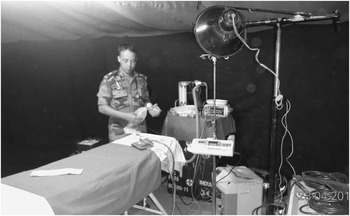
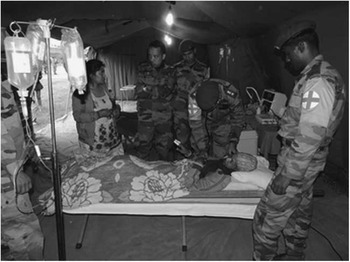
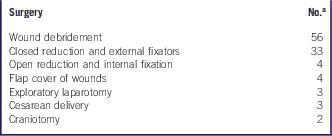
In the immediate aftermath of the quake, the Government of India directed the National Disaster Management Authority to coordinate with the Nepal Centre for Disaster Management in managing the crisis. Accordingly, 10 teams of the National Disaster Response Force and 2 MSTs of the Indian Army were mobilized and airlifted. These teams were in position in Nepal within 4 hours of the first quake that had occurred at 11:56 AM. They were registered with the Nepalese government and were assisted by the Nepalese Army. Each MST consisted of 1 each surgeon, orthopedic specialist, and anesthetist and 8 operating room assistants. They were airlifted by helicopters and deployed to Kathmandu and Nuwakot. An emergency operation theater (OT) and a first aid post were established. Because the remnant buildings were considered structurally unsound and adequate tents were lacking, temporary shelters were erected to house postoperative cases. The caseload handled by these MSTs is outlined in Table 1. Subsequently, 2 field hospitals were deployed in these locations, one at Kathmandu and another at Nuwakot. These hospitals were registered with the United Nations and functioned to replace the district hospitals that had been destroyed at these places. Once fully operational, each hospital had a 50-bed ward, a 6-bed intensive care unit, radiology and dental suites, a laboratory, and 2 OTs (Figures. 1 and 2). There were 2 surgical teams in each field hospital comprising an anesthesiologist, general surgeon, orthopedic surgeon, OT technician, and OT nurses. Each field hospital also had 1 physician and 1 preventive medicine specialist. The hospitals also had a complement of retired Gorkha soldiers of the Indian Army who had volunteered their services as guides and translators for the medical teams.
Mobile Operating Suite.

Mobile Intensive Care Unit.

Surgeries Conducted by Mobile Surgical Teams

a Total n=105.
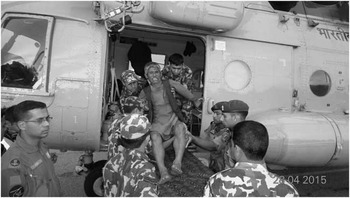
Meanwhile, a health cluster had been activated in collaboration between the Ministry of Health, the Nepalese government, and the World Health Organization (WHO). A health cluster field office was opened on 4 May at Gorkha. Representatives from the Indian Army Medical Corps were positioned at the National Emergency Operations Centre, Kathmandu, to participate in the intercluster meeting convened by the Ministry of Home Affairs. The trauma treatment protocols developed by the Ministry of Health and Population (MOHP) were distributed to the Indian Army MSTs and outreach teams. The primary survey by the MOHP had by now identified 14 districts that were most severely affected. The clusters identified remote areas that had become inaccessible by roads due to landslides, and the Indian Army MSTs were redeployed by choppers to these locations. Mi-17 and Mi-18 heavy lift helicopters were deployed to ferry outreach teams and bring in casualties from far-flung areas, namely Gorkha, Dumre, Damauli, Jitpur, Tipling, and Borang (Figure 3). A third field hospital was deployed at Sindhupalchok District after the 12 May earthquake.
Helicopter Deployment of Mobile Surgical Teams and Casualty Evacuation.

Flipcharts on the Integrated Management of Childhood Illness were developed by the WHO in consultation with the MOHP’s Child Health Division. These charts were acquired by the Indian mission and were distributed to all its field hospitals. In the meantime, the MOHP Health Emergency Operation Center with the support of the WHO instituted an epidemic-prone diseases early warning and response system (EWARS) to identify 4 syndromes for surveillance: acute respiratory infections, acute watery diarrhea, acute bloody diarrhea, and fever of unknown origin. The field hospitals participated in the EWARS by collecting data from observations at hospital outpatient departments and submitted the data daily at intercluster meetings chaired by district health officers.
DATA COLLECTION AND RECORD KEEPING
Each field hospital had a centralized registration that maintained the database of all cases reporting at the field hospital. The surgical teams in each field hospital kept a separate log of operations performed in their respective OTs. The patient data collected by the MST included age, sex, diagnosis, mechanism of injury, and surgical procedure done. The medical officer in charge of the ward kept a separate log of all cases admitted and treated in the field hospital. These cases included those in whom no surgical procedure was carried out. A separate discharge and dispatch section was created. The personnel manning this section ensured that the patients being discharged home were given a summary of their treatment and were provisioned with medication for 7 days. They also ensured that the patients being transferred to other hospitals or centers for rehabilitation carried details of their injury or illness and the treatment provided.
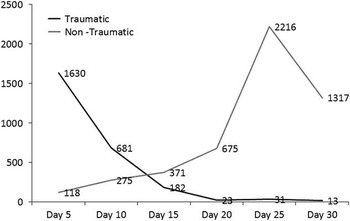
During the deployment, which spanned the period from 25 April 2015 to 28 May 2015, a total of 7532 patients were treated at the 3 field hospitals. The radiology department performed 2116 imaging studies, including 432 ultrasounds. The OTs were functional from 25 April to 16 May 2015. During this period, 105 operations were performed in 83 patients (Table 1). Most surgeries were related to bone and soft tissue injuries. Among all patients treated, the majority were Nepalese citizens (6477/7532; 86%). There were also Indians (843/7532; 11%); Tibetans (96/7532; 1.3%) and Bhutanese (116/7532; 1.5%). Twenty-one percent (or one-fifth) of the patients were children. One-third of the patients (34%) sought medical attention for injuries caused directly by trauma consequent to the earthquake. The remaining had infectious diseases, probably due to breakdown of the sanitation/hygiene standard. A large percentage of these cases consisted of fever and diarrhea. The surgical teams also conducted 22 normal childbirths and 3 cesarean deliveries. Surgical referrals came from primary care providers within the hospital, from Nepalese Army units, or from nongovernmental organizations in the region. The trend of injuries and other illnesses that presented in the 3 field hospitals is presented in Figure 4. As indicated in the figure, trauma-related injuries were maximal within 5 days of the index event and showed a steady downward trend thereafter. Other illnesses, either a direct consequence of the earthquake or preexisting diseases, started presenting after 1 week and showed a gradual upward trend thereafter.
Time Trend Analysis of Caseloads Presenting to the 3 Field Hospitals.

DISCUSSION
The Indian Armed Forces Medical Services has a policy of earmarking medical personnel for such eventualities beforehand. This allowed us to deploy these personnel within 4 hours of receiving notification of the mission. We also have prepacked medical and surgical equipment in the form of “medical bricks.” These bricks are stored in designated areas to allow for rapid retrieval and deployment when required. Apart from medical equipment, logistics requirements for the surgical teams, such as tents, rations, generators, and ancillary equipment, are catered for and kept ready. The bricks are designed such that they can be carried in Mi-17 and Mi-18 helicopters. It has been our experience in the past that fixed-wing aircraft require intact airfields on which to land and air traffic control for guidance. These facilities are often damaged during an earthquake. Although the airports at Kathmandu and Pokhara were relatively intact, the general state of panic in a post-earthquake scenario prevented a coherent response from relief teams in the initial 48 hours. Mi-17 and Mi-18 helicopters provided an alternative for transport and facilitated rapid deployment of the first 2 field hospitals.
We noted that traumatic injuries directly attributable to the quake accounted for 34% of all cases reporting to the field hospitals. These included both major and minor injuries. A relatively small number actually required surgical procedures. Experience of MSTs deployed in other earthquake zones in the past indicates that surgical patients accounted for only 3% to 10% of all patient encounters.Reference Malish, Oliver and Rush 2 , Reference von Schreeb, Riddez and Samnegård 3 The relatively higher proportion of surgical load seen by our surgical teams could be attributed to the fact that our teams deployed early (within 24 hours). The maximum number of casualties are expected to be reported within 48 hours of an earthquake. It has been recognized that if there is a delay between the earthquake and the establishment of surgical capacity, most of the caseload will not be directly related to the earthquake. In such a scenario, most casualties have either been brought to other facilities or have died of their injuries.Reference Malish, Oliver and Rush 2 , Reference von Schreeb, Riddez and Samnegård 3 WHO guidelines indicate that a unit should be on-site and operational within 24 hours if it intends to provide life-saving trauma resuscitation and surgery. Unfortunately, the window of opportunity to perform life-saving surgery is narrow and passes before the deployed surgical teams can become operational in most cases.Reference Haley and DeLorenzo 4 Our experience indicates that the surgical load peaks 48 hours after the quake and then rapidly tapers off from the seventh day onward. The survivors are recovered from the debris and brought to the nearest medical post and then transferred to the surgical teams in the initial 48 hours. By the seventh day, most survivors would have been recovered and treated in situ or would have been transported out of the quake zone. It is unlikely that more survivors would be recovered; hence, the surgical load tapers off. Our experience is analogous to those reported by other surgical teams in the past. In the 1999 Turkey earthquake, the Israeli Defence Forces (IDF) Field Hospital was deployed to Turkey 4 days after an earthquake. They reported a high proportion of acute trauma patients, which decreased progressively over the next 10 days.Reference Bar-Dayan, Mankuta and Wolf 5 Similarly, the IDF field hospital deployed to Haiti within 3 days of the earthquake treated a much greater proportion of earthquake victims than the American field hospital that deployed after 17 days.Reference Merin, Ash and Levy 6 , Reference Amundson, Dadekian and Etienne 7 After the surge of surgical cases attended to in the immediate aftermath of the earthquake, another minor surge is noted after 3 weeks. These are primarily the follow-up of cases who were managed initially in the emergency setting. They may also represent complications of emergency surgeries, such as flap necrosis, secondary infection, etc. Nontraumatic conditions, not attributable to the earthquake, formed the bulk of the caseload of the field hospital from the 10th day onward. They represented preexisting chronic conditions that were neglected as local health facilities had been destroyed. A fairly large proportion of these cases were also due to diseases resulting from poor hygiene and sanitation.
A major problem faced by the surgical teams was ensuring that patients would receive adequate postoperative care and rehabilitation. The field hospitals, by their very nature, are lightly staffed and equipped. This is to ensure rapid mobility and deployment. While they are adequate to treat injuries and conduct emergency surgeries, they are grossly inadequate for holding patients. It was recognized at a very early stage that a large percentage of patients would require prolonged postoperative care and rehabilitation and that this would add to the congestion in the field hospitals. The management of spinal cord injuries was identified as a critical gap. A need was felt to establish alternative rehabilitation and extended care facilities. Liaison was made with military medical units of the Nepalese Army as well as multiple agencies working in tandem in the health cluster. Medical liaison in this context was an active process that involved visiting other medical facilities to assess their capacity to care for specific patients. Representatives from the field hospitals participated in the intercluster meeting conducted by the district health officer and could develop liaisons with other agencies. It was found that Handicap International was working in 4 major hospitals in the Kathmandu Valley, supporting the medical teams once a patient had been discharged and ensuring that the right care and equipment to address spinal cord injury was provided. Our field hospitals could thereafter transfer their patients to premises of Handicap International. A major lesson learned was that it is in the best interest of the local population that a surgical team or field hospital be as fully integrated as possible within the broader disaster relief effort.
It has been recognized that disaster relief operations follow a relatively well defined pattern of events. In the first phase, most search and rescue is done by survivors, not external teams. Most successful rescues take place within the first 24 hours and most lives are saved by the immediate actions of survivors. Local authorities implement the second phase, when a more coordinated response is established with local rescue teams joining the survivors. In the third phase, extra help is co-opted from other areas for more intensive and focused efforts. Specialist aid for rescuing people deeply entrapped forms the fourth and final phase.Reference Walk, Donahue and Stockinger 8 Unfortunately, as was our experience, the second phase was completely left to the external aid as the local authorities themselves were crippled, incapable, or inaccessible to mount an effective rescue due to the mountainous terrain, poorly developed infrastructure, and lack of coordinated local effort. There were far more patients injured than killed and mass movement of the populace away from the scene presents an enormous burden on the temporary medical facilities created by the field hospitals. The combination of injury and entrapment places a limit on survival. Major head and chest injuries are usually fatal. Peripheral limb injuries are the most common surgical problems, and the effects of crush injury are the most complex.Reference Kaim Khani, Baig and Humail 9
Debridement of wounds and stabilization of fractures with external fixators were the most common procedures carried out by our surgical teams. More definite procedures were deferred for a later date. Despite logistical constraints, we attempted to adhere to established OT standards as closely as possible. We noted that only 4 cases had to undergo repeat surgery for a surgical complication. But it must be admitted that this may not reflect the true scenario. Complete documentation of other complications was not possible because our follow-up period was short and the rate of loss to follow-up was high. Data collection in disaster situations is desirable but problematic: desirable because it helps to plan and prepare for future humanitarian and disaster response operations, and problematic because the current paper-based system of data collection is subjective and user-dependent. The paper-based system is not standardized and often fails to capture vital input. It was realized that the paper-based system of registration and the case sheet–based method of case recording followed by our field hospitals was inadequate. The process of data collection should be integral to such missions. Ideally, a computerized database should be used, and dedicated personnel should be responsible for data collection.
A SWOT (strength weakness opportunity threat) analysis was carried out at the end of the mission. We noted that the strengths lay in the fact that a plan is already in place to meet such eventualities. Designated specialists and other personnel are earmarked for deployment within hours. The medical stores are kept ready in brick format. There exists a coordination cell at the highest level (office of the Director General of the Armed Forces services) to coordinate with the government and other branches and services. The weakness we noticed was that that compared with Western armies and aid agencies, our equipment and other infrastructure like tents, modular OTs, and other logistics need further improvement. A need was felt for separate child health and reproductive health services. Natural disasters like these provide us an opportunity to serve those in acute need of our services. Each such mission provides us with experience to further hone our skills in the management of mass casualties.
CONCLUSION
The mission was considered a success in many ways. Rapid early deployment of MSTs at or near the site of maximum damage provided maximum clinical benefit of a life- and limb-saving nature. Further augmentation of the same with field hospitals helped to provide full-spectrum medical care in an area without functioning health facilities. Even if deployment of an independent full-fledged surgical unit is not possible owing to logistical or geographical constraints, the capacity to perform emergency surgery can still be useful if it can be deployed to augment local health facilities.