1. Introduction
The whole rock chemistry and mineral chemistry of intrusive rocks can help fingerprint the melt source region. The mineral zircon is particularly useful as it is refractory, can survive crustal melting, can be transported from the source with the melt and new zircon can grow as the melt crystallizes (Clemens, Reference Clemens2003; Williams, Reference Williams2001). In situ U–Pb geochronology can help determine both the age of magmatism (by analysing the zircon that represents the melt if they occur as rims) and the age of inherited zircons (by dating xenocrystic cores) from the source region (e.g. Pidgeon & Compston, Reference Pidgeon and Compston1992). In situ Lu–Hf isotopic analysis of the dated domains can determine if the rims grown from the melt represent the same Hf isotopic reservoir as the Hf present in the inherited cores and grains. Similar isotopic compositions imply that the cores are relict members of the source rock zircon population, and thus cognate. Differences point to separate origins, that is, that the cores represent true xenocrysts incorporated from the wall rocks. Mantle extraction ages (model ages) can be calculated for the different zircon components, facilitating evaluation of the tectonic setting, for example, distinguishing juvenile crustal addition from reworking. Use of the Hf isotopic composition of zircon in this way can lead to a more sophisticated understanding of the petrogenesis than is possible using the widely employed whole-rock Sm–Nd technique (e.g. Flowerdew et al. Reference Flowerdew, Millar, Vaughan, Horstwood and Fanning2006; Chen et al. Reference Chen, Zheng, Zhao, Tang, Wu and Liu2007; Wu et al. Reference Wu, Zheng, Zhang, Zhao, Wu and Liu2007; Yang et al. Reference Yang, Wu, Wilde, Xie, Yang and Liu2007; Zeh et al. Reference Zeh, Gerdes, Klemd and Barton2007).
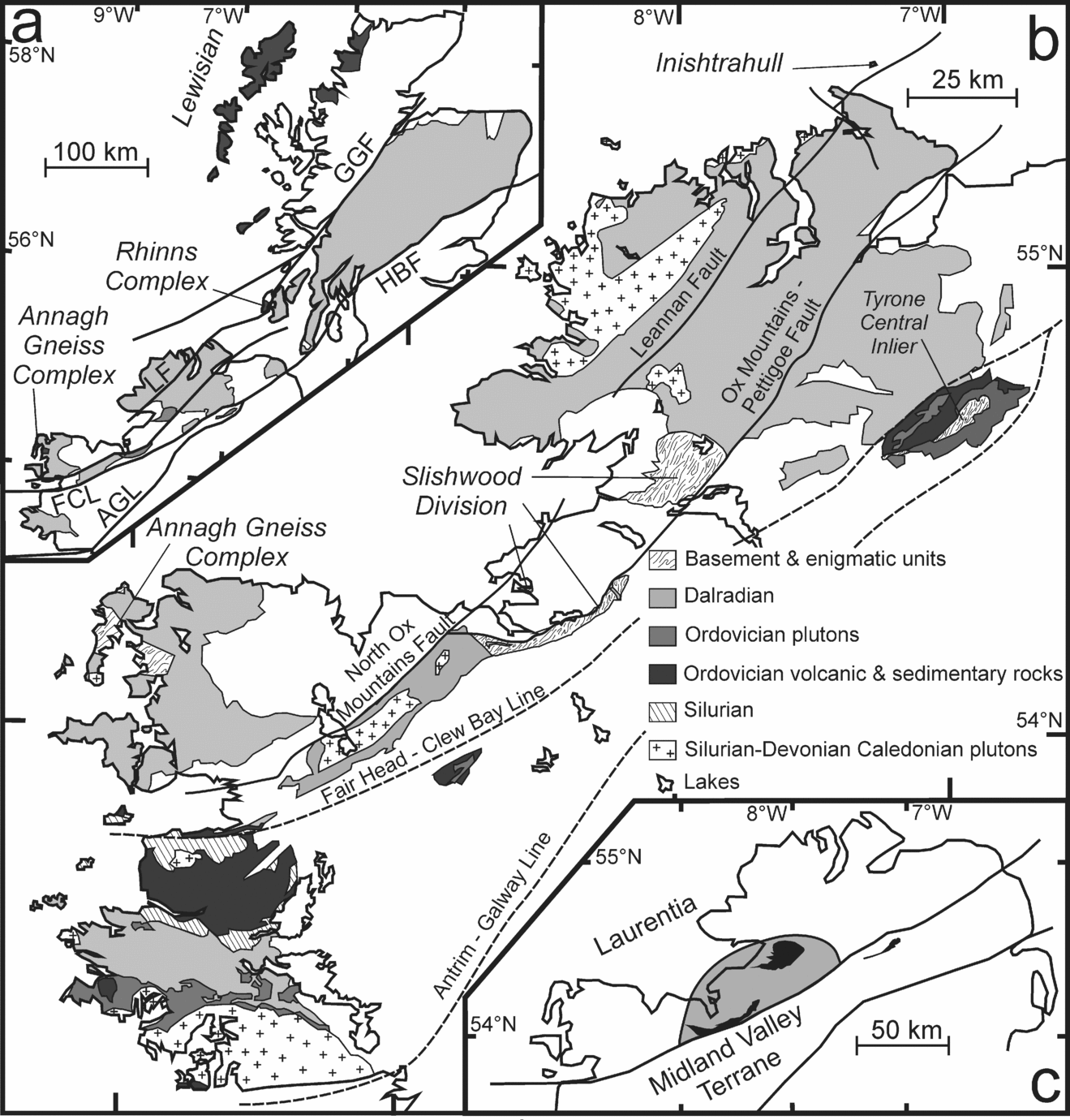
In the Caledonides of NW Ireland, the crystalline basement is rarely exposed. Most of the crustal section is made up of Neoproterozoic to Palaeozoic metasediments of the Dalradian Supergroup folded into large (10 km wavelength) folds, as well as later Silurian–Devonian Caledonian intrusives. Various lines of evidence suggest that the Dalradian metasediments were deposited on Palaeoproterozoic orthogneisses of the Rhinns and Annagh Gneiss complexes at the margin of Laurentia (Fig. 1). The southeastern limit of the buried edge of Laurentia is conventionally delimited by the Fair Head–Clew Bay Line (Max & Riddihough, Reference Max and Riddihough1975; Fig. 1), a magnetic expression of the suture between the Midland Valley Terrane and Laurentia. The arc rocks of the Midland Valley Terrane collided with the Laurentian margin during the Early Ordovician Grampian Orogeny (Van Staal et al. Reference Van Staal, Dewey, Mac Niocaill, McKerrow, Blundell and Scott1998).
(a) Schematic geology of British and Irish Caledonides showing major fault lines. Dark shading: Grenvillian and older crystalline basement rocks (Lewisian, Rhinns Complex and Annagh Gneiss Complex); medium shading: Slishwood Division and Tyrone Central Inlier; pale shading: Dalradian. Bold lines are major fault lines where: AGL – Antrim–Galway Line (Ryan et al. Reference Ryan, Soper, Snyder, England and Hutton1995), FCL – Fair Head–Clew Bay Line, GGF – Great Glen Fault, HBF – Highland Boundary Fault and LF –Leannan Fault. (b) Schematic geology of NW Ireland. Basement includes older crystalline rocks (Rhinns Complex on Inishtrahull and Annagh Gneiss Complex, labelled) and the enigmatic units refer to the Slishwood Division and Tyrone Central Inlier (labelled). Ordovician volcanic and sedimentary rocks include those of the Midland Valley Terrane (Lough Nafooey arc, Charlestown and Tyrone Inlier), South Mayo Trough, Clew Bay Complex. Ordovician plutonic rocks are associated with Grampian Orogeny. Major faults are shown in bold; crustal structures inferred from geophysical data are dashed. (c) Map showing the distribution of the Laurentia and the Midland Valley Terrane based on geology and geophysics and the extent of the geophysical anomaly centred on the Slishwood Division (grey shading). Black areas indicate outcrop of the Slishwood Division and Tyrone Central Inlier.

Two enigmatic bodies of quartzofeldspathic schist and paragneiss, the Tyrone Central Inlier (Hartley, Reference Hartley1933) and Slishwood Division (Max & Long, Reference Max and Long1985), are exposed close to the Laurentian margin in Ireland. Both units lie structurally beneath Dalradian rocks and both have been correlated with either the Dalradian (Sanders, Reference Sanders, Gibbons and Harris1994; Chew et al. Reference Chew, Flowerdew, Page, Crowley, Daly, Cooper and Whitehouse2008) or the Moine Supergroup (Powell, Reference Powell1965), another metasedimentary unit exposed in Scotland. In view of their tectonic position, anomalously high metamorphic grade and evidence for pre-Grampian metamorphism (Flowerdew & Daly, Reference Flowerdew and Daly2005; Sanders, Daly & Davies, Reference Sanders, Daly and Davies1987; Daly, Reference Daly, Holland and Sanders2009), it is possible that these units and their hidden basement were carried along with the Midland Valley Terrane arc and are exotic to Laurentia. Alternatively, they may rest on a tectonically isolated piece of Laurentia that was placed outboard of the margin during the opening of the Iapetus Ocean and was subsequently re-attached to the margin during the Grampian Orogeny (Chew et al. Reference Chew, Flowerdew, Page, Crowley, Daly, Cooper and Whitehouse2008; Flowerdew, Daly & Whitehouse, Reference Flowerdew, Daly and Whitehouse2005). Determining which model is correct is frustrated by the difficulty in dating the metamorphism affecting these units. However, the geochronology presented by Chew et al. (Reference Chew, Flowerdew, Page, Crowley, Daly, Cooper and Whitehouse2008) for the Tyrone Central Inlier lends support for a Laurentian affinity and therefore the latter model is appropriate for the Tyrone Central Inlier.
Using Lu–Hf isotopic analyses of zircons from minor Ordovician granitoid intrusions that cut the Slishwood Division and Tyrone Central Inlier, this study aims to investigate the hidden basement and to explore the tectonic implications of different basement types. Regional variations in the basement architecture would help to trace deep crustal boundaries such as that between the Annagh Gneiss Complex and Rhinns Complex in NW Ireland, which has been distinguished on Pb isotopic grounds by Tyrrell, Haughton & Daly (Reference Tyrrell, Haughton and Daly2007). An exotic affinity for the buried crystalline basement would lend further support for the existence of pre-Grampian basement within the Midland Valley Terrane, which is suggested by whole-rock geochemical studies of lower crustal xenoliths carried to the surface by post-Grampian volcanism (Halliday et al. Reference Halliday, Dickin, Hunter, Davies, Dempster, Hamilton and Upton1993). It would also show that exotic microcontinents within the Grampian–Taconic arcs (e.g. Hibbard, Tracy & Henika, Reference Hibbard, Tracy and Henika2003) are more extensive than previously recognized.
2. Crystalline basement in Ireland
2.a. Laurentian basement
The pre-Dalradian Laurentian geology of Ireland is poorly understood as only small inliers of pre-Dalradian rocks are exposed (Fig. 1). Basement inliers of the Rhinns Complex are exposed on the island of Inishtrahull off the north coast of Ireland (Daly, Muir & Cliff, Reference Daly, Muir and Cliff1991), and on the islands of Colonsay and Islay in Scotland (Muir, Fitches & Maltman, Reference Muir, Fitches and Maltman1995). The Rhinns Complex is composed of Palaeoproterozoic (c. 1.78 Ga) alkaline juvenile crust (Marcantonio et al. Reference Marcantonio, Dickin, McNutt and Heaman1988; Loewy et al. Reference Loewy, Connelly, Dalziel and Gower2003; Muir, Fitches & Maltman, Reference Muir, Fitches and Maltman1994; Daly, Muir & Cliff, Reference Daly, Muir and Cliff1991; Dickin & Bowes, Reference Dickin and Bowes1991) that was metamorphosed shortly after its formation (Roddick & Max, Reference Roddick and Max1975). The Annagh Gneiss Complex, exposed in a small inlier in W Ireland, differs from the Rhinns Complex in that its Palaeoproterozoic component is slightly younger and it contains extensive Mesoproterozoic intrusions (c. 1.27 Ga), termed the Cross Point Gneiss, which variably rework the older Mullet Gneiss protoliths (c. 1.75 Ga), while others such as the Doolough Gneiss (c. 1.17 Ga) are juvenile additions (Daly, Reference Daly1996, Reference Daly, Holland and Sanders2009). Perhaps most significantly, the Annagh Gneiss Complex was intruded, deformed, metamorphosed and migmatized during the Grenville Orogeny (Daly, Reference Daly1996; Daly & Flowerdew, Reference Daly and Flowerdew2005). As Grenville events are not proven to have affected the Rhinns Complex, a major tectonic break, the Grenville front, must be situated between the exposures of the Annagh Gneiss Complex and the Rhinns Complex in Ireland.
As no deep crustal xenoliths have been documented in this part of NW Ireland, extrapolation of the crystalline basement beneath the Slishwood Division and Tyrone Central Inlier is speculative and is dependent on indirect geophysical and geochemical evidence. Deep seismic experiments, summarized by Landes et al. (Reference Landes, Ritter, Readman and O'Reilly2005), record variations in Moho depth and anomalously low middle and lower crustal P-wave velocities (Lowe & Jacob, Reference Lowe and Jacob1989), which may reflect a change in basement composition. Deep seismic reflection studies have also revealed lithospheric mantle reflectors, which are thought to represent fossil, possibly Palaeoproterozoic, subduction zones (Warner et al. Reference Warner, Morgan, Barton, Morgan, Price and Jones1996; Snyder, England & McBride, Reference Snyder, England and McBride1997). These structures led Long & McConnell (Reference Long and McConnell1999) to suggest that Archaean crust may be buried at depth in NW Ireland.
Readman, O'Reilly & Murphy (Reference Readman, O'Reilly and Murphy1997) note a distinct domain on the Bouguer anomaly map that correlates with the outcrop of the Slishwood Division (Fig. 1), and speculate that this unit is underlain by a single low-density body at depth. It may also reflect a different basement character. The Fair Head–Clew Bay Line separates crust of high and low magnetic susceptibility and represents the junction between Laurentia and the Midland Valley Terrane. Crust with a magnetic signature similar to that of the Midland Valley Terrane does occur north of the Fair Head–Clew Bay Line, and spatially overlaps with the gravity anomaly and outcrop area of the Slishwood Division. Both gravity and magnetic data support the interpretation that the Slishwood Division was situated outboard of Laurentia and acted as a rigid indenter during the Grampian Orogeny (Flowerdew et al. Reference Flowerdew, Daly, Guise and Page2000). The Tyrone Central Inlier is also situated within the Midland Valley Terrane but has a Laurentian affinity (Chew et al. Reference Chew, Flowerdew, Page, Crowley, Daly, Cooper and Whitehouse2008), probably representing a thin slice of Laurentia thrust onto the Midland Valley Terrane.
In Scotland, granitoid chemistry including Sr and Nd isotopes and the age of inherited zircons suggest that the sub-Dalradian basement is similar in character to the Rhinns Complex (Steinhoefel, Hegner & Oliver, Reference Steinhoefel, Hegner and Oliver2008; Pidgeon & Compston, Reference Pidgeon and Compston1992). Sr and Nd isotopic analyses of the Donegal granites in NW Ireland (Dempsey, Halliday & Meighan, Reference Dempsey, Halliday and Meighan1990) are also consistent with the presence of juvenile Palaeoproterozoic basement at depth and also suggest a possible break in the sub-Dalradian basement with more juvenile material SE of the Leannan Fault (Fig. 1). Grampian (c. 470 Ma) tonalite intrusions cutting the Slishwood Division have Sr and Nd isotopic compositions consistent with a derivation from a source similar to the Annagh Gneiss Complex, but the ages of inherited zircons within the tonalites do not (Flowerdew, Daly & Whitehouse, Reference Flowerdew, Daly and Whitehouse2005). This led Flowerdew, Daly & Whitehouse (Reference Flowerdew, Daly and Whitehouse2005) to suggest that strong local contamination from the Slishwood Division had masked the geochemical signature of the source, which possibly involved some or all of the Dalradian, Annagh Gneiss Complex and mantle components. The hafnium isotopic data of zircon from a granite sheet from the Ox Mountains Granodiorite (Chew & Schaltegger, Reference Chew and Schaltegger2005) are also consistent with derivation of this intrusion from a source such as the Annagh Gneiss Complex.
Existing geophysical and geochemical studies, therefore, are consistent with the hidden crystalline basement for the Irish Laurentian margin being analogous to either the Annagh Gneiss Complex or the Rhinns Complex, and that beneath the Slishwood Division is basement, with a character distinct from the rest of the Irish Laurentian margin.
2.b. Basement of the Midland Valley Terrane
The putative Ordovician arc rocks of the Midland Valley Terrane are mostly concealed by Devonian and younger rocks. Deciphering whether or not the Midland Valley arc had an older continental foundation is difficult. Chew et al. (Reference Chew, Flowerdew, Page, Crowley, Daly, Cooper and Whitehouse2008) concluded that the Tyrone Central Inlier, structurally beneath the Ordovician Tyrone Igneous Complex (Cooper, Crowley & Rushton, Reference Cooper, Crowley and Rushton2008), was not equivalent to the basement of the Midland Valley. Nd isotopic data from c. 490 Ma arc rocks in W Ireland have yielded depleted mantle model ages of 1400 Ma, suggesting significant assimilation of older crust (Chew, Graham & Whitehouse, Reference Chew, Graham and Whitehouse2007). These authors preferred a model whereby the assimilant took the form of subducted sediment derived from Laurentia rather than any arc basement. Volcanic rocks associated with the Nafooey arc in W Ireland were initially juvenile but become increasingly continental through time (Draut et al. Reference Draut, Clift, Chew, Cooper, Taylor and Hannigan2004). This trend was interpreted by Draut et al. (Reference Draut, Clift, Chew, Cooper, Taylor and Hannigan2004) to also record the influence of subducted Laurentia-derived sediment as the arc approached and collided with Laurentia. An older continental component to the Midland Valley Terrane has yet to be identified in Ireland.
3. Sample descriptions
The samples discussed in this paper come from minor Ordovician intrusions that cut the Slishwood Division and Tyrone Central Inlier in NW Ireland.
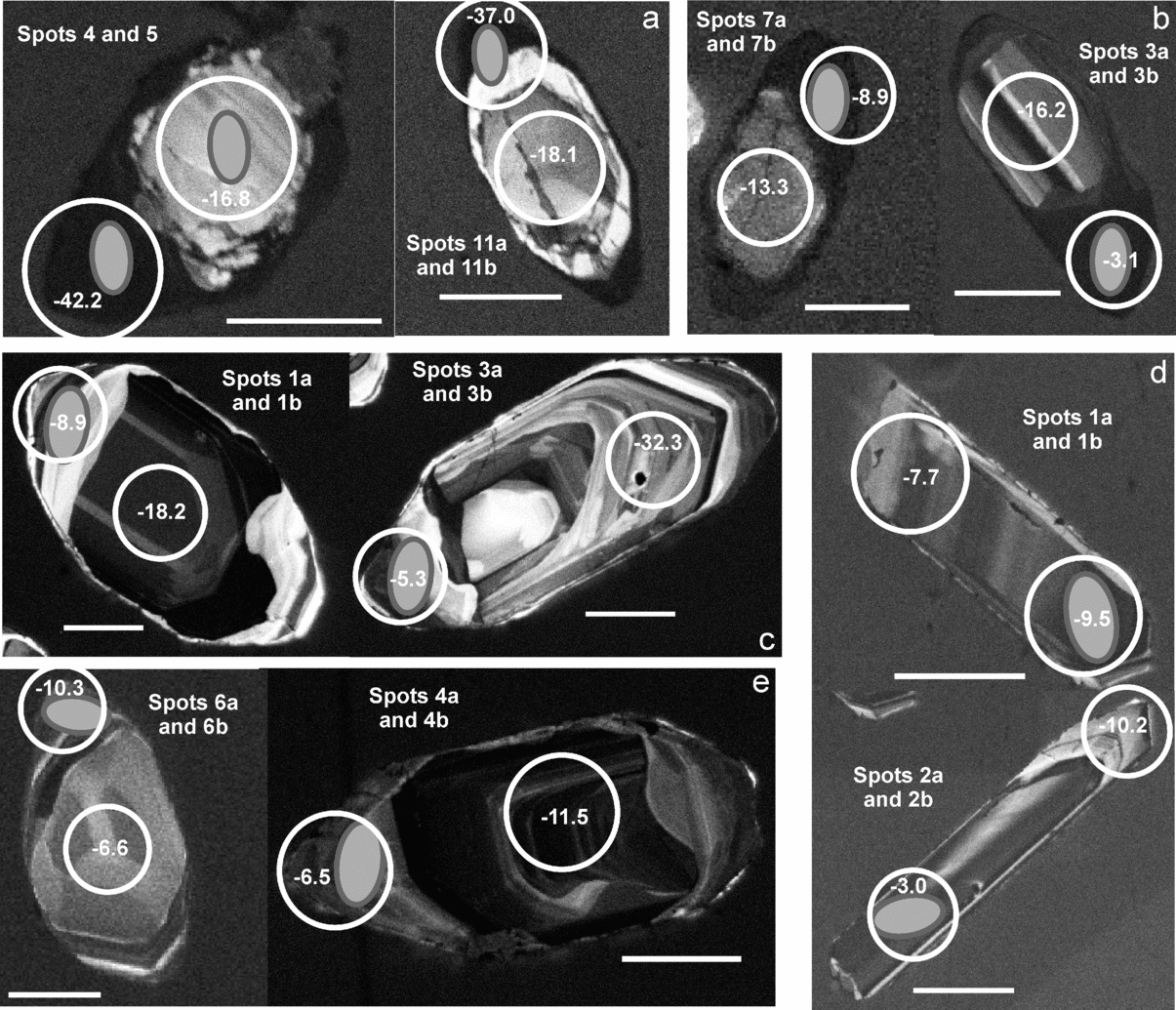
Zircons from five intrusions cutting the Slishwood Division were analysed. The Ballygawley Tonalite (MJF 3/95-39A) and Ballygawley granite (MJF 5/97-16) were both intruded at c. 470 Ma and contain abundant xenoliths that are lithologically similar to the host Slishwood Division paragneisses (Flowerdew, Daly & Whitehouse, Reference Flowerdew, Daly and Whitehouse2005). The internal structure of the zircons are similar in both of these intrusions (Fig. 2). Cores, sometimes exhibiting a multi-stage growth history, have a varying cathodoluminescence but are normally overgrown by brighter zircon with faint growth zoning (Fig. 2c, e). The overgrowths are thickest at the zircon tips and their contact with the core is often lobate and convoluted, a texture demonstrating that some zircon dissolution of the inherited component has occurred (Williams, Reference Williams2001). Minor bodies of the same age (c. 470 Ma), including a mylonitized granite sheet (MJF 5/97-29) and an undeformed pegmatite (MJF 10/94-2A) that cut the Slishwood Division (Flowerdew, Daly & Whitehouse, Reference Flowerdew, Daly and Whitehouse2005 and unpub. data), each contain zircons with distinctive internal structures, which differ from those of the tonalites. The pegmatite contains abundant rounded zircon cores with ubiquitous thick non-luminescent overgrowths (Fig. 2b). The granite sheet only rarely yields zircons with inherited cores, and luminescent, growth-zoned acicular zircon grains dominate (Fig. 2d). The final Slishwood Division sample (SG2) comes from a granulite-facies leucosome that pre-dates intrusion of the granite pegmatite suite. Zircon xenocrysts from this sample are considered to be original detrital grains that were scavenged from the metasedimentary wall rock during intrusion. These only rarely have thin overgrowths, which are too thin to be analysed for their Hf isotope composition.
Zircon CL images from granitoids cutting the Slishwood Division and the Tyrone Central Inlier. Representative images for each sample are shown for: TCI-10 in (a); MJF 10/94-2A in (b), MJF 5/97-16 in (c), MJF 5/97-29 in (d) and MJF 3/95-39A in (e). Grey ellipses show location of ion-microprobe spots and white circles the location of Hf laser ablation spots, together with the ϵHf470 values for the analysis. Each grain is labelled corresponding to the grain number indicated in Table 1 and the adjacent white scalebar is 50 μm.

Zircons from a single sample cutting the Tyrone Igneous Complex (TCI-10) come from a c. 470 Ma granite pegmatite (Chew et al. Reference Chew, Flowerdew, Page, Crowley, Daly, Cooper and Whitehouse2008) with similar field relationships and zircon textures (Fig. 2a) to that of the Slishwood Division pegmatite (MJF 10/94-2A). However, thick rims are extremely rare.
4. Analytical method
Lu–Hf isotope analyses were performed in spring 2005 at the NERC Isotope Geosciences Laboratory, Keyworth, UK, following U–Pb zircon ion-microprobe geochronology at the NORDSIM facility, Swedish Museum of Natural History, Stockholm. In situ Hf isotope analyses were performed using a Merchantek 266nm Nd:YAG laser attached to a VG instruments multi-collector Axiom inductively coupled plasma mass spectrometer. The analytical method is modified after Flowerdew et al. (Reference Flowerdew, Millar, Vaughan, Horstwood and Fanning2006) and is briefly described below. Ablations, which resulted in approximately cylindrical pits with dimensions of 50 μm diameter × 50 μm depth, were targeted over the U–Pb ion-microprobe analysis spot. Where this was not possible, or where magmatic rims overgrowing inherited zircon were obvious, CL images were used to ensure that the Hf analysis was from the same growth zone of zircon on which U–Pb dating was performed.
Isobaric interferences of Yb and Lu on the 176 peak were corrected for using a dual approach, firstly by doping solution standards to determine 176Yb/173Yb (Thirlwall & Walder, Reference Thirlwall and Walder1995), and secondly by determining Yb mass bias in situ during ablation (Woodhead et al. Reference Woodhead, Hergt, Shelley, Eggins and Kemp2004). In the first approach, a Yb solution was mixed with the JMC 475 Hf solution standard to achieve a range of Yb/Hf ratios (0.02, 0.07 and 0.1) in order to determine an empirical vale for the 176Yb/173Yb ratio. This value (176Yb/173Yb = 0.79505) was then used to correct for the interference of 176Yb on 176Hf for the ablations. The Yb mass bias corrections for Yb were assumed to be similar to that for the measured 179Hf/177Hf. Although the mass bias behaviour of Hf and Yb is subtly different (Wu et al. Reference Wu, Yang, Xie, Yang and Xu2006), the assumption is appropriate for grains with low Yb concentrations. Doped and undoped analyses of the JMC 475 standard yielded 176Hf/177Hf values of 0.282129 ± 21 (2 standard deviations, n = 38) and 0.282130 ± 19 (2 standard deviations, n = 32), respectively, and are within the long term laboratory average of 0.282146 ± 74 for the Axiom instrument. A 176Lu/175Lu value of 0.02645 was determined through successive Lu doping of the JMC 475 standard. The second method determined the Yb mass bias using the interference-free 173Yb/172Yb ratio averaged over the course of the ablation, and used the Yb natural abundance ratios of Thirlwall & Anczkiewicz (Reference Thirlwall and Anczkiewicz2004) in order to correct for the interfering 176Yb. Intermittent ablations of the 91500 zircon standard within each of the analytical sessions yielded 176Hf/177Hf values of 0.282294 ± 55 and 0.282297 ± 96 (2 standard deviations, n = 89), in agreement with reported values of ~0.28230 (Blichert-Toft, Reference Blichert-Toft2008; Wiedenbeck et al. Reference Wiedenbeck, Alle, Corfu, Griffin, Meirer, Oberli, Von Quadt, Roddick and Spiegel1995). Any Hf isotopic heterogeneity in the 91500 zircon (e.g. Griffin et al. Reference Griffin, Pearson, Belousova and Saeed2006) would overestimate the external reproducibility.
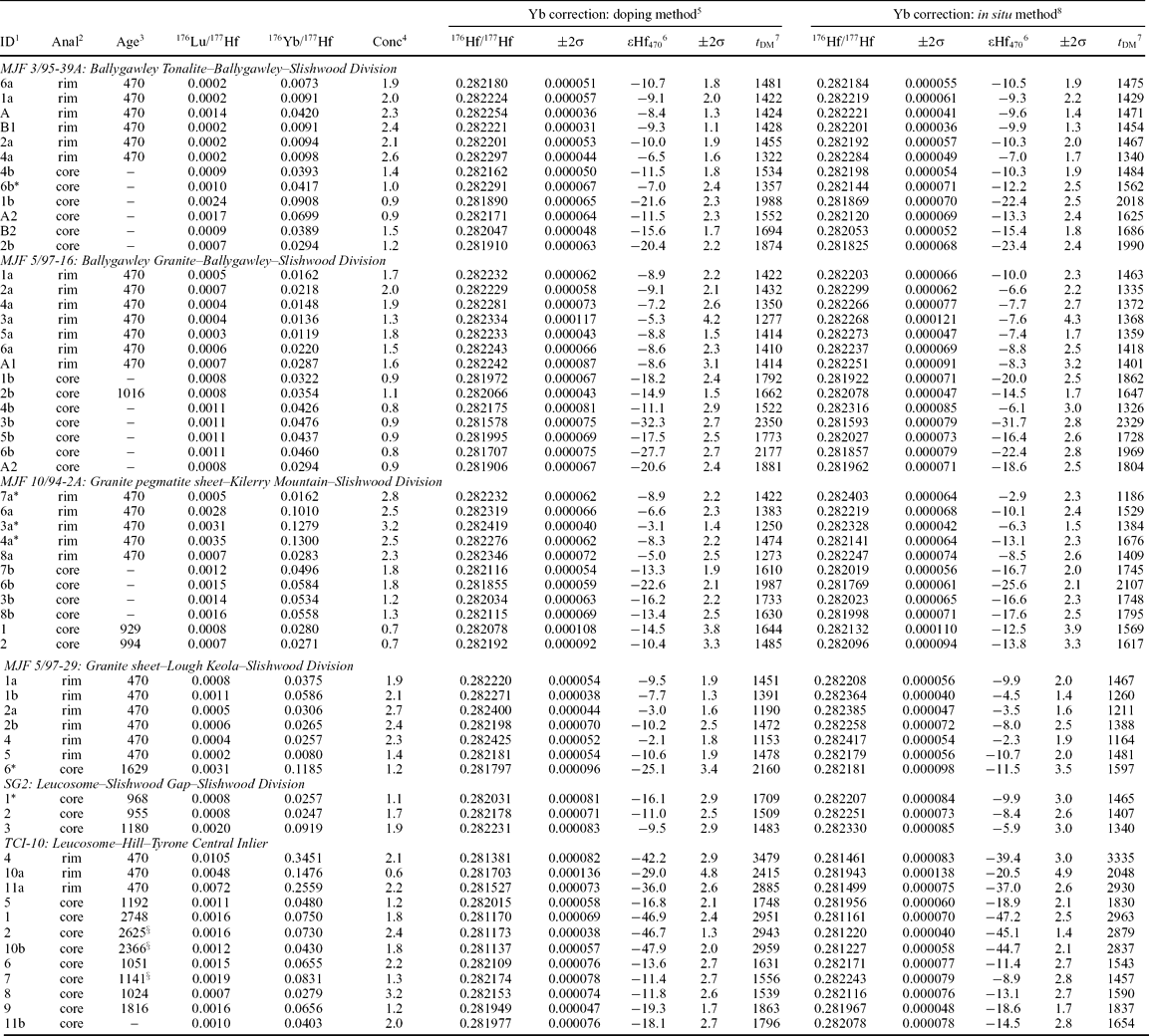
Neither method of reduction is ideal. The second in situ method suffers from a greater uncertainty and reproducibility of the 176Hf/177Hf ratio. The greater imprecision is caused by the combined effect of lower signal intensities and a less precise determination of the Yb mass bias compared with the first method. Additionally, several different natural abundance values for Yb are currently in use. The natural abundance values of Thirlwall & Anczkiewicz (Reference Thirlwall and Anczkiewicz2004) were adopted, as they fit best the Yb corrections of zircon standards (e.g. Wu et al. Reference Wu, Yang, Xie, Yang and Xu2006) but they may not necessarily be correct. The first method is considered inaccurate for zircons with moderate and high 176Yb/177Hf (Wu et al. Reference Wu, Yang, Xie, Yang and Xu2006). The proposed degree of inaccuracy, which is approximately 20 ppm for zircons with 176Yb/177Hf < 0.04, is accommodated by our average 2.0 ϵHf uncertainty (2σ). In fact, the two methods of Yb-correction yield results that are in broad agreement, with just 6 out of 59 analyses not agreeing within analytical uncertainty. Hf isotopic ratios are quoted using both reduction methods in Table 1, and all figures use the values determined by the first, doping method. Additionally, the external precision of approximately 2.0 ϵHf units is more than adequate to resolve different basement provinces or source regions, given the wide range in initial Hf isotopic compositions determined in this study.
Hf isotopic data

1Grain and analysis identification; asterisk indicates analyses where the two different reduction methods do not agree within analytical uncertainty. 2Portion of zircon analysed, inferred from CL images of grains. 3U–Pb age of rims averages 470 Ma and this age is taken for all rim analyses; § indicates 207Pb/206Pb age when anchored through 470 Ma. 4Total Hf volts measured during analysis as an indication of relative Hf concentration. 5Values obtained using the doping method for removal of interfering 176Lu and 176Yb isotopes. 6,7ϵHf at 470 Ma and depleted mantle model ages calculated using a Lu decay constant of 1.865 × 10⁻¹¹ (Amelin, Reference Amelin2005; Scherer, Münker & Mezger, Reference Scherer, Münker and Mezger2001) and modern-day chondrite values of 176Hf/177Hf and 176Lu/177Hf of 0.282772 and 0.0332, respectively (Blichert-Toft & Albarède, Reference Blichert-Toft and Albarède1997). Depleted mantle model ages were calculated using the measured 176Lu/177Hf of the zircon and present day 176Hf/177Hf and 176Lu/177Hf values of 0.28325 and 0.0384, respectively (Griffin et al. Reference Griffin, Belousova, Shee, Pearson and O'Reilly2004). 8Values obtained using the in situ method for the removal of interfering 176Lu and 176Yb.
5. Results
Results are given in Table 1 and are presented graphically in Figures 3 and 4.
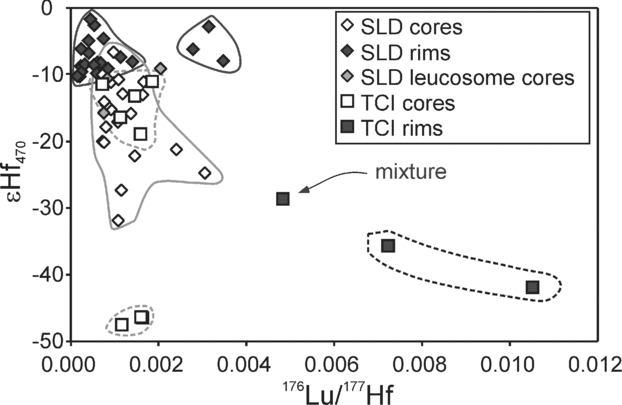
176Lu/177Hf against ϵHf for the analysed zircon. Solid black line defines the field for the Slishwood Division rims and solid grey line defines the field for the Slishwood Division cores. Dashed black line defines the field for the Tyrone Central Inlier rims and the dashed grey lines the field for the Tyrone Central Inlier cores. Abbreviations: SLD – Slishwood Division, TCI – Tyrone Central Inlier.

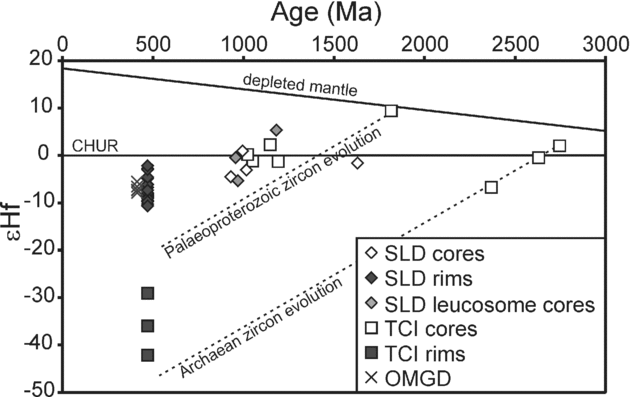
Age against ϵHf evolution plot for the c. 470 Ma zircon rims and zircon cores of known age. Dashed lines show the ϵHf evolution for two grains from the Tyrone Central Inlier with 176Lu/177Hf of 0.0016 (the average value for the inherited cores) and act as a guide for the ϵHf evolution of the other core analyses. Abbreviations: SLD – Slishwood Division, TCI – Tyrone Central Inlier, OMGD – magmatic zircon from the 412 Ma Ox Mountains Granodiorite (Chew & Schaltegger, Reference Chew and Schaltegger2005).

The zircon rims from the Slishwood Division intrusions are generally distinct from their cores (Fig. 3; Table 1), several of which are known to be inherited, based on their U–Pb ages (Table 1). Rim compositions exhibit two clusters, one at about 176Lu/177Hf = 0.0005 and ϵHf470 = −9 and the other at 176Lu/177Hf = 0.003 and ϵHf470 = −6. The Slishwood Division cores have 176Lu/177Hf values ranging between 0.0005 and 0.003 and ϵHf470 between −7 and −32. While the fields for the cores and rims overlap, many of the cores have higher 176Lu/177Hf ratios and most have significantly lower ϵHf470 than the zircon overgrowths that crystallized during intrusion.
Zircon rims from the Tyrone Central Inlier are also distinct from the cores (Fig. 3). The cores are interpreted as inherited on the basis that they yield older U–Pb ages than the rims (Table 1). Rims (excluding analysis 10a which is an inadvertent mixture between core and rim) have extremely high 176Lu/177Hf > 0.007 coupled with extremely low ϵHf470 at approximately −40. Although analysis 10a is a mixture, its intermediate 176Lu/177Hf ratio (Table 1) is consistent with the rim for this grain having low ϵHf470 and high 176Lu/177Hf values similar to the other two rim analyses. Inherited zircons from the Tyrone Central Inlier form two distinct clusters. One has 176Lu/177Hf ratios of 0.0015 and ϵHf470 values ranging between −11 and −19, the other also has 176Lu/177Hf ratios of 0.0015 but with ϵHf470 values of −47 (Fig. 3).
The ages of many zircon cores in the Slishwood Division rocks are not known, but for those cores for which there is age information, the U–Pb age versus ϵHf plot (Fig. 4; Table 1) is most revealing. The Slishwood Division cores have ϵHf values close to zero and formed from a Palaeoproterozoic to early Mesoproterozoic source. The Tyrone Central Inlier also contains cores that cluster close to those from the Slishwood Division and indicate a similar origin. In addition, however, the Tyrone Central Inlier contains Neoarchaean cores derived from a Mesoarchaean source.
6. Interpretation and discussion
6.a. Identifying sources of granitoids through hafnium isotopes
Any rock will have a Hf isotope composition that evolves through time at a rate dependent on its whole rock Lu/Hf ratio. The rock, of course, comprises different minerals themselves with varying concentrations of lutetium and hafnium and varying Hf isotope compositions. The relative behaviour of these compositionally different minerals during melting will control the isotope composition of the resultant melt. Zircon is particularly important on two counts. Not only is it essentially lutetium-free and thus retains a nearly constant hafnium isotopic composition through time, effectively recording the composition of fluid from which it grew, it is also extremely Hf-rich and typically accounts for most of the hafnium in silicic rocks (e.g. Hoskin et al. Reference Hoskin, Kinny, Wyborn and Chappel2000). Therefore, if zircon in a source rock dissolves during partial melting, the resulting hafnium isotopic composition of the melt will be less radiogenic than if zircon did not dissolve or was not present initially (Flowerdew et al. Reference Flowerdew, Millar, Vaughan, Horstwood and Fanning2006; Wu et al. Reference Wu, Zheng, Zhang, Zhao, Wu and Liu2007). In the latter case, the melt composition will be influenced by other pre-existing or co-precipitating phases (Zheng et al. Reference Zheng, Wu, Zhao, Zhang, Xu and Wu2005) and will usually inherit a signature close to that of the whole rock (e.g. Zeh et al. Reference Zeh, Gerdes, Klemd and Barton2007). Identifying whether or not zircon has dissolved is therefore paramount for any interpretation regarding the melted source. One way of demonstrating that zircon dissolution into the melt has occurred is by examining the texture of overgrown inherited zircon cores (Williams, Reference Williams2001; Wu et al. Reference Wu, Zheng, Zhang, Zhao, Wu and Liu2007). The absence of textural evidence for zircon dissolution of the inherited component does not of course preclude zircon dissolution having taken place.
6.b. Source of Slishwood Division granitoid intrusions and leucosome
6.b.1. Zircon core compositions
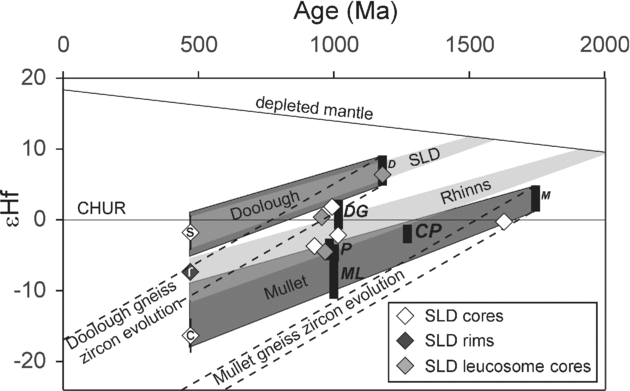
The inherited zircon components from the Slishwood Division intrusions have an average ϵHf value of −16.3 ± 2.4 and tDM ages of c. 1740 Ma (‘c’ on Fig. 5). While the ages for the majority of cores are not known, seven of the Hf analyses come from cores that have a corresponding U–Pb ion-microprobe age. These grains together with the inherited grains within the Giant's Rock Tonalite (for which Hf data is not available) have age populations corresponding with the age populations for detrital grains from the Slishwood Division (Flowerdew, Daly & Whitehouse, Reference Flowerdew, Daly and Whitehouse2005; Daly et al. 2008). The similarity of their ages, together with the similarity between the collective average c. 1740 Ma Lu–Hf model age for the inherited grains with Sm–Nd model ages for the Slishwood Division (c. 1560 Ma: Sanders, Daly & Davies, Reference Sanders, Daly and Davies1987; Flowerdew & Daly, Reference Flowerdew and Daly2005), may simply indicate that the cores were incorporated during intrusion rather than being derived from the magmatic source. If this is the case, it could be argued, based on the similarity of age and Hf isotope composition between the complex and the inherited component, that the Slishwood Division had a sedimentary provenance at least in part from the Annagh Gneiss Complex (Fig. 5). The small number of core analyses with a corresponding age analysis precludes further discussion.
Age against ϵHf evolution plot showing the evolution fields for possible sources for the Slishwood Division-hosted intrusions. Labelled diamonds show ϵHf470 for the average rim composition, ‘r’; the average core composition, ‘c’ (including all Hf analyses for which the inherited core age is not known); and the zircon composition predicted if Slishwood Division were to melt without significant zircon dissolution, ‘s’. Black bars represent the ϵHf ranges for the Annagh Gneiss protoliths (adapted from Daly, Reference Daly, Holland and Sanders2009) where: M – Mullet gneiss (with one analysis excluded), CP – Cross Point gneiss, D – Doolough gneiss, DG – Doolough Granite, P – pegmatites and ML – migmatitic leucosome in Mullet gneiss. Dashed lines show the evolution of zircon with 176Lu/177Hf = 0.0016 for the Mullet and Doolough gneisses. Whole-rock evolution trends (dark bands: Mullet and Doolough gneisses; light bands: Slishwood Division – SLD and Rhinns Complex – Rhinns) were calculated using an average continental crust 176Lu/177Hf ratio of 0.015 ± 0.002, appropriate considering the strong coupling of the Sm–Nd and Lu–Hf systems (Vervoort & Patchett, Reference Vervoort and Patchett1996) and typical continental crust Sm/Nd ratios for the Annagh Gneiss Complex (Menuge & Daly, Reference Menuge, Daly, Gower, Rivers and Ryan1990) and Rhinns Complex (Marcantonio et al. Reference Marcantonio, Dickin, McNutt and Heaman1988; Daly, Muir & Cliff, Reference Daly, Muir and Cliff1991; Dickin & Bowes, Reference Dickin and Bowes1991).

6.b.2. Zircon rim compositions
Zircon overgrowths in the Slishwood Division intrusions all have similar Hf isotopic compositions. Zircon that grew from the melt was more juvenile (average ϵHf values of −7.7 ± 1.1 and tDM ages of c. 1380 Ma; Fig. 5) than the inherited component.
Despite textural evidence for some dissolution of the zircon cores, the Hf isotopic composition of the melt was not dominated by this dissolved inherited zircon. This is consistent with the lower Lu/Hf of the rims compared with the cores (Fig. 3). The zircon rim composition suggests that it is also unlikely that the granitoid melts were wholly derived by bulk melting of the Slishwood Division paragneisses. Whole rock ϵHf470 values for the Slishwood Division (Fig. 5, calculated assuming coherence between the whole-rock Lu–Hf and Sm–Nd isotopic systems) are too high (less negative) for this to be possible. It is possible, however, that the rim Hf composition (‘r’ on Fig. 5) originated from an evolved Slishwood Division at 470 Ma (‘s’ on Fig. 5) mixed with a component from the inherited zircon (‘c’ on Fig. 5). This is compatible with the similarity in ages between the inherited grains and detrital grains from the Slishwood Division (see Section 6.b.1). The pegmatite and foliated granite sheet samples, however, do not share the zircon texture of the tonalites. In these cases, the influence of the inherited component on the Hf isotope composition of the melt may be minimal. The similar Hf isotopic character of the zircon rims in all of the intrusions, irrespective of their texture, might indicate that the melts all had a common source other than the Slishwood Division.
Hf isotope compositions of zircon from the various protoliths forming the Annagh Gneiss Complex are reported by Daly (Reference Daly, Holland and Sanders2009) and are plotted on Figure 5. Two main Hf isotopic reservoirs exist for the complex: Mullet gneiss and Doolough gneiss. The Doolough Granite is a late Mesoproterozoic intrusion that cuts both Mullet and Doolough gneisses, has a Hf signature in between the two reservoirs and is interpreted to be a mixture of the two reservoirs, while the Cross Point gneiss, pegmatites and leucosome rework the Mullet gneiss reservoir in the Mesoproterozoic and early Neoproterozoic, consistent with field, geochemical and other isotopic evidence (Daly, Reference Daly1996, Reference Daly, Holland and Sanders2009).
The Mullet gneiss whole-rock reservoir has ϵHf470 values that range between −9 and −16. These values overlap with those obtained from inherited core compositions from the Slishwood Division intrusions (‘c’ on Fig. 5) but are less radiogenic than the rim compositions (‘r’ on Fig. 5). The Doolough gneiss reservoir with ϵHf470 values of +1 to −5 is more radiogenic than both the core and rim compositions from the Slishwood Division intrusions. This means that if zircon dissolution at the source is minimal, then a mixture of the Mullet and Doolough gneiss reservoirs is required to produce the zircon rim composition of the Slishwood Division intrusions. This is not unreasonable, given that the Doolough Granite evidently formed from such a mixture in the late Mesoproterozoic. Alternatively, if zircon dissolution at the source was significant, then only the Doolough gneiss reservoir can produce the compositions recorded in the zircon rims from the Slishwood Division intrusions (Fig. 5).
The Hf isotopic evolution of the Rhinns Complex cannot be assessed accurately since no Lu–Hf whole rock data are available. However, if the Sm–Nd data from the Rhinns Complex (Marcantonio et al. Reference Marcantonio, Dickin, McNutt and Heaman1988; Daly, Muir & Cliff, Reference Daly, Muir and Cliff1991; Dickin & Bowes, Reference Dickin and Bowes1991) are used as a guide for the calculation of the whole rock Hf isotopic evolution (Fig. 5), a melt derived from the Rhinns Complex would have ϵHf470 values between −12 and −6. These values are indistinguishable from the average of the zircon overgrowths in the Slishwood Division (‘r’ on Fig. 5). If zircon was dissolved at the source and influenced the melt composition such that it deviated significantly from the whole rock evolution trend, the Rhinns Complex could not be the source, as in this instance the melt would have a Hf composition that is less radiogenic than that recorded in the zircon overgrowths.
U–Pb detrital zircon geochronology from the Dalradian Supergroup identifies a broad change in provenance during the development of the Dalradian basin (Cawood et al. Reference Cawood, Nemchin, Smith and Loewy2003; Banks et al. Reference Banks, Smith, Winchester, Horstwood, Noble and Ottley2007). This is most clearly expressed by the appearance and increasing importance of Archaean detritus stratigraphically upwards. Whole rock Sm–Nd data for the metasediments tracks the detrital zircon picture with depleted mantle model ages increasing from an average of c. 1.77 Ga to c. 2.06 Ga up-stratigraphy (Menuge & Daly, Reference Menuge, Daly, Gower, Rivers and Ryan1990; Daly & Menuge, Reference Daly and Menuge1989). Lu–Hf data are not available for the Dalradian or its detrital zircons, so assuming a 176Lu/177Hf ratio of 0.015 ± 0.002 for the metasediments, the Dalradian could potentially yield a granitoid melt with ϵHf470 ranging between approximately −3 and −14. The rim composition for the Slishwood Division intrusions could, therefore, be generated from lower to middle Dalradian metasediments. It should be noted, however, that the argument becomes somewhat circular, as lower portions of the Dalradian Supergroup are thought to have been derived from the Annagh Gneiss and Rhinns complexes (Menuge & Daly, Reference Menuge, Daly, Gower, Rivers and Ryan1990) and so would inherit their geochemical signatures from the eroded basement units. This is also indicated from the inherited zircon component (see Section 6.b.1). If the Dalradian was a source, the resultant melt apparently did not carry with it zircon as an inherited component, as the ages of the inherited grains in the Slishwood Division intrusions do not match well the detrital patterns obtained from the lower Dalradian.
6.c. Source of melts cutting the Tyrone Central Inlier
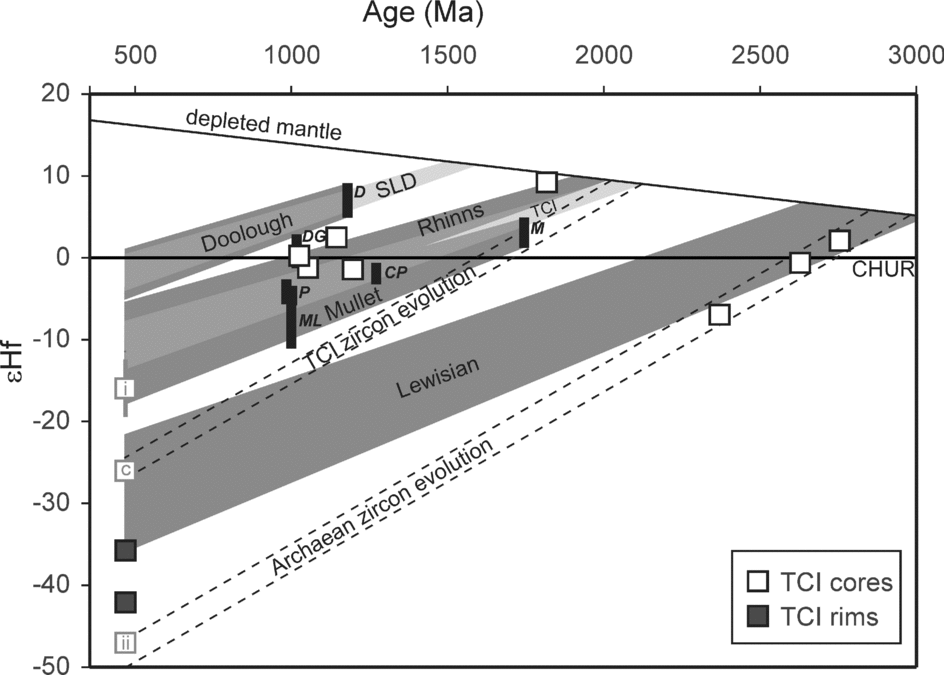
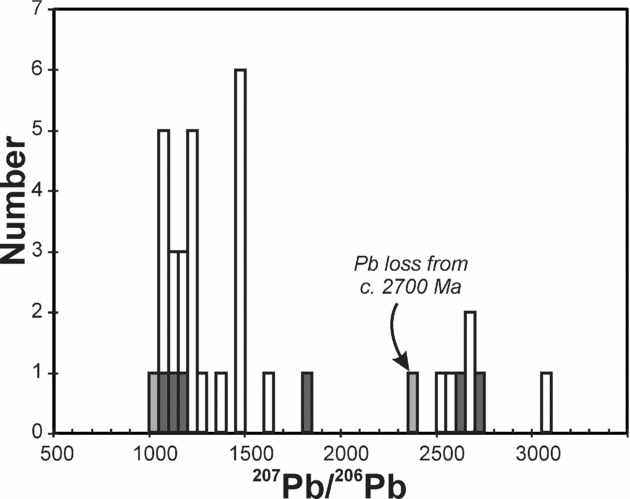
The two reliable analyses of overgrowths from the pegmatite cutting the Tyrone Central Inlier have average ϵHf470 values of −39.1 ± 6.2. The cores have average ϵHf470 values of −26 (‘c’ on Fig. 6) but form two distinct populations, with six of the nine grains giving −16 ± 3.5 (‘i’ on Fig. 6) and the remaining three grains −47.1 ± 1 (‘ii’ on Fig. 6). The age of the inherited grains broadly matches those obtained from the metasedimentary host (Fig. 7), implying it is a source for the intrusion. The Hf isotopic composition of the zircon overgrowths suggests otherwise. The Nd depleted mantle model ages of the metasediments are approximately 2100 Ma (Chew et al. Reference Chew, Flowerdew, Page, Crowley, Daly, Cooper and Whitehouse2008) and thus considerably younger than the Archaean depleted mantle Hf model ages for the overgrowths (Fig. 6). For the Tyrone Central Inlier to be a source, not only must zircons have controlled the hafnium isotope signature of the melt but the contributing zircons were selected by age. Only the Archaean zircons could have dissolved, contributing their hafnium, while all younger zircons must have remained intact. While it is not inconceivable that older grains could be preferentially dissolved in view of their longer opportunity to increase their surface area as cracks and pits in the grain, it is more likely that zircons with high U content would achieve this, since radiation damage would be expected to facilitate dissolution. However, in all likelihood the Tyrone Central Inlier was not the source for this melt and by the same arguments neither was the Dalradian Supergroup. Like the Slishwood Division intrusions, it is envisaged that most of the inherited component was picked up during migration and intrusion and was not derived from the melted source region. The source must be entirely Archaean or remelted Archaean crust, or sediment derived from such crust with no significant juvenile component (Fig. 6). Archaean rocks are not known from Ireland but crop out extensively in Scotland in the Lewisian Complex (Fig. 1).The Sm/Nd ratios for the Lewisian Complex are generally lower than average continental crust values (Whitehouse, Reference Whitehouse1989), so assuming coupling of the Sm–Nd and Lu–Hf systems and a 176Lu/177Hf of 0.011 ± 0.002, Lewisian rocks would evolve to yield ϵHf470 values of between −26.0 to −34.3. The evolved Lewisian Complex does not entirely overlap with the overgrowths, as both rim analyses are more negative than the evolved field (Fig. 6). This implies that if the Lewisian was a source, zircon dissolution must also have occurred in the source region and influenced the Hf budget of the melt, as the rim values approach those of a typical evolved Lewisian zircon, as is indicated by line on Figure 6. These data therefore support the suggestion of Long & McConnell (Reference Long and McConnell1999) that Archaean crust occurs at depth in NW Ireland. If the Lewisian was not a source, then the melt was derived from rocks with older crustal residence ages than the Lewisian. While such rocks have yet to be identified in Britain or Ireland, detrital zircons from Torridonian rocks in Scotland, which are thought to have eroded the Lewisian and contain Mesoarchaean grains (Rainbird, Hamilton & Young, Reference Rainbird, Hamilton and Young2001), suggest that the domains of this age within the Lewisian may be present.
Age against ϵHf evolution plot showing the evolution fields for possible basement sources for the Tyrone Central Inlier hosted pegmatite. Labelled squares show the average core composition, ‘c’, itself made of two distinct populations with averages labelled ‘i’ and ‘ii’. Whole rock evolution trends are calculated using a 176Lu/177Hf ratio = 0.015 ± 0.002 for the Tyrone Central Inlier and 0.011 ± 0.002 for the Lewisian, based on their Sm/Nd values (Chew et al. Reference Chew, Flowerdew, Page, Crowley, Daly, Cooper and Whitehouse2008; Hamilton et al. Reference Hamilton, Evensen, O'Nions and Tarney1979; Whitehouse, Reference Whitehouse1988, Reference Whitehouse1989; Whitehouse & Robertson, Reference Whitehouse and Robertson1995). Labelled dashed lines show zircon evolution for grains with a 176Lu/177Hf ratio of 0.0016 with for the Tyrone Central Inlier and Lewisian gneisses. Abbreviations: SLD – Slishwood Division and TCI – Tyrone Central Inlier. Black bars refer to the Hf data of Daly (Reference Daly, Holland and Sanders2009) for the Annagh Gneiss Complex, abbreviated as in Figure 5.

Histogram of 207Pb/206Pb detrital zircon ages for metasediments of the Tyrone Central Inlier (Chew et al. Reference Chew, Flowerdew, Page, Crowley, Daly, Cooper and Whitehouse2008) and for the inherited zircons from the intrusion cutting the Tyrone Central Inlier. Pale shading indicates inherited grains and dark shading indicates where zircons of that age occur in both the metasediment and the intrusion.

6.d. Architecture of the Irish basement
Major isotopic domains (corresponding to major Laurentian crustal provinces) are recognized in NW Ireland. Hf isotopic data suggest that Archaean crust lies beneath the Tyrone Central Inlier and Palaeoproterozoic crust (either Annagh Gneiss Complex or Rhinns complex) or lower Dalradian metasediments lie beneath the Slishwood Division. If the Annagh Gneiss Complex forms the crystalline basement under the Slishwood Division, then both of the two chemically distinct reservoirs (see Section 6.b.2) are likely present, with the Doolough reservoir being more significant than is apparent from the exposed Annagh Gneiss Complex. A greater proportion of Doolough-type gneiss beneath the Slishwood Division could account for its anomalous geophysical properties when compared with the rest of the Laurentian margin in Ireland.
It is not unreasonable to expect the presence of Archaean crust, given that the Lewisian Complex is not a single entity but rather a collage of Archaean and Proterozoic terraes (Kinny, Friend & Love, Reference Kinny, Friend and Love2005). Given that the Slishwood Division and Tyrone Central Inlier were possibly discrete and outboard elements of Laurentia, both units could have travelled laterally along the margin of Laurentia during collision with the Midland Valley Terrane. These isotopic provinces inferred in the deep crust may, therefore, represent terranes bounded by deep-seated Grampian structural lineaments.
7. Conclusions
Hf isotopic analyses were undertaken on magmatic and inherited zircons from 470 Ma minor granitoid intrusions that cut allochthonous metasediments of the Slishwood Division and Tyrone Central Inlier, both located close to the Laurentian margin in NW Ireland. Major differences in the Hf isotope data are interpreted to reflect the contrasting character of the hidden crystalline basement beneath the two regions.
Magmatic zircon overgrowths from intrusions cutting the Slishwood Division yield Mesoproterozoic Lu–Hf depleted mantle model ages, and are on average more radiogenic than the average inherited component. Magmatic zircon overgrowths from intrusions cutting the Tyrone Central Inlier yield late Archaean model ages, which are much less radiogenic than the inherited component.
The disparity between the ϵHf470 values of the cores and overgrowths and the internal zircon textures are interpreted to suggest that the inherited zircon component was not dissolved and did not, therefore, contribute its Hf budget to the melt. While zircon dissolution may have occurred at source, the origin for the majority of the inherited grains was probably through their incorporation into the melt during intrusion, most likely from local host country rocks.
The Hf data from the Slishwood Division zircon overgrowths suggest an Annagh Gneiss Complex or Rhinns Complex source, or sediment predominantly derived from these units, such as the lower Dalradian, and that crust of this nature is present at depth. Zircon overgrowths in the intrusion cutting the Tyrone Central Inlier require an Archaean source or sediment derived from Archaean rocks, and therefore Lewisian-type rocks are likely present at depth in Ireland.
Acknowledgements
Matt Horstwood and Vanessa Pashley are thanked for their assistance at NIGL. Grit Steinhoefel and Craig Storey are thanked for their helpful and constructive reviews.