Implications
Heart rate as a proxy for feed efficiency can aid in improving beef cattle husbandry, reducing feed costs and environmental impact. Feed efficient heifer calves have a lower overnight heart rate and increased heart rate upon acute stress. Contrasting acute stress results in yearling heifers suggest that coping styles vary across cattle categories. Overall, results indicate that overnight and acute stress heart rates are potential proxies for feed efficiency in heifer calves. Due to its short duration, with further development the acute stress assessment could have potential for on-farm use as a feed efficiency proxy in minimally handled young heifers.
Introduction
The beef industry is challenged with reducing feed costs that represent the largest production expense and with minimizing environmental impact from resource use and greenhouse gas emissions (Gerber et al., Reference Gerber, Steinfeld, Mottet, Opio, Dijkman, Falcucci and Tempio2013; Lancaster et al., Reference Lancaster, Carstens, Michal, Brennan, Johnson and Davis2014). Improving the efficiency of feed utilization could mitigate these challenges. Residual feed intake (RFI; kg dry matter (DM)/day) is a feed efficiency measurement that has experienced increased use due to its phenotypic independence from production traits (Montanholi et al., Reference Montanholi, Swanson, Schenkel, McBride, Caldwell and Miller2009), demonstrated repeatability (Kelly et al., Reference Kelly, McGee, Crews, Fahey, Wylie and Kenny2010) and moderate heritability (Schenkel et al., Reference Schenkel, Miller and Wilton2004). Direct determination of RFI cannot be conducted without substantial input and labour costs, limiting trait improvement. Proxies of feed efficiency have been recognized as alternatives for determination and improvement (Pollak et al., Reference Pollak, Bennett, Snelling, Thallman and Kuehn2012) and upon development could be implemented on-farm as screening tools.
Heart rate (HR) (beats per minute (BPM)) is a non-invasive measure that has been associated with RFI during rest, transport and long-term assessments (Hafla et al., Reference Hafla, Carstens, Forbes, Tedeschi, Bailey, Walter and Johnson2013; Montanholi et al., Reference Montanholi, Lam and Miller2014), suggesting HR could be developed as a feed efficiency proxy. Cardiovascular function is regulated by the autonomic nervous system and responds to the metabolic activity of peripheral tissues (Purves et al., Reference Purves, Augustine, Fitzpatrick, LaMantia, McNamara and Williams2004). Variation in peripheral tissue metabolic activity has been associated with variation in RFI (Kolath et al., Reference Kolath, Kerley, Golden and Keisler2006; Lancaster et al., Reference Lancaster, Carstens, Michal, Brennan, Johnson and Davis2014). Variation in peripheral tissue metabolic activity is associated with a change in peripheral resistance and blood pressure. Baroreceptors sense blood pressure changes and send sensory information via afferent nerves to the cardiac control centre. Sensory information is integrated and an autonomic response is generated, altering cardiovascular function (HR, stroke volume and arterial dilation) in order to restore blood pressure (Purves et al., Reference Purves, Augustine, Fitzpatrick, LaMantia, McNamara and Williams2004; Hall, Reference Hall2015). Variation in HR could be associated with RFI through a combination of metabolic and autonomic mechanisms depending on the conditions under which HR is measured (rest, long-term stress or acute stress).
Hafla et al. (Reference Hafla, Carstens, Forbes, Tedeschi, Bailey, Walter and Johnson2013) identified associations between 7-day resting HR and RFI in pregnant beef cows and pregnant yearling heifers. Evaluation of the association between resting HR and RFI in young female cattle will determine the ability of resting HR assessments as screening tools for breeding stock on-farm. However, during this extended resting period the influence of lying patterns on the association between HR and RFI should be evaluated as lying patterns are associated with HR (Frondelius et al., Reference Frondelius, Järvenranta, Koponen and Mononen2015). Associations between transport HR and RFI in yearling bulls (Montanholi et al., Reference Montanholi, Lam and Miller2014) suggest that HR upon exposure to a stressful stimulus is also associated with RFI. Furthermore, Désiré et al. (Reference Désiré, Veissier, Després and Boissy2004) observed that both sudden exposure and novel stimuli increased HR and that response to the stimulus was associated with changes in autonomic nervous system activity, which could be associated with RFI. Associations among sudden and novel exposure, HR and RFI suggest that short assessments that suddenly expose cattle to a novel stimulus, such as an umbrella (Sandem et al., Reference Sandem, Janczak and Braastad2004), could be developed as feed efficiency screening tools for inclusion in routine husbandry practices, potentially increasing on-farm use. Therefore, the objectives of this study were (1) to assess associations of HR and lying patterns recorded overnight during rest with RFI in beef heifer calves and (2) to assess associations of HR recorded during exposure to an acute stressor (umbrella) with RFI in beef heifer calves and yearling heifers.
Material and methods
Animals, husbandry and facilities
Experimental procedures were determined in accordance with the recommendations of the Canadian Council on Animal Care (2009). Beef heifer calves (n=107; initial age: 285±28 days) and yearling heifers (n=36; initial age: 480±92 days) were obtained from 20 commercial producers from The Maritimes of Canada (7.2±5.4 cattle/producer). Genomic breed composition of both cattle categories (heifer calves and yearling heifers; Supplementary Table S1) was determined on hair follicle DNA submitted for 50 K single nucleotide polymorphism (SNP) sequencing (ADMIXTURE® software, University of California, Los Angeles, CA, USA) using pairwise comparison by estimating individual and population breed allele frequencies (Brito et al., 2015). Heifers were housed in a straw-bedded group pen facility (Maritime Beef Test Station, Nappan, NS, Canada) from June to October 2014. Heifer calves were housed in three pens and yearling heifers in one pen at a stocking rate of 15.1±0.3 m2/animal. Within each pen 50% of space was a concrete outdoor yard, 20% was a straw pack covered by a roof and 30% was a barn containing feeding stations and water bowls. Each pen contained five automated feeding stations (GrowSafe Systems Ltd, Airdrie, AB, Canada) that recorded the individual daily feed intakes of all animals, for the determination of average daily feed intake. Animals were fed twice daily a grass-based ensilage ration of the composition listed in Supplementary Table S2. Ration samples were collected weekly, homogenized on a monthly basis for chemical analysis and monthly results were averaged (Supplementary Table S2).
Upon arrival at the research station, an acclimation period of 3 weeks was given before feed intake recording began. Daily feed intake and productive performance were then evaluated for heifer calves and yearling heifers over a 124-day test (Lawrence et al., Reference Lawrence, Kenny, Earley, Crews and McGee2011), determining BW and ultrasound body composition on 30.6±3.0-day intervals. The acute stress assessment was completed on all heifer calves and yearling heifers over days 121 to 124 within the handling facility at the research station. The overnight assessment was completed on a subgroup of heifer calves selected divergently on RFI (20 lowest RFI; 20 highest RFI) from the 107 heifer calves, over days 126 to 130 in a separate building within the research facility after a 1-day acclimation period. A separate building was used as it was indoors, increasing the ease of monitoring and reducing the daily variation in relative humidity and air temperature while allowing stocking rate to be maintained. At the end of the productive performance test heifer calves were 408±28 days of age and weighed 341±42.2 kg, whereas yearling heifers were 604±92 days of age, weighed 539±52.2 kg and were 109±85.8 days in gestation.
Productive performance assessment
On an individual basis, daily feed intakes were assessed and recording errors were removed. Daily feed intakes that had <2% probability of belonging to the normal distribution of daily feed intake were removed and average feed intake was calculated and standardized to DM intake (kg DM/day). Body weights were collected using a calibrated weigh scale (CattleMaster, Linwood, ON, Canada). Ultrasound measurements were completed using an Aloka SSD-500 long probe, ultrasound unit (model 5044, 172 mm, 3.5 MHz; Corometrics Medical Systems, Wallingford, CT, USA). Ultrasound measures including back fat thickness (mm), rib eye area (cm2), rump fat thickness (mm) and marbling (1 (devoid) to 11 (abundant)) were collected. Average daily gain (kg/day) was calculated as the linear regression of BW on day of BW measurement (day 0, day 31, day 62, day 93, day 124). Feed conversion ratio was the result of DM intake divided by average daily gain. Predicted feed intake (kg/day) was calculated using multiple linear regression in the GLM procedure of SAS software® (University Edition, Copyright©, SAS Institute Inc., Cary, NC, USA). In both heifer calves and yearling heifers, a predicted feed intake model was selected with the highest R 2 and the lowest Bayesian information criteria (BIC) value, resulting in the following models:
 $$\eqalignno{ & {\rm Predicted}\,{\rm feed}\,{\rm intake}_{{{\rm Heifer}\,{\rm calves}}} \,{\equals}\,{\minus}3.66{\plus}0.02\left( {{\rm BW}} \right)\cr & \,\,\,\,{\plus}2.95\left( {{\rm average}\,{\rm daily}\,{\rm gain}} \right){\plus} 0.07\left( {{\rm back}\,{\rm fat}\,{\rm thickness}} \right)\cr & \,\,\,\,{\minus}0.04\left( {{\rm rib}\,{\rm eye}\,{\rm area}} \right){\minus}0.002\left( {{\rm rump}\,{\rm fat}\,{\rm thickness}} \right)\cr & \,\,\,\,{\minus} 0.02\left( {{\rm marbling}} \right){\plus}0.02\left( {{\rm days}\,{\rm of}\,{\rm age}} \right){\plus}{\rm RFI},\,R^{2} \,{\equals}\,0.53 $$
 $$\eqalignno{ & \!\!\!\!\!\!\!\!\!\!\! {\rm Predicted}\,{\rm feed}\,{\rm intake}_{{{\rm Yearling}\,{\rm heifers}}} \,{\equals}\,{\minus}2.88{\plus}0.02\left( {{\rm BW}} \right)\cr & \!\!{\plus}2.66\left( {{\rm average}\,{\rm daily}\,{\rm gain}} \right){\plus} 0.08\left( {{\rm back}\,{\rm fat}\,{\rm thickness}} \right)\cr & \!\!{\minus}0.02\left( {{\rm rib}\,{\rm eye}\,{\rm area}} \right){\minus}0.15\left( {{\rm rump}\,{\rm fat}\,{\rm thickness}} \right) \cr & \!\!{\minus}0.11\left( {{\rm marbling}} \right) {\minus}0.01\left( {{\rm days}\,{\rm in}\,{\rm gestation}} \right) \cr & \!{\plus}0.01\left( {{\rm days}\,{\rm of}\,{\rm age}} \right){\plus}{\rm RFI},\,R^{2} \,{\equals}\,0.49 $$
Heart rate, lying pattern, humidity and temperature assessments
HR was recorded continuously and averaged on 5-s intervals using an electrode-based system (Polar RC3 GPS or RS 800CX Science, Polar Electro, Kempele, Finland) adapted for heifers (Supplementary Figure S1). Cattle were equipped with the Polar system and a custom leather harness that consisted of three parts: (1) a chest strap containing the Polar electrodes, transmitter and logger, (2) a neck strap and (3) four horizontal straps. The chest strap was fastened around the girth with one electrode located behind the scapula and the second behind the elbow. The Polar logger was attached to the chest strap at the midpoint between the shoulders, recording and displaying HR using data sent via wireless transmission from the transmitter. The additional neck and horizontal straps ensured system security during movement. Relative humidity (%), air temperature (°C), lying patterns (%) and body surface temperature (°C) were recorded during the overnight assessment. Relative humidity and air temperature were recorded using a portable weather station (HOBO Micro Station; Onset Computer Corporation, Bourne, MA, USA) located centrally within the separate building over 10-s intervals and then averaged over 30-min intervals. Lying patterns were determined using a tri-axial accelerometer (HOBO Pendant®; Onset Computer Corporation, Bourne, MA, USA) that recorded the degree of vertical tilt (x-axis) over each 1-min interval. Heifers were deemed to be standing when <60° of tilt and lying when ⩾60° of tilt (Ito, Reference Ito2009). Heifers were then classified as lying or standing by assessing tilt readings over 30-min intervals as follows: (1) standing if <50% of the interval was deemed lying and (2) lying if ⩾50% of the interval was deemed lying. Using a technique adapted from Ito (Reference Ito2009), the acceleration logger was attached to the lateral side of the rear right leg at the midpoint of the long pastern, perpendicular to the ground to ensure proper recording of tilt. Body surface temperature was recorded at 2-s intervals using a temperature sensor (iButtonLink LLC, Whitewater, WI, USA) and then averaged over 30-min intervals. The temperature sensor was placed at the midpoint of the long pastern between the accelerometer and the lateral side of the leg. The acceleration logger and temperature sensor were secured to the leg with VetrapTM (3 M, Saint Paul, MN, USA).
Overnight assessment
In the subgroup of heifer calves HR, lying patterns and body surface temperature were recorded overnight. Monitoring occurred from 1600 to 0530 h the following morning in the separate building. HR and body surface temperature were averaged and lying patterns determined over 30-min intervals. Difference in HR during standing relative to lying classifications (mean HR during standing classifications−mean HR during lying classifications; BPM) and time lying (%) were calculated for each animal.
Acute stress assessment
Heifer calves and yearling heifers were individually brought through a corral system, restrained in a squeeze chute and equipped with the Polar system. No interaction with the animal occurred for the first 4 min of HR monitoring, allowing HR to approach a resting value for the current animal state. At 4 min of monitoring, the animal was exposed to the opening and closing of an umbrella in front of their snout, three times, within 5 s. The animal was not interacted with for up to another 6 min when the Polar system was then removed and the animal was released from the squeeze chute and returned to the pen. Average HR over 20 s immediately before umbrella exposure (HRBEF; BPM), maximum HR after umbrella exposure (HRMAX; BPM), time from umbrella exposure to HRMAX (TBEF; s), average HR over 20 s after umbrella exposure with ⩽10 BPM increase in HR (HRAFT; BPM), time from HRMAX to start of HRAFT (TAFT; s) and HRAFT−HRBEF (HRCHG; BPM) were calculated.
A linear-linear-quadratic segmented polynomial was used to determine and compare predicted HR curves across RFI groups. HR was averaged over 5-s intervals, transformed to the inverse of HR to obtain normality and multiplied by 1000 to increase the scale of the values. Adjusted HR means for each RFI group (high RFI; heifer calves 0.9±0.6 kg DM/day n=54, yearling heifers 1.0±1.0 kg DM/day n=18, low RFI; heifer calves −0.8±0.7 kg DM/day n=53, yearling heifers −1.0±0.4 kg DM/day n=18) were generated for each time (T; 0 to 355 on 5-s intervals) point using the MIXED procedure fitting the models described in Supplementary Material S1.
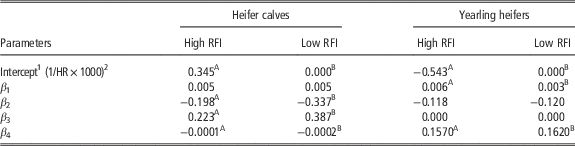
Two knots were selected within each RFI group at inflection points (Supplementary Figure S2). The first knot (C 1) represented the time value (T) when HR started to increase due to umbrella exposure. The second knot (C 2) represented the T when HR started to decline after reaching a maximum value. Knot selection resulted in the generation of three subintervals: (1) 0⩽T⩽C 1, (2) C 1<T⩽C 2 and (3) C 2<T⩽355. Each interval was defined by equations and criteria used to determine covariates for each time value as indicated in Supplementary Figure S2. Using these covariates and the GLM procedure, linear-linear-quadratic segmented polynomials were estimated and the polynomial (Supplementary Material S2) that showed a competitively high R 2 for both cattle categories was used to predict HR separately for heifer calves and yearling heifers. Fixed regression coefficients in the segmented polynomial represented the linear rate of HR decrease pre-exposure (β 1), linear rate of HR increase post-exposure (β 2), and linear (β 3) and quadratic (β 4) rates of HR decrease post-exposure. Using an on-line integral calculator (Integral Calculator, David Scherfgen, Bonn, Germany) the area under the HR curve over the 2nd and 3rd subintervals was calculated and the difference between RFI groups was determined.
Statistical analysis
Heifer calves and yearling heifers were treated as separate data sets for all analyses. Descriptive statistics were determined and normality was assessed using the UNIVARIATE procedure of SAS software®. Normality was assessed using the histogram statement, normal option and Anderson–Darling test. Transformations for heifer calves were natural logarithm (feed conversion ratio, overnight HR, T MAX), inverse (back fat thickness), inverse×1000 (predicted HR) and cubed (body surface temperature), and for yearling heifers were natural logarithm (HRAFT), inverse (HRMAX) and inverse×1000 (predicted HR). Values are presented on their original scale unless otherwise noted.
The repeated measure of overnight HR was analysed and compared between RFI subgroups of heifer calves (high RFI; 1.5±0.6 kg DM/day n=20, low RFI; −1.5±0.6 kg DM/day n=20) through random regression using the MIXED procedure according to the following model:
 $$\eqalignno{ Y_{{ijklm}} \,{\equals}& \,\mu {\plus}RFIgroup_{i} {\plus}time_{j} {\plus}{\rm }lying_{k} {\plus}{\rm }RFIgroup_{i} \cr & {\times}time_{j} {\plus}{\rm }RFIgroup_{i} {\times}lying_{k} \cr & {\plus}{\rm }\mathop{\sum}\limits_{l\,{\equals}\,1}^8 {\beta _{{1l}} \,breed_{l} {\plus}{\rm }\beta _{2} \,{\rm age}{\plus}{\rm }e_{{ijklm}} } $$
where Y ijklm is the HR measured on the mth animal, from the ith RFI group, at the jth time, during a kth lying classification. Where μ is overall mean; RFIgroup i the fixed effect of the ith RFI group (i=high or low RFI); time j the fixed effect of the jth time (1600 to 0530 h; 30-min intervals); lying k the fixed effect of the kth lying classification (lying or standing); RFIgroup i ×time j the interaction effect of the ith RFI group and jth time; RFIgroup i ×lying k the interaction effect of the ith RFI group and kth lying classification; β 1 the contribution of the lth breed to the breed composition of the animal; β 2 the age of the animal; and e ijklm the random residual effect. The autoregressive covariance structure was selected on the basis of BIC. The type III test for fixed effects indicated that body surface temperature, relative humidity, air temperature and the interaction effect of lying×time were non-significant (P>0.05), permitting their removal from the model. Least square means were compared across RFI group and RFI group×lying classification using the Scheffé multiple comparison test within the MIXED procedure.
Significant fixed effects for single measures of overnight, productive performance and acute stress HR traits were determined using the GLM SELECT procedure with the backward and BIC options. Using these options all effects are included in the model and in a stepwise manner effects that produce the least significant decrease in BIC are removed until removal increases BIC. The GLM procedure was then used to adjust trait means for overnight, productive performance and acute stress HR traits for each RFI group (high RFI; heifer calf subgroup 1.5±0.6 kg DM/day n=20, heifer calves 0.9±0.6 kg DM/day n=54, yearling heifers 1.0±1.0 kg DM/day n=18, low RFI; heifer calf subgroup −1.5±0.6 kg DM/day n=20, heifer calves −0.8±0.7 kg DM/day n=53, yearling heifers −1.0±0.4 kg DM/day n=18) using the following models:
Productive performance (yearling heifers) and acute stress HR traits (heifer calves and yearling heifers):
 $$Y_{{ijk}} \,{\equals}\,\mu {\plus}RFIgroup_{i} {\plus}\mathop{\sum}\limits_{j\,{\equals}\,1}^8 {\beta _{{1j}} \,breed_{j} } {\plus}e_{{ijk}} $$
Productive performance (heifer calves) and overnight traits (heifer calf subgroup):
 $$Y_{{ijk}} \,{\equals}\,\mu {\plus}RFIgroup_{i} {\plus}\mathop{\sum}\limits_{j\,{\equals}\,1}^8 {\beta _{{1j}} \,breed_{j} } {\plus}\beta _{2} {\rm age}{\plus}e_{{ijk}} $$
where Y ijk is the trait of interest measured on the kth animal, from the ith RFI group (i=high- and low-RFI groups). Where μ is the unadjusted mean for the trait of interest; RFIgroup i the fixed effect of the ith RFI group; β 1 the contribution of the jth breed to the breed composition of the animal; β 2 the age of the animal; and e ijk the random residual effect. Means of overnight, productive performance and acute stress HR traits were tested across RFI groups using the Scheffé multiple comparison test within the GLM procedure. Intercept and fixed regression coefficients of the segmented polynomials (β 1, β 2, β 3, β 4) for predicted acute stress HR, presented as inverse×1000, were tested across RFI groups using a two-tailed t-test and interpreted on their original scale. For all analyses results were termed significant when P⩽0.05.
Results
Productive performance
Group means and descriptive statistics for productive performance traits are shown in Supplementary Table S3. In both heifer calves and yearling heifers, low-RFI cattle consumed less feed (DM intake) and had a lower feed conversion ratio while obtaining the same average daily gain and body composition (back fat thickness, rib eye area, rump fat thickness and marbling) as high-RFI cattle.
Overnight assessment
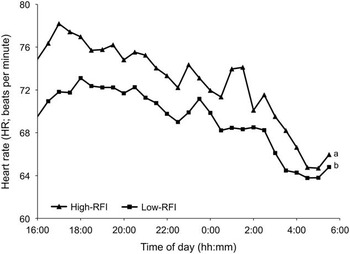
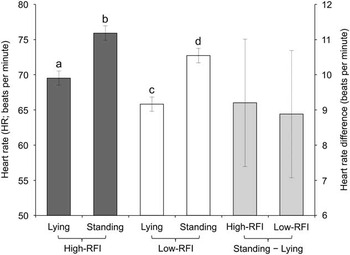
Means and confidence intervals of overnight HR, time lying, and body surface temperature were 70.7±9.7 BPM, 61.2±41.3% and 32.7±1.8°C. Heart rate decreased over the recording (Figure 1) and was lower in low-RFI heifer calves than in high-RFI heifer calves (P<0.01). Low-RFI heifer calves had a lower HR during lying and standing classifications than high-RFI heifer calves (P<0.05) (Figure 2). No difference in HR change between standing and lying classifications (Figure 2) and time lying (low RFI v. high RFI; 61.1±5.9% v. 64.5±5.9%, P=0.44) was observed between RFI groups. Means comparisons quantified the significant fixed effects of RFI group (Figures 1 and 2), time (Figure 1) and lying classification (Figure 2) (P<0.05), and confirmed the absence of an interaction effect of RFI group×time (Figure 1) and RFI group×lying classification (Figure 2).
Overnight heart rate ((HR); beats per minute (BPM)) profiles of high-residual feed intake (RFI) ( ) and low-RFI (
 ) subgroups of heifer calves. Limits of 95% confidence intervals were 71.3 to 74.0 BPM for high-RFI and 67.9 to 70.5 BPM for low-RFI heifer calves. Interaction effect of RFI group×time was non-significant (P>0.05). Differing superscripts denote P<0.05.

Overnight heart rate ((HR); beats per minute (BPM)) means of high-residual feed intake (RFI) ( ) and low-RFI (
 ) heifer calf subgroups during lying and standing classifications and mean difference in HR between standing and lying classifications (
 ) for each RFI group. Vertical bars represent limits of a 95% confidence interval. Interaction effect of RFI group×lying classification was non-significant (P>0.05). Differing superscripts denote P<0.05.

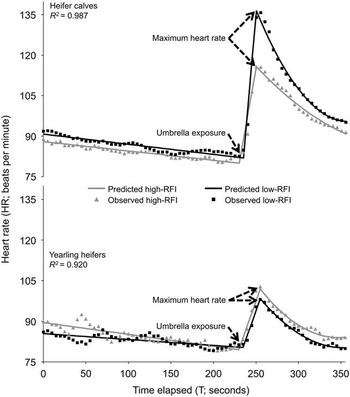
Heart rate ((HR); beats per minute) curves (observed;  /
 predicted;
 /
 ) of high-residual feed intake (RFI) (grey) and low-RFI (black) heifer calves and yearling heifers during the acute stress assessment.

Acute stress assessment
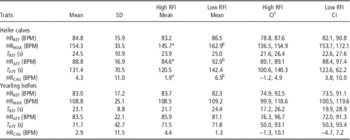
Group means and descriptive statistics for acute stress HR traits are shown in Table 1. In heifer calves, there was no difference in HRBEF, T BEF or T AFT between RFI groups. Low-RFI heifer calves had a greater HRMAX, HRAFT and HRCHG than high-RFI heifer calves. In yearling heifers, no difference in acute stress means was observed between RFI groups. Segmented polynomials were effective in clarifying the observed variation in HR as displayed through the R 2 in both cattle categories (Figure 3). Low-RFI heifer calves had a higher intercept (RFI group effect), and greater absolute values for β 2, β 3 and β 4 than high-RFI heifer calves. No difference in β 1 was found between RFI groups of heifer calves (Table 2). Low-RFI yearling heifers had a lower intercept and absolute β 1 value and higher absolute β 4 value than high-RFI yearling heifers, however, no differences in β 2 and β 3 were observed (Table 2). Area under the HR curve over the 2nd and 3rd subintervals was 13.8 beats higher in low-RFI heifer calves compared with high-RFI heifer calves and 5.7 beats lower in low-RFI yearling heifers compared with high-RFI yearling heifers.
Descriptive statistics and residual feed intake (RFI) group means for acute stress heart rate (HR) traits of heifer calves and yearling heifers

HRBEF=average HR over 20 s immediately before umbrella exposure; BPM=beats per minute; HRMAX=maximum HR after umbrella exposure; T BEF=time from umbrella exposure to HRMAX; HRAFT=average HR over 20 s after umbrella with ⩽10 BPM increase in HR; T AFT=time from HRMAX to start of HRAFT; HRCHG=HRAFT−HRBEF.
a,bValues within a row with different superscripts differ significantly at P<0.05.
1 Confidence interval (CI)=lower limit, upper limit.
Estimated intercept and regression coefficients of predicted heart rate (HR) curves (inverse×1000) for residual feed intake (RFI) groups of heifer calves and yearling heifers during the acute stress assessment

β 1=linear rate of HR decrease pre-exposure; β 2=linear rate of HR increase post-exposure; β 3=linear rate of HR decrease post-exposure; β 4=quadratic rate of HR decrease post-exposure.
A,BValues within a row and cattle category with different superscripts differ significantly at P<0.01.
1 RFI group effect.
2 Inverse of HR×1000.
Discussion
The reduced feed intake and similar productivity of low-RFI commercial cattle in this study indicate the potential benefits of improved feed efficiency. Furthermore, the absence of a difference in performance and ultrasound traits between RFI groups is in agreement with past studies (Lawrence et al., Reference Lawrence, Kenny, Earley, Crews and McGee2011; Gonano et al., Reference Gonano, Montanholi, Schenkel, Smith, Cant and Miller2014), reinforcing the ability of RFI to identify cattle that have equal performance at a lower feed intake. This study sought to promote the use of feed efficiency and associated feed savings on-farm by developing non-invasive, applicable HR proxies for feed efficiency.
Heifer calf DM intake, BW and average daily gain values were comparable with values obtained in beef heifers (Abdelhadi et al., Reference Abdelhadi, Santini and Gagliostro2005). In yearling heifers, values for DM intake, BW and average daily gain were similar to values obtained in pregnant beef yearlings (Gonano et al., Reference Gonano, Montanholi, Schenkel, Smith, Cant and Miller2014). Overnight HR values recorded in the heifer calf subgroup in this study were in agreement with values observed in beef cows using a similar Polar recording system (Hafla et al., Reference Hafla, Carstens, Forbes, Tedeschi, Bailey, Walter and Johnson2013). Percentage of time lying was comparable with the range observed in beef steers during the overnight period (Robért et al., Reference Robért, White, Renter and Larson2011). Heifer calf values for HRBEF, and HRAFT were lower and values for HRMAX were higher than coinciding values observed in beef heifers, where HR was recorded for 1 min prior, during and after exposure to handling facility and handler noise (Waynert et al., Reference Waynert, Stookey, Schwartzkopf-Genswein, Watts and Waltz1999). Longer pre- and post-exposure periods could increase the ability to cope with previous handling and the stressor, resulting in a lower HRBEF and HRAFT. Furthermore, exposure to a novel acute stressor as occurred in this study could result in an increased HRMAX compared with exposure to a previously experienced stressor as occurred in Waynert et al. (Reference Waynert, Stookey, Schwartzkopf-Genswein, Watts and Waltz1999).
Overnight assessment
The lower overnight HR in the low-RFI heifer calf subgroup is in agreement with Hafla et al. (Reference Hafla, Carstens, Forbes, Tedeschi, Bailey, Walter and Johnson2013) and Montanholi et al. (Reference Montanholi, Lam and Miller2014). Changes in cardiovascular function (i.e. HR) are generated by autonomic responses to changes in peripheral resistance that vary based on multiple factors including changes in peripheral tissue metabolic activity (Hall, Reference Hall2015). Increased states 2 and 3 mitochondrial respiration in skeletal muscle (Kolath et al., Reference Kolath, Kerley, Golden and Keisler2006) and a trend towards increased state 3 mitochondrial respiration in liver (Lancaster et al., Reference Lancaster, Carstens, Michal, Brennan, Johnson and Davis2014) have been observed in beef cattle with low RFI. These results suggest that differences in peripheral tissue metabolic activity associated with RFI could contribute to the lower overnight HR in low-RFI heifer calves. It is unknown if differences in peripheral metabolism associated with RFI are sustained as only one assessment was made (Kolath et al., Reference Kolath, Kerley, Golden and Keisler2006; Lancaster et al., Reference Lancaster, Carstens, Michal, Brennan, Johnson and Davis2014). Changes in HR and overall cardiac output restore blood pressure on a moment-to-moment basis (Purves et al., Reference Purves, Augustine, Fitzpatrick, LaMantia, McNamara and Williams2004). However, if peripheral metabolic differences are sustained, additional cardiovascular parameters (i.e. myocardial contractility, chamber size and blood volume) could also be altered, proposing areas of future research.
The differences in HR during lying and standing across RFI groups (Figure 2) suggest that energy expended during lying and standing was lower in the subgroup of low-RFI heifer calves. The absence of a difference in percentage of time lying and in HR change from standing to lying classifications between RFI groups in this study suggest that RFI is not related to lying patterns. A study by Lawrence et al. (Reference Lawrence, Kenny, Earley, Crews and McGee2011) also observed no difference in standing and lying percentages between low- and high-RFI beef heifers. Therefore, the lower HR across lying patterns appears to be a result of underlying physiology rather than differences in energy expended for lying or standing. These results suggest that overnight HR has potential to be a feed efficiency proxy without knowledge of lying patterns, decreasing cost and increasing ease of implementation. Furthermore, the absence of a difference in percentage of time lying between RFI groups suggests that further evaluation is needed before the ability of lying patterns as RFI proxies can be determined.
Acute stress assessment
The increased HRMAX, HRCHG, β 2, β 3 and β 4 observed in low-RFI heifer calves may represent differences in autonomic nervous system regulation. Koolhaas et al. (Reference Koolhaas, Korte, De Boer, Van Der Vegt, Van Reenen, Hopster, De Jong, Ruis and Blokhuis1999) described animals with greater sympathetic reactivity (i.e. increased HR response), lower parasympathetic reactivity and lower humoral reactivity as proactive and the inverse as reactive. Greater HRMAX and greater rate of HR change (β 2) suggest that low-RFI heifer calves had higher sympathetic reactivity in response to the stressor. Whereas greater HRAFT, despite greater rate of HR decrease (β 3, β 4), suggests that low-RFI heifer calves had lower parasympathetic reactivity after HRMAX was reached. While this study did not assess humoral reactivity, Knott et al. (Reference Knott, Cummins, Dunshea and Leury2008) observed that low-RFI rams had a decreased humoral response to an ACTH challenge. The acute stress results in low-RFI heifer calves in conjunction with the results of Knott et al. (Reference Knott, Cummins, Dunshea and Leury2008) suggest that feed efficient heifer calves have a proactive coping style (Koolhaas et al., Reference Koolhaas, Korte, De Boer, Van Der Vegt, Van Reenen, Hopster, De Jong, Ruis and Blokhuis1999). Careau et al. (Reference Careau, Thomas, Humphries and Réale2008) theorized that proactive animals evacuate a stressor more effectively resulting in a lower resting metabolic rate, a potential explanation for the associations between acute stress HR and RFI observed in this study.
Although low-RFI heifer calves had a greater rate of HR decrease (β 3, β 4), the higher HRAFT and greater area under the HR curve of low-RFI heifer calves suggest that low-RFI heifer calves did not come to rest faster. Potentially, heifer calves were not in a state of rest when the assessment was ceased, as values for β 3 and β 4 for both RFI groups were not 0. Considering the lower overnight HR observed in the subgroup of low-RFI heifer calves, the higher intercept value in low-RFI heifers and absence of a difference in HRBEF suggest that a state of rest was also not obtained pre-exposure. Handling before entry and the associated stress of restraint in a squeeze chute (Grandin, Reference Grandin1997) may explain why a state of rest was not obtained, suggesting that the acute stress assessment should not focus on periods pre- and post-exposure unless a resting state is verified. Instead, the agreement of the relationship of HRMAX and β 2 with RFI proposes that the acute stress assessment may only need to include the time interval from exposure until HRMAX. This reduction of assessment length would increase the likelihood of on-farm use in heifer calves. However, evaluation of acute stress assessment predictive ability and repeatability across cattle categories must precede this on-farm implementation.
The higher intercept of high-RFI yearling heifers may reflect differences in HR response to the stress of handling before entering the chute, an association observed in beef bulls during transport (Montanholi et al., Reference Montanholi, Lam and Miller2014). The higher β 1 in high-RFI yearling heifers suggests that habituation to restraint occurred at a faster rate, potentially compensating for this greater response to previous handling. Habituation to non-aversive handling has been reported (Grandin, Reference Grandin1997) and may explain the absence of a difference in the remaining acute stress HR parameters in yearling heifers. Some producers were seedstock operators where yearling cattle were handled frequently and may have habituated. This habituation to handling in yearling heifers may have resulted in a decreased HR response. In contrast, depending on producer selection programs, heifer calves may not have been exposed to frequent handling before entering the research facility. Further evaluation of the influence of handling experience on the relationship between acute stress HR and RFI is warranted. If acute stress assessment results are consistent across gender the assessment could be focused on younger heifers and bulls with minimal handling experience, a requirement that complements the selection programs of beef operations.
Influence of stress on the association between heart rate and feed efficiency
Lower overnight HR in the subgroup of low-RFI heifer calves and the absence of lying pattern differences suggest low-RFI cattle function at a lower HR during periods of rest due in part to differences in peripheral tissue metabolic activity (Kolath et al., Reference Kolath, Kerley, Golden and Keisler2006; Lancaster et al., Reference Lancaster, Carstens, Michal, Brennan, Johnson and Davis2014; Hall, Reference Hall2015). Increased parasympathetic or decreased sympathetic stimulation during periods of rest (Purves et al., Reference Purves, Augustine, Fitzpatrick, LaMantia, McNamara and Williams2004) may be associated with this variation in peripheral tissue metabolism, potentially causing this lower HR, among other potential changes in cardiovascular function. Increased HRMAX, β 2 and area under the HR curve (increased sympathetic reactivity) and increased HRAFT (decreased parasympathetic reactivity) in low-RFI heifer calves in response to acute stress reflect a proactive coping style (Koolhaas et al., Reference Koolhaas, Korte, De Boer, Van Der Vegt, Van Reenen, Hopster, De Jong, Ruis and Blokhuis1999). A proactive coping style may be associated with long-term energy conservation (Careau et al., Reference Careau, Thomas, Humphries and Réale2008), potentially explaining the influence of stress on the association between HR and RFI in heifer calves. Overall, the overnight and acute stress HR results in heifer calves indicate that stress level influences the association between HR and RFI through differences in metabolic function and coping style. Evaluation of associations between bovine energetics (at animal and tissue-specific levels), autonomic regulation and feed efficiency is warranted. Assessment of these associations during both rest and acute stress exposure and across different categories of cattle could help determine the validity of these interpretations.
Conclusions
According to our study, overnight HR and acute stress HR are potential proxies for feed efficiency in heifer calves. Overnight assessment results suggest that overnight HR is associated with feed efficiency without the requirement of lying pattern information. Acute stress assessment results suggest that the assessment may only need to include the time interval from exposure until maximum HR, which may simplify its further application in commercial settings. Acute stress HR dynamics differ in yearling heifers, suggesting that the assessment should be focused on younger cattle with minimal handling experience, a requirement that complements the majority of beef operations. Further studies evaluating predictive ability and repeatability of HR across cattle categories and production systems could result in the development of on-farm HR assessments that increase the efficiency of the beef industry.
Acknowledgements
The authors thank the Maritime Beef Test Station for access to facilities and management of research animals. Financial support provided by Beef Cattle Research Council, Agriculture and Agri-Food Canada, Nova Scotia Cattle Producers, New Brunswick Cattle Producers and Prince Edward Island Cattle Producers, and technical support provided by Beef Improvement Opportunities is highly acknowledged. J. C. M. acknowledges the graduate scholarship received from the Nova Scotia Department of Agriculture through the Growing Forward 2 initiative.
Supplementary Material
To view supplementary material for this article, please visit http://dx.doi.org/10.1017/S1751731116001695