


Discussions of social inequality commonly frame it as the uneven distribution of material resources, political authority, and ideological capital. Within this perspective, inequality and social complexity are frequently linked, assuming that hierarchical leadership and economic specialization naturally arise as societies grow in sophistication (Ames Reference Ames, Price and Feinman2010; Earle Reference Earle1997; Johnson and Earle Reference Johnson and Earle2000; Wright Reference Wright and Earle1984). A contrasting “heterarchy” concept proposes complex organizations can exist without vertical domination and that horizontal pathways of influence and power are situational or distributed (Crumley Reference Crumley and Schiffer1979; Feinman Reference Feinman, Price and Feinman1995; Marcus Reference Marcus1995, Reference Marcus, Feinman and Marcus1998; McGuire Reference McGuire and Schiffer1983; Yoffee Reference Yoffee, Yoffee and Sherratt1993).
A relational approach adds nuance to social organization models by addressing questions of causality regarding how inequality and complexity emerge. This approach establishes that inequality emerges through historically contingent relationships among people, objects, and practices rather than through fixed developmental stages (Feinman Reference Feinman, Price and Feinman1995; McGuire Reference McGuire and Schiffer1993). From this perspective, power is continually reproduced and negotiated in everyday practices.
For northwestern Mexico, Guasave, displaying a Mesoamerica–US Southwest borderland, a relational approach allows the exploration of how communities navigated external influences during the onset of the Aztatlán tradition (AD 1022–1370). At borderlands, the arrival of external influences does not necessarily represent external imposition. Foreign traits can be locally appropriated and reformulated according to preexisting structures and historical contingencies (Clark et al. Reference Clark, Birch, Hegmon, Mills, Glowacki, Ortman and Dean2019; Fournier and Charlton Reference Fournier, Charlton, Nichols and Pool2012). Traditionally, mortuary practices have served as a proxy for understanding social structure, how inequality crystallizes, particularly in how actors negotiate material and nonmaterial mortuary practices to position themselves within shifting social landscapes (Rakita Reference Rakita2009; Ravesloot Reference Ravesloot1988; Seltzer-Rogers Reference Seltzer-Rogers2023).
This study assesses the El Ombligo funerary mound in northern Sinaloa, one of the few long-term mortuary contexts spanning both the Huatabampo period (cal AD 650/700–1022) and the later Guasave period (cal AD 1022–1370; Carpenter Reference Carpenter1996; Meighan Reference Meighan, Ekholm and Bernal1971; Mountjoy Reference Mountjoy, Mathiowetz and Pohl2025). The continuous use of the funerary space over seven centuries provides an opportunity to assess how communities reconfigured ritual participation, authority, and identity during the arrival of the Aztatlán tradition. This research evaluates whether the arrival of the Aztatlán tradition in northern Sinaloa meant the institutionalization of external influences or whether the local organization remained relatively stable and corporate despite the presence of external stimuli.
Using social networks analysis (SNA) and centrality measures, this work evaluates the relational dynamics between actors and funerary practices to explore how changes in participation shaped society over time. By quantifying shared mortuary material and nonmaterial attributes among individuals, SNA enables the mapping of relational density, brokerage, and centralization. These measures can aid in exploring how communities organized participation, providing a baseline to assess inequality and complexity (Brughmans et al. Reference Brughmans, Mills, Munson and Peeples2024; Mills Reference Mills2017; Mills et al. Reference Mills, Peeples, Haas, Borck, Clark and Roberts2015; Pailes Reference Pailes2014; Sosna et al. Reference Sosna, Galeta, Šmejda, Sládek and Brůžek2013).
Results are interpreted through the concept of ritual brokerage, a position of mediation for specific individuals to facilitate symbolic integration between distinct ritual traditions. In this context, “ritual doxa,” following Bourdieu’s (Reference Bourdieu1990) concept of doxa, is proposed to refer to the deeply internalized ritual norms that guide mortuary behavior as a collective ceremonial practice. This concept captures how Huatabampo funerary customs persisted as habitual practices that structured society even after the introduction of nonlocal goods and practices.
Inequality and Complexity Seen from Funerary Practices in Northwestern Mexico
Research on northwestern Mexico has been strongly shaped by the inquiry of Mesoamerica–US Southwest connectivity (Di Peso Reference Di Peso1974; Ekholm Reference Ekholm1942; Foster and Weigand Reference Foster and Weigand1985; Pailes Reference Pailes, Minnis and Redman1990; Pohl Reference Pohl, Mathiowetz and Pohl2025; Sauer and Brand Reference Sauer and Brand1932) (Figure 1). A long theoretical tension on the relative importance of ecological constraints and internal social phenomena as factors of social change has also shaped discussions (Carpenter Reference Carpenter1996; Douglas Reference Douglas1995; McGuire Reference McGuire and Champion1989; Whalen and Minnis Reference Whalen and Minnis2003). In archaeology and northwestern Mexico, mortuary practices have long served as a key proxy for evaluating social inequality and organizational complexity, as they materialize distinctions in access to ritual labor, symbolic knowledge, and valued objects (Binford Reference Binford1971; Pearson Reference Pearson1999; Rakita Reference Rakita2009).
Location of El Ombligo and other archaeological sites in northern Sinaloa within the broader Northwest Mexico–US Southwest cultural landscape. (Color online)

Figure 1 Long description
Map showing archaeological sites in northern Sinaloa, Mexico, within the broader Northwest Mexico–US Southwest cultural landscape. Key sites include El Ombligo, Mochicahui and Guasave. The map highlights regions such as Sonora Desert, Casas Grandes and Rio Sonora. Insets detail the Sinaloa region, with marked sites like Los Mochis and La Palma. Symbols indicate archaeological sites and a scale bar shows distances in kilometers. The map includes geographic features like the Gulf of California and Sierra Madre Occidental, with a compass rose indicating north.
Chihuahua
The Casas Grandes region, particularly Paquimé, constitutes one of the most intensively studied sites of northwestern Mexico. Interpretations of Paquimé’s sociopolitical trajectory have oscillated between arguments emphasizing external Mesoamerican influence (Benfer Reference Benfer1968; Butler Reference Butler1971; Casserino Reference Casserino2009; Di Peso Reference Di Peso1974; Rakita Reference Rakita2001, Reference Rakita2009; Ravesloot Reference Ravesloot1988; Turner Reference Turner, Schaafsma and Riley1999) and those privileging internal developmental processes (Douglas Reference Douglas1995; McGuire Reference McGuire and Champion1989; Whalen and Minnis Reference Whalen and Minnis2003); however, the data coincide with a marked vertical stratification during the Medio period.
The contrasting funerary program between the Viejo and Medio periods (see full description in Di Peso Reference Di Peso1974; Rakita Reference Rakita2009) entails interpretations heavily influenced by the presence of external influences as the driver of increasing complexity and inequality. Di Peso’s evaluations proposed an egalitarian, lineage-based social structure for the Viejo period, followed by a Medio period transformation driven by Mesoamerican migrations and the imposition of elites and merchant–priest institutions (Di Peso Reference Di Peso1974:332–340). Narratives that parallel Di Peso, to an extent, explore inequality during the Medio period through different scopes. From those driven by the control of exogenous symbolic resources, based on lineage control of external traits, complemented by the age-based distributional patterns of restricted goods (Ravesloot Reference Ravesloot1988:42–70), to shifting patterns in mortuary practices contextualized by social aggregation processes. From this perspective, mortuary ritual represents a social arena for the expression and negotiation of hierarchy among coalescent communities (Rakita Reference Rakita2009:64–95).
Bioarchaeological works, in turn, revise long-standing assumptions about migration and long-distance interactions, complementing Paquimé’s social change modeling. Strontium isotope studies indicate Paquimé’s demographic homogeneity during the Viejo and Medio periods, including Medio period elites, with only a small subset of nonlocal individuals (Offenbecker Reference Offenbecker2018:186–193). Results support models of ideological adoption, challenging large-scale population replacement. Additionally, addressing health indicators, violence, bodily processing, and architectural contexts, Waller et alia (Reference Waller, Offenbecker, Kelley and Katzenberg2018:404–410) interpret changes in Paquimé’s funerary practices over time as reflecting emerging elite control of ritual ideologies.
Complementing mortuary analyses of inequality at Casas Grandes has emphasized the ideological and cosmological reorientations of the Medio period. Ritual technologies and symbolism materialized new cosmological principles at Paquimé (Walker and McGahee Reference Walker, McGahee, Lucero and Fash2006), in that nonlocal goods functioned as ritually charged media, opposite to simple wealth markers (Whalen Reference Whalen2013). Iconographic studies further interpret these materials as expressions of imported ritual ideologies, including ceremonial performance (VanPool and VanPool Reference VanPool and VanPool2007; VanPool et al. Reference VanPool, VanPool, Minnis, Whalen, Minnis and Whalen2015). More broadly, elements of the Casas Grandes ritual assemblages have been insinuated within the “Flower Worlds” complex linked to wider Mesoamerican interaction spheres (Mathiowetz Reference Mathiowetz, Mathiowetz and Turner2021), suggesting substantive shifts in ritual meaning.
Sonora
Sonora research expresses significant deviations compared to Chihuahua. Funerary variability is commonly analyzed as an expression of identity and horizontal differentiation. At Cerro de Trincheras, cremation treatment notably represents the most documented funerary custom. Collective cremations have been seen as a deliberate process for downplaying individual distinction and, in contrast, outlining collective identity (Watson et al. Reference Watson, Cerezo-Román, Maldonado, Guzmán, Elisa Villalpando, Schmidt and Symes2015). Technical and sensory aspects of cremation posit significant communal investment, while the reuse of the space through time indicates its lasting significance as a communal memory site (Cerezo-Román et al. Reference Cerezo-Román, Nava Maldonado, Guzmán, Watson and Villalpando2018, Reference Cerezo-Román, Fenn, Guzmán, Nava Maldonado, León Romero and Villalpando2023). In a regional comparison, practice-based interpretations emphasize that the performance of cremating and depositing the remains in ceramic vessels along the central coast and northwest of Sonora transcended local customs and, in turn, symbolizes shared cosmologies.
In the Ónavas Valley of central Sonora, excavations at El Cementerio notably display bodily modification patterns. Nearly all individuals exhibit pronounced tabular oblique cranial modification and patterned dental filing, traits documented in western Mexico (Darlington Reference Darlington2024). These correspond to high-visibility traits widely documented across northwestern Mexico, and which have been interpreted as expressions of ethnic or community affiliation (García-Moreno et al. Reference García-Moreno, Hernández Espinoza and Watson2021). Spatial clustering analysis reveals patterned mortuary organization; however, variation in associated offerings does not demonstrate centralized authority or monopolization of ritual goods. Instead, funerary differentiation appears embedded within local identity structures that persisted contemporaneously with southern Aztatlán interaction spheres but were not structurally transformed by them; yet regional interaction with northern Sinaloa is plausible (García-Moreno et al. Reference García-Moreno, Watson, Phelps, Mathiowetz and Pohl2025).
Baja California Sur
In Baja California Sur, the funerary program diversity associated with the Las Palmas / Pericú tradition has been interpreted as expressions of lineage / family identity to organize resources tenure (Molto and Fujita Reference Molto and Fujita1995; Molto et al. Reference Molto, Stewart, Ens, Kaminski and Fujita2007). The long-term funerary patterning in a single locus, including burial wrapping style and posture, outlines shared mortuary behavior within a kin group, possibly related to the long-lasting resources / land tenure (Fujita Reference Fujita2006; Gutiérrez-Martinez Reference Gutiérrez-Martínez2001; Massey and Osborne Reference Massey and Osborne1961).
El Ombligo Burial Mound, Northern Sinaloa: Signs of Inequality and Complexity
Excavations by Gordon F. Ekholm in El Ombligo (Reference Ekholm1939, Reference Ekholm1942) documented one of the most informative mortuary assemblages in northwestern Mexico. Two phases of site use are recognized: the Huatabampo period (cal AD 650/700–1022) and the Guasave period (cal AD 1022–1370; Carpenter Reference Carpenter1996; Meighan Reference Meighan, Ekholm and Bernal1971; Mountjoy Reference Mountjoy, Mathiowetz and Pohl2025), corresponding respectively to pre-Aztatlán and Aztatlán use of the space, functioning as an exclusively funerary context containing more than 180 inhumations within a bounded mound and a complex mortuary program. The El Ombligo thus displays long-term changes in ritual behavior and social differentiation (Figure 2).
Huatabampo period representative traits (left; Mochicahui, Northern Sinaloa; Carpenter and Sánchez Reference Carpenter and Sánchez2023; Palos Verdes Museum, Guasave [credits Victor Espinoza Perea]); Guasave period traits (right; El Ombligo, Guasave, Northern Sinaloa; AMNH New York). (Color online)

The El Ombligo site is traditionally seen as holding potential to demarcate physical boundaries between Mesoamerica and the US Southwest and nurture insight into the Mesoamericanization process in that region. Overall, the presence of the Aztatlán phenomenon in northern Sinaloa implicitly expresses the increasing connectivity of the region within broader spheres of interaction between AD 1022 and 1370 (see Solar-Valverde et al. Reference Solar-Valverde, Nelson, Ohnersorgen, Solar-Valverde and Nelson2019:1–19).
The funerary assemblages at El Ombligo contextualize interpretations of the Aztatlán tradition in northern Sinaloa, historically leading to two competing narratives, although it is widely agreed that the region became a periphery of Mesoamérica circa AD 1000–1400 (see Mountjoy Reference Mountjoy, Mathiowetz and Pohl2025:41–60). A major discrepancy of El Ombligo’s interpretation is whether the Aztatlán traits in the site reflect a Mesoamerican system or not. Explanations for the mobilization of foreign traits into the region differ across existing models. One explanation situates Aztatlán materials in northern Sinaloa as the result of a northern Mesoamerican expansion, and consequently integrates the region into a Mesoamerican politico-economic and ideological system, participating in various spheres of interaction (Di Peso Reference Di Peso1974; Ekholm Reference Ekholm1942; Jiménez Reference Jiménez2020; Kelley Reference Kelley and Reyman1995, Reference Kelley, Foster and Gorenstein2000; Meighan Reference Meighan1974; Publ Reference Publ1986, Reference Publ and Isaac1990; VanPool and Newsome Reference VanPool and Newsome2012; Whitecotton and Pailes Reference Whitecotton, Pailes, Mathien and McGuire1986). An alternative interpretation emphasizes local agency underlying the presence of nonlocal goods in northern Sinaloa, selectively appropriated and integrated in enduring local social systems. The former frames northern Sinaloa as a self-directed periphery with its own historical trajectory (Carpenter Reference Carpenter1996; Carpenter et al. Reference Carpenter, Sánchez, Abrego-Rivas, Rodríguez-Obregón and García Ferrusca2023; García-Moreno et al. Reference García-Moreno, Hernández Espinoza and Watson2021; McGuire Reference McGuire and Champion1989, Reference McGuire, Nelson and Strawhacker2011).
The implications of these models remain only partially explored by Carpenter (Reference Carpenter1996) through the assessment of the El Ombligo funerary program through the scope of funerary contexts prioritizing ideological and symbolic expressions. The Aztatlán tradition in northern Sinaloa diversified society into broader affiliations (e.g., new social and religious forms, rather than fostering a marked hierarchical segmentation; Carpenter and Sánchez Reference Carpenter, Sánchez, Hutson and Pohl2025).
To date, Carpenter’s reassessment of the assemblage represents the most systematic analysis. And while an extended discussion about El Ombligo site function is minimal, the site’s interpretations range from a regional node concentrating diverse social personae to a commercial outpost of Mesoamerican influence. Overall, despite the limited work conducted at El Ombligo, its integration into broader discussions of Mesoamerica-US Southwest connections has helped refine Ekholm’s (Reference Ekholm1942) proposed chronology and interpretations.
El Ombligo Population
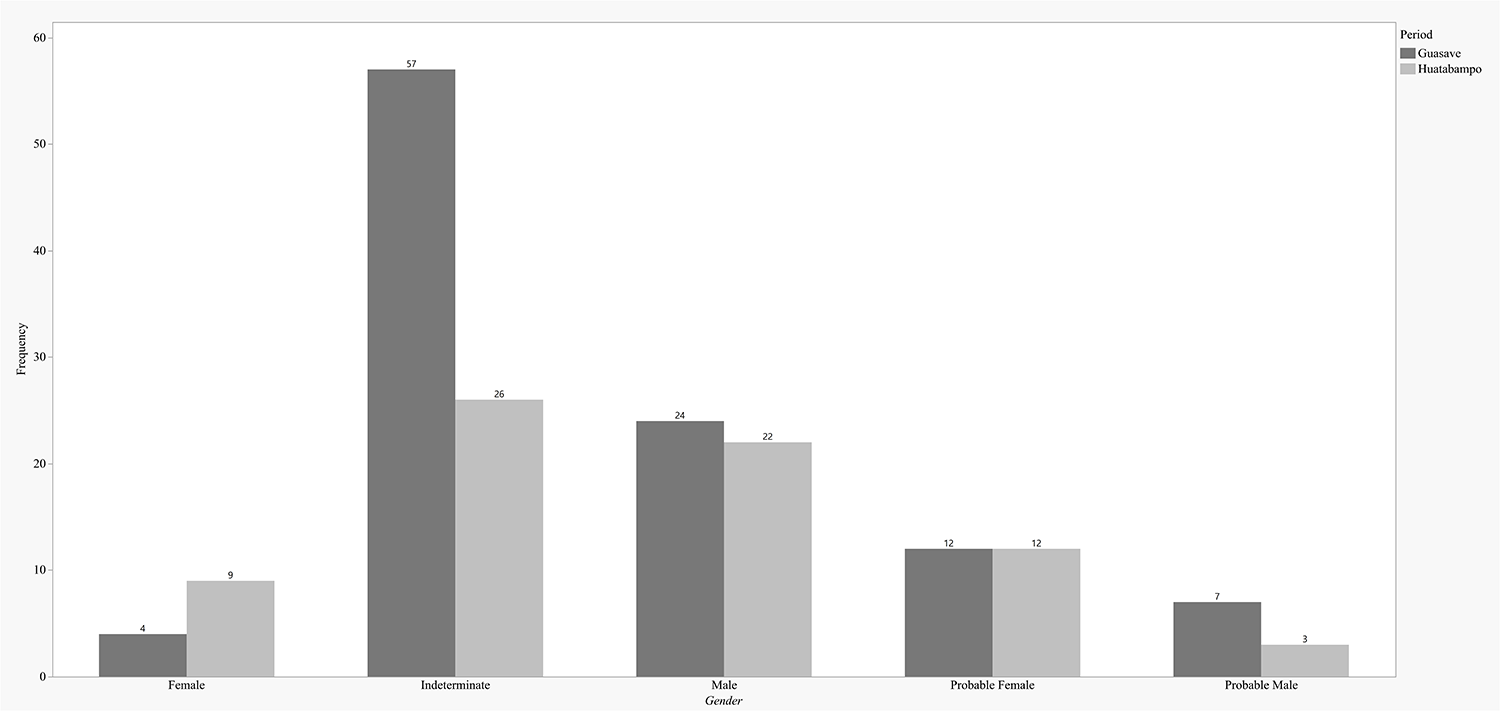
Carpenter’s (Reference Carpenter1996) reassessment of El Ombligo data confirms two periods of use and revises the mortuary sample to 182 burials after excluding 17 individuals from disturbed contexts. Demographic data indicate that El Ombligo was neither sex- nor age-exclusive. While adults are more frequently represented, the number of individuals of indeterminate age complicates firm conclusions (Figure 3). Data highlights that mortuary behavior becomes more variable over time (Supplementary Material 1). Although several practices persist across both periods, there are substantial changes in bodily modifications through time (Supplementary Materials 2 and 3; Glascock Reference Glascock1980).
Demographic data at the El Ombligo (Carpenter Reference Carpenter1996:236).

Notably, variation in material accompaniments is more pronounced over time. The presence of a bundle burial context associated with the Huatabampo phase raises questions regarding an earlier phase of site use. This mortuary practice is uncommon in the region but documented in western Mexico associated with the Capacha culture (Middle Formative period) contexts (Rhodes et al. Reference Rhodes, Joseph, Mountjoy and Cupul-Magaña2016).
During the Huatabampo phase, the most common grave goods are shell beads (n = 4,861), which are distributed unevenly across the population. Other nonlocal materials, including obsidian, turquoise, cloisonné, copper, and iron pyrite/galena, occur infrequently and are more evenly distributed. Ceramic vessels are rare during this period. In contrast, the Guasave phase exhibits a marked increase in the diversity and frequency of grave goods. Ceramic vessels become more common (n = 120) and are distributed more unevenly among individuals. Shell artifacts diversify in form, although beads remain the most abundant (n = 5,498) and continue concentrated among a limited number of individuals. Copper bells (n = 113) are similarly restricted yet not exclusive, occurring in only seven burials. Importantly, most nonlocal materials present during the Guasave phase, excluding Aztatlán ceramics, also appear in the earlier Huatabampo phase, with few additional artifact types introduced.
The transition from the Huatabampo period (ca. AD 650/700–1022) to the Guasave period (ca. AD 1022–1370) thus reflects changes in mortuary variability, particularly when material disparities are considered as potential indicators of vertical stratification. Consequently, alongside material accumulation by specific individuals, new ideologies and economic practices are suggested to have been superimposed over an earlier Huatabampo social structure (Ekholm Reference Ekholm1942; Frisbie Reference Frisbie, Riley and Hedrick1978; Kelley Reference Kelley, Ekholm and Willey1966, Reference Kelley and Reyman1995, Reference Kelley, Foster and Gorenstein2000; Kelley and Foster Reference Kelley and Foster1992; Publ Reference Publ1986, Reference Publ and Isaac1990).
Commonly seen, the Aztatlán tradition at El Ombligo implies elites institutionalized new practices and symbols, leading to the monopolization of nonlocal goods. This study evaluates these assumptions through a systematic analysis of the distribution of material and nonmaterial attributes in El Ombligo’s mortuary record.
El Ombligo Funerary Mound and Its Social Networks
SNA evaluates how the properties/attributes of a node (an individual, a site, or an artifact) influence large relational dynamics through their edges or links (connections) and how, over time, changes in these properties transform the entire system (Freeman Reference Freeman1979; Scott Reference Scott2024; Wasserman and Faust Reference Wasserman and Faust1994). The way nodes connect in a network is defined by the type of properties they share, and consequently, the assessment of links varies theoretically (see Borgatti Reference Borgatti2005:56–57). In this study, SNA is used to examine ritual participation and symbolic exchange through shared material and bodily attributes to assess changes associated with the onset of the Aztatlán tradition.
Five centrality measures were employed across three analytical scales: node-level centrality (degree, eigenvector, and betweenness), network-level centralization, and CP structure (Table 1) through UCINET 6 (Borgatti et al. Reference Borgatti, Everett and Freeman2002). Together, these measures assess patterns of participation, mediation, and differentiation within funerary networks and provide a comparative framework for evaluating how inequality developed across the Huatabampo and Guasave phases (Borgatti et al. Reference Borgatti, Everett and Freeman2002; Freeman Reference Freeman1979; Wasserman and Faust Reference Wasserman and Faust1994). Archaeologically, broadly distributed centrality values are consistent with corporate organization. In this form of organization power and symbolism circulate widely, whereas increasing concentration of participation and mediation indicates incipient social differentiation (Blanton et al. Reference Blanton, Feinman, Kowalewski and Peregrine1996; Feinman Reference Feinman and Haas2001).
Graph-Theoretical Measures Used to Evaluate Relational Dynamics among Burials in the El Ombligo Mortuary Assemblage.

Table 1 Long description
Graph-based measures are mapped to four aspects of relationships among burials: prominence, core versus periphery structure, inequality, and overall network organization. Structural position uses degree centrality to reflect how connected a burial is, and eigenvector centrality to highlight burials tied to other influential clusters that may shape shared practices. Core-periphery structure uses a coreness score to separate a dense, cohesive core from a more weakly connected periphery, informing inclusivity or exclusivity in ritual practice. Relational inequality uses a Gini coefficient applied to centrality values to indicate whether connectivity is concentrated among a few burials or more evenly distributed. Global network structure uses network centralization, reported as a , to summarize whether the network is organized around one or a few highly connected burials versus being more decentralized. Interpretations depend on how connections are defined and on data completeness, since missing ties or sampling differences can shift centrality, coreness, and inequality patterns.
Because excavation records lack complete demographic and biographic information for the full assemblage, analyses focus on a subset of individuals (n = 90) with sufficiently detailed attribute data following Carpenter’s (Reference Carpenter1996) reassessment. This subset includes 45 burials from the Huatabampo phase (23 males, 22 females) and 46 from the Guasave phase (31 males, 15 females). Separate analyses were conducted by period and by sex to capture potential sex-specific trajectories of change through time. Burials with incomplete or ambiguous attribute data were excluded to avoid artificial inflation or reduction of network density.
Each burial was treated as a social actor (node), and the links among burials were defined by shared funerary attributes. These include nonmaterial variables (burial type, body position and orientation, cranial modification, and dental modification) as well as material categories such as shell ornaments, copper objects, ceramic vessels, cloisonné, turquoise, obsidian, spindle whorls, baskets, textiles, and stone tools (Supplementary Material 4). All attributes were weighted equally as expressions of ritual affiliation.
To prepare the data for network analysis, funerary attribute datasets were first transformed into burial-by-burial similarity matrices, which were subsequently converted into undirected, weighted networks. Similarity matrices (burial × burial) were derived from burial-by-attribute datasets for each period and sex. Nonmaterial attributes were coded as binary presence/absence variables, while material attributes were recorded as frequencies representing the abundance of each artifact class per burial. Pairwise similarity was calculated by cross-comparing attribute profiles. Binary attributes were considered shared when both burials exhibited the same trait, whereas frequency data were compared using a proportional-overlap procedure equivalent to the Bray–Curtis index (Equation 1; Bray and Curtis Reference Bray and Curtis1957; Legendre and Legendre Reference Legendre and Legendre2012). This measure captures both the presence of shared attributes and the intensity of their expression and has been widely applied in archaeological analyses of compositional similarity (De Groot Reference De Groot2019; Giovas Reference Giovas2021).
 \begin{equation*}
S_{ij}= 1 - \frac{\sum {\left|\chi_i - x_j\right|}}{\sum \left(x_i + x_j\right)}\end{equation*}
Equation 1 displays the Bray-Curtis index formula. Sij represents the similarity between burials i and j;  $ {x_{ik}}$ and
 ${x_{jk}}$ are the attribute frequency values for each burial across n funerary variables;
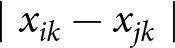 $\mid {x_{ik}} - {x_{jk}}\mid $ is the absolute difference in attribute presence or intensity; and
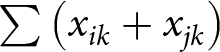 $\sum \left( {{x_{ik}} + {x_{jk}}} \right)$ is the sum of all attributes compared. Resulting coefficients were normalized between 0 and 1 to standardize tie strength across all networks. The formula produces continuous values between 0 (no shared composition) and 1 (identical profiles), allowing simultaneous assessment of ritual participation and material differentiation (Baselga Reference Baselga2013; Ricotta and Podani Reference Ricotta and Podani2017). The resulting weighted one-mode matrices quantify the degree of funerary similarity among individuals.
Two-Mode Networks
The two-mode network model (Borgatti and Everett Reference Borgatti and Everett1997; Breiger Reference Breiger1974) was applied to the El Ombligo assemblage to explicitly map relationships between individuals (burials) and funerary attributes, revealing how shared practices structured participation within the mortuary program. Two-mode (burial × attribute) matrices were visualized using NetDraw within UCINET 6 (Borgatti Reference Borgatti2002; Borgatti et al. Reference Borgatti, Everett and Freeman2002). Networks were weighted by betweenness centrality to emphasize actors occupying structurally significant bridging positions.
Theoretically, different modes of social organization are expected to generate distinct two-mode network configurations. Corporate systems tend to generate dense and evenly connected networks in which most individuals share a broad range of attributes, reflecting collective participation and low differentiation with low centrality values and network centralization (Figure 4; Blanton et al. Reference Blanton, Feinman, Kowalewski and Peregrine1996; Crumley Reference Crumley1995; Hanneman and Riddle Reference Hanneman and Riddle2005; Mills et al. Reference Mills, Clark, Roberts, Haas, Peeples, Borck, Ryan, Trowbridge, Breiger and Knappett2013). Hierarchical systems produce more polarized structures dominated by a limited number of highly connected individuals who monopolize ties to multiple attributes or clusters, resulting in elevated centralization and unequal access to symbolic or material resources (Figure 5; Borgatti Reference Borgatti2005; Freeman Reference Freeman1979; Hanneman and Riddle Reference Hanneman and Riddle2005; Mills et al. Reference Mills, Clark, Roberts, Haas, Peeples, Borck, Ryan, Trowbridge, Breiger and Knappett2013). Even in cases in which elites capture exclusive materials, the shared nonmaterial funerary attributes continue to function as ties linking the broader community. Heterarchical systems occupy an intermediate configuration characterized by internally cohesive subgroups linked through a limited number of bridging actors, where differentiation emerges through negotiation (Figure 6; Crumley Reference Crumley1995; Hanneman and Riddle Reference Hanneman and Riddle2005; Peeples and Haas Reference Peeples and Haas2013).
“Hypothetical Corporate System” two-mode network model (burials × attributes).

Figure 4 Long description
Two-mode network infographic with square nodes labeled “ATTRIBUTE” and circular nodes labeled “ADULT MALE” and “ADULT FEMALE”. The “ATTRIBUTE” squares form a clustered group across the central area. Multiple lines connect between the “ATTRIBUTE” squares. Five adult circles appear around the outer area. One circle is labeled “ADULT FEMALE”. Four circles are labeled “ADULT MALE”. Each adult circle has multiple lines connecting to several “ATTRIBUTE” squares. The connecting lines have no arrowheads and no numeric labels.
“Hypothetical Hierarchical System” two-mode network model (burials × attributes).

“Hypothetical Heterarchical System” two-mode network model (burials × attributes).

Two-mode affiliation networks (burials × attributes) followed the same attribute logic used in the similarity-based analyses to assess how individuals and funerary traits articulated within the mortuary program at El Ombligo through time and by sex. Direct associations between burials and mortuary attributes illustrate relational patterning that underpinned funerary behavior. Two analytical configurations were implemented: one incorporating all attributes (bodily treatments and material accompaniments) and a second excluding material attributes to focus exclusively on embodied ritual practices such as body orientation and cranial or dental modification. This distinction allows evaluation of whether observed relational structures derive primarily from shared bodily practices or from differential access to material goods (Figure 7).
Two-mode affiliation networks, all attributes: Huatabampo period (A = Female; B = Male) and Guasave period (C = Female; D = Males). Two-mode affiliation networks excluding material attributes: Huatabampo period (E = Females; F = Males) and Guasave period (G = Female; H = Males). Red dots, actors; blue squares, funerary attributes.

Figure 7 Long description
Each diagram features red dots representing actors and blue squares representing funerary attributes. The diagrams are labeled as follows: A) Female Huatabampo with all attributes, B) Male Huatabampo with all attributes, C) Female Guasave with all attributes, D) Male Guasave with all attributes, E) Female Huatabampo excluding material attributes, F) Male Huatabampo excluding material attributes, G) Female Guasave excluding material attributes, H) Male Guasave excluding material attributes. The networks illustrate relational patterning between burials and funerary attributes, highlighting differences in bodily treatments and material accompaniments, as well as embodied ritual practices such as body orientation and cranial or dental modification.
Results and Observations
The Huatabampo two-mode networks that include all funerary attributes (Figure 7a–b) display even connectivity and minimal clustering. Shared practices (extended body position, modest offerings, infrequent cranial or dental modification, and limited variation in orientation) are broadly distributed across the assemblage. This pattern indicates standardized funerary behavior characteristic of a corporate network structure (Figure 4). When centrality measures are examined by sex (Table 2), overall connectivity remains balanced but reveals subtle differences in symbolic participation. The Huatabampo male network (Figure 7a) exhibits relatively even connectivity (mean degree = 0.48) and moderate centralization (22.5%), indicating broad participation in shared ritual practices. Burial 61 holds the highest eigenvector centrality score (0.740), linking multiple funerary attributes, burial configuration, and modest accompaniments, without producing pronounced hierarchical differentiation (Table 3).
Mean Centrality and Inequality Measures for One-Mode Similarity Networks (Burial × Burial) by Period, Sex, and Analytical Configuration.

Table 2 Long description
Mean node degree and eigenvector centrality (each with standard deviation), plus network centralization percent and core-periphery Gini, are reported by period (Huatabampo, Guasave), sex, and network type. In both periods, Materials/Body Treatment networks have higher mean degree than Body Treatment networks for the same sex (for example, Guasave females 0.61 versus 0.12; Huatabampo males 0.48 versus 0.07). Centralization is highest for females in Materials/Body Treatment networks, especially Huatabampo at 78.4 percent, followed by Guasave at 64.8 percent. Body Treatment networks often show higher centralization than their Materials/Body Treatment counterparts for males (Huatabampo 52 versus 22.5; Guasave 54.2 versus 38.9), despite much lower mean degree and eigenvector values. Core-periphery inequality (Gini) is generally higher in Guasave than Huatabampo, with the maximum at Guasave males in Materials/Body Treatment (0.196) and the minimum at Huatabampo females (0.062 in both network types). Eigenvector centrality is highest for Huatabampo males in Materials/Body Treatment (0.74) and lowest for Huatabampo females in Materials/Body Treatment (0.22), indicating that higher centralization does not necessarily coincide with higher eigenvector scores. Values are means with variability, so differences should be interpreted cautiously without formal significance testing.
Notes: “Materials/Body Treatment” networks include all funerary attributes, whereas “Body Treatment” networks isolate bodily practices by excluding material accompaniments. Values represent mean ± SD of node centrality scores.
All Centrality Measures Are Normalized for Comparability across Networks.

Table 3 Long description
Centrality scores are reported for burial similarity networks, split by period, sex, and network type, with degree, eigenvector, and betweenness listed for specific burial IDs or small ID sets. In Huatabampo, females have moderate degree in the combined network (burials 65 and 68) and similar averages in the body-only network (burials 87, 23, 58), with betweenness reported as zero. Huatabampo males show a standout eigenvector value for burial 61 in the combined network, while their body-only set (170, 194, 202) has moderate degree and very small betweenness values. In Guasave, females have the highest connectivity and influence overall: burial 89 in the combined network has the top degree and eigenvector, and the body-only set (184, 120, 177) remains high on both measures. Guasave males are slightly lower than Guasave females but still show relatively high degree in both network types, with small nonzero betweenness in the combined and body-only networks. Across the table, betweenness is consistently zero or close to zero, suggesting few burials act as bridges between otherwise similar clusters. Some rows summarize multiple burials using averages with variability, so comparisons between single-burial rows and grouped rows should be made cautiously.
Source: (Freeman Reference Freeman1979; Hanneman and Riddle Reference Hanneman and Riddle2005)
Notes: Degree divided by (n – 1); Closeness and Betweenness normalized by network size and node pairs; Eigenvector scaled so 1 = highest influence. Values reflect results from one-mode similarity matrices (burial x burial) derived from two-mode (burial × attribute) tables.
The Huatabampo female network (Figure 7b) shows a different structural configuration (all attributes included). Network centralization (78.4%) is influenced by Burial 68, in which most of the funerary attributes, including shell ornaments (n = 3626), body treatments, and orientation, co-occur. Despite their structural prominence, beyond shell beads, this burial does not exhibit substantial material accumulation. Low betweenness and modest eigenvector values indicate that their centrality reflects participation in shared ritual configurations rather than hierarchical distinction.
Bodily treatment–only networks further emphasize the integrative character of the Huatabampo mortuary system. In the male network (Figure 7e), connectivity remains moderate (mean degree = 0.07 ± 0.06) while eigenvector centrality declines (0.23 ± 0.20) and centralization increases (52%). Burials 170, 194, and 202 function as brokers linking shared bodily configurations. Their high degree values and minimal betweenness indicate dense relational ties without monopolizing ritual mediation. These individuals represent recurrent embodiments of Huatabampo mortuary norms, reinforcing collective identity through bodily expression (Table 3).
The female bodily-treatment network (Figure 7f) displays comparable degree (0.09 ± 0.07) and eigenvector (0.21 ± 0.18) values but lower centralization (35.7%), indicating a more evenly distributed structure. Central actors (Burials 87, 23, and 58) connect through shared bodily treatments and orientation patterns. The overall homogeneity of this network reflects horizontal integration and broadly shared ritual participation (Table 2).
Core-periphery (CP) results reinforce this corporate configuration. Male and female networks exhibit low differentiation, with mean coreness values of 0.200 ± 0.038 and 0.212 ± 0.025, respectively. Gini coefficients remain minimal (0.10 and 0.06) (Supplementary Materials 2 and 4), indicating near-equal relational participation. Cohesion indices are the highest observed in the dataset (0.78–0.81), underscoring high integration and limited segmentation (Table 3). Even when material attributes are excluded, coreness distributions remain tightly grouped (Supplementary Materials 5 and 6). Taken together, these results portray the Huatabampo mortuary system as a highly integrative configuration in which ritual practices were widely shared across the community.
Taken together, these results portray the Huatabampo mortuary system as a corporate and integrative social system. The ritual expressions seemed to remain standardized for the most part, and differentiation was symbolic rather than hierarchical, allowing cohesion of community identity through shared bodily and material configurations.
Guasave Networks: Differentiation and Symbolic Reorganization
The Guasave two-mode networks that include all funerary attributes (Figure 7c–d) display greater clustering and a more uneven distribution of certain materials relative to the Huatabampo phase. While overall connectivity remains extensive, ties increasingly concentrate around Aztatlán-associated materials such as polychrome vessels, copper, and shell ornaments. Bodily configurations, however, remain comparatively standardized. This pattern suggests the emergence of horizontal differentiation within a still broadly shared ritual system.
Within the Guasave male network (Figure 7c), distinct clusters are formed around specialized material and bodily traits. Burial 29 occupies a key bridging position linking otherwise weakly connected subgroups. Centrality scores identify several individuals as brokers or bridges, linking different funerary expressions as hypothesized in Figure 6, while descriptive statistics indicate that valued ritual goods were concentrated among a relatively small subset of burials.
Burial 29 displays the most extensive material assemblage in the dataset. The burial includes the construction of a ramada and platform, copper bells (n = 87), approximately n = 2,100 shell beads, varying frequencies of obsidian prismatic blades, and only one rare Aztatlán polychrome vessel. Such material elaboration signals exceptional symbolic visibility. However, comparable, though smaller, accumulations of shell beads and copper bells are present in several other burials, indicating that access to high-value goods was controlled but not exclusive. Network centrality measures further show that Burial 29 does not monopolize connectivity within the mortuary arena. The coexistence of material concentration with broadly distributed connections could suggest emerging social differentiation without the consolidation of formalized authority.
The Guasave female network (Figure 7d) remains more densely connected. Burial 89 occupies a central position linking traditional Huatabampo funerary practices with newly prominent Aztatlán attributes. Material differentiation among Guasave period females is not limited to this burial. Two individuals contain particularly large concentrations of shell beads (Burial 119: n = 994; Burial 68: n = 3,626), demonstrating substantial variation in material accompaniments. Despite these concentrations, network centrality values do not show exclusive structural dominance by any single individual (Table 2). Material accumulation therefore increased symbolic visibility while remaining embedded within broadly shared participation.
Bodily modification–only networks highlight continuity alongside material diversification. The Guasave male network (Figure 7g) exhibits moderate connectivity and centralization, with Burials 21, 46, and 148 forming a central cluster. Their elevated centrality and low betweenness values indicate influence through shared bodily treatment configurations rather than monopolization of ritual participation. Similarly, Burial 89 maintains centrality within the female bodily modification network (Figure 7h), where shared bodily treatments continue to structure participation despite increased variability in material assemblages.
CP and cohesion analyses reinforce these trends. CP Gini coefficients increase during the Guasave period relative to the Huatabampo period, indicating greater inequality and reduced cohesion, particularly within the male assemblage (Supplementary Materials 2 and 3). Nevertheless, the broader relational structure remains integrative. Social differentiation intensified, yet participation was not reorganized into a centralized hierarchical system. Instead, certain individuals gained greater visibility and influence through accessing valued goods and positioning themselves as brokers between an enduring Huatabampo ritual doxa and new forms of symbolic expression.
Discussion
El Ombligo and its funerary program stand as outliers in northwestern Mexico / US Southwest literature, given their distinctive material configurations. This situation has fostered debates regarding Mesoamerica–U.S. Southwest connections, placing the region between competing interpretive narratives. The present work addresses these tensions through a local-scale analysis that contributes to understanding the Aztatlán tradition and its effects on communities in northern Sinaloa.
This work interprets El Ombligo as a gathering locus for communities settled along the Guasave River between AD 650/700 and 1370. The assemblage reflects decisions and dispositions of communities and how participation in Aztatlán interaction networks reshaped social life in northern Sinaloa. Hence, El Ombligo likely functioned both as a place of remembrance and as a communal arena where social relationships were periodically renegotiated and identities reaffirmed. These processes were visible in mortuary ceremonies, intensifying during the Guasave period (Pearson Reference Pearson1999).
Network and centrality results provide insight into how these dynamics unfolded. The Huatabampo period data show an integrative system with shared ritual practices across the community. In contrast, the material accumulation of Female 68 suggests the role of a ritually prominent participant in society. Ethnographic parallels with the US Southwest (Mills Reference Mills and Mills2000) indicate that women often played ritualistic roles in ceremonial practices and ritual exchange, highlighted by the use of shell adornment as a marker of ritual significance. Data associated with the Huatabampo period, though, suggest no institutionalized political authority.
The Aztatlán tradition in northern Sinaloa fostered new modes of social participation, echoing Carpenter’s (Reference Carpenter1996) assessment, while accelerating social differentiation and possibly competition, without producing a fully ranked structure. Material and symbolic capital accumulations by certain individuals at El Ombligo, particularly Individual 29 and to a lesser extent 68, suggest aggrandizement strategies in which exotic goods circulated through relational obligations (Hayden Reference Hayden, Forsyth and Hoyt2011). Such strategies occasionally generate non-hereditary leadership roles and ritual authority without producing permanent elite positions. Such patterns show structural parallels to a degree, with the cargo system recently explored in west Mexico (Mathiowetz Reference Mathiowetz, Mathiowetz and Pohl2025).
Although Aztatlán traits and practices present in northern Sinaloa suggest connections with the Sinaloa and Nayarit borderland region, the network structure documented at El Ombligo provides little evidence for centralized control. If institutional authority had existed at El Ombligo, clear disruption of Huatabampo ritual norms would be expected, including segregation between Aztatlán-associated and Huatabampo burials and strong network polarization reflecting monopolized ritual authority. Instead, the funerary assemblage reveals negotiated integration between traditions.
Recent provenance data (neutron activation analysis; NAA) from newly documented sites in the Guasave region and from a curated collection from Navolato (central Sinaloa) provide nuance to mobility patterns in northern Sinaloa, mirroring a local circulation pattern of finished Aztatlán pots reported for southern Sinaloa (Pierce Reference Pierce, Orellana-González, Sánchez, Balbin-Estanguet, Sergues and Taffin2022a). Data indicate that Aztatlán polychromes in Guasave were produced locally, with limited geochemical similarities with the central Sinaloa reference (Figure 8; Supplementary Material 7). These patterns raise the possibility that well-positioned groups in northern Sinaloa could intentionally have adopted and emulated Aztatlán conventions. This should be explored in future research.
Scatterplot of Cr and Fe ppm. Ellipses represent 90% confidence intervals for membership in the groups (Ferguson Reference Ferguson2025). Geochemical references are established considering Red plainwares from Guasave and Navolato as reference groups. (Color online)

Figure 8 Long description
The scatter plot illustrates the relationship between Fe and Cr, with Cr on the horizontal axis ranging from 0 to 150 and Fe on the vertical axis ranging from 0 to 70000. Units are not specified. Various symbols represent initial groups, including Lower Guasave River, Navolato and others, with ellipses indicating 90 percent confidence intervals for group membership. The plot reveals clusters primarily around Cr values of 50 to 100 and Fe values of 30000 to 50000, showing separation between groups. Outliers are marked distinctly. The legend explains symbols for each group, such as circles, triangles and crosses. The plot suggests geochemical patterns and group separation, with dense point distribution in specific Cr ranges, indicating local production and mobility patterns in northern Sinaloa.
Notably, whereas Aztatlán iconographic patterns of northern Sinaloa show slight parallels to southern Sinaloa and Nayarit than to central Sinaloa (Bojórquez-Diego Reference Bojórquez-Diego2009; Mathiowetz Reference Mathiowetz, Mathiowetz and Turner2021; Solar-Valverde Reference Solar-Valverde, Solar-Valverde and Nelson2019), northern Sinaloa’s Aztatlán iconography has been noted to follow a different stylistic trajectory (Ekholm Reference Ekholm1942; García-Cabrero Reference García-Cabrero1991). Normative Aztatlán symbolism in northern Sinaloa is clearly present, and more data is needed to analogously situate the institutionalization of this ritual system in northern Sinaloa. Future work on this will greatly benefit existing discussion (Mathiowetz Reference Mathiowetz2018, Reference Mathiowetz, Mathiowetz and Turner2021, Reference Mathiowetz, Mathiowetz and Pohl2025). In the meantime, it is crucial to consider that objects acquire meaning through circulation and use rather than through inherent symbolic properties (Appadurai Reference Appadurai and Appadurai1986; Kopytoff Reference Kopytoff and Appadurai1986). As materials move across social landscapes, their meanings may be reinterpreted and selectively incorporated into local cultural frameworks. Consequently, assuming that Aztatlán symbols retained uniform meanings across all regions where they appear risks overlooking how communities actively negotiated and transformed these symbolic repertoires.
Northern Sinaloa provides an important case for understanding how agency operated in borderlands and how material patterns can disclose negotiation among enduring and new traditions. Future questions to address imply expanding archaeometric data associated with Aztatlán goods in northern Sinaloa, complementing existing data of the Aztatlán core area (Pierce Reference Pierce2022b; Tenorio et al. Reference Tenorio, Jiménez-Reyes, Esparza-López, Calligaro and Grave-Tirado2015; Weigand and Harbottle Reference Weigand, Harbottle, Ericson and Baugh1993). Iconographically, further work should examine the presence of additional Mesoamerican ritual symbols in Sinaloa, particularly Xipe-Totec (González-Rizo Reference González-Rizo2022), given the complex relationship between materiality and ritual practice associated with the funerary urn traditions in the region. Finally, tracing Aztatlán symbolism within ethnographic Yoeme/Yoreme traditions may provide valuable insights for interpreting these archaeological patterns.
Conclusion
The application of SNA to the funerary assemblage of El Ombligo demonstrates that the presence of exogenous social traits does not necessarily signal abrupt cultural replacement. Instead, it reveals local mechanisms of negotiation that produced both vertical and horizontal differentiation. The possibly selective appropriation of exogenous conventions, reflected in local emulation of Aztatlán symbols in northern Sinaloa, may have provided lineages with new opportunities to assert regional influence that extended well beyond mortuary contexts. The continued reproduction of Huatabampo egalitarian ideologies, alongside the continuous use of the funerary mound, may have mediated and constrained the development of ranked social formations.
The case examined here highlights how agency operated in communities to navigate external influences. This study further illustrates the utility of network approaches for exploring the social implications of material variation. The results presented here contribute to ongoing reevaluations of what the Aztatlán tradition represented across the region.
Acknowledgements
Comments from Matthew Pailes greatly benefited the network analysis, as did reviews and criticism from anonymous reviewers. I also thank Sr. Victor Espinoza Perea for accessing the collections of the Museo de Tamazula, Sinaloa, Mexico.
Funding Statement
NAA was supported by MURR–NSF subsidy program (Award # 2208558).
Data Availability Statement
The datasets generated and analyzed during this study are available from the author upon request. Supplementary materials (tables and figures) are available online.
Competing Interests
The author declares none.
Supplementary Material
The supplementary material for this article can be found at https://doi.org/10.1017/laq.2026.10208.
Supplementary Material 1. Type and frequency of burials (Carpenter Reference Carpenter1996:237; figure).
Supplementary Material 2. Type and frequency for cranial modification by period (Carpenter Reference Carpenter1996:238; table).
Supplementary Material 3. Type and frequency for dental modification by period following Romero’s (1970) classification (Carpenter Reference Carpenter1996:238; table).
Supplemental Materiary 4. Funerary material and nonmaterial attributes included in SNA and network modeling (data obtained from Carpenter Reference Carpenter1996; table).
Supplementary Material 5. Core periphery Gini-coefficients for Huatabampo Period networks, including both nonmaterial and material funerary attributes (figure).
Supplemental Materiary 6. Core periphery Gini coefficientes for Guasave period networks including material and nonmaterial (bodily) funerary attributes (figure).
Supplementary Material 7. Table distribution of compositional groups by ceramic ware (table).




 Open access

