A review of literature on interventions for adolescents
Worldwide, 10–20% of children and adolescents experience mental disorders, most commonly depression or anxiety, with half of these cases beginning by the age of 14 and three-quarters by the mid 20s (World Health Organization, 2005). Furthermore, experiencing trauma in adolescence may lead to symptoms of posttraumatic stress, which can have long-term effects on psychological wellbeing. Trauma-focused cognitive behavioural therapy (TF-CBT) has demonstrated its efficacy for reducing posttraumatic stress and symptoms of depression and anxiety (Silverman et al., Reference Silverman, Ortiz, Viswesvaran, Burns, Kolko, Putnam and Amaya-Jackson2008). However, some clinicians and patients may resist interventions like TF-CBT, as it involves exposure to trauma, which can worsen the symptoms or be inconsistent with the treatment stance (Becker et al., Reference Becker, Meyer, Price, Graham, Arsena, Armstrong and Ramon2009).
Recently, mindfulness-based approaches are emerging as an alternative to TF-CBT. They can provide low-cost, easily learned procedures that foster awareness and acceptance of one’s current internal and external reality, which includes promoting personal attention and awareness, and changing awareness of thoughts and relationships with them by promoting ‘cognitive defusion’ (i.e., thoughts are not facts). One study showed that mindfulness-based approaches were equally effective as TF-CBT, with significantly lower drop-out rates (Frost, Laska, & Wampold, Reference Frost, Laska and Wampold2014). However, research on the effectiveness of mindfulness-based approaches for reducing symptoms of depression and anxiety in adolescents who experienced trauma has primarily focused on these symptoms in the context of other clinical problems (e.g., attention deficit hyperactivity disorder), and studies specifically targeting adolescents in a school setting are scarce (Crowley et al., Reference Crowley, Nicholls, McCarthy, Greatorex, Wu and Mayes2018).
School-based interventions
Schools may be optimal arenas to provide specific prevention and treatment to adolescents with trauma, as the school environment can be familiar, safe and supportive (Kruczek & Salsman, Reference Kruczek and Salsman2006). Although there are several restrictions on school-based interventions, such as time constraints, one advantage is that a teacher can assist a mental healthcare provider by promoting students’ daily use of mindfulness skills, which can maximise the benefits. Some researchers have demonstrated a positive association between its formal practice and mental health outcomes in adolescents (Kuyken et al., Reference Kuyken, Weare, Ukoumunne, Vicary, Motton, Burnett and Huppert2013). Thus, short-term and cost-effective interventions can be developed in the school setting (e.g., implementation of homework and postintervention support from teachers), which can have significant effects.
The present pilot study investigated the efficacy of a short-term mindfulness-based psychoeducation and practice intervention that utilises the school setting to improve the mental health of Japanese adolescents who have experienced trauma. The study makes a valuable contribution to existing literature because trauma experienced at school, such as bullying, is a significant concern for both students and teachers. Furthermore, it is important to provide basic data on the acceptability and effectiveness of the intervention because there are no reports of the efficacy of school-based interventions for adolescents with trauma-related mental health concerns in Japan.
Method
Participants
We screened 111 students using the Japanese version of the Impact of Event Scale — Revised (IES-R; Asukai et al., Reference Asukai, Kato, Kawamura, Kim, Yamamoto, Kishimoto and Nishizono-Maher2002) at a high school in Japan. The principal, students and parents gave informed consent before the screening. Participant inclusion criteria were experiencing trauma and posttraumatic stress symptoms (IES-R ≥ 1) and being capable of giving consent, as determined by the participants and their parents. Based on the screening results, we selected 49 adolescents to participate in the intervention (37 women, 12 men; M age = 17.61 years, SD = 0.70).
Measures
To assess mindfulness, we used the Mindful Attention Awareness Scale (MAAS), developed by Fujino, Kajimura, and Nomura (Reference Fujino, Kajimura and Nomura2015). The scale is comprised of 15 items, with scores for each item ranging from 1 = not at all to 6 = always.
To assess cognitive fusion, we used the Cognitive Fusion Questionnaire (CFQ), developed by Shima, Kawai, Yanagihara, and Kumano (Reference Shima, Kawai, Yanagihara and Kumano2016). The questionnaire is comprised of nine items, with scores for each item ranging from 1 = not at all to 7 = always.
The main outcome measure used was the Kessler-6 (K6), developed by Furukawa et al. (Reference Furukawa, Kawakami, Saitoh, Ono, Nakane, Nakamura and Kikkawa2008). The K6 comprises six items, with scores for each item ranging from 0 = never to 4 = always. It was designed to assess nonspecific psychological distress (depressive moods and anxiety) over the preceding four weeks. A total score of 5 was used as the cut-off for ‘probable mood and anxiety disorders’.
The secondary outcome measure used was the IES-R (Asukai et al., Reference Asukai, Kato, Kawamura, Kim, Yamamoto, Kishimoto and Nishizono-Maher2002), comprised of 22 items, with scores for each item ranging from 0 = not at all to 4 = extremely good. It was designed to assess the occurrence over a week of three posttraumatic stress symptoms: intrusion (8 items), avoidance (8 items), and hyperarousal (6 items).
The Japanese versions of these four measures have demonstrated the reliability and validity. Further, Cronbach’s coefficients were α = .95 (MAAS), .96 (CFQ), .94 (K6), and .92 (IES-R) in these samples. Participants were assessed at baseline and post-intervention.
Procedures
The 49 participants were divided into three groups, each with 16–17 adolescents, and the intervention was delivered using a common manual by one school psychological staff member who provided psychoeducation on stress and mindfulness, one school psychological staff member who facilitated mindfulness skills practice, and teachers who observed the intervention and encouraged participants to use the skills afterward.
These research procedures are summarised based on a Parts and Timing (PaT) plot (Perera, Heneghan, & Yudkin, Reference Perera, Heneghan and Yudkin2007; see Figure 1). The intervention was conducted in a single 60-minute group session involving three steps. We focused on improving individual degrees of mindful attention and awareness through mindful meditation and cognitive defusion, as this is an empirically supported model for mindfulness-based training. This model has been shown to be effective for improving mental health in nonclinical populations (Carmody, Baer, Lykins, & Olendzki, Reference Carmody, Baer, Lykins and Olendzki2009).
Treatment procedures based on Parts and Timing (PaT). Note: MAAS, Mindful Attention Awareness Scale; CFQ, Cognitive Fusion Questionnaire; K6, Kessler-6; IES-R, The Impact of Event Scale — Revised.

The first step (10 minutes) consisted of psychoeducation on the relationship between stressors and stress symptoms, based on the transactional model of stress and coping (Lazarus & Folkman, Reference Lazarus and Folkman1984). We emphasised how cognitive coping strategies for stressors and trauma affect individual stress responses.
The second step (30 minutes) explained ways to use mindfulness for reducing stress. Previous studies showed that cognitive suppression and cognitive fusion have short-term effects on posttraumatic stress and depression (Nitzan-Assayag, Aderka, & Bernstein, Reference Nitzan-Assayag, Aderka and Bernstein2015). First, participants performed an exercise demonstrating how mindfulness would help control internal states, including thoughts with negative valence, as reflected by cognitive suppression (Bowen, Witkiewitz, Dillworth, & Marlatt, Reference Bowen, Witkiewitz, Dillworth and Marlatt2007). Participants learned that rumination can have a negative effect on mental health, so cognitive coping strategies other than suppression and rumination are needed. Then, participants learned cognitive defusion techniques using a worksheet and an exercise for coping with negative thoughts or images, because mindfulness is theorised to engender self-distance and reduced identification with various internal states, including thoughts with negative valence, as reflected by cognitive defusion (Bernstein et al., Reference Bernstein, Hadash, Lichtash, Tanay, Shepherd and Fresco2015). For example, participants were encouraged to avoid saying ‘I’m going to fail’ and instead say ‘I’m having the thought that I’m going to fail’, thereby creating some space between themselves and their negative thoughts.
The final step (20 minutes) involved practising breathing-focused mindfulness, which encourages paying attention to thoughts and using cognitive defusion techniques. Participants were given a homework assignment using mindfulness meditation and cognitive defusion techniques. After the intervention, teachers continued to encourage students to use these mindfulness skills and cognitive defusion techniques. Specifically, the class teacher asked students to review the handouts used in the intervention twice a week during class to reflect on their daily use of the skills, which kept them motivated.
Data analysis
Statistical analysis was performed using SPSS version 25 (IBM Japan, Ltd.). We analysed the data collected pre- and postintervention. The significance threshold for all tests was p < .05. In addition, Cohen’s d (Cohen, Reference Cohen1988) was calculated to estimate effect size. Cohen (Reference Cohen1988) defined d as the difference between means (M1 – M2) divided by the standard deviation of either group. There were no missing data.
Results
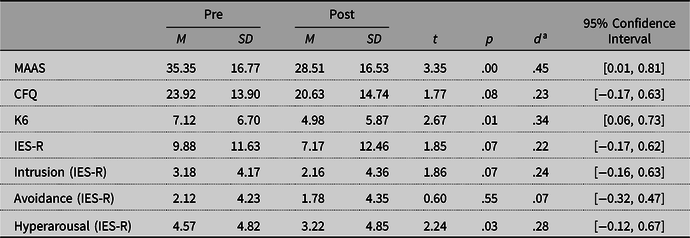
Participants had mild posttraumatic stress, as measured with the IES-R (M = 9.88, SD = 11.63), and displayed symptoms of depression and anxiety based on K6 (M = 7.12, SD = 6.70), which was higher than the clinical cut-off score.
All participants successfully completed the intervention. MAAS, CFQ, K6, and IES-R scores were analysed with paired t tests, and effect sizes were assessed (see Table 1). Although there was no significant improvement between pre- and postintervention for the IES-R factor ‘avoidance’, t(48) = 0.66, ns, d = .07, 95% CI [- 0.32, 0.47], there were significant improvements in MAAS scores, t(48) = 3.35, p < .001, d = .45, 95% CI [0.01, 0.81]; CFQ, t(48) = 2.28, p = .03, d = .35, 95% CI [−0.17, 0.63]; K6, t(48) = 2.67, p = .01, d = .34, 95% CI [-0.06, 0.73]; and the IES-R factor ‘hyperarousal’, t(48) = 2.24, p = .03, d = .28, 95% CI [-0.12, 0.67]. Furthermore, there were significant tendencies toward improvement in total IES-R scores, t(48) = 1.85, p = .07, d = .22, 95% CI [-0.17, 0.62], and the IES-R factor ‘intrusion’, t(48) = 1.86, p = .07, d = .24, 95% CI [-0.16, 0.63].
Outcomes of short-term group mindfulness-based psychoeducation and practice

Note: MAAS, Mindful Attention Awareness Scale; CFQ, Cognitive Fusion Questionnaire, K6, Kessler-6; IES-R, Impact of Event Scale — Revised. SD, standard deviation; M, mean; Pre, preintervention; Post, postintervention.
a Cohen’s d = .20 (small), .50 (medium), .80 (large).
Discussion
The results of this study show that mindful attention and awareness significantly improved, whereas depression and anxiety symptoms, as well as the posttraumatic stress symptom of hyperarousal, significantly reduced. In particular, the mean scores of the K6 at the baseline period exceeded the cut-off, but two weeks after intervention, depression and anxiety symptoms reduced such that they were below the cut-off. Furthermore, this may be an acceptable school-based intervention because it is brief and all participants completed it. The lower dropout rate than that in TF-CBT suggests high acceptability of mindfulness-based treatments among individuals with trauma in places other than medical contexts, such as schools (Hoagwood & Olin, Reference Hoagwood and Olin2002).
Although these findings are promising, additional factors may have contributed to the reduction of symptoms. For example, the efficacy of the intervention may be due in part to the involvement of teachers, who reinforced students’ utilisation of mindfulness skills post-intervention. Even for short-term interventions, we can achieve positive results by utilising the school setting (e.g., postintervention support from teachers, implementation of homework).
These results were generally consistent with previous studies regarding the efficacy of mindfulness for treating depression and anxiety, but the reduction of posttraumatic stress symptoms was not sufficient. Recommended treatments for posttraumatic stress often include exposure to traumatic memories and cognitive reappraisal (processing); however, this intervention did not include these therapeutic elements. Therefore, it is possible to consider adding TF-CBT techniques to mindfulness-based approaches to sufficiently reduce posttraumatic stress symptoms, because mindfulness training may provide a method for increasing emotional regulation skills that may improve engagement in trauma-focused therapy (King et al., Reference King, Block, Sripada, Rauch, Porter, Favorite and Liberzon2016).
Limitations and future directions
This study has several limitations. First, as there was no control group, strong conclusions cannot be drawn about the efficacy of the intervention. Future studies should examine its efficacy using controlled designs and other sample groups. Unfortunately, there was no way to ensure that teachers were involved in enhancing the follow-up of students’ skills; thus, it is necessary to assess whether the efficacy of the intervention differs depending on whether a teacher provides post-intervention support. Second, it is necessary to examine the long-term effects of mindfulness training, because the assessment was only conducted two weeks after the intervention in this study. Third, as the first and second authors conducted the intervention, there may have been a therapist effect leading to overestimating the treatment benefits. Despite such limitations, our findings are encouraging, as they indicate the possible effectiveness of a school-based mindfulness group intervention for adolescents with trauma in non-Western settings. Future directions should also consider using mindfulness-based mobile apps and electronic means, such as Smiling Mind (2020), for follow-up and ongoing mindfulness activities. In addition, it is important to involve not only teachers but also parents to enhance students’ mindfulness activities and ensure that they are performed at an entire school and home.
Acknowledgments
This work was supported by JSPS KAKENHI Grant Number JP19K03315. All authors contributed equally to the design of this study. All study participants provided informed consent, and the study design was approved by the appropriate ethics review board (Hyogo University of Teacher Education; Date: 30.7.2018, Approval number: 2018-19). We would like to thank Editage (www.editage.jp) for English language editing.
Conflict of interest
None.