The Theatrical Public: Theories and Contestations
Stories of American democracy, whether critical or congratulatory, canonical or popular, feature “the public” as their recurring protagonist. “The public” is a rhetorical fixture of political campaigns and democratic theories, opinion polls and calls to action. Its influence is formidable: the very idea scores political speech, and calls citizens into being. Yet as many scholars have argued, “the public” is a moving target, and possibly even a total fiction. Perhaps the best-known challenge in recent decades has come from literary critic and social theorist Michael Warner. “Publics” he writes in his Publics and Counterpublics, “have become an essential part of the social landscape, and yet it would tax our understanding to say exactly what they are.”Footnote 1 If a public is difficult to describe, it is in part, Warner explains, because the idea hovers in modern imaginaries between the concrete and the abstract.Footnote 2 “A public” can conjure at once: a bounded audience—“a crowd witnessing itself in visible space”; a more abstract “social totality” like the constituents of a nation; and a community conjured through shared texts or identities.Footnote 3
The theatrical audience, for Warner, exemplifies a public in its most concrete form because it is constituted through physical assembly and mutual witnessing. Indirectly, theatre scholars have often corroborated this claim; for it might be precisely in the act of assembly, fleeting but immediate and self-conscious, that theatre offers distinctive possibilities for social engagement and democratic participation.Footnote 4 Jill Dolan for instance, has contended that in generously sharing time, space, and attention, theatrical publics—and especially marginalized counterpublics—can enact utopian modes of being together. Dolan's elegantly named “utopian performative” locates theatre's distinctive political potential in its copresence and “present-tenseness,” the features that make theatrical publics, in Warner's terms, “concrete.”Footnote 5
Other scholars however, have argued that the crowd witnessing itself in space is a relatively insignificant component of theatre's democratic potential. Recently, for instance, Christopher Balme has argued that the theatrical public sphere is fundamentally outside of the theatre. For Balme, it is blog entries and reviews, promotions and interviews—the media, in short, that address potential or vicarious spectators—that constitute the publics of greatest significance.Footnote 6 Ultimately, Balme shares Michael Warner's focus on mediated publics, those that circulating texts call into being even (especially, perhaps) when their constituents are dispersed over space and time. He offers a helpful corrective to histories and theories of political theatre by inviting theatre scholars to conceptualize publics “outside the black box.”Footnote 7
Still other theorizations of political theatre find middle ground between Dolan's audience and Balme's public sphere. The work of Lauren Kruger and that of Sara Freeman and Robert Shimko, for instance, suggest that the relationship between bounded theatrical audiences and the mass-mediated publics in which they participate is one of metonymy, or at least continuity.Footnote 8 In these conceptions, the theatrical audience is a stand-in for a larger public, a sample for the opinions it espouses.Footnote 9 In embodied demonstrations such as rallies, marches, and sit-ins, an assembled group may claim to represent the interests of a dispersed whole—and even its potential or action. Yet the assembled group is something like a stunt artist: whether in a public square or an auditorium, it performs what a dispersed public, its uncoordinated double, cannot. An audience in the theatre can rise in a simultaneous standing ovation; a theatrical public sphere, dispersed beyond the theatre's walls, would be hard-pressed to replicate such a palpable and immediate semblance of consensus. If bounded publics “stand in” for mass-mediated publics, they do so in part through sleight of hand.
With Kruger, as well as Freeman and Shimko, I share the conviction that a theatrical public often forms somewhere in between the bounded, “concrete” audience and the more dispersed and “abstract” public sphere. I want to suggest, however, a relationship between the two that is characterized not by metonymy or continuity, but by friction. What happens when the stunt artist encounters its double? Or, put in a different way, what happens when a “concrete audience” bumps up against the abstract “imagined community” it is supposed to represent?Footnote 10
Debates about the public are not new; in fact, they elaborate a rich history, whether consciously or not. In this article, I look back to the period between the United States’ involvement in the First and Second World Wars, when the form and possibilities of the “American public” were hotly contested, much as they are today. In a now-canonical book, journalist and critic Walter Lippmann contended that the American public was “a phantom”; philosopher John Dewey, in a book of his own, countered that the public was very much alive. Lippmann's ghostly rhetoric, I will suggest, offers a new way to characterize the relationship between “concrete” publics and “abstract” ones—especially in the theatre. Turning to a case study, I explore a New York production that ran for only a few weeks in May 1936. The Events of 1935 (usually called just 1935) was explicitly about and for the American public. Moreover, as one of the Federal Theatre Project's (FTP) Living Newspapers, 1935 addressed both “concrete” audiences and the “imagined communities” of the US nation-state. Analyzing production and receptions, I show how 1935 dramatized a public through mimesis and interpellated one in the theatre. In the process, I argue, 1935 provoked spectators to reflect on their collectivity, and to grapple with the “phantom public” that haunted them.
The Phantom Public, the Problem of Presentation
In the field of US communication history, scholars have tended to characterize the period between the First and Second World Wars in terms of a fraught relationship between mass media and democracy.Footnote 11 In the interwar period, the newspaper, having been the dominant news medium for the previous hundred years, faced new competition in the newsreel, radio, and motion picture.Footnote 12 While, for some, these new media offered new venues for political participation, they also engendered fear and suspicion. As Carl Bybee notes, many US Americans had just returned from a war that propaganda had convinced them would be short and easy to win; and though that war was over, they were witnessing fascist movements and regimes making use of mass media in countries such as Italy, Poland, Austria, and Spain.Footnote 13 Thus as new media surged, so did efforts to study and explain public opinion.Footnote 14 Meanwhile, many Americans countered mass media with recuperations of “face-to-face” politics: the interwar period surged with civically oriented adult education classes, public speaking courses, and discussion forums.Footnote 15 Scholars, journalists, activists, and artists struggled to understand what democratic communication could look like in a mass society.
Debates about mass communication suppressed many of American politics’ more urgent afflictions. These included the nation's foundations in genocide, slavery, and settler colonialism; its systematic exclusion of Asian Americans, South Asian Americans, and Latinx populations; the persistence of Jim Crow; sexism, heterosexism, and sexual violence; and discrimination against Americans with disabilities.Footnote 16 The debates and theorizations that ignored these issues—persistent in interwar historiography—were fundamentally incomplete. They are worth considering nonetheless, because they show how democratic imaginaries have rendered invisible populations, issues, and histories of violence.
The paradoxes and preoccupations of democratic communication are evident in the work of two public intellectuals, Walter Lippmann and John Dewey. In fact, communication scholars have canonized their successive books, The Phantom Public (1925) and The Public and Its Problems (1927) as the “Lippmann–Dewey Debate.” Neither book addresses the other directly, nor were the books even widely circulated when they were first published. Yet their arguments crystallized anxieties about the public and the information it consumed.
In The Phantom Public, Lippmann argued that the scale and complexity of American society had rendered predominant ideas of democratic participation all but obsolete. A prominent journalist and political analyst, Lippmann was better informed than most. Yet even he maintained, “I cannot find time to do what is expected of me in the theory of democracy; that is, to know what is going on and to have an opinion worth expressing on every question which confronts a self-governing community.”Footnote 17 The average American, Lippmann surmised—saying nothing of those who did not “count” as such—lacked the expertise necessary to weigh in on decisions that could orient state politics.Footnote 18 Yet political speeches, news media, and the burgeoning field of public opinion research continued to address citizens as if they could, and as if they could do so in concert.
In short, Lippmann believed his colleagues in politics, in the press, in political science and theory, were working with an ideal that was hopelessly anachronistic. They “remembered” an American public from ancient Greece and Rome, where citizens could routinely gather and deliberate in the agora or forum. Yet for Lippmann, neither the gathering nor the deliberation were realistic for the sprawling, industrialized society of modern America. The “public” invoked by his peers might have lived and breathed in antiquity, but it was long gone. It lingered in democratic imaginaries, as persistent as it was ineffectual, a phantom.
Two years after Lippmann published his assessment, philosopher John Dewey offered an alternative in his book The Public and Its Problems. As his title suggests, Dewey tacitly rejected Lippmann's premise that the American public was a dead idea. Rather, Dewey felt the public was incontestably alive. Its existence was guaranteed as long as there were citizens with shared interests and experience. Turning to analogy, Dewey compared America's social problems to a shoe in need of repair. Lippmann's argument implied that Americans should relinquish their shoes to the cobblers—the policy specialists, social scientists, and political leaders who were figurative experts in shoe repair. Yet Dewey contended that there was crucial expertise to be gained from ordinary citizens who were the wearers of the shoes. Just as, according to the adage, the wearer of a shoe best knows where it pinches, Dewey thought the American public best knew the pinch of social issues like unemployment and housing shortage; this experiential expertise was invaluable to the cobbler and crucial to the art of shoe repair.Footnote 19 Dewey shared Lippmann's concern that Americans were inactive and, at times, underinformed. But for Dewey, the public existed, bound by valuable knowledge; what it needed were simply more and richer ways to communicate, and artful reminders of the interests and issues it shared. If Lippmann's public was a phantom, Dewey's was a living body albeit, perhaps, a dormant one.
Although The Phantom Public and The Public and Its Problems never addressed each other directly, political theorists and communication scholars have emphasized their opposing positions. Following the pioneering work of James Carey, they have analyzed significant divergences between Dewey and Lippmann, ranging from the role of expertise in a democracy, to the nature of democratic communication.Footnote 20 The “Dewey–Lippmann Debate,” however, for all of its oppositions, also offered points of convergence. Lippmann and Dewey, both columnists as well as scholars and critics, cared passionately about the information Americans could access through the news. Even more strikingly, perhaps, for performance scholars, both used theatre and drama to characterize the relationship between the news and its citizenry. In doing so they suggested—subtly, indirectly—that theatrical idioms might offer distinctive resources for figuring “the public.”
Lippmann opened The Phantom Public with a theatrical metaphor: “The private citizen today has come to feel rather like a deaf spectator in the back row, who ought to keep his mind on the mystery off there, but cannot quite manage to keep awake.”Footnote 21 Lippmann's use of theatre language to describe the dynamics and vexations of civic participation was not especially unique: Cicero, Rousseau, and Arendt, among others, have all done the same.Footnote 22 Yet Lippmann's distinctly modern appropriation used the theatre to emphasize distance: the citizen was a spectator and therefore peripheral to the action onstage; and the citizen-spectator was not only removed from the action but far away from it, in the back row. Reinforcing the citizen's disenfranchisement was Lippmann's ableist metaphor of deafness, which characterized the audience's exclusion from the sounds of the stage, just as distance barred spectators from its sights. Obstructed in sight and sound, Lippmann's citizen was doubly ineffectual. Thus, his theatrical metaphor was also a dour prognosis: the average citizen was hopelessly estranged from civic information, hopelessly estranged from modern governance. The spectator was an embodied presence in the theatre, but the spectator's relationship to the stage was distanced and abstract. For Lippmann, the space between spectator and stage, the estrangement of citizens from politics, was the primary reason the “public” was a phantom.
For Dewey, by contrast, theatre offered not a metaphor for expertise out of reach but a possibility for reengagement. And strikingly, Dewey's turn to theatre was intertwined with his conception of the news. The problem for Dewey was not that civic information was irredeemably complex, but that it required new and engaging modes of presentation. This requirement, Dewey believed, was fundamentally “a question of art.”Footnote 23 While the menace of propaganda spurred many of his colleagues to make strict divisions between art and information, Dewey saw the news as a fundamentally creative form: creative in its construction of the “new,” and creative in its capacity to call communities into being. Consequently, for Dewey, artistic practice and democratic theory shared a horizon in their commitment to collective experience. If they were to support an informed and active public, journalists would need to embrace—not abdicate—their creative responsibilities. In this respect, Dewey thought, journalists could learn from artists. “Drama,” he believed, along with other art forms like poetry and the novel, were “proofs that the problem of presentation is not insoluble.” In fact, he contended, “Artists have always been the real purveyors of news, for it is not the outward happening in itself which is new, but the kindling by it of emotion, perception and appreciation.”Footnote 24 Whereas, for Lippmann, theatrical metaphor captured the very reasons the public was a “phantom,” for Dewey, artistic and theatrical practice offered a way for the public to become ever more animate, aware of itself and the knowledge it needed to use for sound governance.
In invoking theatrical metaphor and artistic practice, Lippmann and Dewey gestured to the possibilities of theatre in the 1920s and 1930s to redescribe the American public. The spatial metaphors of audience and stage put to use by Lippmann; the creative expression of common problems identified by Dewey; and indeed, the question of corporeality that shaped their disagreement—these were issues that theatre could uniquely address. Moreover, Living Newspapers like 1935 addressed them not only through metaphor and historical example as Lippmann and Dewey suggested, but in contemporary practice. If artists, in Dewey's words, had “always been the real purveyors of news,” Federal Theatre audiences would witness an especially literal and extensive model in the decade to come.
Purveyors of News
Two years after Dewey published The Public and Its Problems, the stock market crashed. The United States catapulted into the Great Depression and, with it, widespread unemployment. Responding to this upheaval, the electorate voted in 1933 for its first Democratic president in more than a decade, and Franklin Delano Roosevelt was quick to execute a suite of social reforms. Under the auspices of his “New Deal,” Roosevelt established the Works Progress Administration (WPA), an agency tasked with creating jobs through public works projects. Among these were the Federal Theatre Project (FTP), which, during 1935–9, would put theatre makers to work in the making of affordable performances for audiences.
Under the auspices of the FTP, an initiative funded and managed by the WPA, Living Newspapers dramatized current and local social issues, from slum dwelling to syphilis, for spectators across the country. Though staff would claim otherwise, Living Newspapers did not originate with the FTP; they adapted a name and documentary form that was evident across Revolutionary Russia, Weimar Germany, and American workers’ councils of the 1920s.Footnote 25 Supported by the FTP, however, which had a mandate to spend 90 percent of its $46 million budget on personnel, they became elaborate productions that reached US audiences of unprecedented size and geographic scope.
Theatre historians and critics have revealed many of the Living Newspaper's functions and effects. Much of this critical analysis falls into three broad historiographical waves. Between the 1930s and 1940s, staff and artists directly involved with Living Newspapers reflected on the form as it coalesced on FTP stages, focusing mostly on formal techniques and downplaying their political implications.Footnote 26 Between the 1960s and 1990s, theatre scholars aiming to recuperate radical theatre traditions foregrounded Living Newspapers’ leftist aesthetics and positions.Footnote 27 Since the 1990s, much of the research has coalesced around questions of identity, citizenship, and their construction by gender, race, nationality, and state institutions.Footnote 28
This recent attention to citizenship and identity retains the second wave's focus on the political, but broadens its scope; it locates the politics of Living Newspapers not only in their leftist lineages or policy positions, but also in the kinds of spectator they addressed and ignored. In doing so, the third wave elicits attention to the ways in which Living Newspapers addressed spectators and/as citizens—one of which, to state the very obvious, was by adapting the news. Living Newspapers reworked journalistic conventions at a moment when the press—and “the public”—were under fire.
To take seriously Living Newspapers’ engagement with the press means, historiographically, to complicate their periodization. The scholarship I have identified so far has associated the form with several overlapping periods: though the form's radical aims to mobilize the masses might locate it in the Great Depression,Footnote 29 its propagation of public goods for white, middle-class citizens foreground the New Deal;Footnote 30 whereas its overt calls to action might align it with the “Fervent Years” that Stella Adler and Harold Clurman associated with the highly politicized Group Theatre,Footnote 31 its agitprop aesthetics might place it in the “Red Decade” that historian Eugene Lyons used to capture the 1930s’ preoccupation with communism.Footnote 32 Attention to the news, I want to suggest, foregrounds Living Newspapers’ relationship to the interwar period: an era that, without denying the significant differences between the 1920s and 1930s, highlights continuities between the two. Fears for the downfall of democracy; a surge in new media; a decline and consolidation of newspaper outlets: considered amid these conditions, Living Newspapers lend themselves to new interpretive possibilities.
Among these are marked resonances with the Lippmann–Dewey Debate. Dewey and Lippmann theorized the public in printed volumes, sanctioned by the authority of their race and gender; though read by few in their day, their publications achieved canonical status in the archive of political theory. By contrast, Living Newspaper Units, which theorized the public in production and were devised by a somewhat heterogeneous group of men and women, would not enjoy this kind of status. Yet their engagement with the news, and the public, was profound.
Living Newspapers’ engagement with news media was especially explicit and extensive in New York, which had a Living Newspaper Unit staffed like a newspaper, with journalists and researchers collaborating with playwrights and theatre artists. Leading the Unit was Managing Producer Morris Watson, vice-president of the American Newspaper Guild, which would sponsor early productions. “Staffs” of journalists and theatre artists collaborated on scripts that drew on quotes, statistics, and legislative excerpts, which were meticulously cited in notes and, in some cases, playbills. Promotional materials took the form of newspaper front pages, and publicized plays as “editions” with up-to-the-minute information. Reviews reflected this alignment as well, frequently assessing productions in relation to journalistic standards. In short, the productions of the New York Living Newspaper Unit (NYLNU) were consistently explicit and self-conscious in their adaptations of the news.
If the NYLNU was the most extensively “journalistic” of the FTP units, The Events of 1935 was its most blatant engagement with print news. It was written by the Editorial Staff of the NYLNU, under the supervision of Managing Editor Arthur Arent and Managing Producer Morris Watson. Staged by H. Gordon Graham in May 1936, its playbill boasted a cast of a hundred, sets by Hjalmar Hermanson, and music by Lee Wainer.
Leveraging theatre's status as artwork and event, Living Newspapers could depict a public onstage while calling one into being in the theatre. In other words, they could figure their publics in two modes: first, through mimesis (the public represented onstage); and second, through interpellation (the public enlisted in the theatre). The second Living Newspaper produced by the NYLNU, 1935 made use of both of these modes—mimesis and interpellation—to figure its public. It staged an encounter between the “concrete public” of spectators gathered in the theatre and the “imagined community” it supposedly represented. In the process, it seems to have conjured a ghost.Footnote 33 While artists and spectators may have never heard of the Lippmann–Dewey Debate, Living Newspapers nonetheless amplified and queried some of its key ideas. For an ephemeral ideal public, much like the “phantom” that Lippmann tried to banish, would haunt the Biltmore Theatre. And though its mythologized classical roots might have been antiquated, as Lippmann complained, it was far from ineffectual. Rather, traces of 1935’s production and reception suggest that a “phantom public” foiled its living counterparts, both onstage and in the audience.
Mimesis: Representing the Public in 1935
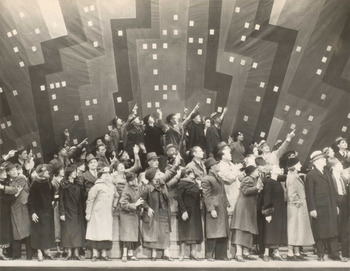
The central tableau of 1935, pictured on its playbill and dramatized in its opening and closing scenes, depicts the “Great American Public.” The public is a crowd of celebrators, predominantly well-dressed white men and women, crammed into Times Square on New Year's Eve.Footnote 34 For the most part, it contradicts the idealized public that Lippmann decried: no romantic depiction of the agora or the forum; no judicious deliberation, or even the casting of votes; this is a scene of revelry. Yet in one respect, the scene reanimates the long-lost ideal: there is nothing abstract or disperse about this group of assembled strangers; this is group that is viscerally present, and palpably together. Indeed, much of the of the play's cast seems to be onstage, with little space between their bodies. Hjalmar Hermanson's expressionistic backdrop exaggerates their proximity, depicting skyscrapers packed together like the people before them (Fig. 1). And while the set compresses the crowd visually, sound effects amplify it aurally: stage directions describe a “terrific din” of horns, balloons, and whistles.Footnote 35
The “Great American Public” celebrates New Year's Eve. Production photo for 1935 at the Biltmore Theatre, New York, 1936. Library of Congress Federal Theatre Project collection, Washington, DC, Container 1181.

The crowd is pointedly together not only in space, but also in time. It is New Year's Eve, a festival that celebrates and performs the sharing of time. The revelers partake in an American New Year's ritual and count down to midnight, together. They share time twofold, synchronizing themselves in both the “chronic” time of the calendar and the “acute” time of the clock.Footnote 36
A voice broadcast by loudspeaker, recurring in Living Newspapers as the “Voice of the Living Newspaper” announces that this is “The Great American Public” (10). While there might be something ghostly about this disembodied Voice, the Public it describes is anything but. The Public's bodily presence before the audience, its togetherness in time and space, is undeniable. Like the romanticized Greek demos in the agora and the Roman vox populi in the forum, this is a collective that modernity seems to preclude, not in its activity, but in its embodied immediacy.Footnote 37 Bodies in proximity, sharing time and space in a town square, the New Year's crowd is a public performing itself, year after year.
Not only does the New Year's crowd share time and space; it demonstrates shared, self-conscious experience. As the Voice counts down to midnight, it asks the crowd to recollect that past year: “In three minutes it will be 1935. … Do you remember the Morro Castle? The $427,000 truck robbery in Brooklyn? The assassination of King Alexander?” The crowd cannot ignore the Voice, which overpowers its din and even stops it, according to stage directions, “dead in its tracks” (10). Animate and cohesive, this crowd seems at first glance to meet Deweyan standards.
Yet the crowd collectively rejects the Voice's imperative to remember major and ostensibly collective events. According to stage directions, the Great American Public “shrugs its collective shoulders, manifesting complete indifference” before returning to carousal. The strains of “Auld Lang Syne,” an anthem of collective remembrance, ironically punctuate its decision to forget (11). A commitment to forgetting and distraction are surely not the shared interests that Dewey had in mind in the public he envisioned. Yet it seems to be the glue that holds together the Public of 1935: How else could this large group of strangers share the single gestus of a collective shrug? Far from Dewey's deliberators, the Public of 1935 is animate but apathetic. Surely then, when the Voice names this flighty, motley group the “Great American Public,” its tone, like 1935 overall, is bluntly sarcastic.
The Voice's tone directs the play's spectators to view the Public critically, and so does acting style. Calling up the Living Newspaper's debts (especially in early productions) to Meyerhold, Piscator, and Brecht, the playscript asks for “automatic gestures, the absence of realistic emotion and color of the crowd.” Stage directions read that this “stylization” should continue “throughout the production” (10), suggesting techniques like estrangement or alienation. Replicating the actions of a crowd but evacuating them of organic movement or realistic emotion, 1935 demands measured engagement, not sympathetic absorption.
The unsympathetic crowd soon dissipates—and it gets the news it deserves. No sooner has the clock struck midnight than the Voice urges the crowd to “make news.” “Well, what are you waiting for?” it asks, “Get going! Make news!” The Voice's urging characterizes the news as an arbitrary expression of the whims of the crowd. “Bite a dog. Invent a mousetrap. Win the sweepstakes” (11); like the headlines from the years before, they need not be significant, only sensational. This is the news of a public who has not, in Dewey's words, solved “the problem of presentation.” It has not found ways to present society's most pressing and meaningful issues in a way that engages the masses; nor does it even seem interested in doing so.
Critiquing a demand for fast-paced variety, 1935 is structured like a tabloid, or its theatrical precursor, the revue.Footnote 38 Unlike the majority of Living Newspapers, which focus on a single issue in detail, 1935 skims over fourteen different news stories.Footnote 39 Each is short and compact; the Voice announces the headline and climax of each scene before it unfolds, forgoing any attempt at suspense.Footnote 40 Design techniques from Soviet avant-garde and German epic theatres abstract and enlarge their representative possibilities: projections depict the complex control room for the China Clipper in flight; a chain gang representing the fate of activist Angelo Herndon is lit in silhouette. The stories these scenes depict, plucked from the previous year's most memorable headlines, play before the viewer like they are on a conveyor belt; inevitable both because they have already transpired and because the Great American Public is unlikely to intervene.
Indeed, as the crowd disperses after the first scene, the Voice distinguishes the makers of news from those that consume it. “Only a mere handful” of the revelers onstage, he states, will actually make news; “[b]ut the others, the millions who make up this nation, will become the Great American Public of 1935. … They read the news … they react to it … we are interested in their opinion, and from this gigantic panel twelve are chosen to represent them all…” (11). With these lines, the Voice turns from the inadequacy of news representation—the small handful of newsmakers—to the inadequacy of public opinion sampling. The panel the Voice describes is the “court of Public Opinion” (12), a jury that will observe and weigh in on the events that make news. Like the reveling crowd, the jurors will share time and space, but the emphasis now is on their (in)capacity to represent a whole, an inadequacy that becomes visible as the Voice quickly assembles a small and motley group of twelve. The Voice calls the jury members by name, creating a comic contrast between the large body politic and the specific individuals that represent it. The contrast becomes even sharper with the entrance of the final juror, Bixby, who must make his way to the stage from the audience, after a spotlight pulls him out of the balcony (12).Footnote 41 Impatient with his listless arrival, the Voice complains, “Why do you have to act like an individualist?” Bixby retorts, “Because I am an Individualist” before the Voice puts him in his place: “I thought so. … That makes you just like everybody else” (12; italics per script). The exchange acknowledges the uncomfortable transition from subject to sample, and from individual to representative of the whole. Bixby and his cohort unsettle a metonymy between an embodied group and the large and unwieldy “imagined community.”
Indeed, if the sample offers modern conventions for reconciling “concrete” publics with “abstract” ones, 1935 continues to unsettle it. In reconstituting the Public as representatives of public opinion, the Voice has robbed it of power, recasting it from subject to object. This is a public constructed through samples and surveys, rather than its performance in Times Square. Perhaps 1935 is responding to the surge of social-scientific attention to publics in the interwar period, catalyzed in no small part by Lippmann, and growing in the “Middletown” studies (of Muncie, Indiana; 1929) and the first Gallup and Roper polls (1935). As historian Sarah Igo observes, the rise of quantitative social science from the 1920s through the midcentury reenvisioned the American public as an aggregate of “Average Americans” who could be sampled, studied, and quantified.Footnote 42 It is unsurprising then that the Public of 1935 is realized through the scrutiny of others rather than its own self-consciousness. Dispersed and then reassembled as a motley sample, this public drifts even further from the heroic democratic protagonist the Voice's moniker (“Great American Public”) first suggested.
The sample that Bixby “The Individualist” joins is, unsurprisingly, ineffectual. As Bixby settles into his place, the Voice announces to the audience:
[W]hat you gaze upon, Ladies and Gentlemen, is the court of Public Opinion, and within the jury box the representatives of the Great American Public […] As each scene in the panorama of important events of 1935 unfolds before them, they will gaze upon it … they will reflect upon it … they will render judgment upon it. … (12)
Bixby and his cohort gaze at a panorama of events (deemed memorable or significant, but by whom?) that unfold before them. It is the Voice that announces each scene; the Great American Public offers no direction on which news stories it should revisit, nor do its constituents express any personal connections to what they see. Though singled out from the anonymous reveling crowd on New Year's Eve, they are not much more effectual.
The discord between the sample and imagined whole is present not only in the summoning by the Voice of the Great American Public, but also by the metaphor of the jury. At first glance the jury, perhaps even more than the New Year's crowd, offers a powerful image of togetherness. Conventionally, the jury is bound in space, enclosed in a box. It shares time, suspending other obligations as it considers evidence presented in succession. Perhaps most important, jurors share time and space qua citizens; it is civic duty that holds them in their post. With the imperative of civic duty comes a highly disciplined repertoire. Jurors do not assemble for revelry or distraction, but for judicious deliberation. The jury encapsulates the model that Lippmann deemed antiquated and elusive: rational, empirical, informed consensus. Surely, the audience held this model in mind as it watched the public in 1935. The phantom public haunts the jury box.
It is the phantom public—figuring the way a jury ought to act—that evokes, through contrast, the inadequacy of the court of Public Opinion onstage. The “jurors” onstage snack on hot dogs while William T. DeBoe is hanged for charges of rape that he denies; they are complacent about reports of Nazi activity, but frenzied by a baseball game. They comprise shallow “types” unresponsive to nuance, whose labels such as “Yes-Man” and “Querulous One” quickly replace the names called in the opening scene. They participate in banal squabbles, predicted by their labeled types, rather than substantive discussion (38–9). In fact, when “Born Leader” finally prompts an issue-based vote, regarding the shooting of Louisiana Governor Huey Long, nobody bothers to participate. “Born Leader” declares the resolution, “passed by unanimous indifference,” and it is punctuated by a blackout (45).
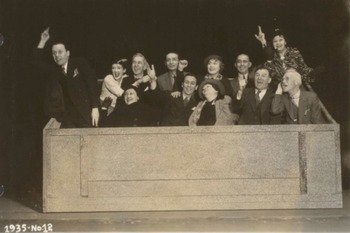
The jury seems most engaged, in fact, in matters that require no deliberation. Figure 2 represents a moment from scene Six, during which the jury takes in a baseball game that made headlines when the Brooklyn Dodgers unexpectedly took on the New York Giants. Contrasting the scene title, “Jury Interlude,” the jury is at its most engaged, eagerly following the game (26–7). In the image, they seem to spill out of the jury box that encloses them. In fact, the jury box here resembles a pen, with contours that emphasize the unruliness of its occupants. The frenzied group crammed into a jury box captures a thin line between crowd and public that pervades 1935. Thus, while the jury box references a thinking public, it also forces physical proximity and contagious affect, connoting an unthinking crowd.
The “Great American Public” spills out of its jury box. Production photo for 1935 at the Biltmore Theatre, New York, 1936. Library of Congress Federal Theatre Project collection, Washington, DC, Container 1181.

The play's next-to-last scene depicts the grim sentencing of African American activist Angelo Herndon; the final scene finds the all-white jury “half asleep” (59). This sequence is, notably, the only moment where 1935 insinuates that apathy is connected to racial privilege. A subsequent Living Newspaper, Hill and Silvera's Liberty Deferred: A History of the Negro in the United States, would explicitly interrogate racialized constructions of the news.Footnote 43 The attention of 1935 to racial violence, however, much like that of its jury, is short-lived. Soon, the Voice rouses the jurors, urging them to “sit still in silent judgment while we go ahead and finish off the year” (59). He races through a few more headlines before announcing New Year's Eve: the time represented in the dramatic narrative is a year later than the opening scene, but nothing has changed. The jury loses itself in a crowd of revelers, repeating its gestic shrug when the Voice asks them if they remember headlines from the year. In the play's final lines, the Voice cedes the loudspeaker to the “Voice of a Vendor” hawking peanuts and popcorn as “Auld Lang Syne” swells (60).
Interpellation: Calling Forth the Public in 1935
I have shown so far how 1935 depicted the Great American Public through mimesis, presenting a forgetful crowd ghosted by a deliberative jury. Yet 1935 also reimagined its public through interpellation, by addressing its audience as a public in the making.Footnote 44 NYLNU's 1935 sought to make its audiences self-conscious of two publics of which they were a part. The first public was, to borrow Warner's phrase, “a crowd witnessing itself in visible space”: 1935 drew explicit connections between the Public it depicted onstage and the group that observed it from the audience; it interpellated a self-conscious audience. The second public was an “imagined community”: 1935 drew explicit connections between the spectators gathered in the theatre and a more expansive, national public; it interpellated a self-conscious group of news consumers.
Thus 1935 addressed a self-conscious audience by establishing a relationship between the stage Public created through mimesis and the crowd assembled to view it in the theatre. Just as the revelers in the jury box face the viewer in Figure 2, the Public in 1935 faced its Biltmore audience; 1935 used myriad dramaturgical and aesthetic strategies to address its audience directly, as a public connected to the one onstage. The juror Bixby, for instance, the self-proclaimed “Individualist,” emerged from the audience, a piece of blocking that identified him spatially with the crowd assembled at the Biltmore Theatre. And if Bixby was “of” the audience, so too, suggested 1935, were his concerns: if Bixby was a mere sample of public opinion, despite his protests, then so too, the play insinuated, were the spectators among whom he started the play. The Great American Public, from which the twelve jurors were plucked, was located not only on the stage but in the audience as well. This would be a recurring motif in Living Newspapers: most famously, One-Third of a Nation, a 1938 Living Newspaper about housing, would depict a Little Man stumbling from the audience to the stage. The physical transitions that players made from audience to stage playfully challenged Lippmann's relegation of the average citizen to the “back row” of the political theatre. Because the division between actor and spectator is physical in the theatre, and therefore malleable, Living Newspapers could manipulate it and implicate the audience in its operation.Footnote 45
Bixby's identification with the audience was not the only way that 1935 connected the Great American Public, represented by the court of Public Opinion, to the spectators before them. When the Voice first introduces the Public in its jury box, he uses the same word to describe the action of the audience and that of the public: “[W]hat you gaze upon, Ladies and Gentlemen, is the court of Public Opinion […] As each scene in the panorama of important events of 1935 unfolds before them, they will gaze upon it …” (12). By using the same verb, “gaze,” to characterize their actions (or lack thereof), the Voice unites the audience and the court of Public Opinion in the passivity of gazing. The Voice accuses the Biltmore's audience of passive spectatorship, which will ultimately render the court of Public Opinion ineffectual. No doubt, mise-en-scène underscored the comparison: the strangers seated in a jury box, facing the (mostly) strangers seated in the Biltmore's house, were positioned to share a single, uninterrupted gaze.
While 1935 was addressing its “concrete” public—the theatrical audience—as a reflection of the sample it depicted onstage, it also identified this sample with an “imagined community” of news consumers. The most obvious way it did so was through the play's generic framing as a “newspaper.” In the NYLNU, this framing was especially explicit. The NYLNU's playbills were designed like newspapers, which rotated every few weeks. As well as the cover image I mentioned earlier depicting New Year's Eve revelers, the playbill for 1935 included “stories” full of quotes and figures. In addition to emulating the newspaper in form, the playbill emphasized the play's journalistic conventions. For instance, under the headline “Fourth Estate and Stage Talent Combined in New Dramatic Form,” a story detailed the process of researching, editing, and staging the Living Newspaper. Another story proclaimed “‘1935’ Audiences Get Latest News Bulletins,” emphasizing the expertise of “experienced news men.”Footnote 46 The NYLNU interpellated spectators as newspaper readers by giving them newspapers to read; before the curtain even rose, 1935 had reminded spectators that they were consumers of the news.
Nor did 1935 allow spectators to forget this identity when the play began. Not only did it present them with a series of news stories; it did so using familiar conventions of mass news media. The Voice of the Living Newspaper, wrote NYLNU Managing Editor Arthur Arent, was initially modeled on the moving teletype on the New York Times Building, offering “a kind of non-participating dateline which introduced the various scenes.” Footnote 47 Yet, as a disembodied, authoritative, male voice, it also emulated the godlike “Voice of Time” in the popular “March of Time” newsreel.Footnote 48 With its references to the “March of Time,” the New York Times, and other mass news media, 1935 reminded spectators of an expansive network of readers—of the nation imagined into being by the news. That Living Newspapers were produced across the country, under the auspices of a federal project, could only have underscored their connection to nationwide, imagined communities.Footnote 49 NYLNU's 1935, then, addressed its audience as consumers of the news, members of an abstract, imagined community as well as a concrete audience embodied in the theatre.
The Animate Audience
Arriving on the heels of the single-issue play Triple-A Plowed Under (produced to general acclaim), the tabloid structure of 1935 did not seem to gain much traction among artists, critics, and audiences. The New York production played for only a few weeks, and evidence of variations in other cities is limited.Footnote 50 Reviewers, by and large, praised memorable moments but compared the production unfavorably to its single-issue predecessor. Yet perhaps most striking in 1935's reception were the critics who were not only dubious of the play's merits, but who took umbrage at its representations of the public. These strong reactions suggest that 1935 was not entirely unsuccessful, as the scant attention it has received from historians and even FTP staff might suggest. Rather it suggests that, through mimesis and interpellation, 1935 provoked at least some spectators to reflect on the nature and possibilities of the American public. If the “phantom public” had haunted the stage in the obvious inadequacy of the Great American Public, it also seems to have haunted the audience. Fervently asserting that the audience was in reality more active and more judicious than the public depicted onstage, reviewers sought to reanimate the phantom public.
Reviews demonstrate that some spectators at least recognized that 1935 was about them, about the public they constituted—or failed to constitute—and witnessed onstage. Brooks Atkinson wrote in the New York Times that 1935 offered a “history of our follies” that was “harshly accented when the Living Newspaper boys pack it into an hour and a half of tabloid showmanship.”Footnote 51 Atkinson's “our” is important, suggesting that the public of which he considers himself a member is in some way responsible for the disconnected trivia on display. A New Yorker reviewer took a page from Lippmann's book, despairing that important news could never engage the masses: the reviewer ceded that the play's reliance on crime stories was “inevitable, since the events that basically affect the welfare of the nation are apt to be dull, unspectacular and very hard to act out on a stage.”Footnote 52 Less favorable reviewers too, recognized that the Great American Public was about them—even if they did not appreciate the implications. A reviewer for the New York Evening Journal called the court of Public Opinion not only “very silly and lugged in” but also “vaguely condescending,” emphasizing the tone (condescension) with which the play addressed its audiences. But whether critical or positive, reviews tended to suggest that spectators (or rather, the white, working- or middle-class spectators these reviewers addressed) recognized themselves represented onstage.
These attestations of self-consciousness were exacerbated, it seems, by another of the play's provocations: its retrospective presentation of the news. The news is conventionally defined, much like Dolan's characterization of theatre, by “present-tenseness”; thus, according to several reviewers, the decision to present the news in retrospect doomed the production to redundancy. The New York Evening Journal critic sardonically commented, “Nothing, they say, is deader than yesterday's newspaper except, perhaps, an obsolete calendar, and for the second production of its journalistic drama the Government Theatre nicely combines the two.”Footnote 53 A column in the New York Post echoed the sentiment, noting that “‘1935’ bumped into the difficulty of presenting highlights from the news headlines of a year which is too close to us and too well remembered.”Footnote 54 Even in a positive review, Arthur Pollock conceded, “We knew it all before, couldn't help but know it” and “this Living Newspaper cannot keep up to date.”Footnote 55 Comments like these held 1935 to the standards of mass-mediated news, registering the play's failure to achieve journalistic simultaneity. Yet for a New York Daily News critic, the presentation of “yesterday's news” prompted reflection even as it made for bad theatre. This critic wrote, “These are all recognizable reminders of old news, but that is all […] it is nothing for the archives.”Footnote 56 As a form in between the news and “the archives,” the Living Newspaper, it seems, prompted this writer to reflect on the kinds of story that he and his public consumed. It is ambiguous, in this review, whether it is 1935 only, or also the news on which it drew that was truly “nothing for the archives.” Though 1935's litany of pulpy news stories may have been too swift and superficial for some, it generated reflection on what kinds of story were making the news. As a review of “yesterday's news,” 1935’s unconventional syncopation was an irritant that promoted reflection in the public sphere.
Whether critical or congratulatory, reviews illuminate 1935 as a site of contestation. Moreover, they show that 1935 prompted a ghostly encounter; for critics could only take offense at this representation of the Great American Public by invoking the phantom public, and the noble ideals for which it was imagined to stand. And perhaps most striking of all, some of them emphatically defended the liveliness and cohesiveness of their cohort of spectators. The critic for the New York Sun, for instance, was careful to tease apart the representation of 1935’s public from the actions of its audiences. He complained that “doubt of the brightness of the American public is the view most clearly expressed in the play”; yet he insisted this reflected the play's authors and not its audiences. It was not only the “Great American's Public,” he argued, but also the play's authors who failed to “form any idea about 1935.” It was only in the rare moments that the authors took a stand, he argued, that they “gave the eager audience one of its few opportunities to express emotion.”Footnote 57 In taking pains to contrast the authors’ apathy with the audience's engagement, the Sun reviewer resisted 1935’s formulation of the public.
A reviewer in the New York Herald-Tribune took a similar tack, drawing even more concrete evidence from his fellow spectators’ behavior:
Although the American Public, represented by twelve men and women who made inane comments on the significance of each news event, remained indifferent to the end, the audience did not. It applauded vigorously after each blackout and let its feelings be known regarding every headline figure who walked upon the stage.Footnote 58
The reviewer later elaborated, “the audience, which apparently read the newspapers more closely than the public's twelve representatives, showed its obvious disapproval of Nazi storm troopers.”Footnote 59 Arthur Pollock of the Brooklyn Eagle corroborated this assessment:
No one [in the jury] votes either for or against and the motion is described as ‘passed by unanimous indifference.’ Last night's audience was rather less indifferent than its fictitious representative on the stage, however, and a hiss could be heard here and there and enthusiastic applause.Footnote 60
It is worth noting that both Pollock and the Herald-Tribune writer described emotional outbursts from the audience as evidence that they were not apathetic after all. They sat among audiences that acted up into being. And the audiences’ feelings, in both critics’ depictions, were appropriately riled; far from the trivial and contagious affect of a New Year's Eve crowd, these audiences reanimated, by acting out, the ideals of the phantom public. With its apathetic and ineffectual public, 1935 goaded some spectators into reflecting upon their own responses to the news, and perhaps even into enacting them more loudly than usual. In the theatrical public sphere, these critics contested 1935’s depictions of the audience, describing an audience that resisted accusations of indifference.
It is tempting to read these accounts as a testament to a theatrical public triumphing over its casting. However there is no evidence that the hissing and applause, powerful interjections in the theatre though they might be, had any corollary outside of it. Indeed, whatever activity 1935 made possible was clearly not very satisfying; the play ran for only a few short weeks. Its theatrical audience was more active, more responsive than the spectators it lambasted onstage; yet it was more bounded, in scale and durability, than the “imagined community” that it addressed. The comments in the reviews above are offered more as a modest rebuttal of the play's charges rather than a testament to its political effects.
The “phantom public,” as Lippmann suggested, haunted all quarters of American political life, yet its ghostly presence in the Biltmore Theatre was distinct: it exposed the deficiencies of the Great American Public presented onstage; it incited resistance from an audience, documented in the theatrical public sphere. The phantom public did not reconstitute itself, potent and animate in the theatre. But it did bump up against the spectators that were there. And it is perhaps in the bumping and jostling, amplified in the theatrical public sphere, that 1935 engaged its public(s). Palpable but provisional, the theatre's ultimate disappearing act, the theatrical audience is not the evidence of an abstract, unified community, but a body bumping up against its ghost.
The Haunted Audience
In many ways, 1935 was unlike the Living Newspapers that came after it. Its tabloid-style presentation of a year's worth of stories would give way to dramatizations of a single issue; its unwieldy “court of Public Opinion” would give way to other, subtler representations of the public; and its satirical tone would give way to more earnest calls to arms. Its structure, depictions of the public, and tone were quickly set aside.Footnote 61 Strikingly though, ghostly metaphors lingered in the language of the Federal Theatre and its critics. They evoked the novel possibilities of a medium forged between the living body and the inanimate text.
Translated from the Russian zhivaya gazeta, the very terms “living” and “newspaper” evoke a corporeal contrast: on the one hand, the newspaper—static, material, dead, or fossilized; on the other hand, the living—supple, vital, in the flesh. The form's achievement, this phrase seems to urge, is its capacity to bring text to life.Footnote 62 Living Newspapers, it seems, conjured a “phantom public” of their own: a public that was ghostly not by virtue of obsolescence, pace Lippmann, but by virtue of being in between the animate and the inanimate.
Neither the juxtaposition, however, nor its ghostly synthesis was limited to the name of the form. An ad for Power boasted, “actors take the place of type.”Footnote 63 A Philadelphia playbill for One-Third of a Nation described its source material as “verbal skeletons rattl[ing] over the boards.”Footnote 64 The Literary Digest called Triple-A Plowed Under a “flesh and blood newsreel.”Footnote 65 Type replaced by actors; verbal skeletons; human documents; a newspaper come alive: all of these phrases are variations of the juxtaposition between bodies and text that the phrase “Living Newspaper” implies.
Deploying a cadaverous, if not quite ghostly metaphor, a May 1936 review in New Theatre hoped that “the whole idea of a government subsidized theatre […] will pump rivers of fresh blood into the anemic theatre structure.”Footnote 66 There was little time however, for the FTP to see this possibility to fruition. In 1939, an act of Congress, suspicious of left-wing propaganda, ended the Federal Theatre Project. Since then the Living Newspaper has only enjoyed occasional US revivals. And in a sense, Living Newspapers were relics of the past even in their FTP inception. The FTP's Living Newspapers were not only born in the face of looming obsolescence; they were overdetermined by it. Their creators were yesterday's workers, made redundant by the Depression. Their materials were yesterday's news, already documented in print, photography, and film. Their signature media were the theatre and the newspaper—both facing formidable challenges in the rise of radio and film.Footnote 67 Yet Living Newspapers, and 1935 in particular, offer some generative insights.
First, at a moment when representations of the public were dominated by mass news media, public opinion research, and political theory, Living Newspapers intervened with a distinctly theatrical idiom—the singular asset, in the words of FTP Director Hallie Flanagan, of “the living body of the actor … massed with other bodies.”Footnote 68 It was the massing of bodies in space onstage—whether in Times Square or in a jury box—that made 1935’s spectators self-conscious of the publics they did or did not embody, and the phantom that haunted them with possibility.
Second, and by using a distinctly theatrical vocabulary, 1935 offered an indirect but provocative intervention in a now canonical debate. Contemporary discussions of “the public” often take recourse to the Lippmann–Dewey Debate, espousing a binary between a feeble “phantom public” and a vital community that need only recognize its living bonds. The production and receptions of 1935 in New York offered a model in between the two: “the public” in a mass society, it suggested, is characterized by gatherings of strangers bumping up against ghostly ideals. NYLNU's 1935 extended Dewey's insight that art galvanizes publics by directing their attention to shared concerns; it showed how theatre, in particular, could do so through the ghosting that sets it apart from other media. It could both represent a public through mimesis and address it within the bounds of the theatre and beyond. Meanwhile, it confirmed Lippmann's observation that there was a phantom public, but showed, pace Lippmann, that it was far from ineffectual.
Finally, 1935 calls attention to the way that social imaginaries work with and on audiences. In The Haunted Stage: The Theatre as Memory Machine, Marvin Carlson has shown how playtexts and performers, productions and performance spaces invoke and alter cultural memory. Perhaps, my case study suggests, the audience, too, can be a site of ghosting. When spectators take in a performance, it is not only texts, performers, or theatre spaces that ask them to remember past performances; it is also the social formation of the spectators themselves. The experience of being in an audience—a palpable experience, for some, of a public—is always mediated by memories, actual or imagined, of what a public is or should be. Of course, no audience is monolithic. My point here is not to suggest that an entire group of spectators shares the experience of ghosting, but rather to suggest how the very fact of being in a group might alter a performance experience for some spectators. In some cases, the experience in the theatre might seem to improve on memories of other gatherings: an attentive group of spectators (drawn to a work, perhaps, by social or political affinities) might feel like a much more cohesive public than an abstract, sweeping public such as an electorate, or even another small, embodied counterpublic like a group marching in protest. In other cases, the experience might not live up to the memory: idealized or romantic visions of the public, such as those that scaffold the US American nation-state, might seem more encompassing, more effectual, than a theatrical audience. In cases like these, the “memory” of a public as it ought to be might shape experiences of a performance, for better or worse. A theatrical audience, then, might behave in opposition to the publics or counterpublics it is supposed to represent. A performance might convene a concrete audience as it conjures an imagined community, and disrupt the relationship between the two. Jostled by the abstract public in their midst, members of the audience might find themselves haunted.
The haunted audience, I propose, is a group of spectators whose embodied gathering—its assembly in time and space—is ghosted by other forms of togetherness. Ghosted by publics past, the haunted audience uses cultural memory to make sense of itself. The Living Newspaper 1935 prompted members of its audience to “remember” the “phantom public” that Lippmann relegated to ancient Greece and Rome, but which democratic imaginaries continued to channel. In interwar America, critics like Dewey and Lippmann publicly interrogated the kinds of intimate public that modernity seemed to disrupt and disperse. The propulsive possibilities of bodies sharing time and space; the jury box that symbolized its deliberative capacities; the newspaper rhetoric that invoked its embodiment of the nation—these features of 1935 invited the “phantom public” into the theatre to consider the news alongside its audience.